Prepare and rest the filling
01Cook the pork loin.
Brown the pork loin gently in a little butter or dry in a non-stick pan until cooked through, then cool completely.
The meat should stay moist enough to mince without becoming dry crumbs.
Bologna tortellini in brodo with pork loin, prosciutto, Mortadella Bologna and Parmigiano filling, rested overnight and served in clear meat broth.
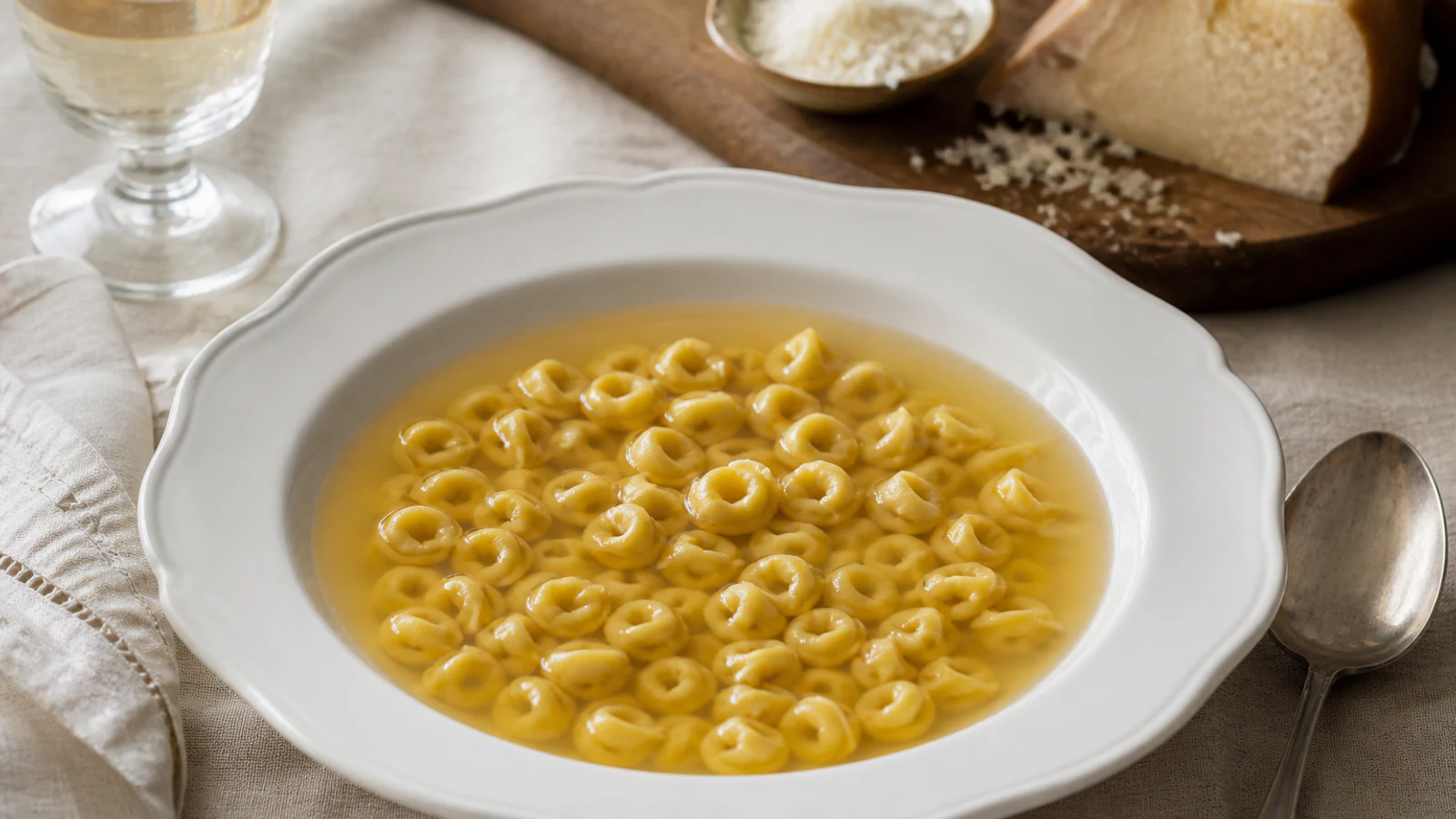
Tortellini in brodo is one of Bologna’s most codified dishes. Bologna Welcome records that the filling was registered in 1974 and the classic Tortellini di Bologna recipe in 2008 at the Bologna Chamber of Commerce, with a filling based on pork loin, prosciutto, Mortadella Bologna, Parmigiano, egg and nutmeg.
The filling is deliberately made a day ahead. Resting at least 24 hours lets the minced meats, cheese, egg and nutmeg settle into one cohesive mass. That rest is part of the registered preparation, not idle waiting.
The pasta is rolled very thin and cut into 4 × 4 cm squares. A small amount of filling goes into each piece before it is folded into a triangle and wrapped around the fingertip to form the characteristic ring. Small scale matters: a classic tortellino is around 5 g.
The broth is not a background liquid. Bologna’s reference calls for an excellent capon broth supported by beef cuts. The pot is kept at a quiet simmer and skimmed carefully so the serving broth remains savoury and reasonably clear.
Tortellini are boiled only briefly in the strained broth. The photographed images show grated cheese and green garnish, but the canonical recipe here keeps the bowl focused on tortellini and broth; any extra table garnish is optional and not required for identity.
Brown the pork loin gently in a little butter or dry in a non-stick pan until cooked through, then cool completely.
The meat should stay moist enough to mince without becoming dry crumbs.
Finely mince the cooked pork, prosciutto and mortadella. Mix thoroughly with Parmigiano, egg and nutmeg until cohesive. Cover and refrigerate for at least 24 hours.
The rested filling should hold a small neat mound rather than crumble.
Put capon or chicken, beef, onion, carrot and celery in the stockpot with 3.5 L cold water. Bring slowly toward a simmer and skim foam as it rises.
A slow approach to heat and regular skimming keep the broth cleaner.
Maintain a bare simmer for about 2½ hours, until the meats are tender and the broth is deeply flavoured. Strain carefully and season with salt.
The strained broth should taste concentrated enough to serve on its own, without a greasy surface.
Knead flour, eggs and salt for 8–10 minutes until smooth. Wrap and rest 30 minutes.
The dough should feel supple and roll without springing back sharply.
Work with small pieces, keeping the rest covered. Roll to about 0.7–1 mm and cut 4 × 4 cm squares.
The sheet should be thin but strong enough to seal around the filling.
Place about 2 g filling in the centre of each square. Fold corner to corner into a triangle, press out air, then wrap the two outer corners around a fingertip and pinch together.
The seam should be fully sealed and the centre should form a compact ring.
Return enough strained broth for four bowls to a gentle boil. Add tortellini in batches if necessary.
The broth should bubble gently rather than violently enough to split the pasta.
Cook until the pasta is tender and the tortellini float and feel cooked through, usually 3–5 minutes depending on thickness. Ladle immediately into hot bowls with the broth.
The pasta should be tender at the folded seams while the filling stays juicy.
Make more broth than the bowls strictly need; pasta absorbs liquid and a generous serving is central to the dish.
Freshly shaped tortellini can be frozen in one layer and bagged after firm. Cook from frozen, allowing a little extra time.
The supplied photographs show cheese and green garnish. They may be used as serving decoration, but the registered Bologna identity does not depend on them.
Estimate includes a portion of tortellini and broth; exact sodium and fat depend heavily on cured meats, Parmigiano and how much broth fat is removed.
Contains wheat/gluten, egg and milk; filling contains pork and cured meats.
Keep the raw egg-and-meat filling refrigerated during its 24-hour rest and shaping.
Cook the pork used for filling thoroughly; refrigerate leftovers within 2 hours and reheat to 74 °C.
The Bologna reference explicitly calls for at least a 24-hour rest; it also gives the minced filling a more cohesive texture.
The registered Bologna method uses small squares around 4 × 4 cm and a classic tortellino around 5 g.
Many modern sauces exist, but this page is specifically tortellini in brodo, where excellent meat broth is part of the dish identity.