
New York City unfolds as a mosaic of neighborhoods, every one shaped by its own heritage, traditions, and personality. Indeed, the city is legally five separate boroughs – Manhattan, Brooklyn, Queens, The Bronx, and Staten Island – each acting like a city unto itself. At the same time, none of the neighborhood boundaries are set in stone, so districts have evolved organically with overlapping names and nebulous borders. A newcomer might feel overwhelmed at first by this city of villages, but this guide is intended as a friendly compass through New York’s diverse quarters. Readers will find historical highlights, cultural touchstones, local lore, and practical tips to help navigate them like a seasoned resident.
- Understanding NYC’s Geography and Borough System
- Manhattan: The Heart of New York City
- Lower Manhattan: Where New York Began
- Washington Square Park and NYU: The Village’s Role in Bohemian and LGBTQ History
- East Village & Lower East Side: Immigrant Legacy and Counterculture
- Chinatown & Little Italy: Cultural Enclaves
- Chelsea & the Meatpacking District: Art and Innovation
- Midtown Manhattan: The Commercial Core
- Upper West Side: Culture and Riverside Charm
- Upper East Side: Luxury and Museums
- Harlem: Cultural Capital and Renaissance
- Brooklyn: NYC’s Most Populous Borough
- Brooklyn Heights and DUMBO
- Williamsburg: Hipster Haven
- Park Slope: Family-Friendly Brooklyn
- Coney Island: Beachside Amusements
- Queens: The World’s Borough
- Long Island City (LIC): Art, Views, and Redevelopment
- Astoria: Greek Heritage and Diversity
- Jackson Heights: Global Crossroads
- Flushing: Authentic Asian Culture
- The Bronx: Authentic NYC Experience
- Staten Island: The Forgotten Borough
- Choosing Where to Stay: Neighborhood Comparison
- Neighborhood Food Guide
- Practical Visitor Information
New York’s neighborhoods define the city’s identity. Think of Greenwich Village, which for generations was known as “the bohemian heart” of Manhattan, or Harlem, which became an emblem of African-American culture during the Harlem Renaissance. Walking these streets, one senses layers of past eras at every turn. This guide does not merely list sights and attractions; it tells the story of how each enclave took shape – from 17th-century Dutch settlements in Lower Manhattan to today’s global immigrant communities in Queens. It will also help you use the city’s geography: from understanding the five-borough system to mastering Manhattan’s rigid grid. In short, readers will learn where to go, what to see, and how to make sense of it all.
The structure of this guide mirrors the city’s own logic. We begin with broad context (the boroughs, city layout, transit), then move borough by borough. Each neighborhood section covers origins, landmarks, culture, dining, and visitor advice. Where possible, first-person wanderings have been avoided in favor of a journalistic, third-person tone that still conveys lived experience. Precise detail is offered – for example, which subway lines connect the neighborhoods or which streets host the best mom-and-pop eateries. Along the way, snippets of local color and human interest are woven in, such as the stories behind famous venues like the Stonewall Inn or Apollo Theater.
By the end of this guide, readers will not only know where New York’s iconic neighborhoods are, but why they matter – what makes each quarter unique, and how visitors can immerse themselves safely and appreciatively. Whether you want to savor soul food in Harlem, stroll among brownstones in the West Village, or hop on a ferry to Staten Island, this is your complete, up-to-date roadmap. The goal is practical illumination, not salesmanship. Expect historical context and neighborhood narratives, balanced with must-see attractions and practical tips – all compiled from the latest sources and local insight. New York’s complexity can be daunting, but with careful reading you will be ready to explore “like a New Yorker,” discovering both beloved landmarks and lesser-known gems.
Understanding NYC’s Geography and Borough System
Before diving into specific neighborhoods, it helps to understand New York’s basic layout. New York City is legally five boroughs. Manhattan (New York County), the Bronx (Bronx County), Brooklyn (Kings County), Queens (Queens County), and Staten Island (Richmond County) were originally separate communities but were merged into one unified city in 1898. Each borough is coextensive with a county of New York State. Manhattan is the smallest borough by area but home to the densest population and business districts; Brooklyn is the most populous, stretching from brownstone-lined heights to waterfront parks; Queens covers roughly 75 square miles of neighborhoods and suburbs; the Bronx is New York’s northernmost borough with parks and cultural institutions; and Staten Island feels more suburban or rural in many parts, connected to Manhattan by the free Staten Island Ferry.
Manhattan itself is organized on a roughly gridiron street plan (the “Commissioners’ Plan of 1811”). Most avenues run north–south and streets east–west. Below Houston Street (in Lower Manhattan) the grid breaks up into older, irregular streets. Above Houston, the numbered streets run from south to north (1st Street in the East Village up to 220th Street in Inwood) and the avenues from east (1st Ave) to west (12th Ave/Hudson River). Manhattan is often divided into three broad areas: Downtown/Lower Manhattan (south of Houston St), Midtown (from Midtown South through Times Square up to Central Park’s southern edge), and Uptown (the area north of Central Park, further split into Upper West/East Sides and beyond). The numbered grid makes navigation easy, but real neighborhood edges overlap. For example, SoHo formally stands for “South of Houston,” and Tribeca for “Triangle Below Canal,” reflecting historical uses rather than strict lines on a map.
The other boroughs have looser layouts. Brooklyn sprawls from a long peninsula on the Atlantic, across hills and shorelines; it includes everything from the brownstones of Brooklyn Heights and Park Slope to the hipster enclaves of Williamsburg and Bushwick, to suburban-like coastal areas like Bay Ridge and Sheepshead Bay. Queens is vast and varied, with Long Island City and Astoria near Manhattan’s bridge, then diverse inner neighborhoods like Jackson Heights and Flushing, and more suburban eastern Queens beyond. The Bronx starts at the edge of Manhattan (across the Harlem River) and stretches into hilly, greenwood country (like Riverdale) and the suburban “Ozone Park” style areas in the east. Finally, Staten Island feels the most separated by geography – connected only by ferry (or a long bridge to Brooklyn) – known for its parks, seaside, and a quiet downtown at St. George where the ferry terminal is.
Transit patterns also link these neighborhoods. The NYC Subway is extensive: Manhattan’s grid means multiple subway lines run north–south (e.g. the 1-2-3 on Broadway, the 4-5-6 on Lexington Avenue, the A-C-E on 8th Ave, and so on), connecting it to Brooklyn (via lines like the 2,3,4,5 going into Brooklyn Heights or 7 and N-R on 59th St to Queens). Bridges and tunnels tie boroughs together too (the Brooklyn and Manhattan bridges into Brooklyn/Queens, the Queensboro and Triboro bridges into Queens, etc.). Commuter rails (Long Island Rail Road from Manhattan to Queens/Long Island, Metro-North from Manhattan to the Bronx and upstate) and buses fill in gaps. The simple fact is: Manhattan’s subway hubs (Grand Central, Penn Station, Fulton St. downtown) are junctions to all other boroughs. One can travel quickly between neighborhoods by transit.
New York’s geography and transport quirks influence how locals see neighborhoods. For instance, Lower Manhattan (everything south of 14th Street) is not only the financial center of the U.S., but where New York “began” (as the Dutch settlement of New Amsterdam). The Wall Street and Financial District remain key landmarks. Greenwich Village, once a village in colonial days, sits just north of Soho, and is bounded roughly by 14th Street, Broadway, and the Hudson River. Areas like Harlem, named for the Dutch city Haarlem, lie in Uptown Manhattan above Central Park. In the outer boroughs, Arthur Avenue in the Bronx was renamed for Civil War General Arthur and became known as “the real Little Italy” of NYC, even as Manhattan’s Little Italy faded. In Queens, Jackson Heights grew around immigrant-rich neighborhoods. The Bronx’s main commercial spine is Bronx Park, along which sit the Bronx Zoo and Botanical Garden.
This guide groups neighborhoods by borough largely in geographic order, rather than strict political boundaries, to help travelers plan visits. Readers interested in Manhattan can expect sections on Downtown (Financial District, Battery Park, Tribeca, SoHo), Greenwich/West Village, East Village/Lower East Side, Chinatown/Little Italy, Chelsea/Meatpacking, Midtown, Upper West, Upper East, and Harlem. Then we turn to Brooklyn (Brooklyn Heights/DUMBO, Williamsburg, Park Slope, Coney Island), Queens (Long Island City, Astoria, Jackson Heights, Flushing), The Bronx (Arthur Avenue, Yankee Stadium area, Bronx Zoo/Botanical Garden), and Staten Island (St. George Ferry, Staten Island’s historic villages). Finally, practical sections will compare neighborhoods for visitors (where to stay first time, budget-friendly areas, safety tips) and a handy food guide (best pizza, ethnic eats by hood, late-night eats, etc.).
New York’s neighborhoods shine through detail: history, culture, food, and anecdotes. We have scoured recent sources to include up-to-date insights (for example, which restaurants have gained acclaim, new transit lines, or rebranded districts). Citations are provided for factual claims (e.g. origins of place names, famous institutions) so you can trust the information. Anecdotes (like the bakery on Arthur Avenue or the beat poets in East Village) are drawn from journalistic accounts and community histories. The tone aims to be informative yet welcoming, factual but with warmth – a narrative from an observer who truly knows the city’s layers.
With that, let’s begin our tour — starting from the southern tip of Manhattan, where New York’s story first started, and working our way north through the island and then across the bridges into the other boroughs.
Manhattan: The Heart of New York City
Lower Manhattan: Where New York Began
At Manhattan’s southern tip lies Lower Manhattan, the oldest part of the city. This is where New Amsterdam, a Dutch colonial trading post, once stood in the 1620s. Today it blends centuries-old streets with towering modern skyscrapers. The Financial District (or Wall Street district) occupies much of this area: names like Wall Street and the New York Stock Exchange conjure global finance, yet the roots go back to the Dutch “wall” that the colonists built to defend their town in the 1600s. Visitors can still see narrow 18th-century streets like Stone Street, lined with historic taverns amid glass towers. A short walk south leads to Battery Park City and Battery Park, green refuges on the harbor. Battery Park (at the very southern tip) overlooks New York Harbor and hosts the departure points to the Statue of Liberty and Ellis Island. As the National Park Service notes, “ferries depart from The Battery, at the southern tip of Manhattan” to Liberty and Ellis Islands, the symbols of immigration and freedom. The park itself often has public art, gardens, and great views of the harbor.
Just inland from Battery Park lies the 9/11 Memorial & Museum at the former World Trade Center site. This solemn pair of reflecting pools (where the Twin Towers stood) is a must-see, memorializing those lost in the 2001 attacks. The adjacent museum provides historical context through artifacts and personal stories. From this vantage, one can also glimpse One World Trade Center (also known as the Freedom Tower), the gleaming new skyscraper whose height (1776 feet) intentionally echoes the nation’s founding year.
To the north and west of the Financial District spread the neighborhoods of Tribeca and SoHo. Tribeca (the “Triangle Below Canal Street”) was long an industrial district of warehouses and shipping. In recent decades it evolved into an upscale residential and tech enclave, with restored lofts and celebrity residents. Art galleries and trendy restaurants fill its cobblestone streets. Just east of Tribeca is SoHo (short for “South of Houston Street”). SoHo is known for its cast-iron architecture: many 19th-century manufacturing buildings were constructed with decorative cast-iron facades, which now house boutiques and loft apartments. SoHo remains a shopping paradise for fashion and design fans. In fact, the name “SoHo” was coined as part of an innovative zoning plan in the 1960s, and it has since become a globally recognized arts and shopping district.
Times Square and Broadway Junction belong to Midtown (see below), but within Lower Manhattan the hub of Times Square marks a boundary. Chinatown and Little Italy lie east of Tribeca. These compact enclaves each recall waves of immigration: 19th-century Chinese emigrants in Chinatown on Mott/Pell/Doyers Streets, and Italian immigrants in Little Italy along Mulberry Street. Manhattan’s Little Italy has shrunk over time, but it still hosts the annual Feast of San Gennaro in September, a street fair of Italian food and folk culture. (For an authentic Italian meal nowadays, one can also hop the Metro North train to Arthur Avenue in the Bronx, which preserves a true “Little Italy” market vibe, discussed later.)
Washington Square Park and NYU: The Village’s Role in Bohemian and LGBTQ History
Greenwich Village and West Village (often just called “the Village”) lie just north of SoHo, roughly from Houston Street up to 14th Street and from Broadway to the Hudson River. This district was long an independent town (called “The Village”) before Manhattan absorbed it. Today it is synonymous with the cultural and social ferment of 20th-century New York. Washington Square Park is the neighborhood’s beating heart. Centered by its iconic arch and fountain, it’s often called the “symbolic heart of Greenwich Village”. (The tall marble Washington Arch, completed in 1892, was originally built to celebrate George Washington’s centennial and now stands as a grand entrance to the park.) The park is adjacent to New York University’s campus, and the plaza hums with students, chess players, buskers, and festival crowds throughout the year.
Washington Square Park, the “symbolic heart” of Greenwich Village, is famous for its marble arch, central fountain, and lively gatherings of students, performers, and locals. In the 1950s–60s, poets of the Beat Generation (like Allen Ginsberg) and jazz artists gathered here. Later, the park became associated with folk music scenes (Bob Dylan played in nearby Washington Square Park). Today one still hears guitarists and sees informal dancing under the arch.
Just south of Washington Square Park is the Stonewall Inn (53 Christopher St). In June 1969, patrons of this unassuming Greenwich Village tavern rose up against a police raid. That Stonewall uprising became a pivotal moment in gay-rights history, and the Inn is now honored as the birthplace of the modern LGBTQ+ movement. (New York City has since designated Christopher Street as part of the “Stonewall National Monument.”) The West Village around it still has a strong queer culture legacy, with rainbow flags, street festivals, and a progressive vibe. This area’s narrow, winding streets (unlike Midtown’s grid) have many cafes and bakeries; famous old haunts include Magnolia Bakery (the first, on Bleecker Street, with its signature cupcakes) and Corner Bistro (a beloved burger joint).
The Village also doubles as Hollywood’s Manhattan stand-in. Film fans will recognize film locations like Carrie Bradshaw’s townhouse (the famed brownstone on Perry St from Sex & the City) or the “Friends” apartment building (facing Washington Square Park). But beyond pop culture, the Village remains lively with independent theaters, jazz clubs, and restaurants. Bleeker Street and MacDougal Street are famous for historic jazz clubs (Smalls, Café Wha?, The Blue Note) and comedy clubs. This is a good stretch to find small bistros, creperies, and late-night coffee shops – quintessential Village fare.
Famous Filming Locations and Dining in Greenwich Village
Greenwich Village’s cinematic heritage invites an informal film tour on foot. On West 4th Street you can see (outside) the brownstone used in Woody Allen’s Manhattan. The corner of Bedford and Grove has been the backdrop for numerous street scenes (it appears in When Harry Met Sally and many TV shows). West 10th Street near Hudson is where Friends was filmed (though its actual interior is shot on a set, the exterior is real). A quick stroll can hit half a dozen movie/TV spots while winding past trendy shops.
For dining and cafes, the Village is a gastronomic playground. New York Herald Tribune in 1958 praised Minetta Tavern (at MacDougal & Minetta) as “the most charming brick-lined restaurant.” Today it’s a pricey, celebrated steakhouse, preserving the red walls. Neighbors include Olivia’s, an Italian sandwich shop, and John’s Pizzeria (on Bleecker) for coal-fired pies – the Village is sometimes cited as where New York pizza truly came of age (though its roots are contested). On Bleecker Street, Bleeker Street Pizza is a thin-crust local favorite, and Magnolia Bakery (Bleecker & 11th) still sees lines for cupcakes and banana pudding.
The southwest corner of Washington Sq. Park has Joe’s Pizza (founded 1975) – classic New York slices. For coffee and brunch, there’s Caffe Reggio (a Village institution since 1927; its bar was purportedly the first to serve cappuccino in America), Ferrara’s Bakery (well-known since 1892 for cannoli and pastries), and countless modern cafes that spill onto sidewalks. Weaving between these spots one catches the old Village feel: peaceful townhouses and historic churches hiding amid the 21st-century buzz.
East Village & Lower East Side: Immigrant Legacy and Counterculture
Just east of Greenwich Village is the East Village and the Lower East Side (LES). Historically, these streets (east of Broadway, north to 14th) were the city’s first melting pot. In the late 19th and early 20th centuries, the LES was densely packed with tenements where waves of European immigrants settled. First came Germans (earning it the nickname “Kleindeutschland” or Little Germany) and Irish. By the early 1900s, it became the world’s largest Jewish neighborhood – home to Yiddish theaters and kosher bakeries. Today the Tenement Museum on Orchard Street preserves this multi-ethnic history. Guests can tour recreated apartments where immigrant families lived in the 1870s–1930s, learning about daily life and survival in cramped quarters. As the museum’s site explains, “The Lower East Side has been home to an incredibly diverse set of immigrants dating back to the 1800s… known at various times as ‘Little Germany’ and ‘the world’s largest Jewish city’”. It also notes later influxes of Puerto Rican and Asian immigrants. In effect, walking the LES is to trace the nation’s immigration story.
By the mid-20th century, much of that immigrant population had moved out, and the Lower East Side took on a new identity. In the 1950s–70s it was a crucible of American culture: the Beat poets, punk rockers, and artists flocked here because rents were low and space (like warehouses) was plentiful. Legend has it that Andy Warhol’s first studio was in this area. Punk clubs like CBGB (on Bowery just east of LES) launched bands like The Ramones and Talking Heads. On St. Mark’s Place – the LES strip stretching roughly east-west around 9th Street – one still feels that legacy of rebellion. Cheap hookah bars, vintage clothing shops, and tattoo parlors jam the block. A walk down St. Mark’s from Third Avenue toward Avenue A passes iconic shops (like the St. Mark’s Bookshop, known for counterculture lit) and bars (Jimmy’s, Psycho) that have seen decades of alternative scene. Street art and murals pop up in alleyways and sides of buildings. Even at night, it has a gritty, energetic vibe quite different from the polished Village.
Food heritage is strong here too: what was once a Jewish immigrant neighborhood retains famous old delis. Katz’s Delicatessen at Houston St/East Broadway (just south of St. Marks) is a living legend – since 1888 it has served pastrami on rye to celebrities and locals alike (it famously starred in When Harry Met Sally). Its neon sign and beef-brisket smoke smell draw lines out the door at lunchtime. Nearby, Russ & Daughters on Houston (actually on the LES border) sells smoked fish, bagels, and knishes since 1914. (Incidentally, the Yiddish word “appetizing” refers to stores like Russ & Daughters that sell cream cheese and lox rather than meat.) Yonah Schimmel’s Knish Bakery on Houston is another century-old family business known for potato knishes.
The LES also became a center for Chinese and Hispanic communities. Today, Chinatown on the far west of the Lower East Side is bustling with Asian markets and restaurants – a successor to earlier Cantonese and Fujianese immigrants. (Chinatown’s history goes back to the 1870s, when Chinese laborers first arrived.) East Houston Street marks Manhattan’s core Chinatown, anchored by Chinatown’s main thoroughfares (Mott, Pell, Bowery) where jade shops, herbalists, and dumpling houses abound. Immediately adjacent on Canal Street you find Arabbers and bodega stands, reflecting the Puerto Rican and Dominican communities that also shape the LES today.
In summary, the East Village/Lower East Side is perhaps the most layered neighborhood in NYC. It holds the ghost of immigrant tenements, early 20th-century garment factories, plus the edgy allure of 1970s counterculture. It remains one of Manhattan’s most dynamic areas, and navigating it on foot is an exercise in contrasts. The Tenement Museum is a must for context, and a stroll along Orchard Street (though many of the old shops are gone) still hints at its past. Meanwhile, St. Mark’s Place is where the city comes out at night.
Chinatown & Little Italy: Cultural Enclaves
Chinatown and Little Italy occupy a tiny corner of lower Manhattan, but a great deal of cultural history. Manhattan’s Chinatown emerged in the late 19th century. As historian Richard Eng notes, Chinese immigrants arrived in New York in the 1870s and what’s now Chinatown was established rapidly. By 1880 the area around Mott, Pell, and Doyers Streets was already called “China Town.”. The neighborhood then grew north and east over the decades. Today’s Chinatown (centered along Canal Street and Chrystie) is packed with shops selling everything from dried seafood to herbal medicines, and restaurants serving regional Chinese cuisines (Cantonese, Sichuan, Hunan, Fujian, etc.). For a visitor, dining in Chinatown is an adventure: numerous restaurants offer dim sum brunch, spicy hot pot, roast duck, and hand-pulled noodles. The area’s skyline is cluttered with pagoda-style roofs and paper lanterns.
Just north of Chinatown sits Little Italy — but the “little” is literal: Manhattan’s Little Italy has shrunk to about two blocks along Mulberry Street. In its heyday (the early 1900s) a much larger Italian immigrant community lived here, but gentrification and expansion of Chinatown have made it much smaller today. Still, in this small zone one finds classic Italian-American restaurants and cafes. In September, the Feast of San Gennaro floods the street with carnival games and food stands — a legacy of the saints’ festival that was first celebrated by 19th-century immigrants. Restaurants like Lombardi’s Pizzeria (America’s first licensed pizzeria, est. 1905) and bakeries like Ferrara’s (est. 1892) evoke the old neighborhood feel.
If Manhattan’s Little Italy seems touristy today, travelers seeking true Old-World Italian flavor often venture to the Bronx’s Arthur Avenue section (“Little Italy of the Bronx”), which remains a working-class center of Italian groceries, bakeries, and trattorias (see Bronx section below).
Beyond food, Chinatown and Little Italy show how New York’s ethnic identity has shifted. Once in one place (like a thriving Mulberry St. Italian district), those communities sometimes migrate or disperse (to the suburbs, or across rivers, etc.). Meanwhile, others arrive (Chinese and later Chinese Americans redefined this part of town into one of the country’s largest Chinatowns). Today these two districts sit at the “shoulder” of Manhattan (Lower East Side, Canal St.), and they attract tourists for their distinctive atmospheres: dimly lit noodle shops, markets, and old-school Italian cafes right next to each other.
Chelsea & the Meatpacking District: Art and Innovation
Just north of Greenwich Village and west of the Meatpacking District lies Chelsea, an area that has seen waves of change. Once a mix of factories and rowhouses, Chelsea is now known for art galleries and creative startups. The High Line is Chelsea’s crown jewel: an elevated rail line converted to public park (opened in stages, beginning in 2009). Today it is a lush, linear garden park stretching from Gansevoort Street to 34th Street on Manhattan’s West Side. Walking the High Line offers unusual views of the city: you pass under the metal undersides of skyscrapers, look into 10th Avenue’s rooftops, and wander amid wildflowers and installations. Official records describe it as a “1.45-mile-long elevated park” built on a former rail spur. It connects Chelsea to Hudson Yards and is an example of New York innovation — taking an abandoned train track and making it a vibrant public space. At certain spots one can peer down onto street-level Chelsea, glimpsing the old cobblestones or the brick facades of historic warehouses.
Alongside the High Line are dozens of art galleries. Chelsea became an art district in the 1990s, after SoHo’s galleries spilled north. Today the district between 10th and 11th Avenues (roughly 18th–28th Streets) contains hundreds of contemporary art spaces. On weekend afternoons one might wander from one sleek gallery to another, spotting works by avant-garde artists. This gallery row contrasts with Hudson Yards, just north, which is a newly built (2020s) complex of skyscrapers and shopping. Chelsea also includes the picturesque Chelsea Market (at 15th Street), a former Nabisco factory turned food hall. Inside, dozens of vendors sell tacos, sushi, lobster rolls, doughnuts, and craft cocktails – a noisy, bustling collection of modern New York food culture under one roof.
Directly south of Chelsea is Hell’s Kitchen (aka Clinton). Once notoriously gritty, Hell’s Kitchen has reinvented itself as a dining and theater hub. The restaurant scene along 9th and 10th Avenues (30s and 40s Streets) is lively, with everything from Thai to Italian to gastropubs. Theaters line 42nd Street (west of Times Square), making it part of Broadway’s reach. This mix means Hell’s Kitchen is often a convenient lodging area: close to Broadway but usually a bit quieter and cheaper than Midtown around Times Square.
Southwest of Hell’s Kitchen is the famed Meatpacking District (Gansevoort to 14th St, roughly 9th Ave to Hudson). Once literally full of butcher shops and slaughterhouses (hence the name), the Meatpacking District saw a dramatic transformation in recent decades. By the 1970s and ’80s, some of its abandoned industrial buildings housed underground clubs and queer nightlife. Today it’s a high-fashion enclave. A historical account notes that its first meat market opened in 1879, and by mid-20th century it was a center of slaughterhouses. Then by the 1990s–2000s, “high-end boutiques joined… solidifying its reputation as iconic and highly fashionable”. Designer stores (like Diane von Fürstenberg’s), trendy rooftop bars, and celebrity hotspots now line the cobblestone streets. The Whitney Museum of American Art, moved here in 2015 to a gleaming new building on Gansevoort, anchors the neighborhood’s cultural side. But Meatpacking still holds hints of its past: historical signs and a few remaining meat lockers linger, making it a district about both memory and luxury.
Midtown Manhattan: The Commercial Core
Midtown is Manhattan’s broad middle section (from 14th to 59th Streets roughly). It is where many of the city’s tourist icons cluster – and often the busiest hub for business and hotels. Key neighborhoods within Midtown include Times Square, Herald Square, the Grand Central Terminal area, and landmarks along Fifth Avenue. We’ll highlight the most famous points:
- Times Square: Possibly the single most famous intersection in NYC. This rectangle (42nd–47th Streets between Broadway and Seventh Ave) is blanketed by enormous electronic billboards and screens. It is often called “the Crossroads of the World”. As the Wikipedia entry notes, Times Square is “one of the world’s busiest pedestrian intersections,” with about 50 million visitors annually. It is the heart of the Broadway Theater District (Broadway runs north–south through it) and the New Year’s Eve ball drop tradition. Visitors will find giant stores (M&M’s, Disney, etc.), chains, and the TKTS booth for discounted theater tickets. Bright neon lights and costumed characters (e.g. Elmo, Iron Man) are ubiquitous. Photographers capture the scene at night in a blaze of light. In short, Times Square exemplifies New York’s urban spectacle.
- Herald Square: Around 34th Street and Broadway, dominated by the big Macy’s department store. This is also home to the Empire State Building a block south on Fifth Avenue. Herald Square itself is a shopping mecca (shopping malls and flags line the plaza). A notable building is the New York Life Insurance Building and its gilded pyramid roof at Madison Ave/34th, seen from Penn Station. (Yes, Penn Station and Madison Square Garden are just to the west between 33rd–34th.)
- Empire State Building and Rockefeller Center: These skyscrapers anchor Midtown’s skyline. The Empire State (5th Ave & 34th St) is an Art Deco 102-story tower from 1931, whose silver spire is lit different colors for holidays. It offers observation decks above the city. As of 2019, it was visited by ~4 million people per year. A few blocks north, Rockefeller Center (built in the 1930s by the Rockefellers) is a complex of 14 buildings between 48th and 51st. It hosts NBC Studios (with a visible news desk on Rockefeller Plaza) and the famous Radio City Music Hall. In winter, its ice-skating rink and Christmas tree under the neon Atlas statue attract crowds.
- Times Square–42nd Street Subway / Grand Central: Two major transit hubs. Grand Central Terminal at 42nd & Park Avenue is a historic station (completed 1913) renowned for its majestic main concourse ceiling and opal-faced clock. It is “one of the world’s ten most-visited tourist attractions”, handling hundreds of thousands of commuters per day. Directly above is the Chrysler Building and the East Side’s office towers.
- Where to stay in Midtown: Many visitors decide on a Midtown hotel for convenience. There are big hotels near Times Square (often pricier) and some quieter ones on the East Side (e.g. Murray Hill, Sutton Place). For example, Murray Hill (around 34th–40th East, Midtown East) often gets recommendations as a somewhat less hectic place for tourists. (Family-friendly: it has parks and near major transit lines.) Central Midtown near the Theatre District is lively and bright but can be “sensory overload”; a hotel one block east or north might cost less and be calmer. Also, apartments and Airbnb in Murray Hill or Tudor City can be surprisingly affordable alternatives to Times Square hotels.
Upper West Side: Culture and Riverside Charm
North of Midtown is the Upper West Side (UWS), roughly 59th to 110th Streets between Central Park West and the Hudson River. This leafy, more residential area is known for its cultural institutions, peaceful parks, and a family-friendly atmosphere. Its eastern boundary is the wooded paths of Central Park (from 59th St up to 110th). Along Central Park West are towering pre-war apartment buildings (Dakota, Beresford, etc.). The western side of UWS runs along the Hudson River waterfront, where Riverside Park (59th to 125th) offers jogging paths, tennis courts, and Hudson views.
Prominent landmarks on the UWS include Lincoln Center (at 66th St and Broadway) – a huge performing arts complex housing the Metropolitan Opera, New York City Ballet, and New York Philharmonic, plus PBS station WNET. Every year thousands attend ballets, orchestras, operas, and Broadway previews here. A few blocks north is the American Museum of Natural History (Central Park West at 81st), one of the world’s great museum collections of dinosaurs, gems, and anthropological exhibits. The annual Late Show at Lincoln Center and starry Planetarium shows make it special for families.
Aside from Lincoln Center and the museum, the UWS has neighborhood points of interest. Historic brownstone blocks (like the “Museum Blocks” on West 77th) give a village feel. Columbia University’s athletic campus extends into Manhattanville (125th St area). The UWS was traditionally Jewish middle-class, and you’ll still find classic “bagel and lox” delis and Jewish bakeries along Broadway (Good Enough to Eat, Barney Greengrass on 86th St).
UWS vs Upper East Side: It’s natural to compare these two residential Uptown areas. Broadly speaking, the Upper East Side (UES, east of Central Park) is known for its stately museum row and grand avenues (Museum Mile on 5th Avenue, Park Avenue’s co-ops, and Madison Avenue boutiques). The UWS by contrast is slightly less formal – it has a bit more woodsy vibe with Riverside and Central Parks framing it, and a somewhat more bohemian history. One travel observer notes: “The Upper East Side offers a peaceful oasis of high-end shops and world-class museums, whereas the Upper West Side offers a lively cultural scene with easy park access and a more relaxed vibe.” Indeed, residents often say the UWS feels more “neighborhoody” – you’ll see many families pushing strollers on the sidewalk at lunchtime – while the UES feels more sleek and museum-oriented.
Dining on the UWS is excellent. Arthur Avenue (past 182nd, ironically) is in the Bronx, but on Manhattan side: Cafe Luxembourg on 70th St (American bistro), Jacobs Pickles (comfort food), and Levain Bakery (famous cookies) stand out. On Broadway around 72nd or 86th you’ll find countless cafes, from Ethiopian (Meskerem) to French (Bistro Cassis). Cafes along Amsterdam Ave and Columbus Ave are also very neighborhood-oriented (wood-fired pizza at Patsy’s on 87th, baby greens at Hu Kitchen, Middle Eastern plates at Cafe Sabarsky on 86th).
Upper East Side: Luxury and Museums
East of Central Park is the Upper East Side (UES), stretching roughly 59th Street to 96th (though the “Upper” often goes higher). This area is synonymous with New York’s grand old-money culture. Fifth Avenue along the park (the “Museum Mile”) is world-famous: the Metropolitan Museum of Art (on 82nd), the Guggenheim (on 89th), the Frick Collection (on 70th) and others all reside here. The houses, apartments, and avenues are many times more costly than on the UWS. Fifth and Madison Avenues are lined with luxury flagship stores – think Tiffany’s, Louis Vuitton, Gucci. Park Avenue boasts the city’s most exclusive co-op residences.
For a visitor, the UES offers the Metropolitan Museum (Met) and the Guggenheim as anchors. The Met’s steps are an iconic meeting spot, and its vast encyclopedic art collection draws crowds year-round. The Guggenheim, a Frank Lloyd Wright-designed cylinder, is an architectural icon as well. Along Lexington and Third Avenues (east of 5th), the neighborhood transitions to shops, cafes, and more ordinary city life – restaurants of all kinds, from deli diners to Japanese sushi bars.
The UES does not lack in dining: Madison Avenue is dotted with Michelin-starred restaurants and upscale brunch spots. Popular local places include Alice’s Tea Cup (for scones and tea), and Pascalou (French bistro). East 86th has Sistina (Italian classics) and RedFarm (innovative Chinese dim sum). Families often pick the UES as a hotel base for easy access to the Met and Central Park Zoo. However, because it’s so residential, it can feel quieter in the evenings compared to Midtown or the Village.
A notable contrast: whereas Upper West Side is sometimes dubbed “More Lively Arts Scene / Families”, the UES is “More Stately / Museums / Upscale Shopping”. On a sunny Central Park day, one can easily walk from Fifth Avenue’s Met across the park to Sheep Meadow and Bethesda Terrace – experiencing both borough’s gems in one afternoon.
Harlem: Cultural Capital and Renaissance
North of Central Park, above 110th Street, lies Harlem, Manhattan’s historically African-American neighborhood. For decades, Harlem has been central to Black culture and history. In the 1920s–30s it was the nexus of the Harlem Renaissance, an artistic and intellectual movement where writers, musicians, and thinkers like Langston Hughes, Zora Neale Hurston, Duke Ellington, and many others created new forms of art and literature. The legacy persists in street names and institutions.
One icon here is the Apollo Theater on 125th Street (its marquee plainly visible). The Apollo, opened in 1913, became famous for its “Amateur Night” performances, launching careers of artists like Ella Fitzgerald and James Brown. It was declared a National Historic Landmark. Today the marquee and neon still burn bright, and frequent jazz, soul, and gospel shows draw crowds. A short walk west is Marcus Garvey Park (Madison Square Park), featuring an amphitheater where summer concerts are held.
Harlem’s main commercial street is 125th Street. The blocks around there have shops selling African-American art, books, and clothing. A famous photo-op is the bronze Duke Ellington Pavilion near the west end, celebrating the jazz legend who grew up in Harlem. Another landmark is the Schomburg Center for Research in Black Culture (Lenox Ave at 135th St), part of the NYPL system, focusing on African diaspora history. These sites underline Harlem as a cultural heritage zone.
Soul food and gospel are part of Harlem’s soul. The neighborhood is known for its soul-food restaurants. Sylvia’s Restaurant of Harlem, opened in 1962 by “Sylvia Woods – Queen of Soul Food,” is famous nationwide. Even President Barack Obama (and Nelson Mandela, Oprah Winfrey) dined at Sylvia’s. On 125th, Sylvia’s invites patrons with its purple façade. One block south, Amy Ruth’s (Frederick Douglass Blvd at 114th) is another staple for fried chicken and waffles. Street fairs (like Harlem Week in August) celebrate the cuisine with shrimp & grits, oxtail, pancakes, and peach cobbler on offer.
Harlem also has celebrated Black churches. For example, Abyssinian Baptist Church (at 138th & Lenox) – founded in the early 19th century – became a center of community and gospel music. Sunday morning services (with choir) can be attended by visitors (suitably quiet and respectful) to experience the rich musical tradition. St. John’s Baptist and Mother African Methodist Episcopal also host powerful gospel concerts on special occasions.
Architecturally, Harlem mixes rowhouses (like in Sugar Hill by St. Nicholas Ave) with more modern buildings. The north part of Harlem around 145th St and above has large housing projects built mid-century. Recently, Harlem has gentrified substantially: new condos and chain restaurants share blocks with classic mom-and-pops. The message, however, is clear: Harlem remains a pillar of New York’s Black identity, from Langston Hughes writing poetry here to headliner music acts passing through the Apollo. In brief: a visitor should feel the pride of Harlem – it’s a true cultural capital.
Brooklyn: NYC’s Most Populous Borough
Brooklyn, across the East River, is now New York’s largest borough by population. It offers a mix of history and hipster innovation. We’ll highlight a few key neighborhoods:
Brooklyn Heights and DUMBO
Directly over the Brooklyn Bridge from Manhattan is Brooklyn Heights, one of the first commuter suburbs in the U.S. Its grid of quiet, leafy streets is lined with well-preserved 19th-century brownstones. Many homes date to the mid-1800s, giving an old-world charm. Front stoops and lanterns make it feel almost village-like. Of course, the star attraction here is the Brooklyn Heights Promenade – an elevated walkway along the Esplanade (between Hudson Ave and the BQE) offering “spectacular views of Downtown Manhattan, the East River and the Brooklyn Bridge”. Locals jog or picnic here, soaking in sunsets behind the skyscrapers. The promenade edge is lined by grand houses, a reminder that Brooklyn Heights became an affluent district by the mid-1800s when steam ferries made commuting to Lower Manhattan possible. Today, it remains one of the safest and most residential parts of New York. Cheaper than Midtown hotels yet minutes from Manhattan, it’s often recommended for visitors who want ambiance: tree-lined Henry St. and Clark St. host plenty of restaurants (Italian at Colonie, burgers at Hometown Bar-B-Que) and cafes for a leisurely brunch.
The Brooklyn Heights Promenade offers “spectacular views of Downtown Manhattan, the East River and the Brooklyn Bridge,” with stately historic townhouses lining the path. From it you can trace the arc of the Brooklyn Bridge’s cables into Manhattan. Nearby, the historic Brooklyn Bridge Park extends along the waterfront, with playgrounds, piers, and lawns. On car-free Sundays, families cycle and sunbathe here; joggers use the path with skyscrapers on the horizon. This waterfront park and promenade together make Brooklyn Heights a scenic urban retreat.
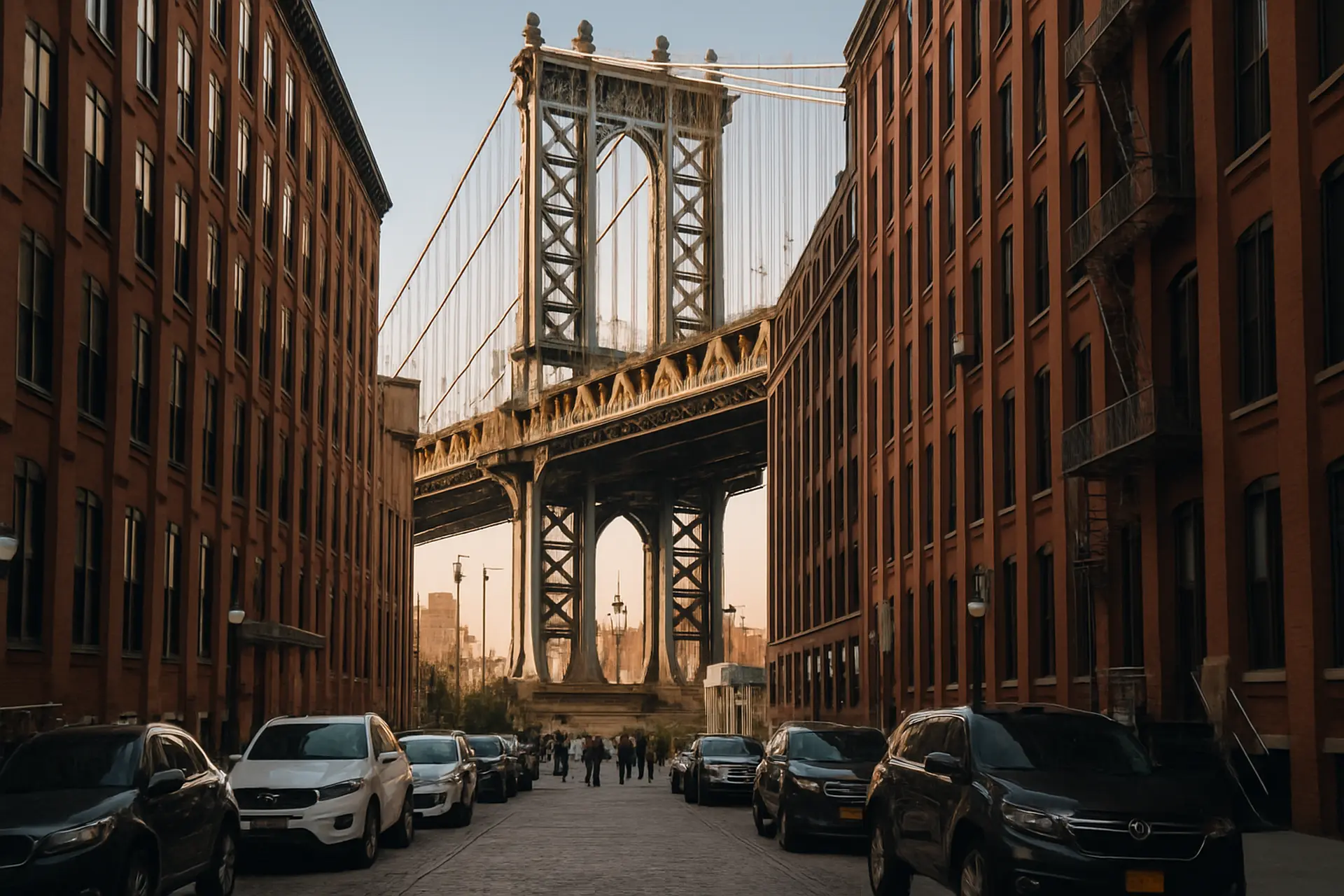
East of Brooklyn Heights (through the Archway beneath the Manhattan Bridge) lies DUMBO (“Down Under the Manhattan Bridge Overpass”). Once an acronym for an industrial zone of flour mills and warehouses, DUMBO has become an artsy, entrepreneurial enclave. Its cobblestone streets and converted lofts now host tech start-ups, art galleries, and boutiques. It also offers arguably the most dramatic view of the Manhattan Bridge framed against the Empire State Building – a photographer’s favorite spot on Washington St (at Front and Water Streets). On summer weekends, the area buzzes with people from the Brooklyn Flea (an antiques/art market on Saturdays) or visitors walking the old streets.
DUMBO (Down Under the Manhattan Bridge Overpass) “is one of Brooklyn’s most visited neighborhoods, attracting visitors with its cobblestone streets, dramatic architecture, great dining and dreamy views across the river.” This magnet draws crowds to the scenic waterfront. Indeed, one of DUMBO’s most whimsical sights is Jane’s Carousel, the 1920s vintage merry-go-round housed in a clear glass pavilion on the waterfront (visible from the photo above). Built in 1922 in Chicago and relocated here in 2011, Jane’s Carousel is exactly 100 years old and still delights families.
Dining in DUMBO capitalizes on its views. The neighborhood boasts a high-end restaurant scene (The River Café, tucked under the bridge, is a longstanding Michelin-starred spot with skyline views). More casual are pizza legends: Juliana’s and Grimaldi’s (coal-oven pizza) thrive here, drawing lines of hungry Brooklynites. For lighter fare, the Time Out Market (recently opened in a refurbished watch factory) houses dozens of food vendors under one roof with a rooftop overlooking Manhattan. Across the river, countless hip restaurants in Cobble Hill and Downtown Brooklyn are a 10-minute drive away, making DUMBO a strategic base for a full Brooklyn experience.
Williamsburg: Hipster Haven
Just north of the Brooklyn Bridge (over the Navy Yard) and extending into Long Island City (Queens) is Williamsburg – Brooklyn’s epicenter of “hipster” culture in the 2000s. Once an industrial warehouse district, Williamsburg’s waterfront and Bedford Avenue corridor have blossomed with warehouses converted to condos, boutiques, and nightlife venues.
Williamsburg’s allure is in its blend of young creatives and reclaimed urban spaces. The East River State Park (now called Marsha P. Johnson State Park) provides another postcard view of Manhattan’s skyline and hosts Smorgasburg, a huge weekly outdoor food market with dozens of vendors. Along Bedford Avenue and its side streets, one finds everything from artisanal bakeries (like Bakeri and Blue Bottle Coffee) to indie clothing shops (opening Ceremony, Uniqlo, etc.). Thrift stores and record shops cater to the vintage aesthetic. At night, the streets thrum with music venues: rock clubs, punk bars, and large concert spaces like Brooklyn Bowl (a bowling alley with live music).
For budget dining in New York, the guide suggests, explore ethnic neighborhoods: areas like Williamsburg’s nearby Smorgasburg offer inventive eats at lower prices. In fact, Los Tacos No. 1 (an acclaimed taco stand from NYC’s Chelsea Market) has a location in Williamsburg’s Smorgasburg market, drawing lines in both boroughs. Also along Bedford are tiny, excellent restaurants: Fette Sau (for craft BBQ), Mehana (for Turkish coffeehouse vibe), and Peter Luger Steak House (an old-school high-end steakhouse on Bedford; Brooklyn’s answer to Manhattan’s cut?). The area is particularly known for creative cocktails and local brews (Williamsburg pioneered microbreweries like Brooklyn Brewery and bars like Egg, though some early spots have moved away in recent years).
Street art abounds: murals and wheatpastes can be found on Bedford, North 6th, and even under the BQE ramp on Wythe Avenue. Music and fashion events often pop up in warehouses. The Williamsburg Bridge (opened 1903) carries loads of rush-hour traffic to Manhattan from here – its pedestrian walkway is popular for running across. Politically, Williamsburg has also been a hotbed of activism (with landmark May Day marches since the 1980s) – a reflection of its young, diverse demographic.
Park Slope: Family-Friendly Brooklyn
Further south in Brooklyn lie Park Slope and nearby neighborhoods, known for brownstones and families. Park Slope (centering around 7th–8th Avenue and Flatbush Ave) is often ranked among New York’s best neighborhoods for families. It has many public and private schools, playgrounds, and the enormous Prospect Park (designed by the same architects as Central Park). Besides the park, Grand Army Plaza (at 7th Ave & Flatbush) and its Soldiers’ and Sailors’ Arch is a local landmark.
Park Slope’s dining and shopping scene caters more to locals: organic cafes, toy shops, and the occasional kid-friendly breweries (Brooklyn Brewery is nearby in Gowanus). It’s relatively quiet in the evenings, and crime is very low (one study in 2024 cited Park Slope as among NYC’s safest and most family-friendly).
Brooklyn Heights, DUMBO, Williamsburg, and Park Slope together showcase how Brooklyn has gone from modest neighborhood to sought-after urban borough over recent decades. It offers a more residential, spacious contrast to Manhattan’s density, while still being fully part of the city’s fabric.
Coney Island: Beachside Amusements
At Brooklyn’s southern shore lies Coney Island, an old-fashioned seaside amusement area that feels worlds away from the skyscrapers. The famous Boardwalk (built 1923) runs a couple of miles along the Atlantic Ocean. Along it are the Cyclone (a classic wooden roller coaster from 1927, still in operation) and the Wonder Wheel (a Ferris wheel dating to 1920, partly on rails). Luna Park (the modern iteration of the 19th-century amusement park) has roller coasters, fun houses, and midway games. In summer, thousands descend on Coney for the beach, the rides, and Nathan’s Famous hot dogs (the original stand is on Surf Avenue, running the annual July 4 hot-dog eating contest).
Coney Island is part of Brooklyn but so distinctive that it merits special mention. Amusement parks and seaside architecture give it a historic, Americana vibe. The New York Aquarium and the still-standing Parachute Jump tower add to its landmarks. At night, lights from the rides and neon signs flicker, echoing the old postcards of joyrides. Many New Yorkers mark the end of summer by one last Coney swim or ride.
Queens: The World’s Borough
The borough of Queens is famously the most ethnically diverse urban area on Earth. It is vast: skyscrapers of Long Island City sit just beyond Midtown, but farther east the borough stretches into suburbs. We’ll highlight a few neighborhoods known for their unique qualities:
Long Island City (LIC): Art, Views, and Redevelopment
Long Island City is Queens’ closest point to Manhattan, immediately across the East River from Midtown. For a century it was an industrial waterfront, but starting in the early 2000s it became a boomtown of condos and art spaces. Today dozens of high-rises along the river offer apartments with skyline views. The waterfront (Gantry Plaza State Park) has walkways and piers for sunset-watching (notably, the lit Pepsi-Cola sign is an LIC icon).
LIC is also an arts hub. MoMA PS1, run by the Museum of Modern Art, occupies a former schoolhouse and is one of the world’s largest contemporary art spaces. It stages experimental exhibitions and a popular summer music festival (‘Warm Up’). Throughout the neighborhood, galleries and studios have sprouted; even new art hotels house contemporary artworks. Industrial turn-of-the-century factories have been repurposed into office lofts and theaters (for example, the Culture Lab inside an old piano factory on 42nd Ave).
Emerging in recent years is Long Island City’s coffee and brew scene: local roasters like Fat Cat and Eagle Rare, microbreweries like Fifth Hammer. The food scene includes everything from Bengali to Polish: Vernon Blvd’s restaurants range widely, reflecting the immigrant mix.
Astoria: Greek Heritage and Diversity
To the north of LIC lies Astoria, a longtime center of Greek-American life. Its 30th Avenue is known for olive shops, ouzo bars, and old-school tavernas (the neighborhood brochure quips it’s “the third city of Greece”). One can still find spanakopita and gyros around Steinway Street and Ditmars Blvd. However, Astoria is highly diverse today: large populations of Egypt, Brazil, and South Asia add to the mix, and no fewer than a dozen languages can be heard on any given block.
Astoria’s cultural attractions include the Museum of the Moving Image (Astoria Blvd, at the old Astoria movie studio lot). This interactive museum (moved to its own building in 2020) examines film, television, and digital culture with hands-on exhibits. Nearby is the Noguchi Museum, in a modern pavilion amid sculpture gardens, reflecting the work of Japanese-American artist Isamu Noguchi (who lived and worked in Long Island City).
Astoria Park, along the East River, provides another scenic Manhattan overlook – here one sees the Hell Gate and Triborough Bridges crossing the river. Astoria has at least half a dozen parks, more than many parts of Manhattan. The Ditmars Blvd subway (N/W line) offers quick commutes to Midtown, making Astoria popular with young professionals looking for lower rents.
Culinary note: Astoria has many ethnic food clusters. For example, the triangle around Steinway & 31st is a hub for Middle Eastern cuisines (Lebanese, Egyptian) with hookah bars and falafel joints. Ditmars Blvd has Burmese and German spots alongside Greek. In short, Astoria exemplifies a Queens staple: neighborhoods where one can eat specialties from many continents just blocks apart.
Jackson Heights: Global Crossroads
Jackson Heights (northern Queens, around 74th St and Broadway) is often cited as a quintessentially diverse NYC neighborhood. Numerous immigrant communities co-exist here. For decades it has been known as “Little India,” with an especially large South Asian (Indian, Bangladeshi, Nepali, Pakistani) presence. 74th Street is lined with sari shops, Bollywood DVD stores, and dozens of curry restaurants. In recent years, other waves arrived: Bangladeshi residents expanded around “Bangladesh Bazaar” on 74th, and there’s a growing Tibetan community as well. At the same time, there’s a prominent Latin American (especially Colombian) population in parts of Jackson Heights, as well as many Filipino and Chinese families.
The insider perspective is that every ethnicity brings its own food legacy: Business Insider describes Jackson Heights as having “Little India, Bangladesh Street, and Little Colombia side by side, serving fuchka and arepas”. (Fuchka is a street food of stuffed fried dough balls from Bengal; arepas are corn cakes from Colombia/Venezuela.) On any afternoon you can see Colombian bakeries next to Nepali momos stands. Given this mix, Jackson Heights has become a food-lover’s paradise: NYC’s most affordable and genuine global eats are found in these blocks. For example, Tortilleria Nixtamal is famous for its Salvadoran quesadillas and pupusas, and SriPraPhai on 37th Ave is world-renowned for Thai cuisine (drawn by Queens’ Thai community).
Jackson Heights also has beautiful historic architecture in parts: tree-lined Garden Apartments (once the dream of early 20th-century housing reformers) and old subway token booths. The main shopping stretch, Roosevelt Avenue (72nd–74th Street), is a riot of color, sound, and languages. Subways (E, F, R, etc.) and buses make this an accessible international bazaar for adventurous diners and shoppers.
Flushing: Authentic Asian Culture
Even farther east in Queens is Flushing, arguably Queens’ largest Chinatown (beyond Manhattan’s). The center is near Main Street and Roosevelt Ave in northern Queens, opposite Citi Field (home of the New York Mets) and Queens Botanical Garden. Flushing’s Chinese community is one of the fastest-growing in the city. Unlike Manhattan’s Chinatown, which was predominantly Cantonese, Flushing has a broad mix of Chinese immigrant subgroups (Cantonese, Mandarin, Fuzhounese, Shanghainese, etc.) as well as many Korean and South Asian residents. One estimate calls Flushing “a culinary destination” built by its Chinese and Korean communities.
Walking down Main Street Flushing feels like being in a big city in Asia. There are endless dim sum palaces and noodle shops. The 100+ restaurants include Szechuan hot pots, Peking duck houses, Taiwanese bubble tea stands, and halal Chinese-Muslim lamb noodle counters. Koreans have concentrated along Northern Blvd (the part sometimes called Koreatown), with Korean BBQ joints and bakeries.
Cultural attractions in Flushing include: the Flushing Town Hall (a historic music venue housed in an 1862 building), the Queens Botanical Garden (Japanese Hill-and-Pond Garden), and Flushing Meadows–Corona Park right adjacent (the site of the 1939 and 1964 World’s Fairs). Citi Field (home of the Mets) at the park’s south edge also draws tens of thousands.
In summary, Queens neighborhoods reflect the global nature of NYC: each enclave, from LIC’s modern art scene to Jackson Heights’s block-party vibe, shows how immigrants and innovators shaped the city. While Manhattan often grabs headlines, locals know that New York’s soul often sits in these up-borough communities, a subway ride away.
The Bronx: Authentic NYC Experience
The Bronx, on Manhattan’s north shore, offers a different slice of the city’s character. It is home to two major “must-sees” as well as some authentic local neighborhoods:
- Arthur Avenue (the Bronx’s Little Italy): In the Belmont section of the Bronx lies Arthur Avenue (Arthur Ave and surrounding blocks). This area is sometimes called “the real Little Italy” of New York. Unlike Manhattan’s small Mulberry Street, Arthur Avenue still has family-owned Italian delis, bakeries, pasta shops, and butcheries. If one strolls along Arthur Ave in the morning, one can buy mozzarella made that day or a pint of freshly blended espresso at the bar. The streets here are lined with green and white awnings; names like Calabria Pork Store or Dominick’s Market have operated for decades. Visitors come for tasks like choosing prosciutto at Reginelli’s or picking Italian pastries at Madonia. Authentic eateries are abundant: Zero Otto Nove (pizzeria and restaurant) and Roberto’s (set menus of veal, seafood, homemade lasagna) are acclaimed. Arthur Ave is classic old-school Italian-American – tie-sporting locals gossiping outside salumerias, mafia movie posters, and every sign in Italian or English. Side note: the Bronx’s large Armenian community also surrounds this area, so one can find Armenian bakeries next door to Italian cafes.
- Yankee Stadium and the South Bronx: The Bronx’s identity is inextricably linked to the New York Yankees. The current Yankee Stadium sits near 161st Street in the South Bronx (opened in 2009). It replaced the original Yankee Stadium (1923–2008), borrowing its facade style. A visit to a Yankees game or even just a walk around the stadium is a popular Bronx experience. Nearby is River Avenue with shops and sports bars. Just south of the stadium is the low-income neighborhood of Longwood and Morrisania – areas with high poverty rates but also strong community ties. The Bronx was historically a working-class borough (factories in Hunts Point, garment shops in Melrose), and these neighborhoods still show that heritage. (Today, renovations and new housing are slowly changing parts of the South Bronx.)
- Bronx Zoo and New York Botanical Garden: In central Bronx, two world-class attractions share acres of parkland. Bronx Zoo, founded 1899, is “one of the largest zoos in the United States by area” (265 acres) and the largest metropolitan zoo in the country. With over 650 species and 4,000 animals, it is a leading conservation institution. Visitors can spend a whole day traversing African savannah exhibits (with giraffes, lions), the Congo Gorilla Forest, and snow leopard habitats. It draws over 2 million visitors annually. Just across the road in Bronx Park sits the New York Botanical Garden (NYBG). NYBG is on 250 acres and “contains a landscape with over one million living plants; the Enid A. Haupt Conservatory… and is a National Historic Landmark”. (The conservatory’s Victorian glass dome is itself iconic.) Seasonal highlights include the holiday train show (model trains through a miniature NYC made of natural materials) and springtime cherry blossoms in the Rose Garden.
Bronx Park environs (Pelham Parkway to Fordham Road) thus offer major attractions. Unlike the Bronx’s southern neighborhoods, here the surroundings are green, wide, and residential. Many local families picnic on lawns or rent bikes. This part of the Bronx is sometimes called Bronx’s “museum mile” (because of the zoo and garden) and is family-friendly.
Beyond the parks, other Bronx neighborhoods each have their own flavor. Riverdale in the far northwest (bordering Yonkers) is suburban with some estates and commuter trains into Manhattan. Fordham Road, the Bronx’s main shopping drag (home to Fordham University and The Hub) is busy with diverse street vendors and passersby. The borough’s demographic is majority Latin American and African-American, which is reflected in its food: Dominican restaurants abound (the Bronx has the largest Dominican population of any NYC borough), as do Puerto Rican ropas viejas spots, African bakeries, and even a rising Bronx Latin disco scene along Sheridan Blvd.
We have already mentioned Arthur Ave above; another lively street is Nostrand Ave in Kingsbridge (Northwest Bronx) with a Latin American supermarket, or City Island Road (in eastern Bronx) which leads to a tiny nautical village (with seafood restaurants and views of the Throgs Neck Bridge). The overall sense of the Bronx is that of a city in a city: it has borough-scale attractions (zoo, ballpark) and micro-neighborhood enclaves that are intensely local.
Staten Island: The Forgotten Borough
Often called “the forgotten borough,” Staten Island has a more suburban character. Yet it too has points of interest for visitors:
- St. George and the Ferry: Staten Island connects to Manhattan via the Staten Island Ferry, a free service that runs 24/7 between Whitehall Terminal (Lower Manhattan) and St. George Terminal (Staten Island’s northeast tip). The 25-minute ride offers great views of the Statue of Liberty and the Lower Manhattan skyline. Once on Staten Island, St. George is the small downtown around the ferry. It recently underwent some revival with new condos and restaurants facing the waterfront. Visitors can walk up to the Staten Island Museum or see the Staten Island Yankees minor-league ballpark (not the MLB Yankees). A short hike up Victory Boulevard from the ferry takes you to Fort Wadsworth, a park with historic old batteries and yet another skyline view (from the Verrazzano Bridge).
- Historic Richmond Town: A 17th-century village preserved in the island’s interior. This living history museum comprises dozens of original buildings (farmhouses, a church, a school) relocated here or reconstructed on site, dating from the 1600s through the early 1900s. Costumed reenactors demonstrate crafts like shoemaking, printing, and farming methods. It provides a window into rural colonial and post-colonial life in New York. The site even runs a seasonal farmer’s market and craft festivals.
- Other Highlights: Staten Island’s Silver Lake and Snug Harbor neighborhoods offer Victorian homes and a Chinese scholar’s garden (on Snug Harbor’s grounds, which was once a retirement home for sailors). There is also a small Staten Island Mall in New Springville. However, Staten’s true visitor attraction is its feel: quiet streets, a bit greener, and the ferry ride itself. Tourists often combine Staten Island with a day of seeing the harbor.
Choosing Where to Stay: Neighborhood Comparison
Given so many options, choosing where to lodge can be daunting. Here are some guidelines:
First-time visitors often gravitate to Midtown Manhattan for convenience (Times Square, Broadway, Fifth Avenue). Staying there means easy access to subway lines (1,2,3, A,C,E, etc.) and being in the tourist buzz. However, Midtown hotels can be expensive and crowded. For a quieter first stay, neighborhoods like Murray Hill (Midtown East) or Battery Park City (Downtown) are often recommended. Battery Park City (near the Statue of Liberty ferry) has peaceful parks and low crime and is literally on the world’s biggest financial campus – great for families. Upper West Side and Upper East Side also have some hotels; these are especially good if museum or park access is a priority and high-rise views appeal.
- Most affordable hotel districts: Generally, Manhattan is priciest. As one guide suggests, staying in outer boroughs can save money. Long Island City (Queens) and Downtown Brooklyn have seen a hotel-building boom; rates there are often 30–40% lower than Manhattan equivalents. Queens hotels near JFK airport (Jamaica) or near the LIRR at Woodside tend to be budget-friendly for tourists who don’t mind a longer subway ride (though Times Square is still under an hour away). Within Brooklyn, the closer-to-Manhattan hotels (DUMBO, Williamsburg) are moderately cheaper than Midtown; going further (e.g. Park Slope, Brooklyn Heights) is even more affordable, but then daily transit back to Manhattan intensifies travel time.
- Safest neighborhoods: New Yorkers often joke that Manhattan feels safer (because it’s crowded) but crime exists citywide. Up-to-date data indicates many Manhattan neighborhoods (Battery Park City, Tribeca, Chelsea, Murray Hill) have low crime. Brooklyn Heights, Park Slope, Forest Hills (Queens), and parts of Staten Island also rank as very safe. In contrast, some travel sites advise avoiding parts of the Bronx like Hunts Point or Brownsville (Brooklyn) at night – though daytime visitor-oriented Bronx (zoo, Arthur Ave, etc.) is generally fine. Regardless, standard urban caution applies: at night, stick to well-lit main streets, and always keep personal items secure on subways.
- Family-friendly neighborhoods: As mentioned, Park Slope (Brooklyn) and Battery Park City (Manhattan) are frequently cited for families. They have parks, playgrounds, and quiet residential blocks. Other family-friendly choices include Lincoln Center area (UWS, with its large park and kid-friendly museums like Natural History) and the Upper East Side near Central Park zoo. For those with children, proximity to parks and museums can outweigh the appeal of being in Times Square’s hustle.
- Budget tips: To save overall, lodging in Queens or Brooklyn plus a MetroCard (or two-week unlimited ride card) can be cheaper than a Manhattan hotel. Even Manhattan travelers can cut costs by heeding these tips: stay off-peak (winter or weekday stays are cheaper), eat in non-touristy neighborhoods, and use public transport or walk whenever possible. (The Staten Island ferry is free, and many museums have pay-what-you-wish hours.)
Neighborhood Food Guide
New York is famously multicultural, and each neighborhood has its culinary claims:
- Best Pizza: Pizza is a citywide obsession, so pick your style. For classic New York slices, Lombardi’s (Little Italy, est. 1905) and Joe’s Pizza (Greenwich Village) are venerable spots. For coal-oven pies with a crusty char, DUMBO’s Juliana’s and Grimaldi’s regularly top the “best pizza” lists. For Detroit-style or other varieties, try slice shops in Queens (e.g. Rockaway Pizza), Brooklyn (Paulie Gee’s for gourmet slices, Denino’s for thin crust), or Manhattan (Prince Street Pizza’s thick Sicilian squares in SoHo). No matter what, every neighborhood has at least one contender claiming “best pizza in NYC” — the abundance of pizzerias makes NYC a pizza pilgrim’s paradise.
- Ethnic Food by Neighborhood: As noted, ethnic enclaves abound. A few highlights: In Chinatown (Manhattan): dim sum at Nom Wah Tea Parlor, soup dumplings at Joe’s Shanghai, Peking duck at Peking Garden. In Flushing, Queens: dim sum at East Ocean Palace, Taiwanese at Hand Pulled Noodles, Muslim Chinese at Xi’an Famous Foods. In Jackson Heights, Queens: Indian street food at Jackson Diner, Nepalese momos at Cafe Himalayan, Colombian arepas at Arepas Cafe. In Astoria, Queens: Greek gyro shops and seafood at Taverna Kyclades. In Arthur Avenue (Bronx): Italian sub shops like Enzo’s, full meals at Mario’s (old-school red-sauce pasta), and fresh mozzarella at Bronx Cheese Company. In Harlem: soul food at Sylvia’s and Amy Ruth’s, Caribbean at Miss Lily’s (135th & Lenox). In West Village: Middle Eastern at Mamoun’s Falafel, French bistro at Buvette, Italian at L’Artusi. Lower East Side has its Jewish deli classics (Katz’s, Russ & Daughters) and new Asian fusion restaurants (Ivan Ramen, etc.) side by side.
- Brunch: New Yorkers brunch nearly every weekend. Trendy areas like Williamsburg, West Village, and the East Village have long lines at brunch spots (pancakes, eggs benedict, and coffee). The Upper West Side has family-friendly diners for brunch (Jacob’s Pickles). Many Midtown hotels offer substantial breakfast buffets. Food markets like Chelsea Market, Essex Market, and Dekalb Market Hall (Downtown Brooklyn) also have great casual brunch counters (smoothie bowls, gourmet bagels, etc.).
- Late-Night Dining: Some neighborhoods really shine after dark. The East Village has late-night ramen spots and pizza by the slice. Koreatown (midtown Manhattan around 32nd St) has 24-hour barbecue joints. Chinatown (Manhattan) has many bakeries and bars open until 2–4 AM (fresh egg tarts, congee). Times Square’s tourist zone has all-night diners (e.g. Junior’s), and the UWS has some late-night Pho restaurants on 82nd St. In Brooklyn, after shows in Williamsburg or Bushwick, many bars serve pizza or dumplings until the wee hours.
New York truly has something for every palate and schedule. The trick is to venture a few subway stops beyond your hotel zone. Some of the best and most authentic meals are often one train ride away in culturally rich neighborhoods. As one money-saving guide notes, “restaurants in Chinatown, Flushing, Jackson Heights, and Sunset Park offer authentic meals at a fraction of tourist-area prices”. (For example, a full Chinese banquet for six can cost less in Flushing than a two-topping pie in Midtown.)
Practical Visitor Information
Getting Between Neighborhoods
New York’s transportation network is a guide in itself. Most visitors rely on the MTA Subway. A single ride is $2.90 (as of 2025) and a 7-day unlimited MetroCard ($34) pays off if you take more than 13 trips. The subway runs throughout all five boroughs (including Staten Island via the S Staten Island Railway, though that’s separate fare). Important tip: it operates 24/7, so you can catch trains (A, C, E to Brooklyn/Queens; 2,3 to Bronx; F, R to Queens) at any hour, which is unique among world cities. Bus service fills in areas without subways (for example, the Bx1 runs along Fordham Road in the Bronx, the M14 runs across 14th Street in Manhattan between rivers). Yellow taxis and app services (Uber/Lyft) are convenient but can be slow in heavy traffic. Many locals, however, walk surprisingly far. Manhattan’s walkable grid means neighborhoods like the Village to Soho (south) or Midtown to the Upper West Side (north) can be reasonable on foot if one is up for miles.
Ferry routes also connect neighborhoods: the Staten Island Ferry (free) between Manhattan and Staten Island; the NYC Ferry has routes linking Manhattan with Brooklyn’s Dumbo/Brooklyn Heights, Long Island City, and Astoria, plus a route to Yankee Stadium. The Roosevelt Island Tram (like a small aerial gondola) shuttles between Manhattan and Roosevelt Island (between Midtown and Queens).
Finally, airports: JFK Airport (the big international hub) is in Queens; the AirTrain connects it to the subway and LIRR (costing around $10.75 total from Manhattan) – a popular budget choice. Newark Airport (in New Jersey) is another option, reachable by train or car but outside NYC. LaGuardia is in Queens (with Q70 Select Bus for $2.75).
Walking Tours by Neighborhood
Many neighborhoods can be explored on foot. For example, Lower Manhattan can be seen on a walking route from the 9/11 Memorial to Battery Park to Wall Street in a couple of hours. The Village and Soho can easily fill a morning stroll: start around Washington Square and wander west and south along cobblestones and brownstones. The High Line is a nice walking tour; you can start at Gansevoort Street (Meatpacking) and walk north to Chelsea Market or even Hudson Yards (passing art installations and gardens). Brooklyn Bridge Park and the Promenade can be combined with walking the Brooklyn Bridge for an all-day adventure: cross over from Manhattan to Brooklyn, then walk the water’s edge.
For self-guided tours, there are many routes online (one example in Manhattan: the MTA.com has downloadable maps, and organizations like freeToursbyFoot offer guided tips). Seasonal walking tours are also popular: e.g. a Spring Blooms walk through the West Village, a holiday light walk around Dyker Heights (Brooklyn).
Seasonal Considerations
Weather varies by season. Summer (June–Aug) is hot and humid in NYC; neighborhoods near water (Battery Park, Dumbo, Coney Island) can be pleasant breezes. This is peak tourist season, so plan museum visits early (timeslot reservations at major museums help). Autumn brings mild weather and is one of the nicest times for walking (especially in parks – Central and Prospect are brilliant with fall foliage by late Oct). Winter can be cold (occasional snow) and some tours slow down. However, winter holidays light up the city: Rockefeller Center Christmas tree, Dyker Heights lights, Harlem Nutcracker performances, etc. If visiting then, warm clothing and waterproof shoes are recommended.
Spring is lovely (flows of cherry blossoms at Brooklyn Botanic Garden and elsewhere). Shoulder seasons (spring and fall) often have lower hotel rates than summer. Notably, January–February often have bargain rates (though extra coat needed)!.
Budget Tips
- Stay in outer boroughs if Manhattan prices are too steep. As noted, hotels in Long Island City or Downtown Brooklyn can be 30–40% cheaper than Manhattan. They still have easy subway rides in. Some visitors use Airbnb or hostels in Brooklyn/Queens to save even more.
- Eat like a local: ethnic neighborhoods as mentioned (Chinatown, Flushing, Jackson Heights, Sunset Park) are gold mines for cheap, authentic food. Street food and food halls (like Queens Night Market in summer, or Smorgasburg in Williamsburg) offer cheap global bites. Shop grocery stores (Trader Joe’s, Fairway, Key Food) to make sandwiches and skip overpriced hotel breakfasts.
- Free and cheap attractions: Many museums have days with suggested or free admission (e.g. Museum of Modern Art Friday nights, MET pay-what-you-wish certain hours, etc.). Central Park, Brooklyn Bridge Park, High Line, and Bryant Park are all free to wander in. Staten Island Ferry rides are free. Walking across iconic bridges and through Grand Central (free!) gives a sense of the city. The New York Public Library on 42nd has a beautiful reading room to see. If you have kids, check for museum free days; for example, the American Museum of Natural History is pay-what-you-wish on certain evenings.
- Transportation: Always buy a 7-day MetroCard if you plan to take more than a dozen subway rides. It pays for itself and avoids having to swipe at each turnstile. Walking when possible saves money and often time (two nearby neighborhoods might be a 2-block walk rather than a 10-minute train ride). The Water Taxi and East River ferries (via NYC Ferry) cost about $4 but can be scenic alternatives for some trips. The Roosevelt Island Tram is $2.75 (same as subway) but gives a brief aerial ride worth the novelty.
By blending these cost-saving practices, even a budget traveler can experience much of what the city offers. At the same time, splurges can be reserved for key experiences (like a Broadway show or upscale dining in a special neighborhood).