

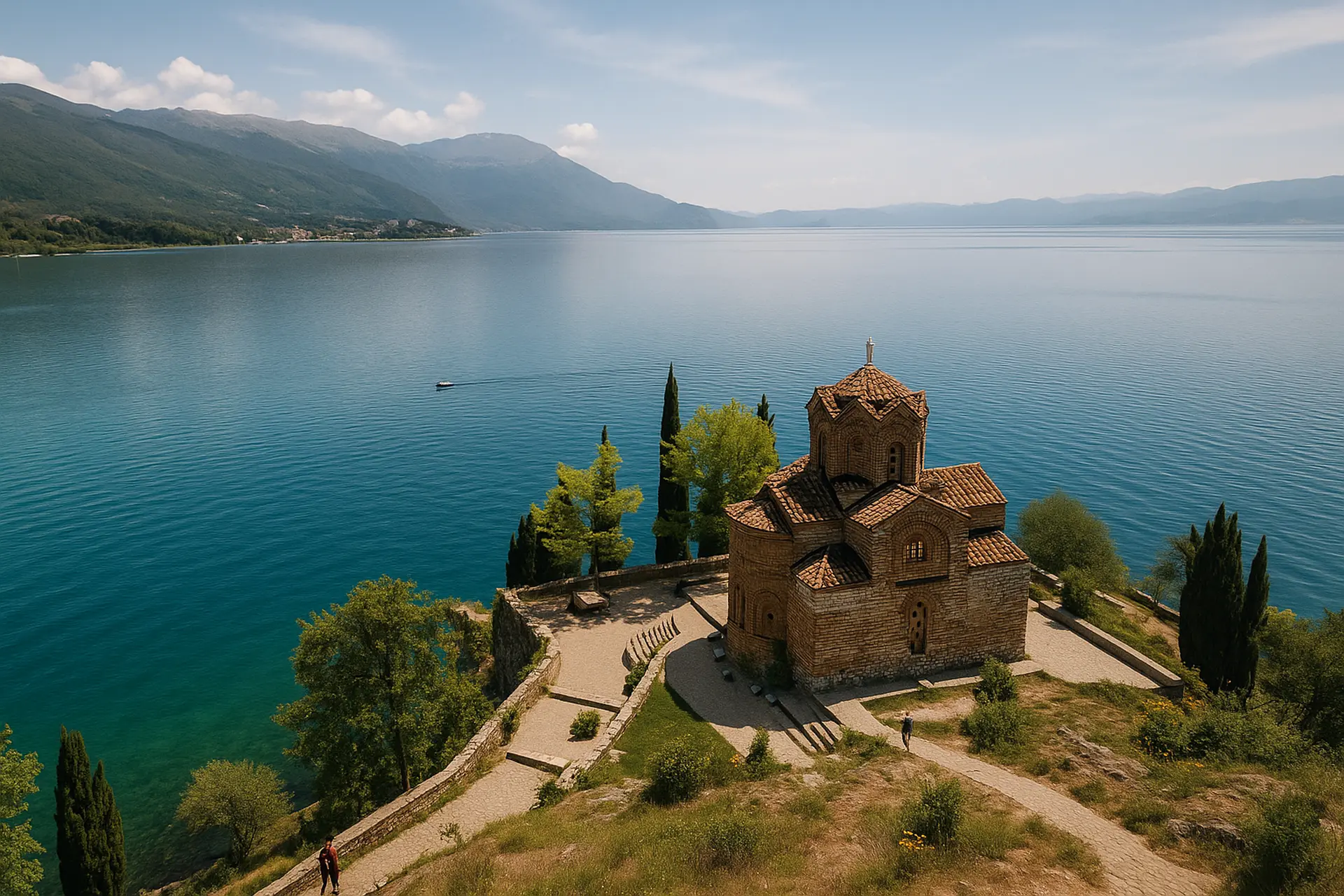
A transboundary Balkan lake
Lake Ohrid Travel Guide: Nature, Heritage and Practical Planning
Clear water, mountain horizons and an extraordinary concentration of cultural history make Lake Ohrid easy to admire—and important to visit with care.
A practical guide to the lake as one connected destination shared by North Macedonia and Albania.
Lake Ohrid is often introduced through age, depth and rarity. Those facts matter, but the travel experience is more immediate: morning light on a broad mountain basin, stone lanes descending toward the water, springs moving through reed beds and villages whose daily rhythm changes sharply between summer and winter. The lake is large enough to have distinct shores yet compact enough for travelers to understand it as one landscape rather than a series of unrelated stops.
Its World Heritage status is unusual because natural and cultural values are formally joined. UNESCO first inscribed the lake for natural significance in 1979, added cultural criteria in 1980 and extended the property into Albania in 2019. Endemic freshwater species, ancient settlement, Byzantine art, medieval religious architecture and a long tradition of lakeside life therefore belong to the same conservation story. A boat view, a church interior and a mountain hike are not competing attractions; together they explain why the region matters.
The same popularity that sustains livelihoods also increases pressure. Shoreline construction, wastewater, habitat fragmentation, overfishing, traffic and seasonal crowding have contributed to a declining conservation outlook. Responsible travel at Lake Ohrid is not an abstract virtue. It means choosing legal accommodation, keeping vehicles and waste away from sensitive shorelines, following protected-area rules, avoiding unsupported claims about “sustainable” fish and spending in communities on both sides of the border.
This guide treats Lake Ohrid itself as the primary profile. Towns, villages, monuments and activity zones appear as supporting options because most travelers combine them within one regional journey. The result is a route-planning article rather than a ranking: choose a base that fits the preferred pace, add a second shore if time permits and leave enough unscheduled space for weather, swimming conditions and the slow pleasure of simply staying beside the water.
Before choosing a base
Lake Ohrid is one ecosystem with several travel personalities
The practical map makes more sense after the natural basin and transboundary heritage are understood.
The lake is not a border attraction split in two; it is one connected natural and cultural region.
Lake Ohrid sits in a tectonic basin between high mountains, with most of its water volume on the North Macedonian side and a substantial Albanian shore to the south and west. Its great age and long isolation allowed species to evolve that occur nowhere else. UNESCO describes the lake as a refuge for endemic freshwater fauna and flora, while the surrounding region records human settlement, religious life and artistic production over many centuries.
The lake’s water balance is connected to springs, groundwater and the neighboring Prespa basin. That relationship is one reason mountains and karst landscapes are not merely a scenic backdrop. Development, extraction, pollution or land-use change in the wider watershed can affect water quality and habitats at the shore. Visitors encounter the system most clearly near spring zones and reed beds, where apparently modest wetlands perform essential ecological work.
Cultural heritage is concentrated but not confined to the town of Ohrid. The eastern shore contains the best-known old-town skyline, monastic sites and archaeological layers, while Struga, Pogradec, Lin and smaller settlements express different relationships to the lake. Traditional architecture, fishing knowledge, religious practice, food and seasonal movement all contribute to the landscape’s identity even where there is no ticketed monument.
The travel season changes the region dramatically. High summer brings warm water, outdoor dining and frequent activity, but also congestion, noise and pressure on infrastructure. Spring and early autumn often provide better walking temperatures and a calmer waterfront, though boat and tourism services may be reduced. Winter can be atmospheric and deeply quiet, but travelers must plan around shorter days, limited seasonal operations and mountain weather.
A useful itinerary therefore begins with priorities rather than a fixed list. Those seeking historic streets and broad restaurant choice usually favor Ohrid. A quieter promenade and access to the northwestern shore may point toward Struga. Pogradec offers an Albanian base with a long lakefront and access to Lin and spring landscapes. Rural stays can bring calm and local contact, but they work best with a car or a confirmed transport plan.
Initially inscribed for natural values, with cultural criteria added in 1980.
The Albanian part completed recognition of the lake as a shared property.
Natural and cultural significance are evaluated together.
Development, pollution and habitat loss require active management and visitor restraint.
North Macedonia · Albania
Lake Ohrid
An ancient freshwater basin where endemic life, mountain water and layered human history remain inseparable.
Best for: combining swimming, cultural walks, small-boat views and mountain landscapes in one compact region.

Primary profile
The landscape that holds the whole journey together
Lake Ohrid’s visual calm can hide ecological complexity. Clear water reveals shallows and stone shelves, yet the system depends on springs, wetlands, groundwater and habitats that are easily damaged by construction or pollution. Many organisms evolved in long isolation, giving the lake exceptional endemism. That rarity is not a decorative fact for brochures; it is the reason careless shoreline change, untreated wastewater and unsustainable fishing have consequences far beyond one holiday season.
Human history is equally deep. The town of Ohrid grew on a strategic and sacred shoreline, preserving churches, archaeological remains, traditional houses and an important collection of icons. Across the region, routes connected communities around the water and over surrounding mountains. Monasteries, mosques, markets, villages and fishing traditions show that the lake has long been a working cultural landscape rather than an untouched wilderness.
Travelers experience the lake through changing scale. From an old-town lane, it appears as a bright opening between roofs. From a boat, settlements become thin lines beneath mountain walls. From Galičica, the whole basin reads as geography, and the relationship with Lake Prespa becomes intelligible. Swimming brings the closest contact, but it should happen only in suitable areas and conditions, away from boat traffic, sensitive reed zones and local restrictions.
The lake is large enough that weather can differ by shore and hour. Afternoon wind may roughen water that was glassy in the morning, while mountain storms arrive quickly. Small boats should be chosen through licensed operators with appropriate safety equipment. Kayakers and paddleboarders need local advice, flotation and a conservative route; distance over open water is deceptive, and cold-water risk exists outside the warmest period.
The most rewarding way to treat Lake Ohrid is as a place of repeated observation. See the water early, when fishing boats and birds animate a quiet surface; at midday, when clarity and color are strongest; and near sunset, when mountain shadow changes the entire basin. That rhythm reduces the temptation to collect viewpoints and instead reveals the lake as a living system whose character cannot be captured in one famous photograph.
Where to stay
Match the base to the desired pace
The “best” shore depends on whether the trip centers on heritage, swimming, nightlife, quiet or cross-border exploration.
Choose the base for daily life, not only for the view from the booking page.
Ohrid is the most convenient first base. The old town rises above the eastern shore, placing churches, viewpoints, museums, restaurants and boat departures within a walkable area. It also carries the greatest pressure in peak season. Staying just outside the historic core can reduce luggage problems on steep lanes and provide easier road access, while a room in the old town favors atmosphere and early-morning walking. Ask directly about parking, stairs, noise and legal registration rather than relying on a broad neighborhood label.
Struga has a flatter, more everyday urban character where the Black Drin flows out of the lake. Its long shoreline and river setting can feel less compressed than central Ohrid, and it works well for travelers continuing toward the western shore or inland villages. It is not a substitute for the old town’s monument concentration; it is a different base with its own evening promenade, local life and transport logic.
Pogradec provides the clearest Albanian alternative. The lakefront is long and accessible, restaurants and hotels cover a range of budgets and nearby Lin and spring areas make natural day trips straightforward. The town can also be busy in summer, and cross-border plans need careful timing. Staying in Albania for only one rushed afternoon misses the change in language, food, settlement form and historical perspective that makes the transboundary journey valuable.
Smaller villages suit travelers who prioritize quiet water access and local scale. They can offer guesthouses, simple apartments and family restaurants, but not every property sits on a safe swimming shore or has reliable public transport. Map distance is misleading around the lake because mountain roads, borders and summer traffic affect journey time. Confirm the exact access road, meal options and late arrival procedure before booking.
Accommodation choice has environmental consequences. Prefer registered properties connected to lawful wastewater systems where possible, avoid buildings promoted as new “secret” waterfront escapes in visibly sensitive zones and do not assume that a pool or private jetty is ecologically neutral. A modest established hotel or guesthouse within an existing settlement may place less pressure on the shoreline than an isolated development marketed as sustainable.
| Base | Strongest for | Trade-off | Transport logic |
|---|---|---|---|
| Ohrid | Historic core, broad dining choice, first visit | Peak-season crowds, hills and parking pressure | Walkable center; strong regional connections |
| Struga | Riverfront, flatter streets, northwestern shore | Fewer marquee monuments in the immediate center | Useful road and bus position |
| Pogradec | Albanian shore, promenade, Lin and nearby springs | Border timing for North Macedonian day trips | Best with planned bus, taxi or car |
| Village stay | Quiet, swimming access and local scale | Limited services and variable transport | Confirm road, meals and transfers in advance |
Cultural route
Read the lakeshore as a sequence of history
The region’s famous monuments become more meaningful when connected to settlement, worship and landscape.
Fewer sites, connected thoughtfully, reveal more than a rushed circuit of doors and viewpoints.
In Ohrid, begin with the shape of the old town rather than the longest possible monument list. Climb gradually from the lower streets, noticing how houses, courtyards and religious buildings occupy the slope. The ancient theater, fortress area and Plaošnik archaeological complex reveal different periods and uses of the same hill. The route is steep in places, and summer stone surfaces can be hot, so an early start is both more comfortable and more atmospheric.
The Church of St. John at Kaneo has become the region’s defining image because its cliff setting compresses architecture, water and mountain into one frame. The viewpoint deserves quiet attention, but it is a functioning sacred place and a fragile site, not merely a sunset platform. Avoid blocking paths or services, keep drones within current law and continue along the shore or upper paths to understand the building’s relation to the wider old town.
St. Naum, near the southern end of the North Macedonian shore, combines a monastic complex with spring landscapes and a border-edge geography. The attraction is often crowded by day tours. The springs should be approached with an ecological as well as scenic perspective: clear channels and vegetation are part of the lake’s water system. Boat rides, restaurants and wildlife encounters should be chosen and observed without feeding animals, leaving litter or treating the area as an amusement park.
The Bay of Bones museum presents a reconstructed pile-dwelling settlement above the water. It is useful as interpretation, but visitors should distinguish the modern reconstruction from original archaeological evidence and read current museum material rather than assuming every visual detail is certain. Lin, on the Albanian shore, offers another kind of cultural experience through village fabric, mosaic remains and a quieter relationship to the lake.
Religious buildings around Lake Ohrid remain places of faith and community memory. Dress respectfully, ask before photographing services or people and accept that access may be limited without warning. A short conversation with a custodian or local guide can reveal more than entering several locked or dim interiors in haste. The goal is not to count churches but to understand why this shore became such a sustained center of spiritual and artistic life.
Four useful cultural threads
The old-town slope
Use elevation and street pattern to connect fortification, worship, housing and lake access.
Sacred continuity
Treat churches and monasteries as active places with current communities, not abandoned art containers.
Archaeological interpretation
Separate surviving evidence from reconstruction and read the institution’s current explanation.
Transboundary perspective
Include Albanian settlements and heritage so the lake is not narrated from only one national shore.
Outdoor rhythm
Swim, paddle, sail and hike with local conditions in mind
Lake activities are rewarding because the landscape is open and legible, but exposure and conservation rules matter.
Good outdoor planning leaves room to cancel or shorten an activity when wind, heat or fire risk changes.
Swimming is simplest from established beaches and platforms where local use indicates appropriate access. The shore varies from pebbles and stone shelves to reeds and developed waterfronts. Clear water does not automatically mean every location is safe or environmentally robust. Avoid entering through reed beds, watch for boat lanes, do not jump from unknown rocks and seek current local advice after storms or water-quality concerns.
Kayaking and stand-up paddling offer a quiet way to read cliffs, coves and settlement edges. Morning often provides calmer conditions, but no pattern is guaranteed. Wear a personal flotation device, protect against sun and carry a waterproof communication method. Stay close to shore unless experienced and properly equipped. The broad water surface makes distances appear shorter than they are, and wind can turn an easy outward journey into a difficult return.
Boat trips range from short old-town panoramas to longer journeys toward the southern shore. Choose licensed operators, confirm passenger limits and look for visible safety equipment. A smaller vessel is not automatically more authentic or safer. Agree on the route and return time, and understand whether a border is involved. Music volume, wildlife approach and wake near shore are also reasonable indicators of how responsibly an operator behaves.
Galičica National Park lifts the journey from water level to a mountain divide between Ohrid and Prespa. Trails vary from short viewpoints to exposed summit routes. Conditions can include heat, sudden cloud, wind, fire restrictions and lingering snow outside the main season. Use the park’s official information, carry sufficient water and choose a route appropriate to fitness and navigation experience. A viewpoint reached safely is better than a summit pursued after conditions change.
Cycling around or beside the lake requires more caution than scenic maps suggest. Some road sections carry fast traffic and have limited shoulders, while border and construction conditions can alter routes. Dedicated local rides, quiet village roads or guided sections may be more enjoyable than attempting a full circuit without current intelligence. E-bikes extend range but do not solve traffic exposure, battery planning or mountain weather.
Activity choices
Swimming
Use established access, avoid reed habitat and check local conditions.
Paddling
Start early when suitable, wear flotation and remain conservative about open-water distance.
Boat trip
Choose licensed operators with clear routes, safety equipment and appropriate capacity.
Hiking
Follow National Park Galičica notices, carry water and respect fire or weather restrictions.
Cycling
Select low-traffic sections and obtain current route advice rather than trusting a generic circuit map.
Practical movement
Transport works best when the lake is planned as a region, not a single town
Airports, buses, roads and borders all shape how much of the lake can realistically fit into one trip.
Flexibility improves the trip only when documents, parking and return logistics are settled.
Ohrid has a seasonal international airport, while Skopje and Tirana offer larger networks but require overland travel. Flight schedules change, and an inexpensive arrival can become inconvenient if it lands after bus services or before a border transfer is practical. Compare the whole journey rather than the airfare alone. Prearranged transfers should identify the operator, vehicle and border plan clearly.
Regional buses and minibuses connect major towns, but online schedules may be incomplete, seasonal or outdated. Confirm at the station or through a reliable local contact, and allow for slower journeys during summer traffic. A route that appears short on a map may involve a change, a wait or a border crossing. Travelers with a fixed flight should return to the departure city with a generous margin rather than relying on the final service of the day.
A rental car gives the greatest flexibility for villages, trailheads and cross-border exploration. It also introduces parking, insurance and documentation questions. Confirm that the agreement permits international travel, that the vehicle carries required papers and that roadside assistance applies in both countries. Historic Ohrid is not a place to improvise parking on narrow streets; choose accommodation with a clear arrival plan or leave the car outside the core.
Taxis are useful for point-to-point trips, especially in a small group. Agree on price or meter use before departure and ask the accommodation to recommend licensed providers. For long cross-border trips, a local taxi may not be authorized or insured to continue, so the journey can require a vehicle change. Boat transport should not be assumed to replace road connections unless a current scheduled service is officially confirmed.
Border crossings are routine for many travelers but remain legal checkpoints. Passport validity, visas, residence permits, rental-car documents and opening hours depend on nationality and current policy. Do not rely on a blog written for another passport. Check both countries’ official sources and leave time for queues, particularly on summer weekends and holidays.
Choose the arrival gateway
Compare Ohrid, Skopje and Tirana using total transfer time, not flight price alone.
Decide whether the trip needs a car
Historic-center travel may not; villages, hiking and multiple shores often do.
Confirm cross-border permission
Check passport, visa, insurance and rental documentation for both countries.
Verify local services on arrival
Reconfirm buses, taxis, boats and trail transport because seasonal timetables shift.
Keep the departure day simple
Avoid combining a border crossing and the last possible connection to an international flight.
At the table
Eat locally without turning rare species into souvenirs
The region’s food is shaped by freshwater, gardens, livestock, Ottoman-Balkan traditions and the different kitchens of two countries.
A meal can support local life without adding pressure to the lake’s most vulnerable species.
Meals around Lake Ohrid can move from grilled vegetables, peppers, beans and salads to pastries, cheeses, meats and freshwater fish. The most memorable tables are not necessarily those closest to the main promenade. Family restaurants and guesthouses often provide a clearer sense of season, while town markets reveal fruit, herbs and preserved foods. Ask what is local that day instead of ordering solely from a list of “must-eat” dishes.
Ohrid trout and related endemic fish are culturally important but ecologically sensitive. Regulations, legal supply and conservation status can change, and menu wording may not make origin clear. A responsible article should not encourage consumption without current verification. Travelers can ask the restaurant about species and source, choose farmed or non-sensitive alternatives where credible and accept that declining a famous fish may be the more meaningful way to value the lake.
North Macedonian and Albanian shores share ingredients while expressing them differently. Crossing the border can change bread, breakfast, coffee, dairy, seasoning and restaurant rhythm. Rather than searching for a single “authentic Lake Ohrid cuisine,” notice how households and towns adapt broader Balkan traditions to local produce and tourism demand.
Tap-water advice should be checked locally, particularly in rural accommodation or after infrastructure problems. Carry a reusable bottle where reliable refill water is available, but do not pressure hosts to make safety guarantees. In hot weather, hydration and food storage matter. Outdoor picnics should leave no waste and avoid feeding birds, fish or other wildlife.
Daily courtesy goes a long way. Learn greetings in Macedonian and Albanian, dress appropriately for religious sites and ask before photographing people, boats or private courtyards. Summer tourism can make residents’ streets feel like a continuous public stage. Respecting quiet hours, parking rules and household space is part of protecting the cultural landscape just as surely as following a nature-trail sign.
Responsible food choices
Ask what is seasonal
Local produce and daily dishes often offer a better regional meal than a fixed tourist specialty.
Question fish provenance
Do not assume an endemic or famous species is legal, sustainable or locally caught.
Try both shores
Shared ingredients take on different forms in North Macedonian and Albanian kitchens.
Reduce shore waste
Refill where water is reliably safe and carry all picnic waste away from beaches and springs.
A fragile success
How to visit without increasing the pressures that threaten the lake
Conservation here is not separate from tourism; it determines whether the qualities visitors seek will remain.
Responsible travel protects both the ecological system and the ordinary life of lakeside communities.
The World Heritage property’s conservation concerns are not a reason to avoid Lake Ohrid. They are a reason to make better choices and to resist developments that sell private access at public ecological cost. Visitors create demand for rooms, roads, boats, restaurants and entertainment. Where that demand is met through illegal building, inadequate wastewater or shoreline clearance, tourism undermines the landscape on which it depends.
Choose established settlements and registered accommodation. A building’s claim to be “eco” means little without evidence about wastewater, energy, construction legality and relationship to habitat. Avoid driving or parking on beaches, do not create informal fire sites and keep out of reed beds and spring zones. Small actions become significant when repeated by thousands of summer visitors.
Noise is also an environmental and cultural pressure. Loud boats, amplified beach venues and late-night disturbance affect wildlife and residents. Travelers can choose quieter operators and properties, keep portable speakers off natural shores and support municipalities or businesses that manage volume responsibly. The lake’s appeal comes partly from the ability to hear water, birds and human activity at a humane scale.
Support interpretation that explains conservation rather than merely advertising beauty. Park centers, museums, local guides, scientists and community organizations can connect a visit to the watershed’s real challenges. When buying crafts or “Ohrid pearl” jewelry, ask about materials and production rather than accepting vague origin stories. Cultural products deserve the same informed attention as natural resources.
Finally, report problems through appropriate channels instead of confronting people or broadcasting unverified accusations. Pollution, wildlife disturbance, illegal construction and unsafe operators may involve legal and local complexities. Photographs with date and location can be useful when shared responsibly with a park, municipality or conservation body. Public concern is strongest when it is accurate, calm and connected to institutions capable of acting.
How many days are enough for Lake Ohrid?
Three nights can cover an Ohrid base and one wider excursion. Five or more allows a second shore, hiking or slower village time without constant transit.
Is a car necessary?
Not for a stay focused on central Ohrid, but it improves access to villages, trailheads and cross-border routes. Documentation and parking need advance planning.
Can visitors swim anywhere?
No. Use established, locally accepted access and avoid reed habitat, boat channels, unsafe rocks and any area affected by a current water-quality warning.
Should travelers eat Ohrid trout?
Only after verifying the species, source and current regulation. Choosing another local dish is prudent when provenance is unclear.
Is the Albanian side worth adding?
Yes when the itinerary allows enough time to experience Pogradec, Lin or nearby landscapes as more than a rushed border photo stop.
The final perspective
Let the lake set the pace.
Lake Ohrid does not need an overloaded itinerary to feel substantial. Its natural history reaches far beyond a holiday, and its cultural landscape rewards repetition: the same water from a lane, a boat, a mountain and another national shore. The best journey uses those changing perspectives to understand one connected region.
Plan carefully where the details are live—borders, boats, roads, weather and protected-area rules—then leave room for slowness. Choose lawful places to stay, conservative outdoor decisions and food whose origin can be defended. A traveler who gives the lake time and reduces pressure will see more than a collection of sights. They will encounter a landscape whose beauty depends on continuing ecological and cultural relationships.