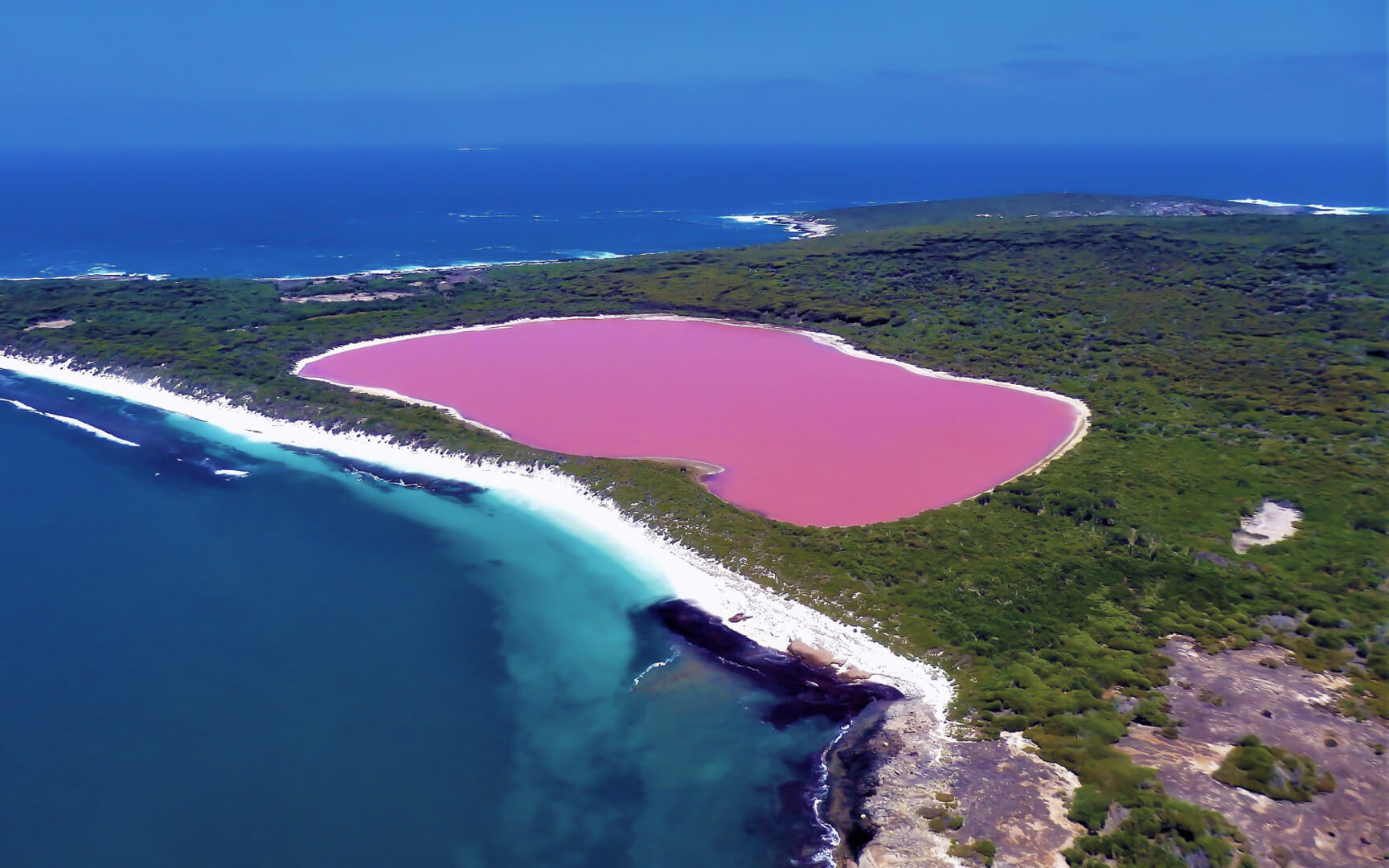
A Pink Lake That Science Cannot Explain

A-Pink-Lake-That-Science-Cannot-Explain
Since its discovery in 1802, Lake Hillier, a stunning pink wonder tucked away on Middle Island off the coast of Western Australia, has enthralled researchers and visitors. This unusual body of water resists easy explanations since it keeps its vivid color all year long. Although its precise color is still unknown, scientists think it results from a mix of high salt content and salt-loving bacteria. Protected for research, Lake Hillier is evidence of nature's continuing ability to astound and motivate.

Far offshore in Western Australia’s Recherche Archipelago, Lake Hillier’s vivid pink waters arrest the eye. Framed by white coastal dunes and paperbark trees, the small lake glows a bubblegum hue amidst the deep blues of the Southern Ocean. From a distance the effect is surreal – tourists flying from Esperance report a “bubblegum-pink” lagoon beside the turquoise bay. Remarkably, the color persists even if its water is scooped into a jar. In fact, the lake’s striking tint comes from microscopic life. Salt-loving algae and bacteria living in its hypersaline water excrete red pigments that turn the lake rose or flamingo pink.

Lake Hillier is modest in size – roughly 600 meters long by 250 m wide (about 15 hectares) – yet its fame is outsized. It lies on Middle Island (70 nautical miles southeast of Esperance) protected within the Recherche Archipelago Nature Reserve. Its shores are part of a wilderness of eucalyptus woodlands. The only life seen there are extremophile microorganisms, but their activity paints the water pink year-round. Scientists have studied this vivid color for decades, but its cause was confirmed only recently. Even now the story isn’t over: a record rainfall in 2022 washed out the lake’s famous hue, turning it blue-gray for a time. Below, this guide unpacks Lake Hillier’s facts, history, science and travel advice, from Flinders’s 1802 journal entry to the latest conservation developments.

What Is Lake Hillier? Essential Facts at a Glance

Location and Geography

Lake Hillier lies on Middle Island, the largest of the Recherche Archipelago islands off Western Australia’s south coast. The archipelago sits roughly 70 nautical miles (130 km) southeast of the port town of Esperance. Middle Island’s northern edge is separated from Cape Arid National Park by an 11 km strip of coast, but by sea it’s accessible only by boat or plane. The lake occupies a natural depression near the island’s north shore. A thin sand and vegetation bank (linked to paperbark and eucalypt woodland) keeps the lake isolated from the open ocean. In winter and spring, wind-blown salt precipitates around its banks into chalky crusts; the area is a protected nature reserve and a mapped wetland of subregional significance.

Physical Dimensions and Features

Lake Hillier is small by lake standards – about 600 m long and 250 m wide (approximately 15 hectares in area). It is roughly oval, sometimes likened to a footprint or bean shape, with a maximum depth of only a few meters. Its water’s extreme salinity (salt content comparable to the Dead Sea) gives the surface a thick, almost jelly-like texture. The shoreline is flat, covered by salt crystals and purple-pink microbial mats in shallow places. On aerial maps the lake stands out not only for its color but for its rim of stark white salt crusts contrasting with surrounding green woods and azure bays. Birdlife such as gulls and terns sometimes perch on its fringes, feeding on the few brine shrimp and tiny crustaceans it supports.

Quick Facts

FeatureDetail
LocationMiddle Island, Recherche Archipelago, Western Australia
Coordinates~34°05′S, 123°12′E
Size≈600 × 250 m (≈15 hectares surface area)
Salinity~10× ocean salinity (among the world’s highest)
ColorNaturally rose-pink year-round (color persists even in samples)
SurroundingsWhite salt crust shoreline; paperbark & eucalypt woodland
AccessScenic aircraft flights from Esperance (common); charter boat only (no public dock)
Protection StatusRecherche Archipelago Nature Reserve (protected since 2012)
Current Status (2026)Recovering after 2022 flooding; pink coloration temporarily faded, with gradual return expected

Why Is Lake Hillier Pink? The Science Behind the Color

The striking pink hue of Lake Hillier has long attracted scientific curiosity. The key agent is microscopic life. Primary among these are halophilic (salt-loving) algae and bacteria that thrive in its salty water. The leading hypothesis involves the microalga Dunaliella salina. These cells produce vast amounts of orange-red beta-carotene (a carotenoid pigment) as they photosynthesize in high-salt, high-sunlight conditions. The pigment protects the algae from UV damage. When Dunaliella populations bloom, they tint the entire lake water pink or orange.. Other pigment-producing microbes also contribute: for example, pink halobacteria (archaea) in the salt crusts release bacterioruberin pigments, and Salinibacter ruber adds reddish tones. Together these microbes create a cocktail of pigments.

Importantly, Dunaliella and halobacteria live only in very salty water. Lake Hillier’s salinity is roughly ten times seawater, comparable to the Dead Sea, which means few organisms can survive. The water’s chemistry, then, selects for exactly these pigment-rich species. When scientists from the Extreme Microbiome Project sampled Lake Hillier, they found Dunaliella salina and multiple halophiles (e.g. Haloquadratum, Salinibacter, Halobacterium) present. These findings cemented the link between biology and color.

However, no single factor tells the whole story. Other conditions help: the high salt concentration and ample sunlight allow the pigments to disperse and dominate the water’s appearance. Some UV-resistant bacteria and even some seasonal freshwater influxes can affect color intensity. Science has yet to quantify every detail (for example, the exact roles of minor microbial species or how seasonal cycles modulate the bloom). In short: Dunaliella and its carotenoids are the chief artists painting the lake, but the full palette of contributors is still under study.

Dunaliella salina: The Orange Alga

The greenish-red microalga Dunaliella salina thrives in Lake Hillier’s brine. Under intense sunlight, it floods its cells with beta-carotene (an orange-red carotenoid) as a sunscreen. When Dunaliella accumulates, the lake water takes on an orange-pink cast. This beta-carotene is the same pigment that colors carrots and flamingos; it allows the algae to survive ultraviolet exposure. In summer months the bloom of Dunaliella is typically at its strongest, leading to the deepest pink tones. Laboratory analysis has confirmed Dunaliella DNA in Lake Hillier, linking this algae directly to the color. Without Dunaliella and its carotenoids, the lake’s color would appear green or clear, as it does when oversized rains suddenly dilute the salinity.

Halobacteria and Other Microbes

Aside from Dunaliella, extremophilic bacteria also tint the lake. In particular, salt-loving Halobacterium (an archaeon) and Salinibacter ruber populate the lake floor and salt crust. These microbes produce reddish-purple pigments (bacterioruberin and others) that add a magenta cast. In 2015 metagenomic sequencing, scientists detected Haloquadratum, Haloferax and other halophiles in the water. Each of these can give the water a pink or reddish shimmer. These organisms thrive on the hypersaline desert conditions, and the lake’s intense coloration is essentially their collective signature. Rarely are bacteria this visible to the naked eye – Lake Hillier offers one of the most spectacular examples of a microbial ecosystem coloring a landscape.

The Role of Beta-Carotene

Beta-carotene is central to Lake Hillier’s hue. As Dunaliella absorbs sunlight, it converts light energy into this red-orange pigment for protection. Essentially the algae “bleeds” a carrot-like dye into the water. When sunlight angle and salinity are just right, the concentrated beta-carotene tints the entire surface. This pigment also explains color variation: on cloudy days or when salt is diluted, the pink fades; when sun re-emerges and salt reconcentrates, the lake reddens again. Notably, beta-carotene is soluble, so it diffuses evenly – no wonder any scoop of the lake water looks vividly colored. In sum, the lake’s pink is a biochemical phenomenon: an extreme example of nature’s palette produced by tiny salt-loving life.

Is Lake Hillier Still Pink? Current Status (2026 Update)

Lake Hillier’s color can change with environmental conditions. In early 2022, an unusually large storm brought heavy rainfall to Middle Island. This runoff delivered fresh water and organic debris into the lake. Environmental scientists reported that “nutrients from the rotting vegetation” and dilution severely interrupted the salt balance. By late 2022, witnesses noted that the iconic bubblegum-pink had all but vanished: the lake surface took on a murky blue-grey color. For now, Lake Hillier is not intensely pink as it once was. Tourism authorities cautioned visitors that “Lake Hillier is no longer the bubble pink it used to be”, and that its rosy hue “cannot be guaranteed”.

Scientists have since monitored the recovery. Salt levels are gradually rising again as the excess water evaporates. Researcher Tilo Massenbauer of Esperance predicts that as salinity creeps back up, the lake will return to pink in time. He notes that when waters concentrate, “the bacteria that drives the red bloom… will start to bloom” and the pink will reappear. Some models suggest the original color could recover within a decade if no further diluting events occur. Meanwhile, climate change adds uncertainty: rising storm intensity could bring more extreme rainfall in the future. As of early 2026, the lake is in a transitional state (paler than its famed pink), but experts remain hopeful it is a temporary phase.

The History of Lake Hillier: From Discovery to Protection

Lake Hillier’s story stretches back to the Age of Exploration. On 15 January 1802, Lieutenant Matthew Flinders was charting Australia’s southern coast aboard HMS Investigator. He climbed Middle Island’s high point (later named Flinders Peak) and saw “a small lake of a rose colour” in the island’s northeast. Flinders noted that the lake’s salt was so abundant “saturated with salt” that it needed only drying to become sea salt. This passage in his journal provides the first recorded description of Lake Hillier. Flinders returned in 1803 to extract salt, and later named the lake after Able Seaman William Hillier, who had died of illness during the voyage.

Late in the 19th century, William Andrews and his sons attempted commercial salt mining on Middle Island. They worked for about a year (1889–1890) extracting salt crystals, but the enterprise failed. Contemporary accounts blamed the practice on the salt’s poor quality – miners said the lake salt was “toxic” and not suitable for consumption. After that, Middle Island saw little human activity for a century, aside from occasional visits by scientists, graziers and (once) a notorious 19th-century pirate.

Conservation began in the late 20th century. In 2002 the lake was formally recognized as a wetland of subregional significance under WA law. A decade later, in 2012, Middle Island and surrounding waters were declared the Recherche Archipelago Nature Reserve. Today the lake and island are protected land; visitors may only land under strict permit. This status shields Lake Hillier’s fragile ecosystem, though it remains a draw for tourism (via overflight or island excursion) due to its unique natural heritage.

Can You Swim in Lake Hillier? Safety and Access Rules

Though its salt content is extreme, Lake Hillier’s water is not toxic or dangerous in itself. The microbes that color the lake cause no known harm to humans. In fact, as travel writers note, “the lake is technically safe to swim in”. Its buoyancy would make floating easy (akin to the Dead Sea), and the rich saltwater poses little risk unless ingested. However, the practical answer is that almost no one swims there. Middle Island is remote and protected: casual visitors cannot simply walk to the lake. There are no beaches or boat ramps on the island, and no scheduled transport. All access is via organized tours.

To set foot on Middle Island (and Lake Hillier’s shores), one needs special permission. The Western Australia Department of Parks and Wildlife requires a research or tour permit for landing on the island. Recreational swimmers do not gain easy access. Tourism providers emphasize viewing the lake from above: scenic flights do not land, and cruises typically approach by boat but do not invite guests into the water. In short, while a daring swimmer could bathe in the brine without ill effect, in reality swimming in Lake Hillier is essentially impossible for normal tourists. All visitors are asked to respect the protected status and stick to authorized flights and guided cruises.

How to Visit Lake Hillier: Complete Tour Guide

Since Lake Hillier can’t be reached by road, visitors must book a tour that includes Middle Island. The scenic flight from Esperance is the most common and convenient option. From the air, passengers get unrivaled views of Hillier’s pink surface next to the blue sea and nearby Rainbow / Pink Lakes. Goldfields Air Services (now operating as Fly Esperance) offers daily flights year-round: about six round-trip tours per day from Esperance Airport, each ~2 hours long. These fixed-wing tours typically circle Middle Island via Cape Le Grand National Park, pass over Hillier, and return via Lucky Bay. All passengers have window seats on small planes, ensuring excellent photo opportunities. Another option is helicopter tour: companies like HeliSpirit run half-day helicopter charters (30–60 min) that can hover or land briefly for photos (weather permitting). Helicopters carry fewer people but command a premium fare, often around A$400–500 per person for a short trip. In both cases, flights offer unmatched panoramas of Hillier’s color, the white Lucky Bay beach and Cape Arid’s peaks.

The other way to experience Lake Hillier is by boat cruise. Esperance Island Cruises runs a full-day voyage from Duke of Orleans Bay on the WA mainland. This ~8-hour tour (≈$380–$400 per person) uses a fast catamaran to Middle Island. It does land passengers on shore. Guests can then walk to Hillier’s bank (about 1.5 km inland) and view it at ground level. The cruise also stops at Frenchman Bay, Lucky Bay, and other island sites (including the ghost camp of 19th-century settler Black Jack Anderson). Lunch is typically provided on board. Note that after 2022 rains, cruises were temporarily suspended – operators plan to resume once Hillier’s color strengthens again.

Tour Type

Operator

Duration

Price (est.)

Lake Access

Highlights

Scenic Flight (plane)

Fly Esperance (Goldfields)

~2 hours (roundtrip)

~$300

Aerial view only

Lake Hillier, Lucky Bay (white sands), whales*

Scenic Flight (plane)

Fly Esperance / others

~1.5–2 hours

~$250–$300

Aerial only

Cape Le Grand NP, Pink & Rainbow Lakes

Helicopter Tour

HeliSpirit / local charters

~0.5–1 hour

~$400+

Aerial only

Small-group, luxury experience, Lake view

Boat Cruise (catamaran)

Esperance Island Cruises

Full day

~$380–$400

Shore landing

Walk to Hillier, Frenchman Peak, lunch included

Lake Hillier vs. Other Pink Lakes: How Does It Compare?

Lake Hillier is not alone in its rosy shade, but it stands out among Australia’s pink lakes. Several Western Australian lakes share a similar cause, and some are easier to visit:

  • Pink Lake (Esperance): Once adjacent to town, this lake (Lake Spencer) lost its color decades ago. After 100 years of salt mining and saltwater dilution, Pink Lake turned blue-gray and has remained that way since the 2000s. Unlike Hillier, its hue seems unlikely to recover naturally. Today Hillier is in the Recherche Archipelago 70 nm from Esperance, whereas Pink Lake is roadside on the South Coast Highway near Esperance. Pink Lake is historically famous but now disappoints visitors.
  • Hutt Lagoon (Coral Coast, WA): About 400 km north of Perth, Hutt Lagoon is a large pink salt lake visible from the road. Its colors range through shades of pink, lilac, and even red, changing with seasons and sunlight. Salt harvested here supports an algal pigment (beta-carotene) industry. Hutt is very accessible (drive 6 hr from Perth) and often brighter under direct sun. In contrast, Lake Hillier is more isolated and consistently pink (Hillier even stays pink in a bottle).
  • Lake MacDonnell (SA Eyre Peninsula): Known as “Red Lake” near Penong, South Australia, Lake MacDonnell often glows a deep watermelon pink on its western side beside the causeway called Watermelon Avenue. The eastern side (called Green Lake) remains clear. This salt lake is at a major gypsum mine and is moderate to reach by road (tarmac plus dirt roads). Its color is intense at times, and its location by the Nullarbor makes it an outback curiosity. Again, unlike Hillier, MacDonnell’s pink is sometimes intermittent (it fades when water rises) and can only be viewed from the road or rail causeway.

The table below compares key features of Lake Hillier with these peers:

Lake

Location

Access

Current Color Status

Unique Feature

Lake Hillier

Middle Island, WA

Flights/cruises only

Faded (recovering)

Color persists in container

Pink Lake (Spencer)

Near Esperance, WA

Roadside (free access)

Blue-gray (since ~2000)

Named “Pink” but now not pink

Hutt Lagoon

Port Gregory, WA

Drive (380 km N of Perth)

Variable (pink to red)

Color shifts with time of day

Lake MacDonnell

Penong, SA

Outback road

Often intensely pink

“Watermelon Avenue” causeway split

In summary, Hillier is unique for being permanently pink and intensely so from any angle. Its sister lakes either lost color or only show pink under limited conditions. This makes Lake Hillier a highlight of Australia’s pink lake circuit, despite its remoteness.

Ecosystem and Wildlife: Life in Extreme Conditions

Only microbes live directly in Lake Hillier’s brine. No fish or large animals can tolerate the salinity and heat. Its ecosystem is a microbial one: Dunaliella, halophilic bacteria, and a scant few invertebrates (brine shrimp and salt-tolerant snails) form the base of the food web. In good years, flocks of migratory birds (e.g. banded stilts, pelicans and shorebirds) visit Hillier to feed on these tiny invertebrates, making it part of a larger wetland network. In that sense, Lake Hillier contributes to a regional ecology: its salty lakes act as feeding grounds for nomadic birds.

The extremophiles found here have drawn astrobiology attention. Because only ultra-tough organisms thrive in Hillier’s concentrated brine, it serves as a natural laboratory for life’s limits. Researchers note that “pink lakes are feeding grounds for nomadic and migratory birds” and contain invertebrates like brine shrimp and salt lake snails, making them “valuable ecosystems” despite their harshness. Moreover, these environments help scientists model life on other planets. For example, the UV-resistant algae and salt-tolerant bacteria suggest how life might exist on Mars-like worlds. Indeed, Lake Hillier’s reddish hue resembles Martian imagery, and the extreme microbiome has parallels to geothermal and saline extraterrestrial models. Angus Lawrie of Curtin University calls these organisms “some of the toughest on the planet”.

In short, Lake Hillier’s pink chemistry sustains a microscopic biosphere, which in turn supports brief visits from birds. Its scientific value lies not just in the color, but in what that color signifies: a highly specialized ecological niche operating at environmental extremes.

Photography Guide: Capturing the Perfect Pink

For photographers and sightseers, Lake Hillier is a bucket-list view – but capturing that perfect shot requires planning. Best conditions: The lake looks most vibrant under bright sunlight. Midday (10 am–2 pm) tends to reveal the truest pink tones, because the sun strikes the water directly. However, low sun (golden hour at sunrise or sunset) can cast warm light and softer shadows, which may deepen color saturation in pictures. Overcast skies or smoke can mute the hue, so choose a clear day when possible.

From the air, every angle reinforces the pink. As noted, all passengers have window seats on Esperance scenic flights – so bring your camera! Position yourself on the side facing the island for unobstructed views of the lake and Lucky Bay. Keep a polarizing filter handy if you have one: it can reduce glare off the salt flats and enhance color contrast. On the ground (for boat cruise visitors), note that the lakeshore water often looks pale pink from beach level, since you only see shallow edge water. To emphasize color, include some of the white saltbank or green woods in the frame to contrast with the pink.

Drone photography: Drones offer creative angles, but check regulations. Middle Island is a protected nature reserve, and drone flights may disturb wildlife or tour aircraft. Recreational drone use is generally not permitted around Lake Hillier. If you have a special permit or are on a private charter, always maintain line-of-sight and keep clear of tour flight paths.

Finally, include familiar landmarks for scale. For example, Lucky Bay’s snow-white sand has been internationally recognized as the world’s whitest beach. A photo showing both Lucky Bay and Lake Hillier’s pink waters together (as happens on many flights) creates a striking color contrast that captivates viewers. Professional photographers often recommend wide-angle shots from altitude and planning for aerial panoramas. In any case, allow time for multiple flyovers or different positions – the best snapshots often come with patience and several passes.

Frequently Asked Questions About Lake Hillier

Q: Why is Lake Hillier pink?
A: Its pink color comes from salt-loving microorganisms. A type of micro-alga called Dunaliella salina and pigmented halophilic bacteria thrive in the lake’s brine. These organisms produce red-orange carotenoid pigments (like beta-carotene) when bathed in sunlight. The collective bloom of these microbes tints the water a vibrant pink. The exact color intensity depends on salinity and sunlight levels, which is why scientists continue to study the lake’s microbiome.

Q: Is Lake Hillier still pink in 2026?
A: As of 2026, Lake Hillier’s color is still recovering from unusually heavy rains in 2022. That event diluted the salts and turned the lake blue-gray for a time. Experts say the pink hue should return once evaporation raises salinity again. Local authorities now warn that visitors “cannot be guaranteed” a bright pink sight. Future color depends on weather and climate: the lake has faded before after rain and later regained pink color.

Q: Can you swim in Lake Hillier?
A: Technically, yes – the water is not harmful to humans. The microorganisms are harmless, and the high salt content would actually make you float. However, Lake Hillier is not open for casual swimming. Middle Island is a restricted nature reserve, and there is no public access. Swimming would require special permits (only granted for research purposes). In practice, all visitors view the lake by aerial tour or from a cruise boat; no one actually wades into it.

Q: How do I visit Lake Hillier?
A: The only ways to see Lake Hillier are via licensed tours. Scenic flights from Esperance are the most popular – about 6 flights a day operate throughout the year. These give a bird’s-eye view without landing. Boat cruises (e.g. Esperance Island Cruises) depart from the WA mainland and land on Middle Island. The cruise includes a walk to the lake and other islands stops (full day, ~$380). There are no regular road or ferry services; private boating is very limited and regulated.

Q: Do I need a permit to go to Middle Island?
A: Any landing on Middle Island requires permission from the WA government. Regular tourism cruises include the permit in their price. Private visitors or researchers must obtain a permit from the Department of Parks and Wildlife. In short, don’t attempt an independent trip; only booked tours will legally take you there.

Q: What is the best time to visit Lake Hillier?
A: Lake Hillier’s color peaks in the late summer (January–February) when salt levels are highest. Winter and spring tours (May–November) may include whale watching along the Esperance coast, but check cloud cover. If you want the most intense pink, visit when the skies are clear after a long dry season. Also, consult local tour operators—after the 2022 rains, they have been monitoring color conditions and will advise whether a trip will show pink water.

Q: Are there other pink lakes nearby?
A: Yes. In Western Australia, Hutt Lagoon (near Port Gregory) is bright pink to red on most clear days. Closer to Esperance, the Pink Lake (Lake Spencer) was once famous but is now colorless. South Australia has Lake MacDonnell (near Penong) which often looks watermelon-pink on one side. Each pink lake has its own conditions; Lake Hillier is unique in retaining color in a container and being consistently rosy when at full strength.

Conclusion: Why Lake Hillier Matters

Lake Hillier’s bubblegum-pink waters make it one of the world’s most extraordinary natural features. This little lake embodies a profound intersection of science and scenery: its color demonstrates the power of microscopic life, while its fragility highlights environmental sensitivity. Although recent rains faded its rosy tint, recovery is anticipated, reinforcing that this phenomenon is cyclic, not permanent. For travelers, Lake Hillier remains a must-see (with the caveat to set expectations) – a vivid lesson in how landscapes can surprise and inspire. For scientists and history enthusiasts alike, its 1802 discovery by Flinders, pioneering microbiome studies, and comparison to ancient terrestrial patterns make Hillier a living classroom. Ultimately, Lake Hillier is emblematic of Australia’s hidden wonders. Even as “Canada’s Spotted Lake” or Tanzania’s “blood-red” lakes capture imaginations, Hillier stands out because its unique combination of location, color persistence, and accessibility (albeit limited) invites both wonder and careful stewardship.

The-Best-Preserved-Ancient-Cities-Protected-By-Impressive-Walls

Best Preserved Ancient Cities: Timeless Walled Cities

Precisely built to be the last line of protection for historic cities and their people, massive stone walls are silent sentinels from a bygone age. ...
Read More →
Venice-the-pearl-of-Adriatic-sea

Venice, the pearl of Adriatic sea

With its romantic canals, amazing architecture, and great historical relevance, Venice, a charming city on the Adriatic Sea, fascinates visitors. The great center of this ...
Read More →
Lisbon-City-Of-Street-Art

Lisbon – City Of Street Art

Lisbon’s streets have become a gallery where history, tilework and hip-hop culture collide. From the world-famous chiselled faces of Vhils to Bordalo II’s trash-sculpted foxes, ...
Read More →
10-WONDERFUL-CITIES-IN-EUROPE-THAT-TOURISTS-OVERLOOK

10 Wonderful Cities In Europe That Tourists Overlook

While many of Europe's magnificent cities remain eclipsed by their more well-known counterparts, it is a treasure store of enchanted towns. From the artistic appeal ...
Read More →
Sacred Places - World's Most Spiritual Destinations

Sacred Places: World’s Most Spiritual Destinations

Examining their historical significance, cultural impact, and irresistible appeal, the article explores the most revered spiritual sites around the world. From ancient buildings to amazing ...
Read More →
Top 10 FKK (Nudist Beaches) in Greece

Top 10 FKK (Nudist Beaches) in Greece

Discover Greece's thriving naturist culture with our guide to the 10 best nudist (FKK) beaches. From Crete’s famous Kokkini Ammos (Red Beach) to Lesbos’s iconic ...
Read More →