
The Viking Age saw thousands of inscribed stones erected across Northern Europe, most abundantly in Sweden. These runestones – typically raised granite slabs carved with Viking runes – stand today as enduring voices from the past. They memorialize family members, proclaim land and lineage, and record both the deeds and beliefs of Norse society. In Scandinavia roughly three thousand runestones survive, overwhelmingly clustered in Sweden. Uppland County (northern Stockholm region) alone has over 1,300 stones, and the Swedish National Heritage Board has mapped more than 6,500 Viking Age inscriptions across Scandinavia. These stones were often painted and publicly visible; as one museum notes, rune stones were erected near roads and bridges to catch travelers’ eyes. In sum, each runestone provides a direct historical text – naming people, voyages, and beliefs – that brings us very close to Viking society.
- Quick facts: numbers, distribution and why runestones matter
- What is a runestone? Definitions & types
- Dates, scripts & language: Elder vs Younger Futhark
- Who made runestones? Runemasters, carvers & workshops
- What runic inscriptions say (formulae & translations)
- Styles, iconography and motifs
- Famous runestones and their stories
- What is the Rök runestone and why is it important?
- What are the Jelling stones and why are they famous?
- Böksta Runestone (Uppland, Sweden – U 855)
- Glavendrup Stone (Funen, Denmark – DR 209)
- Simris Runestone (Skåne, Sweden – DR 344)
- Tullstorp Stone (Skåne, Sweden – Sö 54)
- Erik’s Cross (Uppland, Sweden – U 1173)
- Jarlabanke’s Stones (Uppland, Sweden – e.g. U 127, U 140)
- Karlevi Runestone (Öland, Sweden – Öl 1)
- Tune Stone (Akershus, Norway – N 65)
- Varangian, England & Greece runestones: Vikings abroad
- Dating, cataloguing & academic resources
- Conservation & protection of runestones
- How to visit runestones (travel planning & itineraries)
- Tools for the field: maps, apps, photography tips
- Museums, replicas & where to see runestones indoors
- Authenticity & spotting fakes
- Where can I learn runes and read them myself?
Quick facts: numbers, distribution and why runestones matter
- Total: ≈3,000 runestones in Scandinavia.
- By country: Sweden (≈1,700–2,500, depending on counting) has by far the most; Denmark ~250; Norway ~50.
- Peak era: 10th–11th centuries (Viking and early Christian periods). A few earlier Elder Futhark stones (2nd–8th c.) exist, but the vast majority were carved after 900 AD. The tradition died out by ~1200 AD.
- Hotspots: Within Sweden, Uppland (north of Stockholm) and Södermanland contain the densest clusters. Östergötland (site of the Rök stone) and Gotland (picture stones) are also rich, as is Skåne (Tullstorp, Simris). Danish runestones are mostly in Jutland and Funen. Norway’s scarce stones lie near Oslofjord.
- Cultural value: Each runestone is a primary historical document. By naming individuals and relationships, they fill gaps in written history. The inscriptions – often formulaic e.g. “X raised this stone in memory of Y” – sometimes add crosses or prayers (reflecting Christian faith) or even invocations of Norse gods. As the Danish National Museum puts it, runestones allow us “to be very close to the Vikings… to hear their names”. They embody the shift from pagan Norse tradition to a Christian Scandinavia.
Bottom line: Walk among the stones and you walk through true Viking-era texts in the landscape. Each carving in the field speaks to posterity – a personal story of family, faith and heritage carved in stone.
What is a runestone? Definitions & types
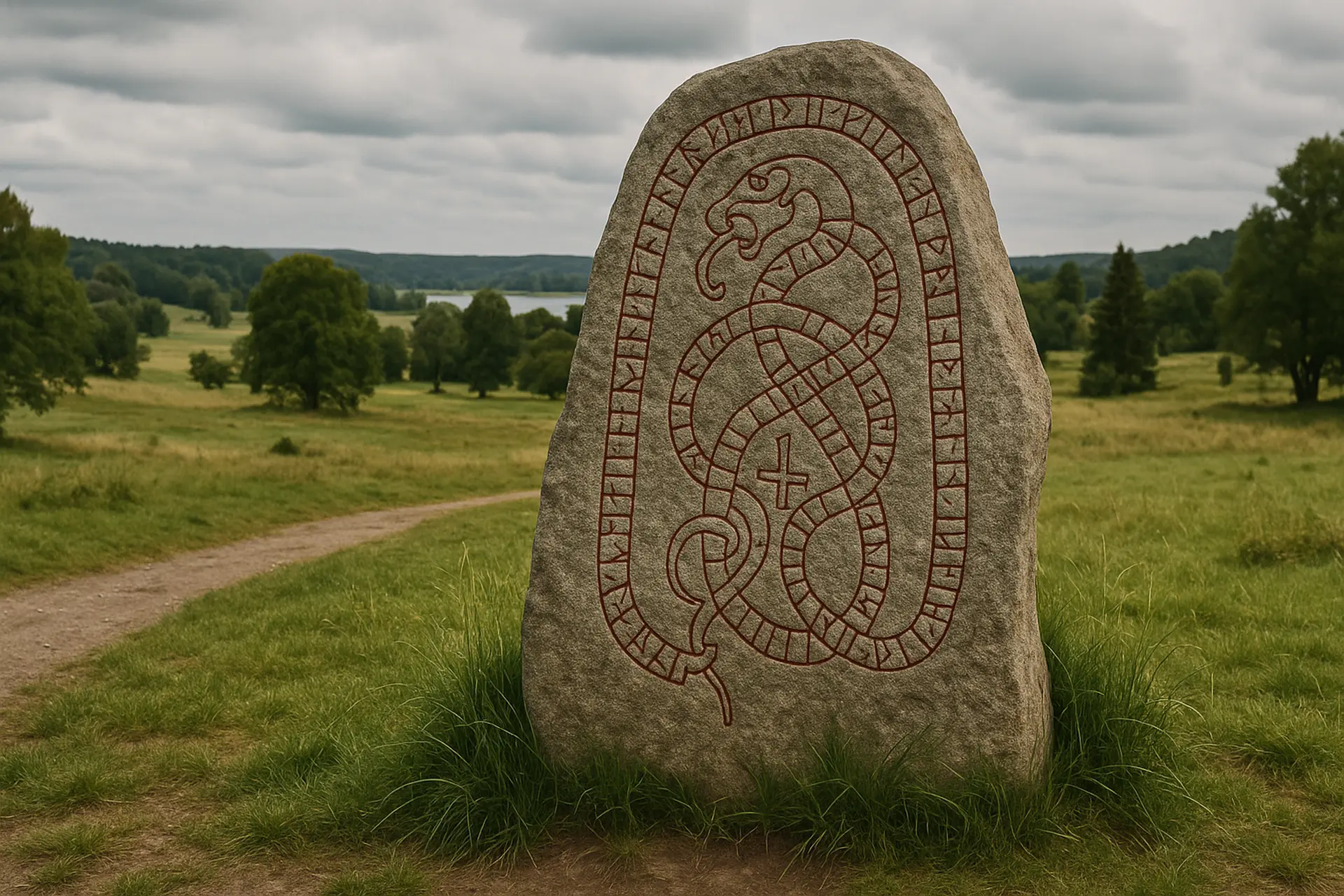
A runestone is fundamentally a raised stone slab inscribed with runic letters. In practice, the term applies to those carved mostly between about 800 and 1200 AD in Viking Age Scandinavia. Typical memorial runestones are granite (sometimes gneiss or sandstone) pillars 1–3 meters tall, set on a natural boulder or worked base. The text is cut into the stone, and originally the runes were often painted (red or black) to stand out. Many stones were coated with whitewash and decorated in bright colors – a vivid billboard of memory and status.
Runestones usually carry memorial inscriptions: “X had this stone raised in memory of Y, his [father/mother/brother]…”. They often stand by ancient roads, bridges or churchyards for maximum visibility. The National Museum of Denmark notes that rune stones were meant to be visible to travelers, often placed at roads or bridges. Indeed, many survivors are located roadside or in village centers. Churches occasionally contain runic fragments reused from older stones, a sign that these monuments were once plentiful.
Types
– Memorial runestones: The norm in Viking Scandinavia. These bear a carved inscription around decorative elements (like serpentine beasts or ropelike bands), often with a Christian cross or prayer on 11th-century stones.
– Picture stones: Found especially on Gotland (6th–12th c.), these are large slabs carved with mythic or daily-life scenes but no runic text. They serve a similar commemorative function but through imagery (e.g. gods, ships, warriors) rather than writing.
– Stave or cross stones: In some places, wooden or stone crosses or staves were inscribed. Examples include some early Christian stone crosses with runes (e.g. the Dynna stone in Norway). Surviving fragments suggest this was a minority practice.
A runestone should not be confused with a small amulet or runic-inscribed object (those exist, but are personal items). Here we focus on the standing stones. If you see a mossy granite slab with Old Norse inscriptions in Sweden, Denmark or Norway, you’ve likely found a Viking memorial stone.
Dates, scripts & language: Elder vs Younger Futhark
The runic alphabet on these stones changed over time. The Elder Futhark (24 runes) was used mainly before 800 AD. The vast majority of Scandinavian stones, however, are carved in the Younger Futhark (16 runes) – the Viking Age script. This meant fewer characters to express sounds, so context is needed to interpret some runes (e.g. one rune could stand for both u and o).
Chronologically, runestones appear from the late 8th or early 9th century, peaking in the 10th–11th centuries. By about 900 AD all inscriptions use Younger Futhark, and after ~1100 they taper off. For example, in Denmark the last known stone is c.1200. Over this period the Old Norse language also evolved, but since inscriptions use formulaic language (names, relationships, titles) we can generally transliterate and translate them accurately. Modern publications like the Rundata database provide a line-by-line transliteration, Old Norse text and English rendering for each stone. The main linguistic challenges are that medieval carvers often left out short vowels and used unconventional spellings, but those issues are well-understood by runologists.
After 1200 AD, runic writing in Scandinavia survives only in specialized forms (like Dalecarlian runes used rurally), so runestones capture essentially the end of a millennium-long tradition.
Who made runestones? Runemasters, carvers & workshops
Runestones were commissioned by prominent families (farm chieftains, warriors, rulers) and carved by runemasters – craftsmen who could both carve and write runes. By the 11th century runestone carving had professionalized somewhat. Inscriptions often record the carver’s name. For example, in Uppland we find many stones signed by famous runemasters: Balle (who signed 24 stones), Œpir (about 50 signed stones, and 100 more attributed), Åsmund, Visäte, Fot, and others. These craftsmen sometimes traveled; their names appear across regions.
Technically, raising and inscribing a stone was a multi-person effort. The patrons chose a suitable rock, hauled it upright (an engineering task), and then the runemaster carved it. Archaeological experiments confirm that stones were carved with iron chisels and hammers, in a three-step process: rough shaping, smoothing the face, and chiseling the rune lines. This is why the lettering is relatively shallow and regular. No pneumatic drills or power tools were available of course.
Patronage: Often a widow or son commissioned the stone (the inscription will say “so-and-so raised this in memory of her father,” for example). One Uppland stone (U 687) is noteworthy because it was raised by a woman for her husband, showing that women could honor kin this way. The stones therefore reflect local elite networks: wealthy families paid for them. The cost and effort suggest runestones were prestigious displays of memory and wealth.
What runic inscriptions say (formulae & translations)
Most runic texts follow a standard memorial formula. The typical inscription (in Old Norse) is something like: “X raised this stone in memory of Y, his [relationship].” For example, many Swedish stones begin “X let ræisa stein þennsa at Y, sun sinn” (“X had this stone raised in memory of Y, his son”). These records name the deceased, the sponsor, and the relationship. The stone may also include titles or deeds (“he was a good thegn,” “died in battle,” etc.). Often the last line of a Viking Christian stone invokes a prayer, e.g. “Guð hjalpi hans ande” (“May God help his spirit”), and a cross is carved prominently.
The inscriptions can usually be translated with precision by experts. Each rune is transliterated (converted to Latin letters), yielding an Old Norse text. Rundata entries for each stone give an English translation. For example, a translation might read: “Ragnvaldr had this stone raised in memory of Jôrundr, his brother. May God help his soul.” A few stones even include short poems or alliterative verses (the Karlevi stone’s stanza is famous). Some have curses warning against defacement.
Because the phrasing is so formulaic, most texts are straightforward. The main pitfalls are: wear on the stone can obscure letters, unusual spellings require scholarship, and the 16-rune alphabet forces creative spelling (like double letters or runes representing multiple sounds). But in practice any tourist reading a properly transliterated inscription will get the sense right. For example, the Simris runestone’s English notes at the site paraphrase: “Bjǫrngeirr raised this stone in memory of Hrafn, his brother; he was Gunnulfr’s thegn in Sweden”, showing how names and roles come through.
Styles, iconography and motifs
Runestones are also art. The carving style helps date them. Early (c.980–1015) stones are RAK style (plain text bands, no animal heads). Later 11th-century stones show elaborate animal forms: these are classed as Ringerike (Pr1–Pr2) and Urnes (Pr3–Pr5) styles. In Ringerike style, the runic band often ends in a beast’s head carved in profile; Urnes style has ultra-slim, intertwined serpents. Spotting these features helps date and connect stones to broader Viking art.
Common motifs on runestones include:
- Ships: A minority of stones show a Viking longship. Such images (with oars, shields, sometimes a mast or mast cross) likely symbolize voyages or funerary beliefs. Roughly 17 Swedish and 8 Danish runestones depict ships. See the 9th-century Södermanland stones for examples.
- Crosses: By the 11th century, Christian crosses appear on many stones (sometimes as a border or central symbol). For instance, Uppsala’s runestones often have a prominent cross carved in the field. This marks the deceased as Christian.
- Thor’s hammer (Mjölnir): Conversely, a few runestones display a hammer shape (or explicitly say “Thor hallowed these runes”). Five stones invoke Thor, and four or five even depict his hammer. Scholars interpret this as a pagan counterpoint to the cross.
- Masks or faces: Some stones (e.g. the Gren’s Mask Stone) feature a large carved human face or monster mask above the text. These may be protective symbols or artistic embellishments.
- Animals and dragons: Many stones use serpent or dragon figures as the rune-bands themselves. Interlaced beasts (wolves, serpents) and their heads appear, echoing carved metalwork of the era.
As one shifts gaze between runes and pictures on a stone, one reads a layer of cultural coding: e.g. a cross tells of the Christian faith, a masked face or twisted dragon recalls heathen myth. In short, stones were carefully “composed” – from the alphabet to the images – to convey status, belief and identity.
Famous runestones and their stories
What is the Rök runestone and why is it important?
Rök Runestone (Östergötland, Sweden – Rundata Ög 136). Erected c.800–850 AD, it bears the longest known runic inscription on any stone. Raised by a man named Varinn for his son (likely named Vámod), it contains about 760 runes of poetic lore. The text is famously cryptic – it mentions legendary figures (like King Theodoric) and mythic puzzles. Rök is often described as “the first piece of written Swedish literature”. Linguists and historians study it for what it reveals about Viking-age ideology.
Visiting: The Rök stone stands beside Rök Church near Ödeshög. Today it is protected under a wooden shelter to slow erosion. Visitors can walk around it (reading aids are posted). The stone’s several sides are carved, so you may need to move to see all runes. There is an information panel nearby with an English translation. For photography, it’s best lit in the morning or late afternoon.
What are the Jelling stones and why are they famous?
Jelling Stones (Jutland, Denmark – Rundata DR 41–42). Two massive stones from c.965 AD raised by King Harald Bluetooth. One (DR 41) declares: “King Harald ordered these runes to be made in memory of Gorm, his father, and Thyra, his mother… Harald who won for himself all of Denmark and Norway and made the Danes Christian.”. The smaller stone (DR 42) by Harald’s father simply commemorates Queen Thyra. These stones boldly proclaim the founding of the Danish kingdom and the conversion to Christianity. They’re often called Denmark’s “birth certificate.”
Visiting: The stones stand in the Jelling churchyard, part of a UNESCO World Heritage site. They are on open display and have translation plaques. Nearby is a visitor center on Viking kings. The stones are easy to photograph at eye level. The larger stone’s runes are clear; on sunny days use indirect light to reduce shadows. They are a must-see for Viking history, and every year thousands visit Jelling’s park to see Harald’s message.
Böksta Runestone (Uppland, Sweden – U 855)
Raised c.1050 AD near Uppsala, this stone is known for its vivid imagery. It portrays a hunting scene rather than serpentine bands: a mounted warrior spears an elk, accompanied by hunting dogs and a falcon (perhaps representing Odin’s birds). Another figure skis with a bow (possibly the god Ullr). The runic text is carved along a broad animal band at the left, dating it to around 1050.
Visiting: Found at Balingsta Church, south of Uppsala. It stands without enclosure by the roadside. The relief carvings are three-dimensional and best seen by circling the stone. The colors (dogs, elk) are still partially visible. There’s usually a sign with a brief translation. Time of day matters – side lighting reveals the relief depth.
Glavendrup Stone (Funen, Denmark – DR 209)
A 10th-century monument at Horne, near Faaborg. Inscribed by a woman Ragnhild for her husband. It contains 210 runes, Denmark’s longest text. The message includes poetic sections and invokes the god Thor: “Þórr gør ræisa þennsa runaʀ” (Thor hallow these runes). It ends with a curse on anyone who would destroy the stone – a rare example of Viking magical thinking on a memorial.
Visiting: The stone stands in a small fence at Horne Church on Funen. Signs provide the translation and explain the Thor invocation. It is well-exposed, so photograph midday or afternoon for best clarity. This is an iconic Danish runestone, showing the persistence of Norse religion in a Christian era. Nearby you can also see Viking Age museum exhibits in Odense.
Simris Runestone (Skåne, Sweden – DR 344)
An ~1050 AD stone from southern Sweden, notable for its text. Inscribed by Bjǫrngeirr for his brother Hrafn, it says Hrafn was “Gunnulfr’s thegn in Sweþiuþu” – one of the earliest rune-occurrences of the name Sweden. The style is Urnes (slender interlaced serpents).
Visiting: Located by Simris Churchyard on the coast (near Ystad). It was recovered from the church wall and set up outside. The runes are clear but weathered; a plaque at the site interprets “Sveþiuþu”. This stone draws historical interest for its mention of “Sverige.” Take a camera under soft light; morning works well here.
Tullstorp Stone (Skåne, Sweden – Sö 54)
Carved around 1000 AD at Tullstorp Church. This stone strikingly depicts a full Viking ship (shields on hull, mast, and large cross on its sail). The inscription reads “Þorulf·let·reisa·stain·þansi…”, identifying the carver Þorulfr. The Christian cross suggests 11th-c. faith, but the ship imagery is a proud Viking motif.
Visiting: It stands right by the road beside Tullstorp Church (near Malmö-Lund). No fence; you can approach it freely. An interpretive sign gives a short translation. Because it’s quite low to the ground, visit when the sun is on its face (afternoon or a bit before). The stone’s artwork makes it a highlight of Scania’s runestone circuit.
Erik’s Cross (Uppland, Sweden – U 1173)
A stone cross with runes, carved ~1050 AD. Located by Rönö Church, it memorializes Erik, son of Hjólmundi. The text (carved by runemaster Åsmund) runs around the cross arms and even marks Erik’s grave. This monument has one of the longer preserved inscriptions in Sweden.
Visiting: Found at a roadside turn (Rönövägen 1) near Skokloster. The cross-shape and runes are easily visible. An information plaque translates the Old Norse. It illustrates how runestones sometimes turned into carved crosses after conversion. Its convenience (by road) means even casual travelers often include it on Uppsala-area tours.
Jarlabanke’s Stones (Uppland, Sweden – e.g. U 127, U 140)
A set of closely-related inscriptions by chieftain Jarlabanke Ingefastsson in Täby/Vallentuna. One famous one boasts, “Jarlabanki erected this stone and made this causeway for his family’s inheritance in memory of himself,” essentially a self-commemoration (raising a second stone for the first). Others mark bridges and family lands; one forms part of a medieval church wall.
Visiting: These stones are clustered north of Stockholm. The Runriket trail (managed by Stockholm tourism) starts at Jarlabanke’s bridge. A self-guided loop with signposts passes by a dozen stones, including one inscribed by his wife and one by the runemaster Fot. The walk is through pine woods; bring a map (or Runkartan app).
Karlevi Runestone (Öland, Sweden – Öl 1)
A 10th-century Öland stone known for its Old Norse poem. Its runic text includes a stanza in fornyrðislag (an alliterative meter), purportedly spoken by a dying king. The imagery includes a sword and possibly a ship. It preserves one of the few complete Viking-age verses.
Visiting: Located just south of the Öland bridge near Karlevi church. It’s outdoors by a road; look for a small signpost. The stone leans slightly. English translation is usually posted. It’s an easy stop on a drive around the island.
Tune Stone (Akershus, Norway – N 65)
Carved ca.900 AD, this is Norway’s largest runestone. Found reused in a church, it names two men (Gulli and his brother) and invokes Thor. The language is distinctly Old Norse. It stands over 1.6 m tall.
Visiting: The Tune stone is in the Museum of Cultural History (University of Oslo). It’s indoors, behind glass (so lighting is controlled). This stone shows that Norway, like Sweden, had substantial stone carving – but most Norse stones were cut down or repurposed. If you’re in Oslo, the museum’s Viking hall is the place to see it.
Varangian, England & Greece runestones: Vikings abroad
A special category of runestones commemorate Norsemen who went overseas. England-runestones (about 30) say things like “He died in England” or “grew up in England”, reflecting Viking service in Anglo-Saxon armies. Similarly, about 29 runestones (often called Greece-runestones) mention journeys to “Greece” (medieval parlance for the Byzantine Empire) – these memorialize Scandinavians in the Varangian Guard. The Ingvar runestones (26 monuments in Sweden) tell of a 1040 AD expedition down the Volga/Caspian (“Serkland”). In short, these stones show Vikings in Byzantium, Kievan Rus’, England and the Islamic world. They serve as pieces of a Viking travelogue carved on home soil.
Examples: Uppsala has a cluster of “Greek” stones for men who died with the Greeks. If you visit Gamla Uppsala or Gotland, look for inscriptions that say “Hann fell i Austarla″ (fell in the East) or “He traveled with Yngvar in Serkland.” These are not separate categories but part of the larger corpus of Norse inscriptions. They demonstrate that the Viking diaspora left records from Scandinavia’s doorstep to far across Europe and Asia.
Dating, cataloguing & academic resources
- Dating & styles: Archaeologists date runestones by art style and language. The Gräslund system is used: RAK (c.980–1015), Pr1–Pr2 (Ringerike, c.1010–1050), Pr3–Pr5 (Urnes, c.1050–1130). If a stone has Urnes interlace with runes, it’s likely mid-11th century or later. If the runes are Latin-script transitional (like a dotted i or þ following Latin conventions), that also narrows the date. In some rare cases, stones found in dated archaeological layers give an absolute date.
- Rundata database: For research, the main tool is Rundata, an ongoing project cataloguing Nordic inscriptions. Each stone has an ID (e.g. U 489 for Uppland #489, DR 209 for Denmark). A Rundata entry provides the Old Norse transliteration, English translation and literature references. The database (online and in print volumes) lists over 6,500 inscriptions. It includes GPS coordinates, bibliographic citations, and comments.
- Corpora and guides: The definitive published references are the Sveriges runinskrifter volumes (Swedish) and Danmarks runeindskrifter. These give full scholarly editions. Handy modern books include The Viking Language (Jesch), Runes: Reading the Past (Sawyer), and museum guides. Websites (like runeberg.org/rundata) allow lookups. When citing, the best practice is to give the Rundata ID and a source (e.g., SRI, DR references). Tourists often rely on the English Rundata translations, but serious work should cite the academic editions or primary publications (usually listed in Rundata entries).
Conservation & protection of runestones
Runestones are nationally protected monuments. In Sweden and Denmark any removal or damage is illegal. Many important stones have been fenced or covered for conservation (the Rök stone’s roof is a prime example). Heritage agencies (Riksantikvarieämbetet in Sweden, NatMus in Denmark) monitor major sites. Preservation efforts include gentle cleaning of lichens or moss (though over-zealous scraping is avoided as it can harm patina) and controlling nearby vegetation. If a stone falls, experts document and re-erect it promptly.
Common threats are environmental: acid rain and road dust can settle in carvings, and freeze-thaw cycles slowly crack the rock. Tourists must follow signage: do not touch the carvings, climb on stones, or apply rubbings (which can lift grit into the grooves). If you notice a fallen or vandalized stone, report it to the local museum – any damage to such heritage is taken very seriously. Donation-funded projects have even added protective glass panels to some stones (though purists debate this). In practice, you’ll see many stones standing in open fields; treat them as fragile historical artifacts. By staying back, not chalking, and generally observing the site’s rules, visitors help ensure these millennial carvings endure.
How to visit runestones (travel planning & itineraries)
Yes – runestones are freely visitable, and many are even on well-traveled roads. Because stones are mostly on public land (roadsides, parks, churchyards), you can approach them freely. Legal/ethical: Always respect property rights – if a stone is in someone’s field, ask permission. Never remove fragments; by law in Scandinavia any found artifacts must be reported. Do not try to extract a buried piece even if you think it’s one. If visiting churchyards, dress respectfully and avoid loud behavior. Photography is generally allowed (no special permits needed unless doing a commercial shoot).
Sample itineraries: There are pre-planned routes. For instance:
- Stockholm–Runriket–Uppsala Loop (1 day): From Stockholm, drive or take the commuter train north to Vallentuna/Täby. Hike the Runriket trail (circling Vallentunasjön) to see about 100 stones. Then continue to Uppsala (20–30 min drive): visit the Gamla Uppsala Museum (it has a great runes exhibit) and then see a handful of stones around the old cathedral. Return via Sigtuna in the evening for more stones if time permits.
- Denmark (2 days): Day 1: Jutland – Jelling (view the big Harald stone), then move on to Aarhus or Viborg to find other Runestones in situ or in museums. Day 2: Funen – see the Glavendrup stone at Horne, and possibly stones in Odense. There are also stones along Bornholm’s coasts if you ferry there.
- Gotland (1 day): Rent a car on Visby, then drive the ring road: stop at Stora Hammars and Tängelgårda picture stones, Viklau stone (with three crosses), and Karlevi on Öland (reachable by bridge). The Gotland Museum in Visby has indoor runs.
- Norway (1 day): Because Norwegian runestones are museum pieces, a worthwhile loop is Oslo’s Viking Ship Museum + Historic Museum (see the Tune and Dynna stones). In between visit the Borre mound park (stone crosses).
Always wear walking shoes – many stones lie a few meters off the road in grass or woods. In summer, carry insect repellent and water. Outside major sites, there may not be cafes, so pack a picnic.
- Accessibility: Some sites are wheelchair-friendly. The Jelling Stones and park have level walkways. Gamla Uppsala Museum is accessible (ramps and indoor displays). However, many rural stones have uneven footing. If needed, consult local tourist offices: they often note accessibility (e.g. Stockholm’s Runriket trail is partly gravel). A safe approach is to stick to stones with nearby parking or those on pavement.
- By train or bus: In Sweden, commuter trains (Pendeltåg) run from Stockholm to Märsta/Uppsala; from those you can take local buses (e.g. to Vallentuna or Gamla Uppsala). Denmark’s regional trains stop at Jelling and Odense; connecting buses reach rural stones. On Gotland, regional buses operate seasonally. A car is usually most efficient, but public transit networks do reach most of the big sites.
- Practical tips: Check opening times – some museums close in winter. Summer’s long daylight is great, but autumn’s colors also look nice on stones. Many stones have no lights, so plan to visit before dusk. Use the Rundata coordinates (available online) in a GPS app for remote stones. Lastly, respect any posted ropes or barriers – they protect fragile carvings.
Tools for the field: maps, apps, photography tips
- Maps & Apps: The Runestone Map (Runkartan) by Uppsala tourism is excellent. It pinpoints all Uppland stones (with descriptions) and is available online/mobile. Swedish Fornsök and Danish heritage apps similarly list rune sites by region. Google Maps has markers for major stones (search “Runestone [region]”). Tourist info centers often provide printed rune-trail maps (e.g. Stockholm’s Viking Walk brochure, or Gotland’s Runic Road).
- Navigation: Download KML tracks of runestones (some heritage sites offer these). Physical guidebooks list Rundata numbers – if you have a smartphone, look up the Rundata entry for extra detail. Some stones are on hiking trails with signposts (Runriket signs look like a tortoise).
- Photography: The key is light: avoid harsh midday sun that washes out carvings. Early morning or late afternoon (side-lighting) brings out the shadows in the lettering. A portable LED light or phone flashlight can be used at dusk to highlight runes (many sites allow casual photography). A polarizing filter can reduce glare on wet stone. You generally do not need a permit to photograph these outdoor sites for personal use. If using a drone, check local aviation rules (most Nordic countries restrict drone flights above people or near heritage sites).
- Gear: If you plan to rub inscriptions (allowed in museums but discouraged on standing stones), bring only paper and soft charcoal. Always get permission if in doubt. Carry a small tape measure to record stone dimensions (some heritage maps list the height and width for reference).
Museums, replicas & where to see runestones indoors
Several museums display runestones or replicas:
- Gamla Uppsala Museum (Sweden): A highlight for runes. It houses original rune stones and fragments found in Uppland. Its interactive exhibits let visitors practice transliteration and even carve a “mock runestone.” It’s a fun stop especially for families.
- Swedish History Museum (Stockholm): In its Viking gallery you’ll find rune-related artifacts; occasionally runestone panels are loaned here.
- National Museum of Denmark (Copenhagen): Houses Viking artifacts including rune-inscribed objects (amulets, pieces of runic slabs). The Harald Bluetooth exhibit includes a copy of the Jelling inscription and related finds. Entrance is free.
- Local museums: Many local heritage museums have rune stone displays. For example, Vallentuna Museum (Stockholm area) has a “Runar” exhibition about Runriket, Gotland Museum (Visby) has a large rune/picture stone section, and Bergen Historical Museum shows the Eggja runestone. The Nordic Museum in Stockholm often has rune facsimile exhibits.
- Replicas: Some famous stones have casts abroad. The British Museum and Nationalmuseet (Copenhagen) once displayed a facsimile of Denmark’s Golden Horn runes (found inscriptions). You’ll see runic alphabets and charts in many Nordic ethnographic museums.
If you can’t travel to a stone’s location, finding the stone in a museum (or a high-quality cast) is a great alternative. For example, Oslo’s Museum of Cultural History has both the Tune and Dynna inscriptions.
Authenticity & spotting fakes
Genuine Viking runestones are easily distinguished by their age. Authentic stones show centuries of weathering, surface lichen, and carving style consistent with medieval iron chisels. In Scandinavia, virtually no new runestone “discoveries” occur – all known stones were catalogued by the 19th–20th centuries. Hoaxes are rare. For example, the infamous Kensington Rune Stone (Minnesota, 1898) and others like it are universally deemed modern forgeries due to anachronisms and fresh carving.
If an alleged new stone appeared, experts would check: does the language match Old Norse grammar? Are the runes carved by ancient techniques (profiled chiseling) or modern tools? A tip: newly carved runes look too sharp and black; over a century old runes are dulled and have microcracks. Always view an “unknown” stone with skepticism, and when in doubt, consult an academic. But for typical travel purposes, all roadside Scandinavian stones are accepted as genuine Viking-Age monuments.
Where can I learn runes and read them myself?
Many resources exist for beginners. Museums: Gamla Uppsala’s exhibit guides you through rune alphabets and even lets you carve an example. Books & courses: Popular introductions (like Elmevik’s Runskriftens hemlighet) teach the Younger Futhark alphabet. Universities and historical societies sometimes offer short courses on runology. Online: The Scandinavia Runic-text Database (Rundata) has a guide to the runic alphabet. Websites like Omniglot list the runes in chart form.
A practical method: memorize the 16 Younger Futhark characters and their sounds. Then take a short runic text (from Rundata or a book) and try to transliterate it back to Old Norse. Forums and Wikipedia entries can help correct you. Remember that rune carving skips some vowels; practice helps. Many travelers find it rewarding to “decode” a simple memorial line or name while viewing a stone. In sum, learning runes is quite doable with online charts and a bit of practice.