

Sacred institutions in a high-altitude landscape
The Monasteries of Tibet: History, Pilgrimage and Responsible Visiting
Tibet’s monasteries are places of worship, learning, memory and contested history—not monuments waiting silently for a tourist itinerary.
Eight major sites receive independent profiles, framed by lineages, visitor etiquette, high-altitude health and the realities of regulated access.
A monastery in Tibet is rarely just one building. It can be an assembly hall, a college, a library, a treasury, a residence, a pilgrimage destination and a landscape of paths used for circumambulation. The architecture holds ritual movement: thresholds slow the body, courtyards gather communities, chapels concentrate attention, and roofs open toward mountains and sky. Even when visitor numbers are high, the deepest rhythm belongs to worshippers, monastics and staff whose relationship with the site is continuous rather than episodic.
The great institutions around Lhasa, Shigatse, the Yarlung Valley and Everest also carry political history. Monastic schools helped shape Tibetan philosophy, art, education and government. Patronage created immense complexes and collections; upheaval damaged or transformed many of them; restoration has returned buildings to use while raising difficult questions about conservation, religious life and interpretation. A responsible guide acknowledges these layers without turning a sacred place into a backdrop for simplified romance.
Travel is operationally complex. Access to the Tibet Autonomous Region is regulated, foreign visitors may require special permission and organized arrangements, and authorities can alter access with little notice. Elevation adds a second constraint: Lhasa is already high enough for rapid arrival to affect healthy travelers, while routes toward Rongbuk climb much higher. The itinerary should therefore be designed around acclimatization, lawful permits and respectful observation rather than the maximum number of monasteries that can be photographed in a week.
Before the route
How to Read a Tibetan Monastery
Names, lineages, architecture and ritual movement reveal more than a checklist of famous halls.
Tibetan Buddhism contains several major schools, each with its own transmission histories, institutions and emphases. Nyingma traditions look to early translations and figures associated with Buddhism's establishment in Tibet. Kagyu lineages are strongly associated with teacher-to-student transmission and meditative practice. Sakya institutions developed scholastic and political influence from their base in central Tibet. The Gelug school, founded through the reform movement of Tsongkhapa and his disciples, established the great seats of Ganden, Drepung and Sera and later became deeply connected with the Dalai Lama institution.
These labels orient a visitor, but they do not reduce a monastery to one doctrine. Large complexes accumulated chapels, colleges, protectors, artistic commissions and regional relationships across centuries. A single hall may contain imagery connected with multiple teaching cycles. The same site can be understood as a living institution, an architectural ensemble, a repository of objects, a political actor and a destination within pilgrimage geography. Good interpretation allows those identities to overlap rather than forcing one definitive meaning.
The Tibetan term commonly rendered as gompa can refer broadly to a place of meditation, learning or monastic life. Within a complex, the dukhang or assembly hall often provides the ceremonial center. Colleges organize specialized study. Chortens hold relic associations and mark sacred space. Prayer wheels, incense burners, murals, thangkas and sculptural programs are not decorative accessories; they participate in religious practice and teaching. A visitor gains more by understanding one iconographic relationship than by collecting dozens of unexplained images.
Movement matters. Pilgrims usually perform kora—circumambulation—clockwise around sacred objects or sites in Tibetan Buddhist contexts. The route may be a compact circuit around a temple or a demanding path across a hillside. Visitors should follow local flow, avoid blocking prostrating pilgrims and never assume that an apparently empty threshold or platform is available for posing. The correct direction and behavior should be confirmed on site because spaces can have specific rules.
Sound and smell are part of the encounter: low chanting, handbells, long horns, the clap of monastic debate, butter lamps and juniper smoke. Tourism often privileges the camera, yet the camera can narrow attention. Spend time observing without recording. Notice how worshippers enter, where they pause, how offerings are made and which areas remain private. This is not passive consumption; it is a discipline of allowing the place to set the pace.
Historical interpretation requires care. Monasteries experienced periods of patronage, rivalry, destruction, restriction, reconstruction and changing religious practice. Accounts can differ sharply depending on source and political perspective. Rather than compressing this history into a sentence about timeless spirituality or a single moment of loss, readers should consult museum, heritage and scholarly sources and remain attentive to what guides, residents and religious practitioners are permitted or willing to discuss.
Four major schools as a first orientation
Early translation traditions
Closely associated with the early transmission of Buddhism to Tibet and the foundational story of Samye.
Transmission and meditation
A family of lineages known for strong teacher-disciple transmission and contemplative traditions.
Scholarship and historic power
Centered historically on Sakya and influential in Tibetan intellectual and political history.
Monastic universities
The school of Ganden, Drepung and Sera, with a major later role in education and governance.
Lhasa · UNESCO World Heritage ensemble
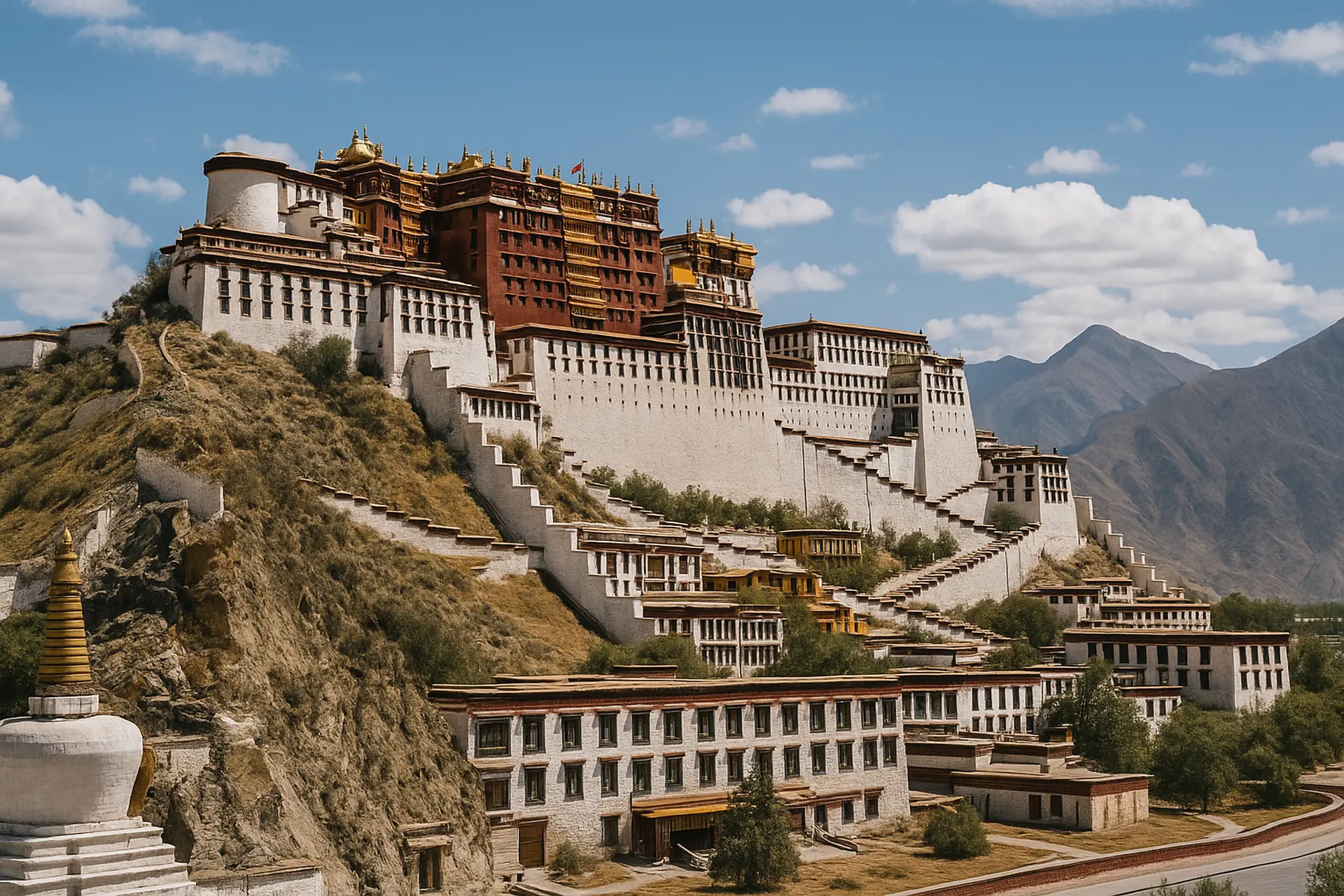
Potala Palace
Rising above Lhasa on Red Mountain, the Potala is both an architectural masterpiece and a concentrated symbol of the historical union of religious and temporal authority.
Best understood as: a palace-fort and sacred complex whose meaning extends beyond its panoramic façade.
What to notice
How architecture joined political and religious authority
The Potala dominates Lhasa so completely that first-time visitors can mistake visual recognition for understanding. Its white and red masses rise in stepped layers along Red Mountain, combining defensive weight with ceremonial elevation. UNESCO's World Heritage description emphasizes the ensemble's architectural originality and its symbolic role in Tibetan Buddhism and traditional administration. The building is not simply a monastery, nor simply a palace: it gathered residence, government, chapels, tombs, storage and ritual authority in one vertical complex.
The site's associations reach back to the seventh-century Tibetan empire, while the monumental form seen today is strongly connected with construction under the Fifth Dalai Lama in the seventeenth century and later additions. The White Palace contained administrative and residential functions; the Red Palace concentrated religious spaces and funerary monuments. That division is useful, but the experience is more intricate: stairs, narrow corridors, courtyards and richly furnished chapels create a sequence in which political and sacred histories remain intertwined.
Inside, the volume of material can overwhelm. Murals, manuscripts, statues, ritual objects and architectural details compete for attention in rooms where movement may be controlled and time limited. It helps to choose a few interpretive anchors in advance: the role of the Dalai Lama institution, the relationship between White and Red Palaces, the purpose of a stupa tomb, and the significance of the wider World Heritage ensemble that also includes Jokhang Temple and Norbulingka. A guided explanation can be valuable when it identifies objects without turning devotion into spectacle.
The climb is physically meaningful at Lhasa's elevation. Visitors should not race the stairs, especially during the first days after arrival. Move slowly, use handrails where permitted, avoid crowding narrow passages and tell the guide promptly if symptoms develop. The high-altitude setting is part of the architecture's drama, but it also reduces the margin for an overpacked schedule. A rushed visit often yields less understanding and more physical strain.
Operational rules can include timed entry, identity checks, controlled routes, limits on what may be carried and strict photography restrictions. These are precisely the details that should be rechecked rather than frozen into a permanent article. The respectful default is that interior photography is not allowed unless a current sign or authorized guide clearly says otherwise. Do not use flash, touch paintings or rest objects against historic surfaces. The palace deserves attention beyond the moment when it appears in the viewfinder.
Lhasa old city · UNESCO World Heritage ensemble
Jokhang Temple
At the center of Lhasa’s old city, Jokhang is encountered through the movement of pilgrims as much as through its architecture and celebrated sacred image.
Best understood as: a living pilgrimage heart whose surrounding Barkhor circuit is inseparable from the visit.

What to notice
The temple and the living circuit around it
Jokhang Temple stands at the spiritual center of Lhasa's old city. UNESCO describes it as an exceptional Buddhist religious complex founded in the seventh century and notes the blend of Tibetan, Chinese, Indian and Nepalese influences in the wider heritage ensemble. For pilgrims, however, its importance cannot be contained in architectural analysis. The temple is a destination of devotion associated with the Jowo Shakyamuni image, and the approach through the Barkhor is animated by circumambulation, offerings and repeated bodily practice.
The exterior can appear modest beside the Potala, which makes the transition inward more powerful. Courtyard, entrance porch and halls compress movement and attention. Rooflines and gilded details open occasional views across the old city, while interior spaces gather centuries of artistic and ritual meaning. A visitor should not expect every significant object to be visible or easily explained. Sacred value is not arranged according to museum display logic, and crowded conditions may allow only a brief passage.
The Barkhor circuit provides essential context. Pilgrims move clockwise around the temple, some walking with prayer wheels and others performing full-body prostrations. Join the flow without overtaking aggressively, stopping suddenly or standing in the path for portraits. Shops and stalls make the area lively, but commerce does not turn the circuit into an ordinary shopping street. The coexistence of trade and devotion is historic; the visitor's task is to recognize when browsing gives way to sacred movement.
Photography requires restraint even outside. A close image of a prostrating pilgrim can be intrusive when taken without consent. Telephoto distance does not solve the ethical issue. Seek permission for identifiable portraits, accept refusal immediately and avoid treating devotional intensity as exotic content. Inside the temple, follow current posted rules and the instructions of staff. Put the camera away before being asked when the situation is ambiguous.
Jokhang rewards return. One visit can focus on the temple interior, another on the Barkhor at a quieter hour, and another on the relationship between the old city's lanes and the sacred circuit. Repetition makes it easier to see that pilgrimage is not a performance scheduled for tourists. It is an ongoing use of urban space that gives the monument life.
Lhasa outskirts · Gelug tradition
Drepung Monastery
Once one of the largest monastic universities in the Tibetan world, Drepung spreads across a hillside like a dense white settlement of colleges, halls and courtyards.
Best understood as: a campus whose scale reflects the historic reach of Gelug scholastic life.

What to notice
A monastery organized at the scale of a town
Drepung lies west of central Lhasa, its white buildings clustered against the slope in a pattern often compared to a heap of rice. Founded in the early fifteenth century by Jamyang Chöjé, a disciple of Tsongkhapa, it became one of the great Gelug seats. At its height it supported a population on the scale of a town and played an important role in education and the early history of the Dalai Lamas. Those numbers should be treated as historical estimates rather than a spectacle; the significant point is institutional scale.
A campus approach helps the layout make sense. The main assembly hall, monastic colleges, residences, chapels, kitchens and storage spaces served different communities and functions. Moving between them involves inclines, steps and courtyards, so the visit is both intellectual and physical. A guide who can explain the colleges and their relationship to the larger monastery is more useful than one who simply names statues at speed.
Drepung's art and architecture also bear the marks of disruption and reconstruction. Twentieth-century damage, changing monastic life and restoration have altered what survives and how it is presented. Avoid the easy language of an untouched ancient world. New paint, repaired roofs and active maintenance are evidence that heritage is being managed in the present. The important questions concern what was conserved, what was rebuilt, who uses the space now and how religious and visitor needs are balanced.
The monastery is closely associated with the Shoton festival and the display of a large thangka on the hillside. Festival dates and visitor access must be checked for the current year, and attendance should not be treated as guaranteed. Large crowds change transport, security and the experience of worship. If visiting during a major event, follow local crowd management, avoid pressing toward ritual areas and accept that the best view may belong to pilgrims who have come for religious reasons.
Even on an ordinary day, allow enough time to sit in a courtyard and understand the topography. Looking back toward the Lhasa valley reveals why the monastery feels connected to the city yet distinct from it. The view is not merely picturesque; it shows how a scholastic institution occupied a strategic and symbolic landscape beyond the urban center.
One of the three great Gelug seats associated with Lhasa.
Colleges, halls and residences matter more than any single façade.
Plan for steps, inclines and high-altitude pacing.
Dates and public access must be rechecked for the current year.
Lhasa outskirts · Gelug tradition
Sera Monastery
Sera is known internationally for monastic debate, but the clapping courtyard makes sense only within a wider system of disciplined study, reasoning and community life.
Best understood as: a scholarly institution where debate is method rather than performance.

What to notice
The logic behind the famous clap
Sera was founded in the early fifteenth century by Jamchen Chöjé, another disciple of Tsongkhapa, and became one of the major Gelug monastic universities. Its name is associated with the landscape in different traditional explanations, but the visitor's most immediate impression is architectural: white walls, dark window surrounds, courtyards and assembly spaces set beneath the mountains north of Lhasa. The complex rewards a route that includes chapels and colleges rather than rushing directly to the debate courtyard.
Monastic debate attracts attention because it is physically vivid. A standing questioner may punctuate arguments with a clap and decisive movement while a seated respondent answers. The gestures follow conventions and support a rigorous process of testing definitions, consequences and scriptural interpretation. They are not improvised martial choreography and should not be described as monks arguing for tourist entertainment. The courtyard is a classroom whose method happens to be visually dramatic.
Whether visitors can observe debate, at what time and from which area is an operational detail that may change. A guide should confirm current arrangements. When observation is permitted, remain within designated zones, silence devices and avoid moving for a better angle during an exchange. Photography may be restricted or inappropriate even if many other visitors are holding cameras. The fact that a practice is visible does not remove the participants' claim to concentration and dignity.
Elsewhere in Sera, murals, images and assembly spaces provide a quieter account of institutional life. Look for the relationship between main paths and college entrances, the way courtyards manage groups, and the contrast between sunlit exterior surfaces and dark interior chapels. Give the eyes time to adjust rather than using a flash. In active rooms, stand aside from offerings and do not occupy seats or thresholds without guidance.
Sera's popularity makes visitor behavior especially important. A large crowd can turn education into spectacle through noise, close-up filming and applause-like reactions. The more famous the debate becomes, the more disciplined observation should be. Understanding one logical exchange through a knowledgeable interpreter is more meaningful than returning with dozens of anonymous portraits.
Dagzê area near Lhasa · Gelug foundation
Ganden Monastery
Founded by Tsongkhapa, Ganden carries the origin story of the Gelug school in a mountain setting that makes landscape, reconstruction and lineage inseparable.
Best understood as: a foundational monastery whose remote-feeling site invites slower historical reflection.

What to notice
Lineage, loss and reconstruction on the ridge
Ganden was founded in 1409 by Tsongkhapa and became the mother monastery of the Gelug school. Its name and institutional role are closely tied to the Ganden Tripa, the holder of the school's senior scholarly office. Unlike a site understood mainly through a single sacred image or palace façade, Ganden is best approached through foundation: why Tsongkhapa's reform movement mattered, how monastic discipline and scholarship were organized, and how the institution shaped later Tibetan Buddhist history.
The monastery occupies a high ridge east of Lhasa, with roads and paths revealing broad views across the valley. The journey can feel more remote than the map suggests, and weather may change quickly. This setting is central to the experience, but it increases the importance of lawful transport, realistic timing and altitude awareness. Do not combine the visit with a demanding walk simply because the air is clear and the landscape appears gentle.
Ganden suffered extensive destruction in the twentieth century and has undergone substantial reconstruction. That history should be visible in the language of the guide. Rebuilt halls are not 'fake,' nor are they identical to what was lost. Reconstruction can restore religious function, recover spatial relationships and transmit craft, while also creating new material histories. Ask what survives, what has been recreated and how current communities use the restored spaces.
A kora route around the monastery and nearby ridge is often discussed as part of the visit, but its condition, accessibility and suitability must be assessed locally. Follow the established direction, remain on the path, and avoid shortcuts that erode the slope or intrude on restricted areas. Prayer flags and small sacred features should not be rearranged for photographs. The mountain circuit belongs to a religious landscape, not an adventure obstacle course.
Ganden's relative distance can encourage a reflective pace that is harder to maintain at central Lhasa sites. Allow silence. Look at how buildings occupy the ridge, how rebuilt surfaces meet older fragments, and how the valley opens beyond the complex. The monastery's importance lies not in being more photogenic than Drepung or Sera, but in representing the institutional beginning from which their Gelug scholastic world developed.
Yarlung Tsangpo region · foundational Buddhist history
Samye Monastery
Samye’s traditional status as Tibet’s first monastery gives its mandala-inspired plan an importance that is architectural, historical and mythic at once.
Best understood as: a foundational sacred landscape connected with the formal establishment of Buddhism in Tibet.

What to notice
A cosmological idea built as a monastery
Samye is traditionally described as the first Buddhist monastery established in Tibet, founded in the eighth century during the reign of Trisong Detsen and associated with Shantarakshita and Padmasambhava. The story marks a decisive moment in the institutional establishment of Buddhism and the formation of translation and monastic traditions. Historical narrative and sacred biography are intertwined here, so a guide should indicate when an account belongs to tradition rather than presenting every episode as modern documentary fact.
The complex is often explained as a three-dimensional mandala, with the central temple representing Mount Meru and surrounding structures corresponding to elements of Buddhist cosmology. This makes orientation essential. A visitor who sees only the main building misses the conceptual relationship that organizes the site. Begin with a plan, identify the central axis and then observe how walls, subsidiary temples and directional elements produce a world model at architectural scale.
Samye also broadens the route beyond the Gelug institutions around Lhasa. Its associations reach into early translation history and Nyingma tradition, reminding the visitor that Tibetan Buddhist heritage cannot be reduced to the later political prominence of one school. Art and architecture at the site reflect periods of change, repair and influence from several cultural regions. Look for variation rather than expecting a single pure style.
Reaching Samye requires more travel time and exposes the itinerary to road, permit and regional-access changes. It should not be treated as a rushed add-on between Lhasa highlights. A lawful operator should confirm routing and current site conditions. Build a day that leaves room for the landscape and for delays, and avoid using a remote location as permission to disregard photography or access rules.
The most meaningful experience comes from holding the plan and the living site together. Cosmological interpretation can become abstract if it ignores worshippers and monastic use; everyday observation can miss the extraordinary intellectual ambition of building a mandala as a place. Samye asks the visitor to move between those scales—from a butter lamp or painted detail to an entire sacred universe organized in space.
Associated with the institutional establishment of Buddhism in Tibet.
Royal, monastic and tantric dimensions meet in Samye's founding narratives.
The arrangement among buildings is a primary interpretive key.
Current permits, roads and access should be reconfirmed.
Shigatse · Gelug tradition
Tashilhunpo Monastery
Tashilhunpo is a major monastic city and the traditional seat associated with the Panchen Lama lineage, combining monumental ritual spaces with the history of Shigatse.
Best understood as: an institution whose scale and lineage are central to the identity of Tibet’s second major urban center.

What to notice
Lineage and monumental space at urban scale
Tashilhunpo was founded in the fifteenth century by Gendun Drup, later recognized as the First Dalai Lama, and became closely associated with the Panchen Lama lineage. It occupies a commanding place in Shigatse, where monastic walls, golden roofs and large halls create the impression of a city within the city. The relationship between institution and urban setting is important: Tashilhunpo is not a remote hermitage but a center historically connected with regional authority, scholarship, pilgrimage and economic life.
The complex contains major assembly and devotional spaces, including a monumental Maitreya image and funerary stupas associated with Panchen Lamas. These objects attract superlatives, but measurements and rankings are less useful than function. Maitreya represents the future Buddha and structures a devotional encounter at a scale designed to transform bodily perspective. Stupa chapels connect lineage memory, precious materials and ritual space. A guide should explain how visitors and pilgrims engage with them, not only how large or valuable they are.
Tashilhunpo's courtyards and passages can absorb a long visit. Follow a coherent route rather than darting between famous rooms. Notice the transition from public gathering space to darker chapels, the role of roofs and walls in organizing processions, and the way the monastery's mass sits against the hills behind Shigatse. The whole complex reveals institutional hierarchy through architecture.
The Panchen Lama institution is historically and politically sensitive. A travel article should avoid reducing complex religious and political questions to gossip or using guides as sources for conversations that may place them in difficulty. It is possible to explain the historical association of the monastery with the lineage while recognizing that contemporary circumstances are contested and that public discussion can be constrained.
Shigatse is also higher than many travelers' home environments and often comes after road travel from Lhasa. Fatigue can accumulate even when acclimatization appears to be going well. Keep the monastery visit flexible, hydrate normally, avoid excessive exertion and leave time for rest. A respectful itinerary treats physical limits as part of responsible presence rather than an inconvenience that must be defeated.
Everest north side · extreme altitude
Rongbuk Monastery
Rongbuk’s power comes from the meeting of monastic life, a severe high-altitude valley and the north face of Everest—but the setting demands conservative planning.
Best understood as: a remote religious site in an extreme environment, not merely a foreground for a mountain photograph.

What to notice
The mountain is context, not possession
Rongbuk lies in the valley north of Everest, in a landscape where scale becomes difficult to judge. Monastery buildings, prayer flags and stone walls appear small against glaciers, ridges and the mountain's vast upper structure. This visual relationship has made Rongbuk one of the most recognizable remote monasteries in Tibet. Yet the site should not be reduced to an Everest viewpoint. It has its own religious history, associations with meditation sites and a community whose presence gives the valley meaning beyond mountaineering.
Elevation is the dominant practical fact. Exact figures vary by reference and location within the area, but Rongbuk is far higher than Lhasa and belongs to an altitude range where serious illness can develop. The CDC emphasizes that risk is shaped by rate of ascent and individual susceptibility, not fitness alone. A route should progress gradually, include acclimatization and maintain a clear plan for descent and medical help. Anyone with concerning symptoms should follow qualified guidance rather than trying to complete the itinerary.
The road and permit environment can also change. Access to the Everest region may depend on multiple authorizations, registered transport and current security or weather conditions. A photograph on social media is not evidence that the same route is open today. Use a reputable operator, confirm what accommodation and emergency support actually exist, and carry realistic expectations about delays. Remote travel at altitude punishes schedules built around certainty.
At the monastery, avoid treating every resident as part of an expedition narrative. Ask before photographing people, do not fly drones without explicit legal authorization, and keep noise low. Prayer flags, mani stones and small structures are sacred features, not props to be moved or climbed. The wind and openness can make a visitor feel alone even when others are nearby; that sensation should encourage humility rather than staged conquest.
A successful visit may be shorter than expected. Weather can hide Everest, fatigue can narrow attention, and the body may need rest more than the itinerary needs completion. The monastery offers a different measure of value: presence in a landscape where human ambition, religious practice and environmental limits are visible together. Leaving early when conditions require it is consistent with that lesson.
A broader sacred map
Beyond the Eight Profiled Sites
Several important monasteries deepen the story of Tibetan Buddhism, but they should be added only when route, access and editorial space allow proper treatment.
Sakya Monastery is central to the history of the Sakya school and is known for its distinctive architecture and major collections. Pelkor Chöde and the Gyantse Kumbum present a different relationship between monastery, fortified town and a multi-level structure filled with chapels and imagery. Reting is associated with important religious and political histories in a wooded setting north of Lhasa. Drigung Til represents a major Drikung Kagyu institution, while Tidrum is known for its nunnery and hot-spring landscape.
These places should not be squeezed into a route merely to increase a monastery count. Each requires context, current access confirmation and enough time to distinguish it from the sites already profiled. The value of a broader itinerary lies in seeing different schools, landscapes and institutional forms. It disappears when every stop becomes another dark chapel, golden roof and hurried photograph.
A specialist operator can help determine what is realistically open and meaningful for the season. The editorial rule should match the travel rule: add a place only when it can receive independent attention. Otherwise, acknowledge it as part of the wider sacred geography and leave it for a future journey.
Five directions for a later, deeper journey
Sakya Monastery
A major seat of the Sakya school with distinctive historical, architectural and textual importance.
Pelkor Chöde and the Kumbum
A monastery and monumental multi-level structure best understood within Gyantse’s larger historic landscape.
Reting Monastery
A site associated with Gelug history and a notable natural setting; access must be checked.
Drigung Til
A significant Drikung Kagyu institution whose remote route deserves dedicated planning.
Tidrum Nunnery
A nunnery and pilgrimage landscape that can broaden an itinerary beyond male monastic institutions.
Respect in practice
Etiquette, Photography and Offerings
Respect is visible in small decisions: direction of movement, where the body stands, when the camera stays away and how money is offered.
Dress for a place of worship and a variable high-altitude climate. Shoulders and legs should be reasonably covered, hats removed when local custom or signs indicate, and sunglasses taken off during direct interaction when practical. Layers are more useful than a single heavy garment because sun, shade and interiors differ sharply. Footwear should be stable for stairs without being so cumbersome that it scrapes thresholds or encourages sitting on sacred architecture.
Follow clockwise movement where that is the local practice, but do not imitate gestures without understanding them. A visitor does not need to spin every prayer wheel, touch every object or perform a prostration to prove respect. Observation can be more respectful than copying. Never step over a person, religious text, offering or ritual implement. Do not point feet toward altars when seated, and avoid touching heads, statues, murals or manuscripts.
Photography should be governed by permission rather than opportunity. Signs may vary by room, and a paid camera fee at one site does not imply permission everywhere. Flash can harm sensitive materials and disturb worship. Tripods block circulation. Drones raise legal, security, privacy and religious concerns and should never be used without explicit authorization from every relevant authority. When people are identifiable, consent matters even in a public courtyard.
Offerings and donations should use the channels provided by the institution. Small notes may be placed where guides or signs indicate; larger support should go through an official office when possible. Do not hand sweets, money or objects to children in a way that encourages begging or disrupts family and community norms. Buying from legitimate local businesses can complement donations, but neither purchase nor donation buys access to private ritual space.
Conversation requires the same restraint. Ask guides about architecture, lineage, festivals and permitted daily practice. Do not pressure monastics for personal opinions, political statements or private photographs. Translation may simplify complex terms, and silence may reflect privacy or constraint rather than lack of knowledge. A respectful traveler leaves room for what is not available to be consumed.
Pause at the entrance
Read signs, silence devices and observe the direction and behavior of local worshippers.
Ask before recording
Treat photography, audio, video and portraits as permission-based activities.
Keep circulation clear
Do not block thresholds, kora routes, debate areas, prostrations or offering points.
Use official donation channels
Follow site guidance and avoid turning generosity into access pressure.
Leave private life private
Accept closed doors, unanswered questions and spaces reserved for religious use.
Practical planning
Permits, Altitude and an Itinerary That Can Breathe
The strongest route is not the longest; it is the one that remains lawful, physically conservative and spacious enough for understanding.
Foreign travel to the Tibet Autonomous Region can involve a China entry document or current visa-free eligibility, a separate regional permit, an organized itinerary and additional permissions for some routes. Requirements depend on nationality, purpose, date and destination, and authorities may suspend permits or close areas. The correct workflow is to consult current official travel advice, a reputable specialist operator and the relevant diplomatic or immigration authority before buying non-refundable connections.
Altitude should shape the sequence. Rapid arrival in Lhasa exposes the body immediately to reduced oxygen pressure. The CDC recommends gradual ascent when possible and warns that individual susceptibility is variable. The first days should avoid strenuous stair climbing, alcohol excess and packed dawn-to-night touring. Symptoms that worsen at rest, severe headache, confusion, loss of coordination or breathing difficulty require urgent attention and may demand descent; readers should learn current medical guidance before travel.
A sensible cultural route might begin with low-intensity orientation in Lhasa, then introduce Jokhang and the Barkhor, followed by Potala or one of the nearby great monasteries when the traveler is responding well. Drepung and Sera can be separated rather than compressed into one frantic day. Ganden deserves its own weather and transport margin. Shigatse and Tashilhunpo can follow gradual acclimatization, while Rongbuk belongs late in the journey and should remain conditional on health and access.
Samye requires a different geographic commitment and can anchor a Yarlung-focused extension. The point is not to prescribe a universal itinerary but to demonstrate sequencing: cultural density and elevation both accumulate. Rest days, shorter visits and repeated time in one neighborhood often improve the journey more than adding a remote monastery. A guide who is willing to remove a stop may be more responsible than one who promises every headline site.
Insurance should explicitly address high-altitude travel, medical evacuation, itinerary changes and the activities planned. Emergency support can be limited outside urban centers. Carry essential medication in original packaging, follow current entry rules, and bring copies of prescriptions. These preparations are not signs that the trip is unsafe by definition; they are the infrastructure of a serious high-altitude journey.
| Stage | Cultural focus | Physical emphasis | Decision point |
|---|---|---|---|
| Arrival in Lhasa | Old-city orientation and quiet observation | Rest, hydration and symptom monitoring | Do not assume the first day predicts later altitude response |
| Central Lhasa | Jokhang, Barkhor and Potala when ready | Slow stairs and controlled visit length | Reduce the schedule if symptoms or fatigue increase |
| Lhasa monasteries | Drepung, Sera and later Ganden | Separate sites and allow transport margin | Confirm debates, festivals and trails locally |
| Shigatse extension | Tashilhunpo and regional context | Higher elevation and road fatigue | Keep an unscheduled recovery window |
| Everest region | Rongbuk only with permits, health and weather aligned | Extreme altitude and remote support | Cancel or descend without treating it as failure |
The wider view
The monastery should remain larger than the visitor’s experience of it.
Potala and Jokhang express the concentration of political, architectural and pilgrimage meaning in Lhasa. Drepung, Sera and Ganden reveal the scale and variety of Gelug scholastic institutions. Samye reaches toward the foundational story of Buddhism's establishment in Tibet. Tashilhunpo anchors the religious landscape of Shigatse, while Rongbuk places monastic life within an environment that exposes the limits of the human body.
No single itinerary resolves the history or present condition of these places. Their meanings are carried by architecture, texts, images, rituals, communities, restoration choices and political realities that a short visit can only begin to encounter. That is not a reason to simplify them. It is a reason to travel with better questions and to leave room for uncertainty.
A responsible visitor follows the law, moves slowly at altitude, protects private religious life, asks before recording and accepts that some doors will remain closed. The reward is not privileged access. It is a more accurate relationship with the place: one in which the monastery is not consumed as an attraction, but encountered as an institution that existed before the traveler arrived and will continue after the itinerary ends.