

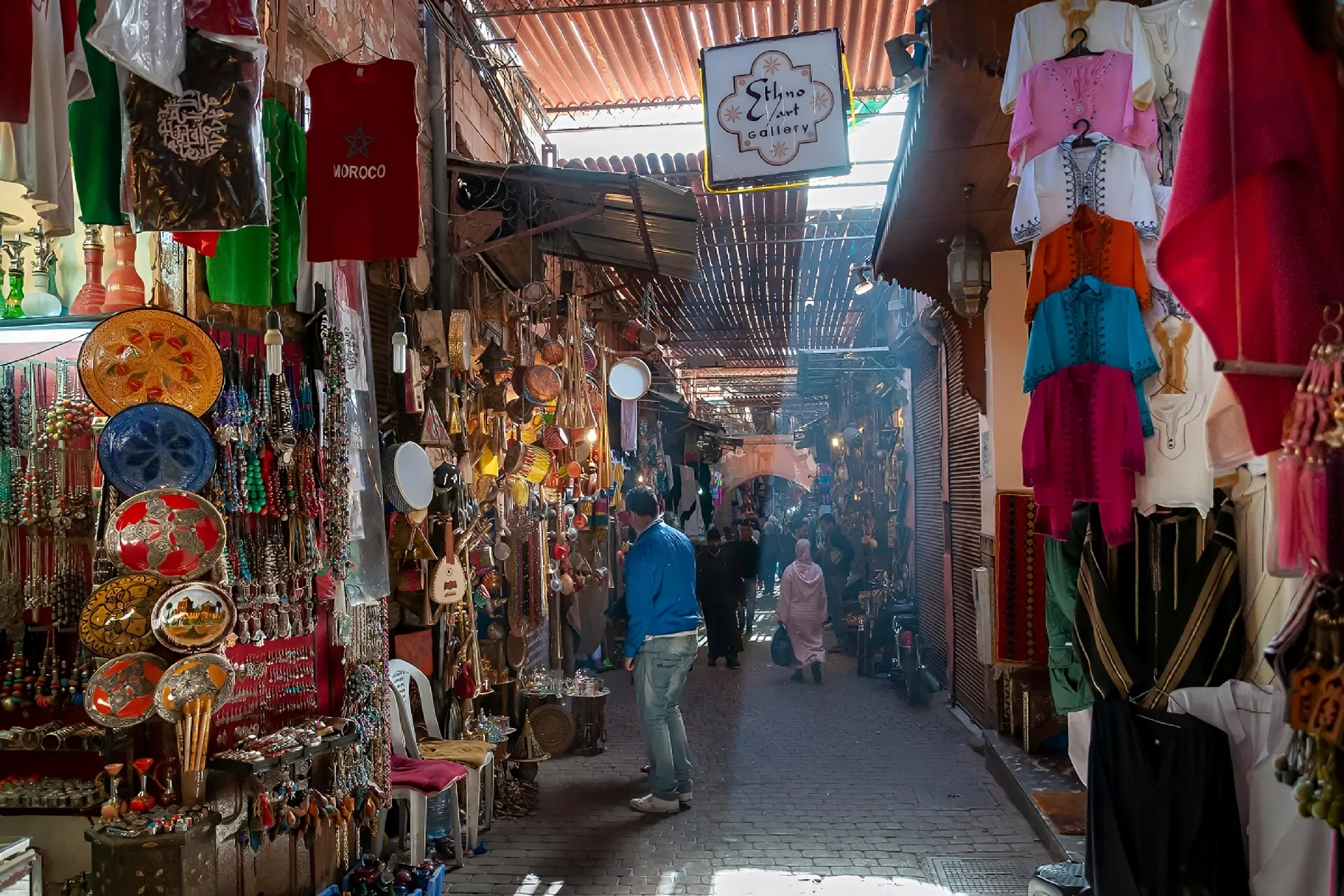
Inside the medina’s working marketplace
Marrakech Souks: A Thoughtful Guide to Shopping and Haggling
The souks are not a single shopping street but a network of specialised markets, workshops, passages and neighbourhood connections shaped by trade and craft.
A rewarding visit depends less on finding the lowest price than on reading the place, asking precise questions and buying only after understanding quality.
Marrakech’s souks are frequently described as a maze, which is accurate in one sense and misleading in another. The lanes can be disorienting, but they are not random. Historically, trades clustered in particular areas, practical routes linked gates, mosques, workshops and caravan commerce, and the market functioned as part of the medina rather than as an attraction separate from it. Today, tourism, modern retail and global supply chains have changed what is sold and how it is presented, yet the older logic remains visible in streets associated with leather, metalwork, textiles, carpets, wood, spices and dyeing.
For a first-time visitor, the intensity is sensory and commercial at once. Light changes beneath reed roofs, motorbikes and handcarts share narrow passages, metal rings from workshops, and sellers invite conversation from densely arranged displays. That energy can be exhilarating, but it also makes hurried decisions easy. The most useful preparation is not memorising a universal “correct price.” It is learning how to compare workmanship, how to ask whether an item was made locally, how to identify materials, how to leave a negotiation politely and how to recognise when an object creates customs, ethical or transport complications.
This guide treats the principal market zones as independent places because each has a different rhythm and product emphasis. It then explains haggling, authenticity, shipping and respectful behaviour as skills that apply across the medina. Fixed prices, access conditions and operating patterns can change quickly. Current official guidance should be checked before travel, while any purchase with significant value should be supported by clear documentation rather than a persuasive story alone.
Before the first purchase
How to read the souks as a living urban system
The market becomes easier to navigate when its streets are understood as craft districts, circulation routes and neighbourhood space.
The medina of Marrakech is recognised by UNESCO for an urban and cultural ensemble that includes monumental architecture, traditional quarters, markets and public spaces. The souks belong within that whole. Their value is not limited to colourful displays; it also lies in the continuity of skills, family businesses, supply relationships and the daily movement of residents through the centre. Visitors therefore benefit from replacing the idea of a themed bazaar with a more accurate picture: a commercial ecosystem in which tourism is important but not exclusive.
A practical orientation begins at a known point, often Jemaa el-Fna, but the square should be treated as a reference rather than a compass that solves every turn. Offline mapping can help, although narrow covered passages and dense construction sometimes limit location accuracy. A photographed landmark, the name of the nearest major street and the card of the accommodation are more reliable backups. When asking directions, use a clear destination such as a gate, museum or recognised square. Unsolicited guidance may lead to a shop or create an expectation of payment, so agree explicitly before accepting a service.
The market changes by time of day. Morning can reveal deliveries and workshop activity, midday brings heavier visitor traffic, and late afternoon often feels more compressed as shoppers, workers and returning residents overlap. Friday prayers, religious observances, public holidays and seasonal heat can alter the rhythm. A first visit is usually easier in daylight, with a defined meeting point and enough time to return without rushing. Travellers who are uncomfortable with crowds should avoid treating the busiest hour as mandatory authenticity.
Photography deserves restraint. A shopfront may be visually inviting, but the person working inside is not part of the merchandise. Ask before photographing people, close-up craft processes or private interiors, and accept refusal without argument. In active workshops, distance also protects tools, materials and workers. The same respect applies to bargaining: conversation can be warm and theatrical, yet no seller is obliged to provide a performance, and no visitor should feel obliged to buy merely because tea, time or explanation was offered.
Choose an anchor
Start from a recognised square, gate or museum and save the location of the return point.
Walk before buying
Observe product ranges, construction and seller explanations across several streets.
Mark specialist areas
Note where rugs, leather, metal, wood and dyes cluster instead of assuming all stalls are equivalent.
Return with intent
Negotiate only after deciding what material, size and quality are actually wanted.
Central medina · Main market artery
Souk Semmarine
The broadest introduction to Marrakech retail, where textiles, leather goods, metalwork, clothing and tourist-oriented merchandise mix along a major covered route.
Best for: first orientation and comparing a wide range of product categories before specialising

Shopping method
Use variety as a research tool
Souk Semmarine is often the first market street encountered from Jemaa el-Fna and one of the easiest places to understand the commercial scale of the medina. Its relative width, heavy foot traffic and broad assortment make it less specialised than the smaller souks branching away from it. That variety is useful. A visitor can see several grades of leather goods, textiles, slippers, metal lamps, ceramics and decorative objects within a short distance, learning how presentation, weight and finish affect both quality and asking price.
The same breadth makes impulse buying a risk. Items may be locally made, assembled from mixed components, produced elsewhere in Morocco or imported. “Handmade” can describe several levels of intervention, from fully hand-shaped work to machine-made bases with hand-applied decoration. Ask concrete questions: where was it made, which material is used, which parts were made by hand, whether the colour is dyed or painted, and whether another size can be shown. Specific answers are more useful than a general claim of authenticity.
Semmarine also demonstrates why comparison should happen before bargaining. Two visually similar bags may differ in leather thickness, lining, stitching and hardware. Two lamps may differ in metal gauge, punched detail and electrical compatibility. A lower price can simply reflect a lighter product or weaker finishing. The goal is not to expose every seller as dishonest; it is to define the object accurately enough that a negotiation compares equivalent goods.
Use this street as a survey route, then move into specialist areas for deeper examination. If an item remains memorable after several comparisons, return with a target price based on material and workmanship, not on a generic percentage reduction. Keep receipts and written details for significant purchases. When shipping is proposed, record dimensions, declared material, delivery method and the party responsible for damage or customs delays before payment.
A high-traffic route linking several specialist branches.
Use the variety to understand ranges before committing.
Similar-looking objects can differ sharply in construction and origin.
Medina square · Apothecary and basket market
Rahba Kedima
A small, intensely atmospheric square where woven goods, herbs, pigments, spices and apothecary-style displays create a different scale from the covered arteries.
Best for: observing market presentation, basketry and the boundary between culinary goods, cosmetics and souvenir claims

Quality lens
Separate atmosphere from product claims
Rahba Kedima offers one of the medina’s most recognisable market scenes: low displays, woven baskets, cones or bowls of colour, dried plants and goods presented with a strong sense of visual abundance. The square is smaller than the main covered routes, so it can feel both intimate and congested. It is worth pausing at the edge before entering the bargaining flow, watching how residents, guides, delivery workers and visitors use the same space.
Many products are described through culinary, cosmetic or traditional-use narratives. Those stories may reflect real local practices, but they should not be treated as medical evidence. Avoid ingesting an unidentified powder or using an unlabelled preparation on skin simply because it is described as natural. For edible spices, ask about freshness, storage and whether the product is intended for cooking. For oils or cosmetics, sealed packaging, ingredient information and a reputable producer offer more confidence than an open container exposed to heat and dust.
Basketry and woven household goods can be easier to assess directly. Look for even tension, secure handles, stable bases and fibres without excessive cracking. Natural variation is normal and can be part of the appeal, but a decorative basket designed for light use should not be mistaken for a durable travel or storage piece. Large hats and baskets also occupy more luggage volume than expected; compressing them may permanently distort the weave.
The square is an excellent place to practise polite non-purchase. A visitor can ask one or two questions, thank the seller and continue without inventing an excuse. If a negotiation begins, it should concern a specific item and quantity. Multi-item deals can hide the price of each component, so clarify the total and inspect every piece before payment. Colourful presentation is the invitation; careful identification is the responsibility that follows.
Carpet market · Medina
Souk Zrabi
The rug market is a place to study regional weaving traditions, construction and provenance before any serious negotiation begins.
Best for: travellers prepared to spend time comparing fibre, knotting, weave, condition and documented origin

Inspection guide
Turn the rug over before discussing price
Carpet shopping can become the most elaborate transaction of a souk visit. Rugs may be stacked in large numbers and presented through a sequence of unfolding, explanation and comparison. Hospitality and storytelling are part of the social experience, but they do not replace due diligence. Before asking for many pieces to be shown, state the approximate size, preferred construction, colour range and budget. This reduces unnecessary handling and makes it easier to compare relevant examples.
The word “Berber” is widely used in tourism, yet Morocco’s Indigenous Amazigh communities and regional weaving traditions are diverse. A seller may identify a rug with a particular region, community or style. Ask what evidence supports that attribution, whether the piece is new or older, which fibre and dyes are used, and whether repairs are present. Age claims should be treated cautiously unless documentation and condition are consistent. A rug can be beautiful without being antique, and an honest new piece may be a better purchase than an unverifiable story.
Inspect both sides. The reverse reveals weave structure, repairs and irregularities more clearly than the pile. Check edges and ends, look for weak areas, smell for damp or chemical treatment, and ask whether the rug has been washed. Natural fibres can shed, and handmade work is not expected to be perfectly symmetrical, but structural damage is different from character. Photograph the exact rug, its measurements and any agreed description before it is wrapped or shipped.
Shipping changes the negotiation. The relevant number is not the shop price but the delivered total, including packing, insurance, customs charges and possible taxes. Obtain the seller’s full business details, an itemised receipt and a written shipping commitment. Credit-card protections may differ by issuer and transaction type, and a promised delivery window is not a guarantee. For a high-value rug, walking away to research the seller is reasonable. A good object remains good after a night’s consideration.
Leather market · Medina
Souk Cherratine
A specialised leather area where bags, belts, slippers and small goods reveal large differences in hide, stitching, lining and finish.
Best for: comparing leather construction rather than relying on scent, colour or a broad “genuine” label

Material guide
Construction tells more than the label
Leather is one of the product categories most vulnerable to vague terminology. “Real leather” does not explain the animal source, grade, thickness, tanning process or construction quality. Begin with the intended use. A soft unlined market bag can be appealing and lightweight, but it will behave differently from a structured bag with reinforced stress points. A belt should be examined at the buckle attachment and holes; slippers should be checked for sole construction and sizing consistency.
Smell is not a reliable test of quality. Strong odour may come from tanning, dye, storage or finishing products, and it can persist after travel. Rub a hidden area gently with a light-coloured cloth only with the seller’s permission to see whether colour transfers. Inspect cut edges, stitch spacing and corners. Glue is not automatically a defect, but it should not be the only element holding a load-bearing seam. Metal fittings should open smoothly and align with the weight of the item.
Claims about vegetable tanning, hand dyeing or a particular production location should be met with specific questions. Some shops can explain their workshop relationships clearly; others repeat general market language. The aim is not to conduct a forensic investigation over a modest souvenir. It is to match the confidence of the claim to the price being asked. A high-value piece deserves documentation and time. A small, inexpensive item can be judged primarily on whether the buyer likes it and understands its likely durability.
International transport also matters. Leather may be restricted if it comes from protected species, and unusual skins should never be purchased without clear legal documentation. Ordinary livestock leather creates fewer complications, but import rules still vary. Keep receipts that describe the material. Before packing, allow any strong-smelling item to air in a suitable place and protect nearby clothing from possible dye transfer.
Blacksmiths’ souk · Medina
Souk Haddadine
The metalworkers’ area keeps the sound and heat of production close to the point of sale, making workshop safety and object construction equally important.
Best for: seeing metal craft in context and assessing whether decorative objects are practical to transport and use

Practical check
Ask how the object will function at home
Souk Haddadine is associated with blacksmiths and metalwork, and it can feel more industrial than the polished retail passages. Hammering, cutting, heat and sharp materials are not theatrical effects; they are workplace conditions. Stand where directed, keep children close, avoid blocking access and never reach toward a tool or unfinished piece. Photography should be requested, especially when workers are identifiable.
Metal objects require practical inspection. A lantern may be visually intricate but unsuitable for electrical use at home unless its wiring, socket and earthing meet the destination’s standards. Treat it as a decorative shell until a qualified electrician confirms otherwise. Check for sharp edges, loose panels and weak hanging points. For trays, bowls or utensils, ask whether the item is food-safe and whether its finish requires special care. Decorative patina should not be confused with verified age.
Weight can make a seemingly affordable object expensive to transport. Measure large pieces and check airline limits before negotiating. Thin metal may dent in checked luggage, while glass panels require substantial protection. If a shop offers shipping, examine packing methods and insurance terms. A photograph of the item before wrapping can help if damage occurs, but it does not substitute for a clear written agreement.
The best purchase in this area is often one whose use is already understood: a small hand-worked tray, a sturdy decorative hook or a lamp shade that will be rewired professionally. Buying an object simply because it looks dramatic in the souk can lead to an awkward, unsafe or unusable souvenir. Craft appreciation and consumer caution belong together.
Woodworkers’ souk · Medina
Souk Chouari
A district of carved, turned and assembled wooden goods where species, seasoning and joinery matter as much as ornament.
Best for: small wooden objects, craft observation and buyers willing to check import rules for plant material

Material guide
Check species, joinery and destination rules
Woodworking adds another sensory layer to the souks: shavings, carved surfaces, turned forms and the smell of timber. Small boxes, kitchen tools, game sets, stools and decorative panels appear in many shops, while active workshops show parts of the production process. As elsewhere, the presence of handwork does not mean every object in the room was made by the person visible at the bench. Ask which pieces come from the workshop and which are sourced from other producers.
Inspect wood for cracks, unstable joints and movement around hinges. A small natural check may be harmless, but a split crossing a load-bearing area is different. Boxes should close squarely, stool legs should sit evenly, and glued decorative inlay should not already be lifting. Freshly finished surfaces can conceal rough workmanship or emit strong odours. If the object will touch food, ask about the wood species and finish, then verify appropriate care independently.
Plant-material import rules are important. Some countries restrict untreated wood, bark, seeds or items that may carry pests. Protected timber species create additional legal and ethical concerns. A seller may not know the regulations of the buyer’s destination, so responsibility remains with the traveller. A receipt naming the wood can help, but it does not override customs law. When species cannot be identified, a small decorative purchase may still be acceptable locally but unsuitable for international transport.
The area is most rewarding when observation comes before shopping. Watching a simple form emerge from turning or carving clarifies the labour behind an object and makes differences in finish easier to see. A modest, well-made piece with a known use often carries more meaning than a larger decorative item chosen in haste.
Dyers’ souk · Medina
Souk Sebbaghine
The dyers’ area is known for saturated hanging skeins and textiles, but colourfastness, fibre content and production claims require careful questions.
Best for: understanding colour as a craft process rather than buying solely from a photogenic display

Textile guide
Ask what the fibre is before asking how it was dyed
Souk Sebbaghine is associated with dyers and with the memorable sight of yarn or cloth suspended in strong colours. It is easy to approach the lane as a photographic set, but dyeing is labour, and the surrounding shops sell materials of varied origin and quality. Ask before photographing workers or entering a production space. Displays positioned for visitors may be legitimate retail presentations without necessarily representing every stage of local manufacture.
For a textile purchase, begin with fibre content. Wool, cotton, viscose, acrylic and blends behave differently in wear, washing and sunlight. “Silk” is sometimes used loosely in tourist markets, so ask whether the material is silk fibre, cactus-derived rayon marketed under a local name, or another textile. A burn test is neither appropriate nor safe in a shop; labels, seller specificity and tactile comparison are better starting points.
Colourfastness matters. With permission, a discreet rub using a pale cloth can reveal surface transfer, though no simple test predicts every washing condition. Strongly dyed items should be packed separately on the journey home and washed according to reliable care guidance. Natural-dye claims are difficult to prove from appearance. Plant- or mineral-based colour is not automatically more durable or more ethical, and synthetic dye does not automatically mean poor craft. What matters is accurate description and workmanship appropriate to the price.
A visit here is most valuable when it connects colour to process. Look at how yarn thickness, twist and fibre change the result. Notice whether seams are finished, fringes secured and patterns aligned. A scarf or small textile can be an easy souvenir, but it should be selected with the same attention as a rug: material first, construction second, story third.
The transaction
How to haggle respectfully and still protect the budget
Negotiation works best when both sides are discussing a clearly identified object and either can end the conversation without humiliation.
Haggling is common in many souk transactions, but it is not compulsory in every shop and not every price is equally flexible. Fixed-price cooperatives, contemporary boutiques and clearly labelled stores may use a different model. Ask whether the price is fixed before launching into a routine. When negotiation is expected, begin only after deciding that the item is genuinely wanted. Bargaining over an object as entertainment wastes time and creates unnecessary tension.
There is no universal opening percentage that guarantees fairness. Asking prices vary by product, seller, season, perceived interest and the strength of the story surrounding the object. The buyer’s leverage comes from comparison and a private maximum, not from a memorised formula. Ask the price, clarify what is included, make a calm counteroffer and move in small steps. Silence is useful. Repeating the same number aggressively is not.
A respectful negotiation avoids insulting the object or the seller. Saying that workmanship is poor and then trying hard to buy the item is contradictory. A better phrase is that the price is beyond the available budget. If the numbers do not meet, thank the seller and leave. Walking away is legitimate only when the buyer is actually willing to end the transaction; using departure as repeated theatre can turn a simple exchange into pressure on both sides.
Tea, conversation and demonstrations can be generous, strategic or both. Accepting hospitality does not create a legal obligation to purchase, but basic courtesy remains appropriate. For an expensive item, slow the process down. Write the agreed specifications, inspect the exact object again, confirm currency and payment method, and obtain a receipt before funds change hands. If a deal feels confusing, emotionally coercive or too complicated to explain in one sentence, pause it.
Define the object
Confirm material, size, condition, included accessories and whether shipping is part of the offer.
Set a private ceiling
Decide the maximum total before the conversation becomes emotionally engaging.
Make one clear counteroffer
Use a realistic number based on comparison, then negotiate in calm increments.
Close precisely
Repeat the final total, currency and inclusions before payment.
Leave cleanly when needed
A polite thank-you is enough when the price or confidence level is wrong.
After the choice
Authenticity, documentation, shipping and what happens after purchase
The quality of a transaction is measured at home as well as in the market.
Authenticity is not a single property. An object can be handmade but newly produced, locally designed but assembled elsewhere, traditionally patterned but made with modern material, or old without being rare. Buyers should decide which quality matters to them and ask questions accordingly. A souvenir does not need museum-level provenance to be meaningful. Problems arise when a seller’s claim materially raises the price and cannot be supported.
Documentation should scale with value. For a modest textile, an ordinary receipt may be sufficient. For a costly carpet, antique claim, unusual leather or large commissioned object, request the business name, address, detailed description, dimensions, material, condition, agreed origin, total payment and shipping terms. Photograph the object and receipt. Do not accept a blank or vague customs declaration, and do not participate in understating value or mislabelling materials.
Shipping deserves its own decision. Ask who packs the object, who contracts the carrier, whether tracking and insurance are included, how damage claims work and which charges may arise on arrival. A shop’s quoted shipping fee may not include destination customs duty, taxes, brokerage or storage. Credit-card dispute rights vary and should not be assumed. When the object is fragile or valuable, an established specialist carrier may be more appropriate than an informal promise.
Aftercare begins before packing. Separate potentially colour-transferring textiles, protect sharp metal edges, allow leather to breathe and do not compress structured baskets beyond recovery. At home, avoid applying oils, cleaners or waterproofing products before identifying the material and finish. Professional cleaning may be sensible for valuable rugs or delicate textiles. The final souvenir should carry the memory of the market, not a preventable problem created by haste.
Is every item in the Marrakech souks made in Marrakech?
No. Goods may be made in Marrakech, elsewhere in Morocco or imported. Ask for specific production information and judge the confidence of the answer against the price.
Is haggling always required?
No. Some sellers and shops use fixed prices. Ask first, and negotiate only when the practice is expected and there is genuine purchase interest.
How can a buyer prove that a rug is antique?
A story alone is not proof. Significant age claims require consistent condition, specialist assessment and documentation; uncertainty should be reflected in the price.
Should a large purchase be shipped by the seller?
Only after the carrier, insurance, packing, customs responsibility, final cost and written remedy for loss or damage are clear.
The lasting purchase
The best souvenir is an object the buyer understands.
Marrakech’s souks are compelling because commerce, craft, neighbourhood life and performance overlap. That complexity cannot be mastered through a price chart or a list of “must-buy” goods. It is read gradually—in the difference between two seams, the explanation of a fibre, the rhythm of a workshop and the moment a buyer decides not to be rushed.
Walk first, compare carefully, bargain without hostility and document any significant claim. The reward may be a rug, a lamp, a basket or nothing at all. A successful visit is not measured by the number of bags carried out of the medina, but by whether the experience respected the place and whether every purchase still feels intelligent when unpacked at home.