

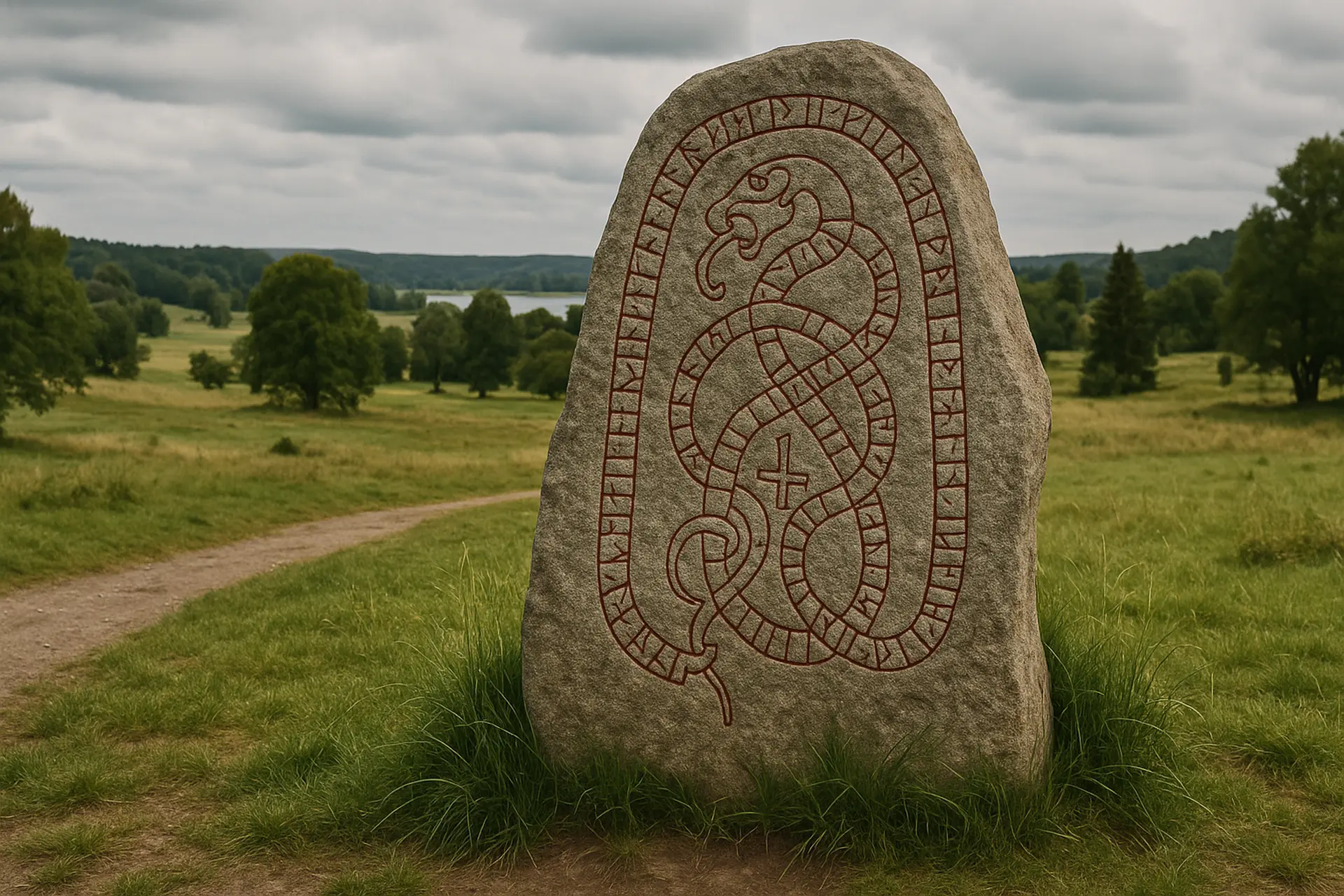
Runes in the landscape
Viking Runestones in Sweden, Denmark and Norway: A Field Guide
Runestones are public texts made monumental. They name families, commemorate the dead, mark status and turn roads, bridges, churchyards and assembly landscapes into places of memory.
The guide introduces the scripts and social conventions, then profiles five major monuments without pretending that every difficult inscription has one final translation.
A runestone looks silent only until the visitor understands what it was designed to do. The carved line usually names a person who commissioned the monument, identifies the person remembered and establishes a relationship between them. Around that concise social statement may appear a journey, inheritance, bridge, prayer, title, curse, image or signature. The stone was not a private diary. It was placed where people could encounter it, and its letters were often enhanced with colour so that the message stood out in the landscape.
Most Scandinavian memorial runestones associated with the Viking Age belong broadly to the tenth and eleventh centuries, with Sweden holding the greatest concentration. Yet runic writing is older than the Viking Age, and monuments such as Norway's Tune Stone demonstrate the deeper history of the tradition. The field guide therefore includes Tune as a chronological prelude, clearly distinguished from the later Viking Age stones rather than incorrectly forced into the same date range.
Reading requires humility. Scholars transliterate carved signs into the modern alphabet, normalise the words into a reconstructed language form and then translate their meaning. Damage, unusual spelling, compressed language and poetic references can create genuine uncertainty. The Rök Runestone is famous partly because its long text has supported competing interpretations. A responsible article should describe the debate rather than presenting the most dramatic theory as settled fact.
Visiting also requires a different pace from museum sightseeing. Many stones stand beside rural roads, churches or farms. There may be no ticket office, dramatic entrance or extensive shelter. Light moves across shallow carving, traffic passes nearby and the wider landscape often explains why the monument was visible. The essential equipment is less a specialised camera than time, a map, weather protection and respect for protected archaeological remains.
Runic literacy
How to read a runestone without pretending certainty
The carved text passes through several scholarly stages before it becomes the fluent English sentence seen on a sign or in a guidebook.
The first task is observation. Runes may run inside a ribbon, around an animal body, in straight lines or across several faces of a stone. The beginning can be marked by layout, punctuation or formula, but not always. Weathering, lichen and old breaks interrupt the sequence. Modern painted grooves can make signs easier to see, yet they are a conservation interpretation and should not be mistaken for surviving Viking pigment.
Transliteration represents each rune with a character in the modern scholarly alphabet. It stays close to the carved signs, including uncertainty and damaged sections. Normalisation then renders the words in a standardised historical language form, often Old Norse or a related stage, so that grammar and vocabulary become easier to compare. Translation is the final interpretive step. A smooth English sentence may therefore conceal several decisions made earlier in the chain.
The Younger Futhark, widely used during the Viking Age, had fewer signs than the spoken language had sounds. One rune could represent several related consonants or vowels, and spelling was not standardised. Context does much of the work. Names, kinship terms and memorial formulas can be recognised because they recur, but a rare word or poetic reference may remain ambiguous even when every sign is visible.
Many inscriptions follow a pattern: one or more named people caused the stone to be raised in memory of a relative, sometimes adding praise, a journey, a prayer or the carver's name. Formula does not make the text impersonal. On the contrary, the choice to name a mother, son, partner, companion or lord in a public monument reveals social bonds. The repetition also allows unusual statements to stand out more clearly.
Images should be read alongside text but not forced into a single mythological identification. A cross can signal Christian affiliation or commemoration; a serpent may organise the inscription and participate in a wider art style; a hunting scene may communicate elite activity, narrative or identity. Scholars may propose specific gods or stories, but the guide should distinguish strong evidence from attractive possibility.
At the site, begin with the whole stone, then move closer to the inscription and finally step back into the landscape. Read the official sign or heritage database before a popular summary. Photograph the stone from several angles as light changes, but never enhance carving physically. Side light often reveals grooves more effectively than direct noon sun, and a small reflector or rubbing technique is neither necessary nor appropriate on protected material.
Locate the inscription path
Identify the ribbon, lines or stone faces and look for where the text likely begins.
Separate signs from interpretation
Distinguish visible runes, scholarly transliteration, normalised language and English translation.
Find the social formula
Look for the commissioner, commemorated person, kinship relation and any praise or prayer.
Read image and setting together
Consider crosses, animals, scenes, roads, graves and churchyards without claiming more certainty than evidence allows.
Check alternative readings
For long or damaged texts, consult official databases and current scholarship rather than one dramatic popular version.
Östergötland · Sweden
The Rök Runestone
Scandinavia's most famous long runic text, carved across several faces and still capable of generating serious scholarly disagreement.
Date and character: early Viking Age, generally placed in the ninth century; an exceptional inscription of more than seven hundred signs

Reading the monument
Why difficulty is part of Rök's historical value
The Rök Runestone stands apart before a visitor reads a single word. Most memorial stones communicate through a concise formula, but Rök carries an extraordinarily long and complex inscription across multiple surfaces. It was carved in the early Viking Age, earlier than the great eleventh-century concentration of Swedish runestones. Its density and unusual techniques made it a monument to learned performance as well as memory.
The text begins from a commemorative impulse associated with a man named Varin and his dead son Vämod, but it quickly moves beyond an ordinary memorial formula. References, riddling structures, shifts in voice and encoded passages have produced generations of interpretation. Earlier readings often assembled the text into heroic legends and historical battles. More recent scholarship has proposed that parts of the inscription refer to anxieties about cosmic or environmental catastrophe and the struggle to restore light. The debate remains active because the stone is difficult, not because scholars have failed to look closely.
That uncertainty is the central lesson. The runes can be documented with precision, yet the cultural knowledge assumed by the carver is only partially recoverable. A name or phrase may allude to stories that were familiar to the intended audience but not preserved elsewhere. Ciphers demonstrate technical command while also controlling who could read. The monument therefore reveals literacy as social power: the ability to carve, decode and perform the text mattered alongside the message itself.
At Rök, location helps restore scale. The stone stands beside the church in a rural landscape, and local interpretation allows visitors to study its faces rather than meeting it only as a photograph. Walk around it slowly. Carving depth and legibility change with the angle of light, while the physical effort required to cover the surfaces becomes obvious. The inscription is not a paragraph transferred to stone; it is an object choreographing the reader's movement.
The correct field approach avoids declaring a favourite translation 'solved'. Read the official Swedish heritage information, compare a current research interpretation and note where wording remains disputed. Photographs should document separate faces and the overall setting. Touching, tracing or adding contrast to the grooves is unnecessary. Rök rewards the visitor who accepts that direct contact with an early text can increase uncertainty rather than remove it.
Jutland · Denmark
The Jelling Stones
Two royal runestones within a larger monument complex connect dynasty, commemoration, Christianity and the emergence of the Danish kingdom.
Date and character: tenth century; a paired royal monument understood together with mounds, church, palisade and ship-setting evidence

Reading the monument
Two stones inside a much larger statement of kingship
Jelling is not simply the site of a famous stone. It is a designed royal landscape. Two burial mounds, two runestones, a church and archaeological evidence for a vast palisade and ship setting create a sequence in which political power was repeatedly expressed. The stones gain meaning from that ensemble. Visiting only the carved surface without reading the surrounding geometry reduces one of Scandinavia's most important monument complexes to a single inscription.
The smaller stone is associated with King Gorm and commemorates Queen Thyra. Its text includes an early recorded use of the name Denmark in the country itself and presents royal memory in a concise runic form. The larger stone was raised by Harald Bluetooth and proclaims his relationship to Gorm and Thyra, his rule and his role in the Christianisation of the Danes. The wording and imagery have made it central to narratives of Danish state formation.
The large stone is sometimes called Denmark's birth certificate, a useful public phrase if not mistaken for a literal constitutional event. Kingdoms do not begin at one carved sentence. What the monument demonstrates is a ruler making claims in durable public form: genealogy, territorial authority and religious change are joined in a composition visible to an audience gathered in a royal centre.
The carved image of Christ and the runic text reveal a transition rather than a clean replacement of one culture by another. Runic writing, inherited monument forms and Christian iconography coexist. The nearby church adds another historical layer, while the mounds maintain the power of the earlier landscape. Jelling is therefore valuable precisely because it does not fit a simple 'pagan before, Christian after' diagram.
Protective display structures and the Kongernes Jelling experience centre influence how the stones are now seen. This is conservation, not a loss of authenticity. Outdoor stone faces are vulnerable to weather, pollution and repeated physical contact. The visitor should use the centre's interpretation to understand both the original monument and the modern decision to protect it. Current access and exhibition information should be checked before travel.
Walk the whole complex. Stand where the scale of the mounds and palisade can be imagined, compare the two texts and return to the church. Jelling's power lies in repetition across media: earth, stone, timber, burial, writing and worship all communicate authority. The stones are the most articulate voices in that landscape, but they are not speaking alone.
Uppland · Sweden
The Böksta Runestone
A memorial inscription wrapped around one of the most vivid surviving Scandinavian hunting scenes, including rider, animals and a skier with a bow.
Date and character: eleventh century; Uppland memorial stone celebrated for complex figural imagery

Reading the monument
Where family memory and visual narrative meet
Böksta changes the visitor's expectation that runestones are primarily text. The inscription matters, but the eye is immediately drawn to a scene of movement: a mounted figure, an animal under pursuit, dogs or other hunting animals, birds and a skier carrying a bow. The figures are organised within and beside the runic ribbon, making text and image part of the same commemorative surface.
The memorial formula identifies family action. Named people had the stone raised for a dead son or brother, placing the monument within the kinship language familiar from many Uppland stones. The image may add status, narrative or mythological resonance. Hunting with horses, dogs and birds could represent elite practice, while the skier connects the scene to winter mobility. Specific identifications with gods or legendary events have been proposed, but they remain interpretations rather than captions supplied by the carver.
The stone's damaged history is visible. It was broken, and part of the central surface is missing. That absence affects both text and image, reminding the visitor that modern reconstructions are arguments assembled from surviving material and older records. A published line drawing can clarify the composition, but it also makes the scene look more complete and certain than the weathered object. Compare documentation with the stone rather than replacing the stone with the diagram.
Böksta belongs to the dense runic landscape of Uppland, where memorials marked roads, estates, bridges and social networks. Seeing it as an isolated masterpiece misses that regional context. Nearby stones repeat names, formulas and styles, allowing researchers to trace workshops and relationships. A field itinerary should therefore include several inscriptions rather than driving a long distance for one photograph and leaving immediately.
The rural roadside setting demands practical care. Park only where safe and legal, remain clear of traffic and private land, and avoid climbing around the monument. Side light helps the shallow carving; overcast conditions can reduce harsh contrast. The goal is to document the relation between inscription, image and setting without touching the surface or treating the field edge as a controlled studio.
Böksta's value lies in the tension between ordinary and exceptional. The text participates in a widespread family memorial tradition, while the image offers an unusually animated glimpse of activity, equipment and visual storytelling. Together they show that a runestone could be both a socially recognisable formula and a highly individual public work.
Funen · Denmark
The Glavendrup Runestone
Denmark's longest runic inscription stands at the end of a large stone ship and combines memorial, title, ritual language and a warning against destruction.
Date and character: early tenth century; long Danish inscription within a reused ceremonial and burial landscape

Reading the monument
A public memorial designed to defend its own memory
Glavendrup announces itself through landscape design. The runestone stands in association with a stone ship more than fifty metres long, composed of upright stones that create a vessel shape on land. Nearby Bronze Age mounds and later memorials show that the place was repeatedly selected for commemoration. The Viking Age monument did not enter an empty field; it participated in a long history of making memory visible through earth and stone.
The inscription is the longest known from Viking Age Denmark. It commemorates a man called Alle and names the people who raised the monument, including a woman commonly rendered as Ragnhild. Titles and social roles make the text particularly valuable for understanding status. The monument is not a neutral grave marker. It presents a network of kinship, authority and ritual responsibility to an audience capable of recognising those claims.
The final warning is among the most memorable elements: harm is invoked against anyone who damages the stone or reuses it for another memorial. Such a clause tells the modern visitor that monument survival was already a concern at the moment of creation. The threat is not evidence of magical theatre for tourists; it is a legal, religious or social strategy to protect ownership of memory and prevent the stone's inscription from being appropriated.
The ship setting changes how the text should be approached. Walk the perimeter first and notice how the runestone occupies a terminal or commanding position. From different points, it reads as inscription, standing marker and part of a vessel-shaped composition. The scale cannot be understood from a close photograph of the runes alone.
Official Danish heritage information notes that the landscape includes monuments from several periods and that later generations added their own commemorative stones. That continuity is useful because it demonstrates that heritage places remain active sites of meaning. At the same time, modern additions should not be confused with Viking Age fabric. Labels and maps help separate the phases.
Glavendrup is an outdoor archaeological site, so weather, ground conditions and vegetation affect the visit. Follow marked access, do not lean on or enter close contact with the stones and leave no trace. A wide establishing image, a view along the ship setting and careful details of the inscription will communicate more than a single frontal shot.
Østfold · Norway
The Tune Stone
An early Norwegian runic monument that predates the Viking Age and reveals the deeper linguistic and social tradition from which later stones emerged.
Date and character: generally dated around the fourth or fifth century; Elder Futhark inscription, not a Viking Age memorial

Reading the monument
Why an earlier stone belongs in a Viking-era field guide
The Tune Stone corrects an easy chronological mistake. It is frequently drawn into popular Viking lists because it is large, Norwegian and runic, but its inscription is centuries earlier than the conventional Viking Age. Usually dated to around the fourth or fifth century, it uses the older twenty-four-character Elder Futhark and belongs to a different linguistic and social context. Its inclusion in this guide is therefore comparative: it shows that monumental runic commemoration had a deep prehistory.
The inscription is difficult and damaged, but it appears to concern inheritance, family and a burial or funerary context. A name often rendered Woduride is central to interpretation, while the wording has been discussed in relation to heirs and the making of the monument. As with Rök, the existence of published translations does not remove uncertainty. Early language, fragmentary surfaces and limited comparative material require careful qualification.
Tune demonstrates that runic literacy was never invented suddenly by Viking voyagers. The script had already been used for centuries on objects and monuments. What changes in the Viking Age is the scale, distribution, language and social convention of the surviving runestone tradition, especially in Sweden and Denmark. Placing Tune before the later profiles allows visitors to see continuity without erasing transformation.
The stone's modern history also matters. It was found incorporated into a churchyard wall, a reminder that old monuments were moved, reused and rediscovered. Museum display protects the surviving fragments and allows close study, but it removes the original setting. Good interpretation should therefore distinguish what is visible in the gallery from what archaeology and records suggest about earlier location and function.
Because the Tune Stone's display status can change, travellers should verify its current location and exhibition conditions with the Historical Museum in Oslo. Museum rules govern photography, and the stone should be approached as a rare document rather than a dramatic Viking prop. Comparing it with later Younger Futhark stones makes differences in letter forms and inscription style immediately instructive.
Tune's importance lies in chronology honestly stated. It is not 'one of the oldest Viking runestones'; it is an older runic monument that helps explain the tradition inherited and transformed during the Viking Age. Correcting that distinction makes the Scandinavian runic story longer, richer and more accurate.
Field practice
Planning routes through a dispersed archaeological landscape
Runestone travel is rewarding because monuments remain close to roads, churches and farms — and difficult because those places do not operate like a single museum.
Begin with a regional cluster rather than a national checklist. Uppland around Uppsala and Stockholm contains enough stones to reveal variation in formula, style, commissioner and setting within a short route. Östergötland provides Rök and other monuments in a different historical landscape. In Denmark, Jelling can anchor a journey through Jutland, while Glavendrup introduces Funen's archaeology. Norway has fewer Viking Age runestones, so museums and earlier inscriptions become especially important to the itinerary.
Use official heritage databases and museum resources to confirm location. Coordinates copied from old blogs may point to a previous placement, a church storage area or unsafe roadside access. Some stones have been moved indoors; others are protected by shelters; still others stand on private agricultural land visible from a public route. The right to see a protected monument does not create a right to cross fields, open gates or park wherever convenient.
Light and weather determine legibility. Low side light reveals incised lines, while rain can darken the surface but also creates slippery ground and difficult driving. Never wet the stone deliberately. Winter snow can clarify a silhouette but hide access hazards; summer vegetation can obscure the base or nearby features. A flexible route with more sites than can be completed allows conditions to determine priorities.
Conservation ethics are simple. Do not touch, chalk, trace, rub, clean or climb. Modern paint in grooves is applied by specialists according to conservation policy; visitors should not imitate it. Keep tripods clear of roads and graves, avoid flash where museums prohibit it and use a longer lens when barriers protect the monument. A runestone has survived a millennium or more; the visitor's need for contrast lasts only a moment.
Interpretive tools improve the journey. Carry transliterations and translations from official or scholarly sources, but read the stone before reading the solution. Note the inscription path, names, cross, animal ornament and setting. Then compare the published interpretation. This sequence turns the visit into active observation and makes disagreements meaningful rather than confusing.
Finally, connect stones to museums. Outdoor monuments preserve placement and landscape, while museum collections provide comparative objects, reconstructions, language explanation and conservation context. Kongernes Jelling, the Swedish History Museum and the Historical Museum in Oslo can transform isolated field encounters into a coherent understanding of literacy, power and remembrance across Scandinavia.
| Country | Best-known strength | Useful base or anchor | Planning emphasis |
|---|---|---|---|
| Sweden | Greatest concentration and strong regional clusters | Uppsala/Stockholm for Uppland; Rök for Östergötland | Use the heritage database and build short rural circuits |
| Denmark | Royal and monumental contexts with strong museum interpretation | Jelling in Jutland; Glavendrup on Funen | Read stones together with mounds, ship settings, churches and forts |
| Norway | Fewer Viking Age stones but crucial early runic material | Historical Museum in Oslo and Oslofjord region | Distinguish pre-Viking Elder Futhark monuments from Viking Age examples |
Were runestones originally grey?
Many inscriptions were probably painted so that text and ornament were easier to see. Surviving colour is rare, and modern painted grooves are conservation interpretation.
Does every runestone describe a Viking raid?
No. Most are family memorials. Some mention travel, bridge building, service, faith or status, but dramatic expeditions are a minority.
Can visitors make rubbings?
No. Rubbing, chalking, wetting or cleaning can damage protected surfaces and is unnecessary when official documentation exists.
Why do translations differ?
Damage, compressed spelling, ambiguous rune values, rare vocabulary and lost cultural references can support more than one scholarly interpretation.
Words made public
Runestones bring us close to named people, but never remove the distance of a thousand years.
The appeal of a runestone lies in this balance. A commissioner speaks with startling directness — naming a parent, child, partner or lord — while the language, image and social world remain partly unfamiliar. The monument is intimate and difficult at once.
Rök demonstrates the limits of interpretation; Jelling shows royal power operating through landscape and text; Böksta joins family memory to image; Glavendrup protects commemoration with a warning; and Tune extends the story into the centuries before the Viking Age. None should be reduced to a decorative alphabet or a single heroic tale.
Visit slowly, use authoritative sources and leave the stone untouched. The runes were carved to outlast a human life. Responsible fieldwork allows their uncertainty, material presence and public purpose to remain visible for the next reader.