

Trade routes made visible
The World’s Great Bazaars and Souks
In Istanbul, Marrakech and Dubai, markets are not decorative survivals. They are working systems of memory, livelihood, negotiation and urban belonging.
Five primary market spaces · three cities · one practical guide to reading them beyond the souvenir stall
A great market does not reveal itself at the first gate. The initial impression is usually sensory: metal catching the light, sacks of pigment and spice, hammered trays, leather, perfume, voices ricocheting under vaults, and the quick arithmetic of a price offered across a counter. Yet the spectacle is only the surface. Beneath it lies an urban machine shaped by guilds, religious endowments, caravan routes, migration, regulation, tourism and the daily discipline of small trade. To enter well is to notice not only what is for sale, but how streets are organised, how trust is performed, how crafts are grouped and how a city’s history remains legible in commerce.
The word bazaar arrived in many European languages from Persian, while souk or suq is the familiar Arabic term. Neither word describes one fixed architectural type. A market may be roofed or open, formal or improvised, wholesale or retail, local or heavily touristed. Some are districts rather than buildings. Some change character by the hour. What unites the strongest examples is density: of goods, relationships, inherited knowledge and repeated encounter. They are places where a visitor can see the economy becoming social.
This guide focuses on five distinct primary subjects that are too often collapsed into three convenient city labels: Istanbul’s Grand Bazaar; Jemaa el-Fna and the surrounding Marrakech souks, treated separately because one is a performative civic square and the other a network of commercial lanes; and Dubai’s Gold Souk and Spice Souk, neighbouring but materially different markets in Deira. Each deserves its own rhythm, image and set of questions.
The purpose is not to romanticise bargaining or present crowded markets as timeless theatre. These places are living workplaces. The best visit is curious without being extractive, alert without being suspicious, and willing to leave space for ordinary routines. Buy when something is genuinely wanted, ask before photographing people, and remember that a market’s value cannot be reduced to whether a visitor secured the lowest possible price.
Before the first purchase
A bazaar is an urban archive, not a shopping list
The arrangement of doors, lanes, trades and pauses can tell as much about a city as the objects on display.
Look for systems: clustering, circulation, trust, storage, worship, food and repair.
Historic markets grew because movement needed structure. Goods arriving by sea, caravan or regional road had to be unloaded, stored, weighed, taxed, protected and redistributed. Valuable commodities often moved through secure inner halls; bulkier or more perishable goods occupied other streets. Inns and courtyards accommodated merchants, animals and warehouses. Fountains, baths, mosques, workshops and food sellers gathered nearby because commerce depended on an entire ecology of services. Even where that original system has changed, its spatial logic often survives in the clustering of trades.
That clustering is one of the easiest details to read. A lane of jewellers allows comparison, specialist knowledge and informal oversight. A row of leather workshops creates a local supply chain. Spice sellers can watch what neighbouring stalls stock and what customers ask for. Competition is visible, but so is mutual dependence. Markets are not automatically harmonious communities; they contain hierarchy, exclusion and hard bargaining. Still, their density produces a form of public accountability that anonymous retail rarely offers. Reputation travels quickly when traders work beside one another for years.
Architecture reinforces that social order. Covered streets moderate sun and rain, while gates can regulate movement and security. Narrow lanes slow pedestrians and magnify sound. Courtyards introduce light and provide moments of orientation. In a square such as Jemaa el-Fna, architecture becomes more fluid: the empty ground is the stage, and the market is assembled through repeated occupation. The physical form matters because it determines whether people linger, pass, watch, negotiate or gather in circles.
Tourism has altered all five places in this guide, sometimes preserving livelihoods and sometimes simplifying them into consumable images. A shop may now sell objects designed for visitors rather than local use; a craft demonstration may become performance; a food stall may adjust its offer to foreign expectations. That does not make the entire market false. Authenticity is better understood as a question of continuity, skill and honest representation. A recent product can still belong to a living tradition, while an object marketed as ancient may be no more than a story attached to factory production.
Specialist lanes make comparison and reputation visible.
Roofs, gates and courtyards shape movement and comfort.
Trust is built through relationships, not only transactions.
Read the market before deciding what to buy.
Fatih · Istanbul · Türkiye
Grand Bazaar
Behind its famous gates, Istanbul’s Kapalıçarşı remains a layered commercial district where Ottoman foundations, specialist streets and contemporary tourism meet.
Best for: understanding the architecture of a covered market and the long relationship between luxury trade, craft and urban power

Editorial guide
How to see the Grand Bazaar beyond its most crowded aisle
The Grand Bazaar is often described through numbers—streets, gates, shops, daily visitors—but its meaning is easier to grasp through its internal geography. It developed from Ottoman commercial buildings established after the conquest of Constantinople, then expanded through linked streets, hans and specialised trades. The result is not one hall but a district under cover, stitched into the historic peninsula. Its relationship to mosques, caravan routes and surrounding commercial streets places it within the wider urban landscape recognised by the UNESCO World Heritage listing for the Historic Areas of Istanbul.
Visitors entering from the tram corridor near Beyazıt often meet a fast, polished version of the bazaar: jewellery, carpets, leather goods, ceramics and souvenirs presented under bright lights, with multilingual invitations from shopkeepers. This is real commerce, but it is not the whole place. The Grand Bazaar rewards lateral movement. Turn away from the busiest spine, notice where the merchandise changes, and look for workshops, repair businesses, small tea stations, courtyards and the less theatrical exchanges between merchants. The quieter edges often reveal the market as a workplace rather than an attraction.
The old bedestens remain essential to understanding the complex. A bedesten was a secure, masonry market building associated with valuable goods and controlled trade. Its thick walls and domed bays speak to the importance of protection, storage and reputation in an economy built on portable wealth. Even when present-day retail has changed, that architecture explains why the bazaar became a centre for textiles, jewels and other high-value commodities. The building does not merely shelter trade; it records which goods once justified exceptional security.
Shopping here requires discrimination rather than cynicism. The same broad category may include local workshop production, imported factory goods, restored antiques, reproductions and objects whose age or material is described optimistically. Ask concrete questions: Where was it made? What is the metal purity? Is the carpet hand-knotted or machine-made? What fibres and dyes were used? Can the claim be written on the receipt? A serious merchant should be able to explain the object without relying only on romance. Independent appraisal is sensible for expensive purchases, and export rules must be checked before buying anything presented as antiquarian or culturally significant.
Time changes the bazaar. Early in the day, deliveries and preparations are more visible and the lanes are easier to read. Later, group traffic intensifies and the most accessible routes can feel compressed. Yet even at busy hours, patience matters more than speed. The Grand Bazaar is not a checklist of photogenic ceilings. It is a commercial organism with multiple tempos. The best visit may involve one careful purchase, a long conversation and several streets in which nothing is bought at all.
Medina · Marrakech · Morocco
Jemaa el-Fna
Marrakech’s central square is not a conventional souk but a changing public stage whose meaning emerges through storytellers, musicians, food sellers and gathering crowds.
Best for: seeing how commerce, oral tradition and public performance occupy the same urban ground

Editorial guide
Why the square must be read as performance, not scenery
Jemaa el-Fna is frequently introduced as the gateway to the Marrakech souks, but that description understates its independence. It is a civic space with its own rhythm, economy and cultural vocabulary. The square is relatively open by medina standards, yet it becomes dense through use: carts, food stalls, circles of listeners, musicians, itinerant sellers and passers-by establish temporary territories. The market here is not contained by permanent shopfronts. It is assembled and dismantled through repeated acts of occupation.
UNESCO’s inscription of the Cultural Space of Jemaa el-Fna emphasises oral and performative traditions rather than monumental architecture. Storytelling, music, popular entertainment and social exchange give the square its significance. This is crucial for visitors: the heritage is not simply the view from a rooftop terrace. It exists in living practices, and those practices depend on audiences, livelihoods and the possibility of gathering in public.
The square’s tempo changes markedly. Morning and early afternoon can feel transitional, with juice vendors, small-scale services and people crossing between the medina and surrounding streets. Toward evening, food smoke rises, lights appear and performance circles become more prominent. That transformation is one of Marrakech’s defining urban experiences, but it also concentrates pressure. Crowding, persistent offers and rapid sensory change can overwhelm visitors who arrive without a plan. Establish an obvious meeting point, keep valuables secure and resist the urge to stop abruptly in the main flow of pedestrians.
Photography requires particular care. A performer, musician, storyteller or animal handler is not an anonymous visual prop. Ask first, clarify whether payment is expected, and do not photograph children without permission. Some practices involving animals raise welfare concerns; participation is not obligatory simply because an activity is presented as traditional. A respectful visitor can appreciate the square’s cultural importance while choosing not to support interactions that cause discomfort or rely on coercive handling.
Eating in the square is best approached with attention rather than fear. Choose busy stalls with visible turnover, watch how raw and cooked foods are separated, and make decisions based on personal health needs. Prices and menus should be clarified before ordering. Most importantly, allow the square to remain larger than a meal or photograph. Stand at its edge, listen to the changing soundscape and notice how strangers form temporary publics around a voice, a rhythm or a cooking fire. That collective attention is the square’s most distinctive commodity—and it cannot be packed in luggage.
The square feels more open and transitional.
Performers, vendors and spectators occupy more ground.
Crowds intensify and the square becomes fully theatrical.
Medina · Marrakech · Morocco
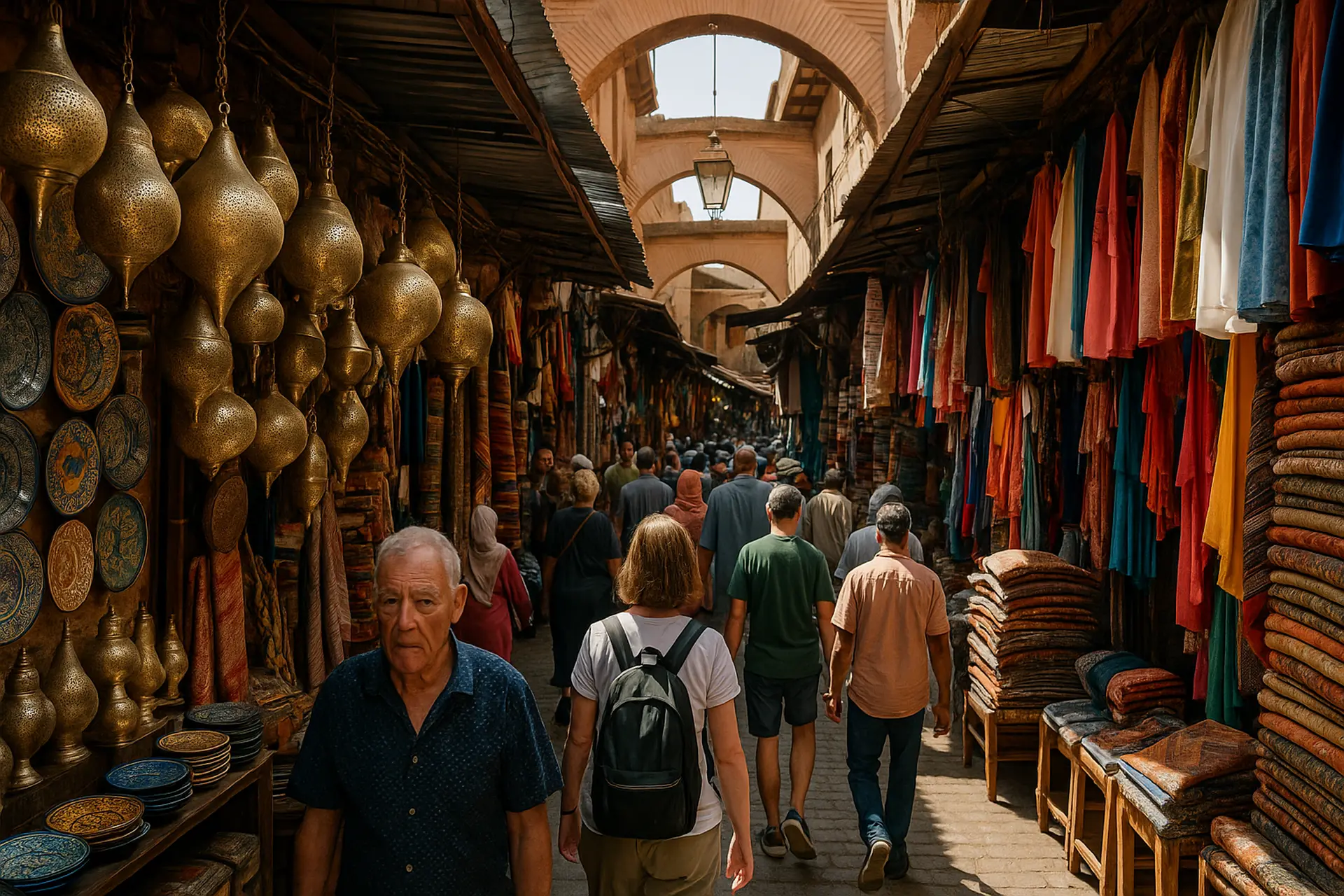
The Souks of Marrakech
Beyond Jemaa el-Fna, a network of narrow commercial lanes reveals the medina through craft, material and the repeated logic of specialist streets.
Best for: following the transformation of raw material into leather, metalwork, textiles, wood and everyday household goods
Editorial guide
Getting productively lost without surrendering judgement
The Marrakech souks are not a single corridor waiting to be completed. They are a network of lanes whose commercial identities overlap and shift. Visitors may encounter sections associated with leather, metalwork, carpets, slippers, spices, woodworking, clothing or household goods, but the boundaries are not a museum map. Businesses change, tourist demand reshapes stock and contemporary products sit beside traditional forms. The useful question is not whether every lane remains exactly as it was, but how craft knowledge and commercial specialisation continue to organise space.
Navigation is part of the experience, yet romantic advice to “get lost” can be unhelpful. The medina’s scale, repeated turns and covered passages can disorient even experienced travellers. A better method is to move in deliberate loops. Note the name of a gate, mosque, square or major junction; keep an offline map; and understand that a phone’s location marker may drift in narrow streets. When offered unsolicited guidance, decide clearly whether assistance is wanted and agree on payment before accepting an extended escort. Courtesy and boundaries can coexist.
The strongest encounters happen when attention shifts from finished merchandise to process. Hammer marks on metal, the density of a carpet knot, the stitching of leather, the joinery of a wooden box and the smell of freshly worked cedar all reveal labour. Ask where an item was made and by whom. A workshop explanation does not guarantee authenticity, but it gives the conversation substance. When possible, compare several examples before discussing price. Variation in weight, finish and material is often more informative than a merchant’s opening story.
Bargaining is common in many tourist-facing stalls, but not universal. Fixed prices may be indicated in cooperatives, boutiques or certain food businesses. Where negotiation is invited, begin with respect and a realistic sense of value. The aim is not to perform domination through a dramatically low offer. Consider the material, workmanship, scale and time involved. A buyer who has no intention of purchasing should not prolong the ritual merely for entertainment. Walking away is acceptable; contempt is not.
The souks also contain ordinary life that rarely appears in travel imagery: repairs, deliveries, school routes, residents buying household items, workers sharing tea and motorcycles threading through constricted space. Make room. Avoid blocking doorways for photographs and step aside when porters or loaded carts approach. The market is most rewarding when its photogenic surfaces do not eclipse its function. Marrakech is not staging a timeless scene for the visitor; it is conducting business in a historic urban fabric under contemporary pressure.
Questions that reveal quality
What is it made from?
Ask for specific fibres, metals, woods, dyes, leathers or finishes rather than accepting a generic label.
Where was it produced?
Distinguish local workshop work, regional production and imported factory goods.
How was it made?
A credible seller should be able to explain construction, stitching, knotting, casting or carving.
How should it age?
Care instructions can reveal whether a material claim is plausible and whether the object suits its intended use.
Deira · Dubai · United Arab Emirates
Dubai Gold Souk
A dense concentration of jewellery retailers turns purity, weight, workmanship and trust into the visible grammar of a specialist market.
Best for: learning how precious-metal retail separates a fluctuating material value from design, labour and commercial margin

Editorial guide
How to compare jewellery without being distracted by spectacle
Dubai’s Gold Souk is visually overwhelming by design. Shopfronts present necklaces, bangles, chains and ceremonial sets in extraordinary density, turning the street into an exhibition of reflected light. Yet the market becomes more intelligible once a purchase is broken into components. The metal has a purity and weight; the design has a level of complexity; stones have their own grading questions; and the retailer adds workmanship and margin. These elements should not be bundled into a vague statement that an item is simply a “good deal.”
Official tourism material from Visit Dubai places the Gold Souk within Deira’s traditional commercial district. Its appeal depends partly on concentration: many retailers operate close together, making comparison possible. That does not remove the need for judgement. Ask the karat or fineness, request the item’s weight, understand whether stones are included in that weight, and obtain written documentation. Hallmarks and invoices matter because appearance alone cannot verify purity.
The relationship between quoted gold value and final price is central. Metal prices fluctuate, while making charges depend on design and labour. A plain chain and an elaborate handcrafted piece should not carry the same workmanship cost. When comparing, use like with like: same purity, similar weight and comparable construction. A merchant may have room to negotiate the making charge even when the underlying metal price is less flexible. This is a more informed conversation than applying one aggressive discount to the entire item.
Custom work and resizing introduce additional questions. Confirm the timeline, final weight, stone specifications, return policy and what happens if the finished piece differs from the order. For high-value transactions, card fees, currency conversion, insurance, import duties and declaration requirements can materially affect the true cost. A purchase is not complete when it leaves the shop; it must also travel legally and safely to its destination.
Non-buyers can still learn from the souk. Notice how styles address different communities and occasions, how scale changes from everyday pieces to wedding jewellery, and how shop displays communicate abundance as reassurance. The Gold Souk is not only a tourist attraction; it serves regional and resident markets with their own aesthetic languages. Looking carefully before asking for a price helps preserve that complexity.
Confirm purity
Ask for karat or fineness and check the hallmark or official documentation.
Confirm weight
Clarify whether the quoted weight includes stones, fittings or non-gold components.
Separate the charges
Understand the metal value, workmanship, stones, taxes and any payment fees.
Document the purchase
Obtain a detailed invoice, return terms and any certification promised during the sale.
Check the journey home
Verify customs declarations, import allowances and insurance before travelling with valuable jewellery.
Deira · Dubai · United Arab Emirates
Dubai Spice Souk
Across a compact network of Deira lanes, aroma and colour introduce a trade built on culinary knowledge, regional exchange and careful questions about freshness and origin.
Best for: comparing whole spices, dried ingredients, incense and blends while learning how storage and turnover affect quality

Editorial guide
Smell first, ask questions second, buy in realistic quantities
The Spice Souk is close enough to the Gold Souk to be folded into the same sightseeing circuit, but its commercial language is entirely different. Here value is less immediately legible. Colour can be intensified, blends may vary by seller, familiar names can refer to different grades, and an impressive open sack does not by itself prove freshness. The market therefore rewards sensory attention and specific culinary questions. What is the ingredient used for? Is it sold whole or ground? When was it packed? How should it be stored in a humid climate?
Official visitor guidance from Visit Dubai highlights spices, herbs, dried fruits, nuts and related goods. The range reflects Dubai’s long role as a port and trading centre connecting the Gulf, South Asia, Iran, East Africa and beyond. Contemporary stock is global, and not every product is Emirati. That is not a defect; it is the point of a trading market. Origin should be described accurately rather than collapsed into a generic claim of local tradition.
Whole spices generally retain aroma longer than pre-ground versions, although quality depends on harvest, handling and storage. Look for clean, distinct fragrance rather than dustiness or mustiness. Avoid buying large quantities simply because the display is seductive. Heat, light, air and moisture will diminish quality after the journey home. A modest amount used promptly is often better value than a decorative kilogram that loses character in a cupboard.
Saffron demands particular caution because its price and reputation invite substitution. Threads should be evaluated through reliable sourcing and documentation, not a single improvised “test” performed at the counter. Likewise, herbal products should not be treated as risk-free medicines. Names, concentrations and contraindications can be unclear, and a seller’s health claim is not a substitute for professional advice. Travellers with allergies, pregnancy, chronic illness or medication interactions should be especially conservative.
Bargaining may be possible, particularly for larger purchases, but the same principle applies as elsewhere: compare equivalent quality and decide what is genuinely wanted. Ask whether a quoted price is per gram, packet or larger unit. Confirm the total before goods are weighed and sealed. Then look beyond the purchase. The Spice Souk’s real richness lies in the vocabulary exchanged across the counter—the names of ingredients, their culinary routes and the knowledge required to use them well.
The social contract
Negotiation works best when neither side is reduced to a stereotype
Bargaining can be ordinary commerce, but visitors often distort it into a contest of cleverness.
Know the object, decide a ceiling, negotiate briefly and accept that no agreement is also a valid outcome.
Travel culture often describes bargaining as a performance in which the visitor must defeat an inflated opening price. That frame produces bad behaviour: theatrical outrage, implausibly low offers, endless haggling over small sums and triumph measured by how little a seller accepted. A more useful approach treats negotiation as information exchange. The buyer signals interest and budget; the seller explains quality and terms; both assess whether a transaction is possible.
Preparation matters. Compare similar items, identify obvious differences in material or workmanship and decide what the object is worth to the buyer—not what an anonymous forum claims someone paid years ago. Opening prices may include room to move, but the scale varies by market, shop and product. There is no universal percentage. Fixed-price businesses should be respected, and even in negotiable settings the seller may decline.
Body language can preserve dignity. Stay calm, avoid insulting the merchandise and do not invoke poverty or local wages as a tactic. If tea is offered, understand that hospitality does not create an obligation to buy, but neither should it be exploited as free entertainment across many shops. When the final price is agreed, honour it. Reopening the negotiation at the moment of payment damages trust.
Walking away is legitimate when the price, quality or interaction does not feel right. A simple thanks is enough. The merchant may call the buyer back with a revised offer, or may not. Either outcome is normal. The goal is not to extract the last possible concession; it is to make a purchase that remains satisfactory after the excitement of the market has faded.
Compare first
Look at several genuinely similar objects before discussing a final price.
Ask for the basis
Clarify material, origin, weight, workmanship and what is included.
Set a private ceiling
Decide the maximum acceptable total before the exchange becomes emotional.
Make a serious offer
Negotiate in good faith only when there is a real intention to buy.
Close cleanly
Accept the agreement, or decline politely and leave without hostility.
Beyond the souvenir label
The most persuasive story is not always the most accurate one
A market object can be beautiful and contemporary without needing a fabricated age, origin or sacred meaning.
Honest provenance protects buyers, craftspeople and the traditions invoked in the sale.
Markets are powerful storytelling environments. A carpet becomes a family inheritance, a metal tray becomes palace work, a stone becomes protective, a bottle becomes an ancient cure. Some narratives may be grounded in genuine practice; others may be simplified, improvised or strategically vague. Visitors should not demand a certificate of timeless purity from every object, but they should distinguish aesthetic pleasure from factual provenance. It is entirely reasonable to buy a modern decorative piece because it is well made and loved.
Craft authenticity is rarely binary. A design may be traditional while production is contemporary. A local artisan may use imported material. A cooperative may standardise patterns to reach wider markets. A workshop may combine handwork with machines. These realities do not invalidate the product. The key is accurate description and fair recognition of labour. Problems arise when factory goods are passed off as unique handcraft, or when a cultural identity is used as a marketing costume with no connection to the maker.
Certain materials require stronger caution. Wildlife products, protected shells, coral, ivory, reptile skins, feathers, archaeological material and antiquities can be illegal to export or import even when openly displayed. Plant products and seeds can also be restricted. The absence of concern at the point of sale does not establish legality. Travellers are responsible for customs compliance, and “the seller said it was allowed” may offer no protection at the border.
Ethics also includes the market encounter itself. Photographing a craftsperson without consent, treating a performer as background, or demanding an unsustainably low price while spending freely elsewhere can reproduce the very inequalities travel claims to bridge. Responsible shopping is not solved by paying any price asked; transparency and comparison remain necessary. It means recognising that a transaction has social effects and that the dignity of the people involved matters as much as the object carried home.
Four tests before buying
Is the origin specific?
A town, workshop or producer is more meaningful than a vague claim of being traditional.
Can the method be explained?
Materials and construction should withstand practical questions.
Can it cross the border?
Check antiquities, wildlife, plant and food regulations independently.
Will it be valued at home?
A thoughtful, usable object is usually a better souvenir than an impulse purchase built on a dramatic story.
Practical rhythm
A little preparation leaves more attention for the market itself
Heat, crowding, closures and sensory overload influence the experience as much as any list of stalls.
Plan a route, protect valuables, carry water where appropriate and keep time for unplanned observation.
Market conditions vary by city, season, weekday, religious calendar and time of day. Early hours can offer easier navigation and cooler temperatures, but some businesses open gradually. Evening may bring the most atmosphere at Jemaa el-Fna while creating the densest crowds. Dubai’s climate can make the coolest part of the day preferable for walking between Deira markets. Istanbul’s covered passages protect from weather but can still become congested. Live details should always be checked through official or local sources.
Dress for movement rather than photographs. Comfortable closed shoes are useful on uneven or crowded surfaces. A small secure bag is easier than loose shopping carriers, and valuables should not be displayed unnecessarily. Cash may be convenient, but carrying a large amount in one place is unwise. For expensive purchases, understand payment fees and keep documentation separate from the item.
Sensory fatigue is real. Noise, heat, fragrance, persuasion and constant visual choice can erode judgement. Pause in a café, courtyard or quieter street before making a major purchase. Travellers who experience anxiety, mobility limitations or sensory sensitivity should identify exits and rest points in advance. A shorter visit with attention is better than a long visit endured as an obligation.
Finally, leave room for the market not to perform. A shuttered lane, a delivery bottleneck or a merchant too busy to explain a product is not a failed travel experience. These places are working environments with ordinary constraints. The visitor’s privilege is access, not control.
| Market | Primary form | Strongest experience | Main caution |
|---|---|---|---|
| Grand Bazaar | Covered commercial district | Architecture and specialist trade | Quality and provenance claims |
| Jemaa el-Fna | Performative civic square | Evening gathering and oral culture | Crowding, consent and animal welfare |
| Marrakech Souks | Network of medina lanes | Craft processes and material comparison | Navigation and unsolicited guidance |
| Dubai Gold Souk | Specialist jewellery district | Comparing purity, weight and workmanship | Documentation and customs obligations |
| Dubai Spice Souk | Compact aromatic market | Ingredient knowledge and regional trade | Freshness, health claims and food import rules |
The wider view
The great market is not preserved by admiration alone
The Grand Bazaar, Jemaa el-Fna, the Marrakech souks, Dubai’s Gold Souk and Dubai’s Spice Souk endure because people continue to work, gather, negotiate, repair, perform and adapt within them. Their beauty is inseparable from that activity. To freeze them as exotic scenery would be another form of loss.
A thoughtful visitor contributes modestly: by asking better questions, paying fairly for genuine value, refusing dubious claims and restricted materials, respecting consent and accepting that not every encounter exists for consumption. The reward is a deeper kind of orientation. A market becomes a map of relationships—between port and hinterland, craft and capital, heritage and reinvention, object and story.
Leave with fewer things than the stalls tempt you to buy, but with a sharper sense of how cities organise exchange. That is the purchase no customs form needs to declare.