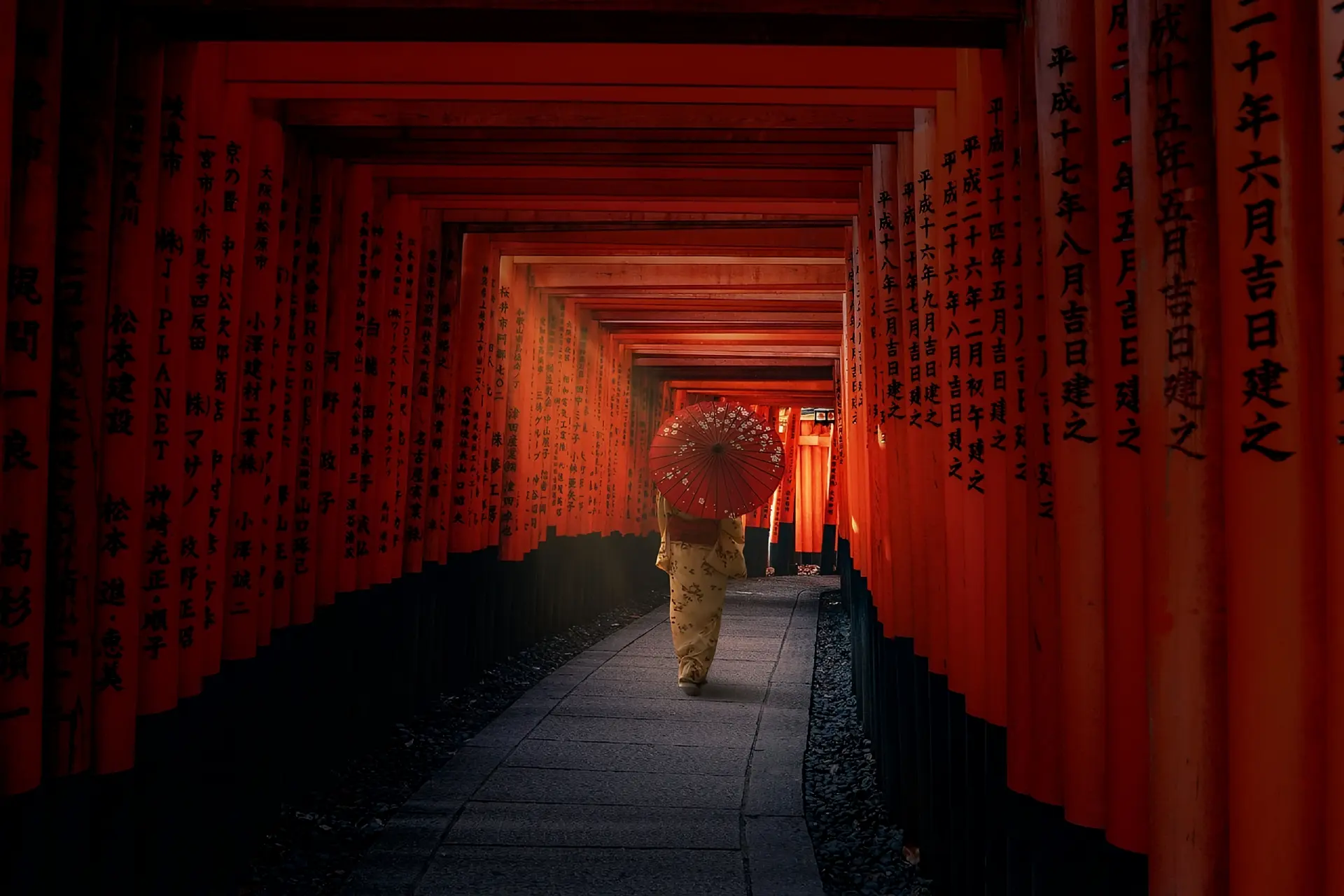

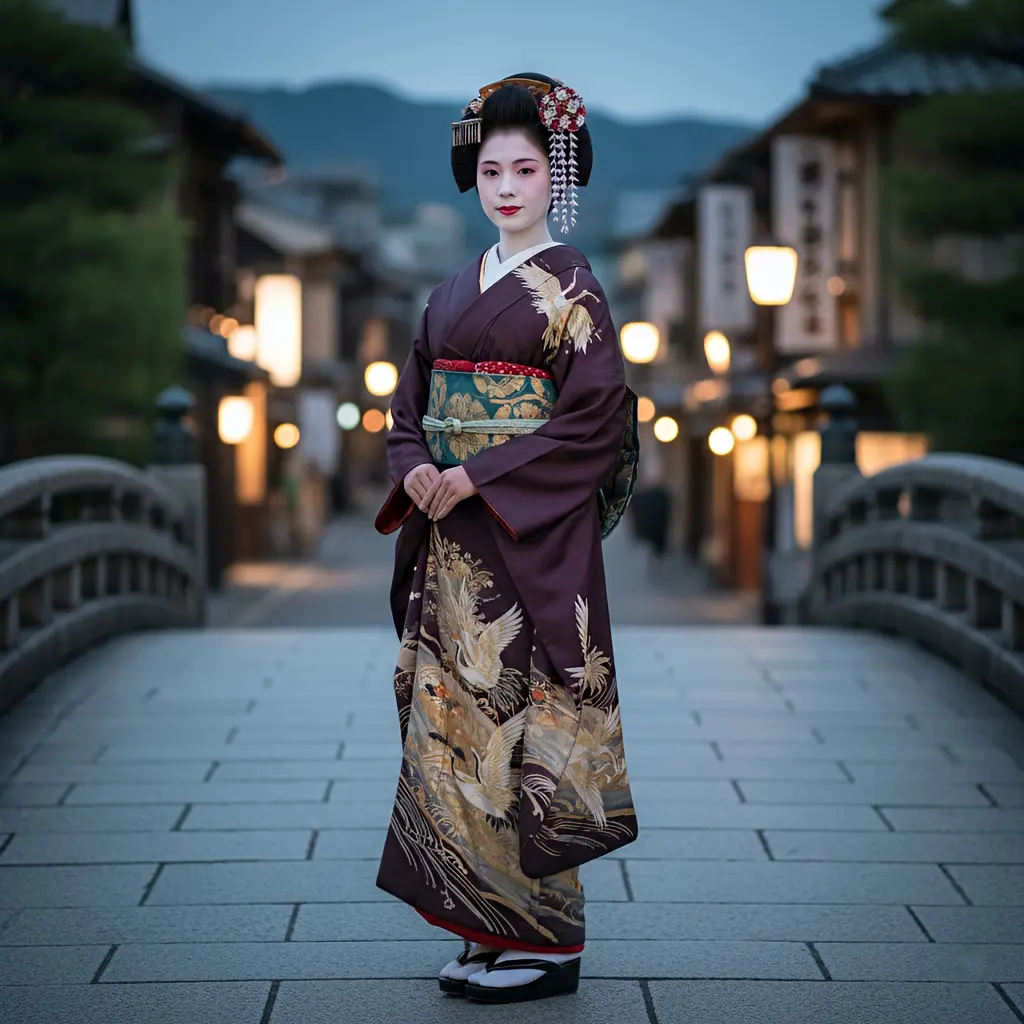
In Kyoto dialect, a fully trained geisha is called a geiko (Geiko, 舞妓) and an apprentice a maiko (舞妓). A geiko is typically 20 or older, whereas a maiko is usually between about 15 and 20, having entered training after finishing junior high. Maiko are still in the process of mastering the arts, whereas geiko have completed their apprenticeship and usually wear wigs instead of styling their own hair. Maiko kimono and makeup are more colorful and ornate (a red collar, long obi, dangling hair ornaments) to signal their youth and training status. Geiko outfits and style are more mature: simpler kimono with shorter obi, a fully white undercollar, and the iconic red lips but minimal flashy hairpins.
- The okiya, ochaya and the geisha ecosystem
- The career path: from shikomi to geiko
- A real 24-hour schedule: sample day for a Maiko
- What time do maiko wake up and why?
- What time do maiko wake up and why?
- Afternoon: rest, hair/makeup prep, dressing for evening
- Evening: ozashiki, performances, social duties — typical timeline
- Night: return home, cleaning, study — how late do they work?
- A real 24-hour schedule: sample day for a Geiko
- How does a geiko’s day differ from a maiko’s?
- Training & disciplines (detailed)
- Makeup, hair, kimono: a preparation timeline
- Okiya life & finances
- Social rules, relationships & restrictions
- How to see geisha in Kyoto (practical guide)
- Where and when to spot geisha on the street
- Are hotel performances, Gion Corner, and Miyako Odori good alternatives?
- How to book a legitimate ozashiki or private performance
- Photography & etiquette: do’s and don’ts
- Cost & tourist experiences: makeover vs real geisha events
- Myths, misconceptions & media representation
- The future of geisha in Kyoto: decline, revival & modern pressures
- Safety, legal & cultural boundaries for tourists
At present Kyoto’s geisha population is quite small. One Kyoto art foundation counts about 73 maiko and 186 geiko in the city’s five geisha districts. (For comparison, Kyoto’s hanamachi hosted over 3000 geiko/maiko at the peak of the 19th century.) These districts – collectively known as the Gokagai or “Five Flower Towns” – are Gion Kobu and Gion Higashi (the two halves of historic Gion), Ponto-chō, Kamishichiken, and Miyagawa-chō (often called Miyagawacho). Each is a tight-knit neighborhood of narrow streets and tea houses. Gion Kobu (along Hanami-kōji Street) is the largest and best-known district, while the others (all within a few kilometers of each other near Kyoto’s center) each cultivate their own style and festivals.
The okiya, ochaya and the geisha ecosystem
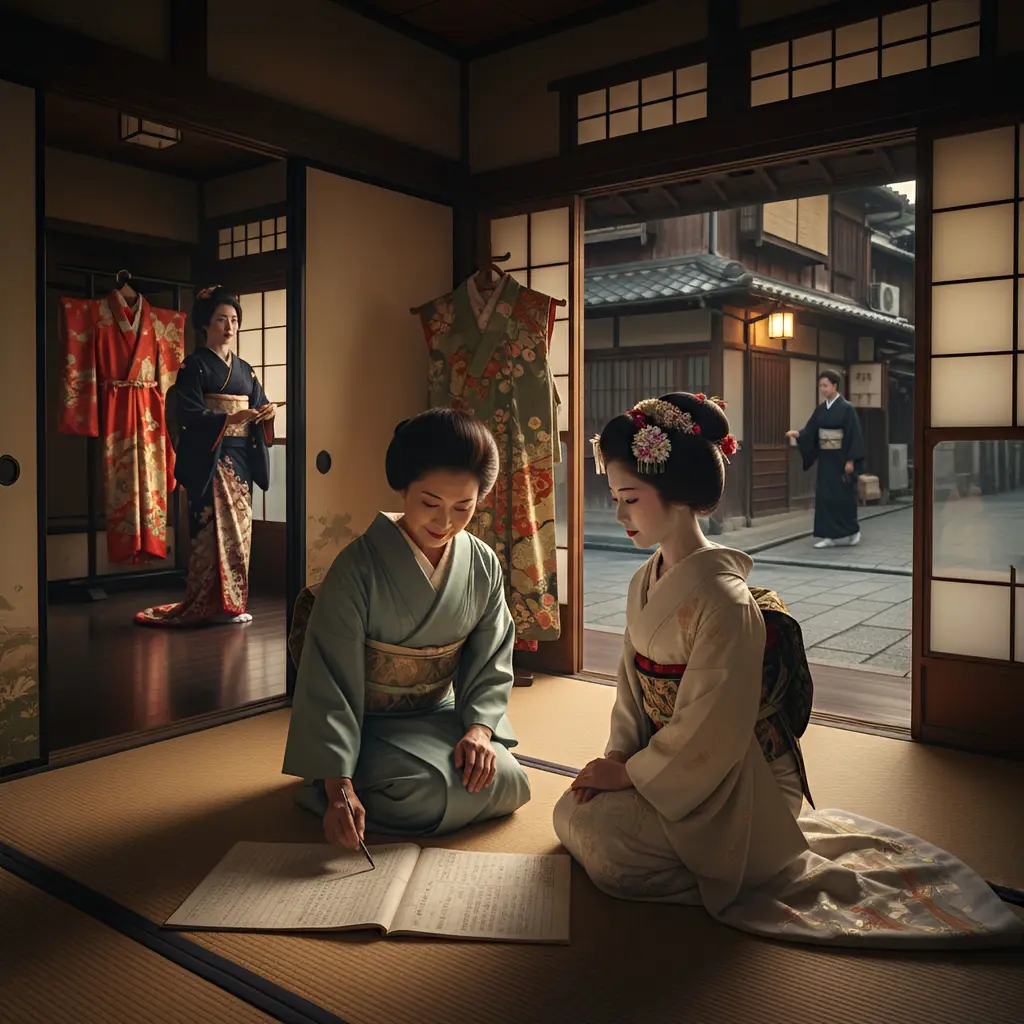
Kyoto geisha live in communal lodging houses called okiya (置屋). An okiya is run by a proprietress known as the okāsan (お母さん, literally “mother”). The okāsan treats her geisha or maiko as daughters: she provides their kimono and meals, manages their schedules and finances, and cares for them much as a parent would. Young trainees typically move into an okiya at the start of the shikomi stage and help with chores while they learn the arts. Okiya pay for all training and living expenses – kimono, lessons, food and lodging – and maiko incur a debt to the house that she repays through her earnings after debuting as a geiko. In practice, maiko usually live in their okiya until “erikae” (turning of the collar) when they become geiko, at which point some move out or live independently.
An ochaya (お茶屋) is a traditional teahouse where geiko/maiko entertain. These are exclusive establishments – historically built as discreet party rooms in Kyoto’s pleasure quarters – and still operate under the rule “ichigen-san okotowari” (“no first-time customers”). In other words, a visitor cannot simply walk into an ochaya; entry requires an introduction by an existing patron (or arranging a formal booking). Private parties held in ochaya are called ozashiki (お座敷). In an ozashiki the geiko/maiko serve tea and snacks, perform dances and music, and lead the guests in drinking games. These encounters are highly choreographed: kikubari (attentive hospitality) is paramount, and a geiko’s skill lies as much in conversation and serving sake as in performing arts.
Other roles in the geisha world include the makanai and the danna. The makanai is the in-house cook for an okiya; she prepares meals for the geiko/maiko and may sometimes be a junior geiko or a widow of a former geiko. (A Netflix drama called The Makanai recently focused on this helper.) The term danna (旦那) refers to a wealthy patron who supports a geiko. A danna typically pays large expenses – luxury kimono, travel costs, etc. – and in return may enjoy regular time with the geiko. Patrons might develop romantic feelings, but this is not obligatory and serious relationships are not expected; rather, patronage is a status symbol and a form of “silent sponsorship” in the geisha economy. By tradition a geiko may have multiple danna over her career, but she may never marry until she retires.
The career path: from shikomi to geiko
Becoming a geiko is a lifetime commitment. Most girls enter the profession at around 15–16, after finishing compulsory education. The training unfolds in stages:
- Shikomi (仕込み): The 3–12 month “trainee” phase of settling into the hanamachi. Shikomi live in the okiya and learn basic etiquette and arts while wearing a simple kimono. They are given domestic duties – cleaning, laundry, cooking and shopping for the house – and take their first lessons in dance, shamisen, and tea ceremony. Shikomi may not wear white makeup; their role is essentially to absorb the style and discipline of geisha life.
- Minarai (見習い): A brief observational period (roughly 2–4 weeks) once the girl has learned some basics. She starts accompanying senior geiko/maiko to real ozashiki to watch and absorb the performance environment. In minarai she may wear the full white makeup and elaborate kimono of a maiko, but does not yet independently entertain guests – she sits shyly to the side, learning by osmosis.
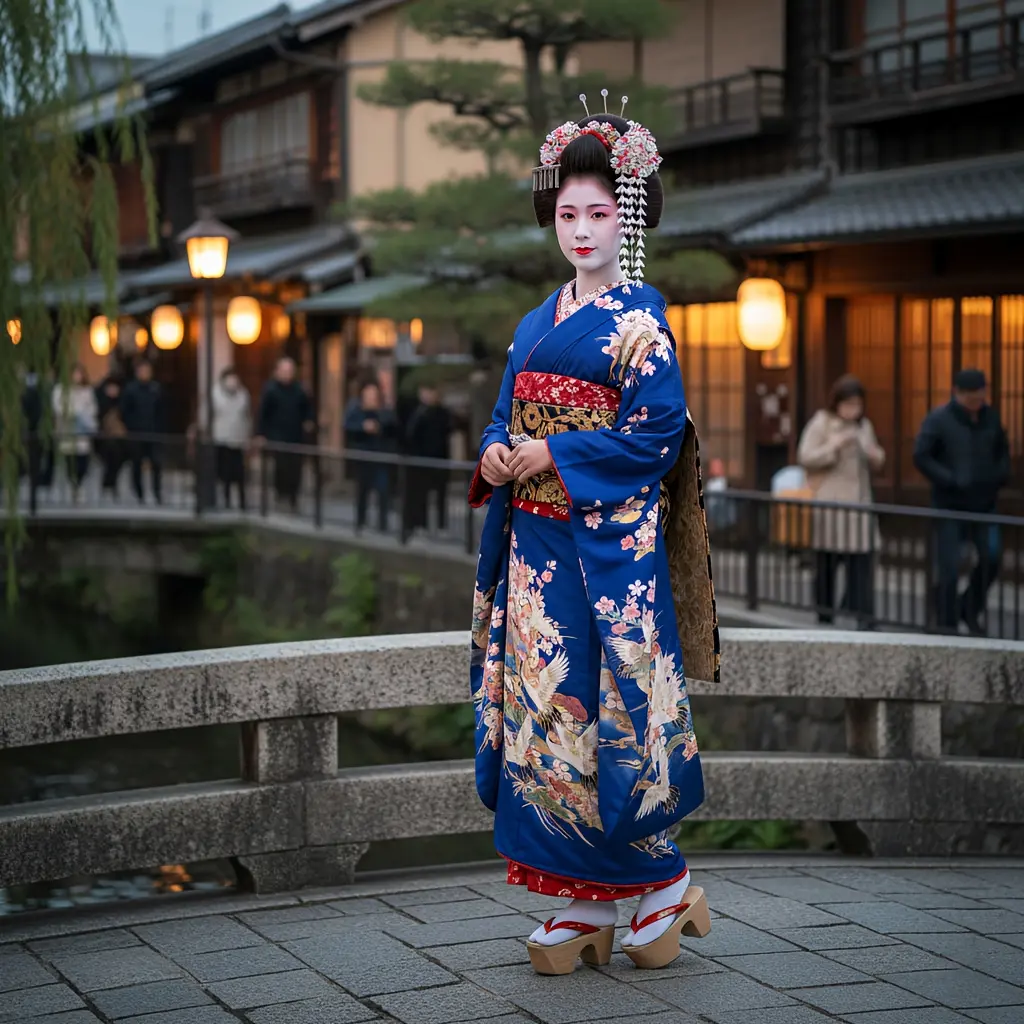
- Maiko (舞妓) stage: The official apprenticeship, usually lasting 5–6 years in Kyoto. At debut (misedashi), a girl becomes a maiko. Maiko live in their okiya under the okāsan’s care, wear the distinctive long-sleeved kimono, darari obi, and elaborate white makeup, and begin to perform as junior entertainers. Young jun-maiko (1st year) have only the lower lip painted and distinctive hair ornaments; senior maiko (2nd year+) wear the full white collar and the more complex hairstyles. Maiko are still learning – they specialize in classical dance (the meaning of “maiko” is “dancing child”) and gradually add musical instruments and conversation to their repertoire. It typically takes until age 20–21 for a maiko to complete this training.
- Geiko (芸妓) stage: Upon turning 20 (and after a formal ceremony called erikae, or “turning of the collar”), a maiko graduates to full geiko status. A geiko wears more subdued attire (short-sleeved kimono, wig) and is considered a senior hostess and artist. Geiko can choose to specialize further (for example focusing on shamisen or dance), and enjoy much more personal freedom – including the opportunity to keep boyfriends – than during apprenticeship. There is no upper age limit: some geiko continue performing well into their 40s or beyond. However, custom dictates that a geiko must retire if she marries.
Becoming a geiko thus requires 6–7 years of intensive preparation in Kyoto’s hanamachi. By law there is no formal “test” at the end; instead the okiya’s okāsan and senior geiko judge when the maiko has learned enough to debut and then when to graduate. In rare cases someone who entered later or wants a short training may skip the maiko phase entirely after a lengthy shikomi, but this is exceptional.
A real 24-hour schedule: sample day for a Maiko
What time do maiko wake up and why?
A maiko’s day is governed by zazen-like discipline. Most Kyoto maiko rise between 6:00 and 7:00 AM, roughly with or before the shopkeepers. (Tokyo geisha often wake later, but Kyoto’s tradition is early.) A Fukuya geiko quoted by Silversea wakes at 8:00; but in Gion it is not unusual for trainees to be up by 6 AM, especially if there are early morning kimono fittings or ceremonies. Waking early allows a maiko to finish personal preparations and help with okiya chores before formal training begins.
What time do maiko wake up and why?
By 8:00–9:00 AM a typical maiko will have changed into her work kimono (or if still shikomi, her simple okiya kimono) and started household duties. Younger apprentices spend the first hour cleaning tatami floors, doing laundry, carrying out any errands (kappō, “scuttling” for tea and sweets), and helping to prepare the morning’s sweets and tea for the house. At the same time senior geiko may perform religious visits or duty calls (jichō) at local temples, and some guests may call early.
By 10:00 AM or so formal instruction begins. The maiko attends a “school” inside a public dance hall (kaburenjō) or a designated lesson room. Training alternates daily among the arts: classical dance (nihon-buyō), shamisen or koto music, tea ceremony, ikebana (flower arranging), and kyō-kotoba (Kyoto dialect conversation). A typical morning session might run two to three hours, often with an older geiko or a professional instructor giving one-on-one lessons. Around midday the young women break for a rice lunch together. Many maiko (and geiko) will nap briefly or study afterwards. (Some travel to Kyoto’s hairstylists in late morning to maintain their coiffure – Gion Kobu geiko famously sleep on rice-straw pillows to preserve style.)
In sum, by late morning a maiko has already spent hours in unpaid apprenticeship (house work + lessons). Altogether a maiko might train 4–6 hours per day in dance and instruments. Only a few geiko manage to practice that many hours after they become independent; apprentices often sleep little and continue learning even past midnight.
Afternoon: rest, hair/makeup prep, dressing for evening
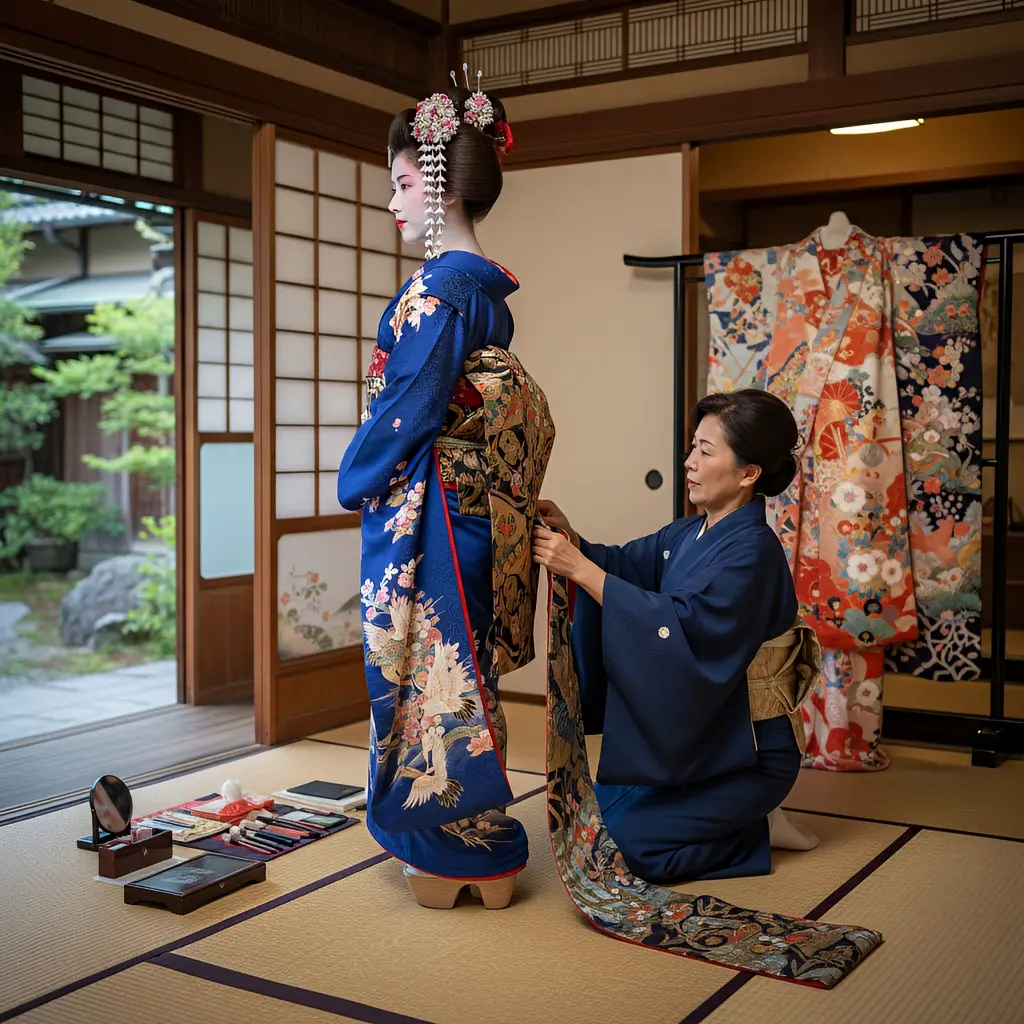
After the morning lessons and lunch, a maiko usually has a brief rest. By 2:00–3:00 PM she returns to the okiya to begin preparations for the evening. This often involves changing into undressed kimono and styling hair if she is still wearing her own hair (most maiko do their own nihongami up until graduation). Junior apprentices may visit a professional dresser for an elaborate wig or hairstyling, while all maiko have assistants helping them into the heavy kimono and perfecting their make-up. Applying full shironuri makeup (white face with red/black accents) and layering on multiple kimono and skirts can take 90 minutes to 2 hours. During this time the maiko is attended by older maiko or geiko who tie the obi (belt) and pin on seasonal kanzashi hair ornaments appropriate to the month.
By about 5:00 PM the maiko is in full dress: elaborately coiffed (or wigged), fully made up, and carrying her small purse and fan. With a final sip of tea she leaves the okiya to make her first dinner visit or head straight to her first engagement.
Evening: ozashiki, performances, social duties — typical timeline
Later on, as dusk falls on Gion Kobu, a maiko makes her way along lantern-lined alleys to the evening’s ozashiki (private banquet). Private parties typically begin around 6:00 PM and last two hours. At each ozashiki, the maiko and a senior geiko perform songs and dances (often Kyomai, the refined Kyoto dance) for a table of guests, serve tea and refreshments, play traditional games (like kaeshi-bai and budōdeshi), and engage in polite banter and praise, always mindful of kikubari (attentiveness). The maiko switches kimono between engagements – she may perform the first party in a bright costume and then change into a more formal one for the next – and spends the lulls between parties sipping sake or snacks. Hotel demonstrations or festival performances (e.g. Miyako Odori in April) follow a similar pattern but in a theatre setting.
If a maiko has two parties in one night (common for sought-after girls), she might be out until 10:00 or 11:00 PM. One Kyoto geiko described that after guests left around 8 PM, she would change and spend one more hour chatting, and then return home. By contrast, if she has only one party, she might be back by 8:30–9:00 PM. It is rare but not unheard-of for a maiko to attend a very late banquet, especially during peak season. (Kyoto now enforces restrictions to keep them off the streets very late, though historically geiko would sometimes stay out past midnight.)
Night: return home, cleaning, study — how late do they work?
Once the parties end, the maiko returns to her okiya. Even then, her day is not over. She helps change and store the kimono (cleaning or airing it for the next day), unwraps the obi, and washes off her stage makeup. If she has an exam or has fallen behind, she may study or rehearse dances until late. Light dinner or sake is often shared quietly in the okiya among the house, and by around midnight or 1:00 AM many maiko finally go to bed. (Some geiko stay later, especially after special events.) In total, a trained maiko can be awake and “on duty” in one way or another for 16–18 hours on a busy evening. Periods of modesty and rest are scarce – even on her two monthly days off, a maiko still trains in studio or helps with kimono preparations.
A real 24-hour schedule: sample day for a Geiko
How does a geiko’s day differ from a maiko’s?
A fully qualified geiko (over age 20) follows a similar outline but with some freedoms and differences. By the morning a geiko is usually already dressed in an easy kimono (she no longer lives in the okiya and has her own lodging) and might wake somewhat later. Her daytime training is much lighter: a geiko will do about 2–4 hours of practice (rehearsing songs, dance, or music) rather than the marathon apprenticeship of a maiko. After lunch she has more personal time. She may manage her own diaries, socialize with patrons, or assist the younger girls in her former okiya.
In the evening, a geiko’s duties focus on conversation and companionship as much as performance. She attends private parties (often booked through her danna or agency), enjoying more choice in scheduling than a bound-to-oikia maiko. Typically a geiko will have one or two engagements per evening. Unlike maiko, geiko generally wear more subdued kimono and wigs (known as katsura) rather than doing the full hair styling. Because a geiko does not have the demanding half-year schedule of colorful outfit changes, she often goes to her evening party dressed by 6:00 PM. Afterward she might stay later than a maiko – some geiko in interviews reported returning home only at midnight or 2:00 AM if the party runs late.
Overall, a geiko can shape her own rhythm. She must entertain all nights she is booked, but she can take more extended breaks on off-days or holidays. (In practice, many geiko still work most weekends – Friday and Saturday remain peak nights.) Since geiko handle their own finances and living costs, they also have more flexibility: by arrangement a geiko might decline a second-party request on her day off, while a maiko would be expected to oblige. In return for this autonomy, however, each geiko faces intense competition to stay in demand. Only the most popular geiko regularly earn the plum Friday-Saturday slots; others must supplement with smaller clubs or hotel events.
Training & disciplines (detailed)
Daily lessons for maiko and geiko cover a dizzying array of traditional arts. Dance (nihon-buyō) is central: Kyoto geiko generally learn the elegant Kyokanyen or Kamogawa dance styles, taught by local masters (like the famed Inoue school). Maiko practice months in advance to master each season’s repertoire of dances. An experienced maiko often spends 3–6 hours per day on dance practice alone. Geiko, while past the apprentice stage, still rehearse and invent new performance pieces, especially if they lead the major dances at events.
Music is the other pillar. All maiko learn to play shamisen (the three-stringed lute), the instrument most identified with geiko. They practice shamisen several times a week, learning both solo pieces and party songs. Some also train on koto (Japanese harp) or percussion like taiko drums. In an evening ozashiki a maiko will strum a shamisen tune or sing along to accompany her dance. Only the top geiko become standout musicians; most focus on shamisen and karaoke-style dancing, occasionally picking up a koto or flute for variation.
Beyond performing arts, apprentices study tea ceremony (sado), ikebana, shodō (calligraphy), poetry and Kyoto dialect. Every maiko must be able to host a tea ceremony in the traditional way, and they each serve as maturisai (festival priestess) at local shrines yearly. Strong Japanese conversation skills and wit are taught as kyō-kotoba, enabling geiko to navigate subtle social cues and keep any guest entertained. In total, the daily curriculum can include 6–8 classes of various arts. By contrast, modern corporate bridesmaid courses or one-off dance lessons cannot begin to match this breadth. Geiko often describe themselves as custodians of an old-world aesthetic, combining every lesson into a single standard of charm and attentiveness known as iki (a discreet sophistication).
Makeup, hair, kimono: a preparation timeline
A geiko’s appearance is a work of art in itself. Maiko makeup (white oshiroi paint, red-and-black accents) must be applied twice a day. In the morning before duties, a trainee simply washes her face and may put on light lotion; she avoids full stage makeup except for special events. By afternoon she completes her shironuri: first a thick layer of white foundation, then red on lips and the corners of the eyes, and bold black eyebrow paint. A senior geiko needs only a touch-up (her “everyday” look is often a soft pink blush), but she may reapply full makeup if she has an evening engagement. The signature red lipstick pattern – initially just the lower lip on new maiko – is broadened to both lips as an apprentice matures.
Hair styling is equally elaborate. Junior maiko wear their own hair in a complex updo called wareshinobu, with long pins and dangling kanzashi flowers (long petal hairpins). Senior maiko adopt simpler buns like ofuku. Geiko do not do their own hair: they switch to wearing a wig (katsura) styled in a mature shimada or yu-shimada fashion, which stands in for them nightly. Kanzashi ornaments change month to month: plum blossoms and camellia in winter, waving grasses in summer, gold Autumn leaves in fall, etc. Seasonal timing is crucial – for example, maiko wear special red maple leaf pins for Momiji Odori dances in November. The entire process of dressing – washing one’s hair, then arranging the real or wig style, then sitting still while assistants lace on layers of kimono and obi – can occupy 2–3 hours in the late afternoon.
The kimono itself is a study in weight and formality. A junior maiko wears a furisode (long-sleeved) kimono with an exquisitely tied darari obi that trails behind; this outfit can weigh 15–20 kg. Geiko wear shorter sleeves (tomesode) and tie the obi in a simple square knot. Underneath both wear multiple undergarments and stiff padding to hold form. In summer they change to lighter, unlined kimono (nagajuban and yukata), while for formal performances they may switch to karaginu (ceremonial robe) briefly. In all cases, onlookers see only the polished final result by showtime: by 6 PM a fully dressed maiko’s appearance is entirely transformed from her groggy morning self.
Okiya life & finances

The okiya system underwrites geisha careers. All training and living costs (lessons, kimono rental, food, and even allowances) are advanced by the okiya’s proprietress. A new apprentice never pays any money upfront; instead she accrues a debt to the okiya which the house recoups from her first earnings. In practice this means the okāsan negotiates each party’s fee (often via the kenban office) and keeps a share, passing the rest to the geiko. A modest geiko might be engaged for ¥40,000–¥60,000 per two-hour party, of which only part goes into her pocket after the okiya’s cut and other fees. As a rule, maiko do not receive direct payment – their household is “paid” by the okāsan as a normal part of apprenticeship – whereas geiko take home whatever portions have been promised.
Because of these complex deductions, a young geiko’s monthly take-home pay can be very small, even a few tens of thousands of yen, until she becomes popular. A superstar geiko, by contrast, can gross several million yen per month in private bookings. (Precise figures vary widely.) Advantour notes that geiko “receive full compensation for their engagements,” yet incomes vary drastically with skill and popularity. In any event, the okiya debt must usually be cleared within a few years. Once a geiko has repaid her training costs, she is said to “stand on her own” and keeps most of her future pay. Long-serving geiko may even receive a small allowance or pension contribution from the okiya as they age.
Geika do get rest days – but few. By regulation a maiko is entitled to only two days off per month. (These might fall midweek and are strictly for personal matters, not sightseeing.) Extended breaks come only at major holidays: New Year, Golden Week and Obon each grant a week-long closure at most okiya. Geiko (as household heads) largely set their own schedule, taking time off when they see fit. Even on off days, a geiko may be expected to rehearse privately or meet patrons. In short, live-in trainees work six days a week year-round.
Social rules, relationships & restrictions
Geisha traditions impose strict personal rules. Apprentices may not have boyfriends: sleeping quarters in the okiya are shared, and communications are tightly controlled. Indeed, a Maikoya guide jokes that chasing after maiko on the street is futile (they won’t speak). In practice, geiko (post-debut) do gain some private lives: many will quietly date, provided it does not become public or violate the town’s reputation. However, marriage is forbidden as long as one is an active geiko. If a geisha chooses to wed, she must formally retire from the profession. This rule underlines the geisha ideal that she is “married” to her art and clients, rather than forming a conventional household. Modern geiko may use cell phones or email – many do in fact – but still generally avoid flashy displays. (Rule variations depend on the okiya; some older okāsan still restrict internet use for junior maiko.)
New Kyoto geisha face few legal limits beyond these. By custom they do not drink (especially not hot tea or alcohol) while in full ohaguro (blackened teeth) period, although this detail now concerns only the final few weeks of apprenticeship. Smoking is rare due to Kyoto’s health regulations for performers. In recent years, many hanamachi have relaxed certain anachronistic rules: for example, unmarried geiko occasionally do have sincere, boyfriend relationships, especially those who live apart from the okiya. But on any account, the geisha path remains demanding and insular by nature. Only a small fraction of hopefuls finish the training, and each must devote herself almost entirely to the okiya and the profession.
How to see geisha in Kyoto (practical guide)
Where and when to spot geisha on the street
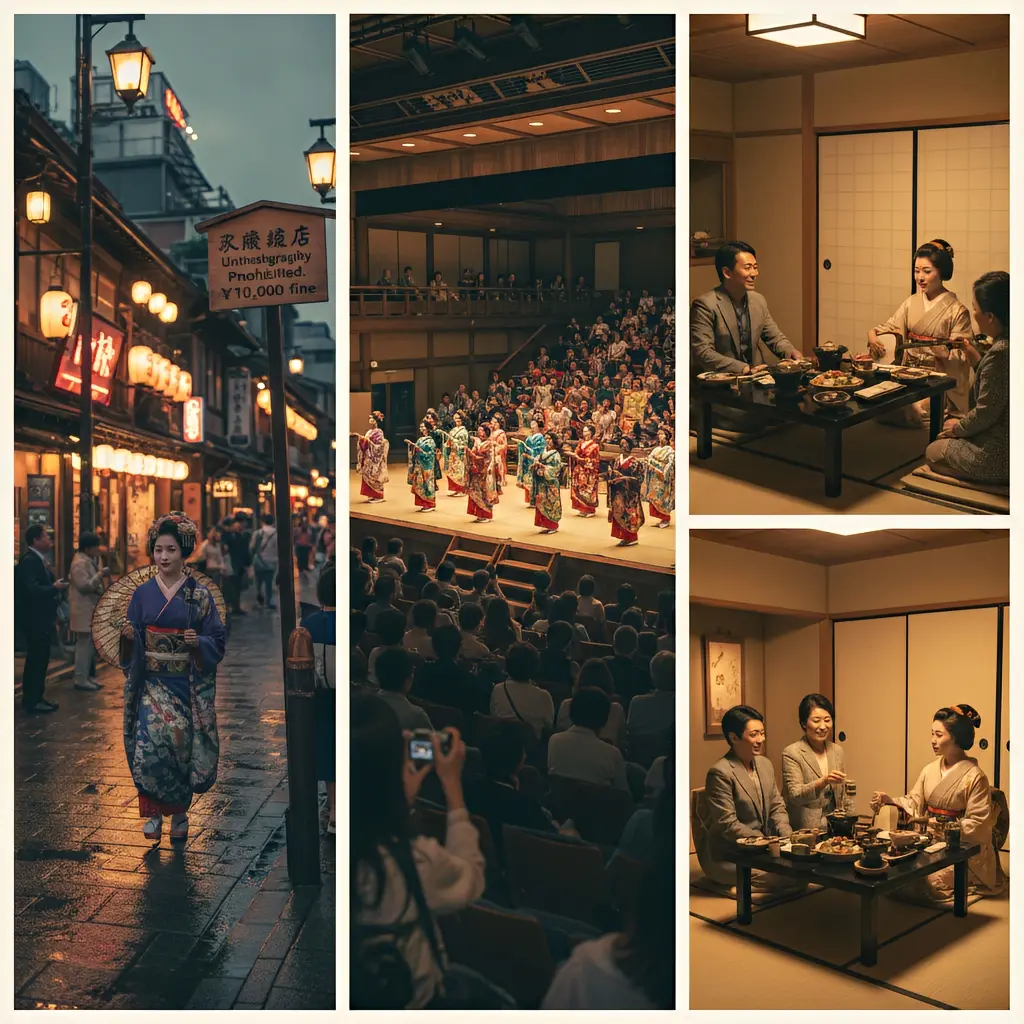
Kyoto’s hanamachi are public so you will see geiko and maiko if you know where to look – but timing and discretion are everything. The most famous spot is Gion Kobu, especially the section of Hanami-kōji Street by Shijō-dōri. After 5 PM on Fridays and Saturdays (the busiest nights), you can sometimes spot a line of maiko rushing to dinner. A few blocks away, around Ichiriki Chaya, is another high-probability corner. Ponto-chō’s narrow alleys are a second hotspot for chance glimpses just after dusk. By contrast, on rainy nights or weekday afternoons you are unlikely to see any geisha at all. In short, early evening (6–8 PM), downtown hanamachi, good weather and weekends maximize your chance.
Importantly: do not chase or crowd. Signs in Gion now explicitly forbid tourists from cornering geiko or taking photos without consent. Many residents bow politely (and often tourists reflexively bow) when a maiko glides past, but aside from a brief nod no one interrupts her task. If you do spot a geiko or maiko, admire from a respectful distance. Avoid blocking doorways or calling out. Under no circumstances should you touch her kimono or try to pull her for a picture. Kyoto introduced fines (up to ¥10,000) for unauthorized photography in the geisha districts. (A tourist in 2022 was even fined for snapping from a car window.) In practice, politely photographing from across a street is tolerated, but expect most geisha to refuse any photo request.
Are hotel performances, Gion Corner, and Miyako Odori good alternatives?
Absolutely. Kyoto provides public alternatives to chance encounters. Gion Corner (in Gion Kobu) runs nightly shows (usually at 6 PM and 7 PM) featuring Maiko dances and short segments of tea ceremony, theater, and Kyogen – all in about a one-hour program. The Kyōmaiko dance showcased there is performed by an apprentice; professional geiko music is highlighted in the concert. This is ticketed (around ¥3,500–¥4,000) but guarantees seeing geiko/maiko in person, if in a stage setting. The annual Miyako Odori (April 1–21) is the most celebrated festival dance: over 80 Gion Kobu geiko and maiko perform a full theatrical program at the Minamiza theatre. Advanced booking is essential, but attending once in Kyoto will reward you with a vivid, authentic glimpse of geisha artistry on the big stage. Similarly, each hanamachi has its own dance show (Gion Odori in November, Kamogawa Odori in May, Kitano Odori in March, Kyo Odori in May/June, etc.).
Many luxury hotels also offer geisha dinners or salon shows for guests. For example, Four Seasons Kyoto has weekly lobby shows, and traditional ryokan (e.g. Hiiragiya, Tawaraya) can arrange a geisha visit for their dining hall. These events typically cost ¥20,000–30,000 per person and include a formal kaiseki meal and a short geiko/maiko performance, followed by conversation and games. Booking through a hotel concierge is a sure way to a respectful experience. Alternatively, several Kyoto “taiken” companies (like Maikoya) sell geisha tea-ceremony sessions (from about $100 per person), or daytime dance performance tickets.
How to book a legitimate ozashiki or private performance
True ochaya parties cannot be accessed on a whim. Foreign visitors historically needed an existing reference. However, some okiya have started facilitating first-timer encounters. Today a common route is through an intermediary (such as a travel agency or hotel). For instance, if you stay at a well-known ryokan, the proprietors often have ogiya who will “invite” a geisha to your private room. Another is to join a group tour that includes a geisha performance and talk (these typically use off-duty geiko with a translator).
The international rule “ichigen-san okotowari” (“first-time guests refused”) still stands in principle, but many ochaya are flexible if the introduction is made. In practice one books an official package – a geisha dinner show or tea ceremony – rather than handling it directly. Be prepared to pay a premium: a hotel-arranged dinner party might run ¥50,000 (~$400) for two hours, whereas a public taiken show is much cheaper. Tip: ask for Kyoto Traditional Musical Art Foundation referrals or look at the official Kyoto geisha calendar for public events. Never take an unverified offer; only trust lodgings or well-known agencies.
Photography & etiquette: do’s and don’ts
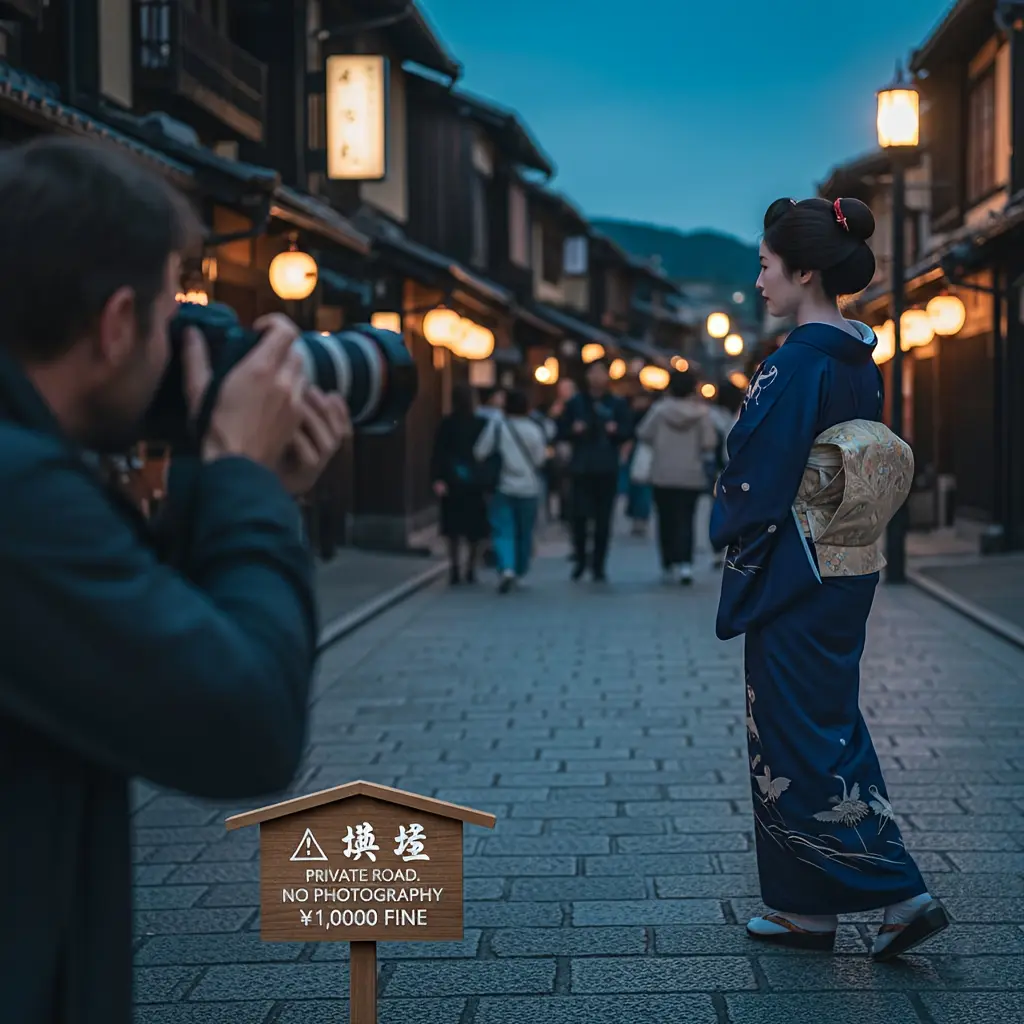
One timeless rule: a geisha’s work is private, not a photo op. Kyoto’s districts now post “no photography” signs in the alleyways, backed by fines. If you see a maiko walking alone, do not follow or surround her. The correct gesture is a brief bow and smiling quietly, then step aside. If you absolutely must take a picture, use a zoom lens from a distance and ask permission in a whispery tone. Expect a polite refusal. Flashes, overtures or pursuit will provoke annoyance or even legal action.
It’s similarly impolite to ask a geiko to stop on the street for questions. If you encounter one, do not assume she will speak English; she may ignore or simply thank you with otsukaresama and move on. Touching any part of her kimono – even a sleeve! – is taboo. Avoid any physical contact: these robes and hairpins are expensive and fragile.
When attending a performance or tea ceremony, dress modestly (summer kimono rentals are fine, but avoid overly short skirts or loud casual wear). Once inside an ochaya or theater, observe formality: remove shoes, sit quietly on tatami cushions, and pour tea for geiko guests if served. Do not interrupt the entertainment during performances. If you are allowed to clap (for an instrument solo, say), follow the cue of locals or the host. Above all, remember that you are a guest in someone’s living tradition – respectful restraint will always be noticed and appreciated.
Cost & tourist experiences: makeover vs real geisha events

Genuine geisha entertainment is luxurious. A private ozashiki (multi-course kaiseki dinner plus two hours of geiko performance) in Kyoto today runs roughly ¥40,000–¥60,000 per person (meal included). A simpler hotel or restaurant geisha show (set meal + entertainment) might cost ~¥20,000–¥30,000. By contrast, geisha/maiko makeover experiences – where tourists dress up in kimono for photos – are much cheaper and very different in substance. For instance, a studio transformation and photo shoot might cost ¥10,000–¥25,000 and takes 2–3 hours. These experiences allow one to wear white makeup and hairstyling, but they offer none of the months of training or live performance.
In short, the makeover shows you the surface of geisha attire, but not the culture. In exchange for the lower fee, you are posing in rented kimono and a false wig, usually in a posed studio setting. By comparison, an authentic geiko will have invested years (and thousands of hours) perfecting every gesture you observe in a dinner show. Travelers should be honest about their goals: if budget is low, the official dance performances and tea ceremonies are far more revealing of geisha artistry than any makeup studio. And if you do spend on a geiko party, do it through a reputable provider (e.g. Maikoya, Gion Corner, Gion Hatanaka) that guarantees a real geiko or maiko will attend. Always read contracts carefully: traditional ochaya services can include substantial deposits and strict cancellation policies.
Myths, misconceptions & media representation

Geisha ≠ prostitutes. This is perhaps the most pernicious myth. Modern Kyoto authorities explicitly condemn that idea as “a wrongful portrayal” – geiko are highly trained entertainers, not sex workers. (One scholar notes the confusion arose only in post-war history when some women in the red-light districts posed as geisha to attract GIs.) In reality, geiko hand over all illicit advances to the kenban (their management office) for punishment. They entertain exclusively with music, dance, and conversation. As one Kyoto guide puts it, geisha “sell their skills, not their bodies”.
Fictional accounts have muddied this further. Memoirs of a Geisha (by Arthur Golden) was written without full permission and dramatized geisha life. Many Kyoto geiko protested its inaccuracies; its author was sued for defamation by geiko Mineko Iwasaki. While Memoirs correctly conveyed that geiko must maintain celibacy, it falsely implied mass “mizuage” (forced sale of virginity) traditions, which ended in Kyoto long ago. Today geiko characteristically form relationships at their discretion, but never through purchase. Academic sources and retired geiko writings make clear: the sex worker stereotype is a post-war Western delusion.
Other media portrayals: Netflix’s The Makanai: Cooking for the Maiko House (2023) is based on a manga, and centers on the house cook and her trainee sister. It brought attention to geisha culture but is a feel-good fiction. The meals and rice-working scenes are often accurate (the makanai role is real), but the show simplifies the long training and reality of work. Similarly, geisha-theme songs, anime or novels will emphasize the beauty and drama – not the tedium of daily practice. In using such media, bear in mind the distinction: books and movies may point you toward the real Kyoto geisha world, but should not be taken as literal documentaries.
The future of geisha in Kyoto: decline, revival & modern pressures

Like many traditional arts, Kyoto geisha are in a precarious era. Nationwide there were about 80,000 geisha in the 1920s, but now fewer than 1,000. In Kyoto alone, numbers fell dramatically over the 20th century. For example, there were over 3,000 geiko/maiko in Gion around 1880; by the early 2000s the figure was in the low hundreds. Reasons are many: urbanization, WWII devastation, modern career alternatives, and the expense of training have all played roles. Today only about 260 women are registered as geiko in Kyoto’s five districts (with ~70 of them maiko) – a steep drop from past generations.
Yet Kyoto’s geisha culture is far from extinct. Both government and private groups are promoting new entrants. Schools (kaburenjō classes) hold informational sessions for young women; some okiya have started accepting foreign trainees (though none have yet debuted). Tourism is a double-edged sword: while too many gawkers can aggravate geiko, revenue from tourists funds public shows like Miyako Odori, and some tea houses share profits with geisha subsides. One unique initiative is the Ookini Zaidan (京都伝統芸能振興財団, Kyoto Traditional Arts Foundation), which publishes annual stats and even sponsors exchange events. Festivals like Gion Kobu’s Miyako Odori and Kamishichiken’s “Kitano Omukae” encourage public interest and scholarship.
Many geiko see hope in international interest. Some retired geisha become ambassadors – writing books, lecturing, or mentoring. Others partner with universities to offer cultural programs. Modern technology also finds a place: while geiko themselves rarely post on social media, some hanamachi publish official Instagram accounts to share seasonal events. And though a maiko may not tweet, the community embraces YouTube documentaries and travel articles that respectfully document their world, so long as privacy is guarded.
Ultimately, Kyoto geisha endure by balancing tradition with change. While numbers will likely remain small, each new apprentice is greeted as a revitalization of centuries-old beauty. The geisha districts are vigilant against anything that might turn them into “men’ya” (male-dominated entertainment) locales. For now, that means educating tourists carefully (with guides like this one), regulating behavior with fines, and celebrating the art at public venues. The future of the geisha rests on this cautious embrace of tourism – enough to survive, but not so much as to lose their mystique.
Safety, legal & cultural boundaries for tourists

Visiting Kyoto’s geisha districts is generally safe, but common sense is key. The narrow wooden alleys can be dimly lit – watch your step (tatami threshold, uneven pavement). Do not stumble into geisha bustle or lean on their house walls. Tokyo travel advisories note past incidents of foreign tourists harassing geiko; in Kyoto the police now patrol Gion on busy nights to prevent problems. If an encounter with an offended geisha occurs (e.g. a tourist refuses to back off), politely apologize and retreat. Citizens can report misconduct by calling the Kyoto Tourist Safety Hotline.
Legally, the main risk to tourists is violating Kyoto’s public-access rules. As noted, taking flash photos or pushing through crowds in prohibited side-streets can incur fines. It is not illegal to wear a kimono on the street (many locals rent them daily), but do not wear one with the intention of “following” geiko – it can attract unwanted attention. Always have your Kyoto rail pass or purchase stamp card ready to present on request in special geisha areas (they’re official heritage zones).