

Cultural etiquette · Japan
Attending a Traditional Japanese Tea Ceremony: A Respectful Guest’s Guide
A bowl of matcha is the visible centre of the gathering, but the deeper experience lies in the host’s preparation, the guests’ attention and the temporary harmony created between room, season, objects and people.
This guide prepares first-time guests to participate calmly without pretending to master a lifetime discipline.
The phrase “Japanese tea ceremony” can refer to experiences of very different depth. A short visitor demonstration may explain the main gestures in an accessible way. A tea gathering may include sweets and thin tea. A formal chaji can unfold over several hours, with a meal, charcoal procedure, thick tea and thin tea arranged as one continuous act of hospitality. Before worrying about how to rotate a bowl, a traveller should therefore understand what has actually been booked. The host’s instructions for that gathering are more important than a generic list of rules.
The tradition is commonly called chanoyu, “hot water for tea,” or chado and sado, “the way of tea.” Those terms point to overlapping but not identical emphases: practical preparation, an artistic and social discipline, and a path of sustained study. The practice has many schools and local variations. Gestures that are correct in one context may differ in another, so humility is more appropriate than memorising a supposedly universal script.
For a first-time guest, the most useful qualities are punctuality, clean and simple clothing, willingness to observe, and the confidence to ask what is expected before the ceremony begins. Hosts who welcome international visitors generally do not expect flawless performance. They do expect guests to treat the room, utensils, food and one another with care. A sincere bow and attentive silence communicate more than a nervous display of technical knowledge.
This guide follows the useful subject coverage of the original article while clarifying distinctions that are often blurred in tourism marketing. It explains the ceremony’s ethical frame, the sequence a guest is likely to encounter, the role of sweets and tea, practical booking questions, accessibility, children, photography and common mistakes. It is not a substitute for a teacher. Its purpose is to make the first invitation less intimidating and more meaningful.
Before the gathering
Tea as hospitality, discipline and encounter
The ceremony is not a museum performance frozen in time; it is a living practice renewed between a particular host and particular guests.
At its simplest, chanoyu is the preparation and sharing of powdered green tea in a deliberately arranged setting. That simplicity is deceptive. The host may have spent days choosing utensils, cleaning the garden path, considering the weather, selecting a scroll, arranging flowers and matching sweets to the season. Movements that appear economical are supported by years of practice. The guest’s role is not passive consumption. By observing, responding and appreciating, the guest helps complete the occasion.
Urasenke and other traditions describe principles commonly expressed as wa, kei, sei, jaku: harmony, respect, purity and tranquillity. These words should not be treated as decorative slogans. Harmony includes the relationship among people, objects, food, room and season. Respect is visible in how guests handle utensils and acknowledge labour. Purity includes physical cleaning but also the effort to set ordinary distraction aside. Tranquillity is not simply silence; it is the quality that can emerge when the other principles have been practised.
Another frequently encountered phrase is ichigo ichie, often translated as “one time, one meeting.” It does not mean that every ceremony must be solemn or that the same people can never meet again. It asks participants to recognise that this exact combination of season, light, host, guests and objects will not recur. That awareness gives weight to small details: condensation on a water jar, the sound of the kettle, the texture of a bowl or the way a sweet anticipates a flower not yet open outdoors.
The modern visitor experience occupies a broad spectrum. Some venues present an explanatory demonstration in ordinary seating, designed to make key ideas visible within a short booking. Others invite guests onto tatami, teach basic bows and allow them to whisk their own tea. A chakai is a relatively light gathering, often involving sweets and tea. A formal chaji is more extensive and may include a meal, charcoal, thick tea and thin tea. None should be judged solely by duration. An introductory experience can be excellent when it is honest about its format and led with care.
The tradition also has multiple schools, each with its own lineage, utensils, procedures and teaching culture. Even the way a bowl is turned or a sweet is handled may vary. A guest should avoid correcting another participant based on a video watched beforehand. The host or assistant will guide the room. When instructions are not understood, it is respectful to pause, watch the next person and ask quietly rather than improvising with an expensive or fragile object.
Understanding this frame changes the traveller’s purpose. The ceremony is not a test of Japanese identity, an exotic photo opportunity or a performance purchased for entertainment. It is an invitation to notice how hospitality can be made visible through preparation. The guest honours that invitation by bringing curiosity without entitlement and by allowing a simple bowl of tea to command undivided attention.
Four working principles
Harmony
Host, guests, setting, season and objects are considered together rather than as separate attractions.
Respect
Careful handling, listening and acknowledgement make the guest an active part of hospitality.
Purity
Cleaning prepares both the physical space and the mind for focused attention.
Tranquillity
Calm is cultivated through practice; it is not demanded as a mood before the gathering begins.
Tea room · Japan
A Traditional Chanoyu Gathering
A carefully prepared meeting in which the host offers tea and the guests respond through attention, movement and appreciation.
Primary subject: the complete host-and-guest experience rather than any one utensil or gesture.
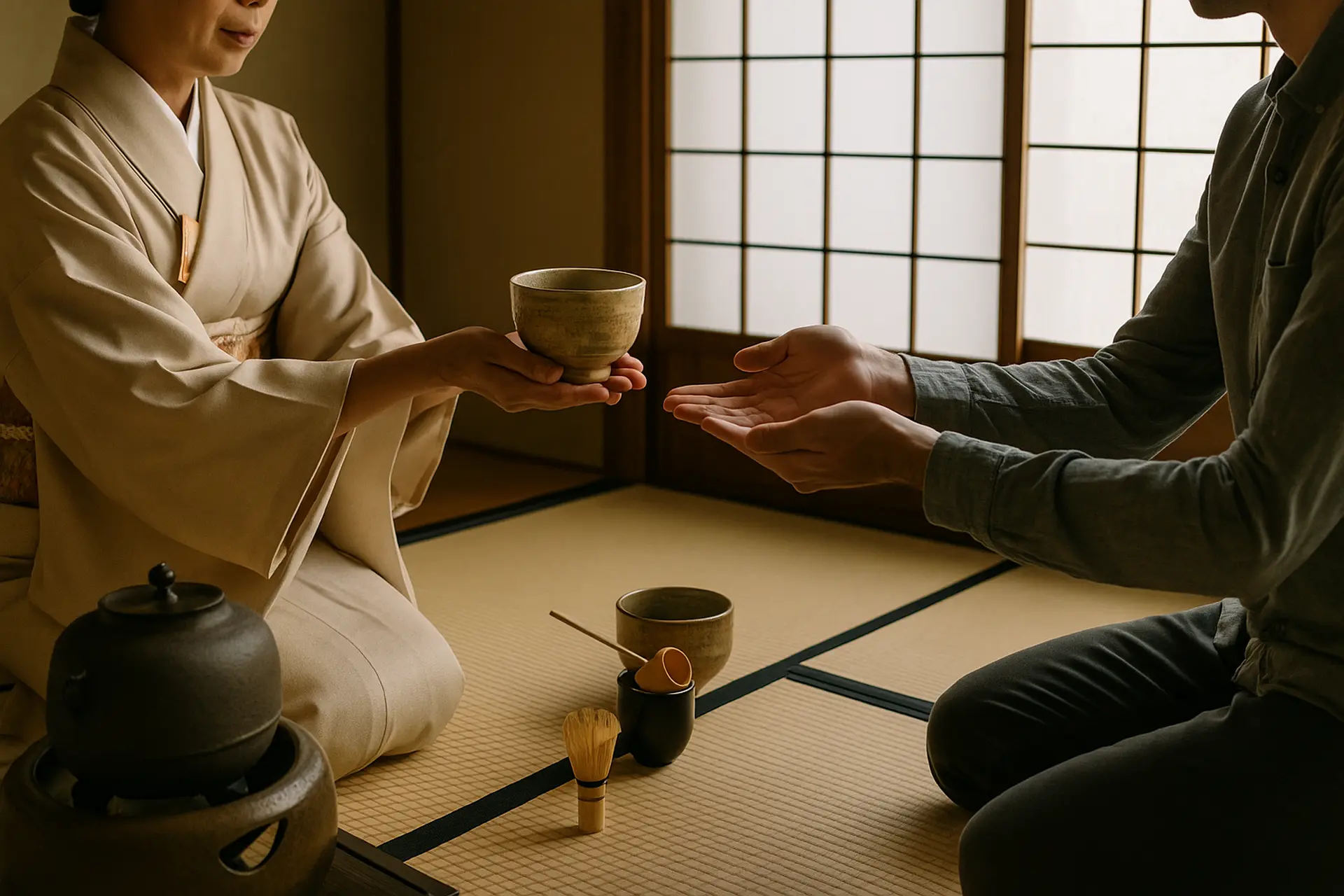
Inside the room
How the parts become a single act of hospitality
A guest’s experience begins before tea is whisked. At a formal venue, shoes are removed and clean socks protect the tatami. Outerwear, large bags and unnecessary objects are left where directed. A waiting area gives the group time to settle, confirm the order of guests and hear instructions. In a more traditional sequence, the approach through a garden path helps mark the transition from ordinary movement to a focused interior space. The change need not feel mystical; it is a practical slowing down.
The main guest, or shokyaku, carries more conversational responsibility than the others. That role is normally assigned to someone experienced. First-time visitors should not worry about being placed into it unexpectedly at a well-run introductory session. Guests enter in order, acknowledge the alcove and utensils according to the host’s guidance, and take their places. The alcove may contain calligraphy or painting and a restrained flower arrangement. These are not background decoration. They establish season, theme or intention.
The host purifies utensils in front of the guests even though the objects have already been cleaned. The visible procedure expresses readiness and care. Water, kettle, tea container, scoop, whisk and bowl form a working composition whose placement has been practised precisely. The guest does not need to identify every object. It is enough to notice material, sound and relationship: bamboo against ceramic, steam above iron, the green of matcha against the bowl’s glaze.
Sweets usually precede matcha because sweetness balances bitterness and because wagashi can carry seasonal meaning. The guest waits for the signal, bows to neighbours as instructed, transfers the sweet using the provided utensil and eats it before drinking tea. Ingredients vary widely. Bean paste, rice flour, sugar, agar, wheat, nuts or other components may appear, and cross-contact is possible. Dietary needs should be communicated during booking, not announced only when the tray reaches the guest.
When tea is offered, the guest acknowledges the host and adjacent guest according to the demonstrated sequence. The bowl is received with both hands. In many traditions, it is turned so the most honoured face is not drunk from directly, then returned after drinking; the exact number and direction of turns can vary. The important point is not arithmetic. The turn expresses care for the object and awareness that the bowl has a face, history and maker. After drinking, the guest may examine the bowl from a low position, protecting it from a fall.
Thick tea, koicha, and thin tea, usucha, are distinct. Koicha uses more matcha and less water, producing a dense texture, and in formal settings may be shared from one bowl among guests. Usucha is lighter and usually served individually. A short visitor ceremony commonly focuses on usucha. Travellers who dislike bitterness should still avoid asking for sugar unless the host explicitly offers it; the sweet has already been designed as the counterpoint.
Conversation is purposeful but not necessarily absent. In a formal gathering, the main guest may ask about the scroll, tea container, scoop or bowl at appropriate moments. Introductory hosts may explain continuously and welcome questions. Guests should follow the room’s tone. Whispering private commentary, checking a phone or treating silence as awkward can break the shared concentration more than an imperfect bow ever would.
The ending is gradual. Utensils may be inspected, questions answered, and the host and guests exchange final bows. The guest leaves without rushing to convert the experience into content. A moment outside the room is useful: recall one sound, one object and one gesture before opening messages or reviewing photographs. That small act continues the ceremony’s discipline of attention beyond the threshold.
The guest observes, follows, appreciates and helps complete the occasion.
Thick and thin tea differ in preparation, texture and formal use.
Scroll, flowers, bowl and sweets may all refer to the time of year.
Careful observation matters more than flawless memorisation.
The practical choreography
A first-time guest’s sequence, step by step
Knowing the order reduces anxiety, but every movement remains subordinate to the host’s actual guidance.
Arrive earlier than the booking time, not at the exact minute. Traditional spaces may have a small entrance, limited storage and a sequence that cannot be paused for a late guest. Use the toilet beforehand, silence the phone completely and remove smart watches if their screen or alerts will distract. Fragrance should be minimal because scent can compete with incense, tea and food. Smoking immediately before arrival can also affect the sensory experience for others.
Wear clothing that allows comfortable sitting and does not sweep across utensils. Formal kimono is not required for most visitor sessions. Clean, modest Western clothing is usually appropriate when the venue does not specify otherwise. Avoid short skirts, very tight trousers, bare feet, trailing sleeves and prominent jewellery that could scratch lacquer or ceramics. Bring clean white or neutral socks in a bag if the day involves substantial walking. A small handkerchief can be useful, while food, gum and drinks remain outside.
Seiza—kneeling with the lower legs folded under the body—can be painful or impossible for many people. Do not injure yourself to prove respect. Ask during booking whether chairs, low stools or an alternative sitting position are available. If discomfort arises, change position discreetly when the host indicates it is acceptable. Experienced hosts understand that bodies differ. Silence about a genuine limitation is less helpful than clear advance communication.
At the threshold, wait to be shown how to enter. Tatami borders may carry etiquette significance and are also easy to catch with a foot. Move slowly, avoid stepping over another person’s space and place hands or bags only where directed. When invited to view the alcove or utensils, remain low and do not touch. The temptation to lean close for a photograph should be resisted unless the host has specifically opened a photography period.
During service, watch the guest before you. The sequence of bows is relational: an acknowledgement to the host, an apology for taking before the next guest, or gratitude for receiving. Exact phrases may be supplied. A visitor who cannot remember them can use the demonstrated bow and a quiet “arigato gozaimasu” where appropriate. The social intention matters more than perfect pronunciation.
Handle the bowl with both hands and keep it low when examining it. Rings, bracelets and watches may be removed beforehand to protect surfaces. Do not place the bowl on an uncertain edge, lift it high for a camera or rotate it repeatedly while trying to remember an internet rule. Follow the host’s demonstration once, then drink naturally. Slurping conventions and the final sound can differ by context; imitate only what the host teaches rather than performing an exaggerated gesture.
Questions are welcome at many visitor experiences, but timing matters. Save broad historical questions for an explanatory pause. During a formal service, the main guest normally speaks for the group. Do not interrogate the host while a delicate procedure is under way. A useful question is specific and observational: the meaning of the scroll, the material of the bowl, or how the sweet relates to the season.
At departure, thank the host and return borrowed items exactly as directed. Tipping is generally not part of the transaction unless the venue explicitly has a policy for it. Buying tea or craftwork can support a venue, but there should be no pressure. The most respectful response is accurate appreciation: name the moment or object that stayed with you rather than saying only that everything was “beautiful.”
Confirm the format
Ask what kind of gathering is offered, how long it lasts, which language is used and what participation is expected.
Prepare clothing and body
Wear clean flexible clothes, bring clean socks, minimise fragrance and request chair seating or access support in advance.
Enter at the host’s pace
Remove shoes, store belongings, silence devices and wait for instructions at thresholds and tatami areas.
Receive sweets and tea
Follow the demonstrated order, use both hands, eat the sweet before matcha and protect the bowl.
Observe before asking
Notice the scroll, flowers, utensils, sound and seasonal references; ask questions at the appropriate pause.
Leave with attention intact
Offer thanks, avoid rushing into phone use and remember one concrete detail from the gathering.
What the guest encounters
Matcha, wagashi and objects chosen for one season
The bowl is not isolated from the sweet, room or garden; each element contributes to the host’s temporary composition.
Matcha is made from shade-grown tea leaves processed into tencha and ground into fine powder. Because the leaf is consumed rather than infused and removed, its flavour is concentrated. Quality, storage, water, temperature and whisking all affect the bowl. Ceremony matcha should not be judged by the sweetened café drinks familiar to many travellers. Its bitterness, umami, aroma and texture are experienced in relation to the sweet and the setting.
Wagashi are equally important. A seasonal confection may suggest plum blossom before spring, cool water in summer, coloured leaves in autumn or a snow-covered branch in winter. The design can be literal or abstract. Its name may refer to poetry or landscape. Even a simple dry sweet has been selected for the tea and occasion. Guests with allergies should ask about ingredients, but the question should not reduce wagashi to a nutrition label; it is also a form of communication between maker, host and guest.
The tea bowl, or chawan, is chosen for handling, temperature, season and visual character. A deep bowl can retain heat in colder months; a wider, shallower form may feel cooler in summer. Glaze irregularities, repaired areas and marks of firing are not necessarily flaws. In traditions shaped by wabi aesthetics, restrained or imperfect surfaces can reward close attention. Guests examine from a safe low position because the bowl may be unique, old or personally significant.
The bamboo whisk, chasen, is a precise tool whose fine tines aerate thin tea. The scoop, chashaku, may have a poetic name. The tea container differs according to the tea and procedure. The kettle, water jar, waste-water vessel, lid rest and silk cloth form an ordered workspace. In a demonstration, the host may explain each object; in a quieter gathering, guests are expected to infer relationships through observation.
The alcove anchors the room. A hanging scroll often carries calligraphy selected for the gathering’s theme. Flowers are arranged with restraint in a style that aims to preserve a sense of their natural life rather than create a dense bouquet. Guests should not touch, rearrange or photograph these elements without permission. Their value lies partly in being temporary: a flower opens further, a shadow moves, and the arrangement exists only for this meeting.
Utensils also connect the ceremony to living crafts. Potters, lacquer workers, bamboo artisans, metalworkers, textile makers, confectioners and tea producers are present through their work. A visitor can deepen the experience by visiting a ceramics district, tea-growing region or wagashi shop, but should avoid treating “tea ceremony style” as a single national aesthetic. Materials and forms reflect region, school, maker and historical period.
How to look without over-analysing
Sweet before bitter
Wagashi prepares the palate and often carries the clearest seasonal image.
The bowl in the hands
Weight, rim, warmth and glaze are part of the experience, so handle slowly and low.
Kettle and whisk
Water, bamboo and ceramic create an acoustic dimension easily missed when a phone is active.
Scroll and flower
The alcove can reveal what the host wants guests to consider during the meeting.
Choosing an experience
Book for honesty, teaching and access—not for a costume photograph
A good visitor ceremony clearly explains what it offers and makes respect compatible with practical inclusion.
The first booking question is the format. Listings may use “tea ceremony” for a ten-minute tasting, a group demonstration, a hands-on whisking class or a private gathering. None is automatically wrong, but the description should be precise. Ask how much of the time is explanation, whether the host prepares tea for each guest, whether guests make tea themselves, and whether the setting is an active tea room or a staged studio. Transparent answers are a sign of professional care.
Language support matters because meaning resides in detail. A ceremony conducted mainly through demonstration can still be moving, but a visitor who wants history and symbolism should choose a host able to explain them in a shared language or through a qualified interpreter. Avoid expecting an apprentice or host to deliver an unscheduled lecture in English. The language arrangement should be part of the booking.
Accessibility should be discussed directly and without embarrassment. Traditional buildings may include steps, narrow thresholds, tatami and toilets that are difficult for some visitors. Other venues offer table-based ryurei service, chairs, ramps or adapted procedures. Ask about the full route from street to room, not only whether the ceremony itself is “wheelchair friendly.” Visitors with hearing or sensory needs may benefit from written instructions, smaller groups or a quieter session.
Children can participate when the venue welcomes them and the format suits their attention span. A short explanatory session may be more successful than a long formal gathering. Parents should prepare children to sit without touching utensils, but hosts should also state realistic age guidance. Booking a private session can reduce pressure. Infants, food needs and toilet timing should be discussed rather than assumed.
Photography policies vary. Some hosts allow photographs before or after service, some permit quiet images without flash, and others prohibit photography to protect concentration or privacy. Ask once and accept the answer. Even when photography is permitted, do not block another guest’s view, place a device on tatami without permission or request repeated gestures. Posting an image of the host should follow their consent and venue policy.
Commercialisation is not automatically disrespectful. Hosts, teachers, interpreters and craftspeople deserve payment for skilled work and space. The concern is whether marketing distorts the practice. Warning signs include promises to make visitors “tea masters” in an hour, pressure to wear costume unrelated to the ceremony, careless handling of utensils or a schedule built entirely around photographs. A credible host describes the experience as an introduction and encourages further learning.
Reviews can reveal punctuality, explanation quality and accessibility, but they should not determine cultural authority. Look for the venue’s own account of lineage, teachers or educational purpose. In Kyoto and other heavily visited cities, choose a schedule that respects neighbourhoods and avoid congregating outside a small machiya. The ceremony begins with how guests arrive in the community, not only with what happens inside the room.
Must a visitor wear kimono?
Usually not. Formal gatherings may have dress expectations, but many visitor sessions accept clean modest clothing and socks. Confirm with the venue.
What if seiza is painful or impossible?
Request a chair, low stool or alternative posture before booking. Respect does not require injury, and many hosts can adapt the seating.
Can a guest decline the tea?
Dietary, medical or caffeine concerns should be discussed in advance. The host may adapt the portion or participation, but silently refusing at the moment of service can disrupt the sequence.
Is it rude to make a mistake?
A sincere beginner error is normally less disruptive than panic or performative certainty. Pause, observe and follow the host’s correction.
Can photographs be taken?
Only according to the host’s policy. Ask before the ceremony and avoid flash, sound, obstructive devices or publishing identifiable people without consent.
Should the host be tipped?
Tipping is not generally expected in Japan unless a specific service states otherwise. Pay the published fee and express thanks directly.
Historical perspective
A living way of tea, not a single unchanging ritual
History gives the ceremony depth when it is used to understand development, not to claim that every modern gesture has always been identical.
Tea reached Japan through long exchanges with China and developed within Buddhist, courtly, warrior and urban cultures. Powdered tea, competitive tasting gatherings, imported Chinese objects and elite display all form part of the wider history. The restrained wabi ideal now strongly associated with chanoyu emerged through specific teachers and social contexts rather than appearing as a complete timeless system.
Sen no Rikyu is central to the historical imagination of tea. Urasenke describes his role in perfecting a form of chanoyu grounded in wabi aesthetics and elevating tea into a “way.” His use of small rustic rooms, bamboo and everyday objects changed how value could be perceived. Yet tea history is larger than one person, and modern practice continues through multiple families, schools, regional lineages, craftspeople and students.
The tea room is often described as an egalitarian space because guests lower themselves to enter and swords were historically left outside certain small rooms. That symbolism is powerful, but it should not erase hierarchy. Guest order, expertise, patronage and social status have shaped gatherings across centuries. A mature appreciation can hold both ideas: the ceremony offers disciplined respect among participants while also reflecting the societies in which it developed.
Modernity did not end chanoyu. Tea traditions adapted to new institutions, international exchange, women’s education, public demonstrations, tables and chairs, tourism and global teaching networks. Urasenke’s history includes major efforts to share chado internationally. A visitor session conducted in English or with chair seating is therefore not automatically “inauthentic.” Authenticity depends more on honest transmission, competent practice and respect for the tradition than on recreating an imagined sixteenth-century scene.
Seasonality remains one of the clearest links between history and contemporary practice. The use of the sunken hearth, the choice of kettle, the naming of a scoop, the design of a sweet and the flower in the alcove can all situate the gathering within the year. Returning in another season does not simply repeat the same tourist activity. It reveals how a disciplined framework can generate continuous variation.
For travellers, history is most useful when it sharpens observation. Knowing that a rough bowl may express a different value system from polished imported ware, or that a tiny room changes the relationship between host and guests, makes the encounter richer. The goal is not to recite a timeline to the host. It is to recognise that the quiet procedure before the guest carries centuries of debate about beauty, hospitality, discipline and the meaning of an ordinary object.
After the final bow
A good guest does not disappear into the rules; attention becomes the rule.
First-time visitors often fear committing an offence with the bowl, the bow or the order of a sweet. That anxiety can make the ceremony feel like a trap. In practice, a competent host creates a path that beginners can follow. Punctuality, clean preparation, honest communication and willingness to observe solve more problems than memorised choreography.
The deepest lesson of a tea gathering is not that every movement must be perfect. It is that care can be made concrete: water heated, utensils chosen, a flower placed, a sweet shaped and time reserved for another person. The guest responds by being fully present. That exchange is small enough to fit inside one bowl and expansive enough to change how the traveller notices the rest of the day.