

Japan's bathing culture
The onsen is not merely a hot bath
A good visit begins with understanding the quiet social choreography around the water, then choosing a town whose landscape and pace fit the journey.
This guide explains the shared rules, the safety logic behind them and four distinctive bases for a first or return hot-spring trip.
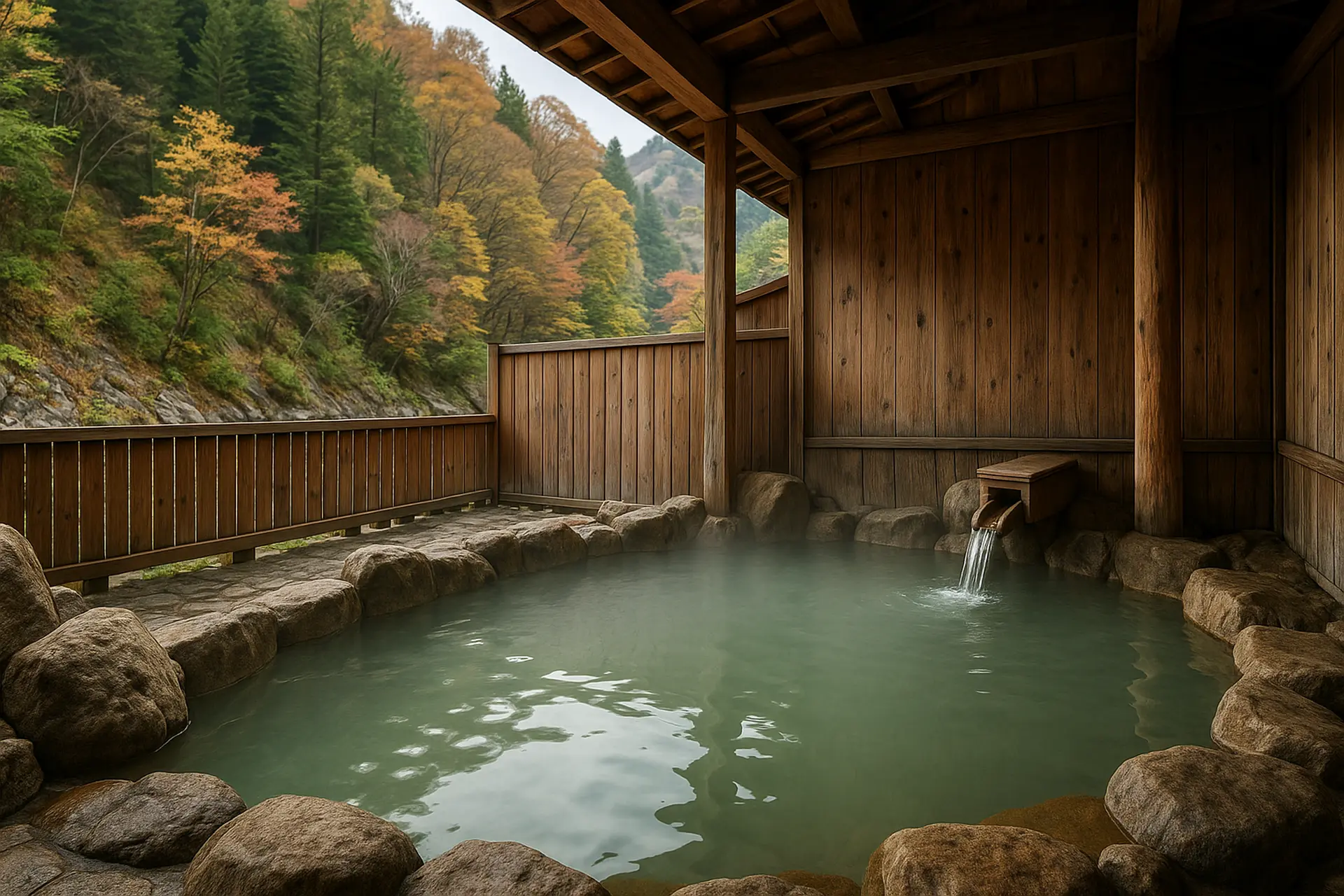
Japan's hot springs are often presented as scenic travel rewards: steam lifting above cedar roofs, snow settling on rocks, or a mineral pool looking toward a mountain valley. Those images are real, but they show only the final minutes of a much larger experience. An onsen visit also involves changing-room customs, careful washing, awareness of other bathers, attention to one's own health and a willingness to move at the pace of the place. The ritual is not difficult. It becomes comfortable quickly once the visitor understands that the central principle is consideration rather than performance.
The word onsen refers to a naturally heated spring that meets Japan's legal criteria for temperature or mineral content, while everyday conversation may also use it for the bathing facility or the wider resort built around the spring. That distinction matters because a town can contain public bathhouses, hotel baths, open-air pools, footbaths and private bathing rooms, each with its own access rules. A luxurious ryokan bath and a modest neighborhood bath can share the same basic etiquette even though the atmosphere, water chemistry and degree of privacy differ substantially.
Visitors sometimes worry that one small mistake will cause offence. In practice, most facilities communicate their expectations with pictograms, multilingual notices or staff guidance. The essentials are consistent: remove shoes where indicated, undress in the correct area, wash before entering the shared pool, keep towels and hair out of the water, avoid swimming or noisy conversation and dry the body lightly before returning to the changing room. The point is to keep communal water clean and to preserve a calm setting for everyone using it.
This guide treats etiquette as a practical sequence rather than a list of prohibitions. It also explains why hotter water is not a test of endurance, why alcohol and dehydration increase risk, how tattoo policies differ and what private bathing options can solve. The destination profiles then focus on four places that offer contrasting introductions to the culture: transport-friendly Hakone, strongly traditional Kusatsu, walkable Kinosaki and volcanic Noboribetsu. Other well-known towns remain useful route alternatives, but they are summarized rather than inflated into profiles when source media and current detail are insufficient.
Before the first soak
The bath makes sense when the social purpose is clear
Onsen etiquette is a compact system for protecting clean water, personal space and a shared atmosphere of rest.
Rules feel intuitive once they are read as forms of care rather than ceremony.
Communal bathing has long occupied a place in Japanese daily life, hospitality and travel. Hot-spring settlements grew where geology brought heated water to the surface, while bathhouses turned that resource into a social institution. The modern visitor therefore encounters several layers at once: the physical pleasure of warm mineral water, an inherited bathing routine, local architecture and a town economy shaped by overnight stays. The experience can be deeply restorative without requiring mystical claims. Warmth, quiet, unhurried movement and a temporary break from screens are sufficient explanations for much of its appeal.
Cleanliness is the first organizing idea. The body is washed outside the pool so that many people can share the same water without treating it as a place for soap, shampoo or vigorous grooming. Shower stations usually provide a low stool, handheld shower and taps; many also supply soap and shampoo. Bathers rinse the stool and surrounding area when finished. Long hair is tied up, and even a small towel is kept on the side or folded on the head rather than dipped into the pool. These habits are both hygienic and visible signs that the bather understands the collective arrangement.
Quiet is the second idea, although an onsen is not necessarily silent. Friends may speak softly, local bathers may exchange greetings and families may use the space naturally. What changes is volume and intensity. Phones, photography, splashing and loud group conversation are normally incompatible with a setting where others are unclothed and trying to relax. The rule against photography is especially important: it protects privacy even when a beautiful open-air bath seems made for a picture. Promotional photographs are produced under controlled conditions and do not imply permission for guests to take their own.
Modesty is handled differently from a spa in many other countries. In gender-separated communal baths, swimwear is normally not worn, because fabric can carry soap or dirt into the water and because the established custom is to bathe unclothed. That can feel unfamiliar for a few minutes, but the environment is generally matter-of-fact rather than observant. The small towel can cover the front of the body while walking, then remains outside the pool. Visitors who prefer more privacy can look for a reservable family bath, an in-room bath or a lodging whose bathing facilities can be booked for exclusive use.
The logic behind the rules
Keep the pool clean
Soap, towels, hair and unwashed bodies stay out of shared soaking water.
Protect other bathers
No cameras or phones should be used in bathing and changing areas.
Lower the social volume
Move carefully, avoid splashing and let conversation remain unobtrusive.
Leave before discomfort
The goal is relaxation, not proving tolerance for very hot water.
Soaking begins only after the body is thoroughly rinsed.
Place it beside the pool or fold it on the head.
Hair should not trail into communal water.
Privacy rules apply even when no one appears nearby.
The shared routine
From entrance to changing room, the sequence is simple
Most uncertainty disappears when the visit is treated as a series of small, observable steps.
Signs vary, but the order of preparation, washing, soaking and cooling is remarkably consistent.
At the entrance, look for the division between men's and women's bathing areas, often marked by curtains, colors or characters. Staff can point to the correct side if anything is unclear. Shoes are usually removed before entering a tatami or raised-floor area, and valuables may go into a locker or reception safe. In the changing room, clothing and the large drying towel stay in a basket or locker. Only the small modesty or washing towel normally accompanies the bather into the wet area.
The washing stations are the essential transition. Sit on the stool rather than standing, because seated washing reduces spray onto other people. Use soap and shampoo as needed, then rinse the body, hair, stool and nearby floor thoroughly. Some experienced bathers also pour a few small basins of hot water over the limbs and torso before entering. This helps the body adjust to the temperature and reduces the shock of stepping directly into a hot pool. It is a sensible practice, not a competition to withstand heat.
Enter slowly at a point that does not obstruct others. Sitting on the edge for a moment and immersing the legs first can be more comfortable than descending all at once. Once in the water, remain still enough to avoid waves and splashes. A short soak may feel more pleasant than a long one, especially in mineral-rich or very hot water. Moving between indoor and outdoor pools, cool air and rest areas can extend the overall experience without forcing the body to remain immersed continuously.
After the final soak, some facilities encourage leaving a trace of mineral water on the skin, while others provide showers and expect a rinse. Follow local signs or staff instructions rather than assuming one universal rule. Before re-entering the changing room, wipe excess water from the body with the small towel so the floor remains dry. Use the larger towel for full drying, dress at an unhurried pace and drink water. The post-bath pause—sitting, hydrating and letting body temperature settle—is part of the visit, not wasted time.
Confirm the correct entrance
Check the bath designation and ask staff when curtains or signs are unfamiliar.
Store shoes, clothes and valuables
Use the designated shoe area, basket, locker or reception service.
Bring only the small towel
Leave the large drying towel with clothing unless the facility instructs otherwise.
Wash and rinse thoroughly
Sit at a shower station, keep spray controlled and remove every trace of soap.
Acclimatize to the heat
Pour warm water over the body and enter the pool gradually.
Soak quietly
Keep hair and towels out of the water and avoid swimming, splashing or loud talk.
Cool and repeat only if comfortable
Rest between pools rather than extending one continuous hot soak.
Dry before the changing room
Use the small towel to remove surface water, then finish with the large towel.
Hydrate and recover
Drink water and allow heart rate and body temperature to normalize before leaving.
Practical exceptions
Good planning matters most when the standard routine does not fit
Medical conditions, tattoos, children and privacy needs are not minor details; they determine which facility is appropriate.
A few direct questions before arrival can prevent awkwardness and protect health.
Hot water changes circulation and can produce dizziness, particularly when a person is tired, dehydrated, hungry, overheated or affected by alcohol. The safest approach is conservative: drink water, avoid bathing immediately after heavy drinking, enter gradually and keep the first session short. Anyone who feels faint, nauseated, breathless, confused or unusually weak should leave the water immediately and seek help. People with cardiovascular conditions, unstable blood pressure, pregnancy concerns or other medical risks should obtain individual medical advice rather than relying on a generic travel article.
Temperature is only one variable. Mineral composition, outdoor air, the depth of the pool and the number of repeated sessions all affect how demanding a bath feels. Winter rotenburo can create a pleasant contrast between cold air and hot water, yet the transition may also strain the body if rushed. Very hot local styles are part of the identity of some towns, but visitors are never required to imitate residents who have years of experience. A cooler pool, partial immersion or a private bath where the pace can be controlled may offer a better first encounter.
Tattoo access remains one of the most misunderstood parts of onsen travel. Policies are facility-specific. Some public baths welcome tattooed guests; some accept small tattoos covered by a patch; some offer designated sessions; and others refuse entry regardless of size or meaning. The restriction has historical associations in Japan, but international visitors should treat it as an operational rule rather than an invitation to debate staff at the door. The most effective solution is to ask in advance, obtain written confirmation when possible and keep a backup facility or private-bath option.
Private baths are also useful for families, mixed-gender couples, people who need assistance and anyone anxious about communal nudity. They may be called kashikiri-buro, kazoku-buro or family baths, and access can range from a timed room reservation to an in-room open-air bath attached to a guest room. Private does not mean rule-free: washing first, avoiding alcohol, supervising children and respecting the allotted time still matter. Travelers should also confirm whether the water is continuously flowing, recirculated, temperature-controlled or especially hot, because the term describes access rather than one technical bathing system.
Can a guest wear a swimsuit?
Not in a conventional gender-separated communal onsen unless the facility explicitly permits it. Swimsuit bathing exists at some mixed or recreational complexes, but it should never be assumed.
Are tattoos always refused?
No. Policies range from fully welcoming to conditional or restrictive. Check the individual facility and ask about covering patches, private baths or tattoo-friendly public baths.
Should mineral water be rinsed off afterward?
Practice varies with the facility and water. Follow posted guidance or ask staff rather than applying one rule everywhere.
Can children enter?
Many facilities admit children, but age, gender-side and supervision rules vary. Confirm details in advance and keep the child within arm's reach around hot water.
How long should one soak?
There is no universal target. Begin with a short session, leave before discomfort and rest between pools. Personal health guidance takes priority.
Kanagawa · Greater Tokyo excursion
Hakone
A broad, transport-connected hot-spring region where first-time visitors can combine bathing with mountain scenery, museums and a ryokan stay.
Best for travelers who want an onsen introduction without building an entire journey around one remote town.
Destination profile
Why Hakone works for a first hot-spring journey
Hakone is less a single compact bath town than a collection of valleys, stations and resort districts spread across a volcanic landscape southwest of Tokyo. That geography is part of its strength. A visitor can choose a traditional inn, a large resort, a day-use bath or a private bathing room, then combine the soak with Lake Ashi, mountain transport or one of the area's art museums. The range makes Hakone forgiving for beginners: there is rarely only one acceptable way to experience the destination, and a change in weather does not erase every alternative.
The same spread can also confuse travelers who book by name alone. Hakone-Yumoto, Gora, Sengokuhara and the lake area create different journeys, and transport between them may involve trains, buses, cableways or walking on slopes. The best planning method is to select the lodging first, confirm the nearest stop and check how much of the day should be devoted to the wider sightseeing circuit. A ryokan with dinner and breakfast rewards an early arrival; a day-use bath fits better into an itinerary that continues elsewhere before evening.
Hakone's popularity means privacy, price and atmosphere vary widely. Some properties are polished international resorts, while others preserve the small-scale rhythm of tatami rooms, set meals and scheduled bathing. Travelers seeking quiet should examine room count, day-visitor access and whether the bath is also used by tour groups. Those concerned about tattoos or communal bathing should ask specifically about in-room baths or reservable facilities rather than treating the word ryokan as a guarantee of privacy.
The most satisfying Hakone visit is usually paced as an overnight transition rather than a checklist. Arrive before dusk, allow time to learn the property's routine, bathe before dinner if appropriate and return to the water later only if the body feels comfortable. Mountain weather, transport interruptions and volcanic-zone restrictions can affect plans, so live official information matters. What Hakone offers in return is choice: a visitor can make the bathing culture central without sacrificing the variety expected from a broader resort region.
Gunma · Mountain resort
Kusatsu Onsen
Steam, strongly acidic water and a town center organized around the Yubatake give Kusatsu one of Japan's clearest hot-spring identities.
Best for travelers who want the spring itself—not a side attraction—to define the entire stay.

Destination profile
Kusatsu puts water at the center of town life
Kusatsu announces itself through the Yubatake, the hot-water field where spring water moves through wooden channels in the center of town. Steam and the mineral scent make the resource visible rather than hiding it inside hotel walls. Streets, inns, shops and public spaces radiate from this focal point, giving the settlement a coherent identity that is easy to understand on foot. Evening is especially atmospheric, when illumination and cooler air sharpen the contrast with the hot water.
The water is famously strong and hot, which is exactly why a cautious first session matters. Local bathing traditions developed techniques for cooling and managing the springs, and cultural demonstrations may introduce practices associated with stirring the water or preparing the body. A visitor should appreciate that history without treating very high temperature as a challenge. Facilities often offer pools or methods that make the experience manageable, and the correct temperature is the one that allows calm breathing and an easy exit.
Kusatsu suits a traveler who enjoys staying within a town rather than moving between many distant attractions. Bathhouses, footbaths and short walks can structure the day, while nearby natural areas add seasonal variety. Winter brings snow and difficult road conditions; warmer months make walking easier but can still produce mountain weather. An overnight stay provides time to see the center after day visitors leave and to space bathing sessions instead of compressing them into a short stop.
Because the town is well known, accommodation ranges from traditional inns to larger hotels and simpler lodgings. The choice should follow the desired experience: communal bath variety, a quiet private room, meal quality, accessibility or proximity to the center. Strongly mineral water may affect sensitive skin, and guests should follow facility advice about rinsing, session length and jewelry. Kusatsu is memorable not because every person must love its intensity, but because the relationship between geology, custom and urban form remains unusually legible.
Hyogo · Sea of Japan side
Kinosaki Onsen
Canal-side streets, willow trees and a network of public bathhouses turn the entire town into an extension of the ryokan stay.
Best for travelers who want to walk between baths in yukata and experience communal bathing as a town-wide ritual.

Destination profile
Kinosaki makes the walk between baths part of the experience
Kinosaki's defining feature is not one monumental pool but the relationship between its inns, streets and public bathhouses. Guests often change into a yukata at their lodging, carry a small towel and move through town in sandals, stopping at baths and returning to cafés or the ryokan between sessions. This circulation creates a rare sense that bathing is woven into public space. The canal, bridges and low-rise buildings provide continuity, so a short walk feels like part of the ritual rather than a commute.
The format also makes pacing important. Visiting every bath in rapid succession may sound efficient, but repeated heat can turn pleasure into fatigue. A more comfortable plan selects a few contrasting baths, includes long cooling intervals and leaves room for dinner, conversation and sleep. Weather changes the experience: rain can make the streets reflective and atmospheric, while winter requires careful footwear and a realistic view of cold exposure after leaving hot water.
Kinosaki is particularly notable for clear public information welcoming tattooed bathers at the town's public onsen, although travelers should still recheck the current policy and distinguish public baths from private accommodation rules. That distinction is useful everywhere in Japan: a town may promote inclusive public bathing while an individual ryokan applies different conditions to its own facilities. Confirming both parts of the stay prevents a guest from assuming that one policy automatically covers every door.
The destination works best when the lodging is treated as a base rather than a self-contained resort. Location, meal times, bath-pass arrangements and luggage handling deserve attention, especially for travelers arriving by rail. Those with mobility needs should ask about steps, wet surfaces and the walking distance between facilities. Kinosaki's appeal is the gentle repetition of changing, walking, soaking and resting. It turns etiquette from an abstract rulebook into a lived pattern shared across the town.
Hokkaido · Shikotsu-Toya region
Noboribetsu Onsen
A concentrated resort beneath active volcanic terrain, known for varied mineral waters and the dramatic landscape of Jigokudani.
Best for travelers pairing a substantial bath resort with Hokkaido's cold-weather scenery and geothermal geology.

Destination profile
Noboribetsu links the bath directly to the land beneath it
Noboribetsu's hot-spring district sits close to Jigokudani, a crater landscape of vents, mineral-stained ground and rising steam. The connection between source and bath is therefore unusually visible. Walking paths and viewpoints explain why the resort exists where it does, while large hotels channel several types of mineral water into extensive bathing complexes. For a visitor interested in geology as well as relaxation, the destination offers a direct narrative from volcanic terrain to bathing culture.
The resort scale differs from the intimate public-bath rhythm of Kinosaki. Noboribetsu includes substantial hotels whose baths can contain multiple indoor and outdoor pools, each presented with different water characteristics or temperatures. That variety can be rewarding, but it encourages overuse if guests try every pool without rest. A sensible sequence begins with the mildest comfortable option, includes fresh air and hydration, and treats stronger or hotter water as optional rather than mandatory.
Hokkaido's seasons shape logistics. Snow, ice and low temperatures can make outdoor paths beautiful but hazardous, while rapid cooling after a bath can feel sharper than expected. Footwear, layers and realistic walking plans matter. Geothermal areas may also have temporary path restrictions, gas warnings or weather closures; official notices should be checked rather than assuming that every viewpoint is always accessible. The bath itself remains worthwhile even when an outdoor route changes.
Noboribetsu can be reached as part of a broader Hokkaido journey, but an overnight stay avoids turning the experience into a rushed detour. Travelers should compare hotel atmosphere, bath access after check-in, private-bath possibilities and meal arrangements. Some large properties feel lively, while smaller options provide a quieter retreat. The destination's strength is concentration: dramatic geology, broad bathing facilities and northern scenery sit close enough together that the visitor can understand the resort without spending the day in transit.
Beyond the four profiles
The best hot-spring town is the one that fits the journey
Accessibility, bath policy, town form and desired privacy matter more than an abstract ranking.
Several famous alternatives work well when they are selected for a specific reason.
A useful selection process begins with constraints. Tattoo access, private-bath needs, mobility, travel season and arrival time can eliminate unsuitable options before scenery enters the discussion. Next comes town form: some travelers want a compact settlement where they can walk in yukata, while others prefer a self-contained ryokan or a large resort with many pools under one roof. Transport is not a minor afterthought. A remote inn may be ideal for two quiet nights but frustrating as a rushed add-on between distant cities.
Beppu offers scale and variety, including multiple hot-spring districts and visually dramatic geothermal sites, but the city is spread out and benefits from a clear transport plan. Kurokawa is known for a cohesive ryokan-town atmosphere and outdoor baths, making it attractive to travelers who prioritize traditional lodging over urban sightseeing. Dogo places hot-spring heritage inside a larger city journey, while Ibusuki is associated with sand-bathing experiences that require their own health and operational checks. These are meaningful differences, not points on a universal league table.
The ryokan decision deserves equal weight. A traditional inn can include tatami rooms, seasonal meals, prescribed dining times and staff service that may feel more structured than an ordinary hotel. Guests should understand cancellation terms, meal-related allergy communication, luggage access, bedding arrangements and check-in deadlines. A lower-cost room without a private bath may still provide excellent communal facilities; a premium room with an open-air bath may buy privacy rather than a more authentic experience. Authenticity is not a room category.
Finally, leave margin. Trains are missed, mountain buses slow in snow, public baths close for maintenance and bodies do not always respond to heat as expected. An itinerary that depends on several baths in one afternoon creates pressure to ignore fatigue or changing conditions. One excellent soak, a good meal and a quiet walk can be a complete onsen day. The culture rewards repetition over speed, which is precisely why an overnight stay usually teaches more than a hurried checklist.
| Destination | Best suited to | Planning note |
|---|---|---|
| Beppu | Travelers wanting a broad range of geothermal and bathing experiences | The urban area is dispersed; map transport and distinguish viewing sites from baths. |
| Kurokawa Onsen | A cohesive ryokan stay with an outdoor-bath emphasis | Private transport or carefully timed buses may be important depending on the itinerary. |
| Dogo Onsen | Hot-spring heritage combined with a city visit | Recheck building access, renovation status and bathing arrangements before arrival. |
| Ibusuki | Travelers curious about hot-sand bathing | Confirm health suitability, clothing procedure and current operating conditions directly. |
| Beppu or Kurokawa | A Kyushu-focused itinerary | Choose one as a base unless the route allows enough time to appreciate their different scales. |
The lesson of the water
A successful onsen visit is measured by ease, not endurance
The etiquette of an onsen can be summarized in a few actions—wash first, enter clean, protect privacy, keep towels and hair out of the pool and leave before the heat becomes uncomfortable—but its deeper value comes from the pace those actions create. The visitor stops rushing, pays attention to other people and notices how architecture, water and season shape a shared room.
Choosing a destination should follow the same logic. Hakone offers range, Kusatsu gives the spring a commanding public presence, Kinosaki turns bath-hopping into an evening walk and Noboribetsu reveals the volcanic landscape behind the water. None is universally best. The right choice is the place whose access, policies and rhythm allow the traveler to relax without ignoring health or practical constraints.
Once the rules are understood, the experience becomes less exotic and more humane: clean water, warm air, quiet company and time reserved for doing very little. That simplicity is why Japan's hot-spring culture can remain memorable long after the most dramatic steam has disappeared from view.