

Located between France, Italy and Germany, Switzerland packs 65,000 km of waymarked hiking trails into its small area. An avid travel writer notes this network is “protected in the constitution” as national heritage – a hiker’s dream of Alpine meadows, rugged peaks and rustic villages. This 7-day itinerary weaves high-mountain hikes (with SAC T1–T6 grading) together with cultural highlights: AOP-certified cheese dairies in Gruyères and the famous Maison Cailler chocolate factory. Along the way, readers learn practical details (2025 train fares and timetables, packing lists, weather patterns) and enjoy expert insights from Switzerland Tourism and others. Photos and footnotes provide authoritative context throughout.
- How to plan a 7-day Swiss Alps itinerary?
- Understanding Swiss hiking difficulty (SAC T1–T6) and trail signage
- Day 1: Arrive in Zurich – Train to Interlaken
- Day 2: Grindelwald & Lauterbrunnen – Alpine Day Hike
- Day 3: Jungfraujoch – Top of Europe
- Day 4: Travel to Gruyères (Cheese Country)
- Day 5: Chocolate Factory & Castle in Gruyères
- Day 6: Valais Highlands – Matterhorn Region
- Day 7: Return via Lausanne (or Departure)
- Practical Logistics and Tips
- FAQ (Frequently Asked Questions)
How to plan a 7-day Swiss Alps itinerary?
- Timing: Aim for June–September when most high trails are open. Daylight is long, but summer thunderstorms are common, so plan hikes early. MeteoSwiss notes thunderstorm activity peaks in mid-summer. (Choose routes that allow early finishes and have huts or towns nearby.)
- Transport Pass: Get a Swiss Travel Pass for convenience. Switzerland Tourism’s India director confirms “the best seller is a six and eight-day pass”, reflecting that travelers often cover many miles on trains. For 7 days, an 8-day pass (2nd class CHF 419) covers all travel; the 6-day pass (CHF 379) may suffice if you break travel into two segments. The pass includes most trains, many mountain railways and buses, plus free admission to 500+ museums. (A Half-Fare Card costs CHF 185/year but only halves each fare.)
- Booking: Summer is peak season: reserve hotels or mountain huts at least 4–6 months ahead. Major attractions (e.g. Jungfraujoch train, Cailler tours) can sell out – book tickets online if possible. Swiss Travel Pass or Half-Fare holders get museum and rail discounts, and even some ropeways or cogwheel fares are reduced.
- Packing: Prepare for all conditions. Layering is essential: pack wicking base layers, insulating fleece, a warm hat and gloves (nights get cold at altitude) and a waterproof jacket/pants for rain. Sun protection (hat, sunglasses, SPF) is also crucial. Sturdy hiking boots with ankle support and gaiters are recommended, especially above the tree line. A walking pole or two can help balance on steep or uneven paths. (MeteoSwiss reports that even in summer nights can drop near freezing in the Alps.)
- Gear: Carry a daypack with snacks, water (Swiss tap water is drinkable), a first-aid kit and map or GPS. Phone signal may drop in remote valleys, so carry a paper map or download offline maps. If planning high-alpine routes (T4+), consider crampons, helmet or rope, but this itinerary sticks to non-technical hikes. Don’t forget a camera – the Alps are hugely photogenic!
Use the Swiss Travel Pass not only for trains, but also for regional buses, boats and many mountain railways (e.g. Rigi, Schilthorn). It often includes free lake cruises and discounts on cable cars. Always check Swiss Federal Railways (SBB) for current schedules and fares. For example, Bern–Geneva (~2h) costs ~CHF 50–95 and Zurich–Interlaken (~2h) ~CHF 54–96; budgeting accordingly can help choose the right pass.
Travel Tip
Understanding Swiss hiking difficulty (SAC T1–T6) and trail signage
Swiss trails use a Trekking scale (T1–T6) defined by the Swiss Alpine Club. T1 is easiest (well-graded hiking trails) and T6 most difficult (alpine routes requiring technical skills). In practice: T1/T2 are yellow-marked trails (easy/medium) suitable for regular walkers. A white-red-white band means a “mountain hiking” trail (T3-T4) – steeper, rocky sections, possibly requiring hands for balance. White-blue-white indicates an alpine route (T4-T6) with exposure or glacier crossing. Study trail markers at the trailhead: yellow signs with black arrows are T1 (valley paths), yellow tops with red-white stripes are T3 (mountain), and yellow tops with blue-white stripes are T4+ (alpine).
| SAC Class | Trail Type | Markers | Terrain/Example |
| T1 | Hiking trail (easy) | Yellow | Flat or gently graded paths (valley meadows, park). No special gear needed. |
| T2 | Mountain trail (moderate) | Yellow/Red-White | Steeper footpaths on mountainsides. Some rocky sections, but clear path. |
| T3 | Challenging mountain hike | Red-White-Red | Narrow, steep tracks; possible exposure or small climbs. Good boots required. |
| T4 | Alpine hiking (difficult) | White-Blue-White | Exposed sections, hands needed for scrambling. May cross snowfields or rock ledges. |
| T5 | Difficult alpine (very hard) | White-Blue-White | Long, steep climbs; often uses rope or fixed steel. High-alpine terrain. |
| T6 | Very difficult alpine | White-Blue-White | Extreme routes (rock climbing); requires mountaineering gear and experience. |
Regional note: trails in the dry southern Alps (Valais/Engadine) tend to be sunnier and less muddy, whereas northern Alpine trails (Bernese Oberland, Graubünden) see more rain and runoff. As MeteoSwiss notes, Valais and Engadine have notably fewer thunderstorms in summer than the Swiss Plateau – useful for planning which side of the mountains to hike. Always check trail conditions before starting.
Never overestimate your fitness. Choose hikes matching your SAC level. T1–T2 hikes are suitable for most; T3–T4 require sure-footedness and hiking poles; T5–T6 need alpine experience. Local huts often list trail grades. Always start with the easiest section and turn back before dusk if needed.
Hiking Tip
Day 1: Arrive in Zurich – Train to Interlaken
Most international flights land in Zurich or Geneva. For an Alpine start, take the train into the mountains. From Zurich HB (main station), the 2-hour journey to Interlaken Ost runs hourly on scenic routes. (For example, Zurich–Interlaken costs roughly CHF 54–96.) The Swiss Travel Pass covers this fully. From Geneva, change in Bern (2h total).
In Interlaken you’re at the heart of Bernese Oberland, between Lakes Thun and Brienz. Check into your hotel or mountain hostel. In late afternoon, consider a short outing: the Harder Kulm funicular (or hike up a yellow trail) climbs from Interlaken to 1,322m for panoramic views. Otherwise stroll along the Höheweg promenade above town for early Alpine vistas. Keep bags light today. Dinner can be classic fondue or rosti (potato cake) at a local restaurant – many are vegetarian-friendly or serve Chäshörnli (macaroni with melted cheese).
Interlaken’s local transport is highly efficient. Regional trains, buses and boats link to mountain valleys. If staying in town, get an Interlaken Holiday Card (often included with lodging) for free local transit. Otherwise, your Swiss Travel Pass covers Interlaken to Lauterbrunnen (~20 min train) and Interlaken to Grindelwald (~30 min), and all ferries on Lakes Thun/Brienz.
Quick Fact
Day 2: Grindelwald & Lauterbrunnen – Alpine Day Hike
Catch an early train to Grindelwald (35 min from Interlaken Ost). Hikers can choose among famous day-tours here. One classic is the Bachalpsee Loop: take the Firstbahn gondola up from Grindelwald to 2,178 m (First), then hike 6 km round-trip to Bachalpsee (2,265 m) – mostly T2 trails. The sparkling lake with Schreckhorn peak backdrop is a photographer’s dream. Another option is the Männlichen–Kleine Scheidegg hike: ride the gondola to Männlichen (2,343 m) and follow the ridge trail (T2) to Kleine Scheidegg, with sweeping views of the Eiger North Face. Both hikes are about 3–4 hours and moderate.
Alternatively, from Lauterbrunnen (down-valley, ~20 min train) you can take the cable car to Grütschalp and hike the Mürrenberge or simply explore the village and waterfalls. Nearby Schynige Platte (via cogwheel train from Wilderswil) also offers easy, flower-filled trails.
By late afternoon return to Interlaken or choose to stay in Lauterbrunnen/Grindelwald. Mountain restaurants serve local specialties (add a fried egg to your rösti for protein).
At Bachalpsee or when viewing the Eiger’s north face, dawn and dusk light are magical. Pack extra batteries or power bank. Use a polarizing filter (or phone HDR mode) to reduce glare on alpine lakes and deepen the blue sky.
Photo Tip
Day 3: Jungfraujoch – Top of Europe
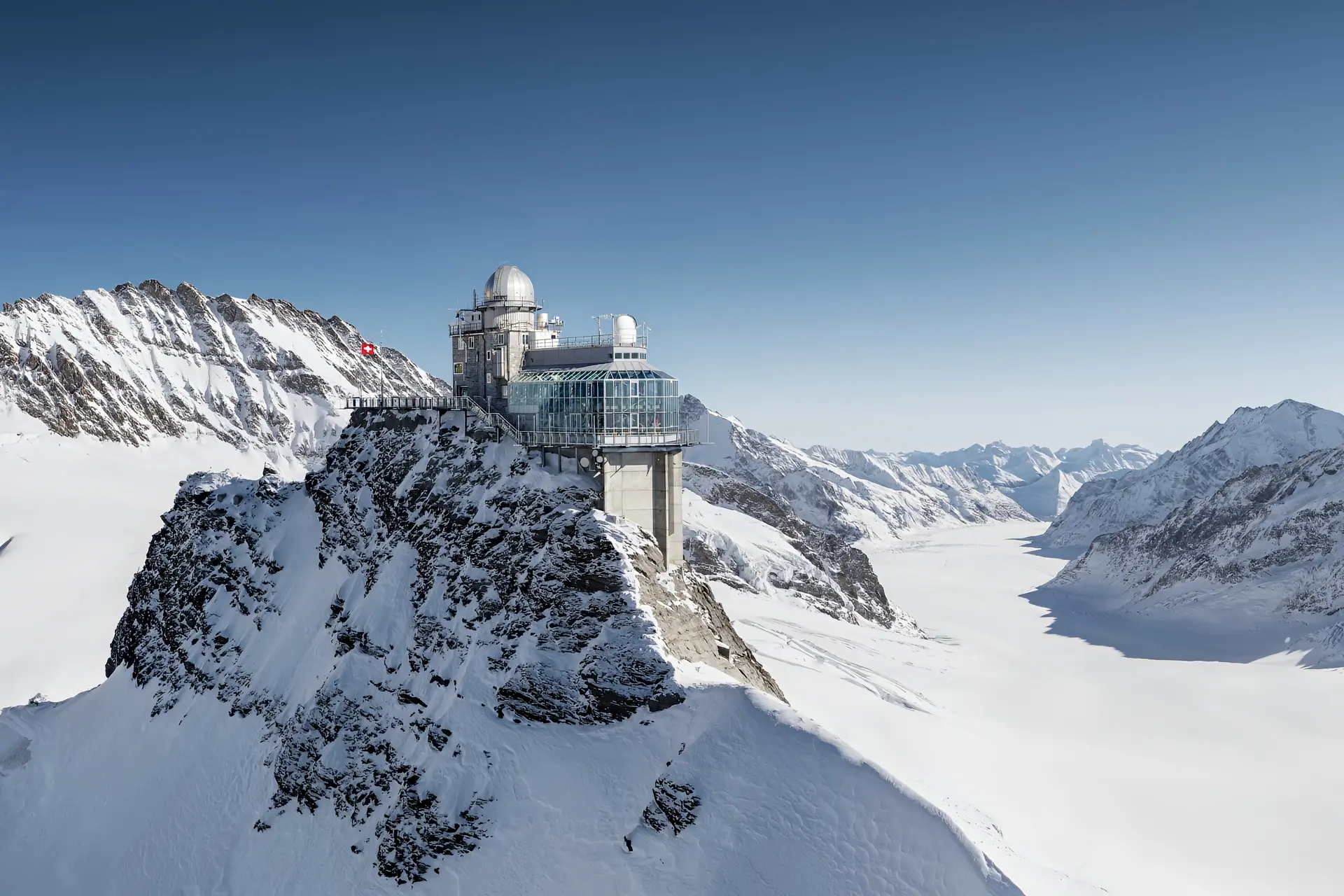
Dedicate a day to the Jungfraujoch railway, Europe’s highest cogwheel train. From Interlaken Ost or Grindelwald, take the Wengernalpbahn to Kleine Scheidegg, then Jungfraubahn to Jungfraujoch (3,454 m). The round-trip fare (2nd class, 2025) is about CHF 210 (Swiss Pass holders get ~25% off). At the Top of Europe, visit the Sphinx Observatory and Ice Palace. If visibility is poor, the experience of riding through the Eiger/Mönch is memorable alone. Dress warmly – temperatures are below freezing. The full excursion takes ~5–7 hours round-trip.
After descending, you may have energy for a short hike around Grindelwald Grund or Lauterbrunnen base. Check local timetables; trains run hourly. If afternoon storms approach, use the remaining time for an indoor alternative in Interlaken (see below).
If weather closes in, consider one of the region’s museums: the St. Beatus Caves (near Lake Thun) or a mountain spa in Leukerbad (bus/train via Visp). Both can be reached by public transport and offer dry comforts.
Rainy-Day Tip
Day 4: Travel to Gruyères (Cheese Country)
Board a train from Interlaken to Gruyères in French-speaking Switzerland. One scenic route: Interlaken → Spiez → Zweisimmen → Montbovon → Gruyères (3–4 hours). This crosses from Bernese Oberland through Simmental and the Pre-Alps into the canton of Fribourg. (Alternatively route via Bern and Fribourg). All connections are covered by Swiss Pass; standard tickets for such journeys cost CHF 50–100. Bring Swiss francs or card; many mountain towns still prefer cash.
Arriving midday, drop bags at your hotel in or near Gruyères. Walk the cobblestone streets of the medieval village – don’t miss Gruyères Castle for mountain views. Then, head to La Maison du Gruyère (located just outside town). Here you can tour the cheese factory, watch demonstrations and taste the famed Gruyère AOP. Gruyère cheese is Appellation d’Origine Protégée (AOP) certified – meaning all steps (from grass-fed cow’s milk to aging) follow strict rules. In fact, Gruyère AOP uses only raw cow’s milk from nearby farms and is aged ≥5 months. If traveling July–August, reserve a tour slot in advance.
Nearby, sample regional cuisine: fondue moitié-moitié (half Gruyère, half Vacherin Fribourgeois) or raclette du Valais (see sidebar). Vegetarian travelers can enjoy cheese tartes and Rösti with melted mountain cheese.
Raclette du Valais AOP – a creamy melting cheese – is produced only in Valais from unpasteurized milk. Many restaurants offer raclette dinners: ask to hold the pickles/ham for a veggie version (just cheese and potatoes). Emmentaler and Gruyère (seen above) are also Swiss classics, now protected as AOP cheeses.
Cheese Fact
Day 5: Chocolate Factory & Castle in Gruyères
Begin at Maison Cailler in Broc, 15 minutes north of Gruyères by local bus (Route 173). The Cailler chocolate factory – founded 1898 – offers a guided tour through cocoa history and production, ending in a tasting room. Adult entry is CHF 17 (kids 6–15 CHF 7). Tickets must be booked online during high season, or you’ll wait up to 3 hours in line. The tour is fun for all ages (and delicious!).
Return to Gruyères for lunch; the Marché Gruérien (outdoor market) by the train station sells local specialties – fondue, charcuterie and plenty of cheese. Spend the afternoon exploring: climb the ramparts of Gruyères Castle (views of the Alps, plus a fascinating Medieval museum), or visit the HR Giger Museum (if horror art intrigues you).
In the evening, ride the panoramic GoldenPass Line westward. For example, take the evening train Gruyères→Montreux (on Lake Geneva, ~1.5h). Stay overnight in Montreux or nearby: it sets you up for an Alpine finale via Montreux–Glacier Express or a faster route through Visp. Alternatively, head south via Lausanne to Valais for the Matterhorn tomorrow.
The Lindt Home of Chocolate in Kilchberg (near Zurich) is another chocolate museum (CHF 17 entry). If your schedule changes, Lindt’s exhibits (including a 9m chocolate fountain) are world-class. However, the Cailler factory in Gruyères connects more directly to mountain culture.
Chocolate Tip
Day 6: Valais Highlands – Matterhorn Region
Today traverse into Valais (Swiss “Rhone Valley”). From Montreux or Sion, take the train to Zermatt (about 3–3.5 hours). You’ll switch trains at Visp (and at Tasch, final electric car-free town below Zermatt). Swiss Pass covers this journey, but expect regional fares around CHF 80–100 if paid ticket-by-ticket. Zermatt (1,620 m) lies in a deep side valley and is car-free – electric taxis or buses serve the village.
In Zermatt, the iconic Matterhorn looms above (4,478 m). If the weather is clear, catch the Gornergrat Railway (open since 1898) up to 3,089 m for postcard views of the Matterhorn and Monte Rosa massif. A round-trip costs about CHF 70 (Swiss Pass discounts apply). Alternatively, hike from Zermatt: the 5-Seenweg (Five Lakes Trail) is a famous 2-3 hour T2 hike (relatively easy) that loops from Blauherd back to Sunnegga, passing crystal lakes reflecting the Matterhorn. These alpine lakes often freeze until late spring, but in summer the wildflowers are stunning.
End the day in Zermatt, where restaurants offer Valais specialties like capuns (chard-wrapped dumplings) or Alpine vegetable stews. Keep in mind, Zermatt is priciest in the Alps – budget accordingly.
Sunrise on the Matterhorn is legendary. The mountain turns pink (“alpenglow”). For an epic shot, try the Stellisee lake north of town at dawn. Use a fast trigger or app to capture color shifts, and bring a tripod if you have one.
Photo Tip
Day 7: Return via Lausanne (or Departure)
Finish your loop by descending from Zermatt to the Swiss Plateau. One scenic option is to take the Matterhorn Gotthard Bahn via Andermatt and Gornergrat, then connect to the Glacier Express train toward Chur or to Lausanne/Geneva (8+ hours – an epic route). More practical: take Zermatt→Visp→Montreux or Lausanne (around 3-4h). For example, Zermatt–Lausanne is ~4h (most 2nd-class tickets ~CHF 75–100).
If time allows before your flight, stop in Lausanne. Stroll Ouchy harbor or visit the Olympic Museum. Otherwise, head back to Zurich (3.5h) or Geneva (3h) for departure. Trains in Switzerland are punctual and plentiful – SBB runs roughly 7,900 trains on a typical weekday (2024 data).
This completes a week of Swiss Alps highlights: snow-capped peaks, Alpine lakes, cheese and chocolate traditions. By mixing village life and high trails, travelers get a full picture of Switzerland.
Switzerland is not cheap. A broad guideline is ≈95 CHF/day for a backpacker, ≈200 CHF/day midrange and CHF 400+/day for upscale travel. For example, a dorm-bed or campsite, groceries and half-fare rail tickets fit a ~95 CHF/day budget, while private hotels, restaurants and a Swiss Pass put costs near 200–300 CHF/day. Luxury travelers (spas, fine dining, 1st class travel) can easily exceed 400 CHF/day. Using the Swiss Pass and cooking some meals can save money. Note prices (hotels, trains, attractions) are 2025 rates.
Budget Tip
Practical Logistics and Tips
- Public Transport: Switzerland’s rail/bus network is world-class and included in the Swiss Travel Pass. SBB “intercity” second-class fares are typically CHF 40–100 for 1–3 hour trips. For example, Zurich–Bern (1h) is ~CHF 40–75; Bern–Geneva (2h) ~CHF 50–95. Use the free SBB Mobile app or website for real-time schedules. Note that many mountain lifts (cog railways, funiculars) run on their own timetable and often have a surcharge, even with a Travel Pass (though often at 25–50% off).
- Booking: Book overnight stays and popular attractions (e.g. Jungfraujoch, Rochers-de-Naye train, mountain huts) well in advance for summer. Hotels sometimes require 2–3 nights stay minimum. Mountain hut dorms open late June – reserve via SAC or Jungfrau Websites.
- Packing: We covered essentials above. Additional Swiss-specific tips: electrical outlets use Type C/J (Europlug), and tap water is potable everywhere. Many people carry a reusable bottle. Mosquitoes can be present near woods/wet areas, so bring repellent. Trail shoes are crucial – even SAC recommends good hiking boots for any trail.
- Weather Patterns: Summer days warm into the 20–25 °C (often 10–15 °C cooler per 1000 m gained). Thunderstorms often build by late afternoon, so plan high routes in morning. In July–August, Valais and Engadine are comparatively dry, but forests and meadows can still be damp from morning dew. Always layer up at night; at 2000m altitude, temperatures can fall to ~5 °C even in July. Check the Swiss national forecast (MeteoSwiss) for mountain weather each day.
- Vegetarian & Dietary Notes: Swiss cuisine is cheese- and meat-heavy, but vegetarians need not worry. Typical options include rösti (potatoes + cheese), tarte flambée (thin crust with cheese/onions), vegetable soups, muesli and fresh fruit. Many mountain huts offer vegetarian soups or pasta. Even Swiss fondue can be made vegetarian: Emmi’s Original Fondue mix, for instance, is “made with microbial rennet (suitable for vegetarians)”. Salads and pasta dishes are common in restaurants. Still carry snacks (nuts, cheese bars) for hikes – alpine pastures sell cheese, and trail snacks.
- Money & Tips: Swiss currency is CHF (Swiss franc). Credit cards are widely accepted (chip-and-PIN). Tipping is not mandatory; service is good and low-key. A small tip (5–10%) is appreciated but not expected.
- Language: In the Bernese Alps (Interlaken, Grindelwald) and Valais, Germans and Swiss German prevail. In Gruyères/Lausanne, French is spoken. English is widely understood in tourism. A few German phrases (or French in the west) will be helpful, especially in remote huts.
At altitude and on steep trails, always check the return times. If caught in thunder, seek shelter (tree line and metal towers are bad choices). Carry a whistle and headlamp for emergencies. Swiss emergency number is 112 (mountain rescue). Stay hydrated: the Alps have strong sun, and exertion is greater at elevation.
Safety Tip
FAQ (Frequently Asked Questions)
Q: What is the Swiss Alpine Club (SAC) T1–T6 trail difficulty rating?
A: Switzerland classifies hiking trails from T1 (easy) to T6 (very difficult). T1 are simple footpaths (green-yellow signs) on flat terrain. T2 (white-red-white) are mountain trails with some ascent. T4–T6 (white-blue-white) involve exposed alpine terrain, possibly snow or ropes. Always check trail markings and guidebooks – for example, a Grindelwald valley walk is T1/T2, but a steep rock trail up a pass might be T4.
Q: When is the best time to hike in the Swiss Alps?
A: Late June through September is ideal for clear, snow-free trails above ~2,000 m. In high summer, days are long but afternoon showers or thunderstorms are common, so plan to start hikes early. In shoulder season (June, early October), lower trails can still be muddy or closed, and many alpine huts close in late September. Winter skiing and low-altitude snowshoeing are separate topics; this itinerary assumes a summer visit.
Q: How can I save money on transportation and sightseeing?
A: The Swiss Travel Pass often provides the best value for a busy itinerary. It includes unlimited 2nd-class train/bus/boat travel on consecutive days and free entry to 500+ museums. Compare the pass cost to point-to-point tickets (e.g. second-class Bern–Geneva ~CHF50–95). A Half-Fare Card (CHF185) gives 50% off all fares year-round. Also consider city tourist cards (free museums/public transit locally). Buying groceries or picnicking can cut meal costs in Switzerland, which is otherwise expensive.
Q: What should I pack for a week in the Alps?
A: Think mountain conditions. Pack sturdy hiking boots, layered clothing (fleece and a light down jacket or sweater), a waterproof rain jacket/pants and a warm hat. Bring sunglasses, sunscreen and a sun hat (UV is strong at altitude). A refillable water bottle (Swiss tap water is safe) and hiking snacks are essential. Include a basic first-aid kit and any personal medications. Chargers or power banks for your phone are useful – power outlets are common in homes and many stations. If you plan high-alpine walks, trekking poles and a headlamp also help.
Q: Are there vegetarian options in Swiss mountain villages?
A: Yes. Swiss mountain cuisine features many vegetarian-friendly dishes, especially cheese-based. Rostis (grated potato cakes) are common and often served with egg or cheese. Traditional fondue (Gruyère or mix) and raclette are vegetarian if no meat is added – note some cheese uses animal rennet, but many modern Swiss cheeses (and Swiss fondue kits) use microbial/vegetarian rennet. Alpine huts frequently offer vegetarian soups or pasta. Ordering “Gemüsesuppe” (vegetable soup) or “Risotto” (often with cheese) is usually safe. In towns, restaurants offer veggie pizzas, pastas or salad bowls. Always ask or check menus online if unsure.
Q: How expensive is Switzerland, and what budget should I plan?
A: Switzerland is known for its high costs. As a rough guide (all per person): Budget travellers might spend CHF 80–150 per day (hostels or dorms, cooking some meals, using half-fare tickets). A mid-range traveller should plan ~CHF 200–300/day (3-star hotel, some restaurant meals, Swiss Travel Pass). Luxury budgets often exceed CHF 400/day (upscale hotels, fine dining, first-class travel). These figures include lodging, food and local transport. Always budget extra for mountain excursions: e.g. Jungfraujoch (~CHF210 round-trip) or Gornergrat (~CHF70) tickets.
Q: What if it rains or snows?
A: Have a backup plan: most Swiss towns have interesting museums or indoor attractions (e.g. Alpine museums, chocolate workshops, thermal spas). Many mountain destinations (Zermatt, Interlaken, Montreux) also have entertainment options. On a rainy day, riding a panoramic train (e.g. Glacier Express or GoldenPass Line) is a scenic indoor alternative. If caught in mountain weather, seek lower elevations or shelter in a hut/cafe. Always check the forecast: for example, MeteoSwiss warns of frequent afternoon storms in summer, so plan hikes early.
Q: Do I need a guide for these hikes?
A: No, the trails in this itinerary are well-marked and designed for independent hiking. Nonetheless, if you prefer, local mountain guides (Swiss Mountain Guides Association) offer guided hikes and ensure safety on challenging sections. For the T4 hikes, some walkers enjoy the confidence of a guide. If you go solo, always inform someone of your route. The SAC publishes hut-to-hut guides and maps for each region.
Q: What makes Swiss cheese “AOP” and is a tour worth it?
A: AOP (Appellation d’Origine Protégée) is a protected designation. It means, for example, Le Gruyère AOP uses only milk from a specific region and age/production rules. This guarantees authenticity. Visiting a cheesemaker (like La Maison du Gruyère) is very rewarding: you see the traditional process and taste cheese fresh off the vat. Gruyère and Emmentaler tours are educational and include tastings – highly recommended for food lovers. Similarly, chocolate factory tours (Cailler, Lindt) are fun and delicious, offering insight into Swiss chocolatiers’ craft.









