
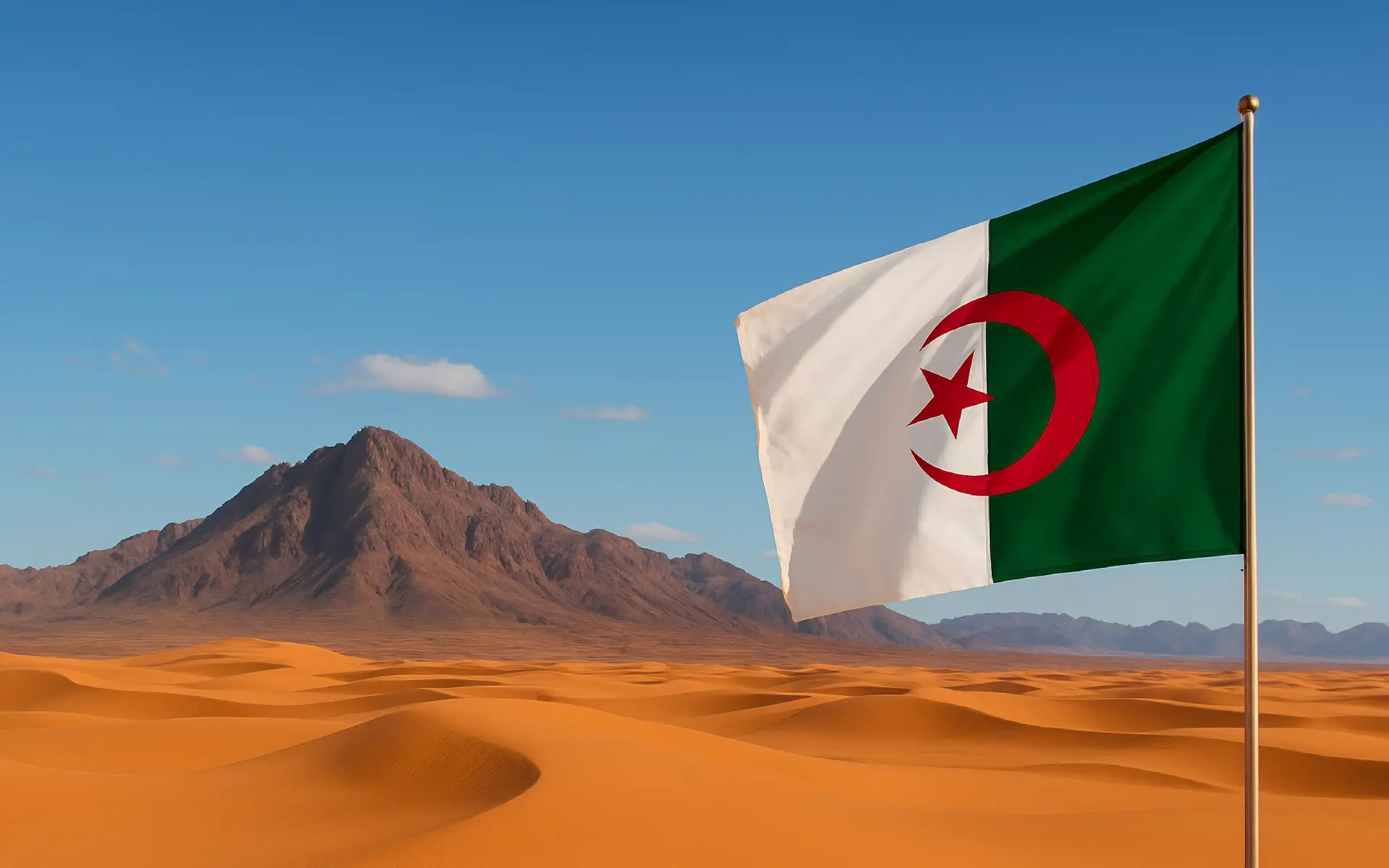
Algeria is a land of superlatives and surprises, the vast, sunbaked expanse known as Africa’s giant. At 2,381,741 square kilometers, Algeria is the largest country on the African continent and the tenth-largest in the world. Its name conjures the Sahara Desert – indeed, over 80% of Algeria’s territory is desert. Yet the nation’s story stretches from ancient kings to modern revolutions, from snow-capped peaks to tropical coastlines. This guide peels back Algeria’s many layers – geographical, historical, cultural, economic, and quirky – with rigorously sourced detail and a measured, journalistic tone.
Geographers and travelers alike will find surprises: Algeria’s Mediterranean coast runs some 1,335 miles (2,148 km) long, bearing waves that never reach the Sahara sands far inland. North of the Sahara lie lush “Tell” Atlas ranges, while in the south the Hoggar (Ahaggar) highlands loom, anchored by Mount Tahat (3,003 meters) – the country’s highest point. Snow even falls in the Sahara: in 2018, the desert town of Ain Sefra (the “gateway to the Sahara”) was blanketed by about 40 centimeters of snow. Such extremes – searing heat by day, freezing cold by night, dust storms and torrential floods – define Algeria’s climate. This article will lay out Algeria’s geography, history, and culture in depth. You will discover not only statistics and dates, but the lived reality behind them – like urban Algerians living in sprawling cities on the coastal plain, and nomadic Amazigh peoples shepherding herds beneath the same stars that watched ancient stone tools.
Algeria’s sheer scale dominates any discussion of its geography. It covers 2,381,741 km² (919,595 mi²), a footprint larger than many European countries combined. This vast land is divided into four major physical regions: the fertile Mediterranean north, the arid highlands and plateaus of the interior, the rugged desert massifs to the south, and the Sahara proper (which itself is split into sub-regions). In practical terms, the heart of Algeria is the Sahara: over 80% of the nation’s surface is desert or semi-desert. Yet most Algerians live far north. Roughly 91% of the population inhabits the narrow coastal strip that accounts for only about 12% of the land.
Algeria’s modern geography belies a layered history that stretches back to antiquity. In ancient times much of what is today northern Algeria was Numidia, the first Berber kingdom and one of Africa’s early states. Around 200 BCE, King Masinissa united rival Numidian tribes and allied with Rome in the Punic Wars. The Numidian kingdom evolved over centuries: it alternated between Roman province and local client kingdom until finally the Roman Empire annexed it in 46 BCE. Roman ruins (like the cities of Timgad and Djémila) still dot the landscape, testifying to 400+ years of Roman rule. After Rome’s fall, Vandals and Byzantines held sway for a time, but by the 7th century Arab Muslim armies arrived from the east. The Arab conquest (c. 680 CE) spread Islam through North Africa; Arabic gradually became dominant, mingling with indigenous Berber culture.
Key Chronology: Ancient Numidia (Berber kingdom) ▶ Roman Africa (Roman province) ▶ Arab-Muslim dynasties (7th–16th c.) ▶ Ottoman regency (1516–1830) ▶ French Algeria (1830–1962) ▶ Independence (1962).
Throughout these eras, Algeria’s cultural heritage accumulated. From the rock art of Tassili n’Ajjer (dating back 10,000+ years) to the Casbah citadel of Algiers (a fortified medieval city), Algeria’s past is engraved in its landscape. Each layer of history – Berber, Arab, Ottoman, French – adds to the nation’s complex identity.
Algeria today is officially the People’s Democratic Republic of Algeria. It is a semi-presidential republic with a multi-party system. Administratively, the country is divided into 58 provinces (wilayas) and over 1,500 municipalities. Key modern facts and symbols:
Modern Algeria has a complex linguistic and cultural mix. The constitution recognizes two official languages: Modern Standard Arabic (MSA) and Tamazight (Berber). (In 2016 the Algerian government fully recognized Tamazight in the constitution.) In daily life, Algerian Arabic – a Maghrebi dialect (Darja) – is the mother tongue for most people. Berber languages are spoken by Amazigh communities mainly in the Kabylie and Sahara regions.
Another legacy of history is French. Algeria has no official colonial language, but French is widely used in media, education, and business. An estimated 15 million Algerians speak or understand French. Its role is hotly debated: younger generations often learn some English or French at school, and Algeria is now rapidly introducing English into education. But for now, French remains the main second language.
Algeria’s identity is also strongly Islamic (99% of Algerians are Sunni Muslim), and Islam is ingrained in daily life and law. Yet there is room for secularism: Algerian women have remarkable educational achievements (see below) and religious minorities have some rights. Algerian cuisine, arts, and music reflect Berber, Arab-Andalusian, Ottoman, and French influences. For example, rai music from Oran blends Arabic vocals with Western instruments, and Algerian literature (from Albert Camus to contemporary writers) is part of a broader francophone and Arabic intellectual world.
In summary, Algeria’s cultural fabric is layered: ancient Amazigh roots, Islamic traditions since the 7th century, and vestiges of French colonial and European influence. This blend is visible in the Algerian psyche: proud of Arab-Islamic heritage, fiercely independent (shaped by the anti-colonial struggle), but also generally open to global culture.
As of the 2020s, Algeria’s population is around 48 million, making it the third-most populous Arab country after Egypt and Sudan, and the tenth-most in Africa. It has a young population: roughly 29% are under age 15 (about one child in three) and median age is only in the mid-20s.
Algerians are overwhelmingly urban: cities and towns hold about 75% of people. The largest city is Algiers, the capital on the coast, with an urban area exceeding 4 million. Other major cities include Oran (northwest coast, ~1 million), Constantine (east, ~500k) and Annaba (near Tunisian border, ~300k). Often these cities have districts known for whitewashed buildings, giving nicknames like “Alger la Blanche” – “Algiers the White” – for the bright stone casbah overlooking the bay.
Ethnically, around 73.6% of Algerians are Arab-Berber and 23% are Berber/Amazigh. Virtually 99% of the population practices Islam, almost entirely Sunni. Small Christian and Jewish communities exist but are tiny. There is a long-standing community of Chaoui, Kabyle, Tuareg and other Amazigh peoples with distinct languages and traditions. Many rural inhabitants in the Sahara are nomadic or semi-nomadic (e.g. Tuareg herders, Sahrawis in the southwest).
Notably, literacy and education rates have soared: over 80% of Algerians can read, and women now slightly outnumber men among university graduates. In fact, Algerian women overall are extremely well-educated (see next section). Life expectancy is around 77 years, and Algeria’s Human Development Index is the highest on the African mainland (reflecting years of investment in education and health).
Algeria’s economy is heavily shaped by its energy wealth. The country holds vast hydrocarbon reserves: as of the 2020s, it is among the world’s top producers of oil and especially natural gas. Specifically, Algeria is the 4th-largest natural gas exporter globally (after Russia, Qatar, Norway) and has the 9th-largest proven gas reserves in the world. It also ranks around 16th in proven oil reserves (about 12.2 billion barrels).
Accordingly, oil and gas dominate Algerian exports and government revenues. Around 95–98% of export earnings come from petroleum and natural gas. State energy giant Sonatrach is Africa’s largest company; it runs the oil fields and pipelines and is a major gas supplier to Europe (especially pipeline gas to Spain and Italy). Algeria is a member of OPEC partly for these reasons.
This oil wealth gave Algeria substantial foreign currency reserves. For years Algeria was debt-free: its reserves cover over a year’s worth of imports, and the country has essentially no foreign debt. This fiscal strength has been a notable achievement – most countries of Algeria’s size carry large debts, but Algeria’s strategic hydrocarbon sales have funded infrastructure, subsidies, and welfare.
Yet Algeria faces economic challenges. Heavy reliance on energy makes it vulnerable to oil-price swings. When oil prices fell sharply in mid-2010s, growth slowed. Moreover, wealth is uneven. Despite public spending, about 25% of Algerians live on $1.90/day or less (World Bank data) – reflecting poverty pockets and regional disparities in services. Agriculture is limited: only ~3.5% of Algeria’s land is arable, and droughts (exacerbated by climate change) frequently hit farming areas.
Some key economic indicators and facts:
Despite oil riches, unemployment (especially among youth) is a chronic issue (see Modern Issues). Economic diversification – into tourism, manufacturing, renewable energy – is a top government goal.
Algeria boasts a remarkable number of UNESCO World Heritage sites – reflecting its diverse history. In fact, 7 cultural sites are recognized (plus the Great Mosque of Algiers, completed in 2021, which has the world’s tallest minaret – a fact we note below). Each UNESCO site is a window into a different era:
Each of these sites tells a story: from prehistoric Saharan farmers (Tassili) and Roman colonists (Djémila, Timgad) to medieval Berbers (M’Zab, Beni Hammad) and Ottoman-era city-builders (Casbah). Together they show how Algeria was a crossroads of civilizations.
Algeria’s vast landscapes support diverse life – from coastal forests in the north to desert flora and fauna in the south.
Despite these pressures, Algeria’s conservation efforts have had successes: for instance, in 2019 Algeria was declared malaria-free by the World Health Organization – becoming the second African country (after Mauritius) to achieve this. It has also created several national parks (Hoggar, Ahaggar, Tassili) to protect wildlife hotspots.
Algeria’s food scene is a rich tapestry woven from Berber, Arab, Mediterranean and European threads. Here are some standout culinary facts:
Algeria has made its mark in international culture and sports:
Overall, Algeria’s contributions to sports, literature, and culture far outweigh what one might expect from a country that was only “re-born” as a modern state in 1962. Its artistic scene – though less known globally – is vibrant, with theaters, art galleries and festivals in Algiers, Oran, and elsewhere.
Algeria has its share of trivia and oddities that often catch outsiders by surprise:
These facts often appear as quiz questions about Algeria, but each underscores a facet of Algerian life – the fusion of ancient tradition (sheep and dates), colonial legacies (camels, French cavalry, Overseas missions) and modern quirks (internet shutdown, protest art).
One of Algeria’s most remarkable social facts is the high status of women in education and the professions – especially relative to other countries in the Arab-Muslim world. Since independence, Algeria has heavily promoted female education. Today, Algerian women account for about 60% of university students. In professions: roughly 70% of lawyers and 60% of judges in Algeria are women, the highest ratios in the Arab world. Women also dominate medicine and science fields.
Despite these strides, challenges remain. Female participation in the workforce beyond the classroom is lower (legal and social barriers persist). One UNESCO report notes only about 50% of female graduates find jobs, and just 7% of Algerian entrepreneurs are women. Traditional attitudes still influence family roles. For example, equal inheritance rights under Sharia for sons and daughters have not been fully realized, and the family law still places some restrictions on women.
Nonetheless, Algerian women contribute more household income than men, and their educational achievements give them new influence. The shift over the past few decades – from strict conservative norms to now having women at the helm of top legal and medical professions – is one of the most striking stories of modern Algeria. It reflects both state policy (laws encouraging female schooling) and Algerian society’s unique balance between tradition and modernity.
Algeria’s regions differ greatly. A brief tour would note:
A visitor might note that Algerians seldom say “Bonjour” like Moroccans or Tunisians do; here it’s often “Salam” (peace). Hospitality is genuine – if you accept dates and mint tea and stay for three cups, you will be respected. However, always be mindful: Algeria is conservative. Women should wear modest clothes; public displays of affection are frowned upon. Algeria is generally stable; tourism is reopening after decades of neglect. Yet one should register with one’s embassy, avoid border areas (with Mali/Niger) unless guided, and heed local advisories. The greatest modern challenge on travel is bureaucracy and visa rules (most nationalities need a visa and must register with police on arrival). Entry usually requires a visa in advance, except for a few visa-exempt African and Middle Eastern countries.
Regional Summary: The north brings the Algerian coastline and historic cities (Algiers, Oran, Constantine). The south is the Sahara—vast dunes, oases (Ghardaïa, Timimoun) and mountain refuges (Tamanrasset, Djanet). Travel is still niche but rewarding. Key must-sees include the Casbah of Algiers (UNESCO), the Roman ruins of Timgad/Djémila, and Sahara highlights like Hoggar and Tassili. Visa and security policies are more restrictive than in neighboring Morocco/Tunisia, so preparation is essential. Spring and autumn (March–May, September–October) are the ideal times to visit, avoiding the searing summer and the cool, wet winter.
Today’s Algeria is a land of contrasts. Its oil revenues brought schools and hospitals and high literacy, but they also bred corruption and an economy not fully diversified. Key issues:
In short, modern Algeria is riding the new resources-for-education economy it built after 1962, but searching for a diversified path and a more inclusive political system. The society is complex: urbanizing fast, religiously conservative but increasingly liberal in other respects, proud of its independence struggle, yet eager for the opportunities of the 21st century.
These quick facts scratch only the surface. Algeria’s true character emerges in the details above – from backstories of ancient sites to everyday customs like tea drinking and family feasts.
Algeria is a land of striking contrasts and deep history. It is at once “old” – with millennia of civilization carved into its ruins and rock art – and “new”, having forged a modern republic only in 1962. Its expansive deserts and Mediterranean coast give it a unique geography. Its people – overwhelmingly Muslim Arabs-Berbers – are proud of both ancient Amazigh roots and later Arab culture. The oil and gas under its sands have brought wealth, but also inequality and dependency that Algeria continues to navigate. Meanwhile, Algerian society surprises outsiders: women dominate the legal profession, children grow up learning ancient Amazigh traditions and French pop culture alike, and a young generation carries on the “Revolution of Smiles,” pushing quietly for more democratic change.
Above all, Algeria demands careful attention. It is neither a Middle Eastern nor a sub-Saharan country, but a North African mosaic in its own right. The white minaret piercing Algiers’ sky, the whisper of the desert night, the call to Friday prayers in a sea of white-clad devout – each tells a story. Through this deep exploration of geography, history, culture, and contemporary life, we see Algeria as a land of layers: each fact unfurls another, revealing a country both richly distinct and unmistakably connected to wider human journeys.


