

A botanical garden is more than just a pretty park – it is a living museum of plants dedicated to research, conservation, and public education. By one definition, a botanical garden “is a garden with a documented collection of living plants for the purpose of scientific research, conservation, display and education”. The world’s oldest, Padua’s Orto Botanico (Italy, 1545), still preserves its original Renaissance layout (a circular pond representing the Earth) and exemplifies this legacy. UNESCO describes Padua as “the world’s first university botanical garden” and highlights how such institutions from the 16th century onward have played a “vital role in communication and exchange of ideas, plants and knowledge” among scholars. In practice, these gardens arose partly to grow medicinal and useful plants for university study, but over centuries they became public attractions and research centers alike.
Historically, many early gardens were attached to universities or royal courts, where physicians and botanists cultivated plants for medicine or taxonomy. Later, as European colonial empires expanded, botanical gardens in tropical outposts played key roles in agriculture and ecology. For example, British scientists in the 19th century established gardens across Asia and the Pacific, moving economically important species (like rubber) into new climates. In Singapore, UNESCO notes the Botanic Gardens “was a centre for plant research in Southeast Asia” and helped expand plantation rubber throughout the tropics. Today, gardens combine these scholarly missions with leisure and art: they often feature landscaped ponds, sculpture exhibits, and cultural festivals, inviting casual visitors as well as scientists.
Europe’s Historic Gardens
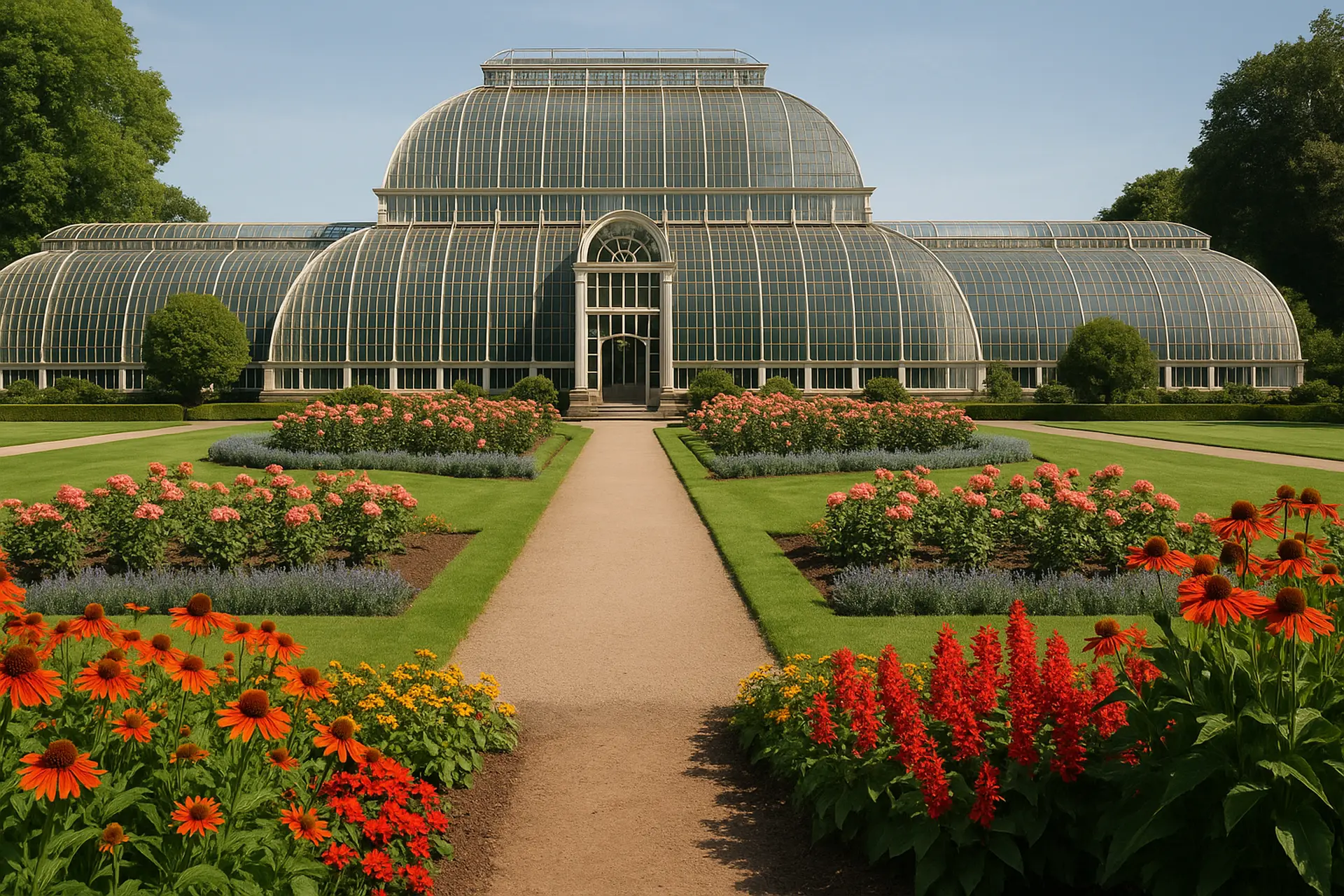
The Royal Botanic Gardens at Kew (London, UK) illustrates how a garden can be both a research institute and a grand public space. Founded in 1759, Kew covers roughly 300 acres along the Thames and now contains over 50,000 living plants. Its Victorian-era Palm House and Temperate House (glass conservatories) showcase tropical palms and delicate orchids under elegant iron-and-glass domes. According to UNESCO’s World Heritage description, Kew has, since its founding, “made a significant and uninterrupted contribution to the study of plant diversity and economic botany”. The garden’s science programs remain world-leading: it manages the Millennium Seed Bank (at nearby Wakehurst), which houses 2.5 billion seeds from 40,000 species – “the most diverse wild plant species genetic resource on Earth”. In other words, Kew not only displays thousands of rare plants for visitors, but also serves as an enormous genetic library safeguarding many of them against extinction.
Italy’s Orto Botanico di Padova (Padua Botanical Garden) represents the other end of Europe’s spectrum. Covering only about 2.5 hectares, it is tiny by modern standards – yet its legacy is immense. Established in 1545, Padua’s garden was built for medical students and remains essentially unchanged. Its classic plan – a circular island of water symbolizing the world – survives intact. UNESCO emphasizes that this small garden “made a profound contribution to the development of many modern scientific disciplines, notably botany, medicine, ecology and pharmacy”. Padua still houses a 50,000-volume library and an herbarium with over 6,000 plant species, reflecting five centuries of botanical scholarship. In short, Padua’s “living museum” of plants and books connects the Renaissance roots of plant science to our modern understanding of life.
Beyond these two UNESCO icons, Europe has many other notable gardens. London’s second major garden – the Cambridge University Botanic Garden – and the century-old Oxford Botanic Garden (founded 1621) both support research and teaching. The Royal Botanic Garden Edinburgh (34 ha) is linked to Scotland’s university system. In Spain, the Royal Botanic Garden of Madrid (since 1755) contains about 20,000 species of native and exotic plants. Each exemplifies a local history of horticulture and science. Across Europe, these institutions are typically administered by universities, governments or royal societies, and include museums, labs and herbaria. For example, UNESCO notes that such gardens “are often run by universities or other scientific research organizations” and “have associated herbaria and research programmes” for taxonomy. In this way, living collections and documented archives work together to advance botanical knowledge.
Asia’s Tropical Treasures
In tropical Asia, the world’s finest gardens blend lush jungles with meticulous landscaping. The Singapore Botanic Gardens (est. 1859) lies at the heart of the city-state’s Orchard Road district, combining swamps, rainforests and ornamental glades. As UNESCO explains, it “demonstrates the evolution of a British tropical colonial botanic garden… to a modern world-class botanic garden”. Today its Rainforest (a preserved patch of original jungle) and iconic Orchid Garden (home to over 5,000 orchid hybrids) coexist with avenues of heritage trees. Singapore’s gardens also had an outsized economic impact: botanists there helped adapt rubber plants from South America into Asian plantations. By 1877, seedlings sent from Kew had thrived in Singapore’s nurseries, making the city central to the expansion of rubber cultivation throughout Southeast Asia. This story – from colonial science to global trade – illustrates how one garden’s collections reshaped entire industries.
In East Asia, China has recently invested heavily in botanical research gardens. The newly designated China National Botanical Garden (Beijing) now spans 600 hectares, combining Beijing’s existing garden with a South China site. It boasts an extraordinary array of plants – over 30,000 species and 5 million specimens in total – drawn from tropical and temperate zones alike. Its South China (Guangzhou) section alone covers 300 hectares with roughly 1,700 species. Together these campuses form one of the world’s largest living collections, meant to study and conserve China’s vast plant diversity. (China is also building other major gardens – for example, Yunnan has the Xishuangbanna Tropical Botanic Garden, focusing on rainforest plants.)
Japan’s oldest botanic garden, Koishikawa (Tokyo, est. 1684), and the famous Neofinetia (Shinobazu) area (now part of Ueno Zoo) show the early Asian tradition of botanical study. In India, both the Acharya Jagadish Chandra Bose Indian Botanic Garden (Kolkata, est. 1787) and the Lalbagh (Bangalore, 1760) played key colonial roles. Southeast Asia also has unique sites: for example, the tropical gardens of Penang and Sri Lanka date to the Dutch and British periods. Although fewer Asian gardens have UNESCO status, they often play major roles in conserving native flora and educating the public. Many feature national specialties (for instance, Philippine gardens highlight palms and orchids) and large arboreta or seed collections.
North American Botanical Icons
In North America, botanical gardens range from urban sanctuaries to regional complexes. New York City hosts two of the continent’s best-known:
– New York Botanical Garden (Bronx, 250 acres) was established in 1891 and today maintains over one million living plants. Its landmark glass conservatory (Enid A. Haupt Conservatory) shelters tropical rainforests and desert biomes under steel arches. The Garden also includes the LuEsther T. Mertz Library (one of the world’s largest botanical libraries) and extensive research programs in plant science.
– Brooklyn Botanic Garden (52 acres, est. 1910) is smaller but iconic, famed for its Japanese Hill-and-Pond Garden and cherry blossom alleys. It “holds over 14,000 taxa of plants” and hosts 800,000 visitors a year. Brooklyn’s garden emphasizes education and community outreach, with classrooms, seed banks and a conservation lab.
The Chicago Botanic Garden (Glencoe, Illinois) exemplifies a midwestern tradition. Opened in 1972, it sprawls over 385 acres of land scattered across nine islands in suburban lakeside terrain. According to one description, it is “one of the world’s great living museums and conservation science centers,” with 28 separate display gardens plus four natural-area preserves. Visitors can wander through specialized gardens – Japanese, prairie, water, rose, fruit – all laid out with modern design. The Chicago staff also runs a large plant research program, studying horticulture and seed conservation.
Canada’s most famous garden is the Jardin botanique de Montréal. Established in 1931 near Parc Olympique, it covers about 75 hectares (190 acres) and cultivates over 22,000 plant species. This vast site contains dozens of themed gardens (including Chinese and Japanese botanical landscapes, a First Nations garden, rose gardens, and many greenhouses) plus a great arboretum. Parks Canada lauds Montreal’s garden as “one of the most important botanical gardens in the world”, thanks to its enormous collections and research facilities. (Indeed, it includes the Insectarium and Biodome next door, creating a unique cluster of nature museums.) Other Canadian cities also host botanical gardens – for example, Vancouver’s VanDusen Garden and Toronto’s Allan Gardens – but Montreal’s remains the largest and most heavily researched.
Further south in the United States, Longwood Gardens (Kennett Square, Pennsylvania) is notable for its scale and display horticulture. It now encompasses 1,100 acres of formal gardens, woodlands and meadows. Its grounds include ornate Italianate fountains, extensive conservatories, and a massive meadow garden. Wikipedia notes that Longwood is “one of the premier horticultural display gardens in the United States”. In other words, its designers use artful planting to complement scientific garden collections. Likewise, the Denver Botanic Gardens, Atlanta Botanical Garden, New Orleans Botanical Garden and other U.S. sites draw visitors with both specialized plant collections and public events.
Latin America and Africa
Botanical gardens in Latin America and Africa often highlight native flora and colonial-era exchanges. In Brazil, Rio de Janeiro’s Botanical Garden (Jardim Botânico do Rio, founded 1808) serves as the national collection of tropical plants. It lies at the foot of Corcovado Mountain, covering about 54 hectares. Today it protects roughly 6,500 species of tropical and subtropical flora, including huge palms lining the central alley and thousands of Amazonian water lilies in its lake. Guided tours and signposts explain Brazil’s biodiversity in what was once King John VI’s private garden. UNESCO has not listed Rio’s garden, but it remains a major landmark. Other Latin American gardens include Mexico City’s Chapultepec Botanic Garden (noted for agaves and cacti) and the historic Buenos Aires Botanic Garden (founded 1898 by architect Carlos Thays), each serving its region’s scientific community.
In southern Africa, the Kirstenbosch National Botanical Garden (Cape Town, South Africa) is a world-renowned example. It stretches over 528 hectares (about 1,300 acres) on the slopes of Table Mountain and preserves the unique Cape fynbos flora. Kirstenbosch’s staff grows more than 7,000 plant species – most of them indigenous to South Africa – in themed sections (such as a protea garden and a woodland section). A highlight is the “Boomslang” canopy walkway (a long steel bridge through the tree tops), giving visitors a treetop view of the gardens. In summer, the lawns at Kirstenbosch host outdoor concerts, marrying culture with nature. Nearby, the South African National Biodiversity Institute (SANBI) operates other gardens and seed banks (for example, Pretoria’s National Botanical Garden is famed for cycads, and Stellenbosch’s garden emphasizes succulents).
Elsewhere in Africa, notable gardens include the Orman Botanical Garden in Cairo (est. 1875, largest in Egypt) and the State Botanical Garden of Hungary’s partner in Dar es Salaam, but data is scarcer. Many African countries use botanical gardens to preserve local trees and crops (for example, Nigeria’s Ibadan gardens focus on tropical fruits). In sum, gardens in Africa often reflect a mix of scientific, historical and recreational missions, much as they do on other continents.
Australia and Oceania
In Australia and nearby islands, botanical gardens often showcase unique Southern Hemisphere floras alongside international collections. The Royal Botanic Garden Sydney (established 1816) lies on 30 hectares by Sydney Harbour. It is considered “the oldest scientific institution in Australia and one of the most important historic botanical institutions in the world”. Its collections include native eucalypts, cycads, and rare rainforest species, all documented in a respected herbarium. Public highlights include heritage palm avenues and the Calyx glasshouse with rotating plant displays.
Further south, the Royal Botanic Gardens Victoria in Melbourne (35 hectares, est. 1845) exemplifies classic 19th-century design. It cultivates over 20,000 plant species, including many Australian natives (waratahs, grevilleas) and exotics in its vast fernery and Lakeside Garden. Its director, when the garden opened, even brought seeds of Sydney’s rare Wollemi pine. New Zealand’s gardens – such as Christchurch Botanic Gardens and Wellington’s Otari-Wilton’s Bush – play similar roles, adapted to Pacific climates. On Pacific islands, botanical gardens like Fiji’s Waisali Reserve focus on local conservation of island flora.
Across Oceania, these gardens are usually public institutions run by state governments or trusts. They hold programs for recovering endangered trees and involve indigenous communities in plant stewardship. Visitors may attend art festivals among banana groves or watch traditional weaving demonstrations in the shade of strangler figs. In every case, the emphasis is on living collections: from Tasmania’s alpine plants at the Royal Tasmanian Botanical Gardens to coral-reef aquariums at Hawaii’s Moanalua, “garden” can include any curated ecosystem.
Conservation and the Future
Today’s top botanical gardens are as much about safeguarding the future as they are about celebrating the past. Almost all have formal conservation programs and partnerships. For example, the Millennium Seed Bank (at Wakehurst, managed by Kew) is a global effort: it has banked seeds for over 40,000 plant species, acting as an underground vault against extinction. Botanical gardens contribute specimens to international seed-banking networks, breed endangered plants in captivity, and reintroduce them to wild habitats. In California, the San Diego Botanic Garden collaborates on restoring native chaparral plants, while in the UK, Kew’s own outreach helps protect North American wildflowers at risk. Many gardens belong to Botanic Gardens Conservation International (BGCI), a network in 100+ countries that shares expertise and living collections.
At the same time, gardens are educational, showing urban visitors where crops and medicines come from. Labels and apps explain, for instance, how Madagascar’s rosy periwinkle at the New York Botanical Garden led to cancer drugs, or how Australia’s Flindersia trees in Melbourne are related to citrus fruits. Family programs, guided tours, and citizen-science projects encourage public engagement. As urban green spaces, botanical gardens also demonstrate horticultural best practices: sustainable irrigation, composting, and habitat creation for pollinators. In short, while each garden has its own character – from Kew’s stately avenues to Singapore’s tropical greenhouses – all share the mission of merging scientific inquiry with public service.
Conclusion
The world’s leading botanical gardens are cultural treasures where science and beauty meet. They range from centuries-old academic gardens like Padua to sprawling national sites like Kew, from tropical paradises in Singapore to desert conservatories in Australia. Each garden reflects its region’s history – royal patronage in London, colonial botany in Calcutta and Singapore, or New World exploration in Rio – yet all emphasize plant life as a global heritage. By walking these gardens’ paths, one literally tours the plant kingdom: ginkgo trees brought from Asia, protea blossoms from Africa, orchids from every continent. Perhaps most importantly, they remind us of our duty to the green world: thousands of species are labeled and preserved in these gardens, a silent pledge that they will not vanish without a trace.









