
The Earth offers an astonishing variety of landscapes that can feel more alien than familiar. Far from gimmicky exaggeration, many of these places truly emulate other planets or moons in striking ways. This guide is for curious travelers and sci-fi enthusiasts who want to see Earth’s most otherworldly scenes up close – from Mars-like salt flats to Venusian acid pools to ice deserts straight out of Voyage to Enceladus. It merges vivid travel narrative with hard science, practical trip planning, and photography advice. Organized by theme and location, the article starts broad (why these sites feel alien) and then dives deep into each must-see landscape (30 sites in all), logistics (permits, seasons, guides), safety, ethics, plus photo tips and even fan-culture notes. In short, it’s a one-stop handbook: part travel planning, part astrobiology primer, and part adventure memoir. Whether you’re a casual sci-fi fan or a dedicated “planetary analogue” researcher, every answer (and citation) you need is here.
- How and Why Landscapes Look “Alien”: The Science Made Simple
- Geological Processes
- Biological Colorants: Thermophiles and Halophiles
- Atmospheric and Optical Effects
- Canonical Mars, Venus, & Icy Moon Analogues on Earth
- Mars-like: Atacama, Dry Valleys, Salar de Uyuni
- Venus-like / Sulfuric analogues: Danakil & Dallol
- Icy Moon Analogues: Antarctica’s Dry Valleys & Cryogenic Sites
- The Ultimate 30-Site List: Alien Landscapes You Must Know
- Danakil Depression and Dallol (Ethiopia) – Hottest Acidic Lowland on Earth
- Salar de Uyuni (Bolivia) – The Ultimate Salt Mirror; Desert of Stars
- Atacama Desert (Chile) – Mars on Earth
- Fly Geyser (Nevada, USA) – Neon Alien Hot Springs
- Grand Prismatic Spring (Yellowstone, USA) – Rainbow Hot Spring
- Rainbow Mountain, Peru – Spectacular Clay Strata
- Lake Hillier (Middle Island, Australia) – Pink Plankton Lagoon
- Dead Vlei (Namibia) – Ghostly Acacia in White Clay Pan
- Socotra Island (Yemen) – Alien Flora & Island Aridness
- Wadi Rum (Jordan) – “Valley of the Moon” and Red Planet Sets
- Pamukkale (Turkey) – The “Cotton Castle” of Terraced Springs
- Tsingy de Bemaraha (Madagascar) – Forest of Stone Needles
- Zhangye Danxia (China) – The Painted Mountains
- Siloli Desert (Bolivia) – Stone Forest and Dunes of the Altiplano
- White Desert (Egypt) – Chalk Mushroom Rocks
- Badlands (USA) – Painted Desert and Petrified Forest
- Cappadocia (Turkey) – Fairy Chimneys and Underground Cities
- Mono Lake (USA) – Alkaline Tufa Towers
- Dunes of Sossusvlei (Namibia) – Towering Red Sand Seas
- Moeraki Boulders (New Zealand) – Smooth Alien Eggs on the Beach
- How to Plan: Permissions, Seasons, Guides & Tours
- Permits for Danakil/Dallol (Ethiopia)
- Choosing Reputable Local Guides
- Insurance, Medevac & Evacuation Planning
- Combining Sites into Regional Circuits
- Safety, Health, & Legal Checklist for Extreme Sites
- Altitude Sickness & Acclimatization
- Toxic Gases & Heat
- Water Safety (Pink Lakes, Hot Springs)
- Drone Rules, Permits & Ethics
- Responsible & Ethical Visiting
- Overtourism Risk & How to Avoid It
- Socotra: Fragile Biodiversity & Visitor Responsibilities
- Indigenous Lands, Sacred Sites & Permissions
- Leave No Trace Ethics
- Photography & Filmmaking for Sci-Fi Fans
- Leave No Trace Ethics
- Camera Settings and Composition “Recipes”
- Low-light / Astrophotography & Milky Way Tips
- Film Location Research & Permissions
- Science & Fandom Crossover: Research on Other-Worldly Terrains
- Mars Analog Research & Instrument Testing
- Extremophiles & Astrobiology Explained
- Citizen Science & How Travelers Can Contribute
- Itineraries for Sci-Fi Fans (Multi-Length)
- 7-Day “Mars in a Week” – South America
- 10-Day “Fire & Acid” – Ethiopia Intensive
- 5-Day US “Alien” Road Trip (Family-Friendly)
- 30-Day World Tour (Grand Alien Circuit)
- Budgeting & Booking: Cost Ranges & Money-Saving Tips
- FAQ
How and Why Landscapes Look “Alien”: The Science Made Simple
Earth’s strange terrains are shaped by familiar processes—but in extremis. Erosion, volcanism, evaporation, and biological pigments combine in rare ways to create scenes more reminiscent of film sets than hiking trails. This section (in plain language) explains the key geological, biological, and optical factors that make a place look “not of this Earth.” By understanding the science, we can appreciate why, say, Bolivia’s mirror-flat salt plain or Turkey’s petrified waterfalls are just as extraordinary as any imagined planet.
Geological Processes
The foundation of alien-looking landscapes is often tectonics and erosion. For example, the Danakil Depression in Ethiopia (below sea level) was formed by the splitting of three tectonic plates, producing deep rift basins, active volcanism, salt lakes, and acid springs. Over millions of years, these processes created salt-crusted plains and sulfur fields so extreme they seem extraterrestrial. Similarly, narrow valleys in Antarctica like the McMurdo Dry Valleys are so cold and arid that scientists describe them as “high-fidelity analogues” to the Martian surface. Even basins that were once underwater play a role: many salt flats (so-called playas or salars) formed where ancient lakes evaporated. As Britannica notes, when desert basins flood and then evaporate, “fine-grained sediment and salts concentrate” into flat, crusty pans. That’s what happened at Salar de Uyuni in Bolivia: a prehistoric lake shrank, depositing a pure salt crust over 10,000 km². Today it’s the world’s largest mirror-like salt flat.
Volcanic and hydrothermal action also create alien ground. Places like Zhangye Danxia in China owe their rainbow stripes to layers of sandstone and minerals that were uplifted and eroded. Turkey’s Pamukkale falls and basins are carved from travertine – calcium-carbonate deposits from hot spring water – giving a “cotton castle” of brilliant white terraces. Worldwide, salt-mineral chemistry produces bizarre solids: Madagascar’s Tsingy de Bemaraha is a forest of razor-sharp limestone spikes formed by groundwater dissolving and eroding ancient reefs. In short, while Earth’s bedrock is familiar, the extreme concentration of these forces (heat, minerals, volcanism, desert basins) sculpts landscapes that look like alien art.
Biological Colorants: Thermophiles and Halophiles
Life itself adds to the palette. In many hot springs and salt lakes, extremophile microbes color the water in living rainbows. For instance, Yellowstone’s Grand Prismatic Spring shows concentric rings of orange, yellow, and green – not because of paint, but because of heat-loving bacteria. Smithsonian reports that cyanobacteria form mats around the spring’s edges, with each species living at a different temperature and producing a different hue. Similarly, Australia’s Lake Hillier was famous for a bubblegum pink hue caused by high-salt-loving organisms (like the algae Dunaliella salina and bacteria Salinibacter ruber) that excrete carotenoid pigments. In 2022 extreme rains even turned Lake Hillier blue-gray by diluting these microbes, highlighting how delicate such ecosystems are.
Other examples: Nevada’s Fly Geyser is partly man-made but still biological – its hot waters nurture colorful thermophiles. Wikipedia notes that the geyser’s runoff hosts algae that stain the mineral mounds bright greens and reds. And the bizarrely colored pools of Ethiopia’s Dallol (sulfur springs) actually get their rainbow of white, green, yellow, orange, red and purple from chemical oxidation of iron and salts – not life. NASA-backed research finds Dallol’s multi-extreme ponds are mostly sterile, with colors arising from mineral precipitates.
In short, microbial mats thrive in heat or salt by making pigments (often carotenoids), and these tints paint landscapes vividly. Without extremophiles, places like Yellowstone’s prismatic pools or salt ponds in Africa would look quite drab. But in these psychrophiles and halophiles, alien ecology meets alien scenery.
Atmospheric and Optical Effects
Even the sky and light play tricks. High altitude deserts (like Chile’s Atacama or Peru’s Lake Titicaca basin) have very thin, dry air, which makes sunlight unusually sharp and the sky intensely blue. This amplifies color contrasts and makes distant scenery unusually clear. Some surfaces become super-reflective: for example, Salar de Uyuni, when covered by a thin film of rainwater, becomes the “world’s largest mirror,” reflecting sky and mountains over its entire 129 km width. This mirror effect can look downright cosmic, as if the ground and sky have swapped. In certain salt flats, optical mirages or shimmering haze (from dust or heat) can also lend an unearthly quality. On another note, albedo differences on Iceland’s black volcanic sands vs. white salt flats or colorful algae blooms can create alien mosaic patterns when seen from above. Though less heralded, these atmospheric/optical factors – intense sun, dust devils, twilight glows – often complete the “science fiction” illusion in a landscape.
Canonical Mars, Venus, & Icy Moon Analogues on Earth
Researchers and travelers alike often group sites by the planet or moon they resemble. This section sorts our must-see destinations into categories like “Mars analogs” or “Venus analogs,” with science-backed notes.
Mars-like: Atacama, Dry Valleys, Salar de Uyuni

High deserts and dry valleys most resemble Mars. Chile’s Atacama Desert (hyper-arid, nearly no rain) is so Mars-like that NASA sent rover tests there. Its salt flats, salt domes, and geysers mimic Martian terrain. Close by, Bolivia’s Salar de Uyuni has a crust of bright salt over red-brown earth – indeed parts of it were used as planet Crait in Star Wars (2017). The Salar’s glassy surface after rain even looks like Mars’s dusty sky reflecting off a flat plain. Meanwhile, Antarctica’s McMurdo Dry Valleys are literally frozen deserts (snow-free by katabatic winds). They are the coldest, driest valleys on Earth – so analog to Mars that since the 1970s NASA has run field tests there. For example, University Valley in Antarctica yielded no detectable life in the permafrost, making it an eerily Mars-like wilderness.
In short, places like the Atacama, the high Andes, and Antarctic dry basins are prime Martian analog sites. Scientists study them to train rovers and instruments; visitors enjoy the superb stargazing (due to dry air) and dramatic expanses of red rock and salt. (For more on research tours and citizen science in such sites, see later sections.)
Venus-like / Sulfuric analogues: Danakil & Dallol

If Mars is parched and red, this next group is blisteringly hot and acidic – evoking Venus’s inferno or Io’s sulfuric fields. Ethiopia’s Danakil Depression and its neighbor Dallol are top of the list. Danakil is one of the lowest, hottest places on Earth; daytime lows rarely fall below 30°C and surface temperatures often top 50°C. Its salt volcanoes and lava lakes (Erta Ale volcano’s persistent lava lake, for instance) lend a space-age vibe. In winter it’s still brutally hot, but at least more bearable.
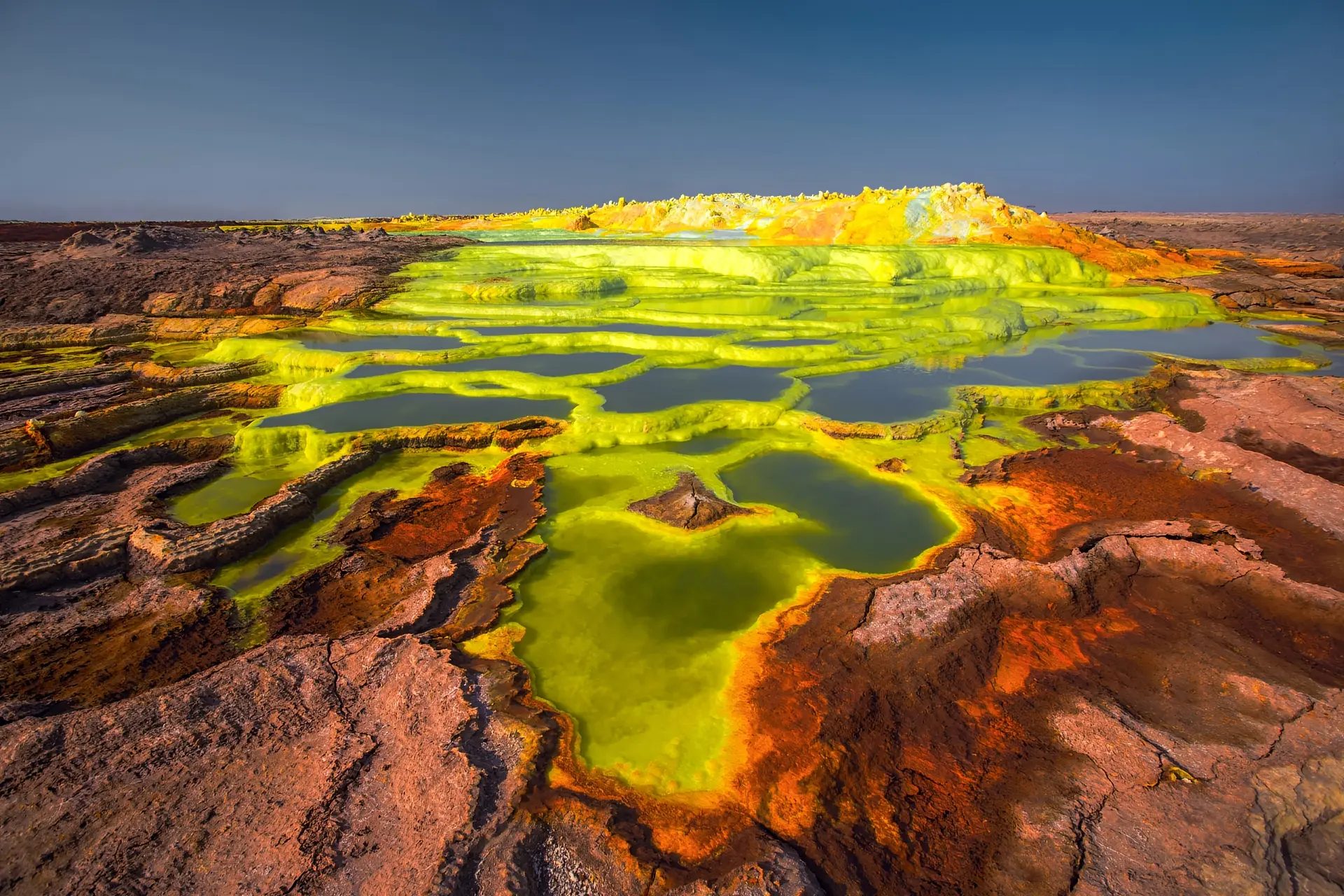
Dallol (nested in Danakil) deserves special notice: it’s a geothermal field with the lowest (410 ft below sea level) volcanic vents on Earth. Its pools are hyperacidic (pH<0) and up to 108°C, bubbling with yellow, green, and pink brines rich in sulfur and iron. Wikipedia notes Dallol’s hyperacidic springs are “poly-extreme” – even acidophiles struggle to survive there. The result is a landscape of neon-yellow sulfur ponds, ochre salt pillars, and wine-red microbial mats (microbes can only live at pond edges). As field reports describe it, Dallol “feels as if we’ve visited Mars and Venus,” with rusty-green acid lakes stacked against neon terraces.
These places look alien not just in color, but in chemistry. They leak sulfur dioxide and chlorine gases, and their water is so saline and acidic that contact is painful. Visiting requires safety gear (masks, goggles), and tourists can only go with armed guides for security. But for sci-fi fans the payoff is huge: Danakil and Dallol are the closest you can get to walking on a Venusian plain or Saturn’s moon Io. (We cover permits and tours in Planning section.)
Icy Moon Analogues: Antarctica’s Dry Valleys & Cryogenic Sites

For analogs to Europa, Enceladus, and other ice worlds, we turn to the polar realms. The McMurdo Dry Valleys already doubled as Mars analog – but they also hint at conditions on icy moons. The valleys are Antarctica’s largest ice-free region, and remain below freezing year-round despite almost no rainfall. Subsurface microbial communities there eke out life under rocks or in permafrost, a bit like what might exist beneath Europa’s or Enceladus’s surfaces.
Notably, researchers use even colder Antarctic lakes as stand-ins for icy oceans. For example, Lake Untersee (East Antarctica) is sometimes cited as a model for Enceladus because of its thick ice cover and trapped gases. Drilling teams have tested Mars-like rovers in Dry Valleys, and the first IceCore drills for life-detection, all in anticipation of outer-planet missions. In the future, icy-world tours might center on extreme glacial environments in Svalbard, Greenland or Antarctica. (Such expeditions are highly specialized and expensive, but they exist – see “Itineraries” and “Travel Tips.”)
The Ultimate 30-Site List: Alien Landscapes You Must Know
Below is an exhaustive, whistle-stop guide to 30 of the most extraterrestrial-feeling sites on Earth. Each entry has a brief hook plus subsections on why it’s alien, how to visit, safety issues, permits, and photography/film notes. (Links in these cards jump to deeper info, but we include key points here.) The list covers classic star-scientific analogs, natural wonders, film locations, and a few surprising oddities – from the acid lakes of Ethiopia to the dessert pavements of California’s “Badlands.” Wherever possible, note that reputable sources (park services, science articles, traveler reports) back the facts below.
Danakil Depression and Dallol (Ethiopia) – Hottest Acidic Lowland on Earth

- Why it feels alien: Situated in the Afar Rift, the Danakil Depression lies about 125 m below sea level. It is the hottest place on Earth on average, with constant volcanic activity and hydrothermal fields. At Dallol, springs of hyper-acidic, salt-saturated water (over 108°C) bubble out of the ground. These create vivid neon fields: sulfur pools (yellow, green), iron-rich crusts (rust-red), salt canyons and “fairy chimneys.” Minerals like halite, jarosite, hematite, and gypsum precipitate into bizarre shapes. Geologically it’s a salt volcano: underground magma boils up through evaporites to the surface, dissolving minerals and depositing them in situ. The result looks like a science-fiction set – and indeed astronauts have trained here.
- Practicalities (When & How): Only short tours from Mekele (Ethiopia) are allowed, with armed police escorts. Visiting is generally limited to December–February (winter) to avoid 50°C+ heat. Access requires military permits and local guides; several Ethiopian tour companies specialize in Danakil trips (including Erta Ale volcano visits). The roads are rough 4×4 tracks; no solo travel is permitted in this area. Facilities are basic (camping on campsites or hotels in Mekele, Berhale); bring water, food and fuel for cooking.
- Safety & Health: Heat stroke, dehydration, and heat exhaustion are top hazards. The sulfur springs emit toxic gases (H₂S, SO₂), so masks and goggles are advisable in Dallol. Springs are highly acidic and dangerous to touch – don’t wade or splash. Mosquitoes are common around salt mining camps at night. Medically, altitude is low here (below sea level), but temperature extremes dominate.
- Permits/Guides: A government permit and at least one (often two) military or police guards are required for international visitors. Guides must be from Afar tribal communities. Tip: book well in advance with reputable operators (e.g. Adventure Specialists, Ethiopian Tours) who include meals and sleeping gear. Total 3-day tours cost roughly USD $300 per person (high season). Always ask about insurance or evacuation plans; Ethiopia’s Red Sea valley is remote.
- Photography & Film Notes: The Depression’s alien vistas have attracted film crews (Giovanni LaPaz’s still from 2007 was NASA’s #EarthToAsteroid to asteroid Ryugu). For photos: mid-morning and late afternoon give best light on Dallol’s colors (midday white light can wash them out). Use filters or bracket exposures for the extreme contrast between bright salt and dark lava. On Erta Ale, night-shot of the lava lake needs long exposures and gas masks for the fumes. Drone flights are generally not allowed without special government approval (they can disturb mining camps and wildlife).
Salar de Uyuni (Bolivia) – The Ultimate Salt Mirror; Desert of Stars

- Why it feels alien: Covering over 10,500 km² in the Andes, Uyuni is Earth’s largest salt flat. In the dry season it’s a vast white desert of hexagonal salt pans. After rains (Dec–Mar), a thin sheet of water turns it into a gigantic mirror. Locals say it feels like walking on clouds. At 3,656 m elevation, the ultraviolet-bleached sun and endless reflections create an otherworldly whiteness by day and incredible starfields by night. Nearby, the red crater lake Coipasa and Eduardo Avaroa National Reserve add flamingo pools and geysers to the odd scene.
- Practicalities (When & How): Uyuni town (Potosí Dept.) is base for tours. High-clearance jeeps cross the salar (4WD only; private drivers or multiday tours). Best visiting times depend on interest: June–Aug (dry) for crisp blue sky and cactus-covered Incahuasi Island; Dec–Mar (wet) for the mirror effect. Salar is public, no permits needed, but entry to the main flats is free. Wear layers: nights can drop below freezing; days are sunny/ultra-bright (sunburn risk!). Water on the salt is shallow (<20 cm), so check local conditions. Travelers often combine Uyuni with nearby deserts (Atacama, Puritama) in multi-day tours.
- Safety & Health: High altitude (3600m) means altitude sickness risk – climb gradually, hydrate, consider acetazolamide. UV exposure is intense (no shade). Vehicle breakdowns are common; ensure spare tires, fuel and food. The salt crust can hide sinkholes or saline mud – keep on tracks. During rains, salar drive can be treacherous and vehicles sometimes get stuck. No drinking water on the flats; the nearest village is 60 km away. At night, temperatures may plunge, so insulated sleeping gear is needed.
- Permits/Guides: No formal permit needed for salar itself. However, Uyuni is at border crossroads (adjacent Chile/Argentina); check visa regs for any cross-border itinerary. Licensed guides/drivers are recommended for safety; many tours are available from Uyuni or La Paz. For salar photos (especially “ant-scaling” perspective shots), be respectful of heritage sites like the White and Train Cemeteries on Uyuni’s edge.
- Photography & Film Notes: Salar de Uyuni is a photographer’s playground. For the mirror: use wide-angle lens at water surface level, set infinite focus, and shoot at dawn or dusk for pastel skies. Neutral-density filters help with daytime long exposures (to blur clouds). The mid-day sun on the white salt can cause harsh highlights – underexpose slightly to retain detail. At sunset, the flats glow red. Incahuasi Island’s giant cacti make a fun foreground. For astrophotography, the clear dark skies produce the Milky Way mirrored on water. The 2017 film Star Wars: The Last Jedi used Uyuni as the crystalline world Crait – its snowy look is cinematic.
Atacama Desert (Chile) – Mars on Earth

- Why it feels alien: The Atacama is one of the driest places on the planet, with some valleys that haven’t seen rain in hundreds of years. Its landscapes — ochre plains, salt crusts, sulfur geysers, and iron-red volcanoes — closely mimic Martian terrains. NASA calls it “a tractable Mars analog” and tests instruments there. Salt flats and red dunes in the desiccated basins look straight out of a sci-fi film. Life survives only in extreme niches: tiny lichens on rocks and flickers of wind-carried seeds. In some spots sunlight is so intense that soil layers bake to dead silence.
- Practicalities: The San Pedro de Atacama region is the tourist center. Key sites include El Tatio geysers (active at sunrise, 4300m high); Laguna Cejar (a salt lake in which you float); the Stone Spheres at Silla del Diablo; and Los Flamencos Reserve. The Atacama’s high altitude (avg ~2500–4000m) can cause altitude sickness. Water is extremely scarce; carry extra supplies. November–March has best viewing (clear skies), but winter (Jun–Aug) is cooler for trekking. Permits are rarely needed except for certain natural reserves; entrance fees and guided tours apply at national parks (e.g. Valle de la Luna).
- Safety & Health: UV and sun exposure are major concerns. The large diurnal temperature swings (hot days, very cold nights) demand layers. Altitude sickness must be managed (gastric issues, headaches). Flash floods are a rare hazard in dry riverbeds. Respect any protected sites (some oasis areas are fragile).
- Permits/Guides: Independent travel is common, but many attractions have private roads or park entrance fees (by vehicle). Booking through San Pedro agencies is convenient. Tour companies can arrange stargazing trips, cactus garden tours (like Valle de la Luna), and sunrise trips to Tatio (with guide goggles to spot condors).
- Photography & Film Notes: Atacama’s blue skies and pastel salt lakes make it a favorite for astro-photographers. The high altitude and dryness give minimal atmospheric distortion. Chajnantor’s ALMA site nearby uses Atacama’s dryness for telescope arrays (interesting for science fans). Sunrise-sunset colors off dunes and red cliffs are dramatic. Composition tip: include a lone rock or cactus silhouette for scale. Star Wars: A New Hope shot Tatooine scenes in the nearby Wadi Rum, but Atacama’s Valle de la Luna was actually used for the 2009 Seventh Son (mountain fortress) and as a backdrop in Quantum of Solace (a Chilean plain stood in for Bolivia).
Fly Geyser (Nevada, USA) – Neon Alien Hot Springs

- Why it feels alien: On private ranch land in Nevada’s Black Rock Desert stands Fly Geyser – a human-made, constantly erupting geothermal mound. Created by a drilling accident in 1964, a 3-meter-tall cone now spouts over 90°C water filled with dissolved minerals. Thermophilic algae and bacteria color the travertine mound in bright green, orange and red layers. The result is a small but surreal rainbow cone against the desiccated high desert. With no similarly colored fountains nearby, it feels almost staged by nature.
- Practicalities: Fly Ranch is managed by Burning Man Project; public access is strictly by guided tour only. Tours (by Friends of Black Rock) run April–October, limited to small groups (COVID restrictions apply). You must reserve weeks ahead. The ranch also has hot springs pools (managed separately) but the geyser area itself is off-limits except on tours. Driving requires 4WD; amenities are minimal.
- Safety & Health: The hot water is scalding; the boulder-cone is slippery. Tour groups keep guests on wooden pathways. Bring sun protection; the sagebrush plains offer no shade.
- Permits/Guides: No independent visits. Book through the official Fly Ranch walking tour (low-cost donation basis). Rangers provide hazmat suits and ensure minimal ecological impact.
- Photography & Film Notes: Fly Geyser is photogenic but hard to access, so images online are mostly from tours. The intense colors call for neutral exposure (bright greens and reds). Drones are not allowed (it’s private land). Interestingly, it has appeared on TV (the show Alien Highway featured it). Sci-fi fans note Fly Geyser’s appearance in offbeat documentaries about UFO hotspots – it’s often featured on “Top 10 Bizarre Lands” lists.
Grand Prismatic Spring (Yellowstone, USA) – Rainbow Hot Spring

- Why it feels alien: Yellowstone’s Grand Prismatic Spring (372 ft wide) is famous for its vivid rings of orange, yellow, green and blue. The rainbow effect is not paint but microbial mat colors: differing thermophiles live at different temperatures, creating concentric colored bands. At the edges are orange-red mats (lower temperature bacteria producing carotenoids) and green in cooler zones. The center retains deep blue from purified hot water. With steam rising from an 87°C pool and multicolored edges, it’s an unreal natural kaleidoscope.
- Practicalities: Located in Yellowstone NP (Wyoming), it’s easily accessible via boardwalk from parking lot. No permit beyond park entrance is needed. Visitor season is May–Oct; winters make boardwalks icy (park open but many roads closed). Trails beyond the spring are off-limits. The area is protected; keep pets on leash and do not litter or disturb bacteria mats.
- Safety & Health: The boardwalk is there for safety: underlying sediments can be thin, and the water is boiling (fumaroles and unstable ground hazards). Stay on designated paths. Beware geyser eruptions (not frequent at this specific spring) and noxious sulfur smell (some are sensitive, but generally minor at Grand Prismatic).
- Photography & Film Notes: Long aerials are spectacular (Yellowstone was also backdrop in Canyonlands documentary). For ground shots: sunrise/sunset light warms the orange mats. Polarizing filters cut glare on the surface. Telephoto is less effective (detail lost in large pool); use wide lens. Drone use is forbidden in the park without FAA permits (strictly enforced for all Yellowstone geothermal areas). This spring has appeared in many science and nature films highlighting extremophiles.
Rainbow Mountain, Peru – Spectacular Clay Strata

- Why it feels alien: Vinicunca, aka Rainbow Mountain, has bands of pastel red, yellow, green, and purple. Unlike microbes, the color here comes from mineral-laden clay that was layered and uplifted. Iron oxides give red and pink; chlorites give green; other minerals yield white or purple hues. After centuries of erosion, the mountain’s geology resembles brushstrokes of an alien rainbow. Local Quechua people consider it sacred, and its profile towers above snowy peaks nearby.
- Practicalities: The trek to the summit (5,200m elevation) starts near Cusco. Access requires a day hike (or horseback tour) from Cusco or select lodges. Permits: the site is a public area but entrance fee applies (small local charge). Best time is dry season (May–Sept) when colors show; in rainy season it can be muddy or covered in snow. Moderate fitness is needed (thin air at high pass). If hiking is too tough, some tours stop halfway for photos.
- Safety & Health: High altitude pulmonary/cerebral edema are concerns here (summit >5km). Acclimatize in Cusco or take oxygen supplements. Trails can be slippery or narrow; hire local guides if unsure. Flash rains can cause landslides; check forecasts. The soil here is fragile (especially rare mosses/lithops) – stay on paths to avoid erosion.
- Photography & Film Notes: The mountain is photogenic from any angle on the ridge. Use a polarizer to saturate colors. Sunrise can highlight the banding with shadow relief. Drones have been used by some travelers, but note that Peruvian law requires permits for drone filming in national parks or archaeological areas. (Vinicunca itself isn’t protected by UNESCO, but hikers should still respect signage.)
Lake Hillier (Middle Island, Australia) – Pink Plankton Lagoon

- Why it feels alien: Lake Hillier’s bubblegum-pink water is world-famous. On Middle Island (Recherche Archipelago), the 600 m lake gets its color from halophilic algae and bacteria producing red pigments. The pink is stable (surrounded by green trees and a blue sea, it’s surreal). However, climate change and heavy rain have shown the pink can fade to gray, as microbial populations shift. Still, the lake’s eerie hue makes it an “alien oasis” in an otherwise untouched wilderness.
- Practicalities: Middle Island is remote – visits generally via scenic flight from Esperance or specialized tours (no regular ferry service). The lake lies within a protected nature reserve, so landing is regulated. There is no beach to swim (the lake is too salty and isolated). Cruises that loop around the island give aerial views; some kayaking tours reach its southern end (only allowed seasonally).
- Safety & Health: No public facilities. Flights or boats to the island require sunscreen, hats, first-aid for seasickness. The lake itself is non-toxic but too salty to swim comfortably. Use tick/mosquito repellent (bushland).
- Permits/Guides: Conservation areas require permissions. Visitors should book through accredited tour operators who follow strict biosecurity (to protect the delicate ecology and prevent pigmented microbe contamination).
- Photography & Film Notes: The color is best captured at midday sun (so the pink is vivid); twilight flattens hues. Aerial drone shots (with permission) have become common on social media. Lake Hillier has appeared in travel documentaries; it was even briefly explored in a sci-fi context on the BBC series Pink: Nature’s Secret.
Dead Vlei (Namibia) – Ghostly Acacia in White Clay Pan

- Why it feels alien: In Namibia’s Namib-Naukluft Park lies Dead Vlei, a dried clay pan dotted with dozens of 900-year-old black acacia skeletons. Against a white cracked floor and red-orange sand dunes (some of the tallest in the world), the stark silhouettes look staged on another planet. Because the trees were killed by shifting dunes, their wood can no longer decompose, preserving their skeletons for centuries – as if life on a moon with no decay.
- Practicalities: Accessible via a loop road from Sesriem, followed by a 1 km walk. No entrance permit beyond park fee is needed (Namib-Naukluft Park entry). Best light is early morning or late afternoon when the black trunks contrast most with the dunes. Bring plenty of water and sunscreen; there’s no shade.
- Safety & Health: The heat and reflected glare on the white clay pan can be intense. Stay on trails to preserve the fragile crust. En route to Dead Vlei, watch for wildlife (gemsbok, ostrich) in Sossusvlei.
- Photography & Film Notes: Dead Vlei is extremely photogenic, especially in chiaroscuro. To emphasize drama, use silhouettes of trees against dunes in background. The site featured in the 2004 film Dune (not the new one, but the Sci-Fi Channel miniseries) to simulate Arrakis. It also appears in astronomy contexts (one astro-artist wrote, “Dead Vlei is exactly what Dune would look like if Arrakis was greenlit by Kubrick”). Drone use is allowed on certain trails (contact park rangers) but must not disturb wildlife.
Socotra Island (Yemen) – Alien Flora & Island Aridness

- Why it feels alien: In Namibia’s Namib-Naukluft Park lies Dead Vlei, a dried clay pan dotted with dozens of 900-year-old black acacia skeletons. Against a white cracked floor and red-orange sand dunes (some of the tallest in the world), the stark silhouettes look staged on another planet. Because the trees were killed by shifting dunes, their wood can no longer decompose, preserving their skeletons for centuries – as if life on a moon with no decay.
- Practicalities: Accessible via a loop road from Sesriem, followed by a 1 km walk. No entrance permit beyond park fee is needed (Namib-Naukluft Park entry). Best light is early morning or late afternoon when the black trunks contrast most with the dunes. Bring plenty of water and sunscreen; there’s no shade.
- Safety & Health: The heat and reflected glare on the white clay pan can be intense. Stay on trails to preserve the fragile crust. En route to Dead Vlei, watch for wildlife (gemsbok, ostrich) in Sossusvlei.
- Photography & Film Notes: Dead Vlei is extremely photogenic, especially in chiaroscuro. To emphasize drama, use silhouettes of trees against dunes in background. The site featured in the 2004 film Dune (not the new one, but the Sci-Fi Channel miniseries) to simulate Arrakis. It also appears in astronomy contexts (one astro-artist wrote, “Dead Vlei is exactly what Dune would look like if Arrakis was greenlit by Kubrick”). Drone use is allowed on certain trails (contact park rangers) but must not disturb wildlife.
Wadi Rum (Jordan) – “Valley of the Moon” and Red Planet Sets

- Why it feels alien: Called the Valley of the Moon, Wadi Rum’s sweeping red sand, sheer cliffs of sandstone and granite, and maze of canyons are other-worldly. Its crimson dunes and pointed mountains have stood in for Mars and Arrakis. In fact, Wadi Rum has been a sci-fi movie workhorse: The Martian, Rogue One: A Star Wars Story, Star Wars: The Rise of Skywalker, Dune (2021) and others have shot scenes here. Locally, the landscape was carved into by wind and occasional flash floods over eons; its rock faces are etched with prehistoric petroglyphs. The result is a haunting red-brown expanse under vast blue skies.
- Practicalities: Wadi Rum is a Jordanian protected area (UNESCO World Heritage) with well-established tourism. The main hub is Wadi Rum Village (south of Aqaaba highway). Visitors enter through the visitor center (entry fee applies). Options include jeep tours, camel treks, or overnight in Bedouin camps (popular for stargazing). Road is paved to Rum village, beyond which trails and sandy tracks lead in. Any tour operator can arrange permits for protected zones (like the Siq Umm Udiyad canyon or Lawrence’s House).
- Safety & Health: It is a desert: bring sunscreen, water (it’s easy to get dehydrated), and sturdy boots (walking on dunes and rocks). Flash floods can come in rainy season (Nov–Mar) – check weather before exploring canyons. Summer (Jun–Aug) is extremely hot (45°C+ in day), so spring/fall is best for hiking. In remote areas, guide/ranger presence is strong, so you won’t be alone unless you venture far.
- Permits/Guides: Independent visitation is possible, but we recommend local Bedouin guides for desert skills and cultural insight (they narrate the area’s history and flora). Many 4WD tours and camel excursions operate legally. The park is partially open for camping (share campsites or book camp packages). Ranger-escorted rock climbs require prior arrangement.
- Photography & Film Notes: Wadi Rum’s red sandstone monoliths glow at sunrise/sunset. Shoot against the crepuscular sky for dramatic silhouettes. Long exposures of star trails here (with a red dune foreground) are popular (one of the darkest skies in region). For drones: domestic regulations now allow recreational drones if registered. Strict no-fly over archaeological sites or without operator permission over camps. As a filming location, Wadi Rum is legendary: photos of the canyon have been passed around fan sites comparing it to fictional planets.
Pamukkale (Turkey) – The “Cotton Castle” of Terraced Springs

- Why it feels alien: Pamukkale’s terraces are literally petrified waterfalls of sparkling white calcite. Over millennia, calcium-rich hot spring water has flowed down a hillside, depositing travertine travertine (limestone) so that the hill looks like it’s draped in fluffy snow or cotton. The basins filled with turquoise thermal pools (though only in historical times; today the pools are more symbolic due to management). It feels like being on a frozen alien world – except it’s warm. In ancient times, people did bathe in these pools; now they walk barefoot on walkways (the pools themselves are closed off to protect them).
- Practicalities: Pamukkale is a UNESCO World Heritage site. It’s easily reached from Denizli by bus or car. There’s a single entry point and footpath that winds up the hillside across the terraces (footwear is not allowed on the travertine). Spring and early summer are best; heavy rain can discolor the pools. Nearby is the Roman spa city of Hierapolis (ruins within the same park). Soak in the restored Cleopatra’s Pool (ruins submerged in warm water) for fun, though note there is a fee and you share it with fish.
- Safety & Health: The surface is rocky, so walk carefully (flip-flops not recommended). Shade is minimal; cover up. The water is hot (up to 35–40°C), so limit soaking time to avoid overheating. The calcium deposits are slippery when wet. Pump water is re-circulated to protect heritage – don’t try to enter the travertine basins.
- Photography & Film Notes: The white terraces glow under sunlight. Best photos come later in the afternoon when shadows add depth. Avoid midday against-the-sun shots which wash the white. Low angles that include a horizon of sky help show the terraced layers. Filming on-site requires permission from Turkish authorities (there have been accidental damage incidents from unauthorized filming). Pamukkale scenes have featured in documentaries about Earth’s wonders; the visual of the “Cotton Castle” is iconic.
Tsingy de Bemaraha (Madagascar) – Forest of Stone Needles

- Why it feels alien: Tsingy (“tsingy” means “walking on tiptoes” in Malagasy) are a karst marvel: a boundless forest of razor-sharp limestone pinnacles that can be tens of meters high. This “stone forest” is so intricate it looks like stalagmite towers grown into the open air. The whole site has UNESCO World Heritage status. Originally reef deposits, groundwater erosion over eons has sculpted the limestone into labyrinthine spikes and canyons. It’s a landscape you have to gingerly cross by rope bridges and tunnels – truly alien in texture and topography.
- Practicalities: Accessible via Bekopaka village. Entry to Tsingy Park is by foot with official guides (hire them in Bekopaka). There are two main sectors: the Grand Tsingy and Petit Tsingy. Routes involve hiking, climbing iron ladders and cables (“via ferrata” style). Bring good hiking shoes, gloves, and headlamps (some tours go into caves). The dry season (Apr–Nov) is best for trails (rain makes the rock slick). Day tours typically start at dawn and include boat or 4×4 transfers to the park.
- Safety & Health: This is strenuous terrain: even on cables, one slip could be serious. Guides supply harnesses. Children under 10 are usually not allowed in the Grand Tsingy (a pity, since kids might love it). The heat and humidity in Madagascar’s dry season can be extreme—stay hydrated. Tropical diseases (malaria, dengue) can occur in coastal or rainforest areas, though the plateau is relatively cooler. Visitors must not dislodge any rocks or disturb the fragile endemic species (lemurs and unique plants lurk in the crevices).
- Photography & Film Notes: The contrast of deep blue sky and grey needles is striking. Wide panoramas should capture the sea of spires; also try abstract shots of patterns (e.g. looking up at a chimney against the sky). A GoPro on a pole can show depth of narrow gaps. The park now issues a cable park pass photo sticker – keep it if you want to show you were part of the rare few to tread there. No drones inside the strict park, but some operators will film externally. It’s not a famous film site, but a gem for documentary crews (National Geographic covered Madagascar’s oddities including Tsingy).
Zhangye Danxia (China) – The Painted Mountains

- Why it feels alien: In Gansu province’s Danxia landform park, there are multicolored stratified mountains. The ridges look painted – stripes of red, orange, yellow, white and green. These hues come from layers of sandstone and minerals deposited 24–200 million years ago, then uplifted by tectonics and partly eroded. The shapes are surreal: ridges folded and tilted as if someone placed a rainbow carpet on the earth. Many visitors say it feels like walking on a crystalline wonderland.
- Practicalities: The main viewing area has several platforms around Mount Danxia near Zhangye city. It’s very touristy (China High-Speed Rail and highways make it accessible). A standard route involves walking along a raised path to panoramic overlooks. Best times are late afternoon or the “Golden Hour” when the layers glow; morning can be good too. Note that filming permits in China are restrictive, so creative use of a still camera is easiest.
- Safety & Health: Very safe by Western standards (flat wooden walkways). Just watch out for sun and crowds. Few facilities exist on the hill itself; bring water.
- Photography & Film Notes: Known for its “Rainbow Mountains” effect, this site is in scores of travel photo feeds. Use cross-polarizing or HDR to handle the high contrast between sunlit ridges and shaded valleys. The Great Wall-esque railing is unobtrusive to most wide shots. No drones without Chinese permit, but satellite imagery of Danxia is widely distributed by media. Danxia (the geological term) features in science shows on China’s geology.
Siloli Desert (Bolivia) – Stone Forest and Dunes of the Altiplano

- Why it feels alien: The Siloli Desert, part of Bolivia’s high-altitude Altiplano, combines rock arches with painted dunes. It’s not one site but a region between colorful lagoons (like Laguna Colorada) and volcanoes. Southwest of Uyuni, the “Arbol de Piedra” (stone tree) is a wind-carved rock pedestal that looks like a stiff-bristled tree in silhouette. Surrounding plains of salt and volcanic sand complete the alien tableau. The night sky over Siloli is also extremely dark (Altitude ~4,000 m).
- Practicalities: Usually visited on 4WD tours from Uyuni to Salar, or La Paz–Uyuni circuits. No permits beyond national park fees (Eduardo Avaroa Andean Fauna Reserve) are needed. It’s on commercial 4×4 routes, so no camping in the immediate desert (there are designated campgrounds or refugios). Spring and fall have best weather; winter is frigid at night; summer (Jan–Mar) sees rains which can disrupt tracks.
- Safety & Health: Harsh sun and wind can cause dehydration quickly. The thin air (4+ km altitude) can cause altitude sickness. Always be with a group/guide here (rescue is slow in this remote area). Beware of thermals off volcanic terrain (heat near Sol de Mañana geyser, for example).
- Photography & Film Notes: Stone arch silhouettes look best at sunrise. Shots of people under Arbol de Piedra often appear in social media with “alien tree” captions. The nearby coloured lagoons (green, red, white) also merit photos, though access may vary by season (birds and flamingos concentrate in summer). One iconic movie use: scenes “on Mars” from The Revenant (2015) were shot near Siloli, leveraging its red dunes and rocks.
White Desert (Egypt) – Chalk Mushroom Rocks

- Why it feels alien: Egypt’s Western Desert has an area called the White Desert, where wind and sand have sculpted chalk and limestone into bizarre mushroom and column shapes. Underneath, the ground is a flat salt playa (Farafra Depression). The peaks, bleached white by sandblasting, appear like abstract icebergs rising out of the sand. UNESCO hasn’t listed it, but it’s as surreal as any rock garden.
- Practicalities: Accessible from Bahariya Oasis via desert Jeep tours (part of Egypt’s Lower Western Desert circuit). Typically, visitors camp overnight among the chalk rocks under starlight (tent camping). There are no facilities in the desert itself. Guide is essential (bedouins often lead the tours). April/Oct have moderate temps; mid-summer is very hot, mid-winter can be unexpectedly cold at night.
- Safety & Health: The desert packs are similar to any Sahara trek: carry plenty of water, watch for feverish heat, and apply sunblock. Guide knows tribal tracks; don’t wander off in fog or night.
- Photography & Film Notes: Color temperature wise, early morning’s blue light on white rock is ghostly; sunset gives golden tinge. Many online timelapses exist of W Des challenges. No major film shoots here (lack infrastructure), but adventurous filmmakers sometimes scout it (one indie sci-fi short was filmed here).
Badlands (USA) – Painted Desert and Petrified Forest

- Why it feels alien: The North American Badlands (e.g. Badlands NP, SD; and the Painted Desert in AZ) are carved by erosion into spires, buttes, and hoodoos of rainbow-banded claystone. In Badlands NP, for instance, yellow, red, purple and white sediment layers tilt at odd angles. The barren, eroded shapes resemble a Mars-streaked moon’s surface. Similarly, the Painted Desert is a bluff of petrified wood and bentonite clay in washes of color.
- Practicalities: These are established US National Parks with visitor centers and roads. Badlands NP near Rapid City, SD, has overlooks accessible by car. The Petrified Forest/ Painted Desert NP in Arizona has a Scenic Drive with many pull-offs. Hiking off-trail is discouraged (fragile soil). Spring and fall are pleasant; summer midday heat is extreme.
- Safety & Health: Canyon and canyon edges can be unstable. Flash flood risk is low but can happen in monsoon. All amenities (restrooms, water) are at designated stops.
- Photography & Film Notes: Classic wide-angle panoramas, using layered foreground, midground, background, work well. For example, John Ford’s Monument Valley (not exactly Badlands but in Navajo desert) was the set for many Westerns and Planet of the Apes (1968) though Badlands themselves have appeared in Cowboys & Aliens (2011). Painted layers look best in diffused light (e.g. after rain or at golden hour).
Cappadocia (Turkey) – Fairy Chimneys and Underground Cities

- Why it feels alien: Central Turkey’s Cappadocia region is another classic “alien” site. Wind and rain have carved a “forest” of conical tuff pillars (nicknamed fairy chimneys) and hoodoos. Beneath the surface, ancient peoples tunneled entire cities (for protection) that now resemble lunar caverns. The topography is lunar-like; colorful hot-air balloons often dot the sky, adding to the surreal vibe. This landscape might be best known from photos of people standing in front of cone-shaped rock chimneys with flocks of balloons overhead.
- Practicalities: Cappadocia (Göreme, Ürgüp, Avanos, etc.) is well-developed for tourism. Hot-air balloon rides at sunrise are extremely popular (and expensive) – worth it for the vantage. Surface tourism includes viewing areas, short hikes (Love Valley, Zelve, Ihlara Canyon), and cave hotels. Turkish authorities manage many sites (entry fees). Spring or autumn are ideal (less haze, mild temps).
- Safety & Health: Ballooning has risks (wind, equipment failure) but is heavily regulated. On foot: stay on trails to avoid collapsing fragile volcanic tuff. Inside caves: mind your head on low ceilings. Hydrate frequently – it’s desert climate (though not high altitude).
- Photography & Film Notes: Sunrise balloon photos are Instagram staples. Sunset also beautiful if balloons aren’t booked out. Wide lenses for vast landscapes and telephotos for detail. Cappadocia’s fairy chimneys featured in Star Wars: Episode I (as part of Tatooine) and in the film Time Bandits. The underground city of Derinkuyu was shown in a segment of The Mummy (1999) as an ancient tomb.
Mono Lake (USA) – Alkaline Tufa Towers

- Why it feels alien: Eastern California’s Mono Lake is a hypersaline, highly alkaline lake with strange limestone (tufa) towers rising from its shallows. Tufa forms underwater from calcium reacting with carbonate; when water levels fell, the towers were exposed. The ghostly spires against turquoise water and mountains make it appear like a Martian beach. Algae blooms give the lake a green-white tint.
- Practicalities: Accessible by car from Yosemite/highway 395. Mono Lake is public, no permit needed beyond parking fees. Boardwalks allow close-up viewing of tufas. The lake’s odor (sulfur smell) in summer can be off-putting but short-lived. Birdwatchers like it (brine flies, gulls, plovers thrive here).
- Safety & Health: Water itself is caustic enough that it burned the feet of children trying to paddle; do not swim. Parking and facilities exist but shade is scarce.
- Photography & Film Notes: Mono has been a location for Star Trek V: The Final Frontier (Ilium field shot) and various car commercials (the weird road next to Mono looks cosmic). The best images include tufas as silhouettes at sunset when the lake glows. High winds whip up on the lake: bring anchor clips for camera gear and be careful with drones (gusts).
Dunes of Sossusvlei (Namibia) – Towering Red Sand Seas

- Why it feels alien: The Namib Desert’s dunes, especially around Sossusvlei and Deadvlei, are among the world’s tallest (300–400m) and colored a deep copper red by iron oxidation. Amongst them, White Death White Cliff and Deadpan lakes (white clay) create stark color contrasts. Atlas Obscura describes Sossusvlei as “a strange and alien landscape… rich red dunes… owe their hue to age – the sand has literally rusted”. Climbing these dunes at sunrise or sunset (when they cast long shadows) is a rite of passage for photographers and adventurers.
- Practicalities: Located in Namib-Naukluft National Park (fee required). The park entrance gate (Sesriem) is southwest of Windhoek. Roads are 4WD (sand tracks). Access at Sossusvlei requires a 65 km sand road; can be done by 4×4 tour or a high-clearance rental. Sunrise visits to climb “Big Daddy” dune are popular; also a road to Deadvlei (park in lot, 4km walk to clay pan). The park closes at night (no camping in dunes except at Sesriem campsite). The dry season (Apr–Nov) is ideal; summer rains (Dec–Mar) can flood the pans and close tracks.
- Safety & Health: The sand can be extremely hot; bring closed shoes, hike in early morning or evening. Loose sand makes walking hard; hydration is essential. There is no water beyond Sesriem camp. High-winds dust storms can sweep through; protect cameras with lens covers.
- Photography & Film Notes: One iconic shot is the back-lit silhouette of a lone camel or oryx atop a dune at dawn. Long shadows make abstract geometric patterns. Mad Max: Fury Road (2015) filmed parts of the chase sequence in Sossusvlei (as “Dry Lake”) and “The English Patient” also had desert scenes here. Avoid midday shooting due to harsh light on sand. Use wide-angle for sweeping dunes, telephoto to compress dunes in layers.
Moeraki Boulders (New Zealand) – Smooth Alien Eggs on the Beach

- Why it feels alien: On Koekohe Beach (South Island), enormous spherical boulders (0.6–2m diameter) lie scattered on the sand. These concretions formed underground 60 million years ago and were revealed by coastal erosion. They look like giant dinosaur eggs or scattered moons across the shore. This lunarlike spread in a surf-washed plain has become a popular photography motif.
- Practicalities: Koekohe Beach is open access; drive along the gravel coast road. Park at the viewing area. Best visited at low tide (the boulders are then fully exposed) and sunrise/sunset for dramatic light.
- Safety & Health: Tides can cover the boulders quickly; don’t climb when waves are high. NZ’s weather can change fast; wear layers.
- Photography & Film Notes: People (or alien helmets!) posed next to the spheres add scale. The boulders appeared in Ghost in the Shell (2017) as a “cyberpunk seashore”. Because they’re slippery from waves, tripods should be weighted down.
How to Plan: Permissions, Seasons, Guides & Tours

Permits for Danakil/Dallol (Ethiopia)
These regions require official permits. Foreign visitors cannot travel independently. A short-term tourist visa for Ethiopia is needed, usually obtained in advance. Danakil tour groups must register with Ethiopian authorities and include an armed police escort for security. Usually this comes via the tour operator. There is no separate entry fee to Danakil, but tours charge for guides. For Dallol itself, there is no entry booth, but local Afar tribes often set informal limits, so stick with your guide. Visiting Danakil/Dallol is strongly seasonal: November–February are safe (cooler nights, only 20–30°C lows). Summer is deadly hot.
Choosing Reputable Local Guides
With many remote locales, your guide is your lifeline. Always choose operators with local affiliations (often no multinational chains here). Look for guides affiliated with national parks or recognized companies. For example, in Socotra one must tour with locals due to sensitive habitat, while in Atacama and Uyuni you might join a larger shared tour or rent a 4×4 + driver. Key questions for guides: Are they licensed? What vehicles do they use (4WD)? Do they carry spare parts and first-aid? Can they speak your language or at least provide translation? Also check for ecolabels or NGO endorsements (e.g., some desert tours partner with environmental groups). Paying a bit extra for a fully equipped, insured guide can be lifesaving in emergencies.
Insurance, Medevac & Evacuation Planning
For any extreme-remote trip, travel insurance that covers evacuation is essential. Standard tourist policies often exclude off-trail adventures or high-altitude illness. Seek specialist providers (e.g. World Nomads Adventure Travel, SafetyWing, or an alpine club membership) that cover heli-evac if needed. Danakil’s toxicity, Himalayas’ altitude, or Amazon’s jungle each pose unique risks. Always register your plan with the guide, and leave your itinerary with a consulate or trusted contact. In Ethiopia or Chad deserts, know where the nearest military or NGO clinics are. Even in places like Yellowstone (Grand Prismatic) or Cappadocia (balloon rides), accidents happen – basic insurance should cover park incidents, too. Bring a personal first-aid kit tailored to heat (oral rehydration salts), altitude (Diamox), and insect prevention.
Combining Sites into Regional Circuits
Travelers often combine nearby “alien” sites. For example, a “Mars in a Week” South America: fly into La Paz (Bolivia), acclimatize, then Uyuni–Siloli loop (salars, deserts), onward to Atacama Desert (Chile) for salt lakes and geysers, ending at Santiago. Or a Fire & Acid Ethiopia tour (Ethiopia): Addis Ababa to Mekele; 3-day Danakil trek (Erta Ale, Dallol); back to Addis. In the US, a 5-day Utah-Arizona trip could link Bryce Canyon (hoodoos), Capitol Reef (striated cliffs), and Moab (red arches) for a “Rocky Alien Road Trip.” The key is clustering geographically to minimize internal flights. Map out national parks and reserves: for example, combining Socotra (Yemen) with Horn of Africa tours (though politics make this rare). Always factor in travel times: high elevations and off-road drives are slow. Season planning is crucial (e.g., don’t do the Upper Atacama in peak summer).
Safety, Health, & Legal Checklist for Extreme Sites

Traveling to earth’s extremes demands extra precautions.
Altitude Sickness & Acclimatization
Many “alien” sites lie at high elevation: Salar Uyuni (3650m), Atacama Plateau (4000m+), Pamukkale (100m, low), Danakil (below sea level, no issue altitude). For anything above 2500m, acclimatize gradually. Ascend no more than 500–1000m per day once above 2500m, and include a rest day if needed. Watch for Acute Mountain Sickness (headache, nausea, fatigue). Over-the-counter acetazolamide (prescription) can help, plus ginger for nausea. Stay hydrated (dry air increases dehydration risk). Consider portable altitude testers (finger pulse ox). If symptoms worsen (severe headache, confusion, swelling), descend immediately – evacuation by jeep or carried stretcher may be necessary. Note: some analog sites (Antarctic fieldwork, Andes passes, Himalaya sides) might require portable hyperbaric chambers in rescue kits if doing research work.
Toxic Gases & Heat
Places like Dallol and some volcanic craters emit sulfur gases (H₂S, SO₂) that can cause headaches, coughing, or worse in enclosed spaces. Always stay on open ground where winds can disperse gas. A simple bandana or surgical mask can filter dust or mild fumes. At high heat (Danakil summer or Death Valley), heatstroke can occur in minutes. Wear breathable clothes, a wide-brimmed hat, and take breaks in shade (if any). Use sunscreen (SPF 50+). Trick: pour water on forearms or napkin on the neck to cool down (like the Afar guide did with a “desert shower” in [69†L1168-L1170]).
Water Safety (Pink Lakes, Hot Springs)
Not all alien waters are drinkable. Never drink from acid or alkaline pools. Even seemingly benign pink lakes (most are safe to soak in, but immune-challenging). The Livescience piece notes some pink lakes turned less pigmented after rains (Lake Hillier), but toxicity wasn’t the issue. Still, eschew swimming in Dallol or Danakil pools (pH<0, 100°C). If snorkeling or kayaking (like at Namibia’s coastal pans or Chile’s geysers), avoid mucous membrane contact. In coastal islands (Socotra) ensure you have treated water. If traveling in the backcountry in high-altitude deserts, carry purification tablets or filters for streams (check resources about local water quality).
Drone Rules, Permits & Ethics
Rules vary widely. Yellowstone, Grand Canyon, most US parks ban personal drones. China requires national permit. Europe is gradually allowing recreational drones with restrictions. Specific notes for our sites:
– Permitted: Often Kazakhstan or Namibia have relatively drone-friendly parks (check local law). Bolivia’s Uyuni is public land so drones can be used if controlled. Drone use in Antarctica requires approval by national program.
– Illegal without permit: Ethiopia bans drones except with special government permission. Jordan prohibits drones except military. Socotra (Yemen) certainly requires permits (if you can even visit!). Canada’s national parks require special permission. If in doubt, leave the drone at home or hire a certified pilot.
Ethical note: Drones can disturb wildlife (e.g. nesting birds near lakes) and other tourists. If you do fly, keep it low (under 200 ft usually), away from crowds, and never in restricted zones. Always bring extra batteries and practice safe operations in advance.
Responsible & Ethical Visiting

Beyond logistics: when visiting fragile “alien” ecosystems, tread lightly and respect local communities.
Overtourism Risk & How to Avoid It
Many of these places are under pressure. Socotra, for example, has limited carrying capacity; guides ask travelers to follow marked trails to protect its unique flora. In Namib Desert, camp only in designated areas to avoid disturbing wildlife like desert elephants or ostrich. In China’s Danxia and similar parks, stick to boardwalks; some formations are much older than humans and can be worn away by foot traffic. Avoid peak weekend crowds at popular sites (if possible, visit Grand Prismatic in early morning before buses arrive, or do Pamukkale at dusk). For very remote parks (Antarctica, McMurdo Valleys), only licensed operators run tours (no wild camping on the glaciers).
Socotra: Fragile Biodiversity & Visitor Responsibilities
Socotra’s environment is extremely delicate. The iconic trees grow slowly. As UNESCO notes, Socotra’s biodiversity has evolved in isolation and is now “highly vulnerable.” Therefore, visitors must follow all rules: do not cut plants (not even for fire); do not feed or disturb animals; carry out any trash. Support conservation efforts by paying any extra park fees and considering a small donation to local conservation projects (like the Socotra Conservation & Development Program). Engage with communities: Socotri people still live in semi-nomadic style, herding goats. Show respect by dressing modestly in villages, and asking before photographing people or customs.
Indigenous Lands, Sacred Sites & Permissions
Some landscapes are sacred to indigenous peoples. For instance, there are Aboriginal sites near Wilpena Pound (Australia) that should not be photographed. The Afar in Danakil consider some salt pans holy; permission for photos is wise. Always check: “Is this a protected reserve?” “Are we on tribal land?” Park signage or guide advice is key. Never remove artifacts (fossils at Patterson Lakes) or culturally significant objects (rocks in Cappadocia for making art). If planning a drone shot, double-check with local guides — certain shrines (Buddhist temples, Maori marae, etc.) are out-of-bounds from above or even in photos.
Leave No Trace Ethics
In all these environments, practice Leave No Trace principles: carry out all waste, stay on trails, minimize noise. Fragile soils (salt flats, desert crusts) can be permanently scarred by vehicles or even footpaths. Use eco-friendly sunscreen to protect thermal pool microbes. Eat locally to support small communities (avoid chains). Avoid plastic water bottles by packing a reusable filter. If travelling by 4×4, refill at designated points – unreclaimed fuel leaks can poison soils. And finally, share your experiences ethically: tag the location responsibly (no exact coordinates of rare plants), and encourage others to respect these places.
Photography & Filmmaking for Sci-Fi Fans

Leave No Trace Ethics
- Clothing: Desert/alien sites demand layers. Lightweight moisture-wicking fabrics for days; insulating layers for nights. A broad-brimmed hat, sunglasses, and buff/face mask for dust and sun. Sturdy hiking boots (waterproof if crossing salt). Gloves (for cactus zone or cold high desert). Packable rain shell (unpredictable mountain or desert storms). If climbing volcanoes, thermal pants (windproof).
- Gear: Alongside camera gear (detailed below): sunscreen (SPF 50+), at least 3L water per day, electrolyte tablets, snacks (energy bars). A GPS device or offline map (many alien places have no roadsigns). Personal first aid: blister care, altitude pills (Diamox), antivenom info (for desert snakes or scorpions). Travel power adapter (for countries’ outlets) and portable charger/battery bank. In cold zones: chemical hand warmers.
- Camera equipment: DSLR or mirrorless body with full spectrum exposure capability (for astrophotography). Wide-angle zoom (e.g. 16–35mm) for landscapes; telephoto (70–200mm) for distant details or wildlife (e.g., flamingos at a salt lagoon). A sturdy tripod is critical for low-light (dawn, dusk, Milky Way shots) and for precise composition. Bring extra memory cards (no card readers in the field) and spare batteries (cold kills battery life). A neutral-density filter for long exposures in bright sun (e.g. to smooth geyser steam or blur clouds over dunes).
- Specialty: For above-tree scenes (e.g. Socotra forest canopies) a drone might be considered – but only if legal (see above). GPS-tagging camera helps organize sites. A headlamp is useful for overnight camps or cave tours. A polarizing filter cuts glare on water surfaces (pink lakes, salt flats). Finally, binoculars or a monocular scope help in wild places (birding at Salar, spotting distant geysers).
Camera Settings and Composition “Recipes”
- Wide Dynamic Range Scenes: Many alien landscapes have bright highlights (snow or salt) and dark shadows. Shoot in RAW and consider bracketing to HDR later. If your camera has “high dynamic range” mode, use it for single-shot blending. Beware over-exposing whites (salt or travertine); use spot meter on the brightest part.
- Color Emphasis: To capture surreal colors (e.g. Grand Prismatic bacteria or Dahlia Dunes at sunset), slightly oversaturating in-post can help (if site guidelines permit). In camera, a polarizer can make skies and water pop. For texture, short exposures (no tripod needed) at aperture f/8–11 keep details crisp.
- Fore-mid-background Layers: For scale, include a foreground object (person’s silhouette, wooden walkway, or plant) against the vast middle-ground of dunes or algae mats, with the sky/mountains behind. This layered approach (technique known as “the pyramid composition”) adds depth.
- Astrophotography: Many of these remote sites are Dark Sky havens. If you’re staying at night (deserts, atolls, remote mountains), bring a tripod, wide fast lens (f/2.8 or wider), and ISO 1600–3200 settings. Expose 15–20 seconds for stars without too much trailing. Use apps (SkyGuide, Stellarium) to plan Milky Way timing. Beware battery drain in cold weather.
- Motion Blur: To capture movement (Milky Way arc, flowing geyser steam, caravans of camels), ND filters or slow shutter (1–2s) and tripod are your friends. The ancient salt-mining scenes in Danakil, for instance, could be artistically shot by panning a slow shutter with the moving camels.
- White Balance: Many “alien” landscapes have unfamiliar colors – consider shooting in RAW and adjusting white balance in editing to match the mood. For example, the sulfur lakes of Dallol looked greeny-yellow to human eyes; setting AWB to “shade” or “cloudy” can warm them up.
- Use of Drones: When legal and safe, drones can get great overheads (e.g., Ozark salt circles, Siberian geyser fields, or Saturno-like rear-earth) – just remember to follow rules and watch for wildlife below.
Low-light / Astrophotography & Milky Way Tips
Popular alien destinations often have prime stargazing. Altiplano deserts (Uyuni, Atacama, Namib) are among the world’s clearest skies. To get star fields: set your camera on manual focus (to infinity), use f/2.8–4, ISO 1600+, and 15-30s exposure. Compose with a foreground (a saltlake horizon or silhouetted rock) and use a cable release to avoid shake. For Milky Way: aim for moonless nights (check lunar calendar). Apps like PhotoPills can tell you the Milky Way’s position relative to landmarks at any time – use that to align with a geo-feature (say, Salt Flats reflecting stars).
If you want star trails (for example, to show the rotation above Sossusvlei dunes), use a sturdy tripod and leave the shutter open for 30+ minutes. A battery grip or external power helps here.
Use red-light on your headlamp so as not to ruin night vision or disturb nocturnal wildlife. Carry spare batteries for cold nights (batteries can die in near-freezing desert temps).
Film Location Research & Permissions
Many alien sites have movie credits. Doing background research on famous films can enhance the journey. Wadi Rum’s use in Hollywood is well-documented; you might even find filming plaques at shooting sites (locals sometimes mark where stars stood). If a site is a private reserve (like Fly Geyser or some Australian pink lakes), the landowner may require a media permit to film. For public areas, a film permit might be needed if crew size is large (e.g. for documentaries or commercial shoots). In national parks, always check the park’s filming policy. Even serious vloggers with a tripod and interview can be asked for a permit in many parks.
Science & Fandom Crossover: Research on Other-Worldly Terrains

Mars Analog Research & Instrument Testing
Rocks and climates of Earth often serve as testbeds for planetary missions. In Chile’s Atacama, NASA and ESA have run field trials of Mars rovers and drills, because its soil chemistry is so Mars-like. In Antarctica’s Dry Valleys, instruments like Mars microphones and metal detectors were tested as early as the Viking landers. Even mini-sats and atmospheric balloons have been flown in these analog environments to simulate other planets’ conditions.
For a space enthusiast, many institutions offer public-engagement at analog sites. For example, the NASA Hub for Int’l Robot Challenges (HIRC) once held competitions in the Atacama for Mars-vehicle prototypes. Volunteers (citizen scientists) can join planetary science field camps – e.g., each year there’s a project called “EURO-Planet” that seeks volunteers for glacier and desert geology surveys. Keep an eye on organizations like the Planetary Society, which sometimes co-hosts such excursions.
Historically, astronauts themselves trained in Earth analogs: Apollo crews practiced in volcanic fields (Hawaiian lava) or underwater (simulating zero-G). In future, astronauts to Mars may train in the Utah desert or Namib to simulate dust storms. For now, space agencies occasionally let students send experiments to analog stations (like sending microbes in Atacama in a can, or designing gear).
Extremophiles & Astrobiology Explained
Astrobiology is the study of life in extreme conditions – precisely what many alien landscapes offer. Scientists studying Dallol and Danakil look for microorganisms that can survive acid, heat and salt – organisms which might exist on Europa or Mars. A 2019 Nature study of Dallol reported no life in its most extreme ponds, setting the record for the most habitable-evident-absent environment on Earth. Yet in salt pans nearby they found halophiles. These studies imply strict limits for where life could thrive on, say, acidic Enceladus vents or Mars brines.
Travelers can connect with astrobiology by sampling (ethically and legally!). Some tours include talks by geologists explaining local extremophiles (e.g., Yellowstone tour guides often discuss thermophiles in hot springs). Citizen-science projects exist: if you visit Lake Tahoe, you can join a NASA initiative that compares Tahoe’s mountain algae to Martian algae. In Iceland, the NASA-funded “MAVEN” project invites tourists to test UV-sensor apps (for example, how UV at high latitudes affects microbes). In some cases, one can bring home harmless extremophile cultures (kalanchoe spores from hot pools, etc.), but check regulations: soil and water transport is strictly controlled to avoid invasive species.
Citizen Science & How Travelers Can Contribute
If you’re a serious fan or budding geologist, here are ways to plug in while you travel:
– Data Collection: Apps like iNaturalist let you document flora and fauna. By photographing and uploading (e.g. a dragon tree in Socotra), you contribute to global biodiversity records. Some projects specifically seek data from remote areas: eBird monitors high-altitude bird migrations, and iStations record water quality.
– Plastic and Microplastics: Even alien sites get pollution. Volunteers in Antarctica or desert sands can gather microplastic samples for university studies (remember the Antarctic study finding plastic in table salt?). If you hike in Socotra or Atacama, collect any trash you find and report via Clean Up App.
– Geological Observations: NASA’s Moon and Mars mapping efforts welcome images of volcanic or karst terrain; you can simply geotag photos and upload to citizen-science portals. For example, the Mars analog National Geographic feature solicited amateur drone shots of Earth’s deserts (with metadata) to compare to Martian or orbital imagery.
In short, treat your trip not just as a vacation but as a field study – share high-quality data. Many science institutes even offer certificates for field observations. A quick example: while hiking in Grand Canyon (US), participants helped NASA test a camera to differentiate shade/moisture regimes – earning them a small stipend. Similar opportunities may pop up in specialized tours (astronomy nights in Atacama sometimes have Q&A with scientists).
Itineraries for Sci-Fi Fans (Multi-Length)

7-Day “Mars in a Week” – South America
- Days 1–2: Arrive La Paz, Bolivia – acclimatize to altitude.
- Day 3: Uyuni salt flat expedition (one-day tour: sunrise on the salar, Incahuasi island, travel by Jeep).
- Day 4: Continue to Eduardo Avaroa Reserve – see Laguna Colorada (red lake with flamingos) and Siloli Desert’s rock formations. Stay at basic lodging near Laguna Chalviri.
- Day 5: Cross into Chile at Ollagüe; overnight in San Pedro de Atacama.
- Days 6–7: Atacama highlights – sunrise at El Tatio geysers, altiplanic lagoons (with flamingos and Vicuñas), and if time permits, Valle de la Luna at sunset. Flight back from Calama to Santiago or La Paz, or loop via Salta (Argentina) for another salinas network.
Alternative: Start in Salta, visit Salinas Grandes (smaller salt flat, pilgrims site), then head north to Uyuni via San Pedro, then combine with Atacama.
10-Day “Fire & Acid” – Ethiopia Intensive
- Day 1: Arrive Addis Ababa, relax, explore the city or nearby highland monasteries (to acclimate to ~2400m).
- Day 2: Fly Addis–Mekele (1.5h); arrange tour with Ethiopian operator.
- Days 3–4: Overland to Danakil (extreme off-road). Day 3: drive to Lake Afrera (salt lake dip), overnight. Day 4 pre-dawn hike up Erta Ale volcano (lava lake view) then camp at Erta Ale rim.
- Day 5: Trek down and drive to Dallol; explore acid pools (with gas mask). Return to base camp by night.
- Day 6: Return to Mekele. Flight Mekele–Addis (evening).
- Days 7–8: Addis–Jimma/Addis – optional Rift Valley lakes (e.g. Langano) or cultural tours.
- Day 9: Addis–Bahir Dar–Lalibela for rock-hewn churches (reduces altitude stress compared to immediate return home).
- Day 10: Fly home from Addis.
Bucket-List Extension: A side trip to the Simien Mountains or Bale Mountains (ethiopian highlands) adds wildlife and different “other-earth” scenery (gelada monkeys, jagged peaks).
5-Day US “Alien” Road Trip (Family-Friendly)
This loop hits several easy-access sites in western USA:
– Day 1: Las Vegas → Valley of Fire State Park (NV): red Aztec sandstone “firewave”. Continue to Zion NP (UT) for evening stroll.
– Day 2: Zion scenic drive: Weeping Rock, Emerald Pools. (Not that alien, but beautiful). Afternoon drive to Bryce Canyon NP: see hoodoos from overlooks at sunset.
– Day 3: Sunrise at Bryce (to avoid crowds), then head to Capitol Reef (UT) via Grand Staircase. Late afternoon drive to Moab, UT.
– Day 4: Arches NP: Balanced Rock, Delicate Arch hike. Canyonlands Island in Sky for infinity overlook (moon-like mesas). Evening in Moab.
– Day 5: Arches morning or Monument Valley (AZ/UT border) – view for free from highway (famous “Totem Pole” spire). Return drive via Route 66 or through Sedona’s red rocks on the way back to Vegas or Phoenix.
This loop avoids extreme hikes, is family-friendly (lots of short walks and car-time), and includes some of the most iconic “alien” scenery in the American Southwest.
30-Day World Tour (Grand Alien Circuit)
For ultimate bucket-listers, one could do a planet-themed world circuit, loosely:
1. North America (7d): Grand Canyon (AZ), White Sands (NM), Death Valley (CA), Joshua Tree (CA) – all surreal deserts.
2. South America (10d): As above “Mars in a Week” plus salt lakes of Argentina (Salinas Grandes, Lake Titicaca).
3. Africa (7d): Namibia (Sossusvlei/Dead Vlei) and then Ethiopia (Danakil as above).
4. Asia (5d): Socotra (if safe) or Cyprus’ salt lake and stalactite caves; Pamukkale & Cappadocia in Turkey.
5. Oceania (5d): White Desert (Egypt, if willing), plus New Zealand’s Moeraki Boulders and Rotorua’s geothermal fields (Hot Springs).
6. Polar (5d): A cruise to Antarctica’s dry valleys / Svalbard glaciers / Iceland’s lava fields or Arctic circle parks.
Time to zigzag is tight; you’d need near-continuous travel or multi-stop flights. Most will pick 1–2 continents.
Budgeting & Booking: Cost Ranges & Money-Saving Tips

Typical Cost Bands (per Region)
- Ethiopia (Danakil): Tours ~$250–400 per person for 3 days (mid-range, including meals/camp). Airfare to Addis ~$800 from Europe.
- Bolivia/Chile combo: Uyuni tours (2-day Uyuni & Siloli) $150–250. Atacama tours $100–200 per day (mid-range). Flight LAX–Santiago ~$700.
- Namibia: Self-drive car rental (~$50/day 4WD) + park fees ($10–15) + camping (~$10) or lodges ($80+) per night. Flights to Windhoek ~$1200 from US/EU.
- Jordan (Wadi Rum): Entry ($10–15), 4×4 desert camp (~$70-100/night incl. meals), hot air balloon $150. Flights to Amman ~$600.
- USA Southwest: National Park Pass ($80/year covers all NPs); hotels $100–200. RV or motel route is cheapest.
Generally, guides add 20–40% to costs (their fees + extras like fuel). Public transit vs private 4×4: public is cheaper but rarely available in remote zones (except maybe Mexico desert, Morroco Sahara). Hitchhiking not recommended in Sahara, Danakil, etc.
Insurance & Special Considerations
As noted, get comprehensive travel insurance. For Asia/Africa deserts, include medical evacuation ($2–5 million coverage). For water-based alien sites (e.g. scuba in cenotes of Yucatán), ensure diving coverage. If renting ATVs or horses (like in Wadi Rum), consider liability waivers and insurance. Visa costs can be non-trivial: e.g. Yemen/Iran visas are tough; US citizens, plan ahead for Chinese permit if visiting Danxia.
Money-Saving Tips
- Off-season: Travel gear is cheapest in off-season (e.g. Patagonia summer deals for tours). But avoid monsoon or dead-of-winter closures.
- Group tours vs solo: Splitting costs with small groups on safari/jeep tours reduces per-person price. Solo trekking in deserts (if legal) can cut guide fees but check local rules.
- Cooking & Markets: Buying local staples (rice, beans) and cooking is cheaper than always eating out in lodges. Sample local markets for meals (e.g. Ecuadorian roast guinea pig – extremely local!).
- Flights: Use multi-city search (open-jaw tickets). Sometimes flying to a hub (Istanbul for Cappadocia) then local legs is cheaper. Budget airlines (LATAM for S America, Air Arabia for Middle East) can cut costs, but beware baggage limits.
FAQ

- What are the most alien landscapes on Earth? They include the Danakil Depression (Ethiopia, neon acid pools), Salar de Uyuni (Bolivia, massive salt flats), Atacama Desert (Chile, Mars-like), Dead Vlei (Namibia, petrified trees in white pan), Yellowstone’s Grand Prismatic Spring (USA, colored hot spring), Socotra Island (Yemen, bizarre plants), Wadi Rum (Jordan, red sandstone desert), and Zhangye Danxia (China, rainbow mountains), among others.
- Which places look like Mars/Venus/Europa/Titan? Mars: Atacama Desert, McMurdo Dry Valleys (Antarctica), Uyuni salt flats, Wadi Rum (many movies). Venus: Danakil Depression and Dallol (sulfur springs resemble Venusian chemistry). Europa/Enceladus: Antarctic subglacial lakes (Europa analog) and sulphur spring vents (Europa-like chemistry). Titan: Subarctic mirages? Possibly Siberian permafrost or mud volcano fields, but no perfect analog.
- Danakil Depression: location and why “alien”? Danakil is in northeastern Ethiopia, in the Afar Rift. It is extremely low (below sea level) and hot (one of Earth’s hottest spots). Its landscape of salt flats, active volcanoes (e.g. Erta Ale), acid hot springs, and colored minerals gives it a dream-like, other-worldly appearance.
- What is Dallol and is it safe to visit? Dallol is a hydrothermal area in the Danakil Depression known for acidic, salt-saturated springs and mineral terraces. Temperatures and acid make direct contact dangerous. However, guided tours keep visitors on safe paths. With precautions (mask, hat) it’s accessible in daylight, but touch nothing.
- Which Earth locations are used as Mars analogues for research? Key analogues: Atacama Desert (Chile), Antarctic Dry Valleys, Svalbard permafrost (Norway) in recent studies, Utah’s desert regions (USA), and Devon Island (Canada’s polar desert) have all been used for Mars mission training and studies. These sites provide similar minerals, dryness, or cold.
- How do places like Lake Hillier get their pink color? High-salt lakes like Hillier get pink from halophilic microorganisms that produce carotenoid pigments. Specifically, algae Dunaliella salina and bacteria Salinibacter ruber produce red-orange pigments in salty water. The color can fade if the microbial community changes (like after heavy rains in 2022).
- Are places like Fly Geyser natural or man-made? Nevada’s Fly Geyser is mostly man-made. It was created by a 1964 well-drilling, which tapped a geothermal aquifer. The continuous water flow has since built up multicolored terraces. However, thermophilic algae living in the hot water give its green/red tints.
- What causes the colors in Grand Prismatic Spring? Its rainbow hues come from heat-loving bacteria mats. Different microbes (cyanobacteria) thrive in ringed temperature zones around the spring: orange and red bacteria live in cooler edges, green in middle, and the center remains sterile deep blue water.
- Planning travel to Danakil/Dallol: permits, guides, timing? Visit with a licensed tour operator. Entry to Danakil requires a guide and police escort (permits handled by tour company). Best time is Northern Hemisphere winter (Nov–Feb) when temperatures are lower. Bring long-sleeves for sun and dust, and a chemical mask for acid fumes.
- Are guided tours available for remote landscapes? Yes, for almost all famous alien sites. Danakil requires it; Socotra historically had guided eco-tours; Wadi Rum is well-organized with Bedouin-led jeep and camel tours. Even Fly Geyser allows only guided walks. Check local tour companies (e.g. EthicalSocotra tours, Namibia Wildlife Resorts, Ethiopian Tours, etc.) and ensure they’re reputable.
- What gear and clothing for alien landscape photography? See above under gear. In summary: layers for shifting climates; sturdy boots; sun/rain gear; a good camera on tripod; extra batteries/memory. Polarizer and ND filters help. A telephoto and wide-angle kit covers most scenes. Satellite phones or SPOT device can be lifesavers in remote deserts.
- What camera settings work best for surreal landscapes? Vary by scene: For midday high contrast (salt flats, deserts) use mid-range aperture (f/8–11) and bracket exposures. For low light (sunrise/dusk, Milky Way) use high ISO (1600–3200), wide aperture (f/2.8–4), and shutter 15–30s. Fish-eye or panorama settings capture big sky or 360° dunes. Always shoot RAW for maximum flexibility on bizarre colors.
- Best time of year to visit Salar de Uyuni/Atacama/Socotra? – Uyuni: Dry season (May–Nov) for driving and dustier vistas; Rainy season (Jan–Mar) for the mirror effect. – Atacama: April–Oct for stable weather (winter night stargazing, autumn colors). – Socotra: October–April avoids monsoon rains and extreme heat. (Socotra peak summer is 40°C and raining.)
- Can you drive on Salar de Uyuni? Safe during rainy season? Yes, official roads cross the salar. During dry months the crust is firm. During the brief wet season, roads may disappear under water and trap vehicles. It’s only safe if local guides say so – they know which paths hold firm. Otherwise tours wait at the edges. Rainy season makes spectacular mirrors, but vehicles need snorkels or 4WD with protection.
- Which places are UNESCO sites or protected? Many: Wadi Rum (Jordan) and Socotra (Yemen) are UNESCO World Heritage. Pamukkale (Turkey), Grand Prismatic/Yellowstone (USA), Cerro Pintado (China’s Danxia), and some caves (Cappadocia has UNESCO area). Danakil itself is not a UNESCO site (Ethiopia is politically unstable), but it is an IUGS geological heritage site for rifting. Always check local protections, especially for endemic flora sites (Socotra, Galápagos analogies).
- Ethical concerns visiting fragile ecosystems? Socotra has very vulnerable biodiversity – stick to trails, avoid wood, respect culture. Salt flats and dunes have crusts that don’t recover quickly; use established roads. Hot springs ecosystems (Yellowstone, Iceland’s Blue Lagoon) are fragile – don’t use soaps or lotions. Use water sparingly (remote lodges recycle). Contribute positively: pick up any litter, support local guides/ artisans, and report any illegal activity.
- Minimizing environmental impact in extreme environments? Follow Leave No Trace: carry all waste out, avoid contaminating soils (biodegradable materials only), avoid single-use plastics, use an Eco bucket system if available (some parks ask you to carry out toilet paper). Off-grid tourism also means respecting wildlife (don’t feed animals, keep distance). Use campsites and marked routes. Consider offsetting your flight carbon footprint through conservation funds.
- Health risks (heat, altitude, gases) to know? – Heat/exhaustion: Desert sites can be >40°C. Drink often, wear hat, rest often. Look out for heatstroke signs (confusion, nausea).
- Family-friendly vs extreme/adventurous locations? Family-Friendly: Many sites are park-easy: Yellowstone, Grand Canyon, Canyonlands, Pamukkale, White Desert, Montevideo’s Painted Desert, Tasmania’s blowholes. More Adventurous: Danakil (extreme heat, remote), Antarctica (logistics), Nepal’s Himalayan glacial valleys, or places requiring strenuous trekking (Rainbow Mtn Peru, Cappadocia cave climbs) are best for fit adults. Socotra and rock parks can be done with teens if planned.
- Best “alien” places near major airports/cities? – USA: Las Vegas→Valley of Fire, Zion. Phoenix→Sedona’s red rocks. Santiago→Atacama (from Calama airport, 1hr flight). Adelaide→Coober Pedy opal fields, Moon Plains. – Europe/Middle East: Amman→Wadi Rum (4h drive). Antalya→Pamukkale (3h drive). Istanbul→Cappadocia (1h flight). – Asia: Bangkok→Phang Nga (limestone karst lakes). Beijing→Zhangye Danxia (~8h drive or 2h flight). Cairo→White Desert (8h 4WD). Johannesburg→Namib (bus flight to Windhoek then 6h road).
- Best stargazing/dark-sky sites? Desert analogs have little light pollution: Atacama (ALMA site at 5000m), Namib (Sossusvlei area), Utah’s National Parks (Bryce Canyon designated Dark Sky Park). Moab/Arches, Death Valley, Kaokoveld Namibia, Aliya (China’s Gobi). Infrared thermals in Atacama have allowed radio astronomy. Check DarkSky.org listings for certified parks (many southwestern US, Australia’s Outback, Southern African Wilderness).
- Famous movie/TV locations with alien landscapes? – Wadi Rum, Jordan: The Martian, Rogue One, Prometheus, Dune. – Atacama/Chile: Scenes from Quantum of Solace, parts of Star Wars: The Last Jedi (Salar Uyuni), and The Revenant as desert. – Bryce Canyon: Planet of the Apes (1968). – Namibia: Mad Max: Fury Road. – Utah: 2001: A Space Odyssey (Monument Valley). – New Zealand’s south island (Moeraki, Hooker Valley): Ghost in the Shell, The Lord of the Rings (though Tolkien’s Middle-earth). – Socotra: Featured in BBC’s Planet Earth II. – Mono Lake: Star Trek V. – Dead Vlei: Dune (TV miniseries).
- Are there scientific tours or citizen-science opportunities? As mentioned above: NASA and ESA sometimes sponsor public treks or contests in Atacama. Look for programs like “Astrobiology training”, university field schools in deserts, or WWF projects (e.g., Socotra biodiversity surveys). Sometimes science centers or zoos sponsor trips to Arctic/exotic sites for enthusiasts. Keep an eye on planetarium announcements or sites like UniverseToday for citizen science field trip programs.
- How do extremophiles make these places colorful? Heat-loving microbes (thermophiles) and salt-loving microbes (halophiles) often produce pigments as protection. For example, Microcystis aeruginosa (cyanobacteria) and algae like Dunaliella generate bright yellow, orange, or red carotenoids in high-salinity or high-UV environments. In alkaline salt lakes, archaea often make pink or red mats. In thermal pools, each color band corresponds to a different species or consortium (orange mats of Sulfolobus, green mats of Anabaena). Where life cannot persist, colors come from minerals (iron oxides make red, sulfur makes yellow).
- Which places change seasonally and how? Many do. – Salt Flats: Uyuni is cracked white in dry season but mirror-like in wet season. – Geysers: Fly Geyser flows year-round (since it’s aquifer-fed), but even it might vary with groundwater. – Lakes: Socotra’s freshwater wadis are full in rains, dry into salt pans otherwise. – Snow/Ice: High Andes (Vinicunca) have summer snow; Colorado Plateau gets winter snow in Bryce. – Wildlife: Flamingos only appear in wet seasons on altiplanic lakes (Atacama, Uyuni).
- Local customs/cultural sensitivities? Many of these landscapes have indigenous or tribal populations. E.g., Afar people in Danakil: women may dress more modestly, and you should ask permission before photographing tribal individuals or ceremonies. Some rock formations are sacred (e.g. Australian Aboriginal sites near Uluru). Always research local etiquette: In some African deserts, it’s polite to offer tea and ask permission to set up camp. Don’t flash bright lights at wildlife or elders in remote villages. In predominantly Muslim regions (Middle East, parts of Indonesia), cover shoulders/legs when near settlements.
- Budget ranges expected? Trip cost varies widely. A two-week Middle Eastern “alien tour” (Jordan + Turkey) might run $3000/person (economy flights, mid-range lodging, tours). A 3-week South American tour (multi-site) might be $4000–6000 (international flights, local tours, some hotels). Solo backpackers can cut costs by camping and cooking, but remote tour fees remain a large fixed cost. Gear (camera, travel kit) could add $1000–2000 if new. Plan on spare $2000 for gear/insurance if globe-trotting.
- Are drones allowed at these sites? (Rules & Ethics.) Covered above: mostly restricted. In general, treat drones as extra-sensitive gear. Check national park rules (many ban). Even if legal, maintain line-of-sight and avoid protected animals. Where allowed (e.g., parts of Bolivia or Utah backcountry), do limited flights to avoid ruining the wilderness experience.
- Where to find authoritative scientific references about analog sites? Key journals: Astrobiology, Icarus, Geology, Nature Geoscience. NASA Astrobiology Institute website (astrobiology.nasa.gov) often has news. The METI (Mars analog) and EuroPlanet expeditions publish findings. Academic databases (Google Scholar) on keywords “Mars analog Earth”, “extremophile hot spring Ethiopia” etc. Online courses (Coursera, edX) sometimes have free modules on astrobiology with recommended readings.
- Most visually dramatic sunrise/sunset photo ops? – Uyuni: sunrise over reflective flats. – Grand Canyon: classic, but also Kyowy Canyon (a little off-path).
- Which places are most similar to icy moons vs rocky planets? Icy moons (Europa/Enceladus): Antarctica’s high-iron saline lakes (Untersee) and Greenland’s subglacial lakes. Rocky planets (Mars/Mercury): high deserts (Atacama, Namib), volcanic highlands (Hawaii’s lava fields, Galapagos), and cold deserts (McMurdo, Tibet). Titan (with methane seas) has no perfect analog on Earth (some analogs: Canadian oil sands or deserts with natural gas seeps, but caution).
- Can I swim in pink lakes or hot springs safely? In general, no without checks. Lake Hillier’s pink lagoon was once swimmable, but after 2022 rains it turned grey, showing ecosystem fragility. Even when pink, the high salinity can be irritating. Hot springs (Yellowstone, Iceland, Danakil) are usually off-limits by regulation (for safety: Grand Prismatic has hot steam vents on the boardwalks). Only bathe in officially managed pools (e.g., Mono Lake does not allow bathing; though Dead Sea you float! which is alien but widely practiced). Always heed warnings: acidic or superheated springs burn skin.
- Insurance or evacuation to secure for remote sites? Definitely secure medical evacuation coverage. Many regions have no helicopter service (e.g. Danakil uses military helicopter in worst-case, very costly). If planning Alaska cruises, have polar medical. Count on private medevac membership (e.g. Global Rescue or AirMed) as extra. Also check country advisories; if site is in warzone (parts of Yemen, Syria, Ukraine) get specialized insurance and know embassy contacts.
- How to find reputable, sustainable local guides? Look for those endorsed by NGOs or travel associations. Examples: Jungle Chronicles (Amazon), Kijahe Tours (East Africa), Sacred Socotra Tours (insider-run, UNESCO-linked), or Lonely Planet forum recommendations. Check that guides keep small groups, use local staff, and mention eco-initiatives (solar camps, local food). Ask direct questions: How do they treat workers? What practices do they have for conservation? Reviews on forums like TripAdvisor can give hints, but also seek travel blogs by responsible travelers.
- Which locations risk overtourism or geopolitical issues? – Overtourism: classic examples are the Galápagos (fragile wildlife), Mount Everest Base Camp (erosion), and parts of Antarctica (too many ships in some bays). Among our list: some worry the Yellowstone thermal basins and Pamukkale terraces are at risk from too many visitors (boardwalk damage was once a problem). Even Cappadocia has tourism pressure (many now wear soft shoes to protect the caves). Always check if visitor caps exist (e.g. Socotra had a daily limit of ~200 foreign tourists).