
Lake Ohrid lies between North Macedonia and Albania, framed by pine-clad hills and historic villages. It is one of Europe’s deepest and oldest lakes – estimated at roughly 2–3 million years old – and supports a unique ecosystem with over 200 species found nowhere else. The lake’s very clarity and biology earned it UNESCO status (for both natural and cultural heritage) from 1979 (N. Macedonia) and 2019 (Albanian shore). From its shimmering waters to hilltop monasteries and medieval fortresses, Ohrid’s region offers a living tapestry of nature and history.
- Quick facts & fast answers (At-a-glance)
- Why visit Lake Ohrid — what makes it special
- A short history: civilizations, churches, and archaeology
- Geography, geology & the ancient lake story
- Wildlife, endemic species & ecology (scientific authority section)
- UNESCO World Heritage: what’s protected and why
- Threats & conservation: pollution, development, and local responses
- Best time to visit: seasons, weather and water temperatures
- Getting there & getting around
- Where to stay: districts, villages & recommended neighborhoods
- Top things to do (micro-guides)
- Beaches, swimming spots & water activities
- Boating, boat charters & how to book
- Diving & snorkelling: what to expect
- Food, drink & local markets
- Festivals, culture & nightlife
- Practical info — money, language, health & safety
- Sustainable travel: how to visit responsibly
- Sample itineraries: 1 day → 1 week
- Costs & budgets: backpacker → midrange → premium
- Photography guide — best viewpoints & framing tips
Quick facts & fast answers (At-a-glance)
- Location: Southwestern corner of North Macedonia on the Albanian border (approx. 41.03°N, 20.72°E).
- Size: Surface area ~358 km², with a shoreline of ~88 km. It is the deepest Balkan lake (max depth ~288 m, mean ~155 m).
- Age: Tectonic origin; sediments date back ~3–5 million years (UNESCO describes it as ~2–3 million years old).
- UNESCO status: Listed as a Natural & Cultural World Heritage site (Macedonia 1979; extended to Albania’s lakeshore 2019).
- Endemic life: Home to ~200 unique species (including 17 endemic fish, notably the Ohrid trout), plus dozens of crustaceans, snails and plants.
- Towns: The lakeside towns are Ohrid and Struga (North Macedonia) and Pogradec (Albania). Historic Ohrid is the main gateway (see “Getting there”).
- Climate: Warm, sunny summers; cool winters. Bathing is best July–Sep when water warms above 20 °C. Shoulder seasons offer mild weather for hiking and festivals.
Why visit Lake Ohrid — what makes it special
Ohrid feels like an old-world paradise to many travelers. It is sometimes called the “Jerusalem of the Balkans” for its 365 churches and ancient heritage. As Culture Trip notes, “Ohrid is one of the oldest settlements in Europe, once the epicentre of Slavic culture”. The town’s cobbled streets and Byzantine architecture invite exploration, but it is the lake itself – nearly 3 million years old – that truly sets it apart. Here one swims where “glimmering beaches, spectacular views, and a wealth of Mediterranean and Turkish cuisine” come together affordably. In the summer, locals relax on shingle shores backed by pine-scented hills; in spring and autumn, the landscape is a riot of wildflowers and golden light. Hikers and photographers prize the panorama from hilltops and monastery overlooks.
The lake’s UNESCO designation underscores its dual appeal: natural beauty and living heritage. Its clear waters (up to 22 m visibility) host fragile relic ecosystems, while the waterside town of Ohrid preserves an unbroken chain of history. Visitors can take boat rides at sunset under medieval forts or wander among Byzantine frescoes. The blend of low-cost hospitality and world-class culture makes Ohrid a rare find: both an offbeat retreat and an endlessly rich journey (on one’s terms).
A short history: civilizations, churches, and archaeology
Ohrid’s story is as deep as the lake itself. Archaeological evidence shows the valley was inhabited since the Neolithic age. On Lake Ohrid’s shores the reconstructed Bay of Bones exhibit preserves Bronze-/Iron-Age pile dwellings on wooden stilts (c. 1600–500 BCE). This open-air museum (near Lin/Pogradec on the Albanian side) hints at the prehistoric agrarian communities that thrived here. In antiquity the city was known as the Greek/Illyrian colony Lychnidos, mentioned in Roman times and later on the Via Egnatia trade route.
Byzantine and early medieval architects made their mark in Ohrid. Massive late-Roman fortifications were repaired after a 518 AD earthquake, but the most famous fortress dates to the reign of Tsar Samuel (10th–11th century). As Britannica reports, “the summit has a ruined fortress… from the late 10th and early 11th centuries when Ohrid was the capital of a Bulgarian tsar”. From this vantage one sees the lake and town below, just as medieval inhabitants did.
Religious artistry flourished in Ohrid. The region produced one of Europe’s oldest Slav schools of icon painting. Excavations have uncovered early-Christian basilicas (4th–6th c.) under the old town. Over 800 Byzantine-style icons and well-preserved frescoes decorate Ohrid’s churches and monasteries. The Church of St. Clement (12th c.) and St. Sophia (11th c.) stand as testaments to Ohrid’s medieval golden age. One of the most photographed sites, the Church of St. John at Kaneo (built ~14th c.), perches on a cliff above the lake (see Top things to do).
More recent history adds Ottoman and modern layers without erasing the old. For centuries Ohrid traded with Greece and central Europe, absorbing culinary and architectural influences (fish stews, Turkish pastries, Orthodox monasteries). The Balkan Wars and World War II changed political borders, but the town’s character endured. Today Ohrid’s archaeology (from ancient to modern) is on display in museums and guided tours, making the city an open-air history lesson on the lake’s edge.
Geography, geology & the ancient lake story
Lake Ohrid occupies a narrow tectonic basin in the rugged Balkans. It is part of the north–south graben system that also contains Lakes Prespa and lesser Korçë lakes. Geologists date the lake’s formation to the late Miocene/early Pliocene: roughly 6 million years ago the region began to rift, and sediments at Ohrid date back 3–5 million years. Thus, like Lake Baikal or Lake Tanganyika, Ohrid is one of Earth’s very old lakes. Its great depth (nearly 300 m) and continued tectonic subsidence have kept it from filling in; meanwhile Karst springs maintain its purity.
The basin’s water balance is unique. The lake receives nearly half its inflow from underground springs along the eastern shore, and another fifth from underground channels draining Lake Prespa (10 km southeast at higher altitude). Only a quarter comes from rivers, and roughly 40% of water is lost to evaporation. Outflow is a single stream, the Black Drin River at the lake’s northern tip, which flows north into Albania toward the Adriatic. This sluggish drainage gives the lake a ~70-year “residence time” – water molecules take decades to circulate fully.
Meteorologically, Ohrid has a sub-Mediterranean climate. Summers are hot and dry (daily highs ~30 °C in July/Aug), moderated by breezes off the lake. Winters are mild and damp – snowfall is common in the mountains but the lake rarely freezes. Average water temperature only exceeds 20 °C from July through September. Spring and fall temperatures hover in the 15–25 °C range, which along with thinner crowds can make these shoulder months appealing. The lake basin’s 88-km shoreline includes quiet coves and marshes as well as resorts, creating microclimates: winds can be calm on one side while a breeze ruffles the opposite shore.
Wildlife, endemic species & ecology (scientific authority section)
Lake Ohrid’s greatest claim to fame is its biodiversity. It is “among the most biodiverse lakes on Earth” when measured by surface area. Every ecological niche is represented by unique species. Microscopic plankton and algae in the lake include dozens of specially adapted organisms, but the richness is most famous in fish and bottom-dwellers. There are eight endemic cyprinid fish and two distinct endemic trout species (the Ohrid trout Salmo letnica and Salmo ohridanus). These trout—once rumored to be related to marine species—are considered relics of the Tertiary period.
Invertebrate life shows even more endemism. For example, about 73.5% of the lake’s freshwater snail species are found nowhere else. Submerged sponge-like creatures and tiny crustaceans also have dozens of unique varieties. Scientists have catalogued over 30 endemic copepods, 68 endemic snails (50 of which are entirely unique), and more than 170 endemic species of bottom-dwelling amphipods and isopods. In short, by surface area this relatively small lake rivals much larger ones like Baikal or Tanganyika in terms of endemism. Every summer, researchers discover new variants and even new species in hidden crevices of Ohrid’s depths.
This ecology reflects the lake’s clear, oligotrophic character. Nutrient levels are low, and algal blooms are rare. Underwater visibility can reach 20 meters. Because mixing is limited (only the top ~150–200m turn over each winter), deep waters stay cold and oxygen-rich year-round. Even at the bottom, oxygen levels remain near surface values, a critical factor for preserving ancient species.
The lake’s shores are also important for birds and wetlands. Reeds and marshy bays host large numbers of waterfowl and waders – especially during migration and winter. Up to 5,000 Dalmatian pelicans can spend winter on Ohrid’s fish-rich flats, and many endangered pygmy cormorants and ferruginous ducks find refuge here. The Studenchishte Marsh (just east of Ohrid) is a protected wetland critical for biodiversity. Overall, Lake Ohrid is recognized as an Important Bird Area for Europe.
In ecological terms, this makes Ohrid a global treasure. Its status as a “museum of living fossils” is not merely literary: it literally houses organisms dating back to ages when Europe’s landscapes were much warmer and wetter. Protecting these species is a main reason UNESCO inscribed the lake region.
UNESCO World Heritage: what’s protected and why
Lake Ohrid’s UNESCO designation is unusual in its breadth. It covers both natural and cultural values under “Natural and Cultural Heritage of the Ohrid Region”. Natural criteria (inscribed 1979) focus on the lake’s outstanding universal value: continuous geological history, oligotrophic waters, and endemic diversity. UNESCO explicitly cites Ohrid as a “superlative natural phenomenon” preserving relic species from the Tertiary. The site’s area is 94,729 ha (including the lake and surrounding catchment). In 2019 the Albanian shore was added to the site, making the World Heritage property transboundary.
The cultural criteria recognize Ohrid town and its surroundings. UNESCO notes the city’s unbroken “ensemble of sacred architecture”. This includes medieval monasteries, fortresses, and a historic theater. Churches like St. Sophia and the iconography they hold are singled out: the region “has one of the best preserved and most complete ensembles of monuments of early Christian churches”. For example, UNESCO documents mention the Church of St. John at Kaneo and its 14th-century frescoes among world-class achievements. The inscription also covers archaeological sites like the Paleochristian basilicas in Ohrid and the fortified settlement of Kale (Tsar Samuil’s Fortress).
Day-to-day protection is managed cooperatively. The Institute for Hydrobiology in Ohrid monitors lake ecology, maintains a fish hatchery, and studies endemic flora and fauna. Museums in Ohrid and Struga care for artifacts, and both N. Macedonian and Albanian agencies coordinate on development policies. For travelers this means that many sites (museums, churches) have admission rules and conservation guidelines. In practice, visitors can enjoy the lake and heritage freely, but are expected to respect protected areas (signposted by UNESCO plaques or government regulations).
Threats & conservation: pollution, development, and local responses
Despite its formal protection, Lake Ohrid faces mounting pressures. UNESCO’s latest monitoring reports (2024) warn that “the state of conservation is not improving”. Key threats include unchecked construction, sewage pollution, tourism growth and over-fishing. In recent years the population in the lake basin has surged (to ~170,000 people in the wider Ohrid-Struga-Pogradec area, a 56% rise in 50 years). Modern hotels, waterfront villas, and road improvements have scarred some shores, prompting UNESCO to criticize the slow progress on mitigation.
Water quality is a concern. Old sewer lines from the 1980s are being overwhelmed by summer crowds. Hydrobiologists note that local sewage systems often overflow or discharge untreated effluent into the lake. The Galichica and Jablanica rivers that feed the lake also carry agricultural runoff and litter from mountain villages. As Reuters reports, pollution is “constantly getting worse,” with native species squeezed by invasive ones as habitats degrade. Fishermen’s illegal nets and garbage (including “ghost nets” – abandoned fishing lines) have choked spawning grounds for trout and other endemics.
In response, local and international groups have mobilized. Cleanup expeditions by NGOs (e.g. Healthy Seas) have removed tons of garbage and ghost nets from the lakebed. Authorities have launched campaigns to upgrade sewage treatment (new plants are under construction in Ohrid and Struga). Protective zoning now limits high-rise resort building on certain shores. Galichica National Park (on the isthmus) strictly controls development of trails and lodges. Ecotourism operators emphasize “leave no trace” visits, and travelers are encouraged to use refillable bottles and avoid single-use plastic on the lake.
For visitors, the takeaway is simple: enjoy Ohrid’s beauty with care. Avoid littering, use marked trails, and consider guided tours that reinvest fees in conservation. By choosing locally-owned guesthouses and boats instead of mass resorts, tourists directly support the community’s will to protect the lake. In a region where UNESCO is actively watching, every responsible trip helps ensure the lake’s survival.
Best time to visit: seasons, weather and water temperatures
Lake Ohrid is pleasant nearly year-round, but different seasons offer distinct highlights. July and August are peak season – hot and sunny, with daytime highs often above 30 °C. The lake water during these months is warm (22–24 °C on average), ideal for swimming and watersports. Expect lively evenings and all attractions open, including the famous Ohrid Summer Festival (opera, music, dance in amphitheaters, usually late June–July). June can be warm too, but the water might still be cool for some (around 20 °C).
Spring (April–June) and fall (Sept–Oct) are mild and less crowded. Temperatures range from 15–25 °C, wildflowers bloom on the trails, and migratory birds pass through. The lake is quieter, making it great for hiking, kayaking or photography. Beware that some seasonal restaurants or beach bars may operate on limited hours outside high summer. The annual blooming of oleander and mountain wildflowers in May is a particular draw for nature lovers.
Winter (Dec–Feb) is cold (near freezing nights), and many tourist facilities close. However, the lake rarely freezes, and the surrounding peaks (Galichica, Jablanica) get snow. This is low season – you’ll find the most affordable rates in Ohrid town. Winter sunsets over the snowy hills can be spectacular if you don’t mind bundling up. (Few travel for skiing, since major ski resorts in Macedonia are farther north.)
In summary: July–August for guaranteed swimming and festival atmosphere; May–June or Sept–Oct for pleasant hiking weather and fewer crowds; off-season for bargains and introspective quiet. Whenever you go, packing layers is wise, as mountain breezes can chill evenings even in summer.
Getting there & getting around
- By air: Ohrid has its own small international airport (IATA: OHD) just east of the city. Low-cost and charter flights run seasonally. Major connections include flights from Western Europe (e.g. Wizz Air, TUI Fly, Turkish Airlines) to hubs like Zurich, Vienna, Amsterdam, Istanbul or Belgrade. As of 2025, the busiest routes were Zurich (≈40 flights/month), Vienna, Amsterdam, Belgrade and Istanbul. Flights are more common in summer; fewer in winter (mostly from Belgrade). From the airport it’s a 15-minute drive to Ohrid city (taxis or hotel shuttles are available; arrange ahead for late arrivals).
- By road/bus: The nearest major airport is Skopje (inland ~170 km northeast). The scenic drive from Skopje to Ohrid takes about 2¾–3 hours via the E65 highway (mostly motorway quality). Buses run frequently: Classic Company and others depart Skopje’s central bus station several times daily, taking ~3 hours (tickets roughly €10–15). (Travel time can reach 4h when roads are busy or in winter.) Driving yourself offers flexibility to stop in towns like Bitola or in the hills.
From Tirana (Albania) the trip is longer. You must cross at an official border: the main route is Tirana–Pogradec–Tushemisht–Struga/Ohrid. Buses and shared minibuses leave Tirana’s international terminal, and usually the journey takes 5–6 hours including border controls. (The Tushemisht–Sveti Naum border crossing is nearest to Ohrid.) There are a few daily bus links, but schedules can vary by season. Driving from Tirana is about 3½–4 hours, though delays at the mountain passes (especially in winter) are common.
From Thessaloniki (Greece) a two-step bus trip is typical. No through-service exists, but one can take a coach to Negotino (N. Macedonia) and then change to Ohrid. Total travel time is about 5–6 hours. Alternatively, one can train/bus via Florina (just over the border) – overall journey is similar in time (train to Florina, then taxi or mini-bus to Ohrid). By car it’s about 240 km, ~3¾ hours. The northern Greek side of the lake is very remote, so most visitors pass via Skopje or Tirana instead.
- Border crossings: The Tushemisht–Sveti Naum crossing (near the famous Saint Naum Monastery) is the scenic route between Albania and North Macedonia at Ohrid’s southern end. It can be walked (8 km between the adjacent towns of Tushemisht and St. Naum), but also served by taxis and buses. The more commonly used Qafë Thanë (Baba Monastery) crossing sits near Struga at the lake’s northwestern tip. Both borders are open to tourists and process EU and non-EU passports (visa rules are straightforward: check with embassies; most visitors need none or a short tourist visa).
- Local transport: Once in Ohrid city, getting around is easy on foot; Old Town’s sights cluster in a few pedestrian-friendly streets. Taxis are plentiful and inexpensive by Western standards. To reach outlying villages or beaches (e.g. Ljubanishta, Trpejca, Gradiste), minibuses (“furgon”) or private taxi-vans depart from Ohrid’s bus station and the Sredna Porta square. Ferry and boat taxis are also an option between certain points along the Albanian-North Macedonian shoreline (for instance, boat shuttles run in summer between Saranda and Pogradec via Lin, but schedules are irregular). Rental cars and scooters are widely available in Ohrid for day-trips. Cycle lanes are minimal, so bicyclists should ride carefully on roads.
- Cross-lake travel: There is no ferry circling the whole lake, but private boat tours and kayaks are popular. In summer, inexpensive kayaks and SUP boards rent by the hour at several beaches. A one-way taxi-boat can be hired (by phone or waterfront kiosks) to hop between Ohrid and Struga or to take you to Sveti Naum. Note that most of the lake is steep-to; beaches and docks are limited, so watercraft are mainly for sightseeing (e.g. sunset cruises) and not routine public transit.
Where to stay: districts, villages & recommended neighborhoods
Most visitors base in the old city of Ohrid itself. The Old Town on the northeastern shore offers historic ambiance, restaurants and easy walking access to sights. Along the central harbor and beachfront (Bay of Kosteni), a range of hotels and guesthouses line the promenade. Popular small hotels include Villa Verica and Villa Nena (seaside, near Kaneo) and Hotel Marko’s (central, with lakeside terrace). Otel Napredok (historic building on main street) and Hotel Ohrid are well-known midrange options. Budget hostels like Villa Susanna also attract backpackers.
For a quieter lakeside stay, the Ljubanishta–Peštani area 5–8 km south of Ohrid town is popular. This coastal strip has several family-run resorts, beach hotels, and vacation rentals. It is good for families (gentle shore, playgrounds) and offers a sunset view back to Ohrid. The Bay of Bones museum is a short boat ride from here. Similarly, Trpejca, a fishing village further south, has boutique guesthouses (e.g. Kalemi 2, Treehouse) in a creek setting.
Struga, 15 km north, is another base. It is a larger town on the lake’s west end, known for its poetry festival. Struga has more apartments and chain hotels (like Hotel Drim) and cheaper restaurants, but it lacks Ohrid’s historic core. Some visitors stay here as a quieter alternative, then visit Ohrid by car or bus (15–30 min away).
On the Albanian side, Pogradec has lakeshore hotels and guesthouses. It sits on a peninsula, with a nice promenade, but fewer international-star hotels. Albanian stays can be slightly cheaper and include large resorts like Hotel New York or Hotel City Park (a midrange lakeside chain). Visitors needing Albanian visa or exploring Prespa often overnight here.
In general, anything on Ohrid’s northeastern shore (Old Town, Kaneo area) is most convenient for sightseeing. Those wanting beach-relaxation often choose the southern shore (Peštani, Ljubanishta) or Pogradec. Be sure to book early for July–August, as hotels can sell out. September and early October still see good conditions but lower prices.
Top things to do (micro-guides)
Lake Ohrid offers a rich menu of activities. Below are major categories; each can be explored by foot, bike, or short excursion.
- Ohrid Old Town & cultural loop: Wander the stone lanes from the harbour, past shops and baroque homes, up to the central plaza. Don’t miss the Ancient Theatre (a Roman amphitheatre in town that now hosts concerts). Nearby, the Saint Sophia church and Saint Clement Monastery contain impressive frescoes and are open to visitors for a small fee. In summer evenings, the Old Town square fills with music and outdoor dining.
- Samuel’s Fortress (Kale) & Amphitheatre: Climbing the hill above Old Town leads to this medieval citadel. The walls afford panoramic views of the lake and city. Below the fortress, the antique theater (rebuilt in Roman times) now hosts opera and jazz shows. Walk the battlements at sunset for prime photos (the view back over Ohrid’s skyline is exquisite).
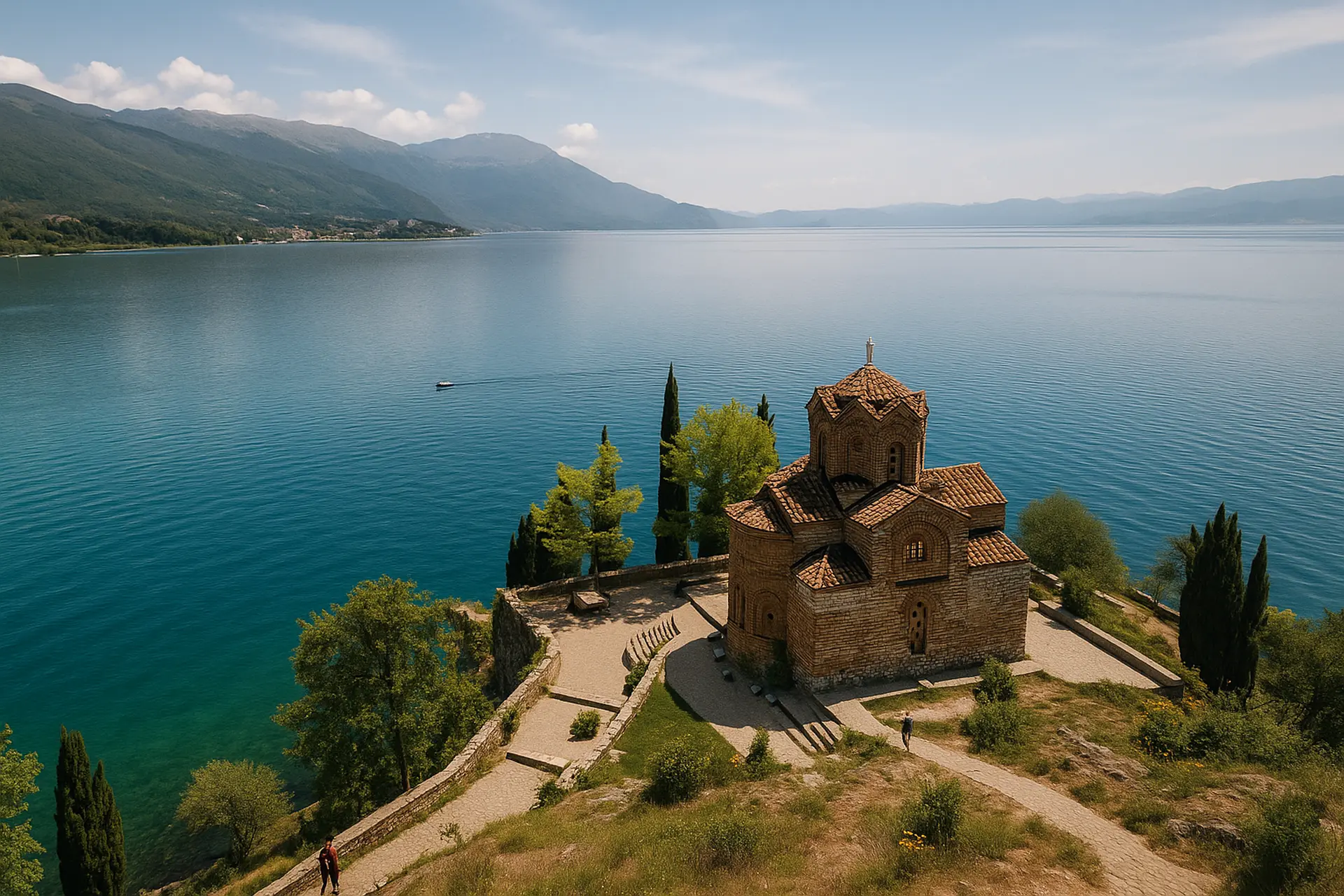
- St. John at Kaneo & lakeside viewpoints: Possibly Ohrid’s most iconic image, this 13th-century church perches on a rocky promontory over the water. A short path or park benches just east of the harbor offer the classic vantage. On clear mornings, sunrise here is haunting; at dusk the red-domed church contrasts against pastel skies. (During the day the church is open, but photography from outside is most common.) Nearby beaches include Plaošnik (with ancient basilica ruins) and Beach Mali Grad, which is sandier.
- Boat trip to Sveti Naum & springs: South of the city at Lake Ohrid’s narrow end is Saint Naum Monastery, dating to the 10th c. Boats depart Ohrid harbor (small group or private taxi-boat) for this popular 2–3 hour excursion. The ride offers lake scenery en route. Naum’s baroque church and tranquil monastery gardens are highlights. Just past the monastery is the lake’s spring: a turquoise bay where water gushes from underground. (There’s a small admission fee to enter the monastery grounds.) Note: Naum can also be reached by road or by continuing across the border on foot (to Albania).
- Bay of Bones & Lin (archaeology museum): On the Albanian shore, near the village of Lin, is a museum built over archaeological remains of a Bronze-Age lakeside village. Walk the reconstructed wooden palisade and huts of the Bay of Bones (Bayu i Gjarpërit). Upstairs is a small museum showing Neolithic tools and the story of early farmers in the region. The site dates to around 1000–600 BCE and overlooks the Albanian bay and mountains. Guided tours explain the findings; it’s reachable via hourly tourist boats from Pogradec or by rental car from Ohrid (crossing at Sveti Naum).
- Galicica National Park & hiking: The Galicica mountain ridge runs between Lakes Ohrid and Prespa. Galicica NP (just 12 km southeast of Ohrid town) offers dozens of trails with panoramic overlooks. A popular hike starts at Plaošnik (just outside Ohrid), then climbs via the Trail of Saints or Viewpoints Trail. The summit area has wild meadows and views down to both lakes. Wildlife (bears, wolves, wild boar) lurk in summer; you might also see Alpine flowers and traditional stone shepherd’s huts. On Galicica’s Prespa side is the scenic village of Bigorski and the 11th-century Bigorski Monastery (worth a detour if driving the circuit).
- Beaches, swimming spots & water activities: Public beaches tend to be pebbly. In Ohrid you’ll find Potpesh, Labino, and the main City Beach near the harbor (all with showers and sunbeds for a small fee). The scenic St. Stefan/Kaneo beach (small cove below the church) has clear water but limited sand. South of town, Ljubanishta Beach and Pestani Beach (longer stretch with bars and walkways) are popular for day-trippers. For solitude, head east around the lake to beaches like Drilë or Sveti Gjini, which are reachable by foot or boat. All bathing is free (no permits) except at a few private hotel sections (check signs). Lifeguards are uncommon, so use caution in deep or unpatrolled waters. Kayaking, paddleboarding and pedal boats can be rented at major beaches; these make easy half-day adventures along calm coves.
- Boat tours & fishing: Numerous local operators run scenic cruises or private charters. A classic is the half-day tour from Ohrid to Sveti Naum (often combined with a fish lunch). Sunset cruises around Ohrid’s bay are also offered. For fishing, only licensed guides can fish the lake (as sustainable management). If you have a boat license you may hire a boat for a few hours (fees vary, ~€30–50/h for a small electric boat) to explore hidden coves. Note that there is a minor hydroelectric dam on the Black Drin outflow; boats cannot circumnavigate the lake, but this dam does not affect the main lake’s calm shoreline.
- Diving & snorkelling: Lake Ohrid’s clarity makes it surprisingly good for fresh-water diving. Diving centers (e.g. Diving Centre Amfora in Ohrid) offer guided dives. Popular sites include an ancient submerged village (near Lin), modern wrecks (scuttled tugboat), and the elegant pillars of sunken St. Andreas Chapel. Visibility often exceeds 15–20 m in summer. Because of the protected species, divers must use hand nets for retrieval of lost equipment (to avoid disturbing the bottom). Certifications are required for deep dives, but beginners can try shallow dives or snorkel with a guide. Water is quite cold below 10 m, even in August, so rental drysuits or thick wetsuits are recommended for serious diving.
From a hilltop, the Church of St. John at Kaneo provides an iconic lakeside vista. Perched on a cliff, this 13th-century church is a symbol of Ohrid’s fusion of nature and culture. Each evening at sunset the golden light paints its stone façade, making it one of the best-known photo spots in the Balkans. The UNESCO listing praises its frescoes as masterful works of Byzantine art. Visitors often climb to the lakeshore here to swim just below the cliff or to sit on benches and watch the evening glow.
Beaches, swimming spots & water activities
Lake Ohrid’s beaches are mostly pebbly, but many allow excellent swimming with minimal crowds. Potpesh Beach (west of the main marina) and Labino Beach are large public spots right in Ohrid city, with umbrellas and cafe-services. Kaneo/Stefan Beach lies below the Kaneo church – it has coarse sand but superb water clarity. Southward, Ljubanishta Beach (near the monastery of St. Clement and Naum) offers a long concrete jetty for jumping in, and Pestani Beach is a popular bay lined with lounge bars. All public beaches are free; you pay only for chairs or shower use (around €1–3). Private beach clubs exist (hotels in Peštani and along the Albanian shore) but are unnecessary unless seeking resort amenities.
Swimming here is generally safe: lake water quality is high and monitored. As cited studies note, Ohrid’s oligotrophic waters keep pollution naturally low. In practical terms, millions of visitors annually swim in Ohrid without incident. (Of course, avoid venturing too far from shore alone and heed any posted warnings, but no special vaccination or water treatment is needed.) The entire lakeshore in North Macedonia and Albania is a national park/reserve, so industrial or sewage spills are rare these days.
The beaches on both sides of the lake are open to public use, but a few hotel complexes (especially north of Ohrid or east of Pogradec) do have private entrances. Access to any beach or shoreline is a constitutional right, so you can always walk onto the water from any public road or path. In summer, lifeguards might staff the busiest beaches (look for the red floats and stands), but in smaller coves you swim at your own discretion.
Besides swimming, the lake offers windsurfing (small rental centers at major beaches), sailing (few small yachts putter here) and scuba diving as noted. Fishing is regulated, but anglers often ply the shallows for trout or carp – a nice way to spend a morning. If you want to try a unique sport, ask at diving shops about “ghost net” clean-up dives; volunteers help remove discarded nets with biologists, turning conservation into an adventure.
Boating, boat charters & how to book
Chartering a boat on Lake Ohrid is a highlight. In the main harbor and at beachfronts you’ll find kiosks and offices offering boat rental (licensed operators only) and tours. You can choose group tours or private charters: private longtail boats (renting at ~€50–70 for 2h) take you on custom routes along the shore. Boats typically hold 4–12 people, run by a captain who may also double as a guide.
Typical tours: – Ohrid ↔ Saint Naum (half day): Cruise along the scenic south bay, stop at Sveti Naum monastery and springs (as above), return via the Ottoman-era fishing village of Sv. Stefan. Cost is usually €15–20 per person for a group tour (book at the quay).
– Sunset cruise: A 2-hour private trip around Ohrid Bay at dusk (ideal summer booking) often includes drinks and use of a stereo system. Price ~€100–150 total.
– Cross-border to Lin: Though less common, some boats go across to Pogradec for a Lin/ Bay-of-Bones visit (~€50/person, call operators in advance).
Negotiating & tips: In peak season or at tourist spots, local boat captains often hail you directly. For the best price, shop around: ask in at least 2 offices before agreeing. Note that most will quote prices in euros or konvertibilna marka; clarify currency. A 1-hour ride (e.g. along the city shore or to the fortress) may start around €10–15 for a small boat (2–4 people), while half-day or tours are €40–60pp. Always ensure the boat has life jackets and a safety kit; reputable operators display official licenses. Tipping a few euros for good service (especially on private charters) is customary.
If you prefer to go without a guide, renting a small electric boat is an option from Pit-Stop boats near the harbor. These can be driven by novices on calm days; rates start around €10/hour. (They have limited speed and range, so they’re mostly for exploring near Ohrid.)
For kayak and SUP rentals, look at the cafes near Gradiste or Plazh Potpesh. Hourly rates are ~€5–10, with discounts for half-day rentals. These allow you to paddle quietly to nearby beaches or simply drift in calm water – a serene way to experience Ohrid’s clarity.
From Galicica ridge above the lake, wildflowers frame a sweeping view of Lake Ohrid. Hiking trails on Galicica National Park (east of Ohrid) offer exactly such vistas. Visitors can follow paths past chestnut groves and shepherd huts up to peak Mt. Magaro. From these heights one sees both Lake Ohrid and Lake Prespa side-by-side – a reminder of the region’s landscape drama.
Diving & snorkelling: what to expect
Ohrid’s clear freshwater makes for surprisingly good diving. Local dive centers (e.g. Dive Spirit Ohrid or Diving Center Amfora) cater to all levels. If you are a certified open-water diver, you can book dives to explore underwater relics. Highlights include:
- Submerged village and church of Lin (Albania): Near Pogradec a stone church and homes lie under 5–8 m of water, dated to around 1400 AD. They’re reachable by boat from Lin.
- Wreck diving: There are a few deliberately sunk boats for divers. A sunken tugboat at ~15 m and small fisher boats provide underwater interest for advanced divers.
- Chapel ruins: Near Ohrid town, the pillar bases of a submerged chapel (St. Andreas) emerge from 8–10 m depth. Good for skilled snorkelers with gear or divers at beginner levels.
Visibility in summer often exceeds 20 m, but the water cools quickly below 10–15 m. Even in August the bottom temperature is in the 6–8 °C range. Thus, divers should rent drysuits or thick neoprene suits from the center (they supply rental gear). Boats to dive sites depart from Ohrid harbor or from nearby beaches (coordinated by the dive center).
For snorkeling, public beaches are the starting point. The new Viewpoint Beach near Gradiste has a shallow stony shore good for beginners. Coral-like sponges and small fish (such as the endemic Ohrid minnow) can be seen without going deep. As in the rest of the lake, make sure not to step on or remove anything; the lake’s bottom life is protected.
All divers and snorkelers are required to use hand nets or grasp any debris (to avoid damaging habitats by swimming nets). Tour operators emphasize conservation dives: when asked, most customers gladly pick up trash from the lake floor.
Caution: Ohrid’s diving is generally safe but remote. There are no hyperbaric chambers nearby; medical facilities in Ohrid handle general emergencies. If planning technical or deep dives, coordinate with local guides and notify them of your plan.
Food, drink & local markets
Ohrid’s cuisine is a highlight of any visit. The lake’s culinary star is the Ohrid trout (Salmo letnica) – a freshwater salmonid prized for its rich flavor. Trout dishes, grilled or pan-fried with lemon-herb butter, are ubiquitous in lakeside restaurants. (Conservation-minded travelers should note that the trout is now on a protected list; many restaurants serve farmed trout or smaller “belvica” carp instead. This seasonal change has helped trout numbers recover.)
Other local specialties include tavče-gravče (baked beans with spices), ajvar (paprika spread), gravče na tavče and kifli (flaky cheese pastries) as noted by food writers. Macedonian cuisine reflects Mediterranean and Balkan influences: olive oil, fresh vegetables and grilled meat (čevapi) feature heavily. Dolma (stuffed grape leaves) and buranci (bean soup) are old favorites. Street food fans enjoy burek (meat or cheese pies) from bakeries on the main square.
The best places to eat are often on the water. The Sveti Stefan Lakeside restaurant (near the Kaneo church) serves daily trout specials. Below Struga, Biser and Kajace restaurants at Potpesh beach are well-known for lake fish. In town, the Osterija Zadarska and Restaurant Dubrovnik (both near the main promenade) mix international fare with Balkans classics. For a panoramic view, the Millenium Restaurant atop a hill south of Old Town rewards diners with sunset vistas.
Markets: visit Ohrid’s Saturday market in the Old Town for local produce and handicrafts. You’ll find farmers selling seasonal fruits, honey, rakija (fruit brandy) and jars of homemade ajvar or preserved trout. Souvenir shopping focuses on Ohrid pearls – nacre-coated beads handmade in local workshops. These imitation pearls come in necklaces and earrings; a good guide is to pick ones made in Ohrid’s workshops (shops often have signboards). Beware cheap knock-offs; genuine Ohrid pearls have a distinct iridescent sheen and cost more. Ask sellers about the “seal of Ohrid Pearl” for authenticity.
Finally, note local dining customs: servers in Macedonia are hospitable but a 10% tip is customary in restaurants. Table water is potable – hotels have filters or provide bottles. Tap water in Ohrid town is treated and safe, but many visitors stick to bottled or boiled water when hiking.
Festivals, culture & nightlife
Ohrid’s cultural calendar offers plenty beyond daylight sightseeing. The Ohrid Summer Festival (late June–August) is an international arts festival held at the ancient theater and other venues. Expect classical music concerts, ballet, traditional dance and open-air theatre. It’s one of the Balkans’ most prestigious summer events, drawing audiences from across Europe. Tickets sell out early for big shows (online booking recommended months in advance).
Struga (N. Macedonia) and Struga Poetry Evenings (summer) also merit mention: poets gather on the river for readings under the full moon. This attracts literary visitors to the wider area.
Nightlife in Ohrid is lively but low-key. The Old Town has several bars and pubs open till midnight or later. Lakeside cafes (e.g. “Jazz Inn” on Sveti Stefan beach) play live music; others host DJ nights. Club Havana and Polo Club offer late-night dancing (often until 4-5 AM) with an international crowd in season. Those wanting a quiet evening can grab gelato or wine at a harbor café and watch the lake lights. In summer there are also occasional outdoor movie nights or folk music concerts in the plazas.
Note: Ohrid is much quieter than Mediterranean resorts. After midnight it tends to wind down. Late-night dining options do exist (pizza and fast food joints), but most restaurants close by 11 PM.
Practical info — money, language, health & safety
- Currency: North Macedonia uses the Denar (MKD); Albania uses the Lek (ALL). Credit cards (Visa/Mastercard) are accepted in most hotels and restaurants, though small villages may be cash-only. ATMs are common in Ohrid and Struga; Pogradec has them too (though narrower selection of banks). Denars and Euros are widely accepted, but change in local currency is given. It’s wise to carry some MKD/ALL when visiting rural beaches. Tipping of 10% in restaurants and small change for drivers or porters is customary.
- Language: Macedonian (a Slavic language) and Albanian are official; many people, especially younger ones, speak decent English. Signs and menus in tourist areas often have English and sometimes German/Italian translations. Basic phrases (hello, thank you) are easy to learn and appreciated.
- Health: There are hospitals and pharmacies in Ohrid and Struga. Pharmacies can dispense common medications without prescription. Tap water in Ohrid is drinkable, but many travelers opt for bottled or purified water when hiking. There are no unusual health risks (no malaria, for example). Summer sun can be strong, so sunscreen and hydration are essential. Common sense applies: lock up valuables and keep an eye on belongings at busy tourist spots. Crime is very low in this region, but pickpocketing can occur in any crowded area.
- Emergency numbers: In North Macedonia dial 112 for any emergency; medical help is reachable via nearby clinics in Ohrid or Struga. Albania uses 112 as well. Always have travel insurance (including medical evacuation) when doing adventure sports like diving or hiking in remote areas.
- Drivers & accessibility: Roads around Ohrid are mostly paved and in good condition on the Macedonian side; in Albania the route can be narrower and slower. Driving is on the right; speed limits are enforced by cameras or patrols on main routes. You can rent cars (and even bicycles or e-scooters) in town. Petrol stations are frequent along main highways but rare in small villages.
Wheelchair access is limited in the Old Town (steep cobbles), though modern hotels will accommodate. Many beaches have concrete ramps or flat sections; however, diving and boat tours are not easily wheelchair-friendly. Family travelers will find many child-friendly hotels with playgrounds and shallow bays for kids to swim. Lifeguards are mostly absent, so parents should watch children closely at any beach.
Sustainable travel: how to visit responsibly
Lake Ohrid’s fragile ecology means travelers should tread lightly. Here are some guidelines for an eco-friendly visit:
- Use refillable water bottles: Carry a reusable bottle and use public drinking fountains or hotel refilling stations. Discarding plastic in a lake-sensitive area adds microplastics to the food web.
- Reduce waste: Say no to single-use plastics where possible. Carry cloth bags and avoid plastic straws. Many cafés will give paper straws on request.
- Respect wildlife: Stay on marked trails in parks and do not disturb nesting birds or harvest plants. If you kayak, paddle quietly near reeds and avoid motorized boats in shallow bird habitat.
- Support eco-operators: Book tours and transfers with companies that adhere to local guidelines (e.g. no fishing nets used, use of native guides). A few operators have “Green Destination” labels.
- Conserve water and energy: The region can experience summer droughts. Use water in moderation (e.g. short showers, do not run tap while swimming). Turn off lights and air-conditioning when leaving your room.
- Help protect habitats: Consider volunteering with a local NGO (Ohrid SOS and others occasionally organize clean-ups and habitat restoration). Even picking up a few pieces of trash after a beach day helps.
- Buy local, pay fair: Eat and sleep locally. This keeps economic benefits in the community so that residents value conservation. For example, buying handmade Ohrid pearl jewelry (from a recognized workshop, not cheap imports) sustains craftsmen. Eating fish at a family-owned kafana supports the fisher who abides by catch limits (rather than a resort that might use market fish with unknown origin).
Remember, your appreciation of Ohrid’s natural charm pays off only if it remains intact. Small choices can ensure the lake stays clear, and the forests above stay green, for the next visitor.
Sample itineraries: 1 day → 1 week
- 1-day quick tour: Morning hike up to Samuel’s Fortress for panoramic views. Descend to the Old Town: visit St. Sophia church and Plaošnik basilica ruins. Lunch at a lakeside restaurant (try trout). Afternoon boat to St. Naum, brief monastery visit (or Bay of Bones museum). Evening in Ohrid Old Town, dinner on the promenade.
- 2–3 days (typical): Day 1 as above. Day 2: Galicica NP hike in morning (e.g. Magaro viewpoint), afternoon swim at Ljubanishta or Trpejca beach. Evening folklore dinner with live music. Day 3: Kayak or SUP around the harbor, visit Ohrid pearl workshop, sample local tavče-gravče. Afternoon ferry or taxi back to Struga (sunset over Black Drin delta).
- Week-long stay: 3 days on North Macedonian side (as above), plus 2–3 days in Albania. From Pogradec: visit the Lin Archaeological Museum and the Bay of Bones; explore Drilon springs (a small lagoon-fed park). Take a day-trip over the mountains from Ohrid to Prespa Lake (another ancient lake, 1.5 hr east) to see rafting herons and the Basilica of St. Achileios. Allow a leisure day for cycling around Ohrid city or attending a cultural event.
Multi-week itineraries could combine Ohrid with Bitola, Skopje, or the Albanian Riviera. But even a short stay at Ohrid gives a deep sense of Balkan nature and history.
Costs & budgets: backpacker → midrange → premium
As of 2025, North Macedonia is very affordable. Rough daily budgets (including meals, transport, modest lodging):
– Backpacker: €30–50/day (hostels or dorms €10–15, street food/markets, local bus).
– Midrange: €80–120/day (3-star hotels €30–50, restaurant meals, car rental split).
– Luxury: €150–200+/day (boutique hotels or resorts, private tours, fine dining).
Meals in a typical local restaurant run €8–15 (plentiful), while pizza or snacks might be €3–5. A midrange hotel room with breakfast is ~€40–60 per night in season. Boat tours are perhaps €15–50 pp, kayak €10/hr, diving ~€50–80 (including gear). Gasoline is ~€1.25/liter (mid-2025), so car rental is cheap compared to Western Europe. For comparison: a dozen mussels and a grilled trout lunch for two with wine might total €15.
Note that Albania is slightly cheaper: a good hotel might be €20–40 in Pogradec. But border shops may prefer LEK for payment.
Photography guide — best viewpoints & framing tips
Lake Ohrid is a photographer’s dream. Top suggestions:
– Golden hour at Kaneo: Framing the lake and church at sunrise or sunset yields iconic shots. Use the stone pier for foreground interest.
– Panoramas from Samuel’s Fortress: Wide-angle shots from the hilltop capture the Old Town basin and lake beyond. Clouds drifting over the lake make dynamic skies.
– Galicica vistas: Early morning light on wildflowers in the foreground with the lake behind (like the image above). Bird’s-eye views of both Ohrid and Prespa lakes can be taken from Magaro or nearby summits.
– Reflections in autumn: In autumn, still mornings can mirror the hills perfectly. Try Bay of Drilon (Albanian side) or the bank at Sveti Stefan for glass-like water.
– Cultural details: Close-ups of carved wood eaves on traditional houses, mosaic patterns inside churches, or local artisans at work (e.g. a pearl-maker’s hands). Night shots: long exposures of the lit harbor, or festival fireworks over the amphitheater.
When photographing, remember that drone use is restricted in national parks and over the lake without permission. Stick to on-foot photography unless you obtain the proper permits.