
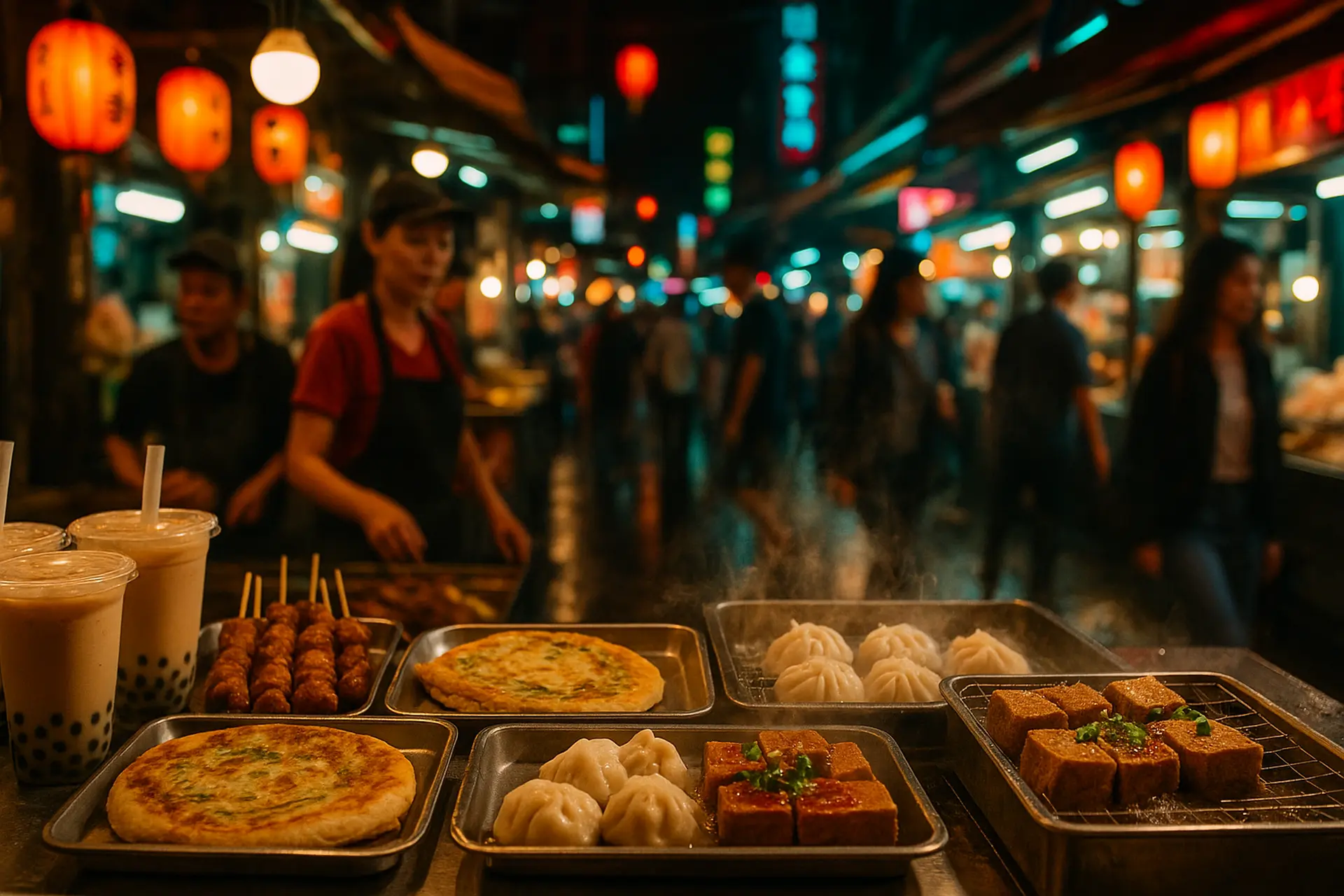

Taiwan’s night markets are more than food stalls – they are vibrant cultural hubs ingrained in daily life. Tracing their roots to temple gatherings in the Tang dynasty, these markets blossomed in modern Taiwan’s postwar boom. By 2025 Taiwan hosts hundreds of night markets island-wide – roughly 700 in total, with about 30 in Taipei alone. Taiwan’s largest night market, Shilin (士林夜市), boasts over 500 stalls; collectively, street vendors number in the hundreds of thousands and employ almost half a million people. Crowds of all ages and backgrounds flock to these markets – “attracting every class in society” – drawn by a mix of sights, sounds, and tastes.
- The Rich History and Evolution of Taiwan’s Night Markets
- From Temple Gatherings to Urban Institutions
- How Economic Changes Shaped Modern Night Markets
- The Role of Government and Tourism
- Understanding Xiaochi – The Heart of Night Market Food Culture
- Complete Guide to Taipei’s Major Night Markets
- Shilin Night Market – Taiwan’s Largest and Most Famous
- Raohe Street Night Market – The Traditional Experience
- Ningxia Night Market – The Local’s Favorite
- Huaxi Snake Alley – The Exotic Adventure
- Ximending – Youth Culture and Street Eats
- Nanjichang Night Market – Hidden Gem for Food Lovers
- Essential Night Markets Outside Taipei
- The Ultimate Night Market Food Guide
- Must-Try Traditional Taiwanese Dishes
- Stinky Tofu – Different Preparations
- Seafood and Grilled Specialties
- Sweet Treats and Desserts
- Vegetarian and Dietary Options
- Night Market Prices and Budget Planning
- Practical Visitor Information and Tips
- Night Market Etiquette and Cultural Tips
- Seasonal Considerations and Special Events
- Night Market Comparison Guide
- How to Avoid Tourist Traps
- Night Markets and Temple Culture
- The Future of Taiwan’s Night Markets
- Conclusion – Your Night Market Adventure Awaits
In economic terms, night markets are a local small-business engine. A 2020 report counted over 315,000 Taiwanese street stalls, nearly all independently run. The government even funds night-market recycling programs to reduce plastic and protect the environment. Travelers visiting Taiwan today find in the night market an iconic experience: a blend of history and modern bustle, where bustling crowds meet neon-lit alleys, sizzling grills, and communal seating. This guide will illuminate that world: from deep historical context to practical visitor tips, and a tour of Taiwan’s major markets and must-try snacks.
The Rich History and Evolution of Taiwan’s Night Markets
Taiwan’s night markets emerged from a blend of ancient Chinese tradition and modern necessity. Originally, informal night bazaars formed around temples in China’s Tang and Song dynasties as peddlers on shoulder poles sold goods into the night. In Taiwan, this temple-market heritage persisted through the Qing dynasty, but the modern night market as a mass phenomenon did not take shape until after World War II. In the late 1940s and 1950s Taiwan’s economy was rapidly transforming. Migrant factory workers, working by day, provided a new evening audience for vendors to sell “xiaochi” (小吃, “little eats” or snacks). Vendors offered affordable “banquet” foods in miniature form – fried dumplings, braised noodles, small seafood omelets – and a communal place to socialize after work. This grassroots postwar boom was intertwined with Taiwan’s Economic Miracle: as industries grew, so did laborers who came to rely on cheap night-market meals.
From Temple Gatherings to Urban Institutions
Temples served as the early magnets for night bazaars. In Taipei and other cities, long before electricity, vendors set up nightly along temple perimeters to serve worshipers. As one retrospective notes, informal clusters of hawkers would linger past sunset around local shrines, a tradition carried to Taiwan. By contrast, densely-built cities after WWII saw night markets expand onto streets that by day carried vehicles. The first large market in Taipei, Shilin Night Market, opened in 1899 during Japanese colonial rule, but real proliferation came in the 1960s. Street corners and alleys filled with stalls selling snacks or odds-and-ends. Vendors offered everything from tofu pudding to bubble tea, adapting to the urban workforce’s needs. Over decades this “walking feast” concept became a defining urban institution.
How Economic Changes Shaped Modern Night Markets
By the 1960s, Taiwan’s night markets were evolving into full-blown bazaars. Mass-produced goods and kitchen wares began appearing alongside food. The 1970s recession pushed exporters to sell excess inventory locally, so markets swelled with electronics, clothing, and trinkets – crowding out some old herbalists and fortune-tellers. In the 1980s and 1990s, Taiwan’s growing affluence brought chain restaurants into major markets and visitor-oriented shops in areas like Ximending. At the same time, authorities intervened: famous markets like Shilin and Raohe were moved into purpose-built indoor courts, while regulators cracked down on counterfeit goods and unauthorized stalls. By the 2000s, many night markets had become mixed formal/informal venues, with local governments issuing licenses and even setting quiet-hours to curb noise.
The Role of Government and Tourism
Originally grassroots, many markets are now partially organized by local government. For example, vendors must obtain permits and pay fees, and some lucrative markets are managed by committees. Despite this regulation, the spirit remains low-key: stalls are family-run, and bargaining or haggling is rare. In recent years the government has also promoted night-market culture abroad and at home, nurturing it as part of Taiwan’s identity. Initiatives to reduce plastic waste and food packaging (even subsidies for compostable bowls) reflect a drive to modernize without killing the tradition. International tourism has also left its mark: many large Taipei markets now cater to foreigners with English menus or street signs, yet efforts continue to preserve the authentic vibe as well.
Understanding Xiaochi – The Heart of Night Market Food Culture
A key concept in Taiwan’s market culture is xiaochi (小吃), literally “small eats.” Unlike Western “snacks,” xiaochi are bite-sized or small-plate dishes meant for tasting many items rather than full meals. Think of them as mini-gourmet street foods: fluffy oyster omelets (蚵仔煎), charcoal-grilled sausages wrapped in sticky rice, steaming bowls of thick oyster vermicelli, or cubes of fermented tofu – each served for just a few dollars. By definition these foods are inexpensive and communal: people often share a few dishes among friends or family at common tables. As one writer observes, night-market xiaochi “offer inexpensive versions of banquet food”, showing how these eats democratize dining. Chefs might apply centuries-old recipes – Taiwan’s oyster omelet dates to Fujianese culinary roots – but serve them at tiny plastic-table roadside stands.
In practice, xiaochi create a level playing field: everyone, from taxi drivers and students to visiting politicians, can sit side by side on a metal stool for a bowl of noodles. Indeed, night markets “attract every class in society”. The casual atmosphere (no shoes removed, no formal seating) allows people of all ages and backgrounds to mix. Economically, the barriers to entry are low, so young entrepreneurs or retirees alike can open a stall. Socially, Taiwanese often visit night markets in groups – dates, families, friends – encouraging sharing and conversation over food. In this way, xiaochi and night-market dining reflect a communal spirit: food is meant to be enjoyed together, in the open air, late into the evening.
Complete Guide to Taipei’s Major Night Markets
Taipei alone hosts a dozen or more notable night markets. Each has its own character, specialties, and crowd. Below are profiles of the city’s best-known markets:
Shilin Night Market – Taiwan’s Largest and Most Famous
Shilin (士林夜市) is Taipei’s flagship night market, sometimes called the “grandest” of them all. It dates to 1899 but in its modern form sprawls along two parallel streets near Jiantan MRT station. Getting There: The easiest route is the MRT Red Line to Jiantan Station (or the nearby Shilin Station), just steps from the market entrance. (It’s a short, colorful walk from Taipei Main Station via Red Line.) Layout: Shilin is roughly divided into a daytime clothing and goods area (Jihe Road section) and an evening food zone behind the JianGuo Elementary School. In 2011, Taipei also relocated hundreds of food vendors into a giant underground food court nearby, so a visitor can queue up at dozens of indoor stands selling grilled squid, soup dumplings, milk tea, and more without braving the rain.
Must-Try Foods: Shilin is a showcase of Taiwanese classics. Don’t leave without tasting the fried chicken cutlets (Hot-Star Chicken is the famous brand), scallion pancakes, and deep-fried stinky tofu. Shilin is also famous for its fresh fruit juices and bubble teas, vendors often tailoring drinks on the spot. At night you’ll find illuminated carts grilling jumbo spring rolls, oyster omelets, pork rib soup, and skewers. A perennial favorite is grilled king oyster mushrooms brushed with garlic butter, and papaya milk (a creamy fresh juice). For dessert, try the local shaved-ice with mango or taro or the mochi-sesame balls. Shopping: In addition to food, Shilin’s clothing bazaar sells cheap apparel, toys, and trinkets, operating until late (10–11 pm). Best Time to Visit: Shilin is busiest on Friday and Saturday nights. To avoid peak crowds, come earlier in the evening or on a weekday. Even late at night, food stall lines are long, but moving fairly fast.
Raohe Street Night Market – The Traditional Experience
Raohe Night Market (饒河夜市) offers a slightly more old-fashioned feel in a compact space. Running one narrow stretch along Raohe St. in Songshan District, it is centered next to Ciyou Temple (慈祐宮). Raohe is smaller than Shilin but “just as packed with delicious food”. Getting There: Take the MRT Green Line to Songshan (also called Nanjing-Fuxing) Station, then walk a few minutes to the market entrance by Ciyou Temple.
Signature Dishes: Raohe is famous for its 胡椒餅 (hújiāo bǐng), the peppery pork buns baked in a clay oven. In fact, even before entering the market you’ll see the long line at Fuzhou Pepper Bun stall, where skilled vendors wrap meat and scallions in dough and slap them against the kiln wall. These pepper buns (sometimes called “black pepper buns”) are crispy on the outside, juicy inside, and well worth the wait. Other Raohe staples include a five-spice meat and herbal soup, steamed buns, grilled seafood on sticks, and as at Shilin – stinky tofu and oyster omelets. Raohe also has a large indoor section where hundreds of small cafés and hawker stands sit under cover.
Raohe vs. Shilin: For first-timers, Raohe provides a more local vibe: the alleys are narrower and vendor-to-vendor hustle feels cozier. Shilin, by contrast, feels touristy and sprawling. Shilin has more variety (clothes, games, indoor food court) but crowds can be overwhelming. Raohe’s old temple backdrop and neon lanterns give it character. If you have time, try both: Raohe is great for a one- or two-hour visit of nonstop eating, while Shilin can take a half-day to truly explore.
Ningxia Night Market – The Local’s Favorite
Ningxia (寧夏夜市) is a smaller, rectangular market in Datong District that has earned praise for authentic flavors. Often described as more popular with Taiwanese residents than tourists, Ningxia feels calmer than the big markets. Its 1–2 block strip is lined with stalls selling traditional dishes. Longtime vendors here are known for perfect oyster omelets, stinky tofu, and a unique fried mochi dessert. There is also Taiwanese rice pudding, scallion pancakes, and giant soup dumplings. Compared to Shilin, Ningxia’s prices are modest and portions slightly smaller – encouraging sampling of many stalls. (Staff will often shout “Nihao!” at Mandarin-speakers or pass out menus in English.) Why It Feels Local: Ningxia opens early (by 5pm) and closes by 11pm, and because it is only a few blocks, visitors breeze through it quickly. Many Taiwanese food writers note that 70–80% of patrons at Ningxia are local residents rather than foreign tourists. The food here is top-notch; for example, Ningxia’s famous fried chicken cutlets are consistently ranked among Taipei’s best. If you want a more laid-back experience than the giant markets, Ningxia is worth a stop late in the evening.
Huaxi Snake Alley – The Exotic Adventure
Huaxi (華西街夜市), nicknamed Snake Alley, is Wanhua District’s compact market near Longshan Temple. It dates to the 1950s and sits along a two-block pedestrian street. What makes Huaxi stand out is its exotic delicacies: historically it became known for stands serving snake and turtle blood, cobra soup, and even deer penis wine. Many of these unusual offerings have disappeared in recent years, but a few specialized “snake alley” restaurants remain. The government banned live snake-killing shows in the 2000s, and the last dedicated snake-only eatery closed in 2018. Today Huaxi still has tiny shops selling stir-fried snake meat or turtle soup alongside more ordinary dishes. (It also has stalls selling fresh seafood noodle soups, since it’s near Longshan Temple.) In 2019 the Michelin Guide even gave Huaxi a Bib Gourmand distinction, reflecting its cult following for street food. If you’re feeling adventurous, try a bowl of snake blood rice wine soup or the grilled snake; otherwise, Huaxi’s main draws are the atmosphere and its historic lantern-lit alley.
Ximending – Youth Culture and Street Eats
Ximending (西門町) is technically not a classic night market, but Taipei’s famous pedestrian shopping district often appears in night-market guides. Known as Taipei’s “Harajuku” or youth culture center, Ximending fills with street performers and food carts after dark. Here you’ll find modern creative snacks – pepper biscuits, cheese-laden fries, bubble waffles – as well as the legendary Ah-Chung flour-rice noodle soup near the Red House Theater. It feels hip and trendy. For visitors, Ximending is a blend of shopping arcade and open-air food bazaar. It has less of the rustic hawker feel, but is included here because it stays busy into late night and offers many Taiwanese street snacks in one place.
Nanjichang Night Market – Hidden Gem for Food Lovers
Located deep in Zhongzheng District, Nanjichang (南機場夜市) is off the beaten path but beloved by locals. It takes its name from a former Japanese-era airport (“south airport” areas) and dates from the 1980s. What to Expect: Unlike Shilin or Raohe, Nanjichang is never overwhelmed with tourists or noise. Since there’s no nearby MRT station, most visitors arrive by bus or scooter. The long strip of stalls emphasizes traditional Taiwanese fare: rice balls in broth, sticky rice with chicken, spicy braised beef soup, and giant spring rolls. Signature items include ba-wan (Taiwanese pork meatballs in translucent dough) and sesame flatbreads. In fact, several stalls here have earned Michelin recommendations for dishes like sesame oil chicken and stinky tofu. Because the fare is straightforward and prices are low, Nanjichang is described as giving “an authentic Taipei night market experience”. The crowd is almost entirely local – one guide notes 70–80% locals to 20–30% tourists. The vendors even operate early and late (some cooks start selling in the afternoon), and the market is rarely too crowded. In short, Nanjichang feels like stepping back into old Taipei’s food culture.
Essential Night Markets Outside Taipei
Beyond the capital, every major Taiwanese city boasts at least one famous night market:
- Taichung – Fengjia (逢甲夜市): One of the world’s largest night markets, sitting near Feng Chia University in Xitun District. It sprawls along Wenhua Road and adjacent streets. Fengjia is especially known for novel snacks (e.g. cheese potatoes, brown sugar bubble tea) and crowd sizes.
- Tainan – Flower Night Market (花園夜市): Centered at He-Wei and Hai-An Roads, it is consistently voted one of Taiwan’s best markets. Open only Thursday, Saturday, and Sunday evenings, Flower Night Market is famous for local specialties like coffin bread (a hollowed toast with meat chowder) and shrimp rolls. It also has carnival games and clothing stalls among the food vendors.
- Keelung – Miaokou (廟口夜市): Near Dianji Temple by Keelung Harbor, this market began as temple queues for worshipers. It has roughly 60 stalls selling seafood-centric dishes. Seafood specialties abound: dingbiannao (oyster vermicelli soup), buttered crab, eel thick soup, Taiwanese-style tempura, plus shaved ice desserts. Its name “Temple Mouth” reflects the temple connection, and its snack-lined alleys bustle nightly.
- Kaohsiung – Liouhe (六合夜市): In the heart of Kaohsiung’s Sinsing District, Liouhe grew in the 1950s from a vacant lot known as Dagangpu. By evening it becomes a pedestrian food arcade. The stalls here focus on hot foods – dozens of small dinner stalls grill steak and seafood, and because Kaohsiung is tropical and coastal, icy treats and fresh seafood are crowd-pleasers. Liouhe is famed for its beef noodle soups, seafood platters, and grilled squid skewers. It aims at local families, offering inexpensive fare in a somewhat orderly layout.
- Others: Cities like Hualien (Dongdamen), Yilan (Luodong), and Kaohsiung (Ruifeng) have nightly markets worth exploring. Many southern markets open every day, while northern markets often operate more on weekends. Check local schedules: some, like Tainan’s, run only on select evenings.
In summary, almost every city has a centerpiece market. Those outside Taipei tend to highlight local specialties (e.g. grilled seafood in Keelung; oyster omelets in Tainan) and may feel less crowded with international tourists. If you have time, plan side trips: Taichung’s Fengjia for novelty snacks, Tainan’s temple markets for culture, and Kaohsiung’s for tropical vibes.
The Ultimate Night Market Food Guide
Taiwan’s street-food repertoire is vast. Below are categories of iconic dishes you must try, many of which can be found across night markets:
Must-Try Traditional Taiwanese Dishes
- Stinky Tofu (臭豆腐): Taiwan’s famous fermented tofu, deep-fried until crispy and served with pickled cabbage and chili sauce. It’s pungent to some, but beloved by many. Note that “stinky tofu” varies by preparation: it can be deep-fried, steamed, or even stewed. At markets, deep-fried style is common: cubes of tofu that are blackened outside, creamy inside. Vendors often offer mild (less odorous) or extra pungent varieties. At Raohe or Shilin you’ll see buyers adding dollops of garlic and chili. (Fun fact: experts say the stronger the smell, the tastier the tofu often is.)
- Oyster Omelet (蚵仔煎): A savory egg-and-oyster pancake, one of Taiwan’s signature snacks. Made from a batter of egg and sweet potato starch, filled with tiny Pacific oysters, and often topped with a tangy sweet sauce. You can sometimes request it spicier. It’s chewy, slippery, and richly flavored. Often topped with fresh coriander or chili.
- Taiwanese Meatball (Ba-Wan, 肉圓): A large gelatinous dumpling filled with pork and bamboo shoots, served in a thick sweet-salty gravy. The texture is glutinous. Nanjichang and other local markets often have outstanding ba-wan stalls.
- Xiao Long Bao (Soup Dumplings): Though originating in Shanghai, soup dumplings are ubiquitous at night markets like Raohe or Shilin. They’re delicate steamed buns filled with pork and hot broth – best eaten quickly so the soup doesn’t cool.
- Coffin Bread (棺材板): A Tainan specialty: a thick slice of toast hollowed out and filled like a soup, often with chicken or seafood chowder. Named for its coffin-like box shape. Creamy and heavy.
- Lu Rou Fan (Braised Pork Rice): Minced pork belly braised in soy sauce over rice. Street vendors serve it in small bowls – a comforting, ubiquitous comfort food.
Stinky Tofu – Different Preparations
True to its name, stinky tofu is fermented tofu with a strong odor. Vendors offer variations: – Deep-Fried: The most common at night markets. Tofu is fermented, then fried to golden brown. One side is crisp (usually skin-side down) and the other is soft.
– Grilled/Steamed: Some night stalls, especially at Gongguan or local markets, may grill or steam tofu to reduce the smell. – Braised: Less common, but some places simmer tofu in a stew.
The flavors differ: fried versions have a nutty fried taste, while braised tofu is milder and more savory. Taiwanese stinky tofu is often served with spicy pickled cabbage and a soy-garlic sauce. Key Tip: If you don’t speak Chinese, you can usually identify the stall by the wafting aroma: follow your nose to the big blackened tofu cubes!
Seafood and Grilled Specialties
Given Taiwan’s island setting, seafood is everywhere:
- Grilled Squid: Almost every night market has stalls grilling whole squids on open flames. You can get them flattened or sliced. They’re brushed with sweet or spicy sauce as they cook.
- Small Grilled Fish or Shrimp: Often sold barbecued on skewers or in a paper cone.
- Crabs and Shellfish: At coastal markets like Keelung or Kaohsiung, grilled buttered crab legs or clams on the half-shell are popular.
- Fried Fish Buns: Minced fish meat shaped into patties or buns and deep-fried; a Shilin specialty.
- Cold Seafood: In Miaokou, you’ll find steamed mussels or sashimi-style sashimi at night – an exception to the norm of only fried or grilled.
Sweet Treats and Desserts
- Bubble Tea (珍珠奶茶): Arguably Taiwan’s most famous drink. Invented in the early 1980s in Taichung, bubble tea (aka boba tea) mixes strong black or green tea with milk or fruit syrup and chewy tapioca pearls (“boba”). Almost every night market stall sells it in dozens of flavors. Try classic pearl milk tea or fruit versions like mango or passionfruit. Bubble tea shops usually offer levels of ice and sugar. It’s best enjoyed with the oversized straw, mixing the pearls into the drink.
- Shaved Ice (剉冰): A crushed-ice dessert piled high with sweet toppings. Common at outdoor dessert carts. Mango shaved ice (fresh mango chunks with condensed milk) and grass jelly shaved ice are popular.
- Mochi and Sweet Balls: Vendors make mochi (glutinous rice snacks) on the spot. You might find peanut ice cream roll: shaved peanut brittle wrapped in a spring roll wrapper with shaved ice cream – a truly Taiwanese invention.
- Soymilk and Pudding: At Raohe and other markets you can find stands selling warm or iced soy milk and soft tofu pudding (douhua) topped with syrup or peanuts, especially in cooler weather.
Vegetarian and Dietary Options
While night markets are famous for meat and seafood, there are options for vegetarians and other diets. Look for stalls selling vegetarian stir-fries, fried glutinous rice with vegetables, or signs for plain starch dishes. Many markets have bubble tea and fruit juice stands for a meat-free snack. Vendors often have fried tofu (which is vegetarian), steamed buns with vegetable fillings, or Taiwanese-style yam pudding (sweet potato dessert). If in doubt, pointing at stall photos (menus with pictures) will usually work; many operators welcome simple requests like “no meat.”
Night Market Prices and Budget Planning
A key appeal of night markets is affordability.
- Typical Prices: Most snacks cost on the order of NT$30–100 each (roughly USD$1–3). For example, a single pork pepper bun (hújiāo bǐng) at Raohe runs about NT$50. A bowl of oyster noodles or braised pork rice might be NT$50–80. Fried chicken cutlets go for NT$60–80. In practice, plan on spending around NT$100–150 per person to eat a few dishes. Splitting a variety of small plates among friends is common.
- Cash vs. Cards: Almost all market stalls operate on cash only. Foreign visitors should bring plenty of New Taiwan Dollars (NT$). There are often nearby ATM machines or banks in larger markets. A few modernized vendor areas (like the Shilin food court) may accept digital wallets (EasyCard, LINE Pay), but these are the exception. Credit cards are rarely accepted at small stands.
- How Much to Bring: A comfortable budget is about NT$1000–1500 per person if you plan to try multiple dishes and maybe buy a souvenir or two. If you’re just tasting a couple items, NT$500 will still yield a feast (e.g. fried chicken, fresh juice, and a dessert). Always carry extra cash for snacks; Taiwan’s small coins and bills make it easy to split costs. Keep an eye on your wallet – pickpocketing is still possible in any crowded venue – but theft is uncommon.
Practical Visitor Information and Tips
- Hours: Most night markets start around 5–6 PM and wind down by 11–12 PM. Few operate much later than midnight. On weekends some stalls open even earlier. Check local listings for exact hours: e.g. Raohe typically runs 5–1 AM daily, while Ningxia and Shilin usually close around midnight on weekdays and 1–2 AM on weekends.
- When to Go: To avoid the thickest crowds, consider arriving just after opening, around 5:30–6:00 PM. Weekdays are generally less busy than weekends. In Taipei, Friday and Saturday nights see peak crowds. During major holidays (Chinese New Year, Lantern Festival) markets can be exceptionally crowded or even partly closed, so research local schedules if traveling in season.
- Getting There: Taipei’s night markets are largely accessible by MRT and bus. Shilin (red line), Raohe (green line), Ximending (blue line to Ximen Station) all lie near MRT stations. Some, like Ningxia, require a short bus ride. Taxis and ride-shares (Uber or local app taxis) are plentiful and relatively cheap. Scooters are ubiquitous; if you’re comfortable riding, a scooter rental lets you zip between markets and find off-route stalls. Parking is limited near major markets, so public transit is usually easier.
- What to Bring: Pack lightly. A small backpack or crossbody bag is ideal for hands-free eating. Bring a portable phone charger and tissues or napkins (some stalls sell tissue packets, but not all). Wear comfortable clothes and shoes – you’ll be on your feet and stepping off curbs often. Umbrellas are wise if rain is forecast (many markets are outdoors). Finally, carry an EasyCard (Taiwan’s transit stored-value card): even if you pay cash for food, an EasyCard can speed transit and sometimes works at modern vending machines.
- Safety: Taiwan is very safe for travelers. Violent crime is rare. Usual precautions apply: keep an eye on belongings in crowds, and avoid carrying valuables in back pockets. Food stalls are heavily used and generally sanitary, but a quick check (e.g. look for clear food containers and busy stands) is wise. Street food is typically fresh-made to order. All in all, solo travelers and families alike will find night markets quite safe; the atmosphere is friendly and communal.
Night Market Etiquette and Cultural Tips
To enjoy the markets respectfully, observe local customs:
- Queuing: Be patient and queue politely, especially at popular stalls. It’s considered rude to cut ahead in line. If queues form, move to the end and wait your turn – this is Taiwan’s unspoken rule, even if there are no barriers.
- Eating: Carrying your food or sitting at communal tables is normal. In Taiwan it’s polite to finish what you order; leftover waste is frowned upon. You may see people standing or squatting to eat at snack counters – that’s fine. When taking your turn at a stall, step aside if you’re done so the next customer can order.
- Photography: Generally, shooting photos of empty stalls or dishes is fine. If you want to photograph a vendor or a person, it’s courteous to ask first (“可以拍張照片嗎?”). Vendors are usually friendly about food photos. Avoid using excessively bright flash in faces; a dim environment and flash can startle people. Feel free to document your food, though – Taiwanese are quite proud of their cuisine, and many even expect customers to share on social media.
- Language: Most stall owners speak some Mandarin or Taiwanese; few speak English. However, menus often have pictures or bilingual items. You can usually get by pointing at a dish name, or simply showing the dish on display. Tech-savvy vendors may even use a translation app. Smiling and saying xièxiè (“thank you”) in Mandarin goes a long way to charm them.
- Politeness: Taiwanese are generally polite. Saying “謝謝” (xièxiè) when you receive your food is appreciated. Refusing an offered sample or being patient if a stallholder mixes up orders will keep interactions smooth. Night markets are lively but not a place to loudly bargain or haggle – prices are fixed at street prices.
Seasonal Considerations and Special Events
- Weather: Taiwan’s climate affects night markets. Spring (March–May) and autumn (October–November) offer the most comfortable evenings (warm but not humid). Summer (June–August) can be very hot and stormy; typhoon-season rains sometimes drench markets. In heavy rain, many markets shrink (some stalls close early) and crowds thin. If visiting in summer, bring rain gear and expect high humidity. Winter (December–February) nights can be cool, and stalls may serve warm ginger tea or thick soups; crowds generally carry on regardless of temperature, but lightning storms can close markets early.
- Festivals: During major festivals, special night markets pop up. For example, Lantern Festival season (late winter) features themed markets by the river in Taipei, and Moon Festival (mid-autumn) sees grilled mutton markets on cold nights. Local temple fairs often include food stalls during temple festivals (e.g. at Longshan Temple in spring). Check local event calendars: sometimes markets host food contests, tofu-eating competitions, or cultural performances, adding festive flair.
- Tourist Season: Taiwan’s peak tourism (summer and Chinese New Year) means more crowds in Taipei markets. If you prefer fewer foreigners and more local vibe, consider visiting smaller markets on weekdays or venturing to markets in medium-size cities (Keelung, Tainan).
Night Market Comparison Guide
With so many choices, how do you pick? Here are quick comparisons based on traveler priorities:
- Best for Seafood: Head north or south. Keelung Miaokou is legendary for fresh seafood dishes. Kaohsiung’s Liouhe also boasts many seafood stalls. In Taipei, Raohe and Shilin have good squid and fish stalls, but big catches usually come from port cities.
- Best for First-Time Visitors: Shilin is “grandest” with a huge variety. Raohe offers a true local market experience. Both have English signage and are tourist-friendly. If it’s your first time, try one big Taipei market (Shilin) plus one iconic specialty market (like Raohe for pepper buns).
- Least Crowded: For fewer crowds, choose smaller or older markets. Nanjichang is rarely overcrowded even on weekends. Shida Night Market (operating Thu–Sun) is relatively calm. Many mid-sized city markets (e.g. Taichung’s Yizhong Street) also feel more relaxed than Taipei’s giants.
- Tourist vs. Local: If you want authenticity, skip the most famous stalls marked “tourist special.” Seek out narrow alleys and queues of Taiwanese diners. Comparing Shilin and Raohe: Shilin has more souvenir shops and international visitors, Raohe more local families. Ningxia is known to have a 75%-local crowd (based on visitor reports). Insider tip: ask a local co-worker or use a Taiwan travel forum for up-to-date “hidden gem” advice beyond the big names.
How to Avoid Tourist Traps
Even in humble markets, it’s good to be savvy:
- Overpriced Stalls: Every market has a few stalls that jack up prices for foreigners (they may label signs in English or hawk “Michelin-recommended”). Instead, watch where local lines form – usually the crowd knows the best value. A long queue is often a sign of quality and fair price.
- Quality vs. Quantity: Beware of “all-you-can-eat” night-market tours or stalls offering many items but at poor quality. It’s better to sample a single dish at a time. Also, avoid plastic-packaged “takeaway combos” sold near exits; these are often reheated fare.
- Local Favorites: Ask (or Google) for iconic stall names. For example, “Ah-Chung” for noodles in Ximending, or “Hot-Star” for chicken in Shilin. Many markets have one or two landmarks known to locals. Seek recommendations from Taiwanese friends or reputable food blogs to find them.
- Evening Markets vs. Day Markets: In Taipei there are separate day and night markets. Don’t confuse them. If a guide says “Taoyuan night market,” make sure it runs after dark, not a morning version. Seasonal or weekend markets also exist (e.g. Linjiang Street Night Market on weekends).
- Health Filters: If you have dietary restrictions, watch cooking methods. Stinky tofu stalls may fry in vegetable or lard; seafood grills may use sauces with MSG. Freshness is usually high, but consider wiping down picnic benches before sitting if you have concerns (some markets provide sanitizing tissue machines nowadays).
By staying a bit local, you’ll enjoy the genuine charm and best value of Taiwan’s street food.
Night Markets and Temple Culture
Temples and night markets have long been intertwined in Taiwan. Historically, temple festivals drew crowds in the evening, and hawkers followed. Today, many markets sit next to venerable temples. For example, Raohe Night Market literally wraps around the entrance to Songshan Ciyou Temple, and Keelung Miaokou began as a temple gathering for worshippers. In Taipei, the famed Longshan Temple area in Wanhua once hosted several markets – Huaxi (Snake Alley) grew beside it. The proximity is no accident: temple fairs and pilgrimages guaranteed a steady stream of visitors at night. Even now, one often finds night-market stalls outside temple grounds, especially during temple festivals or after evening worship.
- Current Temple Markets: Some modern examples: Chiayi’s Wenhua Night Market operates on temple grounds on Thurs/Sat/Sun, serving Mitarashi dango and stinky tofu. Taipei’s Longshan Temple area still has stalls selling snacks like herbal turtle soup. But note – many night markets have shifted a block away for traffic reasons. Nonetheless, the legacy persists: food and religion intermingle, so you might order lotus-seed pastries next to a temple bell. When visiting, you may even stop by a temple to light incense or enjoy temple art – it’s part of the cultural tapestry that night markets are woven from.
The Future of Taiwan’s Night Markets
As Taiwan modernizes, night markets evolve. Recent years have seen government efforts to gentrify and beautify market areas. Some traditional outdoor alleys have been moved into cleaner indoor food halls with fixed seating. Organizers aim to preserve the culture while raising hygiene standards. For instance, Shilin and Raohe now enforce uniform packaging and ban smoking near food. Environmental initiatives are also underway: reducing single-use plastics and promoting compostable utensils in dozens of markets.
At the same time, international tourism has put Taiwan’s night market culture on the global map. Tours and social media often highlight markets, which brings both opportunity and challenge. Some vendors have started catering to foreigners with English menus and credit card readers. Others experiment with new fusion snacks to intrigue visitors. Yet many elder Taiwanese worry that “revitalizing” markets could strip them of soul, replacing mom-and-pop stalls with corporate chains.
Looking ahead, sustainability and authenticity are central debates. Will markets remain open-late and informal, or become regulated “night-market plazas”? Early signs are mixed. New mega-markets like Taichung’s Jin-Zuan (recently Taiwan’s largest) integrate modern designs, yet they replicate familiar stalls. Ultimately, the survival of Taiwan’s night markets may rest on balancing progress with tradition. The passion of local vendors and the nightly throng of food lovers, after all, have preserved these markets for decades. As one observer put it: in Taiwan an “ancient culture has become hybridized” on every corner, and each market is a living page in that story.
Conclusion – Your Night Market Adventure Awaits
Taiwan’s night markets are a must-see tapestry of flavor and history. From the lantern-lit temples of Wanhua to the neon canopies of Taichung, every stall has a story. Armed with this guide – the customs, specialties, tips and comparisons – even a first-time visitor can confidently explore. Remember the essentials: bring cash, share dishes, and savor each new aroma. Strike up a conversation (a smile and a “xie xie” go far) or quietly observe the busy vendors spinning creations. Whether you’re chasing crispy chicken cutlets, exotic snake soup, or a sugarcane juice refresher, the markets deliver both comfort and surprise.
Above all, approach with an open heart. The night market is where Taiwanese come together to eat and unwind. Each visit is both a feast and a cultural immersion. As you sample oyster omelets or slurp a bowl of peppery pepper bun, you’ll taste not just ingredients but decades of tradition. Dive in, and let the lively, warm energy carry you through an unforgettable street-food odyssey. Your night-market adventure is ready – enjoy every bite!









