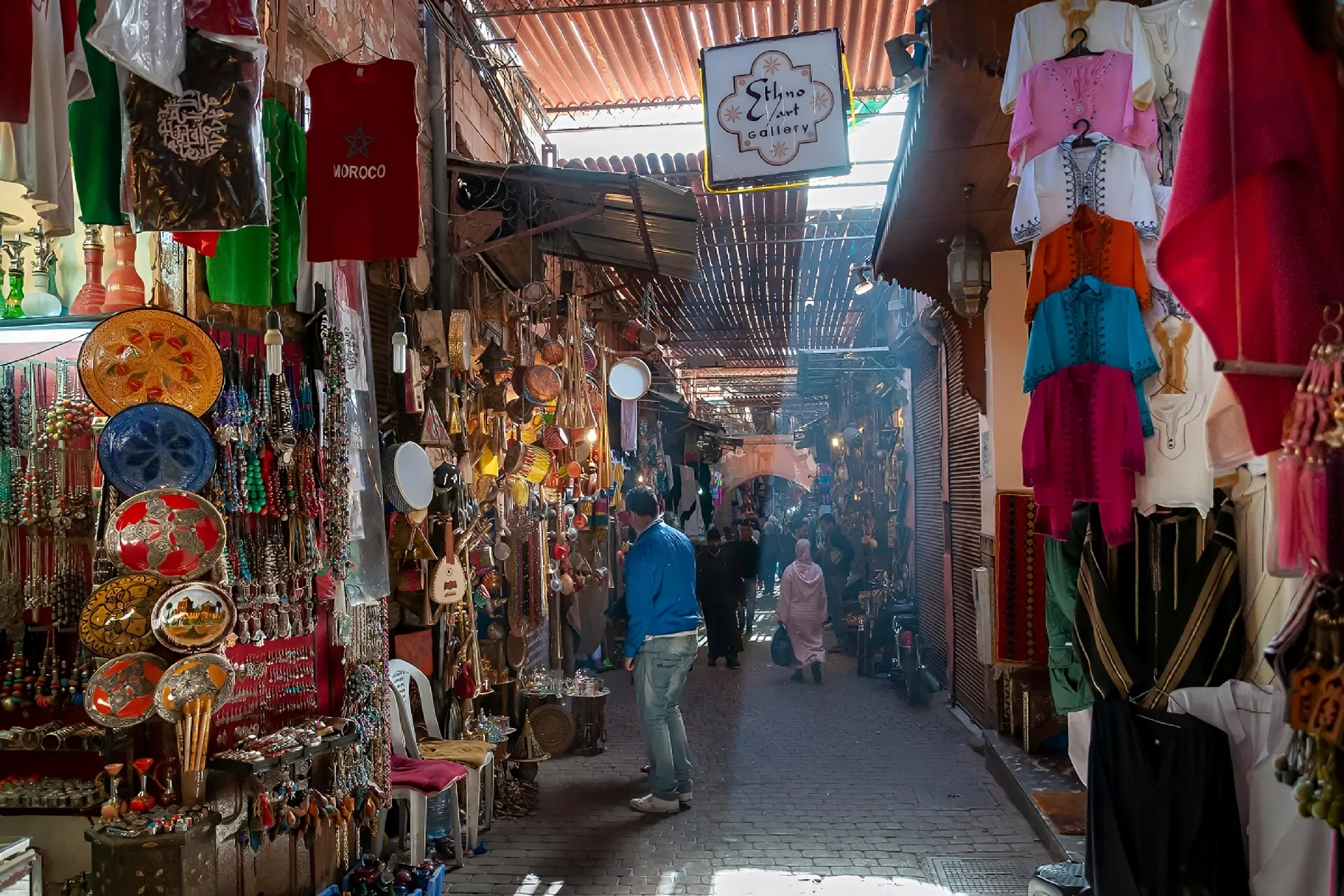

Nestled around Jemaa el-Fna, Marrakech’s fabled central square, the souks unfurl like a thousand‐lane bazaar. Under colorful canopies and stringed lanterns, vendors sell everything from brass lanterns to handwoven rugs. The air is heady with spices, leather and woodsmoke – a “kaleidoscope of sights, sounds and smells” that immerses the visitor in Moroccan life. This guide will serve as your definitive compass: locating each market, revealing what to buy (and at what price), decoding haggling scripts and authenticity tests, and even showing you how to pack or ship your treasures home. The Medina of Marrakech (a UNESCO World Heritage site) has been a center of trade since 1070, and its network of souks – each named for a craft or product – remains as bustling and vital as ever. (Guide updated September 2025; all facts are sourced from local experts and authorities.)
- Quick Facts: What the Souks Are, Where to Find Them
- The History of Marrakech’s Souks
- The Souk Map: Major Souks & What Each Sells
- What to Buy: 25 Authentic Souk Finds
- Price Benchmarks: Real-World Ranges
- The Art of Haggle: Scripts, Psychology & Etiquette
- Authenticity & Quality Checks (How to Spot Fakes)
- From Shop to Home: Packing, Shipping & Customs
- Accessibility, Safety & Practical Tips
- Food & Drink in the Souks: Where to Eat (and What to Avoid)
- Meet the Makers: Artisan Profiles & Case Studies
- Legal & Ethical Shopping: Antiquities, Heritage & Sustainability
- Troubleshooting: Common Problems & How to Solve Them
- FAQ — Common Traveler Questions
Quick Facts: What the Souks Are, Where to Find Them

The souks are a sprawling bazaar district within the old medina, radiating from Jemaa el-Fna (also spelled Djemaa el‐Fna) – the orange plaza fronting the Koutoubia Mosque. From this main square, covered alleyways (often narrow and ground‐level) lead north into the heart of trade. For orientation: imagine the souks as concentric lanes – Souk Semmarine branches directly north from Jamaa el-Fna, with other souks fanning off to the east and west. Major streets are signposted (in Arabic and French), but the maze can still confuse newcomers. A handy map (or smartphone app) can help: note prominent landmarks (tall lamp posts, fountains, or the Koutoubia minaret) as reference points to avoid getting lost.
Most souk shops open daily around mid-morning (≈9 AM) and close by early evening (≈7–8 PM), though many pause for Friday midday prayers. In practice, expect reduced hours on Friday (the Muslim holy day). Some specialized markets meet weekly: for example, a large antiques bazaar (Bab el-Khemis) traditionally runs on Thursdays outside the medina walls.
The Medina of Marrakech was inscribed as a UNESCO World Heritage Site in 1985, reflecting the centuries-old importance of its central square and market system. Over eleven centuries it has remained a true marketplace, not only for locals but for international visitors. Today’s tourists come well-prepared: local guides, travel blogs, and even printable checklists and maps can be found to help navigate the labyrinth of lanes.
The History of Marrakech’s Souks

Marrakech was founded in 1070–72 by the Almoravid dynasty, chosen for its proximity to trans-Saharan caravan routes. Almost immediately it became a hub where North African, Berber, Middle Eastern and even European traders met. Gold and salt caravans from the south converged here with Mediterranean goods like silk and spices. This international commerce gave rise to the city’s famous square (Jemaa el-Fna) and its surrounding markets.
By medieval times, the souks were not just marketplaces but centers of communal life. Guilds of artisans claimed corners of the medina: woodworkers, leatherworkers, metalworkers and dyers each clustered in their own quarter. For example, Souk des Teinturiers (the Dyers’ Souk) became a dedicated zone for textile dying, while Souk Haddadine was home to blacksmiths and lantern-makers. These specializations still define the souks today. Under later dynasties (Almohads, Saadians, Alaouites), Marrakech flourished and its markets expanded. During the 16th–17th centuries the souks reached their zenith: they sold the finest handwoven carpets, intricately worked silver and spices that were sought across the world.
Importantly, the whole medina – including its souks – remains largely intact, a living museum of medieval city planning. As UNESCO notes, the medina “was for a long time a major political, economic and cultural centre” of the Western Muslim world. Today’s wandering shopper can step back into that past: observing a lantern-maker forging iron, or rugs drying in the sun, just as Berber nomads and imperial merchants did centuries ago.
The Souk Map: Major Souks & What Each Sells

Marrakech’s souks are traditionally themed by craft. Below is a mini-map in words to each major lane (with rough tips on what to find there):
- Souk Semmarine (main artery) – A broad, covered boulevard that starts just north of Jamaa el-Fna. It sells a bit of everything. Near the entrance you’ll see pottery, clay tajines and baked goods; farther in, textiles and leather goods appear. Brightly dyed fabrics, scarves, and carpets fill many shops. As Morocco Journey guides remark, “Souk Semmarine…is very much a tourist-friendly souk with a wide range of goods on display”. It’s the first souk most visitors enter, so prices often start high (you should haggle here).
- Souk El-Attarine (Spice & Perfume Souk) – Traditionally the spice market, it remains heady with herbs and perfumes. Mounds of saffron, cumin, turmeric and traditional spice blends (ras el hanout) line the stalls, along with argan oil and handmade soaps. You’ll also find metal teapots, copper cauldrons and brass lanterns creeping into this souk. (Tip: If you are going to buy spices or oils, compare a few stalls – look for rich color and fragrance.)
- Souk Smata (Babouche/Shoe Souk) – A small covered lane dedicated to babouches – traditional Moroccan slippers. Hundreds of brightly colored leather slip-on shoes hang overhead in rows. If you’re looking for souvenir footwear, this is the place: you can haggle for as little as 50–100 MAD a pair (sometimes much lower if bundled) for high-quality hand-stitched babouches.
- Souk El-Kebir / Souk Cherratine (Leather Souk) – These adjacent areas smell strongly of tanned leather. Handcrafted bags, jackets, belts, and wallets are made here (often from local cow, goat or camel leather). Many goods come straight from nearby tanneries. This souk is lined with leather stalls and tanning pits are just a short walk beyond. (Caution: the tanneries themselves are pungent; some local “guides” offer tours for a tip. Stick with the souk shops for a more typical shopping experience.)
- Souk Zrabi (Carpet/Carpet Souk) – Often called the Rug Souk, where all the Moroccan carpets are sold. Here Berber rugs are hung vertically like tapestries, showcasing geometric symbols, natural wool colors or vivid plant-based dyes. It’s not unusual for a vendor to give you mint tea in a rug shop while discussing textures. Even if you’re just browsing, this lane is worth a look: each rug’s intricate pattern reflects the tribe or region of its weaver. If you do buy a rug, note that prices can vary from a few thousand dirhams for a small tribal mat up to tens of thousands for a fine hand-knotted piece.
- Souk Haddadine (Blacksmiths’ Souk) – Marked by the ringing hammer sounds, this area is full of metalworkers. Artisans here forge brass and copper lanterns (Morocco’s famed filigree lamps), trays, tagines, and decorative metal bowls. You may see lantern frames in progress. The wares here make stunning home décor (colorful punched-metal lamps can be negotiated in the 250–400 MAD range if well done).
- Souk Chouari (Carpenters’/Wood Souk) – Wooden craftsmanship abounds here. If you follow the scent of cedar, you’ll find carved chests, boxes, doors, and furniture. Many items are inlaid with mother-of-pearl or hand-painted. It’s usually a quieter corner of the souks where you can sometimes watch a carpenter at work, chiseling a bed or cabinet from raw cedar. Prices here reflect the heavy, detailed work – for example a carved cedar table could be a few thousand MAD (a smaller mirror or decorative panel might start around 200 MAD).
- Souk Sebbaghine (Dyers’ Souk) – Often overlooked by tourists, this lane features wool dyeing and felt-making. Open-air vats of natural dyes (turquoise blues, saffron yellows, vermilion reds) send plumes of color onto hanging skeins of yarn. Wool and leather are soaked in dyes here; you’ll see workers’ hands stained dark from the natural pigments. There are few products to buy directly (aside from blocks of raw wool), but it’s fascinating to walk through and observe the process. (A short detour here adds a vivid cultural touch to your shopping route.)
- Rahba Kedima (Ancient Spice Square) – Not a narrow souk lane but an open market square off Souk Semmarine. Here you’ll see pyramids of colorful spices again (especially saffron and ginger), as well as apothecary items (kohl eyeliner, dried herbs). The square is also fringed by baskets, rugs and poufs. It’s a picturesque spot to rest: rooftop cafés overlook the scene.
Each of the above is a “top souk,” but markets abound. You will also pass Souk des Bijoutiers (jewelry), Souk El-Fekhar (pottery), and countless micro-corners of antiques, brassware or perfumes. The souks are named after trades – for example, Fondeqs (covered courtyard markets) stock everything from handicrafts to food. Moroccan Journeys notes that part of the fun is simply getting lost in the maze and discovering a hidden courtyard selling amber jewelry or a cooperative with pure argan oil. Nevertheless, knowing the major souks by name – and the products they specialize in – helps you navigate purposefully.
What to Buy: 25 Authentic Souk Finds

From haute-artisanship to everyday crafts, Marrakech’s souks overflow with souvenirs. Here are the most iconic categories (roughly 25 items), grouped for clarity:
- Textiles & Rugs. Moroccan fabrics are famed for bright geometric designs. Berber rugs (Beni Ourain, Azilal, Boucherouite) are 100% wool, hand-knotted by Atlas tribes. Beni Ourain rugs (cream with dark zigzags) start around a few hundred euros for small sizes; giant ones climb into the thousands. Kilim rugs (flatwoven), and Boucherouite rag-rugs (bright scraps) are lighter and often cheaper (perhaps €30–€100 for small pieces). When buying, ask if the wool is entirely natural (no acrylic). Authentic rugs are unique: no two are identical. Machine-made lookalikes exist; check the back of the rug: irregular, hand-tied knots indicate true weaving, whereas a uniform grid pattern suggests a factory product. If possible, see or ask for the Moroccan government hand-weaving certificate (called label de qualité), which ensures it’s handmade wool.
- Blankets & Cushions. Look for thick wool handira wedding blankets (charming pillows with sequins) and colorful straw-woven tatami floor mats. While smaller than carpets, these still require negotiation; a decorative handira pillow might go for 200–300 MAD, down from a higher starting price.
- Leather & Babouches. Moroccan leather is traditionally tanned with natural ingredients (often tree barks) so it’s very supple. Popular buys include bags, belts, jackets, and wallets – often personalized with stitching or tooling. In Souk Cherratine, inspect the softness and stitching. A well-made leather bag might start at 500 MAD and negotiate to 300–350 MAD, or more for big items. The babouche slippers (covered upper, pointed toe) come in many colors: leather or suede in vibrant dyes. If buying a pair, a good quality handmade pair might cost 100–150 MAD after haggling. Women’s mules or men’s jellaba-style slippers likewise run in that range.
- Metalwork & Lanterns. Copper and brass goods are everywhere. Lanterns (lanternes), iconic Moroccan items, range from small pendant lamps to large floor lamps. Simple punched-metal lanterns (for candles) can be 150–300 MAD. Larger wrought-iron lanterns (often intricately filigreed and wired for electricity) may cost 500 MAD and up. Negotiation is key: one guide reported a hand-cut lantern at 300 MAD. Also browse lamps, trays, teapots, and decorative bowls, which are often brassware. Brass teapots and trays (for tea service) are 100–250 MAD for well-crafted ones. For higher quality, consider smaller artisans or cooperatives who stamp pieces.
- Spices, Teas & Ras el Hanout. The souks are a spice-lover’s dream. Look for saffron (bright red threads, the priciest), cumin (brown powder), cinnamon sticks, ginger powder, and ras el hanout – the famous “top-of-shop” spice mix (often ~30 ingredients). Packets of spice are cheap (5–20 MAD each) but buy only from a reputable spice vendor. Moroccan green mint tea leaves (or mint sprigs) are also sold; you can buy a 100 g package of loose tea for ~20–30 MAD. For a souvenir, pick up a small jar of ras el hanout – ideally an artisan blend in a decorative tin (50–100 MAD).
- Ceramics, Zellij Tiles & Tagines. Marrakech pottery is instantly recognizable: hand-painted bowls, plates and ornamental zellij tiles in blue, green, ochre patterns. You’ll see glazed tagine pots (cone-lidded clay cookers) in countless stalls. Small bowls or plates might be 50–100 MAD; large platters or a multi-piece dining set could be 500 MAD+. Practical tip: Ceramics can be heavy; pack them carefully in checked luggage or pay to ship them. If you do buy larger pieces, arrange for a shop to bubble-wrap them.
- Argan Oil, Cosmetics & Coop Products. Argan oil (from the endemic argan tree) is one of Morocco’s famed export goods. It’s made traditionally by women’s cooperatives (a UNESCO-recognized craft practice). Pure 100% argan oil comes in cosmetic (for skin/ hair) and culinary grades. A good golden 100 ml cosmetic-quality bottle typically sells for 200–300 MAD (~$20–30); be suspicious if it’s much cheaper. (CityLockMA advises this price range for 100ml.) How to tell real argan: the label should say “100% Argan Oil”, the oil is fluid but not watery, golden-amber in color, and absorbs without a greasy film. Squeeze a drop on your palm or a paper: the scent should be a subtle nutty odor (not overpowering). Besides oil, argan cooperatives sell black soap (an olive-and-argan mixture used for body scrubs) and argan-based lotions. Expect about 50–100 MAD for a mid-size bottle of lotion or a brick of black soap. Buying at a women’s co-op or fair-trade shop (marked “cooperative”) ensures the makers get a good price.
- Jewelry & Silver. Morocco has a rich jewelry tradition, especially in silver. You’ll find silver rings, bracelets, earrings, talismanic pendants (often with Berber symbols), and pieces set with semi-precious stones (turquoise, coral). Gold jewelry is also made, usually 21-22K, but is rarer and more expensive here. For silver, shops sometimes mark “Argent 925” (though Moroccan standards are not tightly regulated). If buying precious metal, look for hallmarks: many respectable jewelers will stamp “925” for sterling silver or “18K” for gold. You may also ask to see an acid-test kit (dropping acid on a small part to confirm purity). Avoid any item that appears too cheap or is offered as “pure gold” below market price. Note: large silver trays and tea sets can be found too (often higher-end and usually more than 1000 MAD).
- Other Treasures. Additional notable buys include handmade carpets, woven baskets, leather poufs (round stools), hand-forged knives (Damascus steel), and maple wood horns or instruments. Herbal remedies (dried rose petals, herbal teas) and local art (paintings or prints of Marrakech) make off-beat finds. Keep an eye out for cooperatives or boutique shops selling women’s clothing (traditional djellabas, embroidered dresses) or fair-trade goods (Moroccan rugs certified as sustainable, etc.).
Collectively, these 20–25 categories capture the main souk specialties. Each item’s authenticity and value depend on quality, materials, and negotiation. Always inspect craftsmanship: a real artisanal item feels substantial, well-finished and uses natural materials.
Price Benchmarks: Real-World Ranges

Here are ballpark ranges for souvenir prices, updated to 2025. Remember: initial sticker prices are typically 2–3× what vendors expect, so assume you’ll haggle down. Currency: 1 USD ≈ 10 MAD as of 2025.
- Small Items (50–300 MAD): This includes fridge magnets, small lanterns, scarves, tea glasses and trays. For example, a 10 cm decorative lantern can start ~300 MAD and be bargained to ~150–200. Silk scarves or cushion covers (handwoven) might be 150–250 MAD. Babouche slippers can be as little as 50–100 MAD if you buy two pairs. Small decorative items (tagines, pottery bowls) often run 50–200 MAD depending on size.
- Mid-Range (300–1000 MAD): These cover items like midsize lamps, leather bags, medium rugs, silver jewelry. From one traveler’s log: a hand-cut metal lantern was about 300 MAD, and a carved cedar wood table about 225 MAD. A hand-woven wool rug (approx. 1×2 m) might cost ~400 MAD (varying by quality). Leather jackets or jackets can start ~500 MAD, negotiable to ~300. A pair of gold or silver earrings (small hoop or stud) might be 500–800 MAD, although quality varies. Fine ceramics (dinner set or large painted plate) can be 500–1000 MAD if artistically detailed.
- Big Ticket (1000+ MAD): These include large lanterns, big carpets, antiques, or bespoke orders. A large hand-knotted rug (2×3 m or more) often runs in the several thousand dirhams; for instance, an intricate 100% wool tribal carpet could be 3000–6000 MAD ($300–600) after bargaining. Large chandelier-style lamps or brass tables can exceed 2000–3000 MAD. Custom orders (e.g. having a rug woven to spec) require a deposit and one to three months of waiting, and cost proportional to size/complexity.
Price Tip: Always ask for a price in MAD (dirhams) even if vendor quotes in euros. Many will give a EUR price (e.g. “200 €”) which at today’s rate is ~2000 MAD, but you will negotiate back to MAD. A helpful tool is a quick currency app or card, but almost everyone here prefers cash, especially for smaller bargains.
To summarize these ranges, here is a sample price cheatsheet (for comparison, all negotiated prices in USD equivalent):
| Item | Typical Negotiated Price (USD) |
| Small lantern (candle size) | $15–$25 (150–250 MAD) |
| Medium lantern (electrical) | $25–$40 (250–400 MAD) |
| Small rug (1×1.5 m, wool) | $30–$50 (300–500 MAD) |
| Medium rug (1.5×2.5 m) | $60–$150 (600–1500 MAD) |
| Leather bag (hand-stitched) | $30–$50 (300–500 MAD) |
| Silver bracelet | $30–$80 (300–800 MAD) |
| Argan oil (100 ml) | $20–30 (200–300 MAD) |
| Pottery tajine (large) | $15–$30 (150–300 MAD) |
| Traditional slippers (pair) | $5–$10 (50–100 MAD) |
The Art of Haggle: Scripts, Psychology & Etiquette

Bargaining is not just accepted – it’s expected and part of the fun. Vendors often quote an opening price 2–3 times higher than their bottom line. Your goal is to reach a fair deal amicably. Keep it light-hearted: a smile and patience go far. Many travelers find it helpful to start with roughly 30–50% of the asking price and meet in the middle.
Helpful Darija phrases (Moroccan Arabic) to deploy:
- “Bsh-hal?” (بشحال) – “How much is it?”. Alternatively in French, “C’est combien ?” – both get the job done.
- “Ghâli bzâf!” (غالي بزاف) – “Too expensive!”. Use it playfully to signal you’re shocked by the price.
- “Khelm llah, sbâhn Allah.” (“God willing, by God”) – a light, respectful way to refuse or signal you need time.
- “N-kass tâmen, afak.” (نكاس الثمن، عفاك) – “Can you lower the price, please?”. Say this firmly but kindly.
- “Ana bghît nshri hâd.” (بغيت نشري هاد) – “I want to buy this one.” Shows intent (often moves negotiation).
- “Lâ choukran.” (لا شكراً) – “No, thank you.” A polite way to decline, or end bargaining when you’ve agreed.
- “Ghir tân chouf.” (غير تانشوف) – “I’m just looking.” Very useful when vendors become persistent; it signals you’re not yet committed.
Always remember to smile and stay polite. A sense of humor helps – Moroccans often appreciate it when a bargain is approached as a friendly game rather than a fight. If negotiations stall or the price remains too high, the ultimate tactic is to walk away calmly. Often, the seller will call you back seconds later with a better offer. In fact, experts advise that once a vendor senses you are prepared to leave, they may “come back with a better price”. When accepting a price, a simple “Inchallah!” (meaning “God willing”) often seals the deal.
Avoid aggressive haggling tricks that might offend: don’t insult the craftsmanship or argue bitterly. Also, never bargain over food – snacks and drinks in Jamaa el-Fna or cafés have fixed prices. Finally, have some cash in small bills ready. Moroccan vendors usually do not carry large change, so making exact payments (or rounding up) keeps goodwill.
Authenticity & Quality Checks (How to Spot Fakes)

The souks offer endless knock-offs, so independent checks are key:
- Argan Oil: Look for cooperatively bottled oil. Authentic cosmetic argan should be golden-amber and absorb without leaving a film. Check the label: it should say “100% Argan Oil”, and list only Argania spinosa kernel oil. Beware of very cheap bottles. A “too good to be true” price often means diluted or imitation oil. Real oil has a subtle nutty smell – sniff it. If it’s odorless or very cheap, skip it. Buying from a woman’s coopérative (often cooperatives list their names on the label) is safest.
- Rugs & Carpets: Genuine Moroccan rugs are hand-knotted wool (sometimes with a bit of cotton warp). Synthetic blends are suspect. Check the back: you should see individual knots and a slightly uneven weave. If the pattern on the back is almost machine-perfect, it’s probably machine-made. All Moroccan government-certified Berber carpets must be entirely wool and hand-knotted. One tip: soak a corner in water (carry a small cloth): if color bleeds significantly, it uses poor synthetic dyes. High-quality rugs use natural dyes that hold fast. And remember, handmade rag rugs (Boucherouite) are supposed to look irregular – uniformity is a warning sign.
- Silver & Jewelry: Look for a hallmark “925” on silver, or “Au 21” on 21K gold, though not all shops use them. A simpler check: genuine silver tarnishes slightly (it darkens with exposure), so rub a soft cloth on it to see if a grey streak appears. A magnet can test silver (real silver is not attracted). Many vendors in Souk des Bijoutiers are reputable; buying from an established shop with a license (often displayed) is wise. Trust your eyes: finely chased silver and gemstones set in silver (Turkish lamp style pendants, Tuareg crosses) should feel solidly made, not hollow or painted.
- Other Crafts: For leather goods, inspect stitching and lining – fine leather goods are stitched straight and have leather-inside linings (cheap ones use nylon). Lanterns and metal lamps should have smooth, even metalwork and no sharp burrs. Textile items like babouches or cushions should have no loose threads or glue residue. When in doubt, small “wet tests” (like the fountain pen trick on silver or scratch test on wood) can be done discreetly.
By combining these checks – ingredient labels, tactile tests, and the vendor’s story – you can avoid most outright fakes. And of course, buying directly from known co-ops or a skilled artisan (especially when they demonstrate work) ensures authenticity and supports the craft tradition.
From Shop to Home: Packing, Shipping & Customs

For large or fragile purchases, planning how to get them home is crucial. Here are best practices:
- Packing Fragile Items: As soon as you buy pottery, lamps or glass, request that the shop pack it in bubble wrap or Styrofoam. Many shops have packing services (sometimes an extra 10–50 MAD). Wrap items twice: first in bubble wrap, then in clothes or newspaper inside your luggage. For hand-blown lanterns or ceramics, keep them in checked baggage with padding on all sides. Tape the box shut and label “Fragile.” If checking is risky or overweight, consider shipping.
- Rugs & Carpets: Rugs can be vacuum-sealed (shops offer plastic vacuum-packing) to save space. The recommended way to carry a big rug is in a carry-on if it fits; otherwise, roll it with a sheet of plastic and place it between other bags. For checked baggage, ensure it’s well-wrapped in plastic or a sturdy rug bag. For very large rugs that won’t fit, use shipping.
- Shipping Options: Major hotels and many shops can coordinate shipments. International couriers (DHL, FedEx, Aramex) have offices in the city; they will pick up bulky items (e.g. antique furniture, huge lamps) from your hotel or the shop. Expect high costs: a 20 kg parcel by air might run hundreds of dollars. Travelers often find Morocco’s postal service (Barid Al-Maghrib) surprisingly economical for heavy goods; you can go to the central post office in Gueliz to mail a parcel. (Two traveler accounts note that official post rates beat private courier quotes.) If shipping rugs, ask for a freight forwarder – some vendors collaborate with agents who offer freight (cheaper than door-to-door by air, but slower). Always insure valuable shipments.
- Customs & Permits: Moroccan law is generally lenient for new crafts. Handmade pottery, textiles, and personal souvenirs have no export limit – you simply take them to the airport. However, by law you must declare goods and may be asked to prove purchase if asked by customs. It is technically illegal to take out antiques or anything deemed an “antiquity” without a permit from the Ministry of Culture. If an item looks very old (ceramics over 100 years, tribal relics, precious antiques), vendors should have paperwork, but as a tourist it’s safest to leave serious antiquities to museums or licensed shops. In practice, flimsy tourist stickers or unmarked “old” items are often confiscated.
For tax matters: Morocco’s VAT is 20%, and tourists can claim a refund if they spend above the minimum (roughly MAD 2000 total on a single day’s purchases). You will need to get a Tax-Free form from the vendor (they may call it a “facture détaxe”) for each qualifying purchase, and present it at the airport customs desk when leaving. Customs officials will stamp your forms to show you are exporting the items. Keep your passport and boarding pass handy for this. If the refund applies, you can be reimbursed at a kiosk or by pre-paid envelope through a service (note: service fees apply).
- On Arrival: Many airlines allow one piece of luggage for free, plus a carry-on. Delicate or high-value items (bulky rugs, heavy vases) are often best shipped to avoid damage or overweight charges. For smaller items, protect them well and consider carry-on for irreplaceables. Keep receipts and paperwork (especially for very expensive buys) in your hand luggage in case customs asks.
Accessibility, Safety & Practical Tips

The souks are generally safe for most visitors, but some practical precautions help everyone:
- Pickpockets: Busy markets do have pickpockets targeting tourists. Keep wallets in front pockets or inside a zipped bag. Many experts recommend a thin money belt or pouch under clothing. Be especially vigilant at crowds and street performances in Jamaa el-Fna. If someone bumps into you, check your belongings.
- Aggressive Vendors/Touts: You will encounter touts offering “guides” or photos of Moroccan monkeys (macques in Jamaa el-Fna). Politely declining (e.g. “La, shukran” – “No, thank you”) is fine. Do not accept help from unofficial “guides”; they often lead tourists into hard-selling situations. If lost, seek official signage, public police booths, or go into a nearby shop and ask.
- Dress & Conduct: Marrakech is a touristy city, but modest dress shows respect. Both men and women should avoid overly short/low-cut clothing in the medina. Especially during Ramadan, be mindful: eating, drinking or smoking in public (including the souks) during daylight hours can offend. The focus of the markets does shift in summer months when older or more religious vendors may close by early afternoon.
- Mobility & Strollers: The medina’s maze has many uneven sections and thresholds. A lightweight stroller may be workable on the wider streets (Souk Semmarine and major thoroughfares). Narrow lanes with protruding tiles or steps will be impassable. Wheelchair users should plan to avoid the tightest alleys: ironically, Marrakech’s old city has many flat, compact surfaces, and one traveler notes, “the streets are very flat and most of the cobblestone is fairly smooth,” making the main souks “fairly wheelchair accessible”. In any case, assistance or a porter may be needed. Many riads (traditional hotels) near the medina have arrangements with accessible taxis.
- Money & Payments: Currency is Moroccan Dirham (MAD); Euros and USD are not accepted in shops. Bring enough cash (Euros to exchange, or use ATMs). As a rule, cash is king here. Only a handful of high-end rug or lamp shops accept credit cards (and often with a surcharge). No worries if you have mainly cash: exchange rates at banks or official booths in the city center will serve you better than on-the-street moneychangers. Tipping is not obligatory for small purchases, but helpful for porters or guides (~10% is customary in restaurants).
- Emergencies: Keep a digital copy of your passport and emergency contacts. The local police (dial 19) or tourist police (dial 177) have offices around the medina. Pharmacies are plentiful if you need medicines. Carry water and sunscreen during hot months; even covered alleys can get very warm midday.
Food & Drink in the Souks: Where to Eat (and What to Avoid)

The souks themselves have few sit-down restaurants, but street food here is part of the experience. Harira (rich tomato-lentil soup) and sfenj (doughnuts) are commonly sold in Jamaa el-Fna. Look for stalls with long lines of locals, as they indicate cleanliness. Traditional vendors often prepare harira in large cauldrons and serve it in a handmade clay cup for a few dirhams. Grilled kebabs (chicken or lamb) skewers are available later in the day. Fresh orange juice stands are ubiquitous – the local fruit (sweeter than European oranges) makes a refreshing drink.
If you prefer a sit-down break, several rooftops and small riad cafes border the edges of the souks, offering mint tea and simple dishes. The prices are higher than street food but the ambiance – overlooking the maze of markets – is memorable. Always check that juices are freshly squeezed, and that meats are cooked thoroughly (well-done in Moroccan eateries).
For special dietary needs: if vegetarian, look for stalls selling falafel and salads. Islamic dietary laws mean all meat is halal. Bathrooms in the souk can be hard to find; use your hotel or a café when possible (often for a small purchase).
Meet the Makers: Artisan Profiles & Case Studies

To truly appreciate souk purchases, let’s spotlight a few artisan stories (from interviews and field reports):
- A Berber Rug Weaver: In an Atlas village workshop (often in or near Marrakech), a Berber weaver sits cross-legged with a simple loom. Using hand-spun sheep’s wool dyed with local plants, she ties each knot individually – it can take weeks to complete even a medium rug. She emphasizes using natural wool and living traditions (“My grandmother taught me this, I teach my granddaughter”). Understanding this process adds value when negotiating for a hand-made rug; you’re not just buying fabric but generations of craft.
- A Leather Tanner: The tanner in a hidden souk alley first soaks goat hides in pigeon poo (an age-old method) to soften them. Then he rinses and tans them with olive bark. The result is beautifully smooth leather. He charges 20–50 MAD to tan a hide for local bag makers. Seeing this, tourists learn why a leather bag made from this hide is worth 400 MAD, not 100.
- A Lantern-Maker: In Souk Haddadine, a smith hammers out a copper sheet, punches intricate patterns, and paints it. He explains each lamp is custom and unique (“Even two we make today will differ”). Watching the sparks fly (literally) gives a new respect for the 250–300 MAD price tags.
- A Woman at an Argan Cooperative: At a women’s cooperative on the edge of town, local Berber women crack argan nuts by hand and grind the kernels into a paste to press oil. They note how labor-intensive it is – each liter of oil takes up to 2,000 nuts. They sell jars for 200 MAD. Shoppers at such cooperatives know their purchase fairly compensates this work.
- A Pottery Family: In Marrakech’s pottery quarter, a family uses wooden wheels to shape tagines and glazed dishes. Each is painted by hand – no two patterns are identical. The father says patterns are passed down from father to son. A 150 MAD painted plate here is the result of an heirloom skill, not factory mass production.
These mini-profiles remind buyers: your purchases support real people with skills. Many artisanal items are priced per the effort involved. Buying at an artisan’s workshop or co-op often means meeting the maker and ensuring a fair price for them (no middleman). It also helps spot quality: if someone confidently explains how they made an item, it’s likely genuine.
Legal & Ethical Shopping: Antiquities, Heritage & Sustainability

Morocco, like many countries, protects its heritage. As a traveler, ensure your shopping doesn’t inadvertently harm culture or nature:
- Antiquities Law: By Moroccan law, true antiquities (generally objects older than 100 years) require an export permit. Most souk stalls deal in new or recently made crafts, but if an item is antique, the seller should have paperwork. UNESCO and local laws forbid the export of genuine archaeological artifacts. If in doubt, err on the side of caution: avoid anything that looks like it was dug up (heirloom tiles, carved stones, tribal relics).
- Cultural Respect: Many patterns (like Amazigh tribal motifs) have cultural significance. Appreciate them and don’t treat them as mere decor. A respectful traveler will enquire about traditional uses (Beni Ourain rugs are bedding, a Gnawa amulet has spiritual meaning, etc.) rather than just blasting photos for social media. People in Morocco value manners, so a few local words (Marhaba, Choukran, Afak) go a long way.
- Supporting Communities: Look for cooperative shops and artisans’ collectives, especially women’s cooperatives (argan, blankets, pottery). These often bear labels like “Made by cooperatives” or “Fair Trade Morocco.” Buying from them ensures more profit stays with the workers rather than middlemen. Many cooperatives also contribute to community projects. Some vendors abroad even collaborate with Moroccan fair-trade networks, so you might be able to identify their wares.
- Environmental Note: Morocco’s water is scarce. Crafts use local resources: be mindful that over-harvesting of argan, cedar, or certain dyes can be issues. You can ask your vendor: “Is this wood local cedar?” or “This dye is from what plant?” Educated vendors will answer about sustainable practices (for example, many zellij tiles today use synthetic dyes instead of toxic older ones).
In short, legal exports are mostly handcrafts. If a deal seems shady (seller can’t prove origin, or pushes “export papers”), walk away. Ethical shopping means buying what you love at a fair price while respecting local rules and culture.
Troubleshooting: Common Problems & How to Solve Them

Even well-prepared shoppers encounter issues. Here’s how to handle them:
- Lost in the Souks: If you find yourself disoriented, look for the nearest landmark (fountain, mosque, large sign). The lanterns street and Babouches street are big thoroughfares, while Souk Smata (the babouche lane) stands out with shoes hanging overhead. If all else fails, head downhill (east) and you should eventually hit Jemaa el-Fna. Alternatively, switch on GPS and mark your hotel as “Home” so it can navigate you out. Many riads will lend a local SIM card or phone for emergencies.
- Vendor Returns/Refunds: Generally, purchases in the souk are “no returns” – once you agree on a price, that sale is final. Haggling means you waive most complaints. However, if an item breaks or is demonstrably flawed (e.g. cracked ceramic), some honest sellers will offer a partial refund or take it back. If damage occurs after leaving the stall (e.g. in transit), the seller usually will not compensate. For expensive items, get an agreement in writing if possible, or at least a name or number in case of a dispute.
- Overcharged at Airport Duty: Rarely, customs may claim items need duty. If you have documentation (invoice, tax-form), challenge politely. Moroccan customs officers usually know traditional crafts come from Morocco, but errors happen. If charged, ask for an itemized receipt and the law reference (both are required). Without them, persist calmly; you are entitled to a fair hearing. Keeping original receipts (or copies) with your tax forms usually prevents this issue.
- Health/Allergy Issues: If you buy spices or cosmetics and break out, know the language for medical help. “Tabaib” (doctor) and “sayada” (pharmacy) are words to memorize. Moroccan pharmacies are well-stocked; just show a photo of what you bought if language is a barrier. For upset stomachs (rare if food was cooked in front of you), carry rehydration salts.
- Language Barrier: Vendors speak Darija (Moroccan Arabic) and many speak French. Few know English (though this is improving). Use polite Arabic phrases (Salam ‘Alaykum = hello; Choukran = thank you). Often, simple French works (“merci”, “combien”, “parlez-vous anglais?”). A translation app or pocket phrasebook is handy. Smiling and using universal gestures (pointing, showing money) bridges the gap.
FAQ — Common Traveler Questions
What are the souks of Marrakech and where are they located?
The souks are a network of traditional open-air markets located in Marrakech’s old city (medina). They radiate from Jemaa el-Fna (central plaza) and fill the north and east sections of the walled medina. Major streets like Souk Semmarine connect to smaller lanes.
What is Jemaa el-Fna and how does it link to the souks?
Jemaa el-Fna is Marrakech’s historic main square – a UNESCO cultural landmark. By day it hosts food stalls and snake-charmers; by night, storytellers and musicians. It serves as the main entrance to the souks. Souk Semmarine begins just north of the square, so you can enter the alleys directly from there.
What are the main souks to visit?
Key souks include Souk Semmarine (central artery – general goods), Souk El-Attarine (spices & perfumes), Souk Smata (babouches), Souk Cherratine (leather goods), Souk Zrabi (carpets), Souk Haddadine (metal lanterns), Souk Chouari (carpentry), and Souk Sebbaghine (dyeing). There are many others; part of the fun is exploring smaller alleys named for whatever items are sold there.
What are the best souks for rugs, leather, metalwork, spices, and jewelry?
– Rugs: Souk Zrabi or Bab Debbagh area.
– Leather: Souk Cherratine for bags and jackets; Tannery shops nearby for finished hides.
– Metal lanterns & brassware: Souk Haddadine (Blacksmiths).
– Spices & teas: Souk El-Attarine and Rahba Kedima Square.
– Jewelry (silver): Souk des Bijoutiers (near the spice square) and small stalls inside Souk Semmarine. Always check quality.
What time of day / time of year is best to visit the souks?
Early morning (10–11 AM) is good: shops open and it’s cooler and less crowded. Midday can be very busy and hot; also many shopkeepers break for lunch/prayer around 1–2 PM. Late afternoon (3–5 PM) is lively as vendors finish their day. Weekends (Friday-Sunday) draw locals too, making it bustling. Avoid Friday midday (prayer break) and Eid holidays when many shops close. In summer, late afternoon is best to avoid heat; in winter, just before dusk (around 4–6 PM) is pleasant. Note: some artisans also open evening stalls but it’s mostly food vendors then.
Are the souks open every day? What about Fridays or holidays?
Yes, most souks operate 6 days a week, typically closed or half-closed Friday midday. Friday is the Muslim day of prayer, so many shops shut roughly 12–2 PM. During major holidays (Eid al-Fitr, Eid al-Adha) expect closures. Conversely, the weekend flea markets (e.g., Bab el-Khemis) occur outside medina on specific days (Thursday/Friday). Plan around religious times by visiting Friday morning or afternoon instead of midday.
Is it safe to walk the souks? How common are pickpockets and aggressive touts?
Generally Marrakech is safe, and the souks are police-patrolled. Pickpocketing can happen in crowds (as it can in any tourist market). Keep valuables hidden and use a money belt if concerned. Violent crime is very rare. Touts (“guides”) do proliferate in Jamaa el-Fna and alleys: they might insistently offer tours or say “photo” for macaques. Firmly say “La, shukran” and move on. If a vendor or helper seems too pushy, back away politely. Using a map or official guide reduces risk of being misled. Overall, trust your instincts: if a situation feels wrong, exit it quickly.
How do I haggle in the Marrakech souks – tactics and phrases?
Haggling is must. Start by asking price (e.g. “Bsh-hal?” – how much). Your counter-offer can be around 30–50% of the initial price. Insist politely (“Ghâli bzâf!” for “too expensive”). Drop your price in stages. Use phrases like “Ana bghît hâd” (I want to buy this), and “N-kass tâmen, afak” (Can you lower the price, please?). Do not show desperation. If stuck, thank and start to walk away – sellers often accept a lower offer as you leave. Keep it friendly: Moroccan merchants often enjoy the banter. When a price is agreed, you can say “Inchallah” (God willing) to seal the deal with respect.
What should I wear in the souks?
Dress modestly but comfortably. No need for headscarves for tourists, but both men and women should cover shoulders and knees out of respect. Sturdy closed shoes or flats are recommended (the ground is cobbled and uneven). A long-sleeve shirt and a lightweight scarf can protect against sun and dust. If visiting during Ramadan or conservative areas, be extra cautious (no eating/drinking during daylight, and avoid sleeveless wear).
What should I buy in Marrakech? (Top 20 authentic items)
Highlights include: Berber rugs (Beni Ourain, Azilal, etc.), leather goods (bags, babouches), metal lanterns and lamps, tajines, argan oil (and black soap), spices (saffron, ras el hanout), Moroccan tea glasses, ceramic plates and bowls (zellij style), silver jewelry, embroidered pillows, brass teapots, woven baskets, wool blankets, poufs (round leather ottomans), and decorative leather kittels. These are authentic Moroccan products that reflect local culture. Check our What to Buy section for more detail on each category.
How do I spot fake argan oil, rugs, antiques, or low-quality silver?
– Argan Oil: See “Authenticity” above – label must say 100% argan, oil is golden, not watery, and absorbs quickly.
– Rugs: As noted, true Moroccan rugs are hand-knotted wool. Ask for the 100% wool label. Synthetic-looking backing or bleeds of color when wet suggest fakes.
– Silver: Look for “925” stamps, or ask vendor to demonstrate. No stamp could mean lower alloy. If uncertain, test with a magnet (silver isn’t magnetic).
– Antiques: Genuine antiques should come with paperwork. Souk stalls mainly sell new handicrafts; “antique” items that look polished or too cheap are often modern reproductions or imports. If provenance is not clear, it’s safer to buy new artisan pieces.
How much should I expect to pay for common items?
See our Price Benchmarks above. In general, small trinkets (<200 MAD), mid goods (300–1000 MAD), large (1000+ MAD). For example, expect about 200–300 MAD for 100 ml of authentic argan oil, 300 MAD for a medium lantern, 400 MAD for a handwoven rug (~1×2 m), 100–200 MAD for quality babouches, and 50–100 MAD for good spices. Use our price table above as a rough guide. Always remember: initial quotes will be much higher, so haggle down.
Can I use credit cards or contactless payments?
Most small vendors and stalls are cash-only. A few mid-to-high-end shops (especially carpets and lamps) might accept Mastercard/Visa or even Apple Pay, but often with a 5–10% surcharge. Generally, bring enough Dirham cash for souk purchases (there are many ATM machines around the medina). PayPal or Venmo are not available locally. It’s wise to have a mix of notes and coins (coins are useful for tipping).
Do vendors ship items internationally?
Yes, many vendors and shops offer shipping services. After purchase, they can help arrange packing and courier for heavy or bulky items like rugs or pottery. Costs vary: a few hundred MAD to air-freight a large lamp, or several thousand MAD for freight shipping a rug to Europe/US. Always ask for insurance. Some shops use local courier companies (Aramex, FedEx) or can advise on how to use the post office. If shipping from the seller, clarify who handles customs export declaration (usually the shop does it for you).
What are the costs and best practices for shipping rugs/ceramics home?
– Rugs: Vacuum-pack them if possible, then ship via specialist rug couriers or standard freight. A 2×3 m rug to Europe might cost ~$100–200 (depending on weight/volume). To the US, expect $200+. Ask your rug vendor for quotes; they often partner with shipping agents.
– Ceramics/Glass: Pack each piece in lots of bubble wrap (two layers) and sturdy cardboard. The seller can usually pack for a fee (20–100 MAD per big item). Use Express Post (Barid Al-Maghrib) for Europe: it’s cheaper than DHL but slower. For example, a small lamp (2 kg) shipped to Europe via post might be ~$40; FedEx/DHL could be $60+.
– When shipping, fill out customs forms honestly as gifts (value should reflect sale price). Keep invoice copies. Insure if item is valuable.
Is VAT/tax refund applicable? How does customs work?
Yes, you can claim VAT refund if you buy above the threshold (~MAD 2000 per day). The shop should give you a “Tax Free” form. At the airport, before check-in, go to the Customs desk to stamp your forms (you need your passport, boarding pass, and goods ready to show). Then you can submit them to a refund kiosk or by mail. The actual refund (about 15–18% of your purchase) will arrive in cash or on your card, minus an agency fee. Keep all receipts and forms until your claim is processed. Remember: this process must be done before you leave Morocco (valid for purchases within the last 3 months).
Are the souks wheelchair/stroller accessible?
The medina’s alleyways were built long before accessibility standards. Nevertheless, some areas are surprisingly flat. A wheelchair blogger notes Marrakech’s medina streets can be “fairly accessible” because the cobblestones are mostly smooth and there aren’t many curbs. Main corridors (Souk Semmarine, Souk Zrabi) are flat enough for most wheelchairs or strollers. However, side alleys often have uneven tiles or short steps. If you use a wheelchair, plan to stay on the main arteries; some riads also lend rolling chairs. Elderly travelers will find the souks manageable if they take breaks. Be prepared to get help over any curbs or cobbles. In short: not fully ADA-compliant, but not impossible either with caution.
Can I take photographs in the souks? Any etiquette?
Yes, you can take photos freely. It’s one of Marrakech’s photo highlights! But do ask permission before photographing a person or an artisan at work. Many stallkeepers smile for cameras, especially if you give a small tip (5–10 MAD) or buy something. Avoid using flash in darker shops without asking. Be mindful of pickpockets while concentrating on shots. In Jamaa el-Fna, photography is especially enchanting (though snake charmers sometimes ask a small fee). Respect “no photography” signs which are very rare.
Are the souks touristy or still authentic? How to find authentic workshops?
It’s a mix. The souks were built for locals historically, but today they serve both locals and tourists. Many shops cater to tourists (selling teapots, T-shirts, plastic souvenirs) but alongside are true artisanal stores. To find authenticity: wander past the main entrances. Hidden off the beaten path are small workshops where the craftsmen actually work (you may see weaving on looms or leather being dyed). Visiting a known cooperative (e.g. for argan oil or carpets) guarantees genuine craft. Also, shop at cooperative-run stands (marked with an association logo). Typically, if something seems a total bargain (especially in the heart of the tourist lanes), it may not be authentic. Trust your research: if a stall claims to have “100% handmade Beni Ourain,” check the tags or look for certificate.
How long should I plan in the souks? Suggested itineraries?
This depends on your interest and stamina. A quick tour (1–2 hours) can hit the highlights: stroll down Souk Semmarine, loop through Smata and el-Attarine, and peek at Haddadine. For a half-day (4 hours), take it slower – sample tea, try a quick local snack, and explore up to 4-5 different souk sections thoroughly. A full day (7–8 hours) allows diving deep: visiting a museum (like Maison de la Photographie or Marrakech Museum) nearby, and even a tile/pottery workshop. Remember to take breaks: a mint tea or juice break is wise. Tour operators often suggest 2–3 hours in the morning, break for lunch, and 2–3 hours more in the afternoon to avoid fatigue.
Should I hire a local guide? Pros & cons?
Guides can unlock hidden gems and help with Arabic/French. If hired through a reputable company, they know reliable shops and history. The downside: guided tours can speed through the souks, sometimes pushing specific stores. Also, unscrupulous guides may take you to shops where they get a kickback. If you choose a guide, vet them with reviews and avoid any who pressure you to buy at certain stalls. If confident in your planning, independent exploration is fun. Another hybrid: ask your hotel/riad concierge to recommend a trusted guide or even a local shopkeeper (some will accompany guests to get a fair commission – clearer than unknown persons on the street).
Are there food and drink options inside the souks (where to eat / safe street food)?
Yes, but modest. The souks have street food stalls along and around Jamaa el-Fna. Look for women cooking harira soup, pancakes, satay and merguez on grills. A good rule: if a stall is busy with locals, it’s more likely hygienic. Drinking bottled water and hot drinks (tea/coffee) are generally safe. You can also slip into a riad courtyard or cafe for pastries and mint tea. Avoid any ice or uncooked salads on extremely hot days unless you trust the source (stick to cook-on-the-spot foods).
Where are the tanneries and are they open to visitors? Ethical considerations?
The famous Chouara Tanneries (open pits of dye) lie just northeast of the medina (outside the main souk area). Many tour groups do a detour, but ethically it’s tricky. It is a working production area: hides are dyed in pits, often with noxious odors (hence the mint). Some say viewing them without paying the locals is exploitative. If you go, pay the local kids or guides who jump to help you reach a vantage point safely. Photography is ubiquitous here. The tanneries are generally open-daily (morning is best, afternoon sun is harsh). Consider the ethics: some prefer to skip it to avoid voyeurism. Either way, if you do visit, keep your distance, don’t throw trash into the vats, and tip those who guide you.
How to pack and protect breakable purchases for flights?
See Packing Hacks above. In short: double-wrap fragile ceramics or lamps in bubble wrap, then in towels or clothes in your suitcase. Fill any hollow spaces in your bags with soft items to cushion. For really heavy/bulky ceramics, shipping is often safer. Place breakable carry-ons in the cabin if possible (e.g. small glassware). Mark your suitcase “Fragile” outside. Airlines sometimes err on the side of caution if labeled – though still be careful. If you have many breakables, limit them or use professional packing at the shop.
How to identify Berber rug types (Beni Ourain, Boucherouite, Kilim)?
– Beni Ourain: Cream or off-white wool with dark geometric lines. Thick pile, usually large area rugs.
– Boucherouite: Made from recycled fabric scraps (bright, multi-colored). Often smaller rag rugs.
– Kilim (Riotapane): Flatwoven (no pile), geometric designs. Will be thinner.
Asking by name or showing a photo to the vendor helps. Genuine tribal weavers know their style names and origins.
How to tell machine-made vs hand-knotted rugs?
The back of a hand-knotted rug will show knots and a less regular pattern; a machine rug has a uniform, almost perfect backing. Also, a genuine rug will feel heavy and plush. Check the edge: hand-knotted have finished fringes (the warp threads), while machine rugs often have sewn-on fringes.
Are there cooperative shops or women’s argan cooperatives / fair-trade stalls?
Yes. Some shops carry “Argan Bella”, “Cooperative Argan”, or the global “Fair Morocco” sign. Women’s cooperatives often have stalls (look for “AMIC” or “Cooperative”). For silver jewelry, look for “Artisan” or UNESCO artisan associations. For carpets, the Amal women’s cooperative in the medina offers ethically-sourced rugs. Ask your hotel about cooperatives – many are just outside town or easy taxi rides.
What scams to watch out for (fake guides, dropped-wallet trick, overpriced customs, etc.)?
– Fake guides/touts: Only trust licensed guides; ignore street touts.
– “You dropped something” scam: If someone says you dropped a ring/coin on the ground and asks for ID or leads you to their friend, it’s a ploy. Do not hand over your passport or bag.
– Animal tricks: Beware children offering to handle a snake or monkey for photos unless a fee is agreed before the photo.
– Currency scams: If changing money, use an official exchange bureau. Some shady exchanges or taxi drivers may short-change. Always count your dirhams carefully.
– Overpriced courier: If a vendor arranges shipping, verify the courier’s identity. Insist on an official invoice for customs.
– Airport swapping: After shopping, keep receipts separate; sometimes dishonest airport staff ask to see them for “export proof” and then say they need a bribe or take money. Always clarify process ahead.
Are there market days / temporary souks outside the medina?
Yes. The Souk Hebdomadaire (Weekly Market) at Bab el-Khemis (in Gueliz) is famous for antiques, used goods and artisan stalls. It is open Thursday mornings (some shops Friday). For crafts, the Marché aux Puces on the boulevard near the cinema on weekends has some furniture and second-hand items. These are more flea markets than crafts, but worth a visit if you like browsing. They are fairly authentic local scenes – expect more locals and haggling.
What’s the best way to get from airport/hotel to the souks?
From Menara Airport (RAK): the souks are about 10 km east. Options: shared airport taxis (about 75–100 MAD to Medina), private taxi (~150 MAD fixed), or pre-booked hotel transfer. Ubers/careem exist but might not come into the medina’s narrow lanes. From the Ville Nouvelle (Gueliz), take a taxi to the old city gates (Bab Ksiba or Bab Doukkala) and walk in; many riads also offer pick-up service. Once inside, walking is the best way; luggage can be carried by porters from the gate.
Are pets allowed? (service animals / local rules)
Morocco does not have formal rules on service animals, and few public spaces accommodate them. The souks themselves have uneven ground and crowds; not practical for a pet (even a well-behaved one). Service animals may accompany their owners, but arrangements (water, rest places) will be your responsibility. In general, it’s uncommon to see animals in the medina, apart from occasional street cats or the monkey performances. If you must travel with a pet or service animal, inquire with your hotel for guidance and be prepared to manage in an environment not designed for animals.