

Food, culture and city life
Taiwan Night Market Guide: 10 Essential Markets and Food Tips
A market-by-market guide to Taipei, Taichung, Tainan, Keelung and Kaohsiung, with practical ordering, safety and etiquette advice.
Each major market receives its own profile because its neighbourhood, operating pattern and food identity shape the experience.
Taiwan’s night markets are among the island’s most visible cultural experiences, yet they are often reduced to spectacle: oversized fried chicken, pungent tofu, neon signs and queues curling around a famous stall. Those images are real, but they overlook the market as infrastructure. Residents buy dinner, students test new snack trends, temples anchor local districts, shops remain open behind temporary stands and municipal systems manage traffic and waste after dark.
This guide profiles ten substantial markets separately, from Taipei’s Shilin, Raohe, Ningxia, Linjiang, Huaxi and Nanjichang districts to Taichung’s Fengjia, Tainan’s event-style Flower Night Market, Keelung’s temple-centred Miaokou and Kaohsiung’s broad Liuhe corridor. Their differences matter. Some are permanent commercial streets, some gather only on particular evenings, some prioritise food and others mix retail, games and neighbourhood services.
The practical advice is deliberately flexible. Vendor line-ups, operating days, payment systems and transport details can change, so they belong in live checks rather than timeless prose. What remains stable is a method: visit by neighbourhood, share small portions, ask clearly about dietary needs, watch how locals use the space and treat the market as part of a living city.
Cultural orientation
A night market is an urban ecosystem, not only a list of snacks
Taiwan’s night markets combine food, shopping, worship districts, neighbourhood routines and entertainment. Their character comes from location and local use as much as from famous dishes.
Night markets are often introduced through a checklist of foods, yet their deeper logic is spatial and social. Some grow around temples, some occupy roads that change function after dark, and others form permanent commercial districts with stores, stalls and game arcades. A night market is an urban ecosystem, not only a list of snacks is a working evening district before it is a tourist food checklist. Its lanes, shops, homes, transit stops and nearby temples explain how the market moves and whom it serves. Begin with that neighbourhood structure, then let individual dishes emerge from the walk; this produces a truer picture than arriving solely to reproduce a ranked list of snacks.
The best-known markets attract international visitors, but they continue to serve residents buying dinner, meeting friends or completing ordinary errands. This overlap explains why a market can feel both highly touristic and genuinely local at the same time. Eating at A night market is an urban ecosystem, not only a list of snacks is an exercise in comparison and attention. Recipes, textures and sauces vary by vendor, so a famous dish is a starting point rather than a guaranteed standard. Watch how queues operate, order manageable portions and ask concise ingredient questions when needed. Shared equipment can matter for allergies even when a dish appears simple.
Plan by neighbourhood rather than trying to cross a city for every famous stall. Public transport, walking distance, rain, queue length and the appetite of the group matter more than collecting a maximum number of names. Use current local information for A night market is an urban ecosystem, not only a list of snacks, including operating pattern, transport and the most useful entrance. Rain, sold-out items and shifting stall locations can change the evening, while older guides may preserve schedules that no longer apply. Carry practical payment options, set a meeting point in dense crowds and build the route around one neighbourhood instead of crossing a city repeatedly.
Arrive curious but not entitled. Vendors may sell out, recipes vary, seating can be scarce and the most photographed item may not be the most interesting thing available that evening. A good visit follows the flow of the street, orders in manageable portions and notices how each market relates to its temple, station, residential blocks or shopping district. A night market is an urban ecosystem, not only a list of snacks remains part of local daily life, and visitor behaviour should reflect that. Keep doorways and scooter routes clear, return reusable dishes correctly, ask before close portraits and lower voices near homes or worship spaces. Ordering without waste and spending patiently with vendors contribute more than chasing a viral stall at any cost. The market’s atmosphere depends on shared street etiquette.
Read the market before ordering
Look beyond the entrance
The first bright row is rarely the whole market; side lanes and established shops often change the experience.
Popularity is only one signal
A line may indicate quality, novelty, social-media fame or a slow cooking process.
Share small portions
Groups can taste more and waste less by dividing dishes rather than ordering a full serving at every stall.
Keep circulation moving
Stand to the side after ordering and avoid blocking residents, storefronts or temple entrances.
Food vocabulary
The point is not to complete a viral checklist
Taiwan’s market food reflects migration, regional ingredients, temple culture, Japanese colonial history, post-war urbanisation and constant small-business invention.
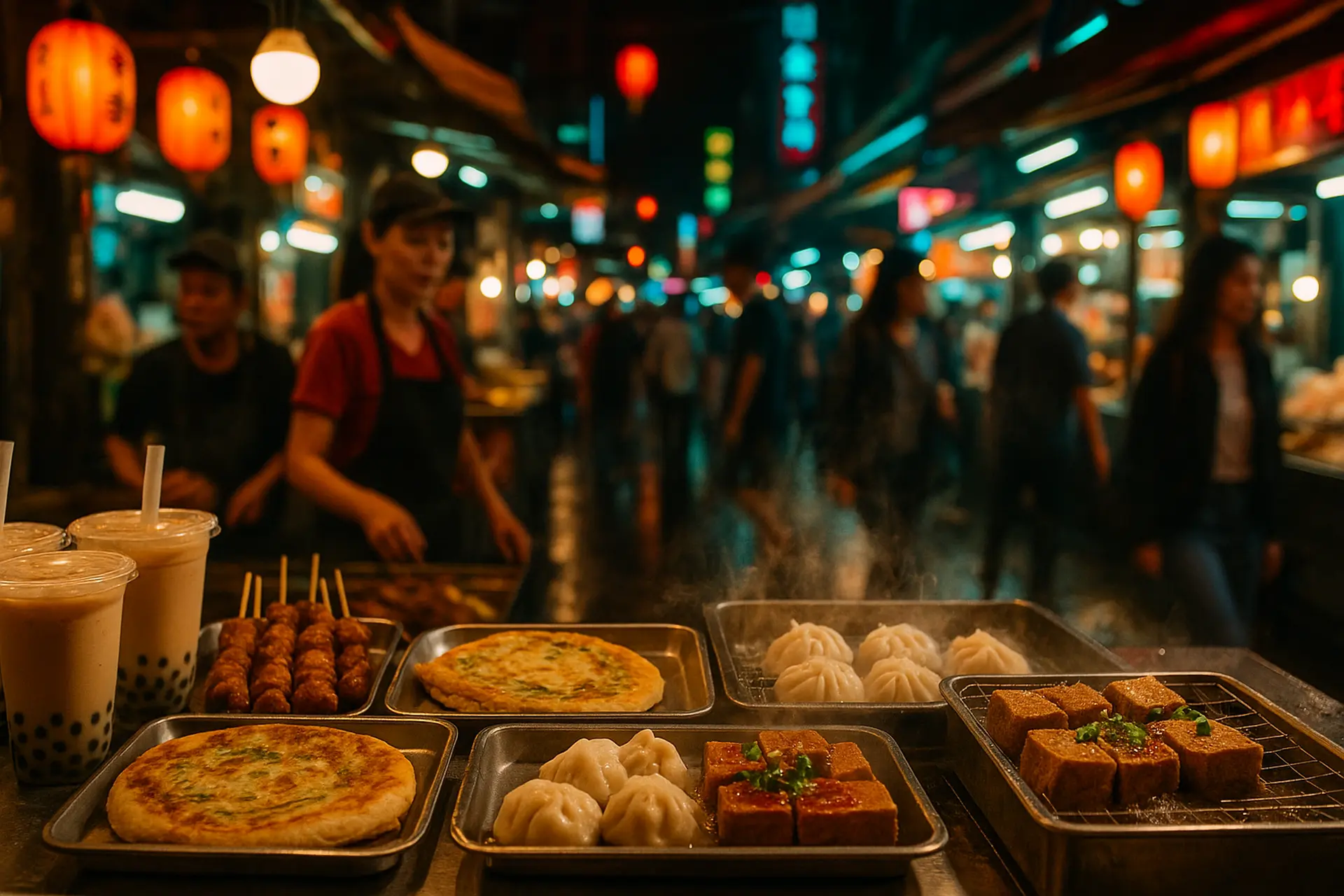
Frequently recommended foods include pepper buns, oyster omelettes, braised-pork rice, fried chicken, grilled squid, dumplings, sweet-potato balls, herbal soups, shaved ice and the fermented tofu commonly translated as stinky tofu. The point is not to complete a viral checklist is a working evening district before it is a tourist food checklist. Its lanes, shops, homes, transit stops and nearby temples explain how the market moves and whom it serves. Begin with that neighbourhood structure, then let individual dishes emerge from the walk; this produces a truer picture than arriving solely to reproduce a ranked list of snacks.
Those names conceal wide variation. Batter texture, sauce sweetness, frying oil, spice blend, offal cuts and fermentation intensity differ by vendor and city. A dish should be judged as a particular preparation rather than as a universal specimen. Eating at The point is not to complete a viral checklist is an exercise in comparison and attention. Recipes, textures and sauces vary by vendor, so a famous dish is a starting point rather than a guaranteed standard. Watch how queues operate, order manageable portions and ask concise ingredient questions when needed. Shared equipment can matter for allergies even when a dish appears simple.
Ask about ingredients when allergies, religious rules or vegetarian needs matter, but recognise that busy stalls may use shared grills, fryers, utensils and sauces. “No meat” may not exclude lard, broth, dried seafood or oyster-based seasoning. Use current local information for The point is not to complete a viral checklist, including operating pattern, transport and the most useful entrance. Rain, sold-out items and shifting stall locations can change the evening, while older guides may preserve schedules that no longer apply. Carry practical payment options, set a meeting point in dense crowds and build the route around one neighbourhood instead of crossing a city repeatedly.
Food safety is strongest when hot food is cooked thoroughly to order, cold items are held correctly, ingredients turn over quickly and the work area appears organised. Travellers with health vulnerabilities should be more conservative. The most satisfying tasting strategy mixes recognised classics with one or two items chosen because they are locally prominent, seasonal or prepared with visible care. The point is not to complete a viral checklist remains part of local daily life, and visitor behaviour should reflect that. Keep doorways and scooter routes clear, return reusable dishes correctly, ask before close portraits and lower voices near homes or worship spaces. Ordering without waste and spending patiently with vendors contribute more than chasing a viral stall at any cost. The market’s atmosphere depends on shared street etiquette.
| Stage | What to seek | Why it works |
|---|---|---|
| Start | A savoury bun, dumpling or small rice dish | Provides substance before richer fried food. |
| Middle | One grilled or fried speciality shared by the group | Allows comparison without ending the evening too early. |
| Reset | Tea, fruit or a light soup | Creates a pause and balances strong flavours. |
| Finish | A regional sweet, shaved dessert or bakery item | Ends with something distinct from the first courses. |
Taipei · Shilin District
Shilin Night Market
A market district best understood through its neighbourhood, signature foods and the way local and visitor routines overlap.
Best for: experiencing Shilin Night Market as a living urban district rather than a single famous queue.
Market guide
How to experience Shilin Night Market
Shilin is Taiwan’s most internationally recognised night-market name and a broad commercial district rather than one narrow food lane. Stalls, shopfronts, indoor food areas and surrounding streets create a large, sometimes confusing circuit near major public transport. Shilin Night Market is a working evening district before it is a tourist food checklist. Its lanes, shops, homes, transit stops and nearby temples explain how the market moves and whom it serves. Begin with that neighbourhood structure, then let individual dishes emerge from the walk; this produces a truer picture than arriving solely to reproduce a ranked list of snacks.
Visitors encounter famous fried snacks, grilled food, drinks, games and retail, but the market’s scale rewards wandering beyond the first crowded entrances. Eating at Shilin Night Market is an exercise in comparison and attention. Recipes, textures and sauces vary by vendor, so a famous dish is a starting point rather than a guaranteed standard. Watch how queues operate, order manageable portions and ask concise ingredient questions when needed. Shared equipment can matter for allergies even when a dish appears simple.
Use the latest Taipei travel guidance for current layout and transport. Visit with time, keep valuables secure in dense crowds and avoid assuming every “Shilin” stall is part of one managed hall. Use current local information for Shilin Night Market, including operating pattern, transport and the most useful entrance. Rain, sold-out items and shifting stall locations can change the evening, while older guides may preserve schedules that no longer apply. Carry practical payment options, set a meeting point in dense crowds and build the route around one neighbourhood instead of crossing a city repeatedly.
Shilin is useful for understanding how a neighbourhood market becomes a national tourism symbol while continuing to change physically and commercially. It suits first-time visitors who want breadth, but those seeking intimacy may prefer smaller markets. Shilin Night Market remains part of local daily life, and visitor behaviour should reflect that. Keep doorways and scooter routes clear, return reusable dishes correctly, ask before close portraits and lower voices near homes or worship spaces. Ordering without waste and spending patiently with vendors contribute more than chasing a viral stall at any cost. The market’s atmosphere depends on shared street etiquette.
Taipei · Songshan District
Raohe Street Night Market
A market district best understood through its neighbourhood, signature foods and the way local and visitor routines overlap.
Best for: experiencing Raohe Street Night Market as a living urban district rather than a single famous queue.
Market guide
How to experience Raohe Street Night Market
Raohe is a linear market associated with Ciyou Temple and is one of Taipei’s most legible first-night experiences. A single long street channels visitors between illuminated gates, temple architecture, food stalls and surrounding shops. Raohe Street Night Market is a working evening district before it is a tourist food checklist. Its lanes, shops, homes, transit stops and nearby temples explain how the market moves and whom it serves. Begin with that neighbourhood structure, then let individual dishes emerge from the walk; this produces a truer picture than arriving solely to reproduce a ranked list of snacks.
Pepper buns are strongly associated with the market, but soups, grilled items, medicinal-herb dishes, sweets and everyday snacks provide a fuller picture. Eating at Raohe Street Night Market is an exercise in comparison and attention. Recipes, textures and sauces vary by vendor, so a famous dish is a starting point rather than a guaranteed standard. Watch how queues operate, order manageable portions and ask concise ingredient questions when needed. Shared equipment can matter for allergies even when a dish appears simple.
Songshan transport links make access straightforward, yet queues can obstruct movement. Explore the temple respectfully and keep food away from spaces where eating is inappropriate. Use current local information for Raohe Street Night Market, including operating pattern, transport and the most useful entrance. Rain, sold-out items and shifting stall locations can change the evening, while older guides may preserve schedules that no longer apply. Carry practical payment options, set a meeting point in dense crowds and build the route around one neighbourhood instead of crossing a city repeatedly.
The relationship between market and temple gives Raohe cultural depth beyond its efficient tourist circuit. Its linear layout makes it easy to navigate but also concentrates congestion. Raohe Street Night Market remains part of local daily life, and visitor behaviour should reflect that. Keep doorways and scooter routes clear, return reusable dishes correctly, ask before close portraits and lower voices near homes or worship spaces. Ordering without waste and spending patiently with vendors contribute more than chasing a viral stall at any cost. The market’s atmosphere depends on shared street etiquette.
Taipei · Datong District
Ningxia Night Market
A market district best understood through its neighbourhood, signature foods and the way local and visitor routines overlap.
Best for: experiencing Ningxia Night Market as a living urban district rather than a single famous queue.
Market guide
How to experience Ningxia Night Market
Ningxia is a compact food-focused market with strong links to established Taipei snack traditions. The street is shorter and more concentrated than Shilin, placing cooks, queues and dining areas in close proximity. Ningxia Night Market is a working evening district before it is a tourist food checklist. Its lanes, shops, homes, transit stops and nearby temples explain how the market moves and whom it serves. Begin with that neighbourhood structure, then let individual dishes emerge from the walk; this produces a truer picture than arriving solely to reproduce a ranked list of snacks.
Oyster preparations, rice dishes, fried taro, soups and long-running family businesses often receive attention, but selection changes and individual stalls may rest or sell out. Eating at Ningxia Night Market is an exercise in comparison and attention. Recipes, textures and sauces vary by vendor, so a famous dish is a starting point rather than a guaranteed standard. Watch how queues operate, order manageable portions and ask concise ingredient questions when needed. Shared equipment can matter for allergies even when a dish appears simple.
Arrive prepared to queue without blocking traffic, carry small cash denominations and share portions because the market’s density encourages rapid tasting. Use current local information for Ningxia Night Market, including operating pattern, transport and the most useful entrance. Rain, sold-out items and shifting stall locations can change the evening, while older guides may preserve schedules that no longer apply. Carry practical payment options, set a meeting point in dense crowds and build the route around one neighbourhood instead of crossing a city repeatedly.
Ningxia demonstrates how a relatively small physical footprint can hold a large culinary reputation. The market is especially rewarding for travellers who value food over shopping or games. Ningxia Night Market remains part of local daily life, and visitor behaviour should reflect that. Keep doorways and scooter routes clear, return reusable dishes correctly, ask before close portraits and lower voices near homes or worship spaces. Ordering without waste and spending patiently with vendors contribute more than chasing a viral stall at any cost. The market’s atmosphere depends on shared street etiquette.
Taipei · Da’an District
Linjiang Street Night Market
A market district best understood through its neighbourhood, signature foods and the way local and visitor routines overlap.
Best for: experiencing Linjiang Street Night Market as a living urban district rather than a single famous queue.
Market guide
How to experience Linjiang Street Night Market
Linjiang Street, also widely known as Tonghua Night Market, serves a residential and commercial area near central Taipei. A neighbourhood-scale street market mixes prepared food, produce, clothing and daily shopping within walking distance of major urban landmarks. Linjiang Street Night Market is a working evening district before it is a tourist food checklist. Its lanes, shops, homes, transit stops and nearby temples explain how the market moves and whom it serves. Begin with that neighbourhood structure, then let individual dishes emerge from the walk; this produces a truer picture than arriving solely to reproduce a ranked list of snacks.
The appeal is variety without the monumental scale of Shilin: dumplings, sausages, fried food, fruit and desserts sit beside practical retail. Eating at Linjiang Street Night Market is an exercise in comparison and attention. Recipes, textures and sauces vary by vendor, so a famous dish is a starting point rather than a guaranteed standard. Watch how queues operate, order manageable portions and ask concise ingredient questions when needed. Shared equipment can matter for allergies even when a dish appears simple.
Confirm the preferred station and walking route using current Taipei information. Keep noise down near residential streets and do not treat every doorway as public seating. Use current local information for Linjiang Street Night Market, including operating pattern, transport and the most useful entrance. Rain, sold-out items and shifting stall locations can change the evening, while older guides may preserve schedules that no longer apply. Carry practical payment options, set a meeting point in dense crowds and build the route around one neighbourhood instead of crossing a city repeatedly.
Linjiang shows that a market can be convenient for visitors while remaining embedded in ordinary neighbourhood life. Using both common names in maps and searches helps avoid confusion. Linjiang Street Night Market remains part of local daily life, and visitor behaviour should reflect that. Keep doorways and scooter routes clear, return reusable dishes correctly, ask before close portraits and lower voices near homes or worship spaces. Ordering without waste and spending patiently with vendors contribute more than chasing a viral stall at any cost. The market’s atmosphere depends on shared street etiquette.
Taipei · Wanhua District
Huaxi Street Tourist Night Market
A market district best understood through its neighbourhood, signature foods and the way local and visitor routines overlap.
Best for: experiencing Huaxi Street Tourist Night Market as a living urban district rather than a single famous queue.
Market guide
How to experience Huaxi Street Tourist Night Market
Huaxi Street occupies part of historic Wanhua and is known for its covered arcade, traditional restaurants and a reputation shaped by older forms of tourism. The market sits near Longshan Temple and neighbouring commercial lanes, so its meaning is tied to one of Taipei’s oldest urban districts. Huaxi Street Tourist Night Market is a working evening district before it is a tourist food checklist. Its lanes, shops, homes, transit stops and nearby temples explain how the market moves and whom it serves. Begin with that neighbourhood structure, then let individual dishes emerge from the walk; this produces a truer picture than arriving solely to reproduce a ranked list of snacks.
Travellers may find herbal cuisine, seafood, noodles, massage businesses and established shops rather than a pure row of youthful snack stalls. Eating at Huaxi Street Tourist Night Market is an exercise in comparison and attention. Recipes, textures and sauces vary by vendor, so a famous dish is a starting point rather than a guaranteed standard. Watch how queues operate, order manageable portions and ask concise ingredient questions when needed. Shared equipment can matter for allergies even when a dish appears simple.
Visit with cultural sensitivity, especially around temples and local social services. Claims about sensational foods should be checked against present reality rather than repeated from outdated accounts. Use current local information for Huaxi Street Tourist Night Market, including operating pattern, transport and the most useful entrance. Rain, sold-out items and shifting stall locations can change the evening, while older guides may preserve schedules that no longer apply. Carry practical payment options, set a meeting point in dense crowds and build the route around one neighbourhood instead of crossing a city repeatedly.
Huaxi is most valuable when read as part of Wanhua’s layered history, not as an exotic spectacle. Combine it with daylight or early-evening exploration of the wider district. Huaxi Street Tourist Night Market remains part of local daily life, and visitor behaviour should reflect that. Keep doorways and scooter routes clear, return reusable dishes correctly, ask before close portraits and lower voices near homes or worship spaces. Ordering without waste and spending patiently with vendors contribute more than chasing a viral stall at any cost. The market’s atmosphere depends on shared street etiquette.
Taipei · Zhongzheng District
Nanjichang Night Market
A market district best understood through its neighbourhood, signature foods and the way local and visitor routines overlap.
Best for: experiencing Nanjichang Night Market as a living urban district rather than a single famous queue.
Market guide
How to experience Nanjichang Night Market
Nanjichang is a neighbourhood food market better known among local diners than on first-time tourist itineraries. Residential blocks and a concentrated cluster of vendors create an everyday atmosphere with less emphasis on souvenir retail. Nanjichang Night Market is a working evening district before it is a tourist food checklist. Its lanes, shops, homes, transit stops and nearby temples explain how the market moves and whom it serves. Begin with that neighbourhood structure, then let individual dishes emerge from the walk; this produces a truer picture than arriving solely to reproduce a ranked list of snacks.
Rice dishes, dumplings, sesame pastries, soups and breakfast-to-evening businesses may be more important than novelty snacks, depending on the hour. Eating at Nanjichang Night Market is an exercise in comparison and attention. Recipes, textures and sauces vary by vendor, so a famous dish is a starting point rather than a guaranteed standard. Watch how queues operate, order manageable portions and ask concise ingredient questions when needed. Shared equipment can matter for allergies even when a dish appears simple.
Because it is not built around one ceremonial tourist entrance, navigation may require a precise map and current vendor information. Respect residents and dispose of waste correctly. Use current local information for Nanjichang Night Market, including operating pattern, transport and the most useful entrance. Rain, sold-out items and shifting stall locations can change the evening, while older guides may preserve schedules that no longer apply. Carry practical payment options, set a meeting point in dense crowds and build the route around one neighbourhood instead of crossing a city repeatedly.
Nanjichang rewards travellers who want to observe how market eating fits into local routines. Its quieter reputation should not be used to publicise private residential space carelessly. Nanjichang Night Market remains part of local daily life, and visitor behaviour should reflect that. Keep doorways and scooter routes clear, return reusable dishes correctly, ask before close portraits and lower voices near homes or worship spaces. Ordering without waste and spending patiently with vendors contribute more than chasing a viral stall at any cost. The market’s atmosphere depends on shared street etiquette.
Taichung · Xitun District
Fengjia Night Market
A market district best understood through its neighbourhood, signature foods and the way local and visitor routines overlap.
Best for: experiencing Fengjia Night Market as a living urban district rather than a single famous queue.
Market guide
How to experience Fengjia Night Market
Fengjia is a vast commercial night-market district that developed around Feng Chia University. Dense streets combine student-oriented food, fashion, electronics, games and constant product innovation. Fengjia Night Market is a working evening district before it is a tourist food checklist. Its lanes, shops, homes, transit stops and nearby temples explain how the market moves and whom it serves. Begin with that neighbourhood structure, then let individual dishes emerge from the walk; this produces a truer picture than arriving solely to reproduce a ranked list of snacks.
The market is a laboratory for new snack formats as much as a place for traditional food, with strong competition encouraging theatrical presentation and portable portions. Eating at Fengjia Night Market is an exercise in comparison and attention. Recipes, textures and sauces vary by vendor, so a famous dish is a starting point rather than a guaranteed standard. Watch how queues operate, order manageable portions and ask concise ingredient questions when needed. Shared equipment can matter for allergies even when a dish appears simple.
Traffic and pedestrian congestion make public transport preferable. Confirm current bus or transit options and choose a meeting point because groups can separate easily. Use current local information for Fengjia Night Market, including operating pattern, transport and the most useful entrance. Rain, sold-out items and shifting stall locations can change the evening, while older guides may preserve schedules that no longer apply. Carry practical payment options, set a meeting point in dense crowds and build the route around one neighbourhood instead of crossing a city repeatedly.
Fengjia reveals the entrepreneurial side of Taiwan’s night-market culture and the influence of a large student population. Travellers should balance viral inventions with established Taichung flavours elsewhere in the city. Fengjia Night Market remains part of local daily life, and visitor behaviour should reflect that. Keep doorways and scooter routes clear, return reusable dishes correctly, ask before close portraits and lower voices near homes or worship spaces. Ordering without waste and spending patiently with vendors contribute more than chasing a viral stall at any cost. The market’s atmosphere depends on shared street etiquette.
Tainan · North District
Tainan Flower Night Market
A market district best understood through its neighbourhood, signature foods and the way local and visitor routines overlap.
Best for: experiencing Tainan Flower Night Market as a living urban district rather than a single famous queue.
Market guide
How to experience Tainan Flower Night Market
Tainan Flower Night Market is a large event-style market whose operation is tied to particular evenings rather than every night. Open-air rows of food, games and retail create a temporary festival atmosphere on an expansive site. Tainan Flower Night Market is a working evening district before it is a tourist food checklist. Its lanes, shops, homes, transit stops and nearby temples explain how the market moves and whom it serves. Begin with that neighbourhood structure, then let individual dishes emerge from the walk; this produces a truer picture than arriving solely to reproduce a ranked list of snacks.
Visitors can sample Tainan-influenced flavours alongside nationwide night-market favourites, but the market should complement rather than replace the city’s daytime food institutions. Eating at Tainan Flower Night Market is an exercise in comparison and attention. Recipes, textures and sauces vary by vendor, so a famous dish is a starting point rather than a guaranteed standard. Watch how queues operate, order manageable portions and ask concise ingredient questions when needed. Shared equipment can matter for allergies even when a dish appears simple.
Operating nights, weather arrangements and transport must be checked live; never publish a fixed weekly schedule without re-verification. Prepare for heat, rain and limited seating. Use current local information for Tainan Flower Night Market, including operating pattern, transport and the most useful entrance. Rain, sold-out items and shifting stall locations can change the evening, while older guides may preserve schedules that no longer apply. Carry practical payment options, set a meeting point in dense crowds and build the route around one neighbourhood instead of crossing a city repeatedly.
The market demonstrates a southern model in which a large temporary gathering differs from Taipei’s permanent street corridors. Tainan’s culinary identity is broader than any one market. Tainan Flower Night Market remains part of local daily life, and visitor behaviour should reflect that. Keep doorways and scooter routes clear, return reusable dishes correctly, ask before close portraits and lower voices near homes or worship spaces. Ordering without waste and spending patiently with vendors contribute more than chasing a viral stall at any cost. The market’s atmosphere depends on shared street etiquette.
Keelung · Ren’ai District
Keelung Miaokou Night Market
A market district best understood through its neighbourhood, signature foods and the way local and visitor routines overlap.
Best for: experiencing Keelung Miaokou Night Market as a living urban district rather than a single famous queue.
Market guide
How to experience Keelung Miaokou Night Market
Keelung Miaokou is a temple-centred food district with a strong maritime identity near the city’s harbour. Illuminated stall signs, covered streets and the temple precinct create one of Taiwan’s most recognisable market environments. Keelung Miaokou Night Market is a working evening district before it is a tourist food checklist. Its lanes, shops, homes, transit stops and nearby temples explain how the market moves and whom it serves. Begin with that neighbourhood structure, then let individual dishes emerge from the walk; this produces a truer picture than arriving solely to reproduce a ranked list of snacks.
Seafood, thick soups, rice dishes, tempura-style snacks and shaved ice reflect both port-city ingredients and long-established local businesses. Eating at Keelung Miaokou Night Market is an exercise in comparison and attention. Recipes, textures and sauces vary by vendor, so a famous dish is a starting point rather than a guaranteed standard. Watch how queues operate, order manageable portions and ask concise ingredient questions when needed. Shared equipment can matter for allergies even when a dish appears simple.
Keelung’s frequent rain makes covered areas useful but also increases slippery surfaces and umbrella congestion. Check train and late return options before travelling from Taipei. Use current local information for Keelung Miaokou Night Market, including operating pattern, transport and the most useful entrance. Rain, sold-out items and shifting stall locations can change the evening, while older guides may preserve schedules that no longer apply. Carry practical payment options, set a meeting point in dense crowds and build the route around one neighbourhood instead of crossing a city repeatedly.
Miaokou succeeds because food, temple and harbour-city history remain visibly connected. Seafood allergies and shared cooking surfaces require direct questions and caution. Keelung Miaokou Night Market remains part of local daily life, and visitor behaviour should reflect that. Keep doorways and scooter routes clear, return reusable dishes correctly, ask before close portraits and lower voices near homes or worship spaces. Ordering without waste and spending patiently with vendors contribute more than chasing a viral stall at any cost. The market’s atmosphere depends on shared street etiquette.
Kaohsiung · Sinsing District
Liuhe Tourist Night Market
A market district best understood through its neighbourhood, signature foods and the way local and visitor routines overlap.
Best for: experiencing Liuhe Tourist Night Market as a living urban district rather than a single famous queue.
Market guide
How to experience Liuhe Tourist Night Market
Liuhe is Kaohsiung’s best-known tourist night market, located on a broad central street that becomes pedestrian-oriented during market operation. Seafood displays, drinks, fruit, grills and open roadway space create a different physical rhythm from narrow Taipei lanes. Liuhe Tourist Night Market is a working evening district before it is a tourist food checklist. Its lanes, shops, homes, transit stops and nearby temples explain how the market moves and whom it serves. Begin with that neighbourhood structure, then let individual dishes emerge from the walk; this produces a truer picture than arriving solely to reproduce a ranked list of snacks.
Papaya milk is a familiar association, while shellfish, squid, fish and southern fruit make the regional setting apparent. Eating at Liuhe Tourist Night Market is an exercise in comparison and attention. Recipes, textures and sauces vary by vendor, so a famous dish is a starting point rather than a guaranteed standard. Watch how queues operate, order manageable portions and ask concise ingredient questions when needed. Shared equipment can matter for allergies even when a dish appears simple.
Confirm current access and market operation through Kaohsiung tourism information. Compare seafood prices before ordering and clarify preparation and portion size. Use current local information for Liuhe Tourist Night Market, including operating pattern, transport and the most useful entrance. Rain, sold-out items and shifting stall locations can change the evening, while older guides may preserve schedules that no longer apply. Carry practical payment options, set a meeting point in dense crowds and build the route around one neighbourhood instead of crossing a city repeatedly.
Liuhe offers an accessible introduction to southern market culture, though visitors should also explore Kaohsiung’s wider food neighbourhoods. A tourist label does not make every stall identical in quality or value. Liuhe Tourist Night Market remains part of local daily life, and visitor behaviour should reflect that. Keep doorways and scooter routes clear, return reusable dishes correctly, ask before close portraits and lower voices near homes or worship spaces. Ordering without waste and spending patiently with vendors contribute more than chasing a viral stall at any cost. The market’s atmosphere depends on shared street etiquette.
Practical fluency
Clarity and patience matter more than perfect Mandarin
Most transactions are brief, but dietary questions, portion sizes and payment expectations can vary by stall.
A visible menu, pointing and a few polite words often carry an ordinary order. Photos help, but travellers should confirm quantity because some items are priced per piece, set, weight or portion. Clarity and patience matter more than perfect Mandarin is a working evening district before it is a tourist food checklist. Its lanes, shops, homes, transit stops and nearby temples explain how the market moves and whom it serves. Begin with that neighbourhood structure, then let individual dishes emerge from the walk; this produces a truer picture than arriving solely to reproduce a ranked list of snacks.
Cash remains useful, especially at small vendors, even as mobile and card payments expand. Carry manageable denominations and do not hold up a queue while reorganising money. Eating at Clarity and patience matter more than perfect Mandarin is an exercise in comparison and attention. Recipes, textures and sauces vary by vendor, so a famous dish is a starting point rather than a guaranteed standard. Watch how queues operate, order manageable portions and ask concise ingredient questions when needed. Shared equipment can matter for allergies even when a dish appears simple.
For allergies, prepare a clearly translated written statement naming the ingredient and the severity of the reaction. Shared fryers, grills, knives and sauces make cross-contact common. Use current local information for Clarity and patience matter more than perfect Mandarin, including operating pattern, transport and the most useful entrance. Rain, sold-out items and shifting stall locations can change the evening, while older guides may preserve schedules that no longer apply. Carry practical payment options, set a meeting point in dense crowds and build the route around one neighbourhood instead of crossing a city repeatedly.
When a stall provides a waiting number or asks customers to stand aside, follow the system. Return bowls, trays or reusable utensils to the indicated point. Politeness is communicated through attention: know what is being ordered, step away after paying and accept that a vendor may not be able to modify a fast, standardised dish. Clarity and patience matter more than perfect Mandarin remains part of local daily life, and visitor behaviour should reflect that. Keep doorways and scooter routes clear, return reusable dishes correctly, ask before close portraits and lower voices near homes or worship spaces. Ordering without waste and spending patiently with vendors contribute more than chasing a viral stall at any cost. The market’s atmosphere depends on shared street etiquette.
Small stalls may not support the visitor’s preferred digital-payment method.
Vegetarian requests and allergen avoidance require precise questions.
Keep the service space open and watch for the vendor’s collection system.
Do not leave cups, skewers or bowls on shopfronts or temple property.
Stay well
Street food is most enjoyable when appetite is matched with judgement
Night markets are generally straightforward to navigate, but heat, dense crowds and repeated rich food can exhaust travellers faster than expected.
Choose stalls where ingredients appear protected, work surfaces are organised and hot food is cooked thoroughly. High turnover can be reassuring, but popularity alone is not a hygiene guarantee. Street food is most enjoyable when appetite is matched with judgement is a working evening district before it is a tourist food checklist. Its lanes, shops, homes, transit stops and nearby temples explain how the market moves and whom it serves. Begin with that neighbourhood structure, then let individual dishes emerge from the walk; this produces a truer picture than arriving solely to reproduce a ranked list of snacks.
People who are pregnant, immunocompromised or managing serious allergies should seek professional medical advice and make conservative choices about raw seafood, undercooked eggs, unpasteurised ingredients or uncertain holding temperatures. Eating at Street food is most enjoyable when appetite is matched with judgement is an exercise in comparison and attention. Recipes, textures and sauces vary by vendor, so a famous dish is a starting point rather than a guaranteed standard. Watch how queues operate, order manageable portions and ask concise ingredient questions when needed. Shared equipment can matter for allergies even when a dish appears simple.
Taiwan’s humidity can make dehydration easy to miss. Drink safe water, pause between dishes and use public transport rather than building an evening around excessive walking in peak heat. Use current local information for Street food is most enjoyable when appetite is matched with judgement, including operating pattern, transport and the most useful entrance. Rain, sold-out items and shifting stall locations can change the evening, while older guides may preserve schedules that no longer apply. Carry practical payment options, set a meeting point in dense crowds and build the route around one neighbourhood instead of crossing a city repeatedly.
Rain changes market circulation. Carry compact protection, watch slippery paving and avoid opening a large umbrella in the densest lane when a covered edge is available. A restrained tasting pace improves both safety and attention. The aim is to remember flavours, not to finish a social-media challenge. Street food is most enjoyable when appetite is matched with judgement remains part of local daily life, and visitor behaviour should reflect that. Keep doorways and scooter routes clear, return reusable dishes correctly, ask before close portraits and lower voices near homes or worship spaces. Ordering without waste and spending patiently with vendors contribute more than chasing a viral stall at any cost. The market’s atmosphere depends on shared street etiquette.
Responsible urban travel
Residents are not background characters in a food tour
The most rewarding market behaviour is almost invisible: moving with the flow, keeping noise proportionate and recognising when a doorway, stool or temple threshold is not public space.
Markets depend on dense neighbourhood infrastructure. Deliveries, scooters, waste collection, residents, worshippers and customers all use the same streets, so visitors should not assume pedestrian priority everywhere. Residents are not background characters in a food tour is a working evening district before it is a tourist food checklist. Its lanes, shops, homes, transit stops and nearby temples explain how the market moves and whom it serves. Begin with that neighbourhood structure, then let individual dishes emerge from the walk; this produces a truer picture than arriving solely to reproduce a ranked list of snacks.
Photography should avoid obstructing service or capturing identifiable people at close range without permission. Ask before making a vendor the central subject of a portrait or video. Eating at Residents are not background characters in a food tour is an exercise in comparison and attention. Recipes, textures and sauces vary by vendor, so a famous dish is a starting point rather than a guaranteed standard. Watch how queues operate, order manageable portions and ask concise ingredient questions when needed. Shared equipment can matter for allergies even when a dish appears simple.
Food waste matters. Order smaller portions, share, and learn where containers belong. Some stalls use reusable dishes with specific return points; others rely on municipal collection systems. Use current local information for Residents are not background characters in a food tour, including operating pattern, transport and the most useful entrance. Rain, sold-out items and shifting stall locations can change the evening, while older guides may preserve schedules that no longer apply. Carry practical payment options, set a meeting point in dense crowds and build the route around one neighbourhood instead of crossing a city repeatedly.
Temple precincts require an additional shift in behaviour. Food, poses and loud commentary that seem ordinary in the market lane may be inappropriate at an altar or ritual space. Spending across several stalls and established shops can distribute benefit more broadly than following one viral queue. Residents are not background characters in a food tour remains part of local daily life, and visitor behaviour should reflect that. Keep doorways and scooter routes clear, return reusable dishes correctly, ask before close portraits and lower voices near homes or worship spaces. Ordering without waste and spending patiently with vendors contribute more than chasing a viral stall at any cost. The market’s atmosphere depends on shared street etiquette.
The wider view
Taiwan’s night markets are memorable because flavour, neighbourhood and movement arrive together.
A pepper bun or bowl of braised rice can be excellent on its own, but the night-market experience is larger than the dish. It includes the temple roof above a gate, the vendor’s practiced sequence, scooters at the edge of the lane, students comparing new snacks, families carrying dinner home and rain beginning against a row of lit signs.
The ten markets in this guide are not interchangeable. Raohe’s linear temple-centred form differs from Shilin’s sprawling commercial district; Ningxia is unusually food-focused; Fengjia reflects a university economy; Tainan Flower operates as a large event market; Miaokou speaks through port-city food; Liuhe offers a broad southern tourist corridor. Choosing two carefully reveals more than racing through six.
The best visitor arrives with appetite and restraint: shares portions, asks clear questions, respects residents, checks current operations and leaves room for an unplanned recommendation. In that balance, the night market becomes what it has always been—not a themed attraction, but a changing piece of Taiwanese urban life.