

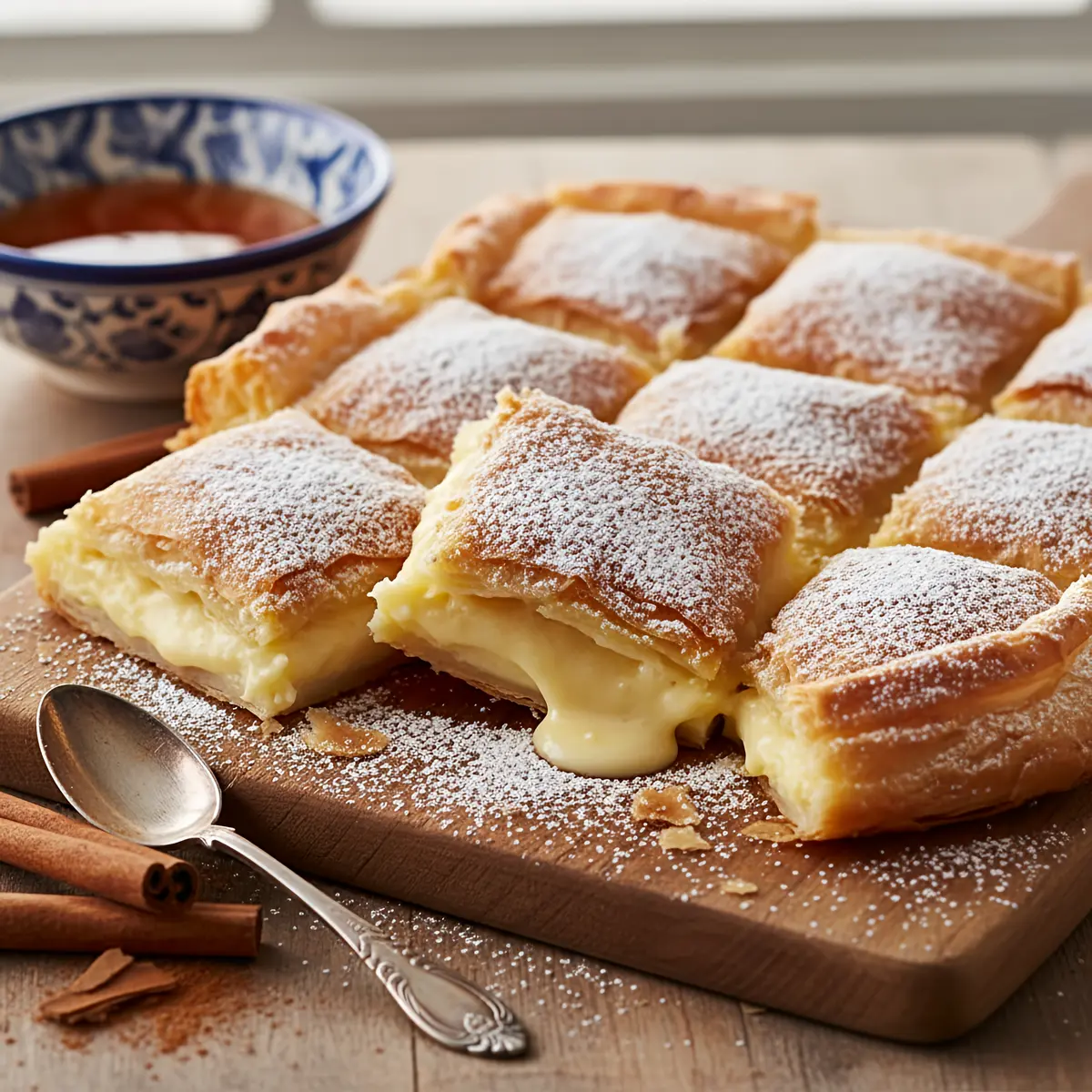

Bougatsa (Greek Custard Pastry with Phyllo)
Course: Breakfast, DessertCuisine: GreekDifficulty: Medium6
servings15
minutes35
minutes350
kcalBougátsa is a Greek pastry made by wrapping a rich semolina custard in layers of buttery phyllo dough and baking until crisp and golden. In this recipe, a vanilla-scented custard is cooked on the stove, then poured between brushed sheets of phyllo in a baking pan. The bougátsa bakes until the top is flaky and golden brown. When cut and served hot, each piece is dusted with powdered sugar (and often cinnamon) to finish. The result is a warm, creamy pie with a delicate crunch – a classic Greek breakfast or dessert.
Ingredients
Whole milk: 4 cups (960 ml) – for the custard base.
Fine semolina: 1 cup (170g) – thickens the custard.
Granulated sugar: ½ cup (100g) – sweetens the custard.
Eggs: 3 large, lightly beaten – enrich the filling.
Unsalted butter: 2 Tbsp – stirred into the hot custard and brushed on phyllo.
Vanilla extract: 1 tsp – or seeds of 1 vanilla bean – for flavor.
Salt: Pinch – balances sweetness.
Phyllo dough: 8–10 sheets – thawed; used for layering (cover when not in use).
Melted butter or oil: For brushing phyllo layers.
Powdered sugar: For dusting the finished pie.
Ground cinnamon: Optional topping.
Directions
Prepare the custard: In a heavy saucepan, combine milk, sugar, salt and semolina. Cook over medium heat, stirring constantly, until the mixture begins to thicken (3–4 minutes).
Add the eggs: In a small bowl, whisk a ladle of the hot mixture into the beaten eggs (tempering). Then pour the egg mixture back into the saucepan while stirring vigorously. Continue cooking and stirring until the custard is very thick (another 2–3 minutes). Remove from heat and stir in vanilla and butter until smooth.
Preheat oven: Set oven to 350°F (175°C). Butter or oil a 9×13-inch baking dish.
Layer the phyllo: Lay 4–5 sheets of phyllo in the dish, brushing each with melted butter or oil before adding the next sheet. (Keep remaining phyllo covered to prevent drying.)
Add custard: Pour the hot custard evenly over the layered phyllo base.
Finish layering: Cover with the remaining phyllo sheets (4–5 more), again brushing between each layer. Tuck in any overhanging dough.
Bake: Place in oven and bake 30–35 minutes, until the top is golden brown and crisp.
Serve: Immediately cut into squares or diamonds. Dust with powdered sugar and cinnamon. Serve slices warm (custard may still be slightly runny when hot).
Tips & Variations
- Serving: Serve bougátsa as a hearty breakfast or dessert. It’s delicious with a dusting of cinnamon sugar or a spoonful of fruit jam on the side.
- Storage: Cool to room temperature, then cover and refrigerate leftovers. Reheat individual pieces in the oven to refresh the crust; the custard stays creamy.
- Variations: Try a savory version by adding feta, kasseri or savory herbs to the filling (skip the sugar). Incorporate lemon or orange zest into the custard for a citrus note. Add spinach leaves under the custard and feta on top for a spanakopita-bougátsa fusion.
- Substitutions: Use frozen puff pastry in place of phyllo for a quicker version (though flavor/texture differ). Swap butter with olive oil or margarine.
- Chef’s Tips: Work quickly when handling phyllo. Keep unused sheets covered with a damp towel. Generously brush each layer with butter or oil for maximum flakiness. Ensure the custard is very thick before layering.
- Equipment Needed: - Saucepan and whisk (for custard) - Mixing bowl and measuring tools - 9×13-inch baking dish - Pastry brush - Oven - Knife and serving spatula









