Asia’s story unfolds in stone and legend. From the Mughal marvels of India to the Buddhist relics of Southeast Asia, the continent holds a vast, centuries-spanning tapestry of human achievement. Each monument here is more than stone—it embodies cultural memory, technological mastery, and spiritual vision. This guide surveys Asia’s top 15 historical sites, blending factual depth with human insight. It highlights why these places matter, how they came to be, and practical tips for visiting. Along the way, it discusses UNESCO heritage versus lesser-known sites, covers planning essentials, and even touches on conservation challenges for the future.
- 1. Taj Mahal, India – The Crown Jewel of Mughal Architecture
- 2. Angkor Wat, Cambodia – The World’s Largest Religious Monument
- 3. Great Wall of China – Monument to Human Ambition
- 4. Forbidden City, Beijing – Imperial Palace Complex
- 5. Borobudur, Indonesia – The Lost Buddhist Temple
- 6. Bagan, Myanmar – City of 2,000 Temples
- 7. Petra, Jordan – The Rose-Red City
- 8. Mount Everest Base Camps – Natural and Cultural Heritage
- 9. Historic City of Ayutthaya, Thailand – Thailand’s Ancient Capital
- 10. Halong Bay, Vietnam – Where Nature Meets History
- 11. Kathmandu Valley, Nepal – Living Heritage
- 12. Mount Fuji and Sacred Sites, Japan – Spiritual and Natural Icon
- 13. Qutub Minar Complex, Delhi, India – Indo-Islamic Masterpiece
- 14. The Grand Palace, Bangkok, Thailand – The King’s Holy City
- 15. Hawa Mahal, Jaipur, India – Rajasthan’s Pink City Jewel
- Comparative Analysis: Understanding Asian Historical Sites
- Planning Your Asian Historical Sites Journey
- Conservation and Future of Asian Heritage
- Expert Tips for Visiting Asian Historical Sites
- Photography Guidelines and Best Spots
- Cultural Etiquette and Dress Codes
- Guided Tours vs. Independent Exploration
- Frequently Asked Questions
- Which Asian country has the most historical sites?
- Are there hidden historical gems in Asia?
- What makes Asian historical sites unique?
- Conclusion: Journey Through Asia’s Living History
Asia has been the cradle of multiple great civilizations. Under the emerald-green forests and soaring mountain ranges lie Neolithic ruins, Buddhist stupas, Mughal palaces, and Shinto shrines. Asia’s timeless legacy resonates in each of our chosen sites. They range from the ivory-white Taj Mahal’s romantic perfection, to Angkor Wat’s jungle-temple expanse, to the Great Wall’s stone ramparts threading deserts and peaks. Though far apart, these monuments share a common humanity: each was born of faith, power, or both. They tell stories of empires, beliefs, and artistic revolutions. By visiting them, travelers can witness how diverse cultures have sculpted Asia’s landscape with enduring beauty and meaning.
This article is structured to take you place by place through Asia’s history. We start with an introduction to the concept of Asia’s heritage and why 2025 is an apt time to explore it. Then comes the Complete List of 15 top sites, each treated in depth: an overview plus architectural and cultural significance, plus practical details. After that, we step back and compare UNESCO-listed sites with other landmarks, outline key architectural styles and periods, and provide travel-planning advice (best seasons, itineraries, fees, tours). Finally, we look at the future: new UNESCO inscriptions, risks from tourism and climate, and tips on respectful, rewarding exploration. The aim is not just to catalogue places, but to convey context and meaning: to help readers understand Asia’s living history as they journey through it.
1. Taj Mahal, India – The Crown Jewel of Mughal Architecture

Built between 1631 and 1648 by Emperor Shah Jahan, Agra’s Taj Mahal is a monument to love and artistry. This vast white-marble mausoleum crowns nearly 17 hectares of gardens by the Yamuna River. Commissioned for Shah Jahan’s favorite wife, Mumtaz Mahal, it embodies high Mughal craftsmanship. “The Taj Mahal is the jewel of Muslim art in India and one of the universally admired masterpieces of the world’s heritage”. Its symmetrical domes, minarets, and pietra dura inlay produce an ethereal effect at sunrise and moonrise.
The tomb’s architectural finesse is extraordinary. Artisans from across the empire and beyond crafted its delicate relief panels, calligraphy, and double dome. The inner chamber, with an ornate marble canopy, centers on Mumtaz’s cenotaph, symbolizing paradise. The whole complex—garden, reflective pools, mosque, and guesthouse—forms a harmonious whole. Tip for visitors: arrive at dawn or dusk. The soft light bathes the marble in gold or pink, making photos magical.
Why is the Taj Mahal considered a wonder? Its universal appeal rests on the harmony of its proportions and details. Every element – from the outer garden layout to the multi-faceted dome – is balanced. UNESCO praises it as a “jewel of Muslim art” and a masterpiece of Indo-Islamic style. It ranks among modern wonders for this timeless symmetry and the poignant love story behind it. The delicate floral motifs and Arabic inscriptions on white marble, with the Yamuna’s waters at its feet, create an almost dreamlike image.
Entry fees and booking: The Taj Mahal requires a ticket. As of 2025, international visitors pay about ₹1100 (around USD 13) for general entry. An additional ₹200 is needed to enter the main mausoleum. Indian and SAARC visitors pay much lower fees. Tickets are available online (official site or authorized portals) and on-site. Note: The site is closed Fridays and restricts bags and food. Arrive early to avoid crowds and scorching midday heat. Also, carry ID: security is strict.
2. Angkor Wat, Cambodia – The World’s Largest Religious Monument

In the jungles near Siem Reap, the Khmer Empire’s grand temple city emerges with five lotus-bud towers. Angkor Wat, built in the early 12th century by King Suryavarman II, is not only Cambodia’s star attraction but literally the largest religious building ever erected. Covering about 400 acres of moat and courtyards, Angkor Wat was originally a Hindu temple to Vishnu and later became a Buddhist shrine. Its bas-reliefs depict gods and epics, and the scale of its galleries and libraries is staggering.
Architecturally, Angkor Wat exemplifies Khmer genius. Its central towers symbolize Mount Meru (the sacred Hindu peak), surrounded by concentric galleries and reflective pools. Beneath the monument’s grandeur lies a story of imperial ambition and spiritual symbolism. Visitors can wander its three tiers of galleries, marvel at the hundreds of stone lions and apsaras (celestial dancers), and trace ancient Khmer craftsmanship in sandstone. Nearly 1,000 carved figures on the walls evoke scenes from the Ramayana and Mahabharata.
How old is Angkor Wat and who built it? According to Britannica, it was constructed in the 12th century by King Suryavarman II. Work began around 1113 AD and took about three decades. The king intended Angkor Wat as his own funerary temple; indeed, it originally held his remains. Only later did it become a major Buddhist pilgrimage site. In its era, Angkor was the thriving capital of Southeast Asia, and Angkor Wat was the crowning architectural achievement of that empire.
Best time to visit Angkor Wat: The dry season (roughly November through February) offers cooler weather and clear skies. Dawn is a popular time – sunrise over the temple is iconic, with mirror-still pools perfectly reflecting the towers. However, expect crowds and book tickets in advance if possible. In the rainy season (May–October) the temple exudes a lush charm, but heavy afternoon rains can disrupt touring. Whatever season, respectful dress is essential: cover shoulders and knees in temple complexes.
3. Great Wall of China – Monument to Human Ambition

Stretched along thousands of miles of ridges, the Great Wall stands as both an imposing fortification and a symbol of China’s vast history. Begun in sections as early as the 7th century BC, it was greatly expanded under Emperor Qin Shi Huang (3rd century BC) and most extensively during the Ming dynasty (14th–17th centuries). Altogether the wall runs over 20,000 kilometers across deserts, mountains, and plateaus.
Often called “the world’s largest military structure,” the Wall’s true significance lies beyond defense. It is “an outstanding example of a type of building… illustrating significant stages in human history” (UNESCO criterion iv). In practical terms, it once marked China’s northern frontier and guarded trade routes. Architecturally, it varies: near Beijing one can walk on relatively well-preserved brick-and-stone sections (e.g., Badaling, Mutianyu), while in western Gansu the Wall was once rammed earth. Key features include watchtowers, beacon towers, and gates like the famous Shanhai Pass.
Historical significance of the Great Wall: The Wall embodies the unification and ambition of ancient China. When Qin Shi Huang linked earlier walls, it signified a new imperial era. Over later dynasties, it protected against nomadic raids. More than a relic, it now symbolizes the lengths to which China’s rulers went to secure their realm. A UNESCO summary notes that it is “the greatest extant example of a fortification system”, showcasing both technological skill and social organization.
For travelers, focus on accessibility: the Beijing sections (Badaling, Jinshanling) offer restored paths and cable cars for visitors. For fewer tourists and scenic hiking, try Simatai or Jiankou (though these can be steep). Plan autumn visits when the Wall is framed by fall foliage, or winter for a snow-capped panorama. The Wall is largely open year-round; dress warmly in winter.
4. Forbidden City, Beijing – Imperial Palace Complex

At Beijing’s heart lies the grand Forbidden City, the seat of Chinese emperors for over five centuries (1406–1911). Officially known as the Palace Museum, this sprawling complex contains nearly 10,000 rooms in 980 buildings. It is “the greatest extant wooden building complex in the world”, embodying Ming and Qing dynasty power and style. Visitors pass through spirit-away gates, golden halls, and imperial gardens, all radiating the red and gold of ancient China.
The Forbidden City’s design stresses symmetry and hierarchy. The Hall of Supreme Harmony (Taihe) is a breathtaking throne hall atop marble ramps, used for major ceremonies. Lining its courtyards are thousands of artifacts: from gilded thrones to dragon carvings. UNESCO notes that the complex “remains a priceless testimony to Chinese civilization… during the Ming and Qing dynasties”.
Logistics: Since this site is Beijing’s top attraction, buy timed-entry tickets online in advance. Arrive early to wander freely; afternoon crowds can be heavy. The complex is about a kilometer long—allow several hours. Nearby Tiananmen Square is often combined on the same trip.
5. Borobudur, Indonesia – The Lost Buddhist Temple

Towering above central Java, Borobudur is the world’s largest Buddhist temple. Built in the 8th–9th centuries by the Sailendra dynasty, it was a monumental display of Mahayana Buddhism. The temple’s nine stacked levels—six square bases topped by three circular terraces—support a central dome ringed by 72 bell-shaped stupas, each containing a Buddha statue. Around the square tiers lie 2,672 relief panels narrating Buddhist teachings and 504 Buddha figures in all.
Borobudur’s history is dramatic. After flourishing for centuries, it fell into obscurity by about the 14th century, as powerful Javanese courts shifted to Islam. Tarzan-like undergrowth hid the monument, preserving it like a time capsule. It was “rediscovered” by British colonial officer Stamford Raffles in 1814, reigniting international interest. Massive restoration projects (notably 1975–1982 by UNESCO) returned it to its former glory, though conservation challenges persist due to humidity and tourism.
Why was Borobudur abandoned for centuries? The primary reason was the decline of its royal patronage and a changing spiritual climate. As Islam became dominant in Java, Buddhist institutions lost support and many temples ceased to be maintained. Combined with volcanic ash (from nearby Mount Merapi) and earthquakes, Borobudur was largely forgotten under jungle cover. Its stupas and corridors survived intact under vegetation until modern excavations and restorations began.
Today, Borobudur is a UNESCO-listed pilgrimage site. At Vesak (Buddha’s birthday), monks and devotees process through its corridors. Tourists come year-round; sunrise and sunset tours (when a soft glow silhouettes the stupas) are especially popular. Because the site is high above the surrounding plains, mornings can be cool. Note: The inner circles of stupas are off-limits—visitors may walk only on designated paths to protect the monument.
6. Bagan, Myanmar – City of 2,000 Temples

Spread across the arid plains of central Myanmar lie Bagan’s thousands of temples and pagodas. From the 9th through 13th centuries, this was the heart of the Pagan Kingdom, a center of Theravada Buddhism. Even after Mongol invasions, Bagan’s plains remained studded with stupas. Today, roughly 2,200 structures remain intact within the archaeological zone, ranging from low brick pagodas to towering temples like Shwezigon and Ananda.
UNESCO recognized Bagan as a World Heritage Site in 2019, acknowledging its “extraordinary Buddhist art and architecture.” Many temples contain centuries-old murals and Buddhas. Travelers often rise before dawn to view the sunrise from atop smaller pagodas or even in hot-air balloons drifting above the plains. At sunrise, mist often hangs over the red-brick monuments, creating a mystical panorama.
Major highlights include the gilded Shwezigon Pagoda and Ananda Temple, notable for their symmetry and interior carvings. The Shwesandaw Pagoda offers expansive views and is a popular climb for visitors (respect rules on covering legs and shoulders). Bagan has a relaxed vibe: e-bikes and horse carts are common ways to explore, and small museums pepper the villages. Traffic is light, making it easy to craft self-guided temple circuits. Note that Bagan’s climate is hot; the cooler months (November–February) are best for touring.
7. Petra, Jordan – The Rose-Red City

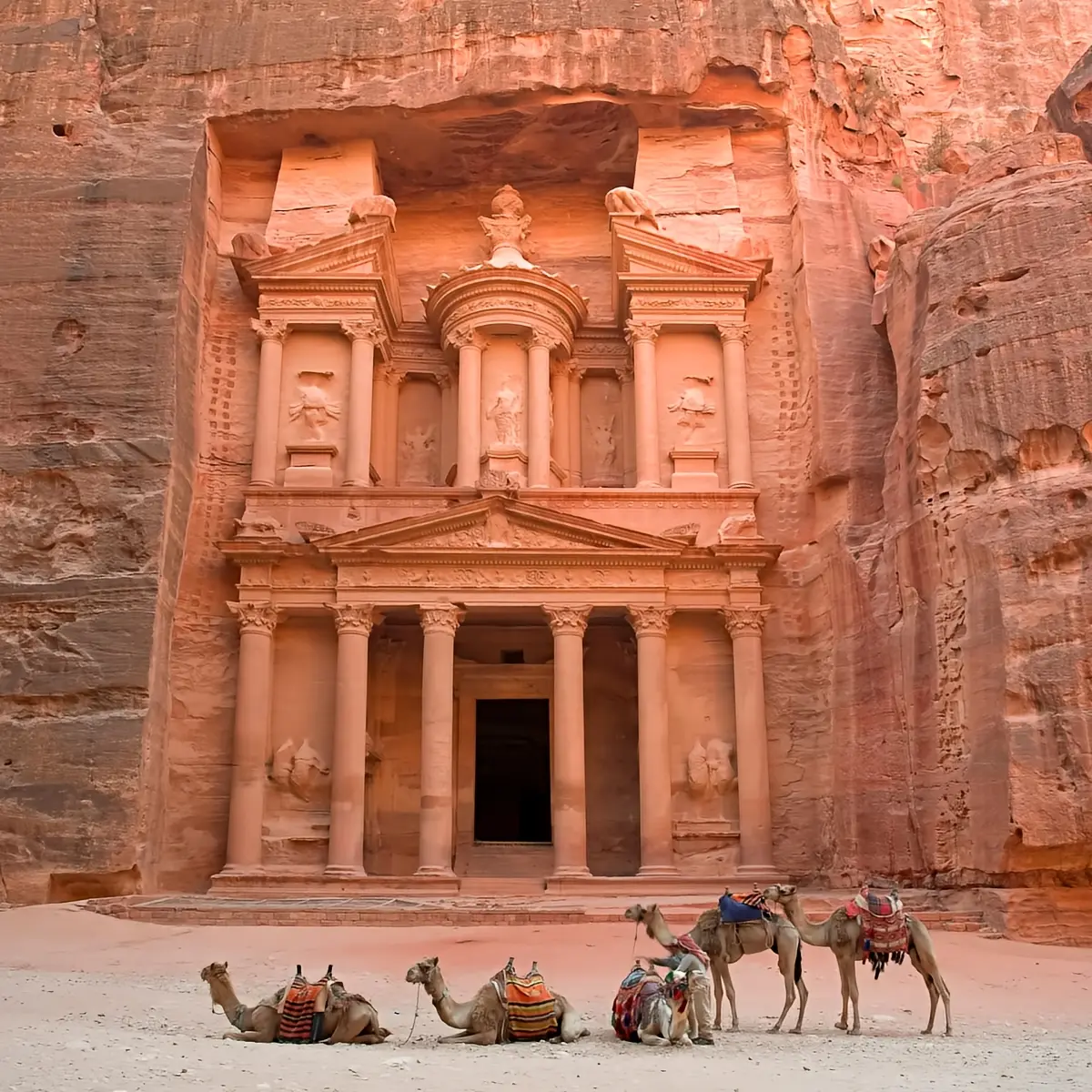
Hidden amid desert canyons in Jordan, Petra was the great Nabataean capital nearly 2,000 years ago. Rediscovered by a Swiss explorer in 1812, it ranks as one of Asia’s iconic archaeological treasures. Carved directly into rose-tinted sandstone cliffs, its monumental facades blend Hellenistic and Middle Eastern influences. The most famous is Al-Khazneh, the Treasury—an ornate temple façade flanked by Corinthian columns. Nearby looms El-Deir (the Monastery), a majestic temple carved into a mountainside.
Petra’s story is one of trade and adaptation. The Nabataeans controlled incense and spice routes between Arabia and the Levant, and their wealth financed this rock city. Over time, earthquakes and shifting commerce routes led to Petra’s decline by the 7th century. The Romans later occupied it, but it was largely abandoned until the modern era.
Today, Petra’s “Siq” gorge entrance, a narrow winding cleft, suddenly opens into a courtyard before the Treasury—creating dramatic first sightlines. Exploring deeper, one finds temples, tombs, and an amphitheater hewn from solid rock. Visitors should wear sturdy shoes for sandy paths and stairs; temperatures are high by day. Sunset tours at Petra’s high hilltop viewpoint give one of the Middle East’s most romantic views, as the city glows in fading light.
8. Mount Everest Base Camps – Natural and Cultural Heritage

Mount Everest (Sagarmatha) straddles the Nepal-Tibet border as Earth’s highest peak (8,848 m). Its base camps—one in Nepal’s Sagarmatha National Park and the other on Tibet—offer more than natural thrills; they sit in a culturally sacred landscape. Everest is revered in local religions. In Tibetan, Qomolangma means “Holy Mother”; in Nepali, Sagarmatha means “Goddess of the Sky”. Sherpa villages in the valley venerate the mountain with festivals and mani stones (inscribed rocks).
Sagarmatha National Park (UNESCO-listed 1979) protects an exceptional alpine environment, from deep river gorges to rhododendron forests. Rare wildlife like snow leopards and red pandas thrive here at lower elevations. To visit the base camp side of Everest, trekkers typically pay a national park fee (~NPR 3,000) and a climbing permit (the environment permit). The trek from Lukla involves Sherpa villages, Buddhist monasteries, and glaciers – a cultural and physical journey. On the Tibetan side, base camp treks require permissions from Chinese authorities, but they similarly pass through Buddhist monasteries that honor the mountain spirit.
Visitor note: Altitude sickness is a serious risk near Everest, so allow several days for acclimatization. Trek during the relatively stable pre-monsoon (April–May) or post-monsoon (September–October) seasons. Those times also align with Everest’s climbing windows and offer the clearest mountain views. Even if you cannot summit, reaching Base Camp is an achievement, giving a sense of how Everest has long drawn human aspiration.
9. Historic City of Ayutthaya, Thailand – Thailand’s Ancient Capital

Northeast of Bangkok lie the ruins of Ayutthaya, Thailand’s second capital kingdom (1351–1767). Once a rich cosmopolitan city, it was razed by the Burmese in 1767; today, a UNESCO park preserves dozens of temple remains. Tall prang (corncob-shaped towers) and crumbling buddha statues survive in a landscape of reflective ponds. Wat Mahathat’s famous buddha head entwined in roots exemplifies Ayutthaya’s mystery.
UNESCO notes that Ayutthaya was “one of the world’s largest and most cosmopolitan cities” in its heyday. It combined Khmer, Mon, Indian, Persian, and later European influences in art and architecture. The city was crisscrossed by canals (known as the “Venice of the East”), which you can still imagine as you tour by longtail boat around old forts. Today, key sites include Wat Phra Si Sanphet (once the royal chapel) and Wat Chaiwatthanaram (a riverside temple with towering spires).
Ayutthaya is about 80 km north of Bangkok, making it a popular day trip. It is hot year-round; morning visits avoid the midday blaze. Because many ruins lie in open fields, rent a bicycle or bike taxi for easy access. The site is open-air and largely self-guided, though local guides can add historical context. Dress for temple visits (knees and shoulders covered) to show respect. The fusion of styles here—Thai prangs, Khmer influences, and even early Portuguese architecture—reflects Ayutthaya’s cross-cultural era.
10. Halong Bay, Vietnam – Where Nature Meets History

Limestone towers rise abruptly from emerald waters in Halong Bay, a UNESCO natural heritage site since 1994. While famous as a natural wonder (with some 1,600 jungle-topped islands studding the bay), Halong Bay also has a layer of human history. Legend claims dragons formed the islands to protect Vietnam’s people. In fact, archaeological finds on Cat Ba Island (within the bay area) show prehistoric human habitation. Today, floating fishing villages carry on a centuries-old way of life among the karsts.
Halong’s beauty earned it a world heritage listing in 1994. The site is sometimes called “Descending Dragon’s Bay”. Its iconic towers (dolomite karsts) were formed over 500 million years, but local cultures attribute them to mythic origins. Cruise boats and kayaks are the main ways to explore—many travelers spend a night on a junk boat among the isles. Caves like Sung Sot (Surprise Cave) display ancient stalagmites.
Conservation note: As Halong celebrated 30 years on the UNESCO list, the agency warned of modern threats. Rapid coastal development and unregulated tourism have raised alarms. UNESCO sent experts in late 2024 to assess the impact of new hotels and ports on the bay’s outstanding universal value. When visiting, be mindful of these pressures—stay with reputable tour operators, avoid single-use plastics, and support local guidelines to help protect Halong’s fragile ecosystem.
Seasonal tip: Avoid the stormy typhoon season (summer months) when seas can be rough. The best months for calm water and good visibility are October–December. Early morning is also less crowded, and mist may cloak the peaks for atmospheric photos.
11. Kathmandu Valley, Nepal – Living Heritage

Nepal’s Kathmandu Valley is a cultural mosaic of Hindu and Buddhist art, on UNESCO’s list since 1979. Rather than one site, the listing covers seven monumental zones: three royal Durbar squares (Kathmandu, Patan, Bhaktapur) and four great monuments (Swayambhunath Stupa, Bouddhanath Stupa, Pashupatinath Temple, and Changu Narayan Temple). Together these display centuries of Newar craftsmanship: intricately carved windows, golden pagodas, and palace courtyards.
The Durbar squares are medieval royal palaces surrounded by temples. At Kathmandu Durbar, the former palace of Nepal’s Shah kings stands beside pagodas like Taleju; at Patan, bronze Buddhas glint in temple halls. Bouddhanath and Swayambhu are giant layered stupas built around 600–700 AD, still used for meditation by monks and pilgrims. Pashupatinath (a Hindu temple to Shiva on the Bagmati River) sees devotees and cremations daily.
In recent memory, the 2015 earthquake ravaged Kathmandu’s heritage – many temples and buildings collapsed. Since then, restoration has been underway with UNESCO’s guidance. Visitors today will see a mix of original and repaired structures. Exploring the Valley, one feels everyday life amidst shrines: cows wander the squares, priests offer blessings, and villagers ascend the stupas with butter lamps.
For travelers: Kathmandu city is chaotic but rich. The UNESCO area is scattered, so plan transport between zones. Spring (Mar–May) and autumn (Sept–Nov) have clearer skies; monsoon months bring lush greenery but occasional flooding. In temples, remove shoes and be respectful of worshipers. A guide can enrich the experience with stories of the local deities and Newar legends behind each temple.
12. Mount Fuji and Sacred Sites, Japan – Spiritual and Natural Icon

Nearly 100 km southwest of Tokyo, Mount Fuji (Fujisan) is Japan’s highest peak (3,776 m) and a near-perfect volcanic cone. Far from just a natural landmark, Fuji has been sacred for centuries, blending Shinto and Buddhist reverence. Recognized as a UNESCO cultural landscape in 2013, the “Fujisan, sacred place and source of artistic inspiration” site includes the mountain’s shrines and pilgrimage routes. It encapsulates the spiritual harmony of nature and culture that Fuji inspires.
Climbing season (July–early September) sees thousands of hikers reach the summit at sunrise, a ritual known as goraiko. On the slopes are shrines like the crater Sengen-jinja, where Fuji itself is worshipped as a deity. Fuji appears in countless works of art, the most famous being Hokusai’s woodblock prints, which have introduced the mountain to world audiences.
To visit: The easiest access points are the “fifth stations” on different sides (Gotemba, Subashiri, Fujinomiya, or Yoshida Trail). A new initiative (as of 2023) charges a voluntary climber pass of ¥4,000 (~USD 30) to help fund trail maintenance and safety. Even if not climbing, the area around Fuji Five Lakes offers great views and cultural experiences (e.g. Arakura Sengen Shrine’s famous pagoda framing Fuji). Autumn (late September–October) is ideal for clear skies; winter ascents require special mountaineering skills due to ice and snow. Visitors should observe worship customs at Fuji’s shrines (no loud behavior or littering, treat altars respectfully).
13. Qutub Minar Complex, Delhi, India – Indo-Islamic Masterpiece

On Delhi’s southern edge stands the Qutb Minar, a soaring tapering tower of red sandstone, 72.5 meters high. Built in the early 13th century by Qutb-ud-din Aibak and his successors, it marked the Delhi Sultanate’s arrival. The Minar’s alternating fluted and cylindrical bands, inscribed with Quranic verses, exhibit early Indo-Islamic artistry. Its surrounding complex (a UNESCO site since 1993) includes the Quwwat-ul-Islam Mosque (India’s oldest), the Alai Darwaza gate, and an iron pillar dating to 4th century AD.
The Quwwat-ul-Islam Mosque, made from spolia (reused temple pillars), shows how Indian and Islamic motifs merged. The courtyard’s broken pillars and intricately carved arches demonstrate this cultural fusion: some Hindu lotus motifs and Sanskrit inscriptions appear alongside Arabic calligraphy. Visitors can enter up to the base of the Qutb Minar (climbing is no longer allowed inside for safety).
Delhi attracts millions of visitors each year, and the Qutub complex is among the most accessible heritage sites. It’s open daily, with higher entry fees for foreign tourists (around ₹500, locals ~₹50). The complex is landscaped, so expect a pleasant stroll. Photography is allowed. To avoid midday heat and crowds, visit early morning or late afternoon. Afterward, other nearby ruins (e.g. Alauddin Khalji’s tomb) reward those who want to explore more of Delhi’s Sultanate era.
14. The Grand Palace, Bangkok, Thailand – The King’s Holy City

Bangkok’s Grand Palace is actually a complex of ornate buildings rather than a single structure. Since its founding in 1782 (at the start of King Rama I’s reign), it has served as the ceremonial and spiritual center of Thai royalty. The palace grounds are home to the Temple of the Emerald Buddha (Wat Phra Kaew), the most sacred Buddhist shrine in Thailand.
The palace architecture illustrates Thai pride and craftsmanship. The Royal Chapel of the Emerald Buddha glitters in gold and mosaic, housing a small but revered jade Buddha. Golden chedis (stupas), royal halls with peaked roofs, and the Grand Palace’s lavish Middle Court all showcase Rattanakosin-era style. Each king after Rama I added new structures, so the complex contains a mix of neoclassical and Thai traditional elements.
Today, the palace is partly open to tourists (though the king’s residences are closed off). Etiquette is strictly enforced: shoulders and knees must be covered, and shoes removed at the Emerald Buddha temple. Visitors should dress conservatively (long skirts or pants, shawl over shoulders) to enter. Guided tours enhance understanding of the royal symbolism (e.g. Makara gates, Garuda emblems). The Grand Palace still hosts state ceremonies, which the public rarely sees; however, the complex’s legend and the Emerald Buddha’s changing seasonal costumes lend a mystical allure to any visit.
Practical: There is a moderate entrance fee, and it is crowded midday. To fully appreciate the details, arrive mid-morning or late afternoon. Nearby attractions (e.g. Wat Pho’s Reclining Buddha) can be combined in a walking itinerary.
15. Hawa Mahal, Jaipur, India – Rajasthan’s Pink City Jewel

Rajasthan’s capital Jaipur is nicknamed the “Pink City,” and nowhere is this more charming than the Hawa Mahal, or “Palace of Winds.” Built in 1799 by Maharaja Sawai Pratap Singh, Hawa Mahal is an urban palace façade five storeys high, made of red and pink sandstone. It contains 953 tiny latticed windows or jharokhas. The effect is a bee-like honeycomb wall that was designed to allow royal women to watch street life without being seen, and to channel cooling breezes into the palace (a clever ventilation trick for the desert heat).
Its delicate facade makes Hawa Mahal one of the most photographed buildings in India. Inside are a series of corridors and chambers around a central courtyard. The interior is modest compared to the exterior spectacle, but the hillside view of the city through those tiny windows is unique. Each jharokha is carved with filigree screens that create intricate shadow patterns when sunlight falls.
Jaipur’s city planning made room for this façade; behind it lies the Zenana (women’s quarters) of the City Palace complex. Today, tourists enter from the rear courtyard; the ornate front looks like a giant piece of lace. Suggested view: many come in the evening when local lights illuminate the windows. Visitors can also stroll across the square in front for photos (just be careful of traffic). As always at Hindu palaces, modest dress is advised if you go inside.
Photography tip: The best light is early morning or at sunset, which brings out the warm color of the sandstone. Since Hawa Mahal is in the middle of a busy square, photos taken from across the street include horses and camels that often offer short rides—a quintessential Pink City scene.
Comparative Analysis: Understanding Asian Historical Sites

UNESCO vs Non-UNESCO Sites: What’s the Difference?
Asia’s UNESCO World Heritage List is long (China alone has 59 sites). UNESCO recognition means a site has been deemed of “outstanding universal value” under strict criteria. These sites benefit from international awareness, conservation funding, and global tourism interest. For example, UNESCO status helped mobilize restoration at Kathmandu’s Durbar squares after earthquakes or more cautious tourism management at Halong Bay.
However, many significant Asian historical places remain off the UNESCO list. Local jewels—like the ancient city of Mohenjo-daro (Pakistan) or the Durbar Square in Nepal’s Patan (until 1979)—might be well preserved but not globally inscribed due to nomination priorities or meeting the specific criteria. Non-UNESCO sites can be equally rich culturally, though they often receive less preservation support and public awareness. Both categories are worth visiting. A heritage traveler should know that UNESCO status guarantees a baseline of value and protection but does not exhaust the continent’s heritage. Lesser-known temples, forts, and ruins abound: from forgotten Saiva temples in Indonesia’s Sulawesi to Hampi’s ruins in India, so-called “hidden gems” reward curious explorers. The main difference lies in recognition and resources, but not in intrinsic interest.
Historical Periods and Architectural Styles
Asia’s monuments span millennia and diverse faiths. Buddhist stupas like Borobudur (9th century Indonesia) and Angkor Wat (initially Hindu, converted to Buddhist) reflect Indianized temple forms with layered terraces and Buddha imagery. Hindu influences are evident in Cambodia’s relief work and in Southeast Asian temple layouts. The Indo-Islamic style appears in South Asia: for example, the Taj Mahal and Qutub Minar showcase Mughal architecture’s synthesis of Persian/Islamic design with local motifs (calligraphy, chhatri domes). East Asia adds its own flavor: China’s Forbidden City represents Ming-Qing palace architecture (axial symmetry, glazed tile roofs), while Japan’s architecture (e.g. shrines on Mount Fuji) blends Shinto simplicity with Buddhist ornament.
Medieval periods produced many of Asia’s grandest sites: between the 10th and 15th centuries, empires like the Khmer, Javanese Sailendra, Delhi Sultanate, and Ming dynasty built monumental works. However, much older heritage also survives: prehistoric cave complexes in China and rock-cut tombs in the Middle East (like Petra) trace to the first millennium BC. Each site thus fits into broader timelines: examples include Bronze Age cities (Ayutthaya had roots in earlier Khmer sites), classical-era temples, and modern landmarks. Understanding the style usually means noting religion and empire: e.g., predominantly Buddhist sanctuaries in Myanmar, Hindu-Buddhist temples in Southeast Asia, Islamic monuments in South Asia, and Shinto-Buddhist complexes in Japan.
Planning Your Asian Historical Sites Journey

Best Times to Visit Each Region
Asia’s climate zones vary drastically, so timing is crucial. Generally, dry season or moderate-season visits offer the most comfort:
- South Asia (India, Nepal, Pakistan): Winter (November–February) is peak travel time. Monsoon rains (June–September) can disrupt plans, though some sites (like Bagan or Angkor Wat) can be seen in less crowds but slippery conditions. Taj Mahal and Jaipur are extremely hot in April–June, so aim for cooler months.
- Southeast Asia (Thailand, Cambodia, Vietnam, Indonesia): The cool dry season (roughly November–March) has pleasant days and clear skies. For Halong Bay and Angkor Wat, winter means calm seas and cool air. Rainy season (May–October) brings intense afternoon storms; if visiting then, spread out indoor/outdoor site visits.
- East Asia (China, Japan): China’s Great Wall is enjoyable in spring and autumn when foliage is colorful. Summer can be rainy; winter is cold but crowds are lower. Mount Fuji is officially climbable only in July–August; otherwise trails are closed due to snow. Autumn (Sept–Oct) is ideal for Fuji views and pleasant weather in Japan.
- Himalayas (Nepal, Tibet): Spring and autumn are Everest trekking seasons: April–May and Sept–Oct offer stable weather and mountain views. Winters are bitterly cold with heavy snow on trails.
Research regional festivals and holidays too. Visiting cultural sites during a festival can be enchanting (e.g. Vesak Day at Borobudur, Songkran at Bangkok’s temples) but expect crowds. In contrast, off-season travel often means fewer people but less reliable weather. Always check local climates for the specific time of year.
Multi-Site Itineraries and Routes
Combining monuments into routes maximizes travel. Consider geographical clusters and cultural themes:
- South Asia: A classic Golden Triangle (Delhi–Agra–Jaipur) links Qutub Minar and Humayun’s Tomb in Delhi, the Taj Mahal and Agra Fort, and the palaces of Jaipur (including Hawa Mahal). Extending from Jaipur to Jodhpur adds Mehrangarh Fort, while Agra–Delhi could include Fatehpur Sikri. In India, guided circuits often cover Delhi–Agra–Jaipur–Varanasi with stops at temples and forts.
- Nepal/Bhutan/Malaysia: Nepal tours often pair Kathmandu Valley sites with Everest region. Bhutan circuits can include Paro’s Tiger’s Nest and Punakha’s dzongs. In Malaysia, a route might include the new Forest Research Institute Park and other heritage sites.
- China: Beijing’s Forbidden City and Great Wall can be done in tandem. From Beijing one can take high-speed trains to Xi’an (Terracotta Army), and then to Shanghai (City God Temple) to cover major UNESCO sites. Separate journeys focus on ethnic minority villages or southern temples.
- Southeast Asia: Cambodia-Vietnam trips often bundle Angkor Wat (Siem Reap) with Vietnamese sites like Hue’s citadel and Halong Bay. A common route is Siem Reap–Phnom Penh–Saigon (Ho Chi Minh City). Thailand circuits link Bangkok (Grand Palace) with Ayutthaya and Sukhothai. Multi-country tours may span Angkor-Wat–Bagan–Bangkok.
- Middle East: A “Levant loop” could connect Petra in Jordan with sites in nearby Syria or Palestine (though safety varies). In South Asia, some combine Petra/Jordan with India via connecting flights.
List approaches flexibly: Choose one region per trip or a transnational theme (Buddhist monuments across borders, e.g.). Travel agencies often offer specialized heritage tours (e.g. “Mughal India Tour” or “Ancient Khmer Trail”).
Entry Fees and Booking Requirements
Each site has its own system. Generally, popular sites require paid entry, and many now encourage or mandate online booking:
- Taj Mahal: Ticket counters and online sales are run by India’s Archaeological Survey. Foreigners ~₹1100; Indians ~₹50. A separate ₹200 ticket is needed for the inner chamber. No bookings are available for specific times, but day tickets sell out on weekends and holidays—arrive early in the morning.
- Everest Base Camp (Nepal side): Foreign visitors need two permits: one for Sagarmatha National Park (~NPR 3,000) and a TIMS card (trekking registration, ~$25). These can be obtained in Kathmandu via authorized agencies. The Tibet side requires Chinese mountaineering permits and an organized tour.
- Mount Fuji: Climbers (or day-trippers beyond the Fifth Station) must register online and pay a voluntary fee of ¥4,000 to support conservation. This pass (introduced in 2023) is recommended for safety and crowd data.
- Forbidden City: Entry tickets must be booked online for specific times (CNY 60). No photos inside certain halls are allowed. Plan at least half a day inside.
- Angkor Wat: Three-day passes cost around USD 40, single-day around USD 37. Tickets are checked on entry. There’s no fixed daily quota, but lines are common. A guided tour or audio guide is useful to understand the vast site.
- Petra: Tickets cost about JD 50 (2-day) for foreigners. Expect security bag checks at entrance. Horse or carriage rides are optional extras for the Siq path.
- Halong Bay: There is no single “entry ticket,” but cruising is the only way to see the bay. Plan tours in advance. National park fees are usually included in boat tickets. Choose reputable cruise companies that handle all permits.
- Kathmandu Valley: Each zone (Durbar square, monument) has its own ticket (often NPR 1,500–2,000 for foreigners for all seven sites). It pays to buy the Heritage Passport book for multiple zones. Cash only, no booking needed.
- Grand Palace: Tickets (around THB 500) are sold at the gate. Dress code is enforced; mismatched attire (even if purchased by foreigners on site) may be penalized by asking for cover-ups.
- Hawa Mahal: Entrance to the courtyard/museum is about ₹50 for Indians, ₹200 for foreigners. It’s usually open daylight hours; lines are rare.
For any site, check online for up-to-date fees and consider hiring licensed guides at monuments (some destinations require official guides inside temples). Group rates sometimes exist but often individual fees apply.
Conservation and Future of Asian Heritage

2025’s Newly Inscribed UNESCO Sites
Asia’s heritage list is still growing. In 2025, UNESCO added two notable entries: – Cambodian Memorial Sites (Criteria vi): This serial property comprises three dark reminders of the Khmer Rouge era—Tuol Sleng (S-21) prison, Choeung Ek killing fields, and M-13 jail. Preserved as memorials, they document the genocide of the 1970s. Their inscription acknowledges not ancient culture but recent history, highlighting human rights abuses and the imperative of remembrance. – Forest Research Institute Malaysia (Criteria iv): A contrast to Cambodia’s memorials, this Malaysian site is a success story. A former tin-mining wasteland, it was transformed into an experimental forest park beginning in 1929. Today it is a mature tropical rainforest, pioneered as a model of ecological restoration. Its UNESCO listing (2025) makes it the first human-regenerated forest to be inscribed, demonstrating nature’s comeback and sustainable forestry research.
These new additions show UNESCO’s expanding scope: from memorial sites of tragedy to scientific landscapes. They remind us that heritage includes not only ancient ruins but also places of social memory and environmental innovation.
Sites at Risk and Preservation Efforts
Many Asian sites face threats from climate change, over-tourism, and development. Halong Bay’s recent UNESCO review underscores concern: new hotels and roads near the bay might “jeopardize the integrity” of its ecosystem if unchecked. Similarly, Angkor Wat contends with water table changes and foot-traffic on delicate sandstone. On Everest, retreating glaciers signal broader Himalayan warming, threatening local ecosystems and water sources.
Urban expansion is another threat. Kathmandu’s old temples nearly collapsed in the 2015 quake. Since then, international aid has helped restore some, but rapid construction around sites remains an issue. In Beijing, pollution poses long-term risks even to the Forbidden City’s wooden halls.
Over-tourism is a double-edged sword: it funds conservation but can harm sites. Ayutthaya once sat on UNESCO’s Danger List due to water pollution and deterioration from floods (removed in 2022 after cleanup efforts). Limits on visitor numbers at Petra and ruins-aware signage in Angkor are examples of mitigation. Responsible tourism practices—like guided monitoring, revenue for maintenance, and visitor quotas during peak times—are increasingly applied. For example, Angkor’s ticket system now restricts night entry to certain temples to protect their murals.
In essence, Asian heritage stewards—governments, UNESCO, NGOs—are scrambling to protect these treasures. Tourists can play a role by following local guidelines, supporting sustainable tour operators, and engaging with the sites’ deep meanings rather than treating them as mere backdrops. As UNESCO’s convention states, heritage is “our legacy from the past… what we live with today, and what we pass on to future generations”. Each of these Asian sites is part of that legacy, requiring vigilance to ensure they endure.
Expert Tips for Visiting Asian Historical Sites

Photography Guidelines and Best Spots
- Golden hour lighting: Aim for early morning or late afternoon photos. For example, Taj Mahal at sunrise or Mount Fuji at sunset reveal subtle colors. Pink sky on Hawa Mahal’s facade, or balloons above Bagan at dawn, make iconic shots.
- Vantage points: In petra, photograph the Treasury from the Siq entrance or the high hilltop. At Kathmandu’s Swayambhunath, capture the stupa with the city below. On the Great Wall, Jinshanling offers sweeping curves. Use wide-angle lenses for large complexes, but telephoto to capture detail (e.g. Buddha faces in Borobudur’s stupas).
- Tripods: For low-light interiors (Forbidden City halls, dark shrines) a small tripod can help. Respect no-flash rules inside temples (fluorescent lighting might be available).
- Drone use: Prohibited at most heritage sites (Taj Mahal, Forbidden City, Angkor Wat) – do not fly without explicit permission (likely impossible for tourists). Even at Everest or Halong, check local regulations and weather.
- People photography: Always ask permission before photographing locals, monks, or worshippers. In many Buddhist sites, photos of people are allowed if unobtrusive, but always be polite and quick.
Cultural Etiquette and Dress Codes
- Modest attire: In temples, cover shoulders and knees. Long pants/skirts and shirts with sleeves are a must at Taj Mahal, Emerald Buddha (Grand Palace), Angkor temples, and Halong Bay’s communal areas. Short sleeves or shorts are often forbidden (and guards enforce it). Scarves can be handy to cover up quickly if needed.
- Shoes: Remove footwear when entering wats or shrines (Thailand, Laos, Myanmar). Signs mark no-shoe zones. Leave shoes in provided racks.
- Gestures: Avoid pointing feet at Buddhas; instead tuck ankles under. A slight bow or wai (Thai gesture) shows respect. Do not touch religious artifacts or monks.
- Temple rules: Many sites (Jade Buddha, Emerald Buddha) explicitly forbid photography inside the main image hall. Check signs. Silence phones and keep voices low.
- Historic environment: Do not touch carvings or wander off marked paths. Ancient stairways and railings are often fragile.
- Local customs: Greet monks with nods (even on Everest treks, Sherpa monks at monasteries appreciate respectful acknowledgement). In markets near heritage sites, haggling is normal but remain polite.
Guided Tours vs. Independent Exploration
- Guided Tours: A knowledgeable guide can illuminate a site’s history and anecdotes. UNESCO sites like Angkor or Petra have rich symbolism that a guide can decode. In countries where English signage is sparse, a guide or audio tour is valuable. Group tours can handle logistics (visas, transport) seamlessly.
- Independent Travel: Freedom to linger where you like and move at your own pace. Good maps/apps now exist for major sites. For example, Angkor has pocket guides, and many temples offer volunteer guides (whose English varies). Independent travelers should do homework to catch key facts (a guidebook or online source helps).
- Balance: Consider doing a guided half-day at the start of a complex and then revisit independently. Or take a group tour to a site like the Grand Palace, then spend the afternoon wandering Bangkok by yourself. Some sites (like Taj Mahal) have rules that restrict local unofficial guides, so you may need to rely on audio tours or prior reading.
- Accessibility: Guided tours are beneficial for logistical reasons (e.g. obtaining permits or navigating public transport to remote sites). In contrast, tech-savvy travelers might prefer independent booking and flexible day plans. Always carry local emergency contacts and respect group timings if on a tour.
Frequently Asked Questions
Which Asian country has the most historical sites?
By UNESCO World Heritage count, China leads Asia with 59 sites (as of 2024). India is next with 43 sites, followed by Japan with 25, and others like Korea and Iran with around a dozen each. (These numbers include all natural and cultural sites.) However, “most historical sites” can also be measured by local heritage listings and known monuments. China and India, given their large size and history, naturally top the list. Remember that many countries boast rich histories: for example, Cambodia has dozens of temple complexes (only a few UNESCO), and Thailand’s lesser-known ruins (like Sukhothai) also count as important sites.
Are there hidden historical gems in Asia?
Absolutely. Beyond the famous 15, Asia teems with overlooked treasures. Examples: The island ruins of Dai in China’s Fanjingshan, the wooden temples of Lumbini (Nepal), remote Khmer temples like Beng Mealea (Cambodia), or Gothic fortresses in India’s Deccan. Many countries have local “heritage treks” to less-visited ruins: Vietnam’s ancient citadel at Hue, Malaysia’s historic Malacca, or Japan’s Kyoto backstreets. To find these, one can consult national heritage lists, local tour guides, or travel forums. Often, the lesser-known sites offer the same sense of history and architecture without the crowds—Sukhothai’s park in Thailand or Prambanan temple in Java (besides Borobudur) are such examples.
What makes Asian historical sites unique?
Asian monuments stand out for their fusion of religion, craftsmanship, and context. Many are living sites: still worshiped at or tied to ongoing cultural traditions (e.g. Tibet’s Everest shrines, or Japan’s Shinto pathway up Fuji). Architecturally, they often blend multiple influences: Indo-Islamic at the Taj and Qutub Minar, Hindu-Buddhist in Angkor’s design and in Borobudur’s reliefs, or the theatrical symmetry of Chinese palaces like the Forbidden City. Additionally, many Asian sites harmonize with nature: Petra and Halong Bay integrate geology into their narratives. Technically, Asia boasts marvels like the world’s largest brick pagodas (Bagan), the largest human-made monument (Angkor), and mountain-spanning walls (Great Wall). In short, what makes them unique is this deep intertwining of local belief, art, and environment, reflecting the diverse civilizations that built them.
Conclusion: Journey Through Asia’s Living History

Asia’s historical sites invite us not merely to observe ancient walls or temples, but to step into the ebb and flow of human time. This guide has spanned the continent, from the desert rose of Petra to the snowy crown of Everest, highlighting how each location intertwines architecture, art, and belief. A traveler who visits these 15 places (and beyond) experiences the palate of Asia’s past: imperial India’s marble romance, Southeast Asian gods carved in stone, East Asian dynasties rendered in wood and stone, and sacred mountains where pilgrims still tread.
Above all, the journey is about respect and wonder. Each site carries the memory of what people valued — be it love (Taj Mahal), faith (Borobudur, Angkor), power (Forbidden City, Grand Palace), or hope (Khmer Rouge memorials). The best visits occur when we pause to understand these stories. Note the small details (the buds in Hawa Mahal’s latticework, the Sanskrit in Qutub’s mosque, the silhouettes of buddhas in Bagan’s sunrise) as much as the grand vistas.
Today, many of these treasures face modern challenges: climate threats, unrestrained development, and even political changes. As we plan travel, thoughtful choices—such as visiting sustainably, following local rules, and contributing to preservation—ensure these sites endure. The world heritage convention reminds us that these sites are “our legacy from the past, what we live with today, and what we pass on to future generations”. In that spirit, let a journey through Asia’s historical sites be more than sightseeing: it can be an education in the enduring values of art, faith, and human resilience.