

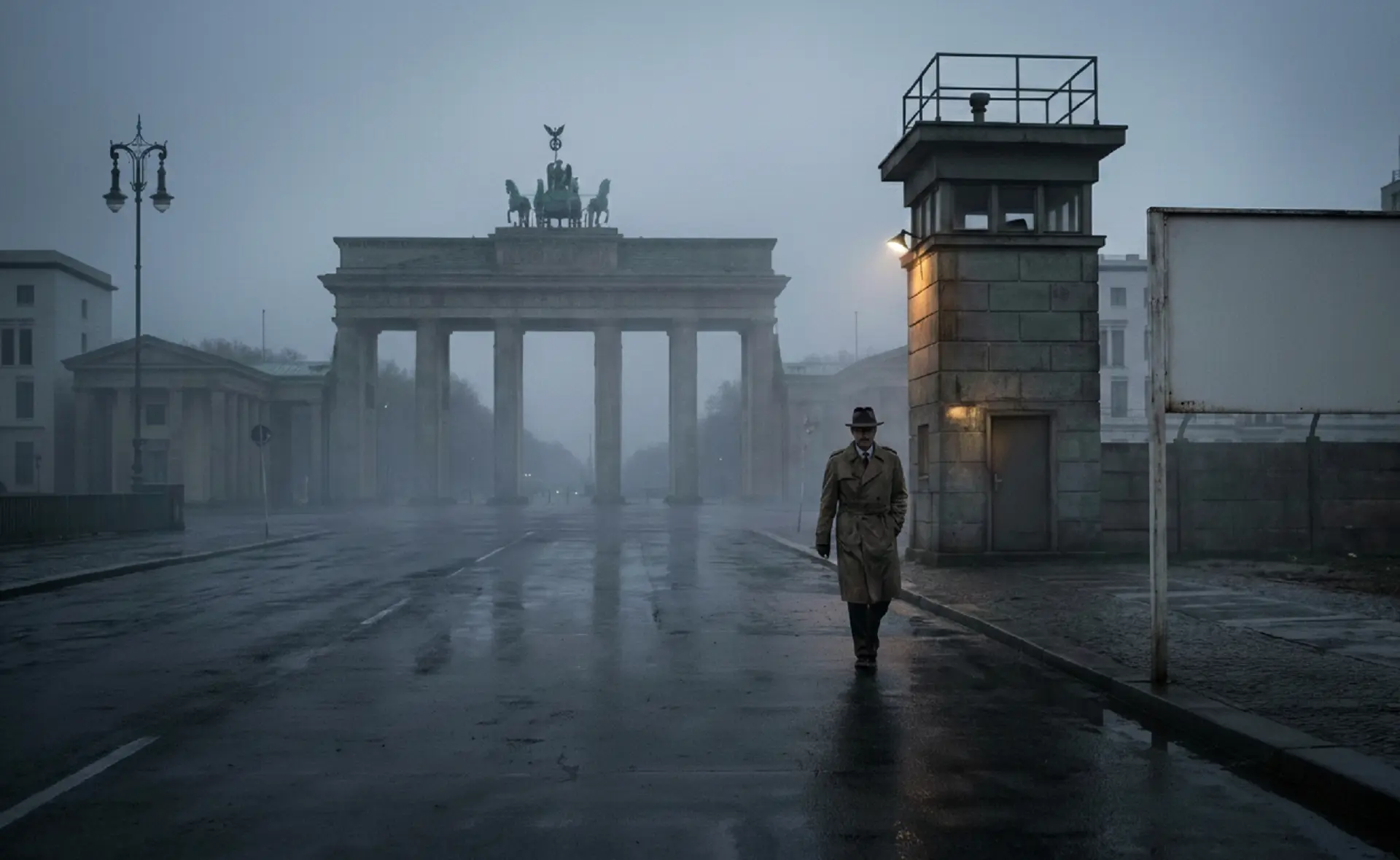
Cold War Berlin
Berlin, Capital of Spies
In a city cut into sectors, intelligence work was not hidden beyond the horizon. It ran under streets, across bridges, through ministries and beside the platforms of ordinary commuters.
A historically grounded guide to the places where Berlin’s divided geography became an intelligence instrument.
Berlin did not become the symbolic capital of Cold War espionage because every spy was more ingenious there than elsewhere. It became central because the city made rival systems physically adjacent. After 1945, the former German capital was divided among the United States, the United Kingdom, France and the Soviet Union, while the surrounding territory lay inside the Soviet occupation zone and, from 1949, the German Democratic Republic. West Berlin consequently formed a Western enclave deep inside East Germany. Diplomats, military personnel, railway lines, telephone cables, refugees, couriers and intelligence officers crossed or approached boundaries that were politically explosive but geographically intimate. Information that would have required long-distance penetration in another theatre could sometimes be sought from the next district, the next tunnel or the other end of a bridge.
That closeness did not make espionage simple. It made Berlin a place of overlapping legal authorities, controlled access, clandestine surveillance and constant uncertainty. Western services watched Soviet forces and East German institutions. The Soviet KGB and East German Ministry for State Security, universally known as the Stasi, studied Western military intentions, political networks and the lives of people who might flee or resist. Allied liaison missions moved through East Germany under negotiated rules while being followed. Checkpoints processed legitimate travellers and concealed operational opportunities. Underground railways passed below hostile territory. Telephone infrastructure crossed sectors that had once belonged to a single city. The same urban fabric could therefore serve administration, escape, interception and counterintelligence at once.
The popular image of Berlin espionage is full of trench coats, coded phrases and midnight exchanges. Those images are not entirely false, but they are incomplete. Much of the work was technical, bureaucratic and patient: recording calls, translating traffic, cultivating sources, cataloguing files, photographing installations and correlating small changes over time. It also depended on people who were not glamorous professionals. Secretaries, engineers, border guards, railway employees, neighbours, relatives, defectors and coerced informants could all become part of an intelligence system. For many Berliners, spying was not an exotic story. It was entangled with employment, housing, travel, family separation and the fear that a private remark might be recorded or reported.
The surviving sites do not tell one clean narrative. A tunnel section displayed in a museum represents an audacious Western operation, but also a counterintelligence success made possible by a Soviet mole who could not be exposed without compromising a more valuable secret. Glienicke Bridge became a stage for carefully negotiated exchanges, yet most prisoners never crossed it. Former Stasi offices reveal the administrative architecture of surveillance, while preserved records show how deeply that architecture entered daily life. A ghost-station exhibition explains how public transport was redesigned as border infrastructure. Read together, these places turn “the city of spies” from a slogan into a map of institutions, technologies and human consequences.
The strategic setting
Why Berlin concentrated intelligence work
Berlin’s importance came from the unusual overlap of four-power rights, military confrontation and a functioning city whose infrastructure had never been designed to become an international frontier.
Understanding the map is the first step toward understanding the operations.
The post-war settlement created a city that was simultaneously local and international. Each occupying power administered a sector, but Berlin as a whole remained subject to four-power arrangements. When the Federal Republic of Germany and the German Democratic Republic emerged in 1949, West Berlin retained a special status rather than becoming an ordinary West German city. Roads, railways and air corridors connected it to the West across East German territory. The Soviet military presence in the region and the political importance of the East German capital made the city a front-row observation post. Intelligence agencies were drawn to a place where they could study personnel, communications and policy at unusually close range, while adversaries could do the same to them.
The border hardened in stages. Before the Berlin Wall was built in August 1961, the sector boundary remained a major escape route from East to West. That movement created both a humanitarian crisis for East Germany and a rich, unstable environment for intelligence collection. Refugees could bring current information about factories, military units, political institutions and public morale, but their stories required careful verification. Agents and couriers could also exploit the flow. Once the wall and its associated barriers restricted movement, the intelligence problem changed rather than disappearing. Services invested more heavily in technical collection, controlled crossings, long-term penetrations and the monitoring of people with authorised access.
Berlin’s infrastructure preserved the memory of a unified metropolis even as the political system divided it. Telephone cables did not respect the new ideological boundary. Some underground and suburban railway lines connected two points in West Berlin by passing beneath East Berlin. Waterways, parks and suburban roads approached sector lines in ways that were difficult to secure without disrupting the city. This inherited network created opportunities, but every opportunity produced a defensive response. A tapped cable could be rerouted or fed deceptive traffic. A tunnel could be detected. A border employee could become an informant for either side. A legal transit privilege could be turned into a surveillance platform, then constrained by new procedures.
The city also accumulated agencies. American, British and French military and civilian services operated alongside West German institutions, while Soviet and East German organisations maintained their own divisions of labour. Cooperation was essential but never frictionless. Allies shared operations and reporting while protecting sources from one another. Separate chains of command could interpret the same event differently. Counterintelligence officers worried not only about enemy penetration but about leaks inside friendly organisations. The story of Berlin therefore resists the neat contest implied by “East versus West.” It involved multiple services, competing bureaucracies and individuals whose loyalties could be ideological, financial, coerced or mixed.
A useful visitor route should preserve that complexity. The Berlin spy tunnel represents technical interception and inter-allied cooperation. Glienicke Bridge represents diplomacy, custody and the highly controlled performance of exchange. The former Stasi headquarters reveals surveillance as a state institution rather than a collection of isolated tricks. Nordbahnhof’s ghost-station exhibition shows how border policy transformed transport architecture and ordinary movement. Teufelsberg, Checkpoint Charlie, the Berlin Wall Memorial and specialist museums can deepen the picture, but they should not be treated as interchangeable “spy sights.” Each answers a different historical question.
Berlin was divided into American, British, French and Soviet sectors after the Second World War.
The Federal Republic and the German Democratic Republic created a lasting political division around the city.
The construction of the Berlin Wall transformed movement, escape and intelligence practice.
The political system that produced divided Berlin came to an end, while archives and sites entered a new public history.
Rudow · American Sector
The Berlin Spy Tunnel
Beneath the city’s southern edge, Western intelligence built one of the Cold War’s most ambitious technical collection systems—an operation that was compromised before excavation began yet still produced a vast body of intercepted communications.
Best for: understanding how engineering, signals intelligence and counterintelligence could coexist inside one operation

Technical intelligence
A tunnel built to reach Soviet communications
The operation known to the Americans as Gold and to the British as Stopwatch began with a practical target: landline communications used by Soviet military and diplomatic organisations in the Berlin area. Western intelligence believed that important cables passed near the boundary of the American sector. Rather than attempt a brief surface tap, the partners planned an underground chamber where technicians could connect recording equipment to the lines and maintain collection over time. A warehouse-like installation in Rudow provided cover. From there, engineers drove a tunnel hundreds of metres toward the cable route in East Berlin, working under conditions that required secrecy, structural stability, drainage, ventilation and the removal of excavated material without attracting attention.
The project demonstrates that espionage was often an industrial undertaking. It required surveys, specialised equipment, secure staffing, communications analysis and a large processing organisation. Intercepted conversations and teleprinter traffic were valuable only after they had been recorded, translated, indexed and compared with other intelligence. The aim was not simply to overhear dramatic secrets. Routine logistical exchanges, unit movements, personnel changes and technical discussions could reveal readiness, command relationships and Soviet military practice. Collection continued for roughly eleven months after the tunnel became operational, creating an enormous volume of material for analysts.
The paradox is that the Soviet side had been warned. George Blake, a British intelligence officer secretly working for the Soviet Union, passed information about the plan before construction. Soviet authorities faced a counterintelligence dilemma: if they immediately exposed the tunnel, they risked revealing Blake as the source. They therefore allowed the operation to proceed for a period. When Soviet and East German personnel finally “discovered” the tunnel in April 1956, the exposure was presented publicly as proof of Western aggression. The tunnel became propaganda, but its history cannot be reduced to a failed trick. Western services knew only later how early it had been compromised, and assessments of the collected traffic have continued to examine whether and how much material was manipulated.
For visitors, the physical remnant matters because it corrects the cinematic scale of the story. A tunnel is cramped infrastructure. Its success depends on mundane details: keeping water out, controlling noise, protecting cables and sustaining technicians who must work in a sealed environment. At the Allied Museum, the surviving segment and related interpretation connect those material facts to the wider political operation. The object also prompts a more sophisticated question than “Did the tunnel succeed?” It asks how intelligence value is measured when an adversary knows about a collection system but cannot close it immediately without sacrificing a protected penetration.
The site’s afterlife is part of the narrative. Most of the original underground route is not a walk-through attraction, and the museum object should not be mistaken for an intact secret world preserved below modern Berlin. What survives is evidence selected and interpreted in a public institution. Before visiting, current access must be checked because exhibition arrangements and building works can change. The most rewarding preparation is to read the operation as a three-layered case: an engineering achievement, a signals-intelligence programme and a counterintelligence contest shaped by a mole at the centre of the British establishment.
Three ways to read Operation Gold
The hidden construction
Excavation, ventilation, drainage and concealment were operational requirements, not background details.
The intercepted traffic
Recorded communications became useful only through translation, indexing and long-term analysis.
The protected mole
The delayed Soviet response reflected the need to protect George Blake rather than simple ignorance of the tunnel.
Potsdam–Berlin Border
Glienicke Bridge
Its quiet span over the Havel became a carefully managed threshold where states exchanged a small number of people whose freedom carried exceptional political and intelligence value.
Best for: seeing how diplomacy, custody and symbolism were compressed into one border crossing

Exchange diplomacy
A border crossing made for choreography
Glienicke Bridge connects Berlin with Potsdam across the Havel, but during the Cold War it also crossed a jurisdictional divide between West Berlin and East Germany. Its relative isolation, clear sight lines and controlled approaches made it useful for exchanges. Unlike a busy city checkpoint, the bridge allowed officials to limit traffic and observe movement across an exposed span. That physical simplicity supported a highly complex process. Before anyone stepped onto the bridge, governments and intermediaries had negotiated identities, legal status, timing, sequence and the possibility that one side might delay or refuse at the last moment.
The best-known exchange took place in February 1962. The Soviet intelligence officer Rudolf Abel, convicted in the United States, was exchanged for the American U-2 pilot Francis Gary Powers, whose aircraft had been shot down over the Soviet Union in 1960. The event gave the bridge its enduring popular identity. Later exchanges included other intelligence officers and prisoners, culminating in a larger transfer in 1986. Yet the bridge was never a routine gateway for everyone caught in the machinery of the Cold War. Its fame rests precisely on rarity: only people with unusual strategic, political or propaganda value were likely to become part of such a negotiated transaction.
The exchanges were performances for states even when cameras were limited. Each side needed to demonstrate control. Vehicles approached from separate directions. Prisoners were watched until reciprocal movement was confirmed. Officials sought to avoid an imbalance in which one person crossed while the other remained in custody. The bridge’s centre line became a temporary stage on which sovereign promises were tested. This choreography helps explain why the location has such a strong hold on memory. It turned abstract bargaining into visible motion: one figure walking west, another moving east, both carrying the accumulated weight of years of imprisonment and international negotiation.
A visit should resist the temptation to see only a film set. The bridge is also part of a wider landscape of palaces, lakes, suburban roads and the former border around West Berlin. That contrast is historically productive. Intelligence history did not always occupy dark rooms. It could unfold in a beautiful, exposed place whose ordinary architectural purpose was to connect communities. Standing near the bridge, the visitor can consider how a structure designed for movement was temporarily made valuable because movement had become scarce, regulated and politically charged.
The nickname “Bridge of Spies” is useful shorthand, but it can flatten the people involved into pieces on a board. Some were professional intelligence officers; others became central because of military missions, dissident activity or geopolitical bargaining. Their experiences before and after exchange were not equivalent. The bridge should therefore be interpreted as a site of statecraft rather than a romantic monument to espionage. Its central lesson is that intelligence conflicts were sometimes resolved not through secret collection but through negotiation, legal calculation and a public act of reciprocity.
Lichtenberg · East Berlin
The Former Stasi Headquarters
The complex in Normannenstrasse reveals a surveillance system not as an assortment of gadgets but as a ministry with offices, records, chains of command and a vast social reach.
Best for: understanding how intelligence power was organised, documented and embedded in everyday governance

Institutional surveillance
Beyond cameras, disguises and hidden microphones
The Ministry for State Security was East Germany’s intelligence and security service, but the familiar word Stasi can obscure the breadth of its functions. It conducted foreign intelligence, counterintelligence, internal surveillance, investigations, border-related work and political repression. Its headquarters in Berlin-Lichtenberg grew into a large administrative complex. The surviving offices, exhibition spaces and archive institutions make the area one of the most important places for understanding the German Democratic Republic because they show how information moved through a state organisation: from observation and informant reports to filing systems, operational decisions and pressure on individuals.
The office of Erich Mielke, who led the ministry for more than three decades, has particular symbolic force. Its sober furniture and institutional rooms are not visually spectacular in the manner of a fortified bunker. That ordinariness is the point. Decisions with profound effects on careers, education, travel, relationships and personal freedom were made within an administrative environment. Visitors who focus only on ingenious surveillance devices risk treating repression as a cabinet of curiosities. Concealed cameras and recording equipment matter, but they operated inside a structure that recruited personnel, set priorities, evaluated reports and coordinated with other state bodies.
The system depended heavily on records. Files could include observations, correspondence, photographs, operational plans and reports from unofficial collaborators. The scale of documentation was both a tool of control and, after 1989, a challenge for democratic accountability. During the final months of the German Democratic Republic, citizens occupied Stasi offices in several cities to prevent the destruction of records. The preservation, reconstruction and regulated access to those materials have since enabled individuals to examine files about themselves and researchers to study the institution. Responsibility for the records is now associated with the German Federal Archives, and current procedures should always be checked through official guidance rather than assumed from older travel accounts.
Informants form one of the most difficult parts of the history. They were not a single type of person. Some collaborated from conviction or ambition, some under pressure, and some through complicated mixtures of fear, advantage and personal grievance. Reports could damage people even when they contained misunderstandings, exaggeration or deliberate falsehoods. The existence of an informant network also produced uncertainty beyond confirmed cases: citizens could suspect colleagues, friends or relatives without knowing who had actually reported. Surveillance therefore worked through both collected information and the social fear that information might be collected.
The Stasi also used methods described as decomposition or Zersetzung, designed to destabilise targeted individuals and groups without always relying on conspicuous trials or imprisonment. Interference with employment, social relationships, reputation and psychological security could make opposition harder to sustain while preserving plausible deniability. This history is essential because it broadens the concept of intelligence harm. The injury was not limited to stolen secrets. It could involve the deliberate disruption of an ordinary life.
A responsible visit allows time for documents and testimony, not only rooms and equipment. The broader Campus for Democracy frames the former headquarters as a place where dictatorship is studied in relation to civic action and democratic memory. Exhibitions can change, and different institutions on the site may have separate hours, tickets or access rules. The historical reward comes from connecting three levels: the leadership offices, the operational machinery and the experiences of people whose lives became subjects in a file.
| Element | Institutional function | Human consequence |
|---|---|---|
| Observation | Recording behaviour, contacts or movement | Private life could become evidence without consent. |
| Informant reports | Extending the ministry’s reach through social networks | Trust among colleagues, friends and relatives could be damaged. |
| Files and indexing | Making information retrievable and operational | A person could be reduced to categories, allegations and risk assessments. |
| Operational measures | Disrupting opposition or controlling conduct | Work, education, travel and relationships could be affected. |
| Archival access after 1989 | Preserving evidence and enabling research | Individuals gained a path to examine how they had been monitored. |
Mitte · Former Border Zone
Nordbahnhof and Berlin’s Ghost Stations
When West Berlin trains passed beneath East Berlin without stopping, sealed platforms became a daily demonstration that urban infrastructure had been subordinated to border security.
Best for: seeing how division altered routine movement rather than only monumental checkpoints

Infrastructure and control
A train journey through a forbidden city
The term “ghost station” describes underground stations in East Berlin that were closed to passengers while trains from West Berlin passed through. The arrangement arose from the peculiar map of the transport network. Certain lines connected districts of West Berlin but crossed beneath the eastern sector on part of their route. After the wall was built, East German authorities sealed the intermediate stations, restricted access and placed guards in the underground spaces. Trains slowed but did not open their doors. Passengers saw dim platforms, barriers and security personnel through carriage windows before returning to stations where normal boarding resumed.
These stations were not merely abandoned. They were actively controlled border installations. Entrances at street level were closed or repurposed. Corridors, stairways and service spaces had to be secured against escape. Railway workers and guards operated under detailed procedures. The system illustrates how the border reached into places that had no panoramic view of the wall. Beneath central Berlin, architecture designed for circulation was reorganised to prevent movement. The absence of passengers became a visible product of policy.
For West Berlin commuters, the passage could become routine, but routine did not erase its political charge. A train offered a fleeting view into a sector that passengers could not enter from the platform. For East Berliners, the inaccessible infrastructure beneath their streets embodied lost connections. Escape attempts and security fears intensified control. The stations also generated practical negotiations because the network required maintenance and because transit services could not function without some coordination across the divided city. As elsewhere in Berlin, hostility and technical interdependence existed together.
Nordbahnhof is a particularly effective place to study this history because the Berlin Wall Foundation’s exhibition explains the border and ghost stations in direct relation to the transport environment. The location is close to the Berlin Wall Memorial, allowing visitors to connect underground control with the above-ground border strip at Bernauer Strasse. This pairing is more informative than treating the exhibition as an atmospheric curiosity. The wall system included legal rules, surveillance, barriers, patrols and redesigned infrastructure; no single surviving object represents the whole.
The stations reopened after the political changes of 1989 and German reunification. Their return to ordinary service can make the former restrictions difficult to imagine. That is precisely why interpretation matters. A platform full of contemporary passengers does not look like a Cold War site, yet the restored network embodies one of reunification’s practical achievements: lines, entrances and transfers were reconnected across a city that had been forced to operate as separate systems. The historical experience is therefore not only about closure. It is also about how quickly extraordinary controls can disappear from view once everyday movement resumes.
Begin at Nordbahnhof
Use the official exhibition to understand why trains crossed the eastern sector and why platforms were sealed.
Continue to Bernauer Strasse
Connect underground control to the preserved border landscape and the experiences of residents above ground.
Ride the modern network
Notice how ordinary transfers now cross boundaries that once required elaborate political and security arrangements.
Planning the visit
How to read Berlin without turning history into a theme park
The strongest itinerary balances operational ingenuity with institutions, victims, urban geography and the uncertain nature of intelligence evidence.
A meaningful route is organised by historical questions, not by collecting the largest number of secret-agent references.
A first-time visitor can build a coherent route by assigning each stop a function. The Berlin spy tunnel explains technical collection. Glienicke Bridge explains negotiated exchange. The Stasi headquarters explains domestic surveillance and bureaucratic power. Nordbahnhof and the Berlin Wall Memorial explain border infrastructure. A specialist museum can add tradecraft objects, while Teufelsberg can introduce signals intelligence and the post-Cold War reuse of a former listening station. This structure prevents repetition: each location contributes a distinct layer rather than retelling the same simplified contest.
Checkpoint Charlie requires particular care. It was an important crossing point associated with Allied rights and moments of confrontation, including the 1961 tank standoff, but the contemporary streetscape is heavily commercialised. Visitors should distinguish the historic location, documentary exhibitions and surviving evidence from souvenir performances that borrow the imagery of border control. The same caution applies to any attraction that promises an uncomplicated “spy experience.” Entertainment can stimulate curiosity, but it should not replace context about coercion, imprisonment, divided families and the possibility that surviving records remain partial.
Teufelsberg offers another productive contrast. The former listening station stands on an artificial hill made largely from wartime rubble, and its radomes have become visual icons. Yet its present identity also includes street art, private operation and changing access arrangements. It should be read as a layered place: a landscape shaped by the destruction of Berlin, a Western signals-intelligence site, a post-Cold War ruin and a contemporary cultural attraction. The current operator is the correct source for visiting conditions. Historical interpretation should be checked against institutional or archival research rather than inferred from the ruin alone.
Archives complicate every itinerary. Intelligence history is unusually dependent on records that were classified, destroyed, selectively released or created for operational purposes. A file may document what an officer believed, not what was objectively true. A memoir may illuminate experience while protecting former colleagues or reshaping a reputation. Declassified Western records and preserved Stasi files are invaluable, but they emerge from different systems and release processes. The visitor should look for exhibits that identify provenance, dates and uncertainty instead of presenting every dramatic claim as settled fact.
The human scale should remain visible. Some operations collected strategically useful information; others failed, were manipulated or produced ambiguous results. Surveillance could threaten national security, but it could also intrude into intimate relationships. Agents sometimes acted from conviction, while others were pressured, paid or deceived. People exchanged on Glienicke Bridge became symbols, although their private experiences could not be reduced to state narratives. Berlin’s intelligence history is most powerful when it shows how institutions converted geography and information into power—and how individuals navigated, resisted or suffered that power.
Practical planning is best kept flexible. Museum hours, renovation projects, guided tours and accessibility provisions can change. Several sites are spread across Berlin and Potsdam, so a single rushed day encourages superficial visits. A two-day approach allows one cluster around central border history and Nordbahnhof, another around Lichtenberg or the western Cold War institutions, with Glienicke Bridge treated as a separate landscape excursion. The goal is not to “complete” spy Berlin. It is to leave with a clearer understanding of why this city generated so many operations and why their legacies remain contested.
Questions worth carrying from site to site
What was being collected?
Separate military, diplomatic, political and personal information rather than treating all secrets as equivalent.
Who controlled the evidence?
Ask which institution created, preserved, selected and interpreted the records or objects on display.
Who carried the risk?
Distinguish the strategic goals of agencies from the consequences for agents, prisoners, informants and civilians.
What does the site no longer show?
Reconstructed rooms and surviving fragments require maps, documents and testimony to recover vanished systems.
Can Berlin’s major Cold War espionage sites be covered in one day?
A few central sites can be combined, but the strongest locations are dispersed and deserve time. Two days produce a more coherent historical sequence and reduce dependence on superficial photo stops.
Is Glienicke Bridge inside central Berlin?
No. It lies on the Berlin–Potsdam boundary and works best as a dedicated excursion linked to the wider former border landscape.
Are the ghost stations abandoned today?
No. The network was restored to normal service. Nordbahnhof’s exhibition interprets the former restrictions within a functioning transport environment.
Can visitors enter the original Berlin spy tunnel?
The operation is represented through surviving material and museum interpretation rather than a complete public underground route. Current museum arrangements must be checked directly.
The wider view
Berlin’s greatest intelligence exhibit is the city itself.
Berlin’s spy history survives because its operations were anchored in the structure of the city. Cables could be reached because sectors touched. Exchanges could be staged because a bridge crossed a controlled frontier. Surveillance expanded because a state ministry joined files, informants and administrative authority. Ghost stations existed because railway lines inherited from one metropolis had to function beneath two political systems. Even the most dramatic episodes make sense only when returned to this geography.
The best visitor experience therefore moves between object and landscape. A tunnel segment explains engineering; the surrounding map explains why anyone dug it. A preserved office reveals institutional routine; personal files reveal who paid the price. A bridge supplies a memorable image; the history of negotiation explains what the crossing meant. A modern train stopping at a once-sealed platform demonstrates how completely political rules can transform—and how easily the former system can become invisible.
Berlin deserves its reputation as a capital of spies, but not because espionage was uniquely glamorous there. It deserves it because the city exposes the full ecology of intelligence: ambition, technology, bureaucracy, deception, fear, compromise and memory. Read with care, its sites do more than revive a vanished confrontation. They show how information becomes power when institutions control movement, records and uncertainty—and why democratic access to evidence matters after the secret system has ended.