
Venice’s charm is unmistakable, but in recent years the city has been inundated by over 20 million visitors each year. By mid-morning, bustling squares and bridges can feel crushingly overrun. This guide promises a different experience: one grounded in long-time local rhythms and subtle discoveries. It is aimed at travelers who prefer narrow canals lapped by gondolas rather than teeming tour groups, and who wish to savor Venice through the eyes of its residents.
Quick Wins: 10 Fast Ways to Escape the Crowds in a Day
- Time it right. Travel in the low season (November through March) whenever possible. According to city data, July and August each drew over 600,000 visitors in 2023, whereas November through March averaged under 400,000. Local guides even call January “the most deserted, foggy, and mysterious month in Venice” (though note some restaurants may close mid-winter).
- Hit landmarks at dawn or dusk. Experience Piazza San Marco before dawn or after sunset, when the bars and shops have closed and the crowds vanish. A Venice expert recommends visiting St. Mark’s Basilica in the evening, when “there are a lot less tourists”. Likewise, arrive at the Rialto fish market by 7:30–8:00 a.m.: you will see fishermen unloading the day’s catch and chefs shopping before the swarms appear.
- Choose a residential base. Instead of the San Marco/Rialto core, stay in a quieter sestieri. For example, Cannaregio (north) and Dorsoduro (south) remain relatively uncrowded. In Cannaregio you can walk peaceful fondamenta and stumble upon neighborhood bacari (small wine bars). As a guide reports, Cannaregio’s “endless number of quiet paths and canals” allowed visitors to explore without another soul in sight. Likewise, Condé Nast notes that lodging in Dorsoduro or along the Zattere is “away from the crowds”, blending local life with a calm atmosphere.
- Hop the vaporetto to outer islands. Take one of Venice’s vaporetto (water bus) lines to an outer island for a dose of solitude. Murano, Burano and Torcello each “offer a quieter but no less interesting experience” than the main city. For example, Murano — known for its glass-making — feels “much quieter than Venice,” even though it is only 10 minutes by boat from the historic center. Giudecca is another easy escape: here, the Palladian church of Il Redentore and a growing park-side promenade offer big views and few tourists. For a truly peaceful island stroll, consider Sant’Erasmo (Venice’s garden isle) or remote Lazzaretto Nuovo; ferries stop at these only in summer.
- Use hidden paths and alternative viewpoints. Avoid following the hordes of souvenir-sellers and selfie-takers. Instead, wander any canal calle and you will eventually reach water or a campo. One author advises: “You don’t need a map – wander and you’ll find something unexpected, usually water”. On maps, seek unmarked bridges (for example, Ponte dei Tre Archi in Cannaregio or Contarini del Bovolo by San Marco) and tiny fondamenta. To see the city from above without lining up, climb the Scala Contarini del Bovolo (a spiral tower off the beaten path) or book the free Fondaco dei Tedeschi rooftop bar just next to Rialto. Each reveals Venice’s rooftops uncrowded by tour groups.
- Book off-hours experiences. Take advantage of guided tours that let you slip past closures. For example, private “secret itineraries” at the Doge’s Palace allow after-hours entry into state apartments and hidden prisons – “almost to yourself,” as one guide says. Likewise, reserve a quiet evening time slot for Saint Mark’s Basilica, or a mid-afternoon visit to the Gallerie dell’Accademia when most visitors have headed back to San Marco. These special-access options must be booked in advance but pay off by sidestepping long lines.
- Snack like a Venetian. Plan a cicchetti crawl in a neighborhood bacaro (local wine bar). Skip the overpriced eateries near San Marco and instead join Venetians at places like Bar All’Arco (near the Rialto Market) at 10 a.m., where they serve impeccable cicchetti as soon as the bar opens. In Dorsoduro, Enoteca Schiavi is a no-frills canal-side wine shop famed for its counter of bites. Enjoy your cicchetti standing at high tables or on a low canal wall – it’s a genuine local ritual.
- Follow a vaporetto cheat sheet. Buy an ACTV multi-day pass and activate it on Day 1 – the savings and convenience add up if you will island-hop or cross the lagoon often. Key lines: #1 and #2 thread the Grand Canal; #4.1/#4.2 serve Murano (ending at Murano Colonna); #13 goes to Burano (change at Fondamente Nove); #12 to Lido; #5.1/#5.2 loop to Giudecca and Riva del Vin (Arsenale, Biennale); #17 to Torcello (also from Fondamente Nove). Keep your pass at hand in your bag (tickets are checked but a single paper ticket expires quickly), and consult the ACTV schedule app or maps (Citymapper and Google Maps work offline here).
- Bring practical gear. Carry a refillable water bottle (Venetians drink from fountains) and a paper Venice map or offline app. Skip heavy backpacks when walking narrow bridges. Wear good walking shoes: the city is all pavement with dozens of single-step bridges. If traveling in winter or high water season, pack waterproof overshoes.
Each of these tactics can be tried on Day 1 of your visit to immediately reduce encounters with tour buses and selfie-sticks. They will also help you connect with Venetians early in your trip.
- Quick Wins: 10 Fast Ways to Escape the Crowds in a Day
- When to Go: Seasons, Crowd Calendar & Event Tips
- How to Think Like a Local: Rules for Quieter Discovery
- Cannaregio (Complete Guide)
- Dorsoduro & Accademia (Artsy, Quiet Afternoons)
- Castello, Arsenale & Sant’Elena — East of the Arsenale
- Giudecca & San Giorgio Maggiore — Quiet Islands with Views
- San Polo & Santa Croce — Markets, Fondaco & Old Alleys
- Islands & Lagoon Escapes: Murano, Burano, Torcello, Lido, Sant’Erasmo, Vignole
- Food & Drink: Cicchetti, Bacari, Markets and Authentic Dining
- Experiences That Feel Local
- Getting Around: Vaporetto Lines, Water Taxis, & Mapping Tips
- Where to Stay: Neighborhood-by-Neighborhood Lodging Guide
- Sample Itineraries: Quiet 24-Hour, 48-Hour, and 4–7 Day Plans
- Photography & Composition: Capturing Venice Without People
- Responsible Travel: Overtourism, DOs & DON’Ts
- Practicalities, Safety & Accessibility
- Complete FAQ
When to Go: Seasons, Crowd Calendar & Event Tips
Timing your trip has a huge impact on Venice’s crowds. Data show that April–October (especially July–August) are peak season, each month drawing well over 500,000–600,000 visitors. In contrast, November through March are Venice’s off-season, with monthly arrivals under 400,000. Planning a visit in late fall, winter or early spring dramatically thins the crowds. For example, a prominent hotelier notes that January in Venice is “the most deserted, foggy, and mysterious month”. (Be aware that a few tourist shops and restaurants close in January.)
Shoulder months can offer a balance: March, late April–early May, and September–October often have mild weather and far fewer daytrippers than midsummer. A recent traveler found March to feel “the best of both worlds” – cool enough for a jacket and occasional rain, but comfortable and completely uncrowded. By comparison, July and August bring stifling heat and can jam daily visitors so tightly that even Piazza San Marco feels claustrophobic.
Major events can also spike crowds. Venice’s Carnival (late winter, usually February–March) attracts tourists worldwide. The Biennale art exhibition (spring–fall of odd years) similarly swells visitor numbers, especially on weekends. The historic Regata Storica (a rowing race each September) packs the Grand Canal’s banks. If your dates overlap such events, expect congestion. Otherwise, you’ll find fewer tourists: for example, museums during the Biennale often feel empty because many visitors are off-site at festival pavilions.
In short, the quietest times are late fall through early spring (excluding Carnival days), plus midweek rather than weekends. Whenever you go, try to spend at least two to three days (an overnight or two). City data suggest that many tour-led visitors never sleep in Venice or stay only 1–2 nights. Taking four or more nights transforms your trip: it lets you explore at a slow pace, spend multiple dawns and dusks in San Marco, and stray into remote corners of the lagoon.
How to Think Like a Local: Rules for Quieter Discovery
Traveling “like a local” in Venice means dropping touristic expectations and following everyday rhythms. Instead of trekking down the main drag, befriend chance and curiosity. Do as Venetians do: wander until you find something captivating. In Venice you literally cannot get lost — every calle (alley) eventually leads to water or a campo (square). One writer advises: “You don’t need a map – wander and you’ll find something unexpected, usually water”. That means turning corners at random, popping into a dark campiello, or crossing an unmarked bridge. Often the result is an uncrowded view of the Grand Canal or a hidden shrine no guidebook mentions.
Follow the flow of residents: if you see parents pushing strollers or schoolchildren, tag along. This will often lead you to local parks, quiet embankments or small grocery shops. Observe daily rituals. For instance, buy your morning bread and espresso at a neighborhood panificio (bakery) before 9 a.m., joining clerks in a rush that tourists miss. Hear the hourly chimes of church bells, not tour guides’ megaphones. See fisherman unloading at Mercato Vecchio and chat over cicchetti when lunch winds down at Campo Santa Margherita. As one detailed account notes, staying in Cannaregio revealed “quiet paths and canals to explore,” allowing us to take in the beauty of Venice without another soul in sight”.
Be flexible. If you encounter a dead end, simply retrace your steps – dead ends are part of Venice’s charm. Learn a few Italian phrases to ask directions or order a drink; smiling locals often point the way to the nearest vaporetto stop or boat. Use the fact that Venice is small and flat to your advantage: it measures about 2×2 km, so any quiet corner is just a short walk from something iconic. In practice, “thinking like a local” means resisting bright tour flags in favor of local cues: stray down a laundry-lined sidestreet, follow the clinking bottles in a tramonto ritual (evening aperitif), or join residents on the waterfront at dusk. Over time, these simple rules — early rising, open pace, and ready willingness to stray from printed maps — will open up Venice’s secret pathways.
Cannaregio (Complete Guide)
- Overview. Cannaregio is the largest sestiere (district) of Venice, spanning from the train station west along the Grand Canal. It is a lively mixed area of locals and small shops, with one edge fronting the lagoon. Historically, this district housed the Jewish Ghetto (Europe’s first ghetto, 1516). Today the narrow roads around Campo del Ghetto Nuovo still feel uncrowded relative to San Marco. Bright storefronts in Cannaregio sell kosher pastries, traditional crafts and fresh produce. At night you may hear rabbinical prayers from the active synagogues or see the Jewish Museum with lighted ark through a stained-glass window.
- Key Sights & Route. A suggested half-day loop: begin at Venezia Santa Lucia train station, then walk north past Santa Lucia Church to bustling Strada Nuova. Veer off into shaded Corte Nova and then Fondamenta di Noale. Turn right toward the Ghetto: visit Campo del Ghetto Nuovo and the ancient Scola Tedesca or Scuola Canton. Inside one finds Europe’s oldest still-used synagogue, as well as a poignant Holocaust memorial (an empty bench in the campo). (The Ghetto is quiet by day; no crowds linger except on occasional tours.) Double back south along Fondamenta della Misericordia, a broad canalfront street lined with traditional bacari. One notable stop is Osteria da Rioba, a local bacaro famous for its crostini and spritz. Continue to Chiesa di San Giobbe, a Renaissance church at the canal’s bend. From there, head west through Campo San Geremia, cross the Ponte dei Tre Archi (One of Venice’s few three-arched bridges), and loop back to the station.
Along the way, you’ll find bakeries such as Pasticceria Tonolo (try the zaeti cornmeal cookies) and quiet supermarkets (Coop or Despar) where Venetian housewives shop. Noteworthy bacari include Cantina do Mori (historic wine bar) and Bar Pasticcio (for homemade cicchetti). If you wish to extend your stay, check the canal-side Violino d’Oro hotel. Local experts recommend it for its atmospheric courtyard and personal touch.
- Transport & Stay. Cannaregio is served by vaporetto lines 4.2 (from Rialto) and 41/42 (from Ferrovia). A quieter cruise along the Grand Canal can be enjoyed from Fondamenta Misericordia. If arriving by cruise, note that large ships dock at the Tronchetto terminus beyond Cannaregio; a quick vaporetto will bring you into the district. Many visitors choose to sleep here for authenticity: Cannaregio is largely residential, home to about 50,000 residents. Business Insider found that unlike tourist hubs, Cannaregio’s “quiet paths and canals” let travelers soak in local life with minimal crowds. Small B&Bs and pensioni (many above small shops or hostels) offer wallet-friendly rooms.
- Sample 4–6 Hour Plan in Cannaregio. Allow 3–4 hours for the above loop on foot. If time permits, you might add a visit to the Scala Contarini del Bovolo (nearby in San Marco) or detour further west to see the Sant’Anna cemetery island. Always move at a leisurely pace: sip coffee at Campo di San Marziale or pause to watch nets drying outside a fishing co-op. Take in Cannaregio’s real Venice — children playing soccer by the Fondamenta, laundry strung between windows, and the soft blur of vaporettos – at your own pace. This is a contrast to rushed tourist tours, and a powerful reminder that Venice is still a lived-in city.
Dorsoduro & Accademia (Artsy, Quiet Afternoons)
- Overview. South of the Grand Canal, Dorsoduro is Venice’s bohemian quarter. Its name means “hard ridge” (an island hill), but today its charm is gentle: broad churches, college campuses and museum palazzos. The Gallerie dell’Accademia (Venetian art gallery) and Peggy Guggenheim Collection lie here, but visitors tend to spread out across its campo (squares) and canals. Inside, Dorsoduro “is one of Venice’s quieter neighborhoods”. Campo Santa Margherita buzzes with students and locals at dusk, but quiets by late night.
- Sights & Walk. Start near Accademia Bridge. Visit the Peggy Guggenheim Collection (modern art in Peggy’s canal-side palazzo) or slip into Basilica di Santa Maria della Salute for Tintoretto frescoes (the church itself is a wedge in the Grand Canal and often less crowded). Wander to Fondamenta delle Zattere: the long waterfront promenade here is ideal for a sunny walk across to Giudecca. Halfway along, Campo San Barnaba has a gentle non-religious church facade (seen in the film Indiana Jones). Back on Dorsoduro’s north side, explore Accademia Bridge – if crowds block Rialto at the same hour, cross here instead. Just east lies the tranquil Campo San Vidal, whose shallow basin reflects the sky, and behind it Accademia Bridge Views, one of the best for photographing the Grand Canal without throngs (early morning is ideal). At day’s end, mingle with Venetians at Campo Santa Margherita: have an apertivo at one of the bars lining the campo and watch families stroll home.
- Arts & Local Life. Dorsoduro has a youthful, artistic vibe. Visit hidden spots like Squero San Trovaso, where gondolas are hand-built in a working boatyard (most of the day you’ll be among only local craftspeople). Browse the Scuola Grande di San Rocco off-San Marco (Tintoretto’s masterpiece set, usually calm in off-hours). On sunny mornings, Santo Barnaba’s flea market or the Museo di Storia Naturale (with its dodo!) can be delightfully uncrowded. Local dining highlights here (as recommended by Venetian guides) include Enoteca Schiavi for cicchetti and Osteria Al Bacareto for fresh fish. The long-established Cantine del Vino già Schiavi is a timeless bacaro near the Guggenheim — a place to get an ombra (glass of wine) under 1–2 euros and nibble on house specialties.
Castello, Arsenale & Sant’Elena — East of the Arsenale
- Overview. Castello is the largest sestieri by land. Its western half (around St. Mark’s) is still busy, but east of the Arsenale shipyard things get quieter and more residential. Via Garibaldi, the broad pedestrian street running north from Arsenale Gardens, bustles with markets and locals. Beyond, Castello’s vibe is neighborhood-friendly. At the southern tip lies Sant’Elena, a green peninsula with a park (Parco delle Rimembranze) that locals love for jogging or twilight strolls. The beautiful church of San Francesco della Vigna and Scuola della Misericordia hide in leafy blocks here as well.
- Sights & Stroll. Begin at the Arsenale: in summer (or Biennale years) you can peak inside the historic dockyard gates. Else simply see the arched brick wall and head into the Arsenale Gardens, a peaceful grove where architecture students sketch. Walk north on Via Garibaldi: you’ll pass daily fruit-and-vegetable stalls, bakeries, and the main mercato pubblico. Stop at the small Farsetti Gardens (the only botanical garden in Venice) for a tree-shaded bench by the shipyard. Continue to Bacini Square (Campo Santa Caterina) for one of Venice’s only playgrounds and a waterfront view of the Arsenale basin (often still calm). In the late afternoon, push on to Parco Sant’Elena at the tip. At sunset the park is magical: locals fish or picnic beneath pines, and the lagoon breeze is freshest.
- Offbeat Castello. Hidden gems abound: Scuola di San Giorgio degli Schiavoni (with Carpaccio frescoes) and the Peggy Guggenheim’s Zen garden are seldom crowded mid-day. For authentic dining, Condé Nast notes that the traditional eateries Corte Sconta and Al Covo (serving baccalà mantecato and sarde in saor) are both in Castello, “which tends to be a bit quieter than San Marco”. Another tip: catch a vaporetto from Giardinetti (inside Giardini di Castello) to the Arsenale Nuovissimo stop – it’s a quick way to the Biennale pavilions without jostling at Riva degli Schiavoni. Castello’s nighttime safety is high; on late walks you may hear flocks of local ducks or see parishioners in front of their churches.
Giudecca & San Giorgio Maggiore — Quiet Islands with Views
- Overview. The long island of Giudecca lies just south of Dorsoduro, separated by the Sant’Angelo Canal. Historically a working island of shipyards and gardens, today it is Venice’s latest hotspot for new hotels and waterfront dining — and yet it still offers a quiet alternative to San Marco. Its northern edge along the Fondamenta delle Zitelle has shaded cafés and a sweeping promenade facing the Salute church across the canal. The grand Il Redentore church (by Palladio) anchors Giudecca’s center. Farther south, former factories have been converted into galleries and an elevated garden, while the Molino Stucky silo (now a Hilton hotel) boasts a rooftop bar with panoramas to die for.
Across the basin from Piazza San Marco is the small island of San Giorgio Maggiore. Despite its proximity, San Giorgio is “far from the crowds,” according to local guides. A short 10-minute vaporetto from San Marco or Giudecca, it offers tranquility: the only building of note is Palladio’s majestic San Giorgio church. You can climb its white marble campanile (bell tower) to stand above Venice’s skyline – a view matched by few, yet requiring no reservation or lines (unlike the Campanile in St. Mark’s Square). On summer evenings, small concerts on the island sometimes draw a local crowd but nothing like the St. Mark’s throngs.
- Sights & Tips. On Giudecca, walk or bike the broad canal edge from Punta della Dogana (turning point of the Grand Canal) down to Redentore. The church’s simple interior is worth a calm half-hour. Cross via vaporetto to San Giorgio; a visit to the Cini Foundation’s garden or a glass of prosecco at its cafe is a hidden pleasure. Sip Venetian spritz on a bench at Bar Pirona (close to Redentore Church) while enjoying the sunset over the Zattere. In short, both islands reward those who seek them out: they are quiet, scenic, and only a short ferry ride from the chaos of the historic center.
San Polo & Santa Croce — Markets, Fondaco & Old Alleys
- Overview. Sandwiched between the Grand Canal and the Giudecca Canal, San Polo and Santa Croce form the western core of the city. San Polo hosts the famous Rialto Bridge and fish market, yet remains small in footprint. Santa Croce is even more local, with only a few sights (the port area at San Stae, and the Fondaco dei Tedeschi department store). These sestieri see many day visitors passing through, but offer quiet corners just steps from crowds.
- Sights & Stroll. Begin early at the Mercato di Rialto (Campo di Pescaria). Arrive by 7:30 a.m., and you will watch vendors unpacking catches and merchants erecting stalls. Chefs from nearby restaurants often fill baskets here before 9 a.m., long before the midday rush of tourists. A food tour tip: enter at the seafood market side (Vogalonga Pier) and work backwards, admiring the Venetian arches of the Pescheria structure. From here, stroll past the Rialto Bridge into San Polo: don’t miss San Giacomo di Rialto, with its famously sculpted 6th-century clock above the doorway (ancient by European standards). Then, twist through the tiny Campo San Polo (Venice’s largest open square) – surprisingly uncrowded even during the day – and the network of alleyways to Santa Croce. In Santa Croce, wander Fondamenta delle Zattere verso Ovest to find local osterie and quieter canals.
- Markets & Bites. Outside of Rialto, a secret street-food haven awaits: the small Mercato del Freschetto (near Campo della Pescaria) serves early snacks like tramezzini (sandwiches). For more ambiance, the snack counter Rosticceria Gislon (near San Marco but run by locals) can be explored after your stroll. As evening falls, this area is home to lesser-known wine bars: the Rialto district’s All’Arco (on San Polo) or Amarone (via Garibaldi) serve cicchetti to a friendly local crowd. Notably, the luxury Fondaco dei Tedeschi shop has a free rooftop terrace that gives a unique view of the Grand Canal and Rialto, but it must be reserved online. If you missed joining locals for aperitivo, you can still slurp spritzes on a bench at Campo San Giacomo or Campo Santa Margherita, where Venetian families settle by nightfall.
Islands & Lagoon Escapes: Murano, Burano, Torcello, Lido, Sant’Erasmo, Vignole
A major way to dodge Venice’s crowds is to spend time in the lagoon. The outer islands each offer their own flavor of quiet, and are easily reached by public ferry. As one guide points out, Venice’s lagoon contains “more than 100 small islands”, and visiting even a few of them can feel like a small vacation.
- Murano (Glass Island). Take Line 4.1 or 4.2 vaporetto from Fondamente Nove. Once famous for glass production, Murano still has a cluster of hot shops and the glass museum (Palazzo Giustinian). Tourists often crowd a few showrooms, so seek out smaller studios, or book a hands-on class to make your own bead. Away from midday, the canals by Campo Santo Stefano and the sea front toward Campo San Donato are pleasantly empty. A good plan is to visit a factory demonstration in the morning, then stroll to the church of Santa Maria e San Donato (a peaceful jewel whose mosaic floor includes a dragon legend). Many Murano eateries cater to locals, serving fresh lagoon fish on terrazza tables. Late afternoon, the vaporetto ride back to Venice (with the Lido and Venice skyline ahead) is often stunningly peaceful.
- Burano (Lace Island). Line 12 from Fondamente Nove runs here. Burano is famous for its rainbow-painted fishermen’s houses and lace-making tradition. Sunrise is the best time: the pastel colors glow and the narrow canals are empty save for a few fishermen. Lace museums and shops open mid-morning; try a visit right at opening to meet the artisans. Sample Burano’s specialty risotto di gò and bussolai (almond cookies) while strolling the very quiet lanes. By noon and early afternoon, crowds from Murano daytrippers and Venice arrivals can appear, so consider returning to the vaporetto by 11 a.m. if you prefer solitude.
- Torcello (Old Venice Island). Line 12 or a boat from Burano brings you here. Fewer than 50 residents live on Torcello, making it one of Venice’s calmest spots. Its main sights are the Basilica di Santa Maria Assunta (with 7th-century mosaics) and the Bell Tower. A short walk will find you in a rural enclave of willows and gardens; even in summer it feels almost empty. Stop at the Locanda Cipriani (opened 1938) on a lagoon-side terrace for a spritz before returning. Torcello’s quiet peacefulness is in sharp contrast to every other part of the lagoon – you may feel as if you’ve traveled decades into the past.
- Lido di Venezia (Beach Island). Venezia’s only sandy beach stretches the length of Lido. In high summer the eastern beaches near Alberoni fill with sunbathers, but outside July–August they’re largely deserted. Ride Vaporetto Line 1 or 11 from Santa Maria Elisabetta. On cooler days, rent a bicycle and circle the island’s pinewoods or venture to the historic Dunes of the WWF Alberoni reserve (park entry free). The streets of Lido town (north end) feel calm year-round, and you can even catch an early morning or late evening swim in October. Each September Lido hosts the Venice Film Festival, which is busy, but outside that annual event it is famously quiet.
- Sant’Erasmo & Vignole (Green Islands). These are Venice’s farmland. Sant’Erasmo (Line 13 from Fondamente Nove, then bus 13V in summer) is known as “the garden of Venice.” You’ll pass fields of artichokes and vineyards. In spring the artichoke fair is a local festival. Rent a bike (available at the landing) and pedal the peaceful roads past estates; stop at a canal-side osteria for produce straight from the fields. Vignole (reachable by a private boat or kayak from Sant’Erasmo) is even more remote – a finger of reeds and vegetable patches. Few tourists ever arrive, making these islands perfect for a picnic or leisurely cycle without anyone else around.
Each of these lagoon destinations can be reached on a standard ACTV vaporetto pass (no extra fees). Plan day trips on non-peak days, and check schedules, as some lines run less frequently at night. The payoff is immense: on Murano, Burano or Lido you will hear birdsong and church bells instead of tour guides, and find benches that are yours alone.
Food & Drink: Cicchetti, Bacari, Markets and Authentic Dining
Eating like a Venetian means seeking out bacari (wine bars), trattorie and markets rather than fancier eateries loaded with tourists. A cicchetto (plural cicchetti) is a small snack: a slice of bread topped with meat, fish or cheese, often enjoyed with a small glass of wine (ombra) at a crowded bar counter. Popular cicchetti include baccalà mantecato on polenta, fried seafood, and tiny meatballs. Go to Market-side bacari early for the best variety: for example, Bar All’Arco (Campo San Polo) opens at 10:00 a.m. and is famous for its panini and crostini. In Dorsoduro, the no-frills Enoteca Schiavi offers authentic cicchetti to drink-eaters.
Rialto Market (Pescheria) by day is also an eat-local spot. Chefs and housewives shop together among fish stalls and produce when it opens. You can buy fresh bread at nearby Forno San Paolo or Tonolo and picnic by the canal or at Campo Santa Margherita. The Rialto area has several bakeries and cheese shops catering mostly to Venetians. At lunchtime, try a cicchetto tour: hop from one bacaro to the next, sampling local wine (prosecco or Valdobbiadene) and small bites.
For sit-down meals, head away from tourist districts. In Castello, two family-run restaurants — Corte Sconta and Al Covo — specialize in traditional lagoon fare like spaghetti alle vongole and risotto al nero. Even the concierge or bartender might point you there, since both are beloved by locals. In Cannaregio, Osteria da Filo serves hearty polenta with wild boar to a neighborhood crowd; in Dorsoduro, Osteria Agli Artisti (near Accademia) is known for seasonal vegetable and fish plates. When in doubt, follow the lines of Venetians: an empty restaurant line usually means it’s for locals.
Avoid the tourist trap eateries lining Piazza San Marco and the banks of the Canal Grande, where menus often list French fries and €25 carafes of sangria. By choosing green-market dishes and daily-special menus (piatto del giorno) you support resident chefs and get authentic value. Moreover, every sip of wine in a local enoteca (often on paper plates overlooking the canal) directly benefits Venice’s own artisans and entrepreneurs.
Experiences That Feel Local
Venice is a living city of crafts and traditions, and there are many ways to join in. Glassblowing & Lace: Rather than watching mass-market souvenir shows, take a class. On Murano, search out a studio where you can make glass beads or a small vase under an artisan’s guidance. One traveler found that learning bead-making from a master was a highlight. Similarly, Burano’s lace museum occasionally offers beginner workshops. Even observing lace artisans at work on a small boat or in a shop window (outside peak hours) is a quiet thrill.
- Venetian Rowing and Kayaking: Most Venetians never ride gondolas — they use rowing boats. Row Venice is a local association that teaches the Venetian style of rowing (standing and facing forward). Joining a rowed regatta boat for a lesson or hiring a small boat with a gondolier who actually uses oars is a genuinely local alternative. For a unique perspective, try a guided kayak tour at sunrise or sunset. Tracy Chevalier’s Guardian piece highlights “Real Venetian Kayak” tours for glide-through-canals adventures. On a calm evening, paddling under old bridges or along the misty lagoon is unforgettable.
- Arts & Workshops: Seek out small-scale cultural events. Numerous churches and confraternities host classical music concerts that attract mostly residents; for example, the Scuola Grande di San Rocco is often almost empty yet hosts amazing sacred-music evenings. Printmaking studios and artisan workshops (mask-makers, bookbinders, walnut-gilders) sometimes allow visitors for demonstrations or short tours. For film and history buffs, the Venetian Ghetto offers guided tours that go beyond museums to meet community leaders.
Each of these experiences requires minimal marketing and often a reservation. They deliver an intimate understanding of Venetian heritage. As one guide put it, patronizing such venues — the print-shop Olivetti showroom, an old gondola yard, a private palace museum — means you won’t just shop for souvenirs, but “learn more about how Venetian aristocrats once lived and seeing midcentury designs far from the crowds”. In practice, book a lesson or small tour in advance, show up on time, and enjoy an experience very few other travelers will have.
Getting Around: Vaporetto Lines, Water Taxis, & Mapping Tips
Venice’s streets are for walking — the whole historic center is pedestrian. When distances grow (for example, to reach Murano or Lido), water transport steps in. The ACTV vaporetto system is extensive: get a multi-day pass to save on repeated tickets. Key routes for quieter travel include line 12 (Fondamente Nove ↔ Burano/Torcello), 13 (Fondamente Nove ↔ Sant’Erasmo), 17 (Fondamente Nove ↔ Torcello), and 41/42 (Murano Colonna ↔ Ferrovia). These hop off the tourist grid. Lines 1 and 2 run the Grand Canal (very popular, can be crowded at peak hours). Most lines have digital timetables posted at major stops. Vaporetti are wheelchair-friendly on selected boats (look for the wheelchair symbol on the schedules).
For airport transfers, Alilaguna boats run to Rialto and San Marco; for any door-to-door speed, private water taxis are available, though they cost €80–€120 for a downtown transfer. On short trips in the main island, consider the traghetti gondola ferries (just a few euros) – they cross the canal at five points (no sightseeing, just a quick ride).
Walking is aided by our digital age: install an offline map app (e.g. Maps.me or Citymapper with Venice data). A custom Google Map with all our recommended spots can be downloaded to your phone (search for “Quiet Venice itinerary” or similar). The street signs in Venice are often tiny stone plaques; a smartphone compass or map helps keep you oriented. Remember: yellow tourism signs (leading to San Marco or Rialto) crowd the main corridors. To escape, ignore them and head toward ordinary-numbered addresses. If you ever can’t find your way, just keep heading downhill – you will reach water or a major canal, and from there you can reorient. In practice, Venice is very easy to traverse by foot and boat, but double-check the last vaporetto of the day if you stay late out on an island. With a pass in hand and a plan, you’ll navigate the lagoon almost as seamlessly as a local.
The ACTV vaporetto is the city’s lifeline. It glides down the Grand Canal with Santa Maria della Salute in view, ferrying locals and visitors alike between sestieri. Buying a multi-day waterbus pass from any kiosk saves time and expense when island-hopping or crossing the lagoon.
Where to Stay: Neighborhood-by-Neighborhood Lodging Guide
Venice’s most atmospheric stays are often outside San Marco. Each neighborhood has its pros and cons:
- San Marco/San Moisè: Ultra-central, but noisy and packed with tour buses and souvenir shops. Hotels here offer prime views (Basilica, Doge’s), but guests often hear late-night crowds.
- Cannaregio: A residential favorite. Lodging (B&Bs and palazzos) is generally less expensive. Waking here feels authentic: expect morning bakery aromas and the clop of water taxis. From here St. Mark’s is a 20–30 min walk along canals. Locals praise Cannaregio for its “authentic feel” and abundance of quiet alleys.
- Dorsoduro: Artistic and safe. Many boutique hotels and guesthouses are tucked in narrow lanes. You’ll share the area with students and art lovers, and be steps from galleries and lively Campo Santa Margherita. As Condé Nast recommends, Dorsoduro’s offerings (e.g. Ca’ Maria Adele or Palazzo Experimental on the Zattere) provide a mix of tourist convenience and quieter streets.
- Castello: Quietest residential core (east of Arsenale). Fewer hotels, but more apartments and long-term rentals. Museums and churches here close by dinner, leaving locals to walk to parks or wine bars. Two quiet high-end restaurant recommendations (Corte Sconta, Al Covo) lie here.
- Giudecca: Island lodging is an escape. Accommodations (from camping pods to luxury hotels) line the waterfront. Expect total calm after sundown. You will still need vaporetto to reach San Marco (20 min), but each morning the ferry ride is serene. Room rates on Giudecca are often lower than San Marco’s, and you wake to panoramic lagoon views.
- Lido: If you prefer beach vibes, Lido has mid-range hotels and old movie festival glamour. Off-season it is very quiet, though getting to the historic center takes 15–20 minutes by vaporetto.
For a crowd-free stay, Dorsoduro or Giudecca should be your first choice. No neighborhood is completely tranquil – Venetians themselves experience morning commutes and ferry noises – but choosing these districts helps insulate you from the throngs. Outside the city, Mestre (on the mainland) has cheaper chain hotels, but you forgo Venice’s unique atmosphere and add bus/train transfers. For maximum immersion and minimal crowds, look in the city’s own wards as above.
When booking, check that your lodging is near a vaporetto stop or scenic paseo (campiello, fondamenta). Avoid bargain apartments near Piazza San Marco labeled “central” but actually on a dead-end street above a noisy shop. Many travelers find that a slightly longer walk pays off in peaceful evenings. All accommodations must collect the city’s nightly tourist tax (a few euros per person). Finally, remember that most buildings are historic: elevator access is rare above the second floor. Request a ground-floor or first-floor room if stairs would be an issue.
Sample Itineraries: Quiet 24-Hour, 48-Hour, and 4–7 Day Plans
- 24-Hour Venice (first day): Early dawn – arrive by vaporetto at San Marco and sip coffee as shops are shuttered. 7:00 a.m. – Walk to Rialto Market. Watch the mercato come alive; pick up fruit for a canal-side breakfast. 9:00 a.m. – Return along the canal and stroll Cannaregio’s quiet fondamenta to Campo del Ghetto Nuovo. 11:00 a.m. – Slow wander through the Jewish Ghetto’s synagogues (small fee) and museum. 12:30 p.m. – Lunch of cicchetti on Fondamenta della Misericordia (e.g. Da Pasticcio, Corte del Pugni). 2:00 p.m. – Walk off food in Sant’Anna or Campo San Geremia. 4:00 p.m. – Cross to Dorsoduro via Accademia Bridge; visit Peggy Guggenheim Collection. 6:00 p.m. – Aperitivo at Campo Santa Margherita. 8:00 p.m. – Dinner at a local trattoria in Dorsoduro (Casazze or Da Fiore’s more casual sister Osteria). 10:00 p.m. – Return to Piazza San Marco: see it lit only by lamplight (locals linger quietly near Basillica San Marco).
- 48-Hour Venice (Day 2): Morning – Flee the center: take the 09:00 vaporetto to Burano. Enjoy the island’s pastel lanes in the soft light. 11:00 – Lunch of risotto di gò on Burano, followed by a ferry hop to Torcello. 12:30 – Stroll Torcello’s meadows and visit Santa Maria Assunta (7thC mosaics). 2:30 – Return by vaporetto to Venice (stop at Fondamenta Nove). 3:30 – Ride Vaporetto Line 2 up the Grand Canal to Arsenale; visit Biennale Gardens if an exhibition is on, or relax in Parco delle Rimembranze. 5:30 – Gondola alternative: meet a gondolier or rowing instructor for a 45-minute lesson on Rio della Fornace. 7:00 – Sunset drink on San Giorgio (vaporetto #2 from San Zaccaria); climb the bell tower at dusk. 8:30 – Dinner on Giudecca at Trattoria al Ponte (with lagoon view). 10:00 – Night cap at your hotel or a quiet bar back in Dorsoduro.
- 4–7 Day Quiet Venice (deep dive): In addition to the above, allocate full days for: Cannaregio in depth (including a vaporetto ride to Villa Pisani on Fusina if you want a suburban escape), mornings on Sant’Erasmo with a bicycle and picnic, cycling on the Lido, and a daytrip by train to Chioggia (Venice’s historic “little sister” south of the lagoon, which is wonderfully tranquil). Plan at least one shopping break at artisanal workshops (for glass, masks or lace) where purchases support residents. Also set aside a rainy-day alternative: for instance, the broad staircases of the Teatro La Fenice opera house are nearly empty by 11am. Each itinerary should be interspersed with downtime: early-afternoon rests or siestas in quiet campos, plus nights on islands (Tronchetto or Punta Sabbioni boats run late). The key is pace: in 4–7 days you can truly set your own rhythm, experiencing Venice as a local might — unhurried, observant, and deeply familiar with its hidden corners.
Photography & Composition: Capturing Venice Without People
Venice may be photogenic, but photographing it devoid of people requires strategy. The simplest trick is timing: early morning (sunrise) and late evening (blue hour) are the golden windows. Before dawn, even St. Mark’s can be completely empty as shutter clicks echo off stone. With patience and a tripod, a 30-second exposure will blur away any few hurried walkers. Neutral-density filters allow long exposures on canals, smoothing out ripples and erasing moving boats.
For composition, embrace negative space. Turn corners to frame a narrow canal or doorway with light streaming in. Climb to altitudes: the Scala Contarini del Bovolo’s tower is noted for its desolate rooftop, and the Fondaco dei Tedeschi’s top deck has an open panorama (secured by reservation). Don’t forget the standard: San Giorgio’s bell tower and the Campanile di San Marco yield cathedral-view photos without street clutter. One photographer’s note of Venice’s laconic mood: aim down any quiet calle as a leading line, or use a tilted canal boat for dynamic reflection shots. Always compose to include stillness – a lone lamppost, a shuttered window – that emphasizes emptiness.
Legally, aerial (drone) photography is restricted in Venice, so stick to handheld cameras. Respect local privacy: avoid intrusive flash inside shops or churches. On nighttime shoots, carry a rain cover – canal mist on your lens can soften lights beautifully if managed. In summary, the key is “slow photography”: go during the hunkered-down hours, use long exposure, and find vantage points deliberately. With these methods, even Venice’s busiest corners can appear achingly serene in your photographs.
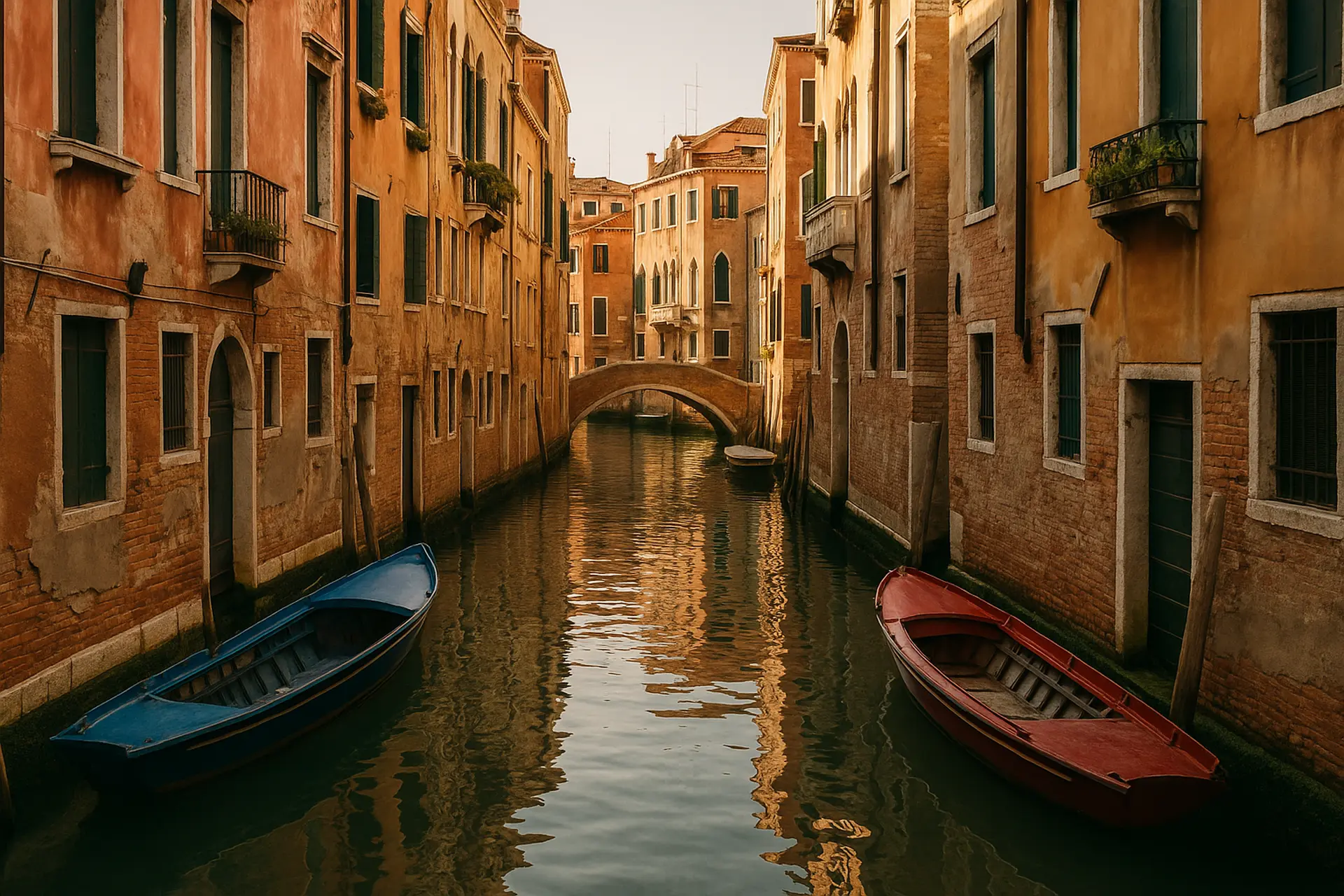
A quiet canal at dusk, with only a single light on, captures the wistful beauty of off-peak Venice. Photographers can compose empty-street shots by lining up canals or bridges in the frame and using long exposures to erase any moving people. In winter or when the sky is cloudy, the soft light and empty benches create their own atmosphere.
Responsible Travel: Overtourism, DOs & DON’Ts
Venice’s fragility demands that visitors tread lightly. Refillable water bottles are a must (tap water is drinkable) to cut single-use plastics. Carry your trash until you find a bin – tossing even fruit peels on canal sidewalks creates unsanitary buildup. When shopping, favor local artisans over tourist stalls. Every euro spent on a genuine Murano vase or lace or wine in enoteca (wine bars) goes directly to Venice’s economy. As one Venice travel writer notes, supporting these glassmakers and grocers sustains a “precious local economy”.
Follow local regulations: don’t sit on church steps or frescoes (many sites prohibit eating), and never swim in the canals (illegal and dangerous). Use marked sidewalks and bridges – although Venice looks pedestrian everywhere, designated paths keep traffic flowing smoothly. Observe Venice’s quiet hours (11 p.m.–7 a.m. curfew for noise in many areas) and avoid bustling the narrow streets at midnight. Avoid behaviors the city has outlawed: feeding pigeons, leaning or walking on monument steps, or using massive selfie sticks in gondolas.
Transportation choices matter: favor vaporetto passes over private motorboats, and if you charter a boat, ask if the skipper uses an eco-friendly engine. Even public buses (ACTV) and water buses operate on clean electricity. If you rent a kayak, share the waterways with care. Protect Venice’s built heritage: clutching a fragile wall or graffiti-ing a basin earns fines and angers locals.
In short, the golden rule is mindfulness. Venice relies on tourism, but it is also a tiny home. Wherever you go, try to give back – buy a gelato from a corner shop, dine in a family-run osteria, or (if you have the time) volunteer or donate to a local charity. These are the best ways to ensure that your visit doesn’t just consume Venetian culture, but sustains it.
Practicalities, Safety & Accessibility
Venice is generally very safe for visitors. Petty theft is the biggest risk. Always keep bags zipped and wallets hidden; don’t leave cameras or phones on tables in quiet cafés. Crowded spots like the Rialto Bridge or vaporetto queues can attract pickpockets, so stay alert there (a money belt worn under your shirt is a deterrent). Locals caution: if someone drops a newspaper or scarf on the ground “accidentally,” it might be a distraction for theft – avoid touching anything that’s dropped by strangers.
Health-wise, Venice is clean, but watch out for acqua alta (high water). In winter and late fall, occasional tidal flooding can cover ground-floor streets. Carry foldable waterproof boots (sold in many shops) if your trip coincides with a higher-than-usual tide. Most hotels and museums will provide raised walkways when flooding is severe.
Accessibility is limited by Venice’s age. Wheelchairs and strollers can manage most promenades and major routes (Piazza San Marco, Accademia Bridge) but many bridges have steps. A few churches have ramps (Santa Maria dei Miracoli and San Giorgio Maggiore have lifts, for instance). Water taxis are generally easier for travelers with mobility issues, as boats can come to your door (though lift access may still be needed at some docks). ACTV service offers at least one wheelchair-accessible vaporetto stop (San Zaccaria). If you require full accessibility, plan ahead: contact Venice accessibility guides, or ask hotels about arranging wheelchair rentals and private accessible boats.
Always have your travel insurance and local emergency info on hand. The tourist emergency number in Venice is 1530 (police) or 115 (medical). Pharmacies (farmacia) are ubiquitous. In extremely rare cases of unrest (the city has seen none recently), follow instructions from local police. Generally, keep usual city-awareness (no blindfolded wandering after midnight) and Venice will feel as safe as any small European town.
Complete FAQ
How can I avoid the crowds in Venice? In short: time your trip and use strategy. Visit off-peak (November–March) and plan main-site visits for early morning or evening. Stay longer (2+ nights) and in a residential sestiere. Alternate your route – do attractions in reverse order or use secondary bridges. When walking, keep to canal-side alleys and avoid streets with tourist banners. On water, choose non-Grand-Canal vaporetto lines (e.g. take #41 or #42 to Murano instead of crowding line 1). Dine at unusual hours or rustic places (skip 7pm at trattoria; try 4pm cicchetti). Above all, embrace randomness: if one calle is packed, turn away from the commotion and trust you’ll end up on a tranquil path or canal. These tactics, cited by travel experts and locals alike, reliably reduce crush.
What are the quietest neighborhoods in Venice? The consensus is Cannaregio and Dorsoduro. Cannaregio (north) is largely residential, with dozens of peaceful fondamenta and the old Jewish Ghetto; many travelers find it “a lot quieter” than the tourist heart. Dorsoduro (south) contains university and arts areas, which empty out in evenings. Other calm areas include Giudecca island and San Giorgio Maggiore island – both are outside the central loop. Even within busy sestieri, you can find pockets of quiet: Castello’s eastern end around Via Garibaldi has local shops, and the small squares of Santa Croce see almost no tour groups. In short, skip San Marco and Rialto quarters if silence is your goal.
When is the best time to visit Venice to avoid tourists? The low seasons (late fall through winter) are best. Aim for November–December or January–February (excluding Carnival days). These months have the fewest foreigners (though expect chilly air and short daylight). March and late October can also be good – mild weather with smaller crowds. Avoid Venice from late April through early September (peak summer and festivals). Note: Venezia’s famous Carnaval in February is not low-crowd (think millions of masked visitors). Check the Biennale and Regata dates too, as these cultural events bring in extra people.
Are Murano and Burano quieter than the main island? When should I visit them? Yes. Murano and Burano each have far fewer people on a given day, precisely because they lie outside the main circuit. If you must choose one, Murano (10-minute vaporetto) is very convenient and close. Arrive first thing (by 9 a.m.) to enjoy its glass shops before the tour buses roll in. Burano’s colors and lace draw midday crowds, so again, morning visits are key. Torcello, reachable via Burano, is the least-visited: by late morning you often have it almost entirely to yourself. Summertime Sundays see more locals visiting these islands, so for solitude pick a weekday. In summary: mornings and off-peak days on Murano/Burano will feel very calm, in stark contrast to any hour on the San Marco strip.
How many days do I need to see Venice without rushing? More than the average visitor, certainly. Venice isn’t large – the core is only 2×2 km – but to absorb it quietly you need time. Data show first-timers often spend only 1–2 nights here. We suggest at least 3 nights/2 full days to begin with: one day for the neighborhoods of San Marco/Castello and Canals (at dawn/dusk) plus one day for Cannaregio + Dorsoduro + San Polo. If you only have 24 hours, plan around one bedtime in Venice so you see it in the early morning and late evening. For a relaxed pace covering most sections (including islands), 4–5 nights is ideal. Any less and you’ll inevitably rush the main attractions. Remember, staying overnight disperses crowds (as Business Insider reports, day-trippers flood in but the city “truly empties at night”). So yes: the more days, the more you enjoy Venice’s hidden life.
Is it possible to see St. Mark’s Square without crowds? Completely crowd-free, never – it’s a public plaza. But you can minimize. The absolute quietest moments are at sunrise or after midnight. A practical approach is to visit the square late in the evening, once the bars close (after 10–11 p.m.), as suggested by local guides. Fewer people linger, and the Basilica lights make the piazza almost serene. Similarly, the first hour of the day (before 8 a.m.) is surprisingly calm: delivery boats pass and pigeons roost, but tourist coaches haven’t arrived yet. During the day, skip the first lines by buying combined tickets online for monuments ahead of time and entering mid-afternoon. In short, if you can stand an early wake-up or a late dinner out, you can have San Marco Square mostly to yourself.
Where can I eat authentic cicchetti away from tourists? Look for bacari frequented by Venetians. Some names to note: All’Arco (near the Rialto market) is beloved by locals; Osteria Ae Fondamenta (Cannaregio) is popular off-hours; Al Merca (Rialto area) is often busy with office workers. The local custom is to stand at the bar or a canal bench with a glass of wine (an ombra) and a few cicchetti. Enoteca Schiavi (Dorsoduro) and Osteria Ai Artisti (Dorsoduro) are known as no-frills, affordable choices. True Venetian plates to look for: polpette (meatballs in sauce), crostini con baccalà, moeche (soft-shell crab, in season). Avoid restaurants with generic continental menus or English-only signs. If you’re unsure, watch where Venice’s workers eat lunch (not on the tourist map).
Which vaporetto lines serve the quieter islands (Murano, Burano, Torcello, Sant’Erasmo, Lido)? Useful lines: 41/42 run between Murano and Venice (Murano Colonna ↔ Ferrovia); 12 goes Fondamente Nove ↔ Burano ↔ Torcello; 13 goes Fondamente Nove ↔ Sant’Erasmo (summer only); 20 loops Venice ↔ Lido di Venezia; 4.1/4.2 go Murano from Rialto; and 17 also connects Fondamente Nove to Torcello via Burano. Alilaguna orange line (airport boats) can also stop at Murano. Each of the islands is also often reached by private lagoon tours or kayak if schedules are tricky.
How do I navigate Venice — maps, apps, offline tips? Download an offline map of Venice (the Venice Citymapper or Maps.me data are excellent). Google Maps also works offline if you preload the map. Create a custom pin map (Google My Maps) of all destinations you plan. Locally, some signs say “SESTIERE…” (the six districts). Yellow street signs typically indicate a major thoroughfare. A phrase to know is “Dove …?” for “Where is…?”. Some Swiss Army knife: a portable phone charger ensures maps don’t die. If you prefer paper, visit a tobacconist (tabaccheria) for a $1 map; it’s often easier to spot tiny calle on paper. Remember: Venezia has no blocks, so coordinates don’t exist. Always note canal or palazzo names; small signboards on walls mark them. Practice reading the mesh of canals and bridges like a spiderweb.
What are the best viewpoints and rooftops with fewer people? Venice’s obvious view is from St. Mark’s Campanile (very busy). Instead, try: Scala Contarini del Bovolo – this spiral tower’s narrow staircase never fills with tourists, and its upper terrace offers unique vistas. Fondaco dei Tedeschi rooftop (near Rialto) is free but needs an online reservation; its panorama covers the Grand Canal with hardly any obstruction. On Giudecca, the Hilton Molino Stucky has an open rooftop bar (day fee) for a lagoon skyline view. Climb the lantern of San Giorgio Maggiore or the less-known stairs of San Pietro di Castello for calmer pros pects. Even some churches have secret terraces: for instance, next to San Zaccaria is a campanile (calls you for coins). These spots see far fewer visitors than, say, the Bridge of Sighs or San Marco’s sides.
How can I plan a 24-hour, 48-hour, or 5–7 day itinerary focused on quiet Venice? Above we sketched out example itineraries for 24 and 48 hours. In general, allocate mornings to major sights (when they are quiet) and afternoons to leisurely neighborhood walks or islands. For a 5–7 day trip, spread out days of famed attractions. For example: Day 1 dawn at San Marco + Rialto + Cannaregio; Day 2 Dorsoduro + Murano; Day 3 Castello + Burano; Day 4 Giudecca + Torcello; Day 5 Lido + Back to favorite spots. Always start early each day and leave evenings free for impromptu canal-side dinners. Include a mix of walking loops (as outlined per neighborhood) and water excursions. If rainy, substitute covered attractions (museums, the Arsenale). Remember: having extra time is your best tool for quiet Venice. If one spot is busy on a given morning, pivot to another plan and return later, as Business Insider travelers often found.
Are there walking routes or sample self-guided routes that avoid San Marco & Rialto crowds? Yes. A basic route is the Cannaregio Circuit (as described above). Another is a Dorsoduro-to-Giudecca loop: start at Accademia Bridge, stroll through Zattere to Giudecca, take the ferry back from Redentore. A Castello-Giardini route goes Via Garibaldi east, through the Arsenale to Sant’Elena park, and back via quieter Fondamenta city streets. VeniceGuide.com and offline apps sometimes label “tourist route” in red; ignore these and look for “residential” or unlabeled paths. In practice, avoid all itineraries that channel you through Piazza San Marco or the Rialto Bridge at peak times. Even simple alternate legs like detouring via Campo San Vio instead of Rialto, or using Accademia Bridge instead of Rialto for crossing, will drastically reduce jostling. We haven’t space to detail every loop, but Google Maps “walking” directions can be switched on and often find shortcuts through calli. Always remember: if a route leads you uphill or directly toward San Marco, there is usually an equivalent backstreet option.
How safe is “off-the-beaten-path” Venice at night? Quite safe by urban standards. Violent crime is very rare. If you wander at night through deserted alleys, keep standard vigilance (no flashy valuables). Most quieter neighborhoods are actually Venetian home areas where locals stroll or chat on benches in the evening. Avoid walking alone through the Ghetto plaza when it’s empty (it’s fine, but can feel eerie); instead stick to main fondamenta if late. Generally, Venice’s off hours are peaceful: small boats still ferry locals home and police do nightly patrols. A tip: if you’re out late, station yourself near a well-lit canal or under a streetlamp in a campo. In any case, the risk of mugging or harassment is low (recent traveler accounts cite the only dangers as slippery sidewalks and high tides, not crime). Use common sense (lock your hotel room, don’t wander with 15-euro gelato dripping). Many single women and families travel Venice at night without incident. In summary, nighttime solo walks are usually safe in residential Venice, far safer than many big cities, as long as you stay alert.
Are there entry fees or tourist taxes I should know about? Yes. City Tourist Tax: Most accommodations must charge a nightly visitor fee (roughly €3–€5 per person per night, depending on hotel rating and season). It is typically collected by the hotel or B&B. Not many people mention it, so be prepared for a few euros extra. Museum & Church fees: Many churches (San Marco, Frari, Accademia) require tickets or suggested donations of €2–€5. The Doge’s Palace and Museo Correr share one ticket. Budget about €25–€30 for entrance fees if you do the big attractions. Some lesser sites are free (Polo della Comunità, Jewish Ghetto heritage sites). Buying a Venice Museum Pass (or combined tickets) can save lines.
Which neighborhoods are best to stay in for an authentic local experience? We covered this above: Cannaregio and Dorsoduro are top picks. Castello east and Giudecca also remain authentically Venetian. Staying in Mestre or near Piazzale Roma could be cheaper, but you’ll sacrifice the charm of winding canals. If authenticity is your goal, stay amid daily life. Even in these neighborhoods, try to rent from Venetians (many locals rent apartments privately) rather than chain hotels. Apartments allow you to shop at the same markets as locals and cook your own Venetian groceries if you wish (thereby living the experience).
What alternative experiences replace a gondola? The quintessential gondola is touristy. Instead, try: Row Venice lessons (real Venetians train enthusiasts to use the oars in the Venetian style). Private boats: Hire a motobarca or a “batèlo” (Venetian taxi boats are smaller than standard water taxis) for a lagoon tour at sunrise. Kayaking tours offer a sporty alternative to float under bridges. Traghetto: a 2€ gondola ferry across the canal (no sightseeing, just a 1–2 minute ride) is a fun quick experience on a working gondola. Any of these gives you the water experience in a more local context.
How to photograph Venice without people in the frame? The key is empty moments: shoot at sunrise or after sunset. Wait at least 10–15 minutes after the published opening time of major sites; often the first entrants will clear out. Long exposures on empty fields (times with fountains off) will blur any stray figure. Use narrow apertures (f/11 or higher) to keep distant structures sharp. For composition, include static foregrounds like a solitary gondola bow or a church shadow. Park at a side-canal and frame distant attractions in a water-channel “tunnel.” If a boat passes, it will ghost out of a 1–2 second exposure. Remember churches often keep stepladders – don’t step up to get that empty shot; be patient for actual emptiness. Finally, sometimes Venice’s emptiness is in detail: close-ups of graffiti on stone, peeling plaster, or quiet café chairs can be as telling as an empty plaza. Keep your gear ready – the empty moments are fleeting – and you will capture Venice as few do.
Accessibility: can travelers with reduced mobility avoid crowds and still see Venice? Touring Venice with mobility needs is challenging but partly feasible. Many main museums now offer ramps or elevators for wheelchair access; for example, Palazzo Ducale and the Accademia Gallery have lifts. The majority of vaporetto lines run wheelchair-accessible boats (look for the symbol at San Zaccaria stop). The Piazzale Roma and Santa Lucia area are fully ramped, as is Piazzale Roma-to-Rialto level. However, narrow bridges with steps block most routes. A few bridges like Ponte della Costituzione have ramps or lifts. Travel in Venice by water taxi if needed – many are wheelchair-friendly with advance notice. Disabled visitors should pick a ground-level hotel and verify its ramp access and how they handle bags. Overall, wheelchair users can indeed visit many sights without crowds, but must plan meticulously with accessible-route maps (available from tourism boards). One positive: with many cars banned, Venice is quieter and (for those in scooters or on wheels) almost more peaceful than a jammed city.
Is Venice overcrowded during festivals (Carnival, Biennale, Regata Storica)? How to handle it? Yes, festival periods are extremely busy. During Carnival (late winter) San Marco and the short, photogenic streets around Piazza will be packed day and night. If you must visit then, expect souvenir stores for masks and schedule exactly — perhaps skip the first weekend and go midweek. The Biennale (May–November, odd years) does bring crowds to the Giardini and Arsenale, but it also draws some tourists off-island to exhibits, so in a way it redistributes people. Still, expect higher hotel rates and metro-vaporetto ticket prices. Regata Storica (first Sunday of September) fills canalsides; locals advise watching from a side canal (or skip it!). In practice, avoid scheduling your only visit during these events. If your trip coincides, use the months’ off-peaks: e.g., see Carnival lantern flights from far Campo Santa Maria Formosa instead of a street view, or reserve island days during Biennale weekends, letting the festival crowds swirl elsewhere.
Are there free or cheap things to do away from the crowds? Absolutely. Venice has many gratis charms: wandering itself is free. Church entry (by donation) at less-touristed churches like San Zaccaria or San Zaccaria Lagoon Mosque is often empty. Public gardens (Parco Sant’Elena, Parco Groggia near Piazzale Roma, and the old Fontego dei Turchi garden) are tranquil open spaces. Watching locals feed pigeons (though discouraged) or hearing bell chimes in a campiello costs nothing. Most squares have free public water fountains (nasoni) to refill bottles. City-run transport costs a modest pass fee (no toll roads here!). Visit the free exhibitions at the Scuola Grande di San Rocco on donation, or the gardens of Guggenheim (some Thursdays free evenings). Keep an eye on local bulletins: sometimes there’s free opera at midnight or orchestral rehearsals in churches. In short, Venice is packed with low-cost experiences – markets, waves lapping stone quays, artisan shop windows – that reveal its character at no price.
How to be a responsible traveler in Venice (sustainability & local impact)? Avoid single-use plastic by carrying your own reusable bag and bottle. Support Venetian craftspeople: buy real Murano glass from a local atelier (many studios have “factory shops”), Venetian linens or leather from family-run stores, and local wines (ombra wines) by the bottle from enoteche. Plan meals at neighborhood osterie so income stays in the community. Respect local norms: queue for boarding the vaporetto, give up your seat to an elderly Venetian, and speak quietly in enclosed spaces. Do not throw coins into canals (pollutes the water) or lift and start walking with a local’s bicycle (illegal). If you use ride-sharing, choose a electric water taxi or a human-powered boat. Read up on Venice’s conservation: consider donating a euro at museum entries for restoration funds. Every small thoughtful act helps ease Venice’s overtourism strain.
Which local artisan workshops accept visitors or take reservations? Many do with notice. Glass: Several Murano studios (e.g. Venice Glass School, Seguso) allow drop-in demos or paid workshops if booked. Mask-makers: Tiepolo or Tragicomica (cast mask shops) often offer brief paid lessons. Marble inlay: The Museo del Merletto in Burano and jewel workshops (off Calle Larga XXII Marzo) sometimes welcome visitors. Printmaking: Stamperia di Venezia (the Olivetti place) occasionally allows observing the Venetian woodblock process. Culinary: The Rialto Market has cooking tour operators (Venice Cooking school). For each, Google the shop name + “workshop” to see if a reservation is needed. In general, avoid any place that looks like a souvenir stall; instead look for signboards like “Laboratorio” (workshop). A good rule is to go mid-morning or early afternoon on a weekday for a chance to chat with the artisan between commissions.
Are night-time and early morning the only times to find solitude? Any alternatives? They are the most reliable, but not the only ways. Mid-day can also be quiet if you are away from major attractions. For example, the Jewish Ghetto is almost always calm after 4 pm even in high summer. The Mercato di Rialto area empties out early afternoon (when chefs have finished shopping). Similarly, after the college students depart Campo Santa Margherita around 10 pm, that square becomes peaceful. If your schedule doesn’t allow pre-dawn hours, try deep afternoons (3–5 pm) in smaller sestieri; Venetians often stay indoors during late afternoon, leaving outer calle nearly deserted. Also, ride the first boat in the morning: even the number 1 vaporetto departing San Marco at 7am will have a handful of commuters and otherwise empty seats. In short, any time you stick to side streets instead of the Grand Canal and main squares, you’ll find a measure of solitude.
Where are the best markets for local life? The Rialto fish and produce markets (Campo de la Pescaria and Campo dell’Albergheria) are Venice’s heart of daily commerce. They open by 7:30 a.m. on weekdays. Here the Venetians shop for their seafood and vegetables, and you can often observe chefs and restauranteurs picking ingredients. Another is the small morning weekly market at Sant’Aponal (Castello) every Wednesday. For grocery-style markets, check Campo Madonna dell’Orto (Cannaregio) and Via Garibaldi (Castello) – these serve locals and close by 1pm. Evening markets are rare in Venice. The advice is: to see Venetian market life, be at Rialto well before 9 a.m.; it is a vibrant, authentic scene long before any tour group arrives.
Can I find quiet outdoor spaces or parks in Venice? Yes. The Giardini (Royal Gardens) near St. Mark’s (entrance free on the waterfront side) are lovely and almost empty by late afternoon. The Rose Garden at San Francesco della Vigna (Castello) is secluded and ringed by cloisters. Sant’Elena Park (Giardino dei Giardini della Biennale, Castello end) offers lagoonside paths and an empty football field. Parco Tiziano (Cannaregio) by the Guggenheim is a tiny secluded square. These parks see mostly local dog-walkers and are safe havens of green. Be wary of sunken piazzette like Campo SS. Giovanni e Paolo on acqua alta days, but otherwise take off your shoes and sit by any public water fountain or bench in a garden for a few quiet minutes.
Does the MOSE flood barrier affect access to islands? As of 2025, the MOSE barriers (designed to protect Venice from sea surges) are operational but have had minimal tourist impact. Occasional tests cause small-tide changes. The islands remain accessible; if anything, MOSE has cut the frequency of high water closures on Venice proper. You do not need to worry about MOSE disrupting your island plans unless a rare maintenance closure is announced.
Are small private tours better for avoiding crowds than independent exploring? They can be. A private walking tour or boat charter ensures you set off on a schedule and often can have priority entry somewhere. Small group tours (6–12 people) will choose off-peak times and the guide can steer you down quieter alleys. However, they cost more and reduce spontaneity. Independent travel (as in this guide) offers ultimate flexibility: if you see an empty street, you can follow it. In practice, a mix works well: you might book one small tour (for instance, a privately guided Jewish Ghetto or Doge’s off-hours tour) and spend the rest of the time unguided. Either way, the slowest, most immersed experiences happen on your own timetable, but guided tours can skip lines and deepen understanding.
How to use public ferry vs private water taxi (cost vs privacy)? A public vaporetto pass (24h, 48h, etc.) is very cost-effective if you ride often – it may cost €80 for 48h unlimited rides (split among travelers). Private water taxis charge roughly €100–€150 for a one-way downtown trip, which is pricey but fast and exclusive. If traveling with family or mobility needs, a private boat may be worth it. Otherwise, aim to rely on public lines (#1–2 on canal, #4–12 on lagoon) most of the time. For single rides or off-hours when vaporetti stop (after midnight), a taxi can save time. In short, compare convenience vs. cost: a 6-person group at €25 each could take a taxi comfortably, but for a solo traveler the vaporetto is usually the better deal.
Can I bike or walk to nearby mainland towns to escape crowds? Venice itself has very limited cycling (bikes on Lido only). However, short daytrips to the “mainland” islands are possible: Pellestrina (south of Lido) can be reached by ferry from Lido, and it has quiet beaches and villages. The fishing town of Chioggia is accessible by train from Venice (Santa Lucia station, about 1h trip). Chioggia is nicknamed “Little Venice” and sees far fewer tourists; its canals and market are genuinely local. On the Venetian lagoon’s fringe, you could take a day bus from Venezia-Mestre to Treviso or Padua for a change of pace. Overall, while most travelers stick within the lagoon, venturing to Pellestrina or even a train ride to Chioggia (with a seafood lunch) is a great way to extend the calm trip by a few hours.
What apps, maps, or local resources help find quieter routes in real time? Several map apps now include crowd indicators or “popular times.” Google Maps (if data is enabled) shows live busyness levels of attractions. The Venice ACTV app will show the real-time position of ferries (useful to see if the boat is packed). Crowd-sourced apps like Mapstr or even TripAdvisor can reveal user photos timestamps (see if a restaurant or plaza looks empty). Instagram hashtags or Blogger posts titled “Venice dawn” can pinpoint photo spots in emptier conditions. Perhaps the best resource is local advice: chat briefly with a shopkeeper or B&B host about their personal quiet-time tips. We also provide a downloadable Venice Quiet Map (search online or sign up to our newsletter) with pinned lesser-known gems and vaporetto lines. In short, combine official timetable apps with the low-tech map in hand and you’ll quickly learn to sense where quiet Venice is.