

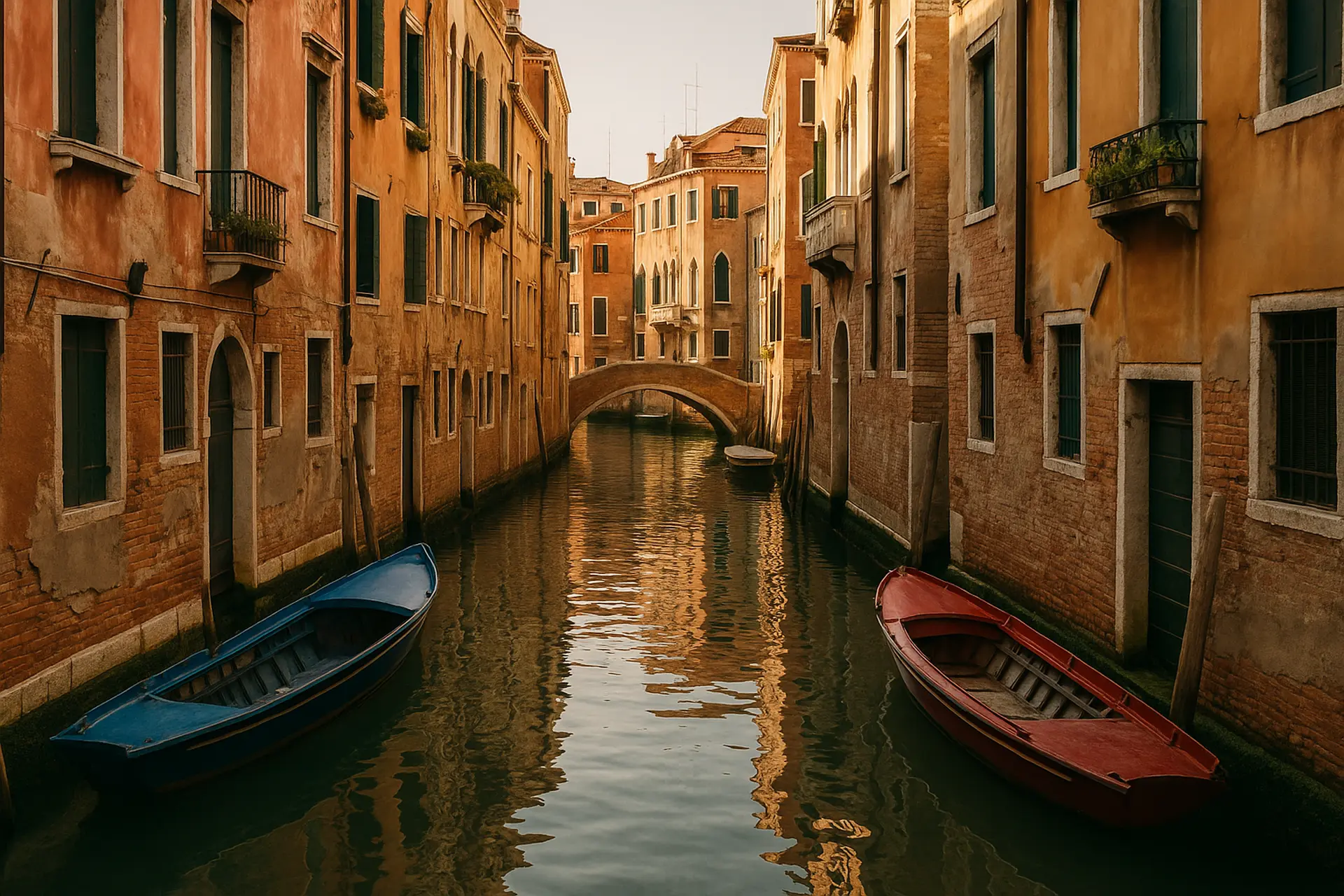
A slower map of the lagoon city
Finding the Real Venice Away from the Crowds
Venice becomes more legible when the landmark checklist gives way to neighbourhood time, waterborne geography and ordinary urban rituals.
This guide treats quiet not as an undiscovered secret, but as a way of moving that gives the living city more room.
Venice does not have a hidden second city waiting behind a theatrical curtain. The same bridges, churches, workshops, apartment windows and lagoon edges that appear in photographs are also parts of a working urban system. What changes the experience is not possession of a secret address but the traveller’s pace, timing and willingness to leave the shortest line between the railway station, Rialto and Piazza San Marco. A visitor who crosses the city as a sequence of famous objects meets congestion. A visitor who reads it as six historic districts, inhabited islands and a tidal landscape begins to notice how many different Venices occupy the same map.
The practical reward is immediate. Early mornings return sound to the canals. Residential fondamenta reveal schools, groceries, boat repairs and conversations that disappear beneath daytime visitor traffic. A ten-minute waterbus ride changes the scale of the journey: campanili become navigation marks, the skyline opens, and the historic centre is understood as one dense cluster inside a much larger lagoon. Quietness is therefore relational. Cannaregio may feel calm beside San Marco at noon but lively beside Torcello. Giudecca may seem removed until a vaporetto shows how closely it faces Dorsoduro. The goal is not to rank places by silence but to match each place with the hour and attention it deserves.
This approach also avoids the language of conquest that often surrounds “hidden gems.” Venice’s less-visited streets are not empty stages, and local life is not scenery arranged for authenticity. The city asks visitors to behave as temporary participants: keep passages clear, respect homes and places of worship, manage waste, use licensed services and spend in businesses that sustain local work. Official guidance from the municipality frames responsible conduct as part of preserving an exceptionally fragile urban and lagoon environment. That ethical dimension is not separate from a better trip. It is what makes a slower, more observant trip possible.
The following route is designed around distinct primary places rather than a single day of frantic coverage. Venice itself comes first as a city to be understood. Cannaregio and Dorsoduro then show two different versions of residential and cultural life. Giudecca changes the viewpoint by moving across the canal, while Torcello extends the story into the lagoon’s long history. Other districts and islands appear as supporting possibilities, not as boxes that must all be ticked. The result is a guide for staying longer, walking less predictably and allowing the city to disclose its structure one crossing at a time.
Before choosing a district
Quiet Venice begins with a different method
Crowd avoidance works best when it is built into the shape of the day rather than treated as a hunt for secret coordinates.
A slow itinerary is not an empty itinerary; it gives each place enough time to become more than a photograph.
The familiar Venice day often begins with a queue, accelerates through a chain of monuments and ends with fatigue. That pattern concentrates visitors in the same narrow corridors at the same hours. A quieter day reverses the logic. It begins with a neighbourhood or waterside walk, gives one major interior its own time window, and leaves enough margin for a ferry, a market stop or an unplanned campo. The central landmarks remain available, but they are no longer the skeleton of the whole day. Piazza San Marco before the daytime rush, for example, is not a “hack” so much as evidence that time can transform a place without changing its architecture.
The most useful navigation skill is to recognise desire lines. Signs pointing to Rialto, San Marco, Ferrovia and Piazzale Roma channel enormous flows through a limited network. Leaving that line by one or two bridges often changes the atmosphere within minutes. This does not require getting deliberately lost in a romantic sense. Venice has dead ends, private passages and boat-only edges, so good judgement still matters. It means using a map to understand orientation while refusing to treat the fastest route as the only route. Parallel fondamenta, secondary campi and cross-canal detours turn transit into observation.
Weather also rearranges the city. Heat makes exposed stone exhausting and pushes crowds toward shade. Rain sends people into arcades and museums. Winter fog compresses distance and softens the lagoon, while high water can interrupt normal pedestrian movement. A calm plan therefore includes an indoor alternative, suitable footwear and the expectation that water transport may be adjusted. The municipality and transport operator publish live information, and those sources should outrank a static itinerary. Flexibility is especially important for travellers with limited mobility, because bridges, steps, narrow boarding points and older buildings create real barriers even when a route looks short on a map.
Finally, crowd avoidance should not become displacement without thought. A group that leaves San Marco only to block a residential bridge in Cannaregio has not solved anything. Small groups, quiet voices, compact luggage and respect for doorways matter. So does spending: a morning coffee, a bookshop purchase, a craft workshop or a meal in a neighbourhood business supports the city more directly than a trail of photographs. The best measure of a quiet itinerary is not how few other visitors appear in the frame. It is whether the route makes room for residents, gives the traveller a fuller understanding and reduces the pressure to consume the city at speed.
Choose one anchor
Select one major museum, church or landmark for the day and let the rest of the route remain flexible.
Travel at the edges of the day
Use early morning and evening for central spaces, when commuter and visitor patterns are different.
Cross the main flow
Move perpendicular to the signed landmark routes and explore parallel canals rather than following the fastest path.
Add one water journey
A vaporetto ride gives rest, orientation and a wider sense of the lagoon city.
Leave before saturation
When a small place becomes crowded, move on rather than waiting for the atmosphere to improve.
Veneto · Italy
Venice
The real alternative to crowded Venice is not another destination but a deeper reading of the same city.
Best for: first orientation, dawn walks, evening returns and understanding how the historic centre relates to the lagoon

Editorial guide
Read Venice as a network of thresholds
Venice is compact enough to encourage overconfidence. On a map, the historic centre appears walkable from end to end, and many visitors assume they can collect its major sights in a single sweep. The physical distance is indeed small, but the experiential distance is not. Bridges slow movement, alleys redirect it, queues consume time and the absence of wheeled road transport changes the meaning of every arrival. Luggage, deliveries, waste collection, emergency services and commuting all move through constrained spaces. Understanding that friction turns apparent inconvenience into the central fact of the city.
The Grand Canal is the clearest organising line, but it should not become the only one. Smaller canals reveal how buildings meet water at service doors and stone steps. Campi function as neighbourhood rooms rather than decorative pauses. Churches mark former parish communities, and each sestiere retains a distinct balance of housing, institutions, tourism and open space. A waterbus journey along the Grand Canal is therefore most useful near the beginning of a stay. It establishes the sequence of palaces, bridges and stops, but also shows how much city remains invisible behind the facades.
Staying overnight changes the relationship dramatically. The last wave of day visitors recedes, shutters close, deliveries resume and residents reclaim routes that felt impassable earlier. Morning brings another transformation: market workers, school journeys and café routines appear before sightseeing traffic thickens. None of this guarantees solitude. Venice is a globally famous city with events, commuters, students and seasonal peaks. The point is that an overnight visitor can choose among several urban moods instead of encountering only the busiest one.
The city’s fragility should remain visible throughout the experience. UNESCO recognises Venice together with its lagoon, not as an isolated museum of stone. Tides, erosion, wave motion, maintenance and demographic pressure shape what the visitor sees. Responsible behaviour is therefore practical heritage care. Sitting on bridges obstructs circulation; swimming in canals is dangerous and forbidden; feeding birds distorts urban ecology; and careless waste becomes a burden in a place where collection is logistically complex. A quieter Venice is inseparable from a more respectful Venice because both depend on recognising that the city is alive, constrained and shared.
Distinct districts connected by bridges and water routes.
UNESCO treats the built city and its water landscape as one property.
Neither mode alone explains the city’s full geography.
North Venice · Residential canals
Cannaregio
Long fondamenta and layered Jewish history make Cannaregio a district for walking with context rather than chasing a single attraction.
Best for: early walks, evening bacari, the historic Ghetto and a gentler arrival from the railway station

How to experience it
Move north of the transit corridor and let the canals lengthen
Cannaregio receives almost every rail traveller, yet much of the district remains outside the direct station-to-Rialto flow. Strada Nova carries heavy foot traffic, but the atmosphere changes along the northern canals, where long, comparatively straight fondamenta create room to walk and observe. The district is neither a preserved village nor a tourist-free enclave. It is a mixed urban area of homes, bars, workshops, religious institutions and accommodation, and that mixture is precisely its value.
The historic Ghetto requires more than a quick photograph. Created in the sixteenth century, it became the enforced residential area for Venice’s Jewish population and gave the word “ghetto” to later languages. Its campi and synagogues tell a story of restriction, community, commerce, scholarship and survival. Visitors should approach active religious spaces with the same care they would bring to any living place of worship. Museum and guided-visit arrangements can change, so current official or institutional information should be checked before arrival. The strongest experience comes from allowing historical interpretation to shape the walk rather than treating the area as an atmospheric backdrop.
West and north of the Ghetto, the district opens toward quieter canals and the lagoon edge. Fondamenta della Misericordia and neighbouring stretches become social in the evening, when residents and visitors gather outside bacari. This is not silence, but it is a local form of public life that differs from the compressed tourism of San Marco. A cicchetto and a small drink can be part of that rhythm when ordered with awareness: avoid turning narrow thresholds into private seating areas, keep groups small and remember that the surrounding buildings are homes.
Cannaregio also works well as an arrival or departure district because it allows a gradual transition. Instead of racing from the station, a traveller can store luggage appropriately, step away from the main axis and spend the first hours learning the city’s scale. Bridges, laundry lines, boat traffic and ordinary shopping streets establish a vocabulary that makes later monuments more intelligible. By the time Rialto or San Marco appears, it belongs to a wider urban story rather than standing as the whole of Venice.
South of the Grand Canal · Art and waterfronts
Dorsoduro
Dorsoduro balances major collections with broad waterside walks, student life and small-scale crossings that reward an unhurried afternoon.
Best for: art museums, architectural walks, sunset on the Zattere and an evening around Campo Santa Margherita

How to experience it
Pair one collection with the district around it
Dorsoduro contains enough celebrated art to reproduce the same checklist pressure found elsewhere, yet its geography encourages a more balanced day. The Accademia, the Peggy Guggenheim Collection, Punta della Dogana and major churches can each justify a focused visit. Trying to combine all of them reduces the district to interiors and queues. Choosing one anchor leaves time to understand how palaces, boatyards, university buildings and waterfronts fit together.
The Zattere is the district’s great release of space. The long promenade faces the Giudecca Canal, where working boats, ferries and changing light replace the enclosed perspective of minor canals. It can be hot and exposed in summer, so morning or late afternoon is often more comfortable. From here, the city’s waterborne logic becomes obvious: Giudecca sits directly opposite, industrial and religious landmarks share the horizon, and the lagoon breeze alters the physical experience of walking.
Inside the district, smaller crossings create a different rhythm. Squero di San Trovaso offers a view of the gondola-building tradition, though it remains a working site rather than a staged attraction. Campo San Barnaba and surrounding lanes bring visitors into contact with shops, schools and residential life. Campo Santa Margherita becomes animated later in the day, particularly with students and families. The square is not a guaranteed refuge from crowds, but its social life feels less ceremonial than Piazza San Marco and makes a natural endpoint for a day that has mixed art with walking.
Dorsoduro is also a useful lesson in timing. Museum opening periods, church services and temporary exhibitions shape the day, while the waterfront remains available as a flexible interval. A reservation should create structure, not urgency. Arrive with enough time to cross the Accademia Bridge slowly, notice the Grand Canal from a less compressed viewpoint and continue without treating every doorway as an obligation. The district’s strength is not that it is unknown; it is that substantial cultural institutions are embedded in a neighbourhood with enough spatial variety to absorb attention.
A balanced Dorsoduro afternoon
Choose one major collection
Give the Accademia, the Guggenheim or Punta della Dogana enough time rather than rushing between all three.
Walk the Zattere
Use the waterfront to recover orientation and see the Giudecca Canal as a working route.
Cross the inner campi
Small squares and bridges reveal the district beyond its museum addresses.
Giudecca Canal · Island neighbourhood
Giudecca
Across a short stretch of water, Venice becomes a skyline and Giudecca becomes a place with its own working, religious and residential identity.
Best for: broad views, waterfront walking, Palladian architecture and a calm evening reached by vaporetto

How to experience it
Use the crossing to change scale, not merely to escape crowds
Giudecca is often described as an escape from central Venice, but that framing risks making the island valuable only in relation to somewhere else. It has its own sequence of churches, housing, former industrial sites, gardens and waterfront businesses. The vaporetto crossing is short, yet the separation by water is psychologically powerful. San Marco and Dorsoduro become a continuous skyline, and the pressure to move between individual monuments gives way to a wider view.
The church of Il Redentore provides a strong architectural focus. Designed by Andrea Palladio and associated with the city’s deliverance from plague, it remains both a major work of architecture and a living religious site. Its annual festival transforms the canal with a temporary bridge and intense activity, demonstrating that “quiet Giudecca” is not a fixed condition. Event dates, services and access should be checked. Outside those peaks, the church and surrounding fondamenta can anchor a measured walk that includes long pauses rather than constant stops.
Giudecca’s industrial past appears in large buildings and conversions, including the former Molino Stucky complex. Contemporary hotels and cultural spaces have changed parts of the island, creating tension between local life, luxury development and tourism. A thoughtful visit notices that contrast instead of presenting the island as uniformly traditional. The most rewarding stretches are often ordinary: a bench facing the canal, a grocery errand unfolding around a vaporetto stop, a boat being loaded, or evening light moving across the facades opposite.
Because every return requires water transport, Giudecca encourages commitment. It works particularly well for travellers who are willing to stay through sunset or sleep on the island rather than treating it as a brief viewpoint. The trade-off is dependence on service frequency and possible disruption. Checking the official timetable, validating the correct ticket and allowing margin for the last connections are basic parts of the experience. The reward is a Venice that feels less like a maze and more like an archipelago.
The island is close to Dorsoduro and San Marco but not connected by a public footbridge.
Palladio’s church gives the island a monumental focus.
Looking back across the canal reveals Venice’s horizontal form.
Northern lagoon · Historic island
Torcello
Torcello replaces urban density with fields, canals and early religious monuments, offering historical depth rather than a catalogue of attractions.
Best for: lagoon history, early mosaics, a rural walk and travellers prepared to plan around boat connections

How to experience it
Come for historical scale, not a list of sights
Torcello is frequently marketed as an empty or forgotten island, but its importance lies in how it complicates the story of Venice. Settlement in the northern lagoon developed in response to changing political and environmental conditions, and Torcello became an important early centre before the dense urban islands farther south assumed dominance. The remaining cathedral complex and archaeological traces are therefore not picturesque leftovers. They are evidence of a shifting lagoon civilisation.
The approach is part of the visit. From the landing stage, a path follows a canal through a low landscape that feels unexpectedly rural after central Venice. The cathedral of Santa Maria Assunta and the nearby church of Santa Fosca form the principal historic ensemble. Interior mosaics reward slow looking, but access arrangements, religious use and tower availability should be checked before travel. Torcello is not a place where a closed door can easily be replaced by ten nearby alternatives.
That limitation is also its discipline. Visitors need to understand waterbus connections, seasonal demand and the relationship with Burano, where transfers are often made. Missing a connection may produce a long wait, so the island should not be squeezed into a narrow gap before another reservation. Bring water in warm weather, prepare for exposed conditions and treat the walk itself as the main activity. The absence of dense retail or entertainment is not a defect to be filled.
Torcello makes the lagoon’s environmental dimension visible. Reeds, channels, mudflats and distant islands surround the historic structures. The setting demonstrates why Venice cannot be separated from water management, navigation and ecological change. A visitor who has already explored crowded central routes may find the contrast restorative, but the deeper value is intellectual: Torcello reveals that Venetian history is a story of movement among islands, not the inevitable growth of a single fixed city.
The city between profiles
Small practical choices determine whether the itinerary stays humane
Tickets, meals, luggage and behaviour are not administrative details; they shape the pressure a visitor places on the city.
Use official systems, avoid obstructing narrow spaces and choose businesses that contribute to local life.
Venice’s public transport is part of the destination’s identity, but it is also a regulated system used by residents. Visitors should understand the difference between a scenic ride and a commute. At busy stops, prepare the correct ticket before boarding, validate as required, allow passengers to disembark and avoid blocking gates with luggage. Multi-day products can be useful for an itinerary that includes Giudecca or the outer lagoon, but current validity, inclusions and fares should be confirmed through ACTV or the official AVM Venezia app. A static list of route numbers can become obsolete when services change.
Food offers another route into the city’s rhythms. Cicchetti work best as small bites within a social pattern, not as an excuse for a large crawl through residential streets. Standing bars have limited space, and popular addresses can become crowded quickly. Move on after a short stop, order with clarity and remember that the cheapest item is not the only measure of value. Markets and fish dishes also require context: seasonality, lagoon ecology and changing regulation influence what appears on counters. Asking where ingredients come from can be more meaningful than searching for a single supposedly authentic plate.
Accommodation choices affect both experience and the city’s housing pressures. Sleeping in Venice gives access to quieter hours and reduces the frantic logic of a day trip, yet visitors should choose lawful, professionally managed lodging and follow local registration and tax rules. Historic buildings may lack lifts, step-free access or modern sound insulation. Check the exact route from the nearest stop, including bridges, before booking. A room that looks close in straight-line distance may be difficult with luggage or mobility limitations.
Secondary districts and islands can extend the itinerary without becoming additional obligations. Eastern Castello offers parks and residential streets beyond the Arsenale. Burano is visually distinctive but can become extremely busy in the middle of the day. Murano’s glass tradition deserves attention beyond free demonstrations designed mainly to funnel visitors into showrooms. Sant’Erasmo and other lagoon areas require more planning and provide fewer services. These are valid options when they match the traveller’s interests and available time, not because every map label must become a stop.
Responsible travel also means accepting limits. Churches may be closed for worship, paths may be flooded, boats may be full and residents may not want to be photographed. The city is not failing when it refuses perfect access. Building margin into the itinerary turns those limits into manageable changes rather than crises. That margin is the practical form of respect: it reduces rushing, lowers conflict and allows Venice to remain a place rather than a product delivered on schedule.
Secondary possibilities
Castello beyond the Arsenale
Residential streets, gardens and wider waterfronts offer a different urban texture when visited without turning them into a new checklist.
Burano at the right hour
The island’s painted houses are most rewarding when arrival and departure avoid the busiest middle of the day.
Murano beyond the showroom
Look for serious interpretation of glassmaking and respect working studios rather than expecting unrestricted demonstrations.
Sant’Erasmo and slower routes
Less-visited islands require more timetable awareness and a willingness to accept limited services.
Is winter always the quietest time in Venice?
Winter can be calmer, but Carnival, holidays, weather and event calendars can produce sudden peaks. Check current conditions rather than relying on a seasonal slogan.
Can Venice be experienced without visiting Piazza San Marco?
Yes, but the square remains central to the city’s history. A better strategy is to visit at a quieter hour and place it within a broader neighbourhood itinerary.
Is walking always faster than taking a vaporetto?
Not necessarily. Bridges, indirect routes and crowding can slow walking, while a waterbus may provide a direct connection and valuable rest. Compare official route information.
Are the outer islands empty?
No. They contain communities, workplaces, religious sites and seasonal visitor flows. Treat them as inhabited places, not private refuges.
Final perspective
The real Venice is not found by escaping the city, but by allowing it more time.
Venice’s most powerful alternative itinerary is not a secret chain of empty courtyards. It is a change in relationship. The traveller stops demanding instant access, accepts water and time as organising forces, and recognises each district or island as a place with its own history. Cannaregio, Dorsoduro, Giudecca and Torcello do not compete to be the “most authentic.” Together they show how varied the lagoon city becomes when the central corridor no longer dominates every hour.
That variety makes a strong case for fewer plans and longer stays. One major interior, one neighbourhood, one water journey and one unstructured interval can produce a fuller day than a catalogue of attractions. The city’s beauty survives repetition, but its meaning grows through contrast: dense and open, monumental and ordinary, stone and mudflat, crowded and suddenly still.
The responsible visitor leaves with no claim to having discovered a Venice unknown to others. Instead, the visitor has learned to notice how the city works and to move through it with less friction. That is a quieter achievement, and a more durable one. It returns Venice from the status of impossible postcard to the complexity of a living place.