
Tibet’s monasteries are not mere stone and prayer wheels; they are the living centers of a millennia-old Buddhist tradition. High in the Himalayas, gompas (Tibetan monasteries) once shaped every aspect of Tibetan life – from politics and education to art and daily culture. Quick Facts: Tibet’s great Potala–Jokhang–Norbulingka complex is a UNESCO World Heritage ensemble; the Dalai Lama was both the spiritual abbot and temporal ruler from 1642; Samye (8th c.) was Tibet’s first monastery; Sera Monastery in Lhasa still hosts daily debating sessions. Monasteries range from sprawling complexes like Tashilhunpo to remote hermitages in the Everest region. This guide will weave history, culture and practical advice: travelers will find site-by-site details, insider tips, festival dates, and a full FAQ answering every question about visiting Tibet’s sacred gompas.
- Why Tibetan Monasteries Matter: Religion, Culture & Power
- The “Great” Monasteries: Lhasa’s Big Three and Why They Matter
- Lhasa’s Spiritual Heart: Potala Palace & Jokhang Temple
- Other Major Monasteries: Samye, Tashilhunpo, Sakya, Rongbuk, Reting, Pelkor
- Tibetan Buddhist Lineages & Monastic Education
- Architecture, Art & Iconography of Tibetan Monasteries
- Rituals, Festivals & Daily Life
- Ethics & Etiquette: How to Be a Respectful Visitor
- Practical Planning: Permits, Tours & Logistics
- Health, Safety & Responsible Travel
- Experience Guides & Suggested Itineraries
- Can I Stay, Volunteer or Study at a Monastery?
- Monastery Conservation, Restoration & 20th-Century History
- FAQ
- Timeline, Glossary
Why Tibetan Monasteries Matter: Religion, Culture & Power
Buddhism is woven into the very fabric of Tibet. One travel writer observes that “Buddhism is the lifeblood of the region,” visible in “strings of prayer flags, mountaintop lamaseries and chanting, maroon-robed monks”. Legend says the 7th-century king Songtsen Gampo married Buddhist princesses from Nepal and China, planting faith at Tibet’s royal core. From that era forward, monastery and throne became intertwined.
By the 15th century, the scholar Tsongkhapa founded Ganden Monastery (1409) with a strict observance of discipline. Britannica notes that “Tsong-kha-pa…founded his own monastery at Dga’-ldan, devoted to the restoration of strict monastic discipline.” This attracted Tibetans weary of conflicts among older schools. Tsongkhapa’s disciples formed the Gelug (Yellow Hat) order, which gradually moved into governance. In 1578 Altan Khan of Mongolia conferred the title Dalai Lama on the Gelug hierarch, an honor signifying “Ocean-Great Lama” as spiritual ruler.
By 1642, Mongol patron Güüshi Khan enthroned the 5th Dalai Lama as Tibet’s ruler, uniting temporal and spiritual authority. Britannica recounts that “Güshi enthroned the Dalai Lama as ruler of Tibet, appointing…a reformed government. Lhasa, long the spiritual heart, now became the political capital.” Gelug became supreme over older orders; traditional rivalries were suppressed. As a result, monasteries acted not only as universities and temples but as political power centers. They held vast estates, collected tithes, and educated thousands of monks in scripture and ritual.
Across the centuries, these monasteries preserved Tibetan art, language and ceremony. In their halls lay great collections of murals, thangka scrolls and historic texts, protected through upheavals. UNESCO writes that the Potala and Jokhang monasteries are “outstanding examples of Tibetan Buddhist style” with thousands of images and scriptures. In daily life, monks recited prayers, taught laypeople, and directed pilgrimages. One writes of accompanying farmers and nomads on kora (pilgrimages) for Losar New Year – “You hear them uttering prayers under their breath…incense-sweetened air.” Monasteries remain today depositories of intangible heritage: the rituals, debates and festivals that animate Tibetan society.
Major Lineages: Tibetan Buddhism is traditionally divided into four main schools. The Nyingma (“Old Translation,” 8th c.) owes its start to Guru Padmasambhava and Shantarakshita at Samye. Sakya (founded 1073) and Kagyu (11th c.) emerged later, each with distinct monasteries. The Gelug (1409) became the dominant order, running great campuses like Drepung, Sera and Ganden (the so-called “Three Seats of Lhasa”). Each school still operates its own monasteries today, but Gelug’s role in history left a unique mark on Tibet’s political landscape.
The “Great” Monasteries: Lhasa’s Big Three and Why They Matter
Lhasa holds the highest concentration of famous monasteries. The so-called “Three Great Monasteries” of Lhasa are Drepung, Sera and Ganden. All three are Gelug institutions founded in the 15th–17th centuries atop nearby hills. Together they enrolled thousands of monks, rivaling a modern university in size.
- Drepung Monastery: Once home to over 10,000 monks, Drepung (“Rice Heap”) lies just west of Lhasa. Founded in 1416 by a disciple of Tsongkhapa, it served as a training ground for Dalai Lamas and other Gelug leaders. Visitors encounter vast courtyards and assembly halls (dukhangs) filled with gilded statues. The oldest section, Jey College, dates to the 15th century. Inquire at the ticket office about guided tours: these will explain the monastery layout – famously built like a miniature palatial city with chapels, dormitories, and storage chapels. A dozen decades ago much of Drepung was damaged, but restoration has revived its bright red and white walls. From the rim above Drepung one can see Lhasa below – an impressive sweep of rooftop prayer flags. (Allow 2–3 hours to visit; altitude ~3,650 m.)
- Sera Monastery: Sitting just north of Lhasa city, Sera still functions as an active monastic campus. It is famed for its daily debate sessions: on warm afternoons, hundreds of visitors gather on the monks’ stomping ground for an intellectual spectacle. Young monks in crimson robes leap and clap to punctuate their points as they argue Buddhist logic. These debates are part of the traditional geshe examination, not a staged show. The church-like White Hall (Zha-lu) contains an enormous Buddha and frescoed walls; the orange-tiled Nakartse complex overlooks quiet students under plum trees. Weaving through Sera’s college quarters, one senses scholarly rigor: a staffer noted that memorization of scriptures and formal debate are required stages of any monk’s education.
- Ganden Monastery: Perched higher still, Ganden was Tsongkhapa’s original monastery (1409) and the historic seat of the Gelug school. It requires a steep trek about 40 km from Lhasa or a rugged road journey (4–5 hours by 4×4). On clear days, a path above the Prayer Wheel Hill leads to Ganden’s red-and-white complex sprawling over a ridge. From there the sight of “Ganden Khangmar” (the highest point) beneath a backdrop of distant Karola Glacier is unforgettable. Inside the main Tsokchen (Great Assembly Hall) are gold statues of Shakyamuni and Tsongkhapa. A gentle kora (pilgrimage circuit) winds around the hilltop stupa complex. Ganden often closes mid-winter due to snow; visitors should verify open dates.
Lhasa’s Big Three are Gelug bastions, and in narrative one hears how each backed the Dalai Lamas. (For example, the 5th Dalai Lama prayed there during the Mongol campaign that won him power.) Today their courtyards are spiritual theaters: aside from Sera’s debates, one can witness early-morning pujas or simply join pilgrims circling the chapels clockwise.
Lhasa’s Spiritual Heart: Potala Palace & Jokhang Temple
Lhasa’s skyline is dominated by the Potala Palace and near the old town center stands the Jokhang Temple. Both are living monasteries of a sort, though each is unique.
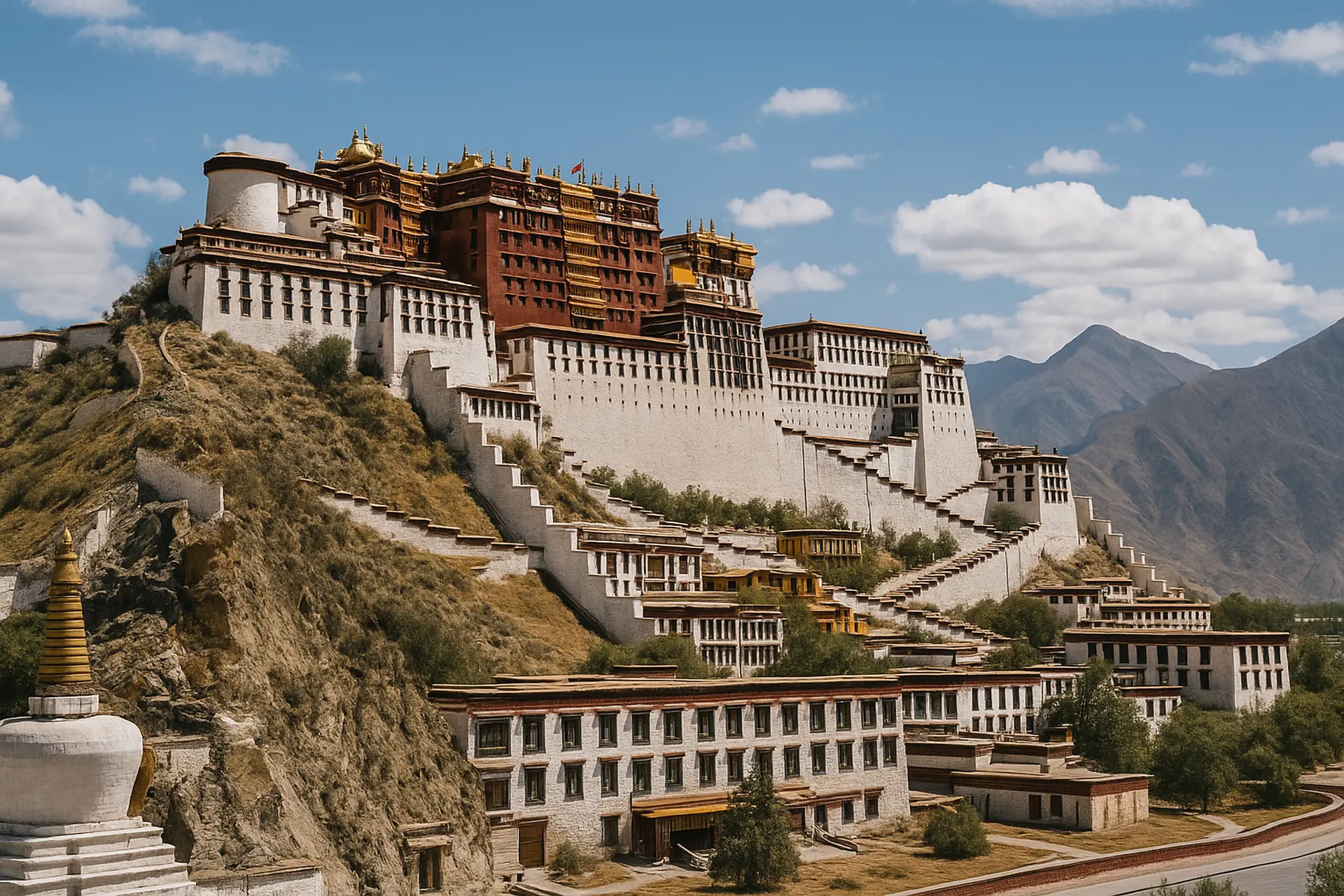
The Potala Palace was built on Red Hill starting in the 7th century (9th Dalai Lama) but took its present form under the 5th Dalai Lama in the 17th century. This vast white and red fortress is partly a monastery. It served as the winter palace and monastic home of the Dalai Lamas. UNESCO notes that “the White and Red Palaces and ancillary buildings of the Potala Palace rise from Red Mountain” at 3,700 m altitude, symbolizing Tibetan Buddhism’s central role. The White Palace contains the Dalai Lama’s former living quarters and audience rooms; the upper Red Palace holds gilded stupas enshrining past Dalai Lamas. The lower hill contains the small Namgyel Monastery, the Dalai Lama’s private chapel (mentioned in UNESCO’s listing). Visitors today can tour dozens of rooms. Tickets must be booked in advance through your travel agency, as daily entry is capped for preservation. Photos inside are prohibited to protect murals.
Is the Potala a monastery? Strictly speaking, it functioned as one. Today it is maintained by state heritage authorities more than as a community of monks. In comparison, the Jokhang Temple, down in the old town, is a fully active shrine-monastery. Founded in 647 CE by Songtsen Gampo, Jokhang houses the venerated Jowo Shakyamuni statue and anchors Tibetan ritual life. The Jokhang complex is a maze of chapels and bell towers. UNESCO describes Jokhang as “an exceptional religious complex…outstanding example of Tibetan Buddhist style”, filled with over 3,000 images and precious manuscripts. Every day pilgrims in robes and laypeople in homespun coats circle the temple via the Barkhor courtyard, spinning prayer wheels or prostrating on the stone path. When visiting Lhasa, one typically attends both: witness Jokhang’s sunrise puja or evening butter-lamp offering, and climb Potala’s seven stories for panoramic views.
Visiting Potala & Jokhang: Both sites require permits and timed tickets (ask your tour guide). Modest dress is mandatory. Potala’s steep stairs mean only able-bodied visitors should plan the tour. At Jokhang, respect for priests, bowing pilgrims and the central shrine is expected. In either place, photography inside is usually forbidden or only allowed discretely (no flash).
Other Major Monasteries: Samye, Tashilhunpo, Sakya, Rongbuk, Reting, Pelkor
Beyond Lhasa, Tibet’s cultural map is dotted with historic monasteries. Each has a story:
- Samye (Nyingma, 8th c.): In the Yarlung Valley south of Lhasa, Samye was Tibet’s first Buddhist monastery (c. 770 CE). Its layout forms a three-dimensional mandala of the Buddhist cosmos: a central temple surrounded by four stupas at the cardinal points. Legend says Guru Rinpoche (Padmasambhava) tamed local spirits here. Destroyed in later wars, Samye was partly rebuilt in the 1980s. Visitors find a simple white stupa and wooden hall on a flat pad beneath a rocky hill. Climbing up behind Samye leads to the original cave where Padmasambhava meditated. Samye is quiet today, but hikers and pilgrims still complete the pilgrimage circuit (kora) around it.
- Tashilhunpo (Gelug, 1447): In Shigatse city (second largest city in Tibet) sits the seat of the Panchen Lamas. Founded in 1447 by the 1st Dalai Lama, Tashilhunpo Monastery is famed for its giant sitting Buddha (26.2 m tall) and its richly carved chapels. As Tibet Travel notes, “Tashilhunpo Monastery…is the traditional seat of the successive Panchen Lamas, who are the second most important spiritual leaders…after the Dalai Lamas.”. The Panchen Lama historically acted as regent to young Dalai Lamas. Touring Tashilhunpo (alt. 3,800 m), visitors see the ornate Gold Wheel Chapel and a tree under which past lamas meditated.
- Sakya Monastery (1073): Built near Mt. Everest (Kailash region), Sakya Monastery gave its name to the Sakya sect. Its beige mud-brick walls and library of scriptures set it apart. Sakya’s 13th-century patron-master, Mongol ruler Kublai Khan, adopted Sakya lamas as his chief priests, establishing the priest-patron model that influenced all later Tibetan governance. Today Sakya retains its unique Thirteenth Dalai Lama ruins and colorful frescoes. (It’s off most tourist routes, requiring permits for West Tibet.)
- Reting and Pelkor (Gyantse): Near Gyantse town is the three-tiered 14th-century Phalkhor Chode Monastery, famed for Tibet’s only circular kora (circumambulation path) and the Pelkor Chode temple. A short distance away, Reting Monastery, a smaller Gelug foundation, sits on a hill with green cupolas. Reting offers a quiet spot (we once joined monks chanting at dusk in its dim assembly hall). Both can be visited via Gyantse, often en route to Shigatse.
- Rongbuk & Everest Region (Nyingma, c. 1902): Rongbuk Monastery is the world’s highest monastery (~5,150 m) and a gateway to Mt. Everest’s north face. Established around 1902, its cluster of red-topped buildings nestles below Everest. Tibet Vista notes “Rongbuk Monastery…was established in the early 20th century, under the Nyingma Sect”. In 1921 a British expedition stayed there, describing friendly blue sheep grazing outside. The original monastery was destroyed in the 1960s but rebuilt in the 1980s. Today monks and nuns live together in Rongbuk. In good weather, the main prayer hall offers a breathtaking view of Everest’s peak. As one guide points out, Rongbuk is “the highest monastery in the world” with Everest forming a grand backdrop.
- Getting to Rongbuk: Lhasa→Shigatse→Tingri (by road or private tour) takes 2–3 days. A special permit for Everest Base Camp is needed. Travelers typically overnight at Tingri or a rustic camp on the way. At Rongbuk, note the stupa and small museum. If possible, coordinate a visit during the Tibetan Saga Dawa festival (April/May) when monks perform masked dances.
- Hidden Gems: Away from tourist paths are lesser-known gompas. For example, Drigung Til (a Kagyu monastery 70 km NW of Lhasa) lies in a steep valley. Few foreign visitors arrive – local guides cherish it as a spot to meet elderly monks. Another is Tidrum Nunnery (see etiquette below) near Lhasa: visitors recount that nuns there live in a cluster of simple white buildings and spend hours in prayer. Each such place offers intimacy absent in big sites: one traveler notes being greeted by nuns with katas (ceremonial scarves) in Tidrum. Tour agencies sometimes include these on special itineraries for a taste of authentic Tibetan monastic life.
Tibetan Buddhist Lineages & Monastic Education
Tibetan Buddhism comprises several schools, each with its own monasteries. Wikipedia summarizes that “Tibetan Buddhism has four major schools, namely Nyingma (8th century), Kagyu (11th century), Sakya (1073), and Gelug (1409)”. Gelug and Nyingma monasteries are most common in Tibet today. For example, Ganden, Drepung and Tashilhunpo are Gelug; Samye and Dorje Drak are Nyingma; Sakya is Sakya. Kagyu monasteries (e.g. Karmapa lineage) were mostly destroyed or lie outside Tibet now, though Drigung (Kagyu) still exists in Lhasa environs.
Within each monastery, monks undergo rigorous training. Candidates enter novitiate as children, learning ritual, Tibetan language and basic doctrine. In higher education, memorizing thousands of scriptural verses is standard. One account notes that “memorization of classic texts as well as other ritual texts is expected…Another important part of higher religious education is the practice of formalized debate.”. This dialectic training is why Western visitors see the energetic debates at Sera and Drepung. Successful monks may earn degrees like Geshe (comparable to a doctoral degree in Buddhist philosophy).
Monasteries are headed by abbots (often hereditary tulku lines). The lineage of the current Dalai Lama is a chain of tulkus (reincarnated lamas) each recognized by searching monks. Similarly, the Panchen Lama line resides at Tashilhunpo. The abbots manage monastery land, direct ceremonies, and (traditionally) advise lay leaders. Today, many lamas also teach Buddhism to tourists or foreign students.
Architecture, Art & Iconography of Tibetan Monasteries
Tibetan monastery buildings share common features adapted to high altitudes. Typically, a large assembly hall (dukhang) with a high wooden ceiling is flanked by smaller chapels. Stupas or chortens – white conical reliquaries – mark sacred spots on the grounds. Many temples have tiered roofs with gilded finials and windhorses (lungta) at corners. Walls are often whitewashed mud-brick, with black banding around windows (visible on Sera’s exteriors).
Inside, walls blaze with thangka murals and statues. These follow rich iconography: mandalas, bodhisattvas, protectors. For example, a painting of Wheel of Life may cover one wall, while gilded copper statues of Sakyamuni Buddha preside over altars. UNESCO notes Potala’s walls display “over 3,000 images of Buddha and other deities”. These works are often layered in minerals and gold leaf – fragile in the dry Tibetan sun. Visitors should keep a respectful distance, and using only quiet light, as many murals are centuries-old.
Monastery layout often follows strict planning. Samye’s mandala plan (see above) is unique. Many others, like Reting or Tashilhunpo, are nested on hills. High walls and narrow gates protect against winter winds. Courtyards hold circular prayer wheels: devotees spin them rhythmically on a kora.
Conservation is a constant challenge. The thin air and cold sun crack paint; flat roofs demand frequent repairs. Some restoration is funded by UNESCO or NGOs. For instance, the Potala has undergone a multi-year structural reinforcement project. Travelers who write or donate to heritage funds can help preserve these sites.
Rituals, Festivals & Daily Life
Monasteries are active, not museums.
Daily Life: In dawn light one hears drums and horns as monks enter the assembly hall. They chant mantras for hours, often in group recitation. Lay visitors may see this in each temple hall. Monasteries typically observe four daily pujas (prayer services) – at dawn, mid-morning, afternoon and evening. Unspecialized tourists can quietly watch; just sit or stand at the back and avoid blocking monks.
The famed monastic debate happens (for Gelug schools) each afternoon, often 2–4 pm. At Sera and Drepung, outsiders can stand on the steps outside the debate courtyard; no ticket needed, but bring warm clothing as winds can howl. Debates last a few hours, but even 30–60 minutes will show how juniors face seniors with lively foot-stomping logic contests.
Festivals: Timing a trip to coincide with a festival can be rewarding. Major monastery festivals include:
– Losar (Tibetan New Year, Jan/Feb): Full-moon celebrations with masked dances (Cham) and yak-butter lamps in all major monasteries.
– Saga Dawa (May/June full moon): Commemorates Buddha’s birth/enlightenment/parinirvana. Monasteries like Rongbuk hold special dances and lhundrup (long life ceremonies).
– Shoton (Yogurt Festival, July): Originally a Tibetan tradition at Norbulingka near Lhasa, now Shoton is celebrated in some monasteries with giant thangka unfurlings. E.g. at Tashilhunpo or Reting, a huge Buddha thangka is revealed and throngs gather.
– Butter Lamp Festival (in 15th moon of Tibetan calendar): Some monasteries light thousands of lamps.
Check local dates as Tibetan calendar shifts. We recommend booking travel months in advance if you plan to join a festival crowd.
Visitors should note: festival times bring crowds and higher hotel prices. Advance tour reservations are essential for February and summer months, as flights and trains sell out.
Ethics & Etiquette: How to Be a Respectful Visitor
Tibetan monasteries are sacred spaces. Respectful behavior is crucial. Follow these guidelines:
- Dress code: Wear modest, conservative clothing. Shoulders and knees should be covered. Remove hats and boots upon entering temples. Touching or handling sacred objects is forbidden.
- Behavior: Walk clockwise around temples or mani stone walls (the direction of prayer). Don’t point your feet at Buddhas, images or monks. Children should not cry or shout inside halls. Always ask before interacting with monks or taking photos of them. At rituals, remain silent and unobtrusive.
- Offerings & Donations: It is allowed to leave offerings like khatas (ceremonial scarves), butter lamps (with a small donation), or khataks at shrines. Money donations go in locked boxes at major temples. Do not hand cash directly to monks – use donation boxes. Candles and incense may be offered for nominal fee. Keep offerings simple; avoid buying live animals or items against monastic rules (no leather, etc.).
- Photography: Photography rules vary. Outside is usually fine. Inside, many halls ban photos entirely (watch for signs or ask a guard). Incourtesies to Buddha images are serious taboos. Drones are strictly prohibited in monasteries by law and might be confiscated. Assume no flash photography even when cameras are allowed.
- Puja Participation: You cannot join a puja unless invited by a monk or abbot (very rare). If invited, behave like a monk: sit cross-legged, kneel if indicated, and refrain from speaking. Some monasteries allow visitors to have blessings (puja) done for them – discuss this in advance with your guide.
- Kora (Pilgrimage Circuit): Many lay pilgrims perform kora by walking clockwise around monasteries or holy mountains. If joining, wear smooth-soled shoes, keep low voices, and give way to older pilgrims, often with prayer beads and rosary-thumping beats.
- Nunneries: If visiting a nunnery, remember that nuns often have lower status and resources. Do not complain about simplicity. The Audley travel guide notes that nuns in Tidrum wear the same robes as monks but have “don’t share the same social status”. A respectful visitor listens more than speaks.
In all interactions, remember that many Tibetans regard the monastery as a living deity. A slight gesture of respect—a bow, folded hands, a khata—speaks volumes.
Practical Planning: Permits, Tours & Logistics
- Permits: Foreigners must obtain a Tibet Travel Permit (TTP) through a Chinese-approved tour agency. It’s required to board any flight or train into Tibet. Independent travel is not allowed; solo hiking or driving into Tibet is illegal. Agencies will also arrange special permits for restricted areas (like Everest or military zones) if you apply in advance. To get the TTP, you first secure a Chinese visa, then send a scan of that visa and your passport to a Tibetan tour operator. They handle the permit application. The TTP is free (though agencies charge handling fees), but a minimum 8–9 business days processing time should be expected. Carry printed copies at all times.
- Can I travel independently? No. Current regulations require all international tourists to be in an organized tour group, even if it’s a “private” group of one or two. This means you must have a licensed guide with your permit at all times. Enforcement is strict: travelers without permits or guides have been detained in the past. Domestic (Chinese) travelers have more freedom, but foreigners do not.
- Transport & Itinerary Logistics: Lhasa is the typical start. From Lhasa you can fly or drive to Shigatse (Tashilhunpo), Gyantse (Palkhor Chode), and onward to Ngari (Mt. Kailash) or Everest. Roads in Tibet are long; for example Lhasa–Shigatse is ~4–5 hours by car. Many visitors use private jeeps or small buses arranged by their tour operator. There is also the China railway from Chengdu or Xining to Lhasa.
- For inner-city travel, taxis are readily available. Many temples (Potala, Jokhang, etc.) lie within walking distance of Lhasa old town. Tourist buses also shuttle major sites. In remote areas (Rongbuk, Kham region), joint jeep convoys for tourists are common. Our itinerary pages list a few sample routes (e.g. 3-day Lhasa, 7-day central Tibet, 14-day Kailash/Everest).
- Guides and Tours: Because of permit rules, nearly all visitors use a guided tour. There are independent guide services (hire by the day or as part of a package). A guide not only translates but also provides deep context. They can secure tickets, set up local homestays, and ensure respectful conduct. For a monastery-focused trip, seek guides knowledgeable about Buddhist history.
- Costs: Private tours vary from budget to luxury ($70–300 per person per day, often all-inclusive in Tibet). Public hotels and guesthouses range from simple dorms (~$10) to deluxe monasteries-run hotels ($100+). Food costs are moderate ($5–15 per meal). Remember, travel agencies often bundle permits and transport – always confirm what is included.
- Best Time to Visit: Spring (April–May) and autumn (September–October) have clearer skies and festival activities (Saga Dawa, Shoton). Winter (Nov–Feb) is cold but uncrowded; be mindful some rural roads close due to snow. Monasteries operate year-round (unlike some high-altitude lodges that close).
- Accessibility: Many gompas have uneven stone steps and no ramps. Elderly or disabled travelers will need assistance at most sites. Lhasa’s Potala and Jokhang have stairs. Some new rest platforms exist, but plan visits with altitude and mobility in mind. Clinics are available in Lhasa and Shigatse for mild altitude sickness; major hospitals are in Lhasa.
Health, Safety & Responsible Travel
- Altitude Sickness: Above 3,500 m most people feel light-headed. Ascend gradually: spend 1–2 nights in Lhasa before venturing higher. Stay hydrated, avoid alcohol, and consider medication (acetazolamide, “Diamox”) as prophylaxis. If any symptoms (headache, nausea) occur, rest at the same altitude or descend. Oxygen is available at many hotels and clinics.
- Health Precautions: Tap water should only be drunk when boiled. Eat cooked foods (yak butter tea and dumplings are usually fine; raw meats and salads carry risk). Carry altitude sickness tablets, headache remedies and sunscreen (Tibet sun is strong).
- Political Sensitivity: Tibet remains politically sensitive. Official monitors are present. Avoid discussing politics or sensitive topics with locals (monks, government, Tibet vs. China issues). Do not photograph government/military installations or protests (itinerary typically avoids such areas, but be vigilant). GPS units should have political boundaries disabled. Generally, monasteries and traditional culture are safe topics; tourism police are mainly concerned with illegal travel or unauthorized filming.
- Responsible Tourism: By visiting with respect and contributing to the local economy, you help preserve culture. Stay in Tibetan-owned guesthouses when possible. Pay modest entry fees (which go toward temple upkeep). Never remove religious artifacts. If offered to sit for a monk’s interview, any small tip is welcome (they appreciate foot rubs more than dollars!). Bring extra baggage space in return for leaving books or supplies to monasteries. Every visitor should think of themselves as a temporary pilgrim – taking away deeper understanding rather than trinkets.
Experience Guides & Suggested Itineraries
For planning, consider these itinerary sketches:
- 3-Day Lhasa Monastery Circuit: Day 1: Acclimatize at Jokhang Temple (attend evening puja) and Tibetan Medicine Institute. Day 2: Tour Potala Palace (morning) and Drepung Monastery (afternoon). Day 3: Visit Sera in morning for debates; afternoon at Norbulingka summer palace with its small chapels.
- 7-Day Classic Monasteries Loop: Lhasa (2 days as above), drive to Ganden (1 day hiking & visiting), on to Gyantse (visit Pelkor Chode & Phalkhor Kora). Next day Shigatse – Tashilhunpo Monastery. Return via Yamdrok Lake to Lhasa.
- 14-Day Deep Dive (including West Tibet): Start Lhasa (3 days), then EBC route via Shigatse/Rongbuk (2 days each). Return and head west to Kailash/Mt. Manasarovar (4 days around the mountain and sacred lakes; several monasteries visited en route). Southern route back via Hilóka (Ksikwang and a few hidden gompas), arriving Lhasa day 14. Seasonal note: the Kailash pilgrimage requires summer months (Jun–Aug).
Each itinerary can be done in “pilgrim” style (stay at monastery guesthouses and walk whole routes) or more relaxed (hotels and car transfers). On budget, use camping beds at monasteries (some allow travelers to stay on site cheaply). For luxury, choose 4–5 star Lhasa hotels and private cars.
Timing & Budget: To cover Lhasa’s highlights takes at least 2–3 days. Every extra day opens options (e.g. day-trip to Samye from Lhasa or Tashilhunpo from Shigatse). On average, budget ~$150–200/day (lodging+transport). Group tours can split costs. For skilled photographers or scholars, consider booking an extra day at key sites (to catch different light or attend morning puja). Always have local cash on hand – ATMs exist only in big cities.
Can I Stay, Volunteer or Study at a Monastery?
Short-term visits to live at a monastery are limited. Few monasteries accept foreigners for overnight lodging (maybe small guest rooms at Sera or Ganden with prior arrangement). International volunteers must have special invitations and typically are expected to assist in non-religious work (e.g. teaching English at a school near a monastery). Tibet’s government tightly controls foreign presence in monastic areas – there are no formal “volunteer programs” as in some other countries. If deeply interested, one may apply years in advance via religious studies programs (some Tibetan Buddhist institutes in India welcome foreign scholars, but not Tibetan monasteries in China).
More feasible is staying with a Tibetan family near a monastery (homestays exist in villages around Lhasa and Shigatse). These provide insight into lay Tibetan life. Another way to “live like a monk” is joining a guided pilgrimage group staying in basic guesthouses each night (a few agencies advertise such experiences for Kailash or Ganden kora treks).
Those seeking long-term study must note: the famous Buddhist academies are now mostly in India (Drepung, Sera, Ganden) with international students. In Tibet, fluent Tibetan language and Chinese are required to enroll in a local monastery school, and permission is rarely granted to outsiders.
In short: short stays at monasteries are possible only by special arrangement; volunteering is practically closed off; scholarly study is outside ordinary tourist scope. Anyone who claims to arrange these should be approached with skepticism.
Monastery Conservation, Restoration & 20th-Century History
The mid-20th century brought devastation to many gompas. During the Cultural Revolution (1966–76), Chinese Red Guards vandalized statues and manuscripts, and many temples were repurposed or left to ruin. Tashilhunpo, like others, saw shrines smashed; Samye lay in ruins until the 1980s.
Today, there is a visible revival. UNESCO and Chinese authorities have invested heavily in restoration, especially of famous sites. The Potala’s structural stabilization (restoring eroded walls and ceilings) has been an expensive multi-year project. Nearby Jokhang was likewise reinforced; new protective overhangs were added over its oldest murals. Lower-profile temples have been rebuilt often by local funds: many sketched new portions in traditional style.
However, restoration is not without controversy. Modern repairs sometimes use concrete or paint that scholars argue is inauthentic. Visitors should observe but not judge; the urgent task is to keep buildings standing at all. Several monasteries now display plaques documenting their restoration history. For example, Samye’s northern temple wall bears the date of its 1984 reconstruction.
Monastic communities themselves have also had to adjust. Where once thousands of monks lived, many monasteries today have only hundreds. Conversely, some smaller Rime (nonsectarian) institutes have grown in India and Nepal, but within Tibet the historic order dominance remains largely Gelug.
As a traveler, one can support preservation by following rules (no touching murals), buying books or art from monastery shops (if available), and donating through trusted channels (some monasteries accept development funds). A small donation to a restoration fund during a visit will often be welcomed.
FAQ
- What are the most famous monasteries in Tibet? The Potala Palace and Jokhang Temple (Lhasa), Drepung, Sera and Ganden Monasteries (Lhasa area), Samye, Tashilhunpo, Sakya, and Rongbuk (Everest) are among the most renowned. (See also “Great Monasteries” section for details.)
- What are the “Three Great Monasteries” of Lhasa? These refer to Drepung, Sera and Ganden Monasteries, founded between 1416 and 1409 by the Gelug school. They historically housed thousands of monks and remain major Gelug seats.
- Is the Potala Palace a monastery? How is it different from other gompas? Potala was built as the Dalai Lama’s winter palace and monastery complex. It contains small chapel and stupa areas (UNESCO: “Red Palace…further west is the private monastery of the Dalai Lama”). It’s not an active monastery with resident monks open to the public; it’s preserved as a museum-temple.
- What is a gompa? “Gompa” is the Tibetan word for a monastery or temple. A gompa typically has a central prayer hall with statues and a flanking monastery for monks.
- How are Tibetan monasteries organized? Usually a head lama or abbot oversees each monastery. Monasteries are divided into colleges (shedras) or departments. Lay officials manage estates. Most follow hierarchy based on monk seniority and scholastic rank.
- What are the main schools of Tibetan Buddhism and which monasteries belong to each? The four main schools are Nyingma (old), Kagyu, Sakya, Gelug. Gelug monasteries include Drepung, Sera, Ganden, Reting, Tashilhunpo, etc. Nyingma centers include Samye, Mindrolling (though that’s in India) and the local Yungdrungling. Sakya is centered on Sakya Monastery itself. Kagyu monasteries are more common outside Tibet today (e.g. in India/Nepal), but historically included Drigung and Shalu.
- How do I plan a monastery-focused trip to Tibet? Use this guide’s itineraries as a starting point. At minimum include Lhasa (3 days), then Shigatse/Gyantse route (2–3 days), and a Northern loop for Everest (3–4 days). Hiring a knowledgeable guide is essential for permits and local insights.
- Do foreigners need permits to visit monasteries in Tibet? Yes. All foreigners must have a Tibet Travel Permit (Tibet Entry Permit) to enter TAR, obtained through a travel agency. Additional permits are needed for places like Everest or military zones.
- Can I visit monasteries independently or do I need a tour/guide? Independent travel is not permitted. All foreign tourists must be part of an organized tour with a licensed guide.
- What is the best time of year to visit monasteries in Tibet? Late spring (April–May) and autumn (September–October) have clear skies and festivals (e.g. Saga Dawa in summer, Shoton in July). Winters are very cold; summer monsoon (July–Aug) can bring road closures.
- What should I wear and what is the etiquette when visiting a Tibetan monastery? Wear modest clothes covering shoulders and legs. Remove hats and shoes before entering halls. Bow or make a small prostration at the entrance. Walk clockwise around stupas and mani walls. Speak softly and ask permission for any rituals.
- Are there photography restrictions inside monasteries? Are drones allowed? Yes. Most inner halls ban photography entirely or allow only without flash. Drones are illegal and confiscated. Always ask or look for posted rules.
- Can tourists enter the main prayer halls? Are certain halls off-limits? In active monasteries, yes if it’s part of a tour or during service, but do not wander alone. Sensitive areas (like an abbot’s chamber) are off-limits. Follow your guide.
- What is monastic debate and where can I watch it? Debate is a scholastic exercise. The best place is Sera Monastery (Ganden Wing courtyard) daily ~2–4 pm. Drepung (Tantric College) also has sessions. They are open to observers without tickets.
- What is a kora (pilgrimage circuit)? How to do one respectfully? A kora is a circumambulation path around a sacred site. Walk clockwise with slow, steady steps, often with chanting. At a kora, do not show impatience; if you carry a megaphone or to play music is forbidden. Offer small mantras at shrines along the way.
- Can I stay overnight in a monastery or volunteer at one? Generally no, not without special sponsorship. A few monasteries have guest rooms but need advance booking. Volunteer programs are virtually nonexistent under current rules.
- Are monasteries in Tibet safe for travelers? Health & altitude considerations? Yes, they are safe. The main risk is high altitude. Acclimatize in Lhasa first and carry altitude medication. Politically, behave respectfully.
- How many monasteries are there in Tibet? Estimates vary. Historically thousands stood before 1950; many were destroyed. Today several hundred major monasteries exist in the Tibet Autonomous Region, with a total (counting smaller temples) perhaps in the low thousands. The term “monastery” can also include nunneries, shrines and pilgrim chapels.
- What are famous festivals connected to monasteries (Shoton, Losar, Thangka unfurling)? When do they occur? Losar (New Year) in Jan/Feb sees ceremonies at all gompas. Saga Dawa (May/June) commemorates Buddha’s life events with grand rituals (some monasteries do thangka reveals during Saga Dawa). The Shoton Festival (July) originally meant yoghourt offerings and now includes giant thangka displays (e.g. at Reting or Drepung).
- What are the architectural features of Tibetan monasteries? Typical elements: high-walled enclosure, central assembly hall, side chapels, painted façades with black window frames, and rooftop ornaments (gilded finials, prayer wheels). Inside: murals of Buddhas and deities, Stupa (chorten) shapes, and mani stone pillars. Potala’s double-palace (White and Red) is an exceptional example.
- What is the role of the Dalai Lama and the Panchen Lama in monasteries? Historically the Dalai Lama is the head abbot of Gelug order; his seat was Drepung (later Potala). The Panchen Lama’s seat is Tashilhunpo Monastery. Both lines involve reincarnated abbots who advise and conduct ceremonies. Today their political roles are more contested, but monasteries honor them in altars and statues.
- How were monasteries affected by 20th-century events? What restoration is happening? Many were damaged or closed during 1950s Cultural Revolution. Samye, Reting, Sakya and others suffered heavy loss of art. Since the 1980s, many have been rebuilt or restored; Potala and Jokhang restorations are major UNESCO projects. Visitors will notice some rebuilt walls and new statues where originals were lost.
- Where are the most remote monasteries (e.g., Rongbuk) and how to reach them? Rongbuk (Everest North) and the monasteries of far West Tibet (Mount Kailash region) are the most remote. Reach them via organized tours. Rongbuk requires 4×4 travel from Shigatse/Tingri; Everest permit needed. Kailash-area gompas (Tarchen’s monasteries) require a long drive from Lhasa or via Nepal (and a Chinese visa/Tibet permit).
- How do monasteries earn a living? Traditionally from donated land, livestock and worship donations. Today tourism fees and selling prayer flags or handicrafts contribute. Some also receive subsidies for cultural preservation. Offerings by pilgrims (money, butter lamps, khatas) support daily expenses.
- What is the difference between a monastery and a nunnery? A monastery houses monks; a nunnery houses nuns. Their structures are similar (temples, dorms). In practice, as one guide notes, nuns wear the same robes but “don’t share the same social status in Tibet”. Nunnery complexes are usually smaller and have fewer devotees.
- Can I bring offerings? What is appropriate to donate? Yes – khatas (white scarves) and butter lamps (provided by the temple for a fee) are welcome. Money donations in the temple’s red boxes are common. Donating food (like tsampa flour) or clothes typically goes through the temple’s charity wing. Always give offerings to the temple authority (abbot’s office) or use donation boxes, not directly to individual monks.
- How long should I spend at each major monastery? Potala (2–3 hrs), Jokhang (1–2 hrs), Drepung/Sera (2–4 hrs each), Samye (2 hrs), Tashilhunpo (1–2 hrs). Adjust time if participating in debates or pujas. Remote sites (Ganden, Rongbuk) merit 3–4 hours or half a day including travel.
- Are there guided tours focused on monastic art, thangka, and manuscripts? Specialized cultural tours exist that include monastery libraries and art experts. Such tours often pair with museums in Lhasa. Some monastery museums (e.g. in Gyantse or Drepung) allow viewing collections. Ask local agencies for “monastic art” themed itineraries.
- What books & resources should I read before visiting? See bibliography above. For a quick cultural primer: “Introduction to Tibetan Buddhism” by Padmasambhava Ling. On monasteries: “Tibetan Monasticism: A Political History” by Melvyn Goldstein. For maps, the latest Lonely Planet Tibet guide is useful, though not as detailed on history as this guide.
- How to behave during a puja or initiation if invited? Sit quietly on the floor (cross-legged). A metal begging bowl may be passed around – you can drop in a small donation without touching it. If monks give you a blessing (generally by tapping your head with a picture of Buddha or sprinkling holy water), lean slightly forward and accept humbly. Avoid making sudden movements or noise.
- Are there accessibility considerations for limited mobility? Yes. Many sites have steep stairs and uneven ground. Wheelchairs cannot navigate most gompa courtyards. Visitors with mobility issues should arrange private transport and limit altitudes. Always check with your guide if a particular temple is wheelchair-friendly (some newer buildings may have ramps).
- Can I witness sky burials? Are they open to tourists? Sky burials (jhator) are a sacred funerary ritual. Authorities prohibit foreigners from watching one. However, near some monasteries (e.g. Drigung Til) one might see vultures circling above traditional burial grounds. Respect local customs: don’t approach burial sites.
- What are rules for visiting politically sensitive religious sites? Even photographing the outside of politically linked sites (like certain statues or offices) may draw attention. The simplest rule: if soldiers or signs are present, assume photography is forbidden. Always follow your guide’s instructions strictly in these areas.
- What local transport options connect major monastery regions? The main route is Lhasa–Gyantse–Shigatse–Ngari–Rongbuk by road (or train/flight to Lhasa, road thereafter). Flights also link Lhasa–Ngari. For Everest, a 10-day loop from Lhasa through Shigatse/Tingri is common (road). The friendship highway connects Lhasa–Shigatse to Kathmandu via Gyirong, useful for Kailash routes. Buses and shared jeeps are available between major towns, but remote routes require private hire.
- How do climate and altitude affect monastery preservation (roofs, murals)? High-altitude sun bleaches wall paint and dries out wood. Melt-freeze cycles crack plaster. Flat mud roofs must be re-plastered annually. Conservation teams often re-coat statues with earth and paint gold leaf for protection. Visitors may notice scaffolding or “pin holes” at lamp holds in ceilings: these help support layers of yak-dung plaster.
- Where can I see the biggest thangka displays and when are they unfurled? Giant thangkas (chasings) are displayed at few places: at Samye (occasionally), at Reting Monastery and at the Potala (in Norbulingka grounds). The most famous is at Reting: a 100×100-meter Buddha thangka is unfurled during Saga Dawa festival (May/June). Tour guides should advise when and where the next scheduled display will be.
- What are lesser-known “hidden” monasteries worth visiting? Besides Drigung and Tidrum (mentioned), consider Changchub Choling Gonpa near Yarlung Valley, or the little-populated Jampa Lhakhang in Shigatse (the oldest iron temple). Also, Larung Gar Buddhist Academy in Sichuan (outside TAR, but in Tibetan cultural area) is remarkable for thousands of gompa houses on a hillside (though it’s in China proper and more of a field institute than ancient monastery). Always research the permit status, as hidden monasteries can be in restricted zones.
- What practical tips reduce impact and show respect as a pilgrim? Stay on marked paths to protect vegetation. Carry a small trash bag (carry out all litter, including tissues – none should be thrown on monastery grounds). Ask permission to film or photograph individuals. Do not haggle over donations. Learn a few phrases (e.g. tashi delek, kunjung (dog)) – these small efforts foster goodwill. As one guide notes, Tibetans remember respectful behavior; an appreciative smile and nod go far.
- How to interpret Tibetan iconography and wall paintings? Many common symbols have specific meanings: White Buddha with a wheel at his feet is Maitreya, the future Buddha; Green Tara is often on the right wall, White Tara on the left. Dharma wheels, vajra symbols, endless knots – these follow standard Tibetan Buddhist iconography. If curious, take a small iconography field guide or ask your guide; some monasteries sell pamphlets explaining their main statues. Generally, the assembly hall ceiling paintings illustrate cosmology (Yama the Lord of Death might loom on a dormitory ceiling, reminding students of impermanence).
- Are there map coordinates and suggested GPS routes for a monastery circuit? We provide an interactive map (linked above) with coordinates for Lhasa attractions (e.g., Potala 29.659,91.116), and key sites (Gyantse 29.238,89.560; Rongbuk 28.105,86.851; etc.). GPS-savvy travelers can download the KML file to input into navigation apps.
- Are there current travel advisories or restrictions to know? China occasionally issues broader Tibet travel advisories (for political anniversaries or border tensions). Check your government’s travel advice for Tibet specifically. Covid-era testing/quarantine rules have eased, but foreigners must still pre-arrange all travel through an agency. Permits can be revoked in the event of riots or demonstrations (very rare in tourist areas). The bottom line: maintain flexibility in itineraries and heed local officials’ instructions (especially around sensitive dates like March 10, Tibetan Uprising Day).
Timeline, Glossary
Timeline of Major Monasteries (founding dates)
- Samye Monastery: 767 CE (construction began).
- Sakya Monastery: 1073 CE (founding).
- Drepung Monastery: 1416 CE.
- Ganden Monastery: 1409 CE.
- Potala Palace (current): begun mid-17th century, completed 1694. (Original site claimed in 7th c.)
- Tashilhunpo Monastery: 1447 CE.
Glossary of Tibetan Terms
- Gompa: Monastery or temple.
- Kora: Circumambulatory pilgrimage route.
- Dukhang: Assembly hall.
- Chögyal: Dharma King (title of Tibetan Buddhist kings).
- Geshe: Monastic degree in Buddhist philosophy.
- Lakhang: Small temple.
- Mani: Prayer (also stone carved with prayer).
- Tulku: Reincarnated lama.
- Chorten: Stupa, reliquary mound.
- Puṣpa (Chöpa): Buddhist liturgy (prayer).
- Chant: Recitation of scriptures.