
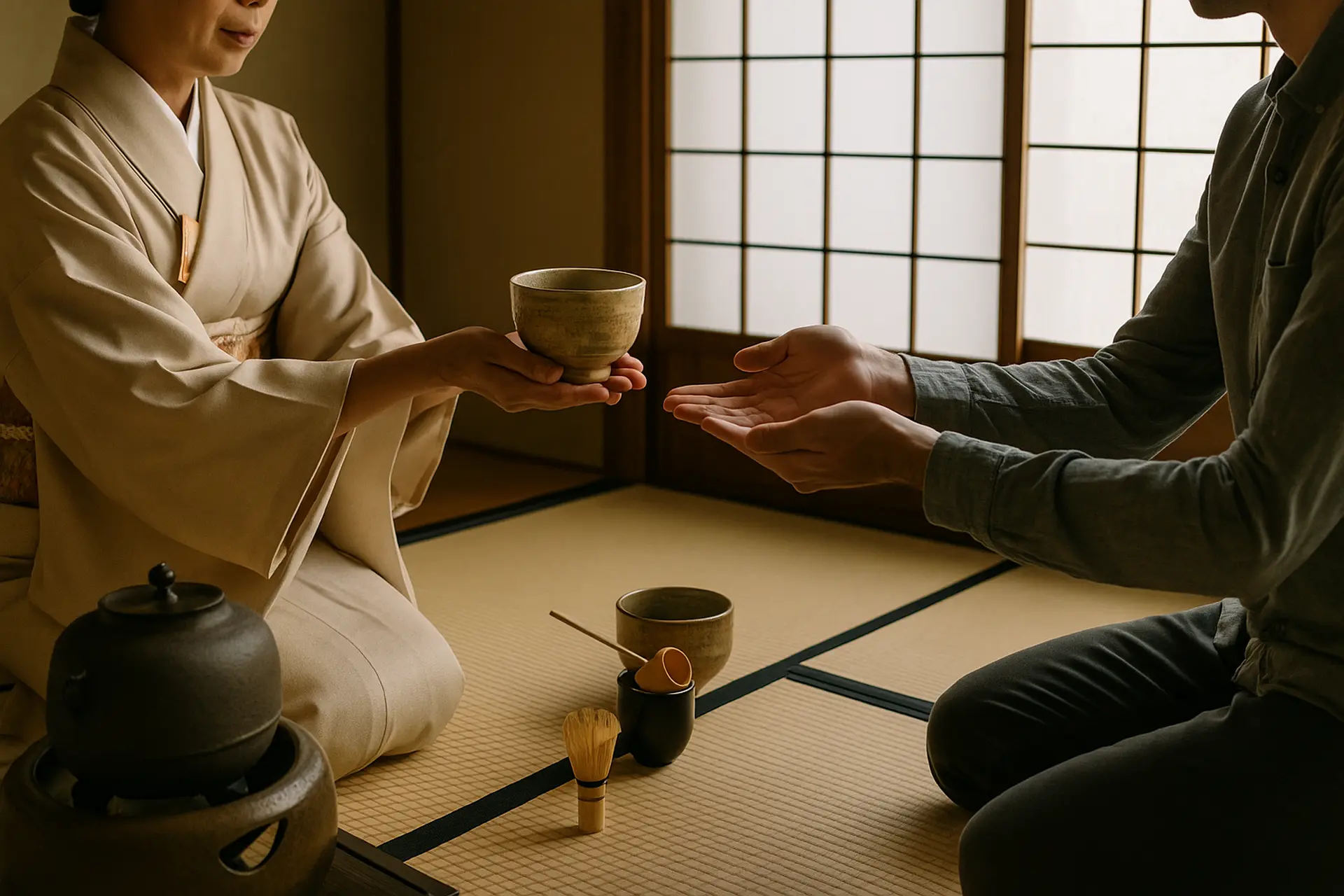

In Japanese, chanoyu (茶の湯) or sado/chadō (茶道) all mean the “Way of Tea.” This term reflects that the practice is more than just drinking tea – it is a disciplined cultural art. The roots lie in Zen Buddhist monks (who introduced tea from China) and medieval tea masters. Sen no Rikyu later refined it: Rikyu emphasized simplicity and the aesthetic of wabi, finding beauty in rustic, imperfect things.
- Chakai vs Chaji — How Long and What Happens
- The Four Spiritual Pillars: Wa, Kei, Sei, Jaku
- Types of Tea You’ll Encounter: Koicha vs Usucha
- Step-by-Step: Exactly What a Guest Does
- Before You Arrive: Booking & Preparation Checklist
- Arrival & Waiting Room: Purify, Bow, Entry
- Crawling In (nijiriguchi) & First Bow
- How to Sit: Seiza vs Alternatives
- Receiving the Wagashi (Sweets)
- Receiving the Chawan (Tea Bowl)
- Returning the Bowl & Post-Tea Etiquette
- What to Wear and What to Avoid
- Utensils & Vocabulary: Chawan, Chasen, Chashaku and More
- Where to Experience a Tea Ceremony
- How to Book: Tours, Private Sessions, Schools, and Costs
- Photography, Tattoos, Accessibility & Children — Modern Rules
- The Host’s Perspective — What the Tea Master is Doing
- History & Context: Sen no Rikyu, Wabi-Sabi, and the Origins of Tea Culture
- Typical Mistakes Visitors Make — and How to Recover
- If You Want to Learn: Classes, Schools, Time & Cost to Study Tea
- How to Host a Simplified Tea Gathering Outside Japan
- Seasonal Elements: Tokonoma, Scrolls, Flowers, and Climate Rules
- FAQ
- Glossary of Terms
In a ceremony, the host follows a sequence called otemae, preparing powdered green tea (matcha) with precise movements. Guests receive tea and sweets in turn. A full chaji involves a meal and two rounds of tea, while a brief chakai is mainly tea and sweets.
- Tea type: Ceremonial tea is almost always matcha (ground green tea). A rare alternative is senchadō, a separate practice of powdered leaf tea (sencha), but tourists will almost always taste matcha. Matcha is served in two forms: koicha (濃茶), a thick, syrupy tea shared from one bowl, and usucha (薄茶), a lighter, frothier tea served individually. (Typically a formal meal-service gives koicha first, then usucha later. For casual visits, often only usucha is served.)
- Ceremony formats: A chakai is a short meeting (30–60 minutes) for tea and sweets. It may include a light soup or snack, but it skips the full-course meal. In contrast, a chaji is the elaborate form: guests purify themselves, enjoy a multi-course kaiseki meal, then are served thick tea (koicha) and thin tea (usucha) over several hours. In practice, most first-time visitors experience a tea ceremony lasting under an hour (a simplified chakai).
- Terminology: Westerners say “tea ceremony,” but Japanese prefer chanoyu or sado, emphasizing tea as a “way” or path. The act of making tea is called otemae, literally the movements before tea. The tea bowl is chawan, the whisk is chasen, and so on (see the Glossary). When you hear ”o-temae dōzo”, it means “please let me prepare tea for you.”
Chakai vs Chaji — How Long and What Happens
Tea events fall into two broad categories: chakai (a simple tea-gathering) and chaji (a full formal gathering).
What is a chakai?
A chakai (茶会) is a casual tea meet-up. Think of it as “tea time”: guests may be served a small confection (wagashi) and a single bowl of thin tea (usucha). It typically lasts 30–60 minutes. In a chakai, there is no multi-course meal; instead there might be a light soup or few savories. Etiquette still applies (shoes off, bows, kneeling), but the atmosphere is relaxed. For example, a university tea club might host a one-hour chakai for visitors. Modern guides say a chakai is “relatively simple” – it might include just sweets and a light tea.
What is a chaji?
A chaji (茶事) is the classic, formal tea ceremony experience. It can take up to four hours. Here is the typical flow: guests first purify themselves at a garden basin (symbolic washing) and often enjoy a very light meal (kaiseki) in silence. Then the main session begins: the host serves thick tea (koicha) in one communal bowl, followed by seasonal sweets, and then thin tea (usucha) served individually. Each step is slow and ritualized. Chairs are never used in a true chaji – everyone kneels. A chaji is sometimes called a honcha or just a “tea gathering” in Kyoto.
The distinction is summarized by Japan’s tea guides: “Chakai are informal gatherings… more formal occasion is a chaji”. In short, a chaji involves meals and both teas and can last about 4 hours, while a chakai is much shorter and lighter.
The Four Spiritual Pillars: Wa, Kei, Sei, Jaku
Chadō is founded on four principles, often heard in Japanese as wa (和), kei (敬), sei (清), jaku (寂). These translate to harmony, respect, purity, and tranquility. Each principle guides the ceremony:
- Wa (harmony): Guests, host, and even the setting should be in peaceful accord. Speech is restrained; movements are gentle.
- Kei (respect): Everything is treated with deference. This means bowing politely to the host and to one another, and showing appreciation for every item (from the tea bowl to the linen cloth).
- Sei (purity): Before entering, guests ritually wash their hands and mouths (symbolically purifying body and soul). The tearoom itself is kept spotless and the actions of the host are very precise, embodying an inner cleanliness.
- Jaku (tranquility): After harmony, respect, and purity come serenity. The final result is a profound quietude—guests and host share a peaceful stillness.
In practice, these ideals are woven into every gesture: a quiet bow creates respect and harmony; rinsing hands creates purity; sipping tea in silence encourages tranquility. When Rikyu set these as his guiding words, he meant that even a brief tea gathering would embody them.
Types of Tea You’ll Encounter: Koicha vs Usucha
Two styles of matcha are used during a ceremony: koicha (濃茶) and usucha (薄茶).
- Koicha (thick tea): This tea has a very dense consistency. The host adds extra matcha powder and only a little water, then gently blends to a near-syrup. All guests share one bowl of koicha – a spoonful is taken sequentially by each person. Because it’s so rich, koicha is saved for the part of a formal ceremony, usually after the sweets, and usually at a chaji. In many tea ceremonies you may actually see two kinds of tea bowls: a ceramic jar (chaire) of very fine matcha for koicha, and then a lacquered caddy (natsume) for usucha.
- Usucha (thin tea): This is the lighter, common form of matcha. It uses less powder and more hot water. The host vigorously whisks it to create a froth. In usucha, each guest gets their own bowl. Typically guests form a row and the host moves down the line, preparing and serving one bowl at a time. Usucha is what you usually drink in shorter ceremonies or after the koicha at a chaji.
For visitors, the experience is: if you attend only one tea serving, it is likely usucha with a wagashi. Some longer ceremonies will also include a round of koicha first.
Step-by-Step: Exactly What a Guest Does
The moment you step into a tea house, there is a protocol to follow. Below is a rough timeline of a typical participatory ceremony. (Your host or interpreter may guide you as well – use this as a “cheat sheet.”)
Before You Arrive: Booking & Preparation Checklist
- Reserve & Confirm: Make a reservation (often online) and note the exact address. Many tearooms are tucked down alleys or in old neighborhoods. Check if they have any house rules (e.g. removing jewelry or quiet required).
- Dress Properly: Wear clean, modest attire. A kimono or yukata is lovely but not required for a casual tea event. In fact, JNTO notes that formal guests “should wear a kimono,” but ceremonies held for visitors do not require it. Simply dress neatly: slacks or a skirt, a blouse or shirt with sleeves, no shorts or tank tops. Avoid bright patterns or logos.
- Socks/Tabi: You’ll remove shoes before entering. Bring a pair of plain socks or Japanese tabi (split-toe socks), since going barefoot on tatami is not customary. Wear comfortable clothing that allows kneeling.
- Leave Valuables/Quietness: You’ll be asked to leave bags and cameras in a designated area (except small items like cameras or phones if allowed). Switch your phone to silent or off; the tearoom is quiet space. Remove dangling jewelry or noisy watches. (If in doubt, keep your hands free of anything that clinks.)
- Be Clean & Neutral: Refrain from heavy cologne or scented lotion – the tearoom should smell only of tatami, wood, and tea. Trim fingernails and remove or cover bold nail polish so it doesn’t distract.
- Prepare Your Mind: Be ready to bow and follow instructions. Tea ceremony is partly about learning to act in a foreign culture. Read a bit on the basics (like how to hold a bowl) if you have time, but your host will guide you too.
Arrival & Waiting Room: Purify, Bow, Entry
When you arrive, you will enter the tearoom building barefoot. Follow others quietly into the genkan (entryway). Remove your shoes here and line them up neatly, toes pointing out. Inside, you may be offered a small cup of warm water to sip while seated; this is to relax and cleanse your palate.
Next, you will likely proceed (often through a garden path) to the waiting room and then into the garden (roji). At an outer gate (kuro-mon), pause. The host (who has been awaiting guests) stands across. Together you exchange a silent bow. This respectful gesture acknowledges the host and signals your entry into the tea world.
After the bow, move to a stone washbasin (tsukubai). Pick up the bamboo ladle and rinse: left hand, then right hand, and finally pour water into your left palm to gently rinse your mouth (spit water discreetly onto the ground beside the basin). Then hold the ladle upright to let remaining water trickle down the handle. Each motion is deliberate and quiet. This cleansing ritual symbolizes washing away dust and tension.
Finally, you will be invited into the tearoom itself. Before entering, be sure your skirt or kimono collar is properly adjusted. Then you kneel and crawl through the low nijiriguchi (躙口) entrance. You must bow nearly all the way down to enter – this teaches humility (samurai and peasants alike must bow to enter). After fully crossing the threshold, step carefully onto the tatami floor and close the door quietly behind you. Once inside, turn to face the tokonoma (alcove) – you will bow to the alcove as a general greeting to the spiritual focus of the room. Then continue a final small bow toward the host before sitting in your designated spot.
Crawling In (nijiriguchi) & First Bow
As you crawl in through the nijiriguchi, bring one foot forward and then pull the other in – essentially entering on all fours. Once seated in the center of the room facing the host (kneeling or seated on your heels), make a small bow toward the host. This is a greeting and thank-you for being invited. Place your hands gently in your lap (right hand flat on palm of left for men, or both hands stacked for women). Keep your back straight.
How to Sit: Seiza vs Alternatives
You will sit on the tatami. The traditional posture is seiza: kneel with your legs folded under, feet crossed and buttocks resting on your heels. If kneeling is painful, it is acceptable to sit another way once guests are seated. For example, you may shift your feet to one side (called yokozuwari) or sit cross-legged in the back row if offered. Many tea schools today readily allow a chair if you inform them in advance. In short, do the best you can to appear attentive; if you must adjust your legs, do so quietly at a moment when the host is not speaking. Foreign visitors are routinely accommodated – the host will appreciate that you are trying your best.
Receiving the Wagashi (Sweets)
After seating, the host or an assistant will serve wagashi (seasonal sweets) on small plates or leafs. Take the sweet with your right hand and place it on the kaishi (the white paper in front of you). Before eating, slightly bow your head and say “chōdai itashimasu” (I humbly receive this). Use the wooden pick (provided beside your plate) to cut the sweet into bite-size pieces. If the sweet is moist (like mochi or jelly), it is customary to cut it up with the pick; if it is dry (like a sugar candy), you may eat it directly with your fingers. Eat slowly and quietly; the flavor of the wagashi is meant to complement the tea. After eating, fold the paper and tuck it quietly to the side of your bowl.
Remember: eat the sweet before the tea arrives, and do not drink any water after it. One reason is that emptying your mouth of flavors lets you fully taste the matcha later.
Receiving the Chawan (Tea Bowl)
After the sweets, the host will bring the chawan of tea. Listen for your name or a signal; the host may say “o-temae dōzo” (“please let me prepare it for you”). The host will present the bowl to the lead guest (center-right position) first and then hand it to each guest in turn.
When a tea bowl is offered to you, rise slightly and kneel fully. Then take the bowl with both hands: left hand under the base, right hand on the side (or under, if a flat bowl). Always receive with both hands as a sign of gratitude. Move the bowl in front of your knees. Give a slight nod or short bow towards the host. It is polite to say “o-kuchi itashimasu” (I gratefully receive) or simply smile in thanks as you take the bowl.
Next, hold the bowl up between chest and knees and bow your head with the bowl as a gesture of thanks. Then bring the bowl down to rest on the tatami between you and the next guest. Now place both hands on the bowl: left under, right on side.
Before drinking, turn the bowl clockwise about two-thirds of a turn so that the front (the most decorated side) is facing away from you. This rotation is important: it shows you are not placing the nicest side toward yourself. Now bring the rim of the bowl to your lips.
Gently sip the tea. There is no formal count, but typically two to three sips will clear the bowl. Drink the last sip quietly. After the final sip, use the corner of your kaishi to wipe the rim where your lips were. This is to cleanse it before passing it back. Then rotate the bowl back in the opposite direction (restoring the front side toward you).
Holding the bowl with both hands, lift it slightly from the tatami and admire it. Notice its texture, color, or glaze – each bowl is unique. Then slide it back toward the host for collection. When setting the bowl down, do so gently and make sure its front is facing the host. Lastly, bow once more and say “oishii desu” (美味しいです, “it is delicious”) or “ありがとうございます” (thank you) to compliment the host on the tea and bowl. The host may reply with encouragement or nod.
Returning the Bowl & Post-Tea Etiquette
After your turn, all guests will similarly drink and return their bowls. When the last guest finishes, the host will start cleaning the utensils. During this time, remain seated and quiet; guests often return to looking at the alcove scroll or each other in silence. If you are served a second bowl of tea, the same process repeats.
Once the tea has been served, it is polite to stand in unison when the host indicates the ceremony is ending (sometimes the host steps back or closes the cloth). You may then stand, fold your kaishi neatly, and bow one final time to the host and the alcove before leaving. If a small meal was provided earlier, there may be a polite conclusion phrase from the host (like “ojaru-gokoro”). A courteous ending phrase is “arigatou gozaimashita” (thank you very much) to the host as you bow. Only after these bows do you re-enter the waiting room or garden area to put your shoes back on.
Key point: Follow the host’s lead. If at any point you feel confused, a simple nod and gentle follow of others’ actions will keep you aligned. The host expects minor mistakes from beginners, so remain humble and attentive.
What to Wear and What to Avoid
You are now fully involved in the ceremony’s atmosphere, so wardrobe matters. As mentioned, you do not need a kimono for most visitor experiences. Tourist sessions typically accept Western attire, though guests should look neat. Some venues even rent kimono or yukata if you want the full picture.
Clothing: Opt for conservative colors and long sleeves. White is fine, but avoid bright red or flashy prints. Sleeves should not dangle. Girls: tie back long hair. Men and women: remove hats and sunglasses. If you have a kimono, wearing it correctly (with left side over right) is crucial.
Shoes/Socks: You will always remove shoes. Socks or tabi are worn inside. Make sure your socks have no holes or busy patterns; white or light grey is safest. Bare feet are not the norm (and can soil the tatami). Women in skirts might consider light leggings under the kimono for modesty when kneeling.
Accessories: Take off noisy jewelry (long necklaces, bangles, high heels with jangling anklets). Jewelry that jingles can disturb the quiet. No metal bracelets or dangling earrings. If you wear a watch, you may slip it off and set it aside once seated.
Fragrances: Do not wear perfume or strong body odor products. The tearoom is intimate and close-quarters; any strong smell is distracting to others. Coffee breath or cigarettes should be avoided, too (often smoking is forbidden inside).
Tattoos: Japan has varied views on tattoos. For most tea classes (especially private or hotel-based ones), tattoos are overlooked. However, if the ceremony is at a conservative temple or traditional house, large visible tattoos might raise eyebrows. If you have a large tattoo, consider covering it with clothing. Small tattoos are rarely noticed. If you’re concerned, politely ask the organizer ahead of time. In general, attendees with tattoos are usually welcomed in tea settings, unlike say in bathhouses.
Utensils & Vocabulary: Chawan, Chasen, Chashaku and More
The tea ceremony uses a suite of specialized tools (茶道具 chadōgu). Here are the essentials you’ll hear about or see (often on a low table at the entrance or handled by the host):
- Chawan (茶碗): The tea bowl. Each guest receives tea in a chawan. They come in various styles (thick or thin ceramic, with different glazes). Bowls can indicate season: e.g. winter bowls might be thicker and earth-toned.
- Chasen (茶筅): A bamboo whisk. After matcha powder and hot water are added to the bowl, the host uses the chasen to whip it into a froth for usucha. The chasen has dozens of thin prongs and is rinsed/cleaned carefully after use.
- Chashaku (茶杓): A bamboo scoop. The host uses the chashaku (about 18 cm long) to measure and transfer powdered tea into the chawan.
- Natsume (棗) / Chaire (茶入): Tea caddies. These are the containers that hold matcha. A natsume is a small lacquered jar (usually used for usucha tea), and a chaire is a ceramic jar (used for the premium koicha powder). The host opens the caddy and dips the chashaku into it.
- Kama (釜): The iron kettle. Hot water is brought to a boil in the kama over charcoal. Traditional ceremonies may use an in-floor hearth (ro) in winter or a portable brazier (furo) in summer, but at minimum you’ll see a kettle either on a brazier or on a trivet.
- Hishaku (柄杓): A long bamboo ladle. This is used to scoop hot or cool water from containers. One ladleful of hot water is poured into the tea bowl. A separate water ladle may scoop from the mizusashi.
- Mizusashi (水差し): A fresh-water jar. It holds room-temperature water used to replenish the kettle or rinse utensils. The host dips the hishaku into it.
- Kensui (建水): Waste-water bowl. Used tea water or rinsing water is poured into this. Guests will use it to discard mouth rinse.
- Fukusa & Chakin: The fukusa (silk cloth) is for purifying the tea scoop, and the chakin (linen cloth) is for wiping the tea bowl. These cloths are handled by the host.
- Wagashi (和菓子): The sweets themselves are also part of the ritual vocabulary. They come from special wooden boxes or plates.
As a guest, you don’t need to carry these items, but it is helpful to know their names so you can comment or ask politely (e.g. “What kind of bowl is this?”). We cite the core utensil names above, and a more extensive glossary follows at the end of this article with definitions of all key terms.
Where to Experience a Tea Ceremony
Kyoto is the epicenter of tea ceremonies. Nearly every temple and traditional tea house in Kyoto offers some form of tea service. Renowned spots include the Urasenke and Omotesenke headquarters (they sometimes allow visitors to observe their private tea schools) and historic tea houses in Gion. Many travelers book a tea ceremony in Gion or near Kiyomizu-dera.
The Uji area (just outside Kyoto) is Japan’s top tea-growing region. In Uji you can combine a visit to Byōdō-in Temple with a ceremony at an old teahouse, or tour a tea farm and finish with a tasting. Some tea houses in Uji allow visitors in English (since it’s a popular route for tea fans).
In Tokyo, tea ceremony is available too. Look for cultural centers like the Urasenke Demonstration House, or even hotel cultural events. Tokyo’s Meiji Shrine garden has a tearoom open to visitors on weekends.
Outside these big cities, smaller regional centers often offer tea as cultural demo. For example, Kanazawa’s samurai district has tea houses; Hiroshima’s gardens hold English-friendly sessions; even Hokkaido hosts (“Sapporo Tea House”) exist. Many tourist information websites list “tea ceremony experience” options in English.
Important tip: Some places are “tourist-friendly” and explain in English, while others are run by local enthusiasts. If you need English, look for language notes or ask upon booking. In Kyoto, organizations like Camellia House explicitly cater to non-Japanese speakers.
How to Book: Tours, Private Sessions, Schools, and Costs
Booking: You have two main routes.
– Travel Agencies/Platforms: Websites like Airbnb Experiences, Viator, or even one’s hotel can book group tea ceremonies. These often guarantee an English guide and handle all details. They may require full prepayment.
– Direct/Local: Some tea schools accept emails or calls (in Japanese) and welcome individuals. The schools Urasenke and Omotesenke have official programs, and there are many independent sado teachers around Kyoto. A quick search on Google Maps for “Sadō lesson” or “茶道体験” plus the city name often finds local studios. If you go direct, clarify time, cost, cancellation policy.
- Type of session: Decide if you want a demonstration-only (you observe the master doing tea), a participatory class (you make tea under guidance), or a formal ceremony (host does everything and you just sit as guest). All are available. Demonstrations are cheapest; chaji ceremonies (with meal) and private classes cost more.
- Cost: Varies widely. Casual tourist classes range from ~¥2,000 to ¥5,000 per person. For example, one Kyoto tea studio charges about ¥2,950 per person for a group session, and ¥9,000 for a two-person private session. (These include tea and sweets.) Basic temple demonstrations might be only ¥500–¥1,000. Full dining-style ceremonies can be ¥10,000–¥15,000 or more. Extra services add up: kimono rental might be +¥3,000, a full kaiseki meal could add several thousand yen.
- Example: A tourist near Gion might find a one-hour workshop at ¥3,500, a half-day chaji at ¥12,000, or a souvenir platter of matcha for ¥1,000. Always verify what’s included (e.g. “tea and sweets” vs “meal”).
- Tips: Book early for peak travel seasons. If you have any question (English explanation, wheelchair access, dietary needs), ask in advance. Save the confirmation QR or email; some venues require it for entry. Finally, consider timing: some tearooms offer morning and afternoon slots but close by dusk. Align your visit so you arrive relaxed and ready to enjoy the ceremony, not rushed.
Photography, Tattoos, Accessibility & Children — Modern Rules
Modern sensibilities have adapted to tradition in a few ways:
- Photography: Generally, don’t photograph during the ceremony unless expressly permitted. Many tearooms ask guests to keep cameras off, especially during tea-serving, to maintain silence and privacy. If photos are important to you, either take only after everything ends, or ask the host before the ceremony starts. In most tourist settings, quick, silent snapshots of your bowl after drinking are allowed once the main portion is done, but no videos. (Check the booking info – some places explicitly allow photos and some explicitly forbid them.)
- Tattoos: In Japan, tattoos can still be socially sensitive. For tea ceremonies, the rule is loose. Most standalone tearooms, cultural centers, and private classes will not refuse you for having tattoos. However, if the ceremony is at a temple or in a very traditional context, large exposed tattoos might cause the host some hesitation. If possible, cover any prominent ink (say with long sleeves or a shawl). In practice, it is rarely an issue – tea culture focuses on courtesy and does not have an official ban on tattoos. If this worries you, mention it when booking.
- Accessibility: Traditional tea rooms often have low doors and tatami floors. If you use a wheelchair or have knee problems, contact the venue. Many tea teachers now accommodate needs: they may let you bring a chair into the room, or direct you to a more accessible space. For instance, Urasenke and Omotesenke have barrier-free facilities for visitors with mobility issues. You should remove shoes, but staff can sometimes hold your knee to help you to a seat. If you absolutely cannot kneel, the host will not force you. The key is to tell them in advance.
- Children: Children are welcome in tea ceremonies, but keep in mind the quiet environment. As a guideline, children under about 5 are often considered too fidgety for a long ceremony. Some places have minimum ages (e.g. 7+) or no-children sessions. Others love showing tea to kids and may even have shorter “kids classes.” If bringing youngsters, explain beforehand the need for stillness and bows. Have a small snack ready, as starving toddlers may be restless. The main guest (or parent) should instruct the child gently. Note: We found examples where under-5s paid no fee.
The Host’s Perspective — What the Tea Master is Doing
To better appreciate the ceremony, it helps to know the host’s side. The tea master (teishu) is quietly orchestrating the event the whole time.
When you entered, the host had already prepared: they chose a hanging scroll and arranged fresh flowers in the alcove to match the season or theme. They set the kettle on the charcoal brazier to heat the water. Every utensil (whisk, scoop, cloth) has been placed methodically, often in a tiny entry hallway (so they are out of sight).
During the ceremony, watch what the host does between guests. Before serving, the host purifies the bowl and whisk in front of you. They wipe each utensil with a silk cloth (the fukusa), rinse the chawan with water, and ensure everything is impeccably clean. Each motion is deliberate and practiced. Then the host scoops tea powder into the bowl, pours hot water carefully, and whisks it into drinkable form.
While preparing tea, the host maintains a calm focus (embodying sei and jaku). They spend as little time speaking as possible, using every movement to convey respect (kei). Even their breathing is steady.
- Seasonal choices: The host’s selection of scroll and flower is a message. For example, a scroll might bear the words “ichigo ichie” (one time, one meeting), reminding guests to cherish the moment. The flower might be a spring plum blossom or a single bamboo leaf. After drinking, guests often walk to the alcove to admire these items. This is part of the experience: guests are expected to ask about the scroll’s calligraphy or the flower (“What is written here?”) and the host happily explains.
In short, the host’s perspective is one of service and artistry. They anticipate guests’ needs before asking: perhaps providing a kimono-shawl if it’s cold, or pausing between steps to let a foreigner bow. When you say “oishii” or admire the bowl’s glaze, they smile, because they poured their skill into every detail. Watching the host closely will help you notice why each rule exists (like why the bowl must face a certain way, or why silence is cherished).
History & Context: Sen no Rikyu, Wabi-Sabi, and the Origins of Tea Culture
Tea’s journey to Japan began centuries ago, but it became truly ceremonial around the Muromachi and Azuchi-Momoyama periods (15th–16th c.) under tea masters like Takeno Jōō and, most of all, Sen no Rikyu (1522–1591). Rikyu is the figure synonymous with modern tea. He not only formalized many of the procedures, but he instilled the philosophy of wabi-sabi: finding profound beauty in simplicity, imperfection, and impermanence. Under Rikyu’s guidance, the tearoom became a meditative hut, the tea bowl a treasured art piece, and humble things (a cracked bowl, a lone flower) became central to the aesthetic.
Rikyu’s legacy continued through his students and descendants. In fact, his family split into the three major lineages that still teach today: Omotesenke, Urasenke, and Mushakojisenke. Each school has its own style. For instance, Urasenke (the most internationally known) often encourages a friendly atmosphere – it even introduced stools for guest comfort and sometimes more froth in the tea. Omotesenke is a bit more austere and cherishes deep wabi qualities.
Religiously, tea ceremony blends Zen Buddhism and Shinto. Zen taught practitioners to live fully in the moment; the tea ceremony enacts this by requiring focus on each simple action. You’ll notice Zen concepts in the ceremony, such as the idea that each bowl of tea comes but once (ichigo ichie). Shinto influences appear in the purification ritual and in the reverent use of natural, seasonal decor. Even the tearoom doorway (nijiriguchi) has parallels in shrine gates: it is low so everyone bows to enter, symbolizing humility before the sacred space.
Over centuries, tea evolved from a medicinal drink to a court ritual, to a peasant’s tradition, and finally to a cultural symbol. It was through tea masters that this art spread: for example, Rikyu served tea to feudal lords and samurai, and later tea gatherings became part of noble culture. In modern times, tea ceremony is studied by thousands, both in Japan and worldwide, as a symbol of Japanese heritage. As the Urasenke Foundation notes, even dedicated practitioners spend lifetimes perfecting temae, because “even great masters say they are still learning”. In short, attending a ceremony is like stepping into a living history—centuries of aesthetics, religion, and social practice converge in that small room.
Typical Mistakes Visitors Make — and How to Recover
Even beginners generally do fine, and hosts know foreigners will err. Tea culture is forgiving of minor mistakes. If you do slip up, just act with grace. Here are a few common snags and how to handle them:
- Omitting bows: If you forget a bow (when entering, receiving, or leaving), simply do it as soon as you realize. A quick bow or nod is better late than none.
- Shoes: If you accidentally step onto the tatami with shoes, quietly take them off and step back into the genkan. Apologize with a bow – “sumimasen” – and re-enter. This is easily forgiven.
- Dropping items: If you drop the wooden pick or a cloth, pick it up carefully and say “gomen nasai” (pardon me). The host or assistant will not scold you; they may even help without fuss.
- Chatting inadvertently: The room is meant for quiet. If you catch yourself whispering too loudly, quiet down. If you need to say something, do it softly. If interrupted mid-sip, just say “sumimasen” and continue.
- Wiping lips: After drinking, if you forget to wipe the rim with the kaishi, the host won’t make a scene. Just wipe gently on the next sip or after placing the bowl down.
- Posture: If your knees hurt in seiza, gently shift to a side-sit or cross-legged. Preferably do this between guests or during a pause so it doesn’t draw attention.
- Eye contact: It’s not required to look at the host constantly. Feel free to briefly glance around (at the scroll or your neighbors) between actions.
If a bigger mistake happens (e.g. spilling tea), immediately say “sumimasen” and stand back. Let the host handle it. They are practiced at recovering (they’ll usually nod and say it’s fine). In all cases, a brief apology and prompt continuation of polite behavior is enough.
Remember JNTO’s reassurance: minor faux pas are always overlooked. The key is sincerity. As long as your heart is in the right place — following instructions to the best of your ability — the host will be pleased.
If You Want to Learn: Classes, Schools, Time & Cost to Study Tea
Some visitors discover they love tea ceremony so much they want to learn it. That’s entirely possible—many schools welcome foreigners. In Kyoto, Urasenke and Omotesenke both have beginner programs; official routes (called sadonoma or kyokai) lead to certificates for those who study for years. There are also countless independent teachers (often listed in expat guides as “Tea ceremony classes”).
Training can be quite involved. A beginner workshop (2–3 hours) might teach you how to whisk matcha and drink properly. A more intensive course meets regularly (weekly or monthly) to cover temae and etiquette systematically. The Japan Tourism guide says truly mastering tea takes “many years,” and even masters claim lifelong study.
Cost of study: one-off classes can be under ¥5,000. Longer-term programs (with a teacher, tea club membership, and materials) can run tens of thousands of yen per year. For example, Urasenke’s specialized curriculum has yearly fees plus equipment costs.
If you’re curious, look up local sado-semesters or one-day classes in major cities. Even outside Japan, major tea schools have chapters (e.g. Urasenke Hawaii). Often they have summer intensives for tourists. In any case, the journey through tea is as rewarding as it is patient—every practice session teaches a bit more about the nuances of harmony and tranquility.
How to Host a Simplified Tea Gathering Outside Japan
Bringing tea ceremony outside Japan is easier than you think. Here are essentials:
- Setting: Choose a quiet room and remove shoes. If possible, lay down a clean mat or rug to mimic tatami. Arrange a low table (or small surface) for the utensils. Keep seating informal (chairs or floor cushions).
- Utensils: You only need the basics to start: a whisk (chasen), a tea bowl, matcha powder, a ladle, and a kettle. You can buy beginner kits online or at Japanese import stores. Some utensils (like a chasen and chasaku) cost only a few dollars.
- Guests: Invite a few friends who are interested in the ritual. Explain that it’s a calm, respectful ceremony. Ask them to arrive 5 minutes early.
- Process: Begin by inviting everyone to sit. Briefly explain (in simple terms) the four principles or just say “today let’s enjoy tea quietly.” Provide a small sweet to each person. Have each person say “o-negai shimasu” (please) when accepting the sweet (mimic the Japanese phrase). Then, whisk the tea in front of them. Show how to hold the bowl and sip quietly. Encourage a small bow at the start and end.
- Etiquette hacks: You can skip the garden/basin stage. Instead, at the door ask everyone to rinse hands under a faucet (even just as a gesture). You don’t need a scroll, but you might hang a simple picture or say “today’s theme is friendship” to create meaning. Emphasize silence or low voices during the actual serving.
- Focus: Stress that the aim is mindfulness. Even if it’s short, keep all movements deliberate. For example, bow to each guest as you serve tea. Between sips, encourage guests to simply look at their bowl and appreciate it.
If you want more guidance, many tea books and online videos show demonstration of steps. You do not need to have the perfect kimono or a full set of tools to host. What matters is creating an atmosphere of respect. Even a once-off office or home tea party can be memorable if the steps above are followed. It’s a wonderful way to introduce friends to Japanese culture in an intimate, hands-on way.
Seasonal Elements: Tokonoma, Scrolls, Flowers, and Climate Rules
Every detail in a tea room reflects the season. When you enter, look at the tokonoma (alcove). There will usually be a hanging scroll and a small vase of flowers or a branch. These are chosen by the host to match the season or theme. For instance, a spring gathering might display a scroll with a cherry-blossom verse and a sprig of plum blossom in the vase. In summer, you might see green bamboo or the word “涼” (coolness). In autumn, maybe a painted maples. At winter, often a branch of pine or pinecone.
While you don’t have to get the full meaning, it is customary to at least glance respectfully at the scroll and flower. Often the scroll bears a Zen phrase or a poem. A common phrase is “一期一会” (ichigo ichie), meaning “one time, one meeting,” reminding all to treasure the unique moment. Feel free to quietly admire these items – the host picked them just for this day. Guests sometimes ask, “What does the calligraphy say?” or “Where are these flowers from?” and the host will explain.
The climate affects the room too. In winter, a hearth is lit, and sometimes thin screens or a koigara (frost-blocking panel) is used to keep guests warm. The host may provide extra cushions or even small wool blankets. In summer, the hearth might be replaced by a portable brazier on the veranda, and the room may be opened to allow a breeze. Summer sweets and a fan might appear in the tokonoma. You’ll also notice the host’s attire changes: he might wear lighter kimono or omit his jacket in summer.
In short, every seasonal detail is intentional. If you have a minute, ask about it — explaining the arrangement is part of the ceremony’s charm.
FAQ
What is the Japanese tea ceremony (chanoyu/chado/sado)? It is a formal cultural ritual centered on preparing and serving powdered green tea (matcha) to guests. The names chanoyu, chado, and sado all refer to this practice of the “Way of Tea,” which embodies harmony, respect, purity, and tranquility.
How long is the ceremony? (chakai vs chaji) A short tea gathering (chakai) usually lasts 30–60 minutes and includes tea and sweets. A full ceremony (chaji or honcha) includes a meal and two teas and can last around 4 hours.
What should I wear? Do I need a kimono? Dress modestly: smart casual or traditional wear. A kimono is welcome but not required for tourist events. Men and women often wear socks or tabi, since you must remove shoes.
Can foreigners participate? Yes. In fact, first-time foreign guests are often given a place of honor and additional explanation. The ceremony is open to all who show respect and interest.
Where are good places to attend (Kyoto, Uji, Tokyo, etc.)? Kyoto’s temples and tea houses are famous for tea ceremonies. Uji (south of Kyoto) and Kanazawa are also renowned. Tokyo and Osaka have cultural centers offering tea. Even resorts and gardens sometimes host ceremonies. Search for “tea ceremony experience” in your destination.
How do I book a tea ceremony? (Public vs private, class vs chaji) You can book through tour sites (e.g. Viator, Airbnb Experiences) for group classes with guides. Alternatively, contact local tea schools directly (some have English-speaking staff). Be sure to specify if you want a demonstration (watch only), a hands-on class, or a formal full chaji ceremony with meal.
How much does it cost? (Price ranges by type/location) Prices vary. Group classes are often a few thousand yen per person. For example, one Kyoto studio lists about ¥2,950 per person (group) and ¥9,000 for a two-person private lesson. Basic ceremonies at temples can be very cheap (¥500–¥1,000). Full chaji with meals can cost ¥10,000–¥15,000 or more per person. Always check exactly what is included.
What are the four principles (Wa, Kei, Sei, Jaku)? These are the ceremony’s core values: wa (和, harmony), kei (敬, respect), sei (清, purity), and jaku (寂, tranquility). They describe the mood and relationships that should prevail during the ceremony.
What is the difference between koicha and usucha? Koicha is “thick tea” – a very concentrated matcha shared from one bowl. Usucha is “thin tea” – a lighter, frothy matcha served in an individual bowl. Koicha is richer and served less frequently (usually at formal events), while usucha is the common tea in most ceremonies.
What is a chakai vs a chaji? A chakai is an informal tea gathering with tea and sweets (no full meal). A chaji is a formal tea gathering that includes a meal and both thick and thin tea. Chaji ceremonies are longer (up to 4 hours) and more elaborate; chakai are shorter (often under an hour).
What do I do when entering the tea house? (nijiriguchi, bowing, washing) Enter quietly through the genkan and remove shoes (treat tatami as sacred). In the garden, bow silently to the host at the gate. Purify: rinse hands and mouth at the stone basin. Then enter the tearoom through the low nijiriguchi, bowing as you crawl in.
Do I need to remove shoes? Wear socks or tabi? Yes, shoes always come off. Wear socks (or Japanese tabi socks) inside. Going barefoot is uncommon; bring fresh socks if your tour will have you change often.
How should I sit (seiza vs cross-legged)? Traditionally sit seiza (kneeling). If that is painful, it is acceptable to sit with legs to one side or cross-legged (especially in back row). Many teachers will provide a chair if needed – feel free to request it. The key is to keep a respectful posture either way.
How to accept and hold the tea bowl? When offered the bowl, use both hands: one under the base and one on the side. Bring it gently to your lap and bow slightly in thanks. Don’t take just one hand or grab it. Hold it lightly but securely with fingers spread as you bring it to your lips.
How do I drink matcha? (sips, wipe, admire) Before sipping, bow the bowl and turn it so its front side faces away. Then sip quietly (usually 2–3 sips will empty it). After drinking, wipe the rim with your kaishi paper, then rotate the bowl back, set it down, and admire its design. Finally, bow your head in thanks.
What are wagashi and how should I eat them? Wagashi are traditional Japanese sweets (often made from bean paste and rice flour). When served, you say “chōdai itashimasu” and place the sweet on the paper. Use the provided wooden pick to cut bite-size pieces (moist sweets require cutting; dry sweets can be eaten by hand). Eat them before the tea, slowly. Don’t drink water after – you want a blank palate for the tea.
Can I take photos or record? Usually only after the formal part. Photographing the host, other guests, or the detailed steps is considered impolite unless you have explicit permission. It’s best to ask the host first. Many tourist-oriented tea sessions do allow posed photos once the ceremony ends.
Are tattoos acceptable? Will I be refused? In most tea settings, visible tattoos are not an issue. Traditional bathhouse rules don’t apply here. Some very strict venues may ask you to cover them, but most casual tea ceremonies (especially those for visitors) welcome all. If you are unsure, consider discreet coverage.
Is it okay to ask questions during or after the ceremony? What should I say? Yes, respectful questions are welcomed after the tea is served. It’s customary, especially for the main guest, to ask about the hanging scroll or the utensils(for instance “What does the calligraphy say?”). You can also express appreciation: say “oishii desu” (おいしいです, “it’s delicious”) after tasting the tea. Address the host politely (using “san” with names, or “sensei” if called that). During the ceremony itself, remain mostly silent; light conversation or questions should wait until the host has finished serving.
What are the main utensils and their names? See the utensils section above. Core terms: chawan (茶碗, tea bowl), chasen (茶筅, whisk), chashaku (茶杓, tea scoop), kama (釜, kettle), hishaku (柄杓, ladle), mizusashi (水差し, water jar), kensui (建水, waste-water bowl). Learning these names can impress your host and help with polite conversation.
What is temae (tea preparation) and how does it vary by school? Temae (点前) refers to the sequence of movements the host performs. Each school has slightly different temae. For example, Urasenke’s method for whisking usucha might include more vigorous motions and sometimes offering a chair for guests, whereas Omotesenke might move more conservatively. Generally, each way of sitting, bowing, scooping tea, and pouring water has small style differences by school. If you attend multiple ceremonies, you may notice these nuances. But as a guest, just copy the host before you – you will naturally follow whichever temae they practice.
Etiquette differences: tour vs private vs temple? A tour or workshop often explains actions step-by-step, and may allow more conversation. Temple ceremonies can be more austere (less explanation, stricter silence, no photography). A private lesson with a tea teacher is often interactive (they will guide you more and let you try movements). However, the core rules (shoe removal, bowing, how to hold the bowl) are the same.
Can I participate and whisk the tea myself? In most participatory classes, yes. Many workshops explicitly let guests try making tea. Typically, the instructor will demonstrate whisking, then hand you the whisk and say “please try.” In that case, you would each make your own bowl of usucha. In more formal settings (e.g., a chaji demonstration), guests do not whisk, they only receive tea from the host. But if you want hands-on, choose a “tea lesson” or “workshop” option rather than just a demonstration.
Age limit or accessibility concerns? There is no strict lower age limit but consider the length and formality. Very young children may find sitting quietly difficult; some hosts set age minimums (often around 5 or older). If bringing a child, prepare them ahead (e.g. “we will sit and drink a special tea”). For mobility: as noted, many venues accommodate wheelchairs or allow chairs if you need one. Seiza (kneeling) is expected, but if you cannot kneel due to a medical issue, simply notify the host and they will offer an alternative.
Children attending – tips for them: If allowed, explain to children that this is a quiet, respectful event. Teach them to bow when entering and leaving, and to be careful with the utensils. Giving them a small portion of the wagashi can keep them occupied. It’s also fine if a parent quietly steps out with a baby or toddler if they become too loud; the ceremony atmosphere is valued.
Jewelry, perfume, noisy clothing? Keep it minimal. The main thing is silence. Remove jangly jewelry, take off belts or watches that clink, avoid high heels. Skip perfume and aftershave. Even talking softly should be the norm. The ceremony is meant to be meditative, so anything that breaks the mood should be avoided.
How to pay/tip? In Japan, tipping is not customary. For a tea ceremony, you typically pay the fixed fee (often in advance or in cash on the spot). If you purchase tea or sweets afterwards, that’s normal. But do not try to give extra money to the teacher as a “tip.” Instead, a sincere bow and “thank you” conveys your gratitude.
Should I bring a gift? Generally, no, if you’re attending a public class or demonstration. A small omiyage (souvenir) gift is only expected in a private setting or formal invitation. If you visited someone’s home for tea, a box of nice sweets or tea from your home country would be a lovely gesture. But for a standard tourist session, a polite thank-you is sufficient.
What if I make a major mistake or offend? If something goes very wrong (like truly mispronouncing Japanese in an insensitive way), just apologize politely. Hosts are usually very understanding. If you worry, you can say “sumimasen” (“sorry”) or “moshiwake arimasen” (more formal apology). They will likely smile and assure you it’s okay. The ceremony is about enjoyment and respect, not catching faults.
What are the major tea schools and why does it matter? The three main schools in Japan (founded by Rikyu’s descendants) are Omotesenke, Urasenke, and Mushakōjisenke. For most visitors, the only practical difference is style: as mentioned, Urasenke often allows chairs and places emphasis on a comfortable experience, while Omotesenke is more austere and focused on the traditional aesthetic. Unless you’re diving deeply into tea studies, you just follow whichever way your host practices.
Role of Sen no Rikyu in tea history? Sen no Rikyu (1522–1591) perfected tea ceremony into a spiritual discipline. He introduced wabi-sabi and the notion that even a broken tea bowl can be beautiful. Everything he did still shapes tea today: from using simple wooden tearooms to stressing the four principles. In history, he is often called the most influential tea master.
Where to buy authentic teaware (chawan, chasen, wagashi)? As mentioned above, Kyoto is the first choice: ceramics from Kyoto/Mashiko/Shigaraki and bamboo crafts from Uji/Kanazawa. For wagashi, visit traditional sweet shops (in Kyoto’s old streets or department store “wagashi” counters). Other cities with artisans include Kanazawa (gold leaf craft tea utensils) and Tokyo’s Ueno/Nihombashi (traditional crafts markets). A small pottery cup or good matcha powder makes a fine souvenir to remember the ceremony.
Common beginner mistakes (and how to avoid): See the above mistakes section. The gist: Do not panic. Keep calm, apologize briefly if needed, and continue. Watch and mimic the lead guest or the host when unsure. Politeness wins over perfection, every time.
How to host a (small) tea ceremony outside Japan – etiquette shortcuts? We covered this in the “Host a simplified gathering” section. In brief: gather a few friends, set a quiet tone, do a mini version of all steps (bow, sweets, tea, bow). You don’t need full rituals (skip the garden and stone wash). If possible, use proper tools and ceremony phrases. Focus on respect and slowness. Even a 20-minute version can convey the essence.
What is the “guest script” (what the main guest says/does)? The main (first) guest leads by example. Typically, as you receive your bowl: bow deeply, say “arigatou gozaimashita” (“thank you very much”) or “oishii desu”. If requested, the first guest praises the host and maybe comments on the bowl’s design. The first guest also often gets to ask questions about the scroll or utensils while everyone is seated.
Cost and time to learn tea ceremony (classes, schools): Brief classes are affordable (a few thousand yen). Serious study is expensive and time-consuming. To become a certified teacher takes years and significant expense (lessons, tea, travel, ceremony fees). Only a few dedicate their lives to it. Many learners treat tea as a lifetime hobby or spiritual practice.
Vegan/Vegetarian wagashi? Most wagashi are plant-based (made from rice flour, azuki bean, sugar). They do not typically contain dairy or eggs. Some may use a bit of gelatin (especially jelly desserts), so if you are strictly vegan, you can ask the host which sweets are suitable. Many ceremonies use traditional vegan-style sweets anyway (like yokan made with agar). You can definitely ask or bring your own safe sweet if needed.
How to pair ceremony with Kyoto experiences & itineraries? For example, start at Kennin-ji Zen temple in Gion (early morning meditation), then head to a tea ceremony near Kazamidori Museum. Another combo: dress in kimono with Maiko-style hair in the morning, then do afternoon tea in a Gion teahouse, then walk the Philosopher’s Path in spring. Kyoto passes and tour guides often bundle tea with temple visits.
Where find tearoom with English explanation? Many tourist-centric ceremonies advertise “English OK”. Urasenke’s Kyoto center has periodic English-guided sessions. Private studios like Camellia House (Kyoto), or tourist spots like Kyoto Handicraft Center, will provide English instruction. Look for terms like “sado experience english” when searching.
Do tea ceremonies use only matcha? Other teas? Traditionally, only matcha is used in a tea ceremony. A separate less-common style called sencha-do uses powdered leaf tea, but you will almost never see that unless in a specialized sencha workshop. So you can safely assume: bring matcha, and enjoy matcha!
Climate/seasonal rules (summer vs winter setup)? We mentioned seasonal adjustments above. Quick version: in summer the tearoom may be cooler (open-air or fans) and uses fewer layers of clothing; in winter the kettle sits in a sunken hearth (ro) with more charcoal. The host’s kimono might be winter-weight or summer linen. Sweets and scrolls change by season (e.g. cherry blossoms, maple leaves, etc.).
How to interpret the tokonoma (scroll)? The scroll’s calligraphy usually carries a theme or message. Common ones: ichigo ichie (一期一会), seijaku (静寂, tranquility), mochiuu (hold in mind) or seasonal references like kanki (閑機, tranquil time). If you recognize the phrase, it adds depth; if not, ask. The host will be happy to explain its meaning.
What’s a chashitsu and why are entrances low? A chashitsu is a tearoom (often a small hut or alcove-sized room). It’s designed to be simple and intimate. The low entrance (nijiriguchi) forces guests to bow as they enter, symbolizing humility and equality. Once inside, rank does not matter – everyone is on the same level.
Difference between a Japanese tea ceremony and casual matcha at cafes? In a cafe, matcha is served like any drink – you might say “hit me with some matcha, please!” There is minimal protocol. In a ceremony, every action is ritualized: you bow, cleanse your hands, handle the bowl a specific way, and drink in silence. A cafe is about relaxation and flavor; a ceremony is about mindfulness and etiquette. Both can produce great tea, but the atmosphere and meaning are very different.
Glossary of Terms
- Chanoyu (茶の湯), Chado/Sado (茶道): Names for the Japanese tea ceremony (the “Way of Tea”).
- Chakai (茶会): A casual tea gathering (short ceremony with tea and sweets).
- Chaji (茶事): A formal tea gathering (includes a meal and multiple servings of tea).
- Temae (手前, 点前): The series of movements the host performs when making tea.
- Otemae (お点前): Honorific way to say temae (the tea preparation).
- Chashitsu (茶室): A tearoom or tea house (often a dedicated small tatami room).
- Nijiriguchi (躙口): A low “crawl-in” entrance to the tearoom, which forces guests to bow upon entry.
- Tokonoma (床の間): An alcove in a room where a scroll (kakemono) and flower arrangement are displayed.
- Chawan (茶碗): Tea bowl from which matcha is drunk.
- Chasen (茶筅): Bamboo whisk used to mix matcha powder and hot water.
- Chashaku (茶杓): Bamboo tea scoop.
- Kama (釜): Iron kettle over charcoal.
- Hishaku (柄杓): Bamboo water ladle.
- Mizusashi (水差し): Water jar for fresh water.
- Kensui (建水): Waste-water bowl for rinsing.
- Natsume (棗): Lacquer tea caddy (usually for usucha).
- Chaire (茶入): Ceramic tea caddy (for koicha).
- Furo (風炉) / Ro (炉): Charcoal brazier (furo) or sunken hearth (ro) to heat water.
- Wagashi (和菓子): Traditional Japanese sweets served with tea.
- Wa, Kei, Sei, Jaku (和敬清寂): Harmony, Respect, Purity, Tranquility – the four key principles of tea.
- Ichigo Ichie (一期一会): Literally “one time, one meeting,” a Zen concept often used in tea to mean “treasure every encounter.”








