Guatemala City stands amid the Hermitage Valley, its three million inhabitants spread across an expanse carved by mountains in south-central Guatemala; it ranks as the largest urban agglomeration in Central America. Founded in 1776 at the foot of the Sierra Madre after the ruin of its colonial forerunner, Antigua, it bears silent witness to epochs from Maya grandeur to modern reinvention. It serves as the nation’s political core, economic engine and cultural nexus—an entity that pulses with ancestral echoes and metropolitan ambition. A place of highland air and unexpected warmth. A capital defined by resilience.
Long before Spanish intrusions, the upland basin held Kaminaljuyu, a Maya settlement peopled from 1500 BCE until about 1200 CE. Earthworks, mounds and ceremonial plazas once rose here beneath ceiba and ceiba’s shade; trade routes threaded the plateau and sent exotic shells and jade into the highland heart. With its stone platforms and waterworks, Kaminaljuyu became a fulcrum of Highland Maya life—evidence of complex governance, ritual precision and an economy entwined with distant realms. Today, beneath the asphalt and neon of Zones 7 and 11, archaeological excavation has revealed fragments of that vanished city, inviting the visitor to consider layers of human endeavor buried under asphalt and modern commerce.
The Spanish establishment of the present Guatemala City unfolded in the wake of disaster. In July 1773, the Santa Marta seismic event and its tremors demolished the capital then sited at Antigua Guatemala, compelling colonial authorities to seek safer ground. By December of that year, planners gazed upon the wide valley and sketched rectilinear streets inspired by Enlightenment-era ideals of order—an urban grid that drew from Parisian precedents and the newly conceived avenues of Washington, D.C. Ranks of adobe houses and ecclesiastical structures rose from the ashes with porticos, tiled roofs and courts that would later succumb to earthquakes of their own making.
At the threshold of modernity, September 1821 brought a moment of revelation. Within this city’s precincts, elite delegates affixed their seals to the Act of Independence of Central America, severing ties with Spain’s crown. On 15 September of that year, amid trumpet calls and cathedral bells, the Dias Patrios began—a ritual commemoration still observed with civic pomp and solemnity. Guatemala City then became the heart of the United Provinces of Central America, an ephemeral federation that aspired to unify the isthmus. The venture faltered amid regional rivalries, and in August 1847, Guatemala proclaimed sovereignty as a republic. From that moment forward, the city asserted its primacy as national capital.
The great earthquakes of 1917–18 inflicted devastation on streets and plazas alike. For months, aftershocks rippled through the valley, toppling façades and cracking foundations. Reconstruction unfolded with sober pragmatism: boulevards were widened, masonry techniques improved and building setbacks enforced. In the decades that followed, the grid plan expanded outward toward marginal hills and former coffee plantations, accommodating waves of rural migrants drawn by opportunity. Those newcomers reshaped the city’s profile—an urban sprawl that fused high-rise offices with favelas, ancestral languages with Spanish-tinged slang.
Climatically, the city defies its tropical latitude. Perched at roughly 1,500 meters above sea level, it enjoys an almost eternal spring. Daytime temperatures range from 22 °C to 28 °C; nights cool to between 12 °C and 17 °C. Humidity dips from morning’s near-saturation to comfortable levels by evening, and winds often sweep the plazas, keeping heat at bay. The dry season prevails November through April, with April claiming the highest thermometers. Rain falls in earnest from May to October, linking the city’s rhythm to Atlantic storms that hover off the Caribbean coast.
Today’s demographic mosaic reflects centuries of displacement, amalgamation and migration. Mestizo and Spanish-descended families form the majority, their traditions writ into civic ceremonies and private rites. At the same time, nearly every one of Guatemala’s 23 Maya groups has a quarter in which its tongue still resounds—K’iche’, Kaqchikel, Mam and Q’eqchi’ among them. Street vendors haggle in Mam; parish priests deliver sermons in K’iche’. A small diaspora of expatriates—diplomats, entrepreneurs, aid workers—adds further nuance to the city’s polyglot character, yet they constitute only a sliver of the population’s weave.
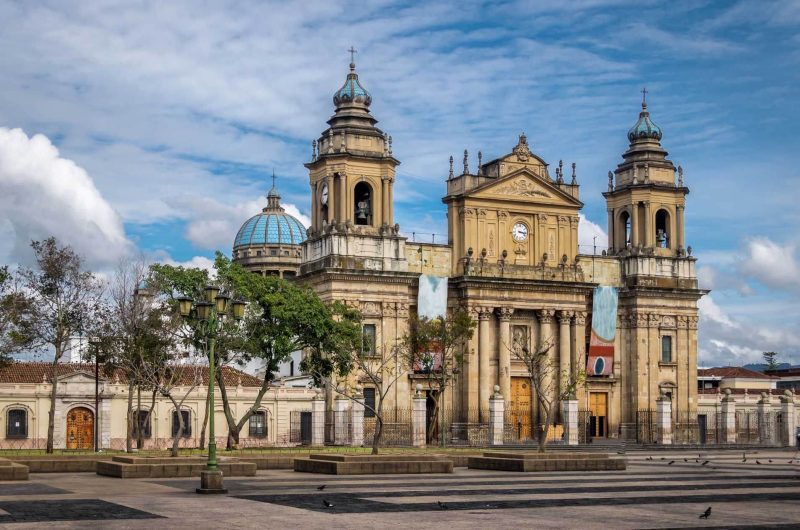
Sundays at Parque Central testify to this confluence of peoples. As evening falls, families drift toward the Plaza de la Constitución in Zones 1 and 4, children chase pigeons beneath torchlight, elders drift among benches recalling eras before motorcars. The cathedral’s baroque façade stands sentinel; the National Palace glows ochre against the dusk. Hundreds gather, their conversation a soft murmur in Spanish interlaced with Mayan syllables. Vendors proffer marquesitas and atol—corn-based sweets—while street musicians tune guitars for traditional sones. It is a moment of communal artistry that encapsulates the city’s persistent homage to heritage.
Religious architecture offers further testimony to layers of belief and conquest. On the hill of Cerrito del Carmen, a white chapel overlooks the sprawl, its alcoves and stained-glass memorials dedicated to virgin and martyr alike. In Zone 1, the Catedral Metropolitana de Santiago de Guatemala draws the faithful beneath vaulted ceilings and gilded altars installed after its consecration in 1815. From Calvario’s stations of the cross to the slender towers of Iglesia de Santo Domingo, to the ochre ramparts of Yurrita and the meretricious baroque of La Merced, each sanctuary asserts a chapter in the city’s sacred geography.
Art and memory cohabit within museum walls. The National Palace of Culture, once seat of executive power, reveals frescoes and grand halls in guided tours every quarter-hour. A rose-clasping statue commemorates the civil war’s end within its inner courtyard. Nearby, the Mapa en Relieve at Minerva Park offers a three-dimensional portrayal of Guatemala’s varied terrain—an enormous relief carved in 1904 before aerial imagery existed. Climb the observation tower to appreciate volcanic cones and river valleys frozen in painted plaster.
Zoo aficionados and naturalists find refuge in La Aurora Zoo, where songbirds flit through canopy and jaguar exhibits hint at wild origins. Botanists wander Jardines Botánico in Zone 10—Guatemala’s first botanical garden—among orchids, towering heliconias and medicinal plants catalogued by the Museum of Natural History. Each species bears a tag that references pre-Hispanic uses, evoking an ecological continuum that predates colonial taxonomy.
Ancient stones beckon within urban bounds. At Kaminal Juyu Parque Arqueológico in Zone 7, mounds and carved stelae emerge from manicured lawns where guided tours unfold the city’s Maya inheritance. That site, in many ways, parallels its buried counterpart beneath Zona 11’s streets, where subterranean excavations reveal plazas marked by ritual caches of jade and pottery shards.
Art galleries and cultural centers further enrich the capital’s fabric. The National Museum of Archaeology and Ethnology on 7 Avenida preserves the storied Tikal mask—an emerald-studded artifact whose visage once adorned a highland king. A few blocks away, the Museo Nacional de Arte Moderno “Carlos Mérida” juxtaposes contemporary canvases with archaeological fragments. Within the Universidad Francisco Marroquín’s precincts, the Ixchel Museum of Indigenous Textiles and Clothing displays huipiles embroidered with ancestral iconography, accompanied by explanations in Spanish and English—and a carefully curated shop of artisanal textiles. Across campus stands the Popol Vuh Museum, its galleries spanning pre-Hispanic antiquities and colonial relics, offering a narrative that transcends any single cultural epoch.
Further afield, yet wholly within city limits, the Miraflores Museum in Zone 11 focuses on Kaminaljuyu’s rediscovered precincts, showcasing ceramics and obsidian blades. In Zone 6, the Museo Carlos F. Novella traces the cement industry’s rise, housed within a repurposed industrial complex. Even rail history finds its voice at the FEGUA Railway Museum, where steam locomotives rest beneath lofty sheds and conductors’ badges lie vitrined.
Recreational ventures surge beyond built environs. Adventurers scale the slopes of Agua and Pacaya volcanos, each climb a test of stamina and altitude that rewards with vistas over the valley and Lake Atitlán. Water enthusiasts gravitate westward to Atitlán’s breezes—windsurfing and kayaking among islets and roadside villages ringed by volcanoes. Closer still, municipal pools and country-club facilities invite swimmers and sun worshippers to weekend repose.
Nightfall beckons within 4 Grados Norte and Zona Viva, where pedestrianized streets teem with galleries, craft breweries, fusion eateries and live music venues. Here the city’s youthful pulse quickens: jazz trios perform within vaulted basements, DJs curate electronic sets atop rooftop bars. Amid this cosmopolitan energy, traditional dances surface in cultural centers, ensuring that folk heritage continues to inform the avant-garde.
In the city’s undercurrent roam legends of El Cadejo and La Llorona, apparitions whispered along cobblestone alleys and through barrio laments. Parents hush children with tales of spectral dogs—emissaries of fate—and mournful cries of women pining for lost offspring. These myths tether the urban expanse to rural lore, reminding inhabitants that the border between past and present remains porous.
By day and night, Guatemala City functions as the operational heart of the republic. Buses and tuk-tuks converge at bus terminals bound for Antigua, Cobán or the Pacific coast. At embassies and consulates, diplomats negotiate trade accords; at NGOs, development plans unfold; at corporate towers, transactions determine regional fortunes. Through its thoroughfares courses the commerce of coffee, textiles, telecommunications—signifiers of a city that anchors national aspiration.
Steeped in millennia of human endeavor yet marked by scars of upheaval, Guatemala City endures as an evolving mosaic. Its avenues chart colonial visions and seismic rebirths; its plazas host civic ritual and popular celebration; its museums and parks preserve fragments of time. Across languages, from Spanish to K’iche’, the capital articulates a shared patrimony. Within its valleys, beneath its skylines, a living narrative persists—one defined by adaptation, by memory and by the spirited cadence of a people who shape it anew each day.