


Living collections · Global heritage
Eight Great Botanical Gardens and What They Teach Us
A botanical garden is more than a beautiful park: it is a living archive where plants are named, documented, studied, propagated, protected and interpreted for the public.
Eight profiles show how history, science, conservation and landscape design take different forms around the world.
Lists of the “world’s best botanical gardens” often reward spectacle: the largest glasshouse, the longest avenue, the rarest bloom or the most photogenic mountain backdrop. Beauty matters, but it is not enough to define a botanical garden. The institution’s deeper identity lies in documented collections, trained staff, research, plant records, exchange networks, conservation work and public education. A garden may look quiet while supporting seed banking, taxonomy, ecological restoration and decades of observation.
The source article ranged widely across historic and contemporary gardens. This rewritten guide selects eight major institutions for independent treatment: Kew in London, Padua’s university garden, Singapore Botanic Gardens, the New York Botanical Garden, Montréal Botanical Garden, Rio de Janeiro Botanical Garden, Kirstenbosch in Cape Town and the Royal Botanic Garden Sydney. The selection is not a universal ranking. It is a comparative route through different climates, histories and scientific traditions.
Visiting these gardens responsibly requires more than staying on the path. Plants may be rare, toxic, culturally sensitive or part of active research. Labels can represent years of taxonomic revision. A fallen seed is not a souvenir, and a close-up photograph does not justify stepping into a bed. International travellers must also respect biosecurity: carrying plant material, soil or seeds across borders can move pests and pathogens and may violate the law.
The most rewarding visit alternates scales. First read the landscape: slope, water, shade, glasshouses and the relationship with the city. Then choose a collection and look closely at leaf form, bark, flower structure or adaptation. Finally, ask what happens beyond public view—herbarium work, propagation, field research, conservation partnerships and horticultural training. That sequence turns a pleasant walk into an encounter with the science and politics of keeping plants known.
Before the gates
What separates a botanical garden from a beautiful park
The distinction lies in documented living collections and the scientific, horticultural and educational systems built around them.
A public park may contain extraordinary trees and expert horticulture, while a botanical garden may include lawns, cafés and ornamental borders. The categories overlap visually. The defining difference is purpose and documentation. Botanical institutions maintain plants as accessions with identities and records: where material came from, when it entered the collection, how it was propagated, who determined its name and how it relates to research or conservation priorities.
Taxonomy—the work of recognising, describing and naming organisms—is fundamental. Plant names change when new evidence reveals different relationships or when historical classifications are revised. A label is therefore not a decorative plaque but a current scientific statement. Behind it may stand herbarium specimens, field notes, DNA analysis, publications and collaboration among specialists in several countries.
Living collections have limits. A tree can outgrow its space, a tropical species may require expensive heat, and a plant collected from one population cannot represent all genetic variation in the wild. Gardens decide what to cultivate based on mission, climate, resources and ethical agreements. Modern institutions increasingly confront the colonial histories through which plants and knowledge moved, asking how collections can acknowledge source communities and support fair partnerships.
Herbaria complement living plants by preserving dried specimens that can be studied long after a field expedition or habitat change. Seeds, tissue cultures and cryopreserved material extend ex situ conservation. Yet keeping a species in a garden is not equivalent to protecting its ecosystem. Conservation works best when botanical institutions support habitat protection, local expertise, restoration and policies that address the causes of decline.
Display design translates this work for visitors. A systematic garden may arrange plants by evolutionary relationship. A geographic collection recreates regional associations. An ethnobotanical display examines relationships between plants and people. A conservatory makes climatic contrast visible, while an arboretum unfolds over decades. Good interpretation states what the arrangement can teach without pretending that a designed bed reproduces a complete wild ecosystem.
Botanical gardens are also civic spaces. They provide shade, cultural programmes, education and contact with nature, often in dense cities. That role can create tension: free access versus revenue, events versus plant protection, tourism versus research quiet, decorative expectations versus ecological management. The strongest institutions make these trade-offs visible and invite the public to understand why a garden may close a path, remove a beloved tree or allow part of a landscape to look less manicured.
For the visitor, one simple question unlocks the institution: “Why is this plant here?” The answer may involve medicine, empire, threatened habitat, evolutionary research, local identity, a historic expedition or a horticultural experiment. Once that question becomes habitual, the garden stops being scenery and becomes an archive of relationships.
Four systems behind the display
Living collections
Documented plants grown for research, conservation, education and horticulture.
Herbarium and archives
Preserved specimens, images and records that support identification and historical study.
Propagation and seed work
Nurseries, seed banks and tissue methods that maintain material and support restoration.
Public interpretation
Labels, tours and programmes that translate specialist knowledge without reducing complexity.
London · United Kingdom
Royal Botanic Gardens, Kew
A globally influential scientific institution where historic landscape, monumental glasshouses and vast collections reveal both botanical ambition and its imperial entanglements.
Best for: connecting garden design, plant science, conservation and the history of global collecting
Institutional scale
The public garden is only the visible layer
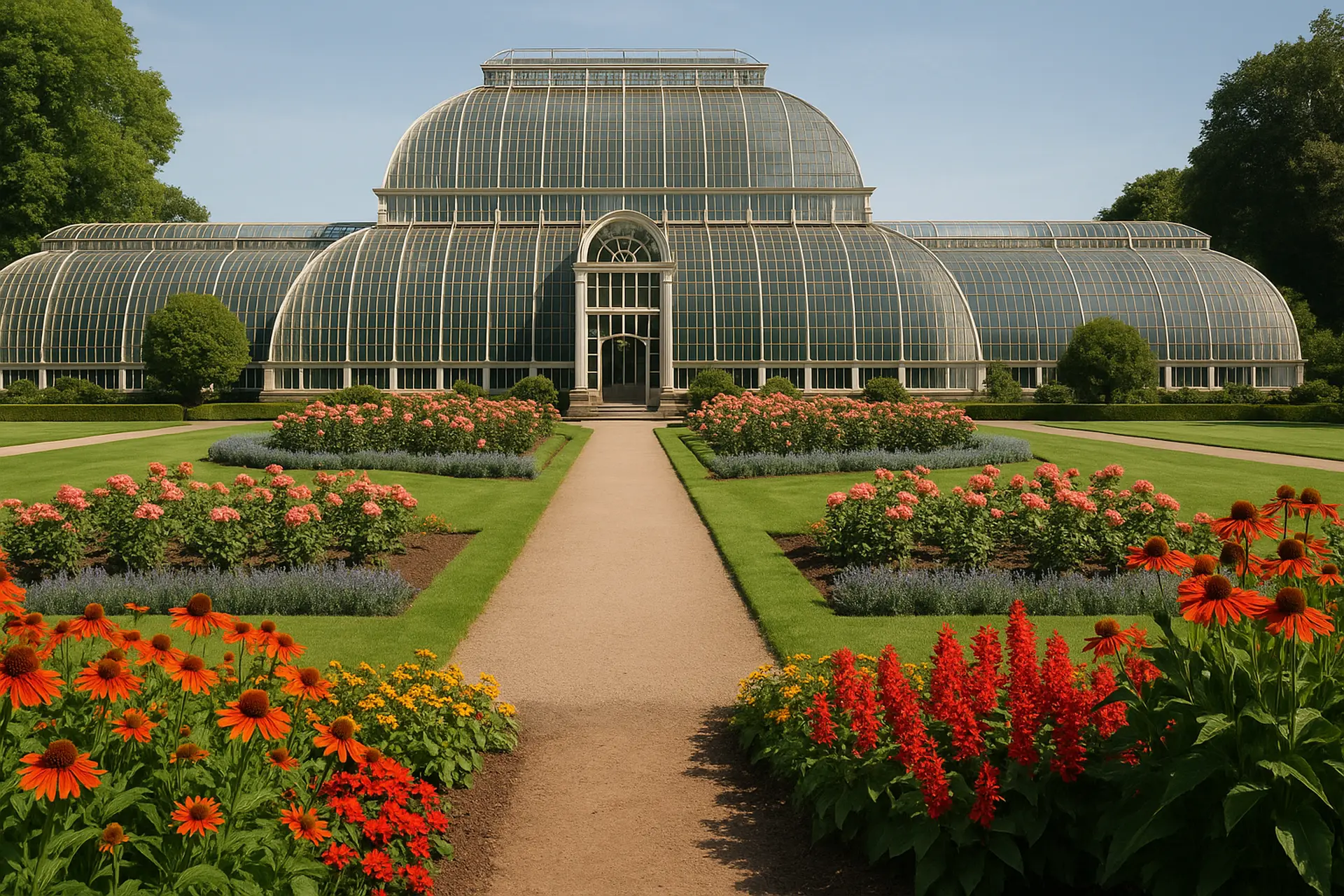
Kew occupies a large historic landscape beside the Thames in southwest London. Its public identity is anchored by structures such as the Palm House and Temperate House, but the institution extends far beyond conservatory spectacle. Living collections, herbarium holdings, libraries, laboratories, seed conservation and international partnerships make Kew one of the world’s central botanical research organisations.
The gardens developed through royal estates, eighteenth-century landscape design and expanding scientific networks. Plants arrived through exploration, trade, diplomacy and empire. That history generated knowledge and collections of immense value, but it also involved unequal power, extraction and the movement of biological material without the forms of consent expected today. Kew’s story should therefore be read with both admiration and critical attention.
A first visit benefits from choosing one glasshouse and one outdoor collection rather than trying to cross the entire site. The Palm House demonstrates nineteenth-century engineering and tropical display; the Temperate House reveals the extraordinary diversity of plants adapted to climates between tropics and cold zones. The arboretum, alpine areas, grass gardens and seasonal borders offer very different scales of observation.
UNESCO recognises Kew as a historic landscape illustrating developments in garden art and botanical science. That status does not freeze the garden. Trees age, storms alter the canopy, collections are re-evaluated and buildings require conservation. Current closures and restoration projects should be checked. A successful visit leaves space for the institution’s contemporary work: identifying species, assessing extinction risk, supporting seed banking and helping answer how plant diversity can persist under rapid environmental change.
Padua · Italy
Botanical Garden of Padua
Founded in 1545 for university teaching, Padua preserves an early scientific garden plan while continuing to interpret global plant diversity.
Best for: seeing how a teaching collection became a model for botanical gardens across Europe
Historic model
A garden built for repeated observation
The University of Padua established its botanical garden in 1545 to support the study of medicinal plants. It remains in its original location, making continuity of place central to its significance. The historic garden’s circular form, enclosed within a square, turns classification and controlled cultivation into architecture. It reflects a period when accurate identification had direct consequences for medicine and teaching.
Padua became a centre for the exchange of plants, seeds and botanical knowledge. Species from distant regions entered cultivation, were observed and circulated through scholarly networks. The garden influenced later institutions, not because every detail was copied, but because it demonstrated how a university could organise living material for repeated study rather than rely only on texts and dried drugs.
The historic core is compact, which encourages close looking. Old specimens, medicinal beds, aquatic plants and labelled collections reveal how the garden changed while retaining its early geometry. The contemporary Garden of Biodiversity extends the interpretation through climate-controlled environments and a broader narrative of plant adaptation. The contrast between old enclosure and modern conservatory is one of the visit’s strengths.
UNESCO describes Padua as the origin of a model that contributed to botanical science, scientific exchange and understanding of relationships between nature and culture. Visitors should avoid treating “oldest” as the sole reason to care. The living institution matters because it continues to teach and revise. A sixteenth-century plan and twenty-first-century biodiversity research occupy the same university mission.
Singapore
Singapore Botanic Gardens
A tropical scientific and civic landscape that connects colonial economic botany, orchid research, public recreation and modern conservation.
Best for: understanding how a tropical garden can be both national public space and research institution
Tropical institution
Public recreation and research share one landscape
Singapore Botanic Gardens developed in the nineteenth century and played a significant role in tropical botany and economic plant research. Its history includes work connected with crops such as rubber, whose cultivation transformed economies and landscapes across Southeast Asia. That legacy must be read alongside the environmental and labour histories of plantation systems rather than celebrated only as scientific progress.
Today the garden is woven into city life. Lawns, lakes, heritage trees and long paths function as an accessible public landscape, while specialised collections and research continue behind and within the visitor experience. The National Orchid Garden is a major attraction, displaying breeding, horticulture and the extraordinary diversity of the orchid family. Flowering abundance, however, should not obscure the scientific work required to document and conserve tropical flora.
UNESCO inscription recognises the garden’s evolution from a colonial botanical garden into a modern institution of conservation, education and science. Its tropical setting makes plant growth feel immediate, but heat, humidity and sudden rain affect the visit. Early hours, water, light clothing and breaks are practical necessities. Some specialised areas have separate admission or schedules that must be checked.
The garden is particularly effective for comparing landscape moods: formal orchid displays, remnant forest, lakeside recreation and research-oriented collections. Listen as well as look. Birds, insects and rain are active parts of the environment. Respecting wildlife means not feeding animals, leaving flowers in place and accepting that a tropical garden is not controlled into perfect stillness.
Bronx · New York City
New York Botanical Garden
A major research garden where an old-growth forest remnant, conservatory displays, herbarium science and urban education coexist.
Best for: seeing how a metropolitan garden connects field research, collections and public programming
Urban science
The herbarium changes how the living garden is read
The New York Botanical Garden occupies a substantial landscape in the Bronx, including a remnant of the forest that once covered much more of the region. That woodland and the Bronx River provide an ecological counterpoint to formal collections and the Enid A. Haupt Conservatory. The institution is not an ornamental retreat outside the city; it is part of the city’s environmental, educational and cultural infrastructure.
Scientific work includes plant exploration, taxonomy, conservation and one of the world’s major herbarium collections. Researchers study specimens gathered across long periods, making it possible to compare distributions, flowering times and morphological variation. The public rarely sees the full archive, but exhibitions and labels can connect living plants to this deeper evidence.
Seasonal shows attract large crowds, especially when orchids, holiday displays or major art programmes are presented. These events can be excellent entry points, though they may dominate the visit. Balance them with one quieter collection: native plants, conifers, roses, rock gardens, forest or a conservatory biome. The contrast shows how horticultural display and botanical documentation serve different but compatible purposes.
The garden’s urban role includes school programmes, community engagement and training. Visitors should check which entrances, trams, paths and buildings are operating, as the site is extensive. A map is more useful than a rushed circuit. The key question is how an institution in a densely populated metropolis makes plant knowledge public while maintaining collections that require long horizons of care.
Montréal · Canada
Montréal Botanical Garden
A large northern garden known for thematic landscapes and greenhouses that place horticultural artistry beside cultural interpretation.
Best for: comparing designed gardens, climatic adaptation and the ethics of representing cultural landscapes
Designed interpretation
Cultural gardens require context as well as beauty
Montréal Botanical Garden, part of the Space for Life museum complex, uses extensive outdoor collections and greenhouses to present plants across a demanding northern climate. Seasonal change is fundamental. Summer landscapes, autumn colour, winter structure and indoor tropical displays produce different institutions across the year, so visitors should choose a visit based on interests rather than expect every collection to peak simultaneously.
The Chinese Garden and Japanese Garden are among the most recognised areas. They should be approached as designed cultural landscapes shaped through collaboration, materials, symbolism and horticultural maintenance, not as miniature substitutes for entire countries. Interpretation is strongest when it identifies authorship, exchange and specific traditions rather than presenting an undifferentiated “Asian” atmosphere.
Other collections examine alpine plants, roses, useful plants, First Nations knowledge, arboreal diversity and greenhouse habitats. Cultural interpretation requires particular care where Indigenous plants and knowledge are involved. Institutions must work with communities, acknowledge intellectual authority and avoid converting living traditions into anonymous folklore. Visitors can look for evidence of those relationships in labels and programming.
Montréal demonstrates the labour of seasonality. Tender plants move indoors, structures protect specimens, snow changes access and horticulturists plan several seasons ahead. Current greenhouse closures, festival installations and path conditions should be checked. The garden is best explored through two contrasting areas rather than a totalising march: one designed cultural garden and one collection organised by ecology, use or plant group.
Rio de Janeiro · Brazil
Rio de Janeiro Botanical Garden
A historic tropical institution beneath the Tijuca massif, where imperial history, Atlantic Forest biodiversity and urban life intersect.
Best for: experiencing a botanical garden as part of a larger forested and metropolitan landscape
Brazilian scale
A city garden opens onto many biomes it cannot contain
Rio de Janeiro’s botanical garden traces its foundation to 1808, when the Portuguese court established a garden linked to the acclimatisation of economically important plants. The institution’s history is therefore inseparable from empire, trade and attempts to move useful species among colonies and markets. Over time it developed broader scientific, conservation and public roles.
The famous avenue of imperial palms creates a formal axis, but it should not become the whole garden. Collections of Brazilian and international plants, lakes, historic structures and research facilities sit beside the ecological presence of the Tijuca massif. Humidity, birds, insects and dense vegetation make the boundaries between curated collection and surrounding tropical life feel unusually porous.
Brazil contains extraordinary plant diversity and severe conservation pressures. A national research institute in Rio can connect taxonomy, fieldwork, herbarium collections and public awareness, yet no city garden can represent the scale of the country’s biomes. Visitors should read geographic labels carefully and avoid collapsing Atlantic Forest, Amazon, Cerrado, Caatinga and other systems into one generic tropical category.
Heat, rain and mosquito activity shape practical planning. Follow current health guidance, bring water and use protection appropriate to the season. Respect any restrictions on sensitive collections and wildlife. The garden is especially rewarding when paired intellectually—not necessarily on the same day—with Rio’s protected cultural landscape, where mountains, forest, city and designed spaces demonstrate how nature and urban identity have been constructed together.
Cape Town · South Africa
Kirstenbosch National Botanical Garden
A garden on the eastern slopes of Table Mountain devoted above all to the extraordinary flora of southern Africa.
Best for: seeing indigenous plant diversity interpreted within the landscape that helps explain it
Regional focus
Global importance through commitment to native flora
Kirstenbosch occupies a dramatic site against Table Mountain, but the mountain backdrop is not simply scenic branding. Geology, slope, fire, rainfall and wind help explain the diversity of the Cape Floristic Region. The garden is especially important for its commitment to southern African plants, demonstrating that a botanical institution can achieve global significance by taking regional flora seriously rather than assembling the broadest possible world collection.
Proteas, ericas, restios, cycads and many other groups reveal forms unfamiliar to visitors from temperate northern gardens. Labels and interpretation can connect those forms to nutrient-poor soils, pollination, fire ecology and geographic isolation. Fynbos should not be treated as a flower style. It is vegetation shaped by ecological processes and includes species vulnerable to habitat loss, invasive plants and altered fire regimes.
Kirstenbosch forms part of the South African National Biodiversity Institute’s garden network and supports conservation, horticulture, research and education. Its history also intersects with colonial land use and the forced removals that shaped South African landscapes. A complete account should acknowledge people and power alongside plant diversity.
Paths range from gentle lawns to steeper routes approaching natural vegetation, and weather can change quickly near the mountain. Check trail conditions, event closures and fire-related restrictions. The canopy walkway offers a different spatial perspective, but the most meaningful experience often comes lower down: comparing leaves, cones, flowers and seed structures while understanding that the cultivated garden is connected to a much larger protected mountain system.
Sydney · Australia
Royal Botanic Garden Sydney
A harbour-edge garden where colonial history, Australian plant science and a highly visible civic landscape meet.
Best for: examining how a central public garden can connect Indigenous history, colonial collecting and contemporary conservation
Civic landscape
The shortcut through the garden can become the destination
The Royal Botanic Garden Sydney occupies a prominent position beside Sydney Harbour, the Opera House and the central city. Its accessibility can make it seem like an elegant public park, but the institution belongs to a wider network of scientific collections, horticulture, conservation and education managed by Botanic Gardens of Sydney. The harbour setting is an entrance to the story, not its conclusion.
The site’s history reaches into early colonial agriculture and botanical collection. That history must begin with the continuing relationship of Aboriginal peoples to Country. Colonial institutions reordered land, names and access while drawing on knowledge that was often insufficiently acknowledged. Contemporary interpretation has the responsibility to make Indigenous knowledge and authority visible through genuine partnership rather than a token introductory panel.
Living collections include Australian and international plants adapted to varied garden conditions. Visitors can compare rainforest species, palms, cycads, succulents and formal landscapes while considering why some plants thrive in Sydney’s climate and others require specialised care. The institution’s scientific collections and research broaden the public display through seed conservation, plant health and documentation.
Because the garden sits on a major visitor route, it can be crossed too quickly between landmarks. A better plan is to choose one collection, join an interpretive walk when available and spend time reading how the garden addresses Country, colonial history and conservation. Check event zones and path closures, especially during large public programmes. Sydney’s lesson is that a botanical garden can be central, free-flowing and popular without surrendering its scientific and historical complexity.
Visitor practice
How to leave a botanical garden with more than photographs
A focused route, ethical attention and tolerance for seasonality produce a deeper encounter than trying to record every bed.
Begin with the institution’s map and mission. Identify one historic feature, one scientific collection and one landscape experience. At Kew that might mean a glasshouse, a research-oriented display and the arboretum. In Singapore it could be the orchid collection, heritage trees and a forest area. In Kirstenbosch, a family such as Proteaceae can connect cultivated beds with the mountain ecology beyond them.
Labels deserve time. The scientific name usually combines genus and species, while family, common name, origin and accession information may also appear. A plant’s wild provenance can be especially important: material collected from a documented population may support research that a horticultural hybrid cannot. Do not assume that a missing common name means poor interpretation; many plants have multiple local names or none widely used in the visitor’s language.
Photography should follow the path. Long lenses and careful framing are better than leaning over barriers. Tripods can obstruct narrow routes and may require permission. Flash can be restricted in exhibitions or disturb visitors. Commercial photography, wedding shoots and drones usually follow separate rules. The ethical image records the plant without damaging the conditions that allowed it to be grown.
Never collect seeds, fallen flowers or cuttings without explicit institutional permission. Material may be part of research, legally protected, treated with chemicals or capable of carrying pathogens. Border agencies regulate biological material for good reason. Posting a location for a highly threatened or theft-prone plant can also create risk; follow the institution’s lead on sensitive information.
Seasonal disappointment can be redirected. When a celebrated flower is absent, look for fruit, seed dispersal, leaf scars, bark, buds or horticultural labels explaining dormancy. Ask staff what is currently significant rather than what was advertised months earlier. Conservatories offer climatic reliability, but even controlled collections follow growth cycles and maintenance schedules.
Accessibility should be planned across the entire route. A garden may advertise step-free entrance while containing steep slopes, gravel, long distances or conservatories with narrow circulation. Ask about mobility devices, shuttle services, quiet periods, seating, sensory guides and accessible toilets. Heat and humidity can be barriers even on level ground.
Support can take several forms: admission, membership, an ethical shop purchase, donation or simply following biosecurity guidance. Avoid buying products made from threatened plants or unverified wild collection. A garden’s shop should extend its mission, not undermine it. The best souvenir is often a field guide, locally propagated legal plant or a note that changes how the visitor sees vegetation at home.
Read the mission
Learn whether the institution emphasises regional flora, global collections, conservation, history or public recreation.
Choose three anchors
Select one collection, one landscape feature and one scientific or historical question.
Observe before photographing
Use labels and plant form to decide what the image is meant to record.
Leave biological material in place
Seeds, soil, flowers and cuttings are not souvenirs and may create legal or ecological risk.
Check what changes
Weather, blooms, glasshouse maintenance and accessible routes should be verified close to the visit.
| Garden | Primary lens | Landscape context |
|---|---|---|
| Kew | Global collections and botanical science | Historic Thames landscape |
| Padua | University teaching and early garden form | Compact walled urban site |
| Singapore | Tropical research and civic use | Equatorial city landscape |
| New York | Herbarium science and urban education | Bronx forest and conservatory |
| Montréal | Thematic gardens and seasonality | Northern climate and greenhouses |
| Rio de Janeiro | Brazilian botany and imperial history | Tijuca massif and tropical city |
| Kirstenbosch | Southern African native flora | Table Mountain slopes |
| Sydney | Harbour civic garden and plant science | Central waterfront landscape |
The larger question
What living collections can—and cannot—do in a changing climate
Botanical gardens are laboratories of response, but they cannot substitute for protecting functioning ecosystems and the communities connected to them.
Climate change is already altering flowering times, water demand, pest pressure, storm damage and the suitability of long-established collections. A tree planted for a cooler climate may struggle decades before the end of its expected life. Gardens must decide whether to move species, change irrigation, alter soils, increase shade or accept losses. Those decisions create long-term records valuable to cities and land managers.
Living collections can hold threatened plants, maintain genetic material and develop propagation knowledge. Seed banks can preserve material under controlled conditions, while nurseries support reintroduction and restoration. Yet ex situ conservation has limits: small collections may capture little genetic diversity, seeds of some species do not tolerate conventional storage, and a plant removed from its ecological relationships is not a saved ecosystem.
The strongest conservation programmes connect gardens with field partners, local institutions and communities who manage habitats. They share skills, respect access and benefit agreements, and avoid treating biodiversity-rich regions as supply zones for wealthy collections. Historical networks often moved plants and knowledge toward imperial centres. Contemporary partnerships should be built on reciprocity and transparent authority.
Visitors can support this work by resisting simple rescue narratives. A rare plant behind glass is not proof that extinction has been solved. Ask where its wild populations survive, what threatens them and who is leading protection. Donate to programmes that connect cultivation with habitat. Learn how gardening choices at home—peat use, invasive ornamentals, pesticide dependence and water consumption—relate to broader conservation.
Botanical gardens also help societies imagine adaptation. Shade trees, drought-tolerant planting, rain gardens, seed diversity and urban habitat can be demonstrated at public scale. Not every display transfers directly to a household or another climate, but the garden can make trade-offs visible. A beautiful landscape becomes most valuable when it teaches why that beauty can endure.
The living archive
The greatest botanical gardens make beauty more precise by revealing the systems that keep plants known.
Kew, Padua, Singapore, New York, Montréal, Rio, Kirstenbosch and Sydney do not succeed for the same reason. One preserves a foundational university plan; another interprets tropical economic botany; another commits itself to regional native flora; others combine metropolitan recreation with vast research collections. Their differences show that “botanical garden” is a working institutional idea rather than one visual style.
A visitor may remember a palm avenue, orchid, mountain view, conservatory roof or autumn tree. The deeper memory should include the label, accession record, herbarium sheet, nursery bench and field partnership behind that image. Plants appear still, but botanical knowledge is active: names change, ranges shift, collections age and conservation priorities become more urgent.
The best garden visit therefore ends with a changed habit of attention. Street trees acquire histories. Weeds become identifiable organisms. Food, medicine, fibres and timber reconnect with species and habitats. Beauty remains, but it no longer floats free of evidence. It becomes an invitation to understand what is growing, why it is here and what must happen for it to continue.


