French Recipes

Ratatouille

A Provençal ratatouille of aubergine, courgette, peppers, tomato, onion and garlic, with each firm vegetable sautéed separately before a final gentle simmer in a reduced tomato base.

French Recipes
Share
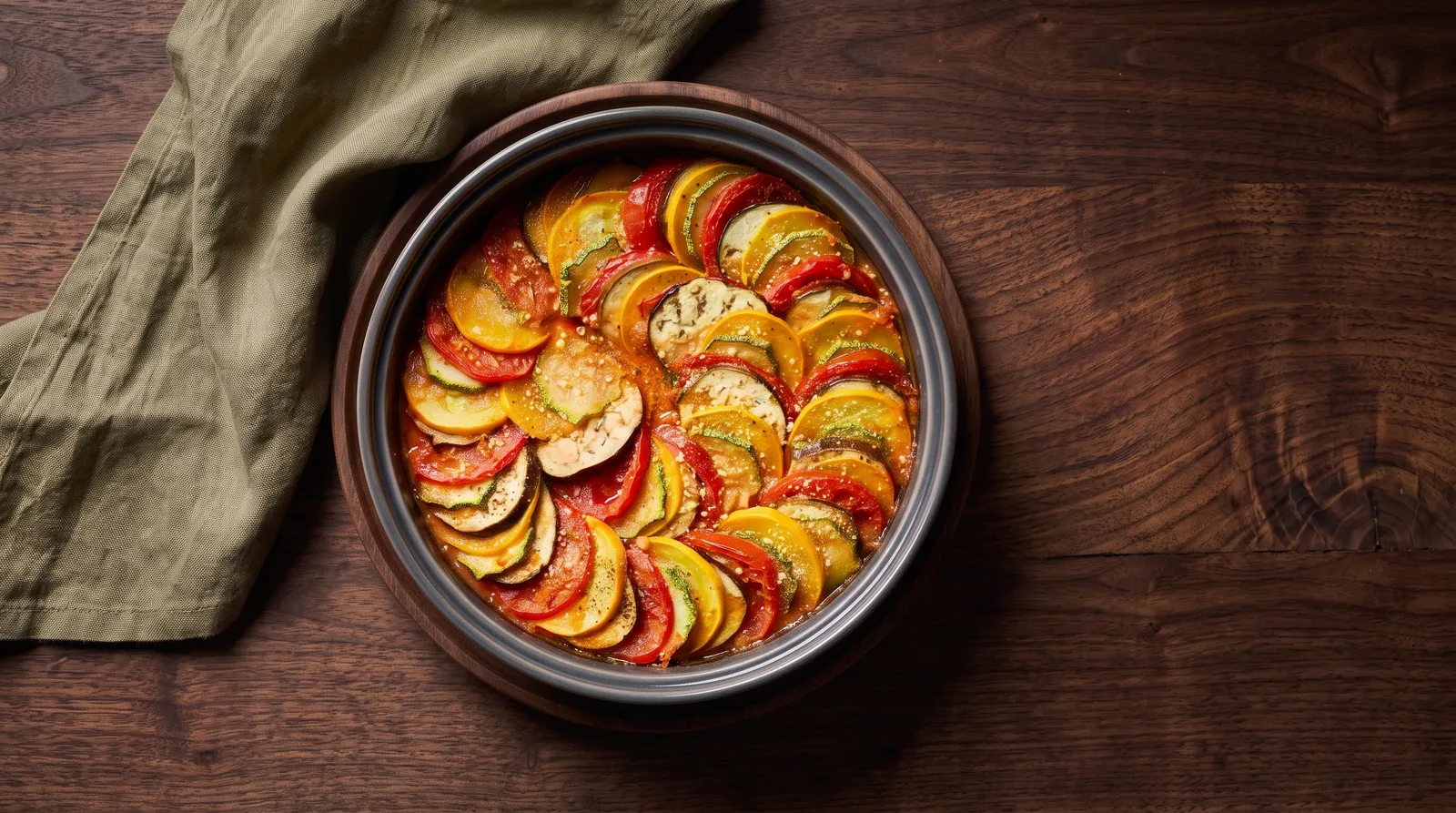
Ratatouille — shown in a pan
Prep 30 minutes
Cook 66 minutes
Total 96 minutes
Yield about 2.25 kg cooked ratatouille, 6 servings
Introduction and overview

Ratatouille — Provençal separately sautéed summer vegetables

Ratatouille is a Provençal summer vegetable dish, not a catch-all name for any mixed vegetable casserole. The core here is aubergine, courgette, sweet peppers, tomato, onion, garlic and olive oil, with thyme, bay and parsley providing a restrained herb profile. There is no potato, cheese or decorative layered oven arrangement. The finished pan should contain tender vegetables that remain recognizable, held together by a reduced tomato base rather than floating like soup.

This preparation uses separate sautéing for the three vegetables most prone to uneven cooking. Aubergine gets 30 ml of the measured olive oil and enough pan space to brown instead of steam. Courgette follows with 15 ml, then peppers with another 15 ml. The pieces are kept around 2.5 cm so they can soften without disappearing. All 80 ml of oil are measured in advance and remain part of the finished dish and its nutrition; there is no invisible extra pour at the pan.

The tomato base is built only after those vegetables have been removed. Onion softens with 10 ml oil, garlic is added briefly, then 700 g tomato, thyme, bay, salt, pepper and the final 10 ml oil simmer uncovered until obvious watery liquid reduces. The separately cooked vegetables are then folded back in for 20 minutes over low heat. The target is tenderness with definition: aubergine should be soft, courgette and pepper should still show their edges, and the spoon should not uncover a puddle of thin tomato water.
Success points

Success points

  • Use the listed prepared edible weights after trimming, not rough whole-vegetable estimates.
  • Keep the aubergine, courgette and peppers in 2.5 cm pieces so they survive the final simmer.
  • Sauté the firm vegetables separately and in an uncrowded pan to develop colour without steaming.
  • Measure all 80 ml olive oil; do not keep adding oil by eye during the separate batches.
  • Reduce the tomato base before recombining the vegetables so the finished ratatouille is coated rather than watery.
Ingredients

Ingredients

  • 500 g aubergine, trimmed and cut into 2.5 cm cubes
  • 500 g courgette, trimmed and cut into 2.5 cm pieces
  • 350 g red and yellow peppers, seeded and cut into 2.5 cm pieces
  • 700 g ripe tomatoes, cored and diced
  • 250 g onion, peeled and sliced
  • 20 g garlic, peeled and finely chopped
  • 80 ml extra-virgin olive oil, measured and fully retained
  • 10 g flat-leaf parsley, chopped
  • 2 g fresh thyme leaves
  • 1 bay leaf
  • 8 g fine salt
  • 2 g black pepper
Method

Method

Directions

  1. Cut the vegetables evenly. Prepare the aubergine, courgette and peppers in similar 2.5 cm pieces, slice the onion, dice the tomatoes and chop the garlic and parsley, allowing 30 minutes. The vegetables are evenly cut, with aubergine, courgette and pepper pieces close to 2.5 cm.

  2. Brown the aubergine. Heat 30 ml olive oil in the 30 cm sauté pan and cook the 500 g aubergine over medium-high heat for 10 minutes in two uncrowded additions, returning both additions to the pan at the end. The aubergine is browned in spots and tender at the surface but still holds its cube shape.

  3. Sauté the courgette. Transfer the aubergine to a bowl, add 15 ml olive oil and cook the 500 g courgette over medium-high heat for 7 minutes. The courgette is lightly golden at the edges and still holds its shape.

  4. Sauté the peppers. Transfer the courgette, add another 15 ml olive oil and cook the 350 g peppers for 8 minutes. The peppers are glossy, lightly blistered and beginning to soften without collapsing.

  5. Soften the aromatics. Lower the heat, add 10 ml olive oil and cook the 250 g onion for about 5 minutes; stir in the 20 g garlic for the final minute. The onion is translucent and soft without dark browning, and the garlic is fragrant but not scorched.

  6. Reduce the tomato base. Add the 700 g tomatoes, 2 g thyme, 1 bay leaf, 8 g salt, 2 g pepper and the final 10 ml olive oil. Simmer uncovered over medium-low heat for 15 minutes. The tomatoes have broken down into a loose sauce and obvious free watery liquid has reduced.

  7. Combine gently. Return the aubergine, courgette and peppers to the pan and fold them through the tomato base. Simmer on low heat for 20 minutes and stir in the 10 g parsley at the end. Every vegetable is tender, the pieces remain identifiable, and no pool of thin liquid collects around the spoon.

Serving, storage and make-ahead

Practical

Serving, storage and make-ahead

Serve ratatouille hot, warm or at room temperature. At about 375 g per serving it can act as a generous vegetable course, though it also works as a side dish when divided more modestly. The sauce should cling around the pieces without hiding their individual textures.

Serving, storage and make-ahead

The entire dish can be made a day ahead. Cool it promptly, cover and refrigerate; the vegetable flavours remain integrated after a night in the refrigerator. Because the pieces are already tender, reheat over moderate heat with gentle folding rather than vigorous stirring or boiling.

Serving, storage and make-ahead

Refrigerate within 2 hours at 4 °C or below and use within 3 days. If serving it hot again, reheat to 74 °C. There is no need to add more olive oil during reheating. Yellow and red peppers can share the fixed 350 g total in a different proportion, but adding potato, cheese or converting the dish to a layered bake changes the preparation rather than merely adjusting colour.

Troubleshooting

Troubleshooting

  • The pan is full of watery liquidtoo many vegetables were crowded together or the tomato base was not reduced enough. Sauté in uncrowded batches and reduce visible free liquid before combining.
  • The vegetables become a mashthe pieces were cut too small or stirred aggressively during the final simmer. Keep the 2.5 cm cut and fold gently.
  • The garlic tastes bitterit browned too far before the tomato was added. Cook it only briefly with the softened onion and move on as soon as it smells fragrant.
Nutrition per serving

Nutrition per serving

  • Serving sizeabout 375 g ratatouille (1 of 6 servings)
  • Calories203 kcal
  • Carbohydrate20.8 g
  • Protein4.2 g
  • Fat12.9 g
  • Fibre6.9 g
  • Sodium544 mg
Allergens and food safety

Allergens and food safety

Allergens: No major allergen from the listed ingredients.

Hot olive oil can spit when damp vegetables are added, so dry washed produce and lower it into the pan carefully. Keep boards and knives clean, especially if raw animal foods are being prepared elsewhere in the kitchen. Cool cooked ratatouille promptly and refrigerate within 2 hours at 4 °C or below. Reheat leftovers to 74 °C when serving hot.

FAQ

FAQ

Does aubergine have to be salted and drained first?

Not for this preparation. The aubergine is cut evenly and sautéed in measured oil without a separate salting-and-draining stage, so the timing and seasoning stay controlled.

Is ratatouille the same as confit byaldi?

No. A layered, thinly sliced baked presentation is a different preparation. This ratatouille is cooked in a sauté pan with separate vegetable stages followed by a combined simmer.

Closing

Closing

  • Result: Tender Provençal summer vegetables that remain distinct, coated in a concentrated tomato-herb base rather than a watery broth.
  • Decisive technique: Sauté aubergine, courgette and peppers separately, then reduce the tomato base before the final gentle combination.