French Recipes

Pâté aux prunes

An Angevin double-crust sweet pie filled with whole Reine-Claude plums, sealed under a pastry lid with a central chimney and baked until the fruit juices bubble.

French Recipes
Share
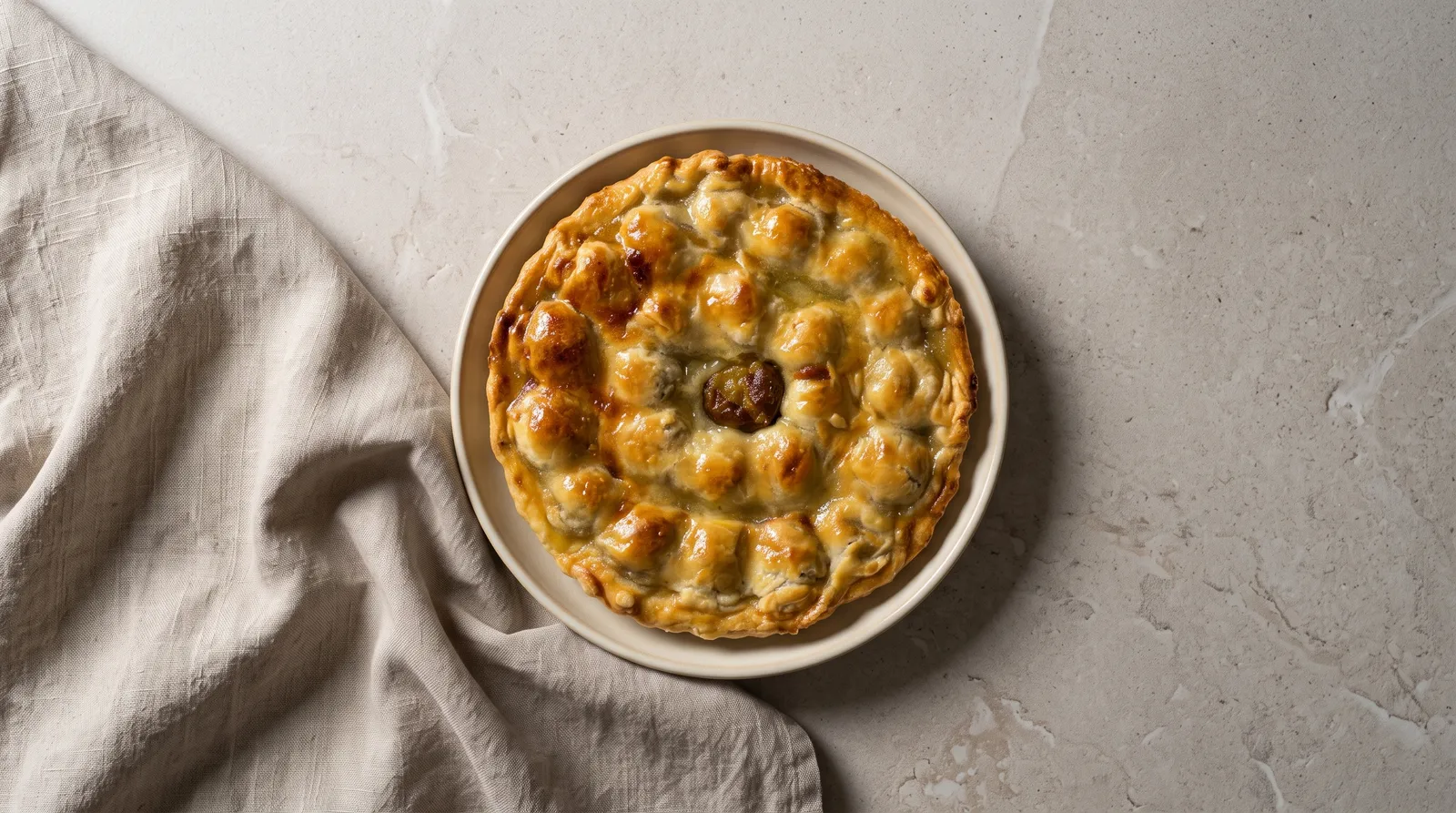
Pâté aux prunes — shown whole after baking
Prep 35 minutes
Cook 50 minutes
Total 235 minutes
Yield 1 round 24 cm pie, 8 wedges
Introduction and overview

Pâté aux prunes with whole Reine-Claude plums

Pâté aux prunes is a sweet speciality of Angers and Anjou, despite the word pâté suggesting meat to many readers. Here it means fruit enclosed in pastry: a round lower crust is packed with small Reine-Claude plums, covered with a second crust, sealed and vented through a central opening. The fruit cooks in its own juice inside the pastry rather than being reduced to jam first.

The whole-plum form matters to the regional identity used here. One kilogram of washed, dried fruit goes into a 24 cm pie with the stones deliberately left in place. That makes the eating experience different from an ordinary plum tart, but it also creates a real hazard: every diner must be told clearly that the stones remain. A pitted version is a sensible household adaptation, yet it should be described as an adaptation rather than as exactly the same whole-fruit form.

The pastry is chilled before rolling, sealed before trimming and given a 3 cm central chimney so steam and bubbling fruit juice have a controlled exit. Baking continues until the crust is deeply golden and juice is visibly bubbling through the opening. A 90-minute cool is not cosmetic: it allows the retained plum liquid to thicken around the fruit instead of flooding the plate as soon as the first wedge is cut.
Success points

Success points

  • Dry fruit, a continuous pastry seal and an open central chimney keep the double crust manageable. Do not rush the cooling interval; the juice needs time to settle.
Ingredients

Ingredients

Pastry

  • 400 g plain wheat flour
  • 150 g unsalted butter, melted and cooled to warm
  • 80 g caster sugar
  • 6 g fine salt
  • 100 g whole egg, 2 large eggs, without shell
  • 18 g egg yolk, 1 yolk for glazing

Fruit

  • 1000 g Reine-Claude plums, whole purchased weight, washed and dried; stones deliberately retained
  • 20 g caster sugar, for scattering over the fruit
Method

Method

Directions

  1. Make the pastry. Mix flour, 80 g sugar and salt. Add the melted cooled butter and 100 g whole egg, then knead only until a homogeneous dough forms. The dough is cohesive and smooth with no dry flour, but is not greasy or overworked. Use clean hands and utensils for the egg dough.

  2. Chill the dough. Wrap and refrigerate the dough for 60 minutes. The dough is firm enough to roll without sticking excessively. Working temperature: 4 °C. Keep at 4 °C or below.

  3. Line and fill the tin. Roll a little more than half the dough and line a 24 cm round tin, leaving a 1–2 cm overhang. Arrange the 1 kg whole plums snugly in one layer and scatter with 20 g sugar. The plums cover the base closely without being crushed and the pastry overhang remains intact for sealing. Warn diners that stones remain in every whole plum.

  4. Seal and vent. Roll the remaining dough into a lid, cover the fruit, moisten and seal the rim firmly, trim excess only after sealing, then cut a central chimney about 3 cm across. The seam is continuous and the central opening is clear through the top crust. Use the knife away from fingers and do not block the chimney.

  5. Glaze and bake. Brush the top with the 18 g egg yolk and bake at 180 °C for 50 minutes. The pastry is deep golden and visibly cooked at the base edge, and plum juices bubble through the central chimney. Hot plum syrup can cause severe burns; keep the pie level when removing it from the oven.

  6. Cool the fruit filling. Cool in the tin for 90 minutes before cutting so the retained fruit juices thicken rather than flooding the plate. The filling is warm or cool rather than piping hot and the juices stay around the fruit when a wedge is lifted. Serve with an explicit stone warning; never assume the stones have softened or become edible.

Serving and planning

Practical

Serving and planning

Serve at room temperature or slightly warm, always telling diners that the whole Reine-Claude plums still contain stones.

Serving and planning

The pastry may be made and chilled one day ahead. Assemble shortly before baking so the raw base does not sit under juicy fruit.

Storage and reheating

Cover and refrigerate cooled leftovers for up to 3 days. Reheat wedges at 160 °C for about 10 minutes if desired, then cool enough that the fruit centre is not dangerously hot.

Substitutions

For a safer household adaptation, pit the plums before filling and keep the same 1 kg purchased-fruit target adjusted to about 940 g edible fruit; the eating experience is safer but should not be claimed as the exact whole-plum traditional form.

Nutrition per serving

Nutrition per serving

  • Serving size1 of 8 wedges
  • Calories436 kcal
  • Carbohydrate62.4 g
  • Protein8.0 g
  • Fat17.7 g
  • Fibre3.1 g
  • Sodium317 mg
Allergens and food safety

Allergens and food safety

The selected identity deliberately retains plum stones; warn every diner clearly and never serve to someone unable to manage stone-in fruit safely.

Fully bake both pastry layers and egg glaze.

Hot enclosed fruit juice remains dangerous well after the pie leaves the oven.

Allergens: egg, milk, gluten.

FAQ

FAQ

Why are the plums left whole?

Whole Reine-Claude plums with stones are documented in the Angevin form used here. The stones must be treated as a serving hazard.

Can the plums be pitted?

Yes for a safer household adaptation. Use the stated edible fruit basis, but do not present the pitted pie as exactly the same whole-plum preparation.

Closing

Closing

  • Result: An Angevin double-crust sweet pie filled with whole Reine-Claude plums, sealed under a pastry lid with a central chimney and baked until the fruit juices bubble.
  • Decisive technique: Dry fruit, a continuous pastry seal and an open central chimney keep the double crust manageable. Do not rush the cooling interval; the juice needs time to settle.