French National Dishes

Pâté en croûte

A moulded pork-and-veal forcemeat enclosed in sturdy short pastry, baked to 71 °C, cooled, filled with measured savoury aspic through two chimneys and chilled before slicing.

French National Dishes
Share
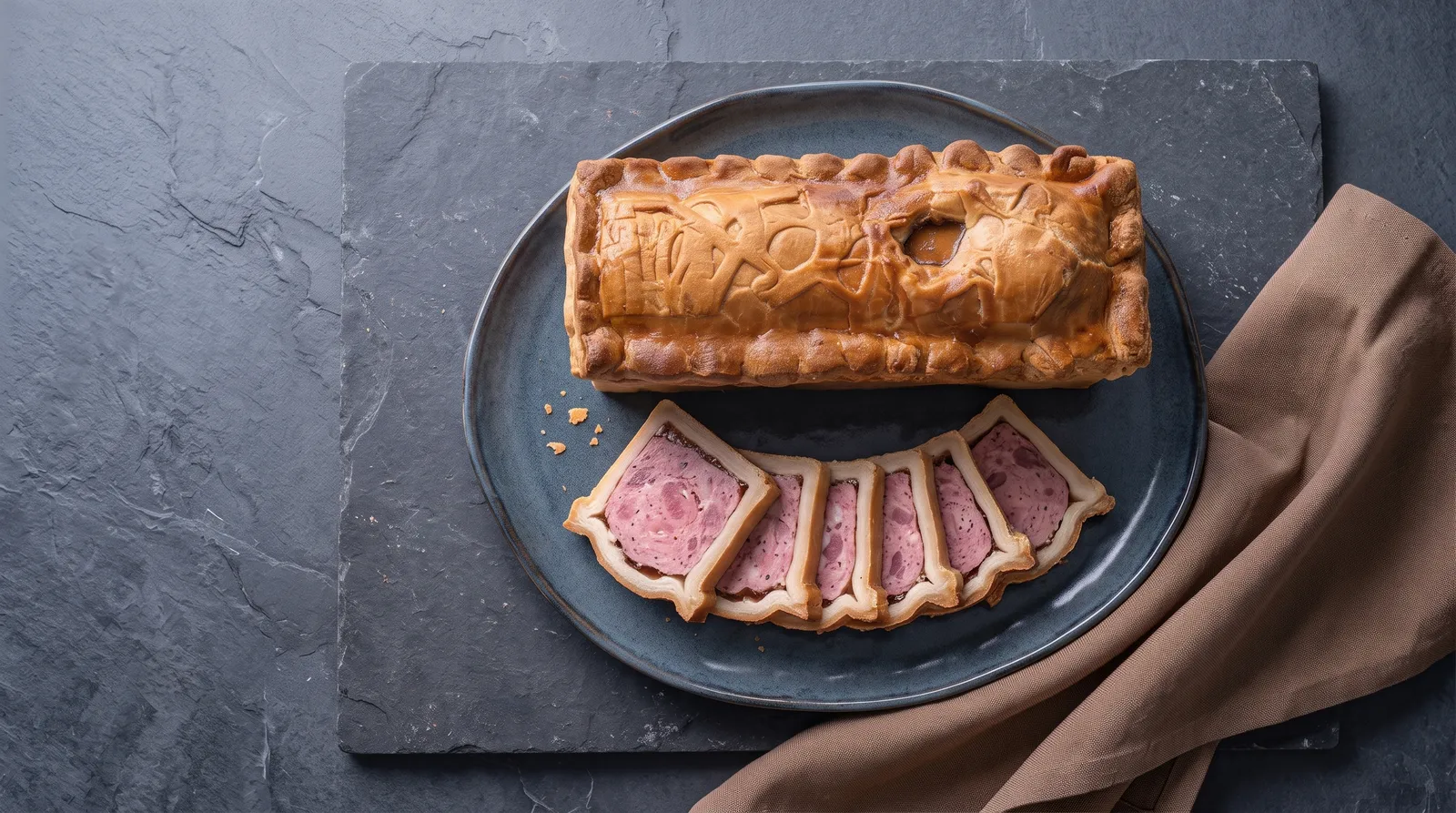
Pâté en croûte — shown with a cut section visible
Prep 90 minutes
Cook 95 minutes
Total 1865 minutes
Yield 1 pâté in a 30 × 10 × 9 cm mould, 12 slices
Introduction and overview

Pâté en croûte with pork, veal and aspic

Pâté en croûte is charcuterie and pastry working as one structure. The filling is a seasoned pork-and-veal forcemeat with visible pork dice, not a meatloaf wrapped in puff pastry. A firm butter-and-milk pastry is rolled around the cold filling in a long mould, two chimneys are left open for steam, and those same openings later accept clear savoury aspic after the baked loaf has cooled.

Temperature control begins before the oven. The meat is marinated under refrigeration, drained thoroughly, then minced and mixed while remaining below 4 °C. The farce is packed tightly against the pastry to exclude large air pockets, but the loaf is not filled to the very top because the meat will contract during cooking. A probe thermometer confirms that the centre reaches at least 71 °C; pastry colour and clear juices are not substitutes for that measurement.

Aspic is added only after the pâté has cooled and had an initial chill. Pouring it gradually through the chimneys lets the liquid occupy the spaces created by cooking shrinkage without flooding through a warm, fragile crust. The full 350 ml is measured and counted in nutrition only if the loaf accepts it. An overnight final chill then sets the gel and meat firmly enough for twelve clean cold slices.
Success points

Success points

  • Cold farce, a crack-free pastry shell, firm packing and a measured 71 °C core are the foundation. Add the aspic only to a cooled loaf and give it the full final chill.
Ingredients

Ingredients

Pork-and-veal farce

  • 500 g lean pork shoulder, cold, 1.5 cm cubes
  • 300 g veal shoulder, cold, 1.5 cm cubes
  • 250 g pork back fat, cold, diced
  • 100 ml dry white wine, for marinade
  • 60 ml Cognac, for marinade
  • 50 g shallots, finely chopped
  • 15 g flat-leaf parsley, chopped
  • 10 g garlic, finely grated
  • 16 g fine salt
  • 3 g black pepper, ground
  • 2 g quatre-épices

Pastry

  • 500 g plain wheat flour
  • 200 g unsalted butter, cold, diced
  • 100 g whole egg, 2 large eggs, without shell
  • 80 ml whole milk, cold
  • 60 ml water, cold
  • 8 g fine salt

Finish

  • 50 g whole egg, beaten for sealing and glaze
  • 350 ml prepared clear savoury aspic, food-safe commercial or professionally prepared stock gel, cooled but still pourable
Method

Method

Directions

  1. Marinate the meat. Refrigerate and marinate the pork and veal with white wine, Cognac, shallot, parsley, garlic, salt, pepper and quatre-épices for 12 hours. The meat remains fully chilled and evenly coated with the aromatic marinade. Working temperature: 4 °C. Keep at 4 °C or below.

  2. Mix the cold farce. Drain the meat very well. Mince two-thirds of the pork, all the veal and the back fat through a medium plate; keep one-third of the pork as small dice. Mix all filling components until tacky while keeping the farce below 4 °C. The farce is cohesive and tacky, with visible pork dice distributed through it, and stays below 4 °C. Never taste raw farce; cook a small sample separately if seasoning must be checked.

  3. Make and chill the pastry. Rub butter into the flour and salt, then add 100 g egg, 80 ml milk and 60 ml water just until a firm cohesive pastry forms. Wrap and refrigerate for 120 minutes. The pastry is firm, smooth enough to roll and no longer sticky. Working temperature: 4 °C. Keep egg-and-milk pastry cold.

  4. Line and pack the mould. Roll about two-thirds of the pastry and line a 30 × 10 × 9 cm mould with no tears. Pack in the cold farce firmly, pressing out air pockets and leaving about 1 cm headspace. The pastry is continuous in the corners and the farce is tightly packed without visible voids. Working temperature: below 4 °C. Return the mould to refrigeration if the farce warms above 4 °C.

  5. Seal and make chimneys. Cover with the remaining pastry, seal with beaten egg, trim, crimp and cut two 2 cm chimneys. Insert small foil collars if needed and glaze the top with remaining egg. Both chimneys are open and the lid is sealed continuously around the rim. Use raw-meat tools only for raw assembly and clean them before any later handling.

  6. Bake to 71 °C. Bake at 200 °C for 20 minutes, then reduce to 170 °C and continue for about 75 minutes until the centre of the forcemeat reaches at least 71 °C. The pastry is deep golden and the centre of the forcemeat reaches at least 71 °C throughout. Use a probe thermometer; colour and clear juices are not adequate safety tests.

  7. Cool before aspic. Cool for 60 minutes, then refrigerate for 60 minutes before adding aspic. The pâté is cool and firm enough that added aspic will not melt into hot fat. Working temperature: 4 °C. Refrigerate within 2 hours of the bake ending.

  8. Add the measured aspic. Warm only enough of the 350 ml prepared aspic to make it fluid, then pour it gradually through the two chimneys in several additions until the internal spaces stop accepting more. Use the full measured volume only as it is absorbed. The aspic level settles slowly rather than draining straight through the pastry, and the measured 350 ml has been taken up without overflow. Working temperature: about 35 °C. Use only safe prepared aspic; do not pour hot liquid into a fragile cold crust.

  9. Chill overnight. Refrigerate the filled pâté for 720 minutes before unmoulding and slicing. The aspic is fully set and slices hold a clean border of pastry, meat and gel. Working temperature: 4 °C. Keep at 4 °C or below and slice with a clean knife.

Serving and planning

Practical

Serving and planning

Serve fully chilled in 12 slices as charcuterie or a first course.

Serving and planning

Marinate the meat and make the pastry the day before assembly. The finished pâté needs the final overnight chill after aspic is added.

Storage and reheating

Keep at 4 °C or below for up to 3 days after final assembly. Serve cold; reheating destroys the aspic and is not recommended.

Substitutions

A commercial clear savoury aspic is acceptable when its ingredients and allergens are known; do not substitute raw gelatin water without a safe, seasoned stock base.

Substitutions

Replacing veal with more pork changes the flavour and texture and is not treated as identical to this pork-and-veal formula.

Nutrition per serving

Nutrition per serving

  • Serving size1 of 12 slices
  • Calories555 kcal
  • Carbohydrate30.5 g
  • Protein25.9 g
  • Fat35.5 g
  • Fibre1.3 g
  • Sodium985 mg
Allergens and food safety

Allergens and food safety

Keep raw forcemeat below 4 °C and prevent cross-contamination.

Cook the entire centre to at least 71 °C.

Cool rapidly and refrigerate within 2 hours.

Use only food-safe prepared aspic and keep the finished pâté at 4 °C or below.

Alcohol can remain after baking.

Allergens: egg, milk, gluten, sulphites from wine and possibly Cognac.

FAQ

FAQ

Why add aspic after baking?

The meat contracts as it cooks. Cool aspic fills those internal spaces after the loaf has cooled and then sets during the final chill.

Can the pâté be served warm?

Not with this aspic-finished construction. It is designed to be chilled until the gel and farce are firm enough to slice.

Closing

Closing

  • Result: A moulded pork-and-veal forcemeat enclosed in sturdy short pastry, baked to 71 °C, cooled, filled with measured savoury aspic through two chimneys and chilled before slicing.
  • Decisive technique: Cold farce, a crack-free pastry shell, firm packing and a measured 71 °C core are the foundation. Add the aspic only to a cooled loaf and give it the full final chill.