French National Dishes

Pâté lorrain

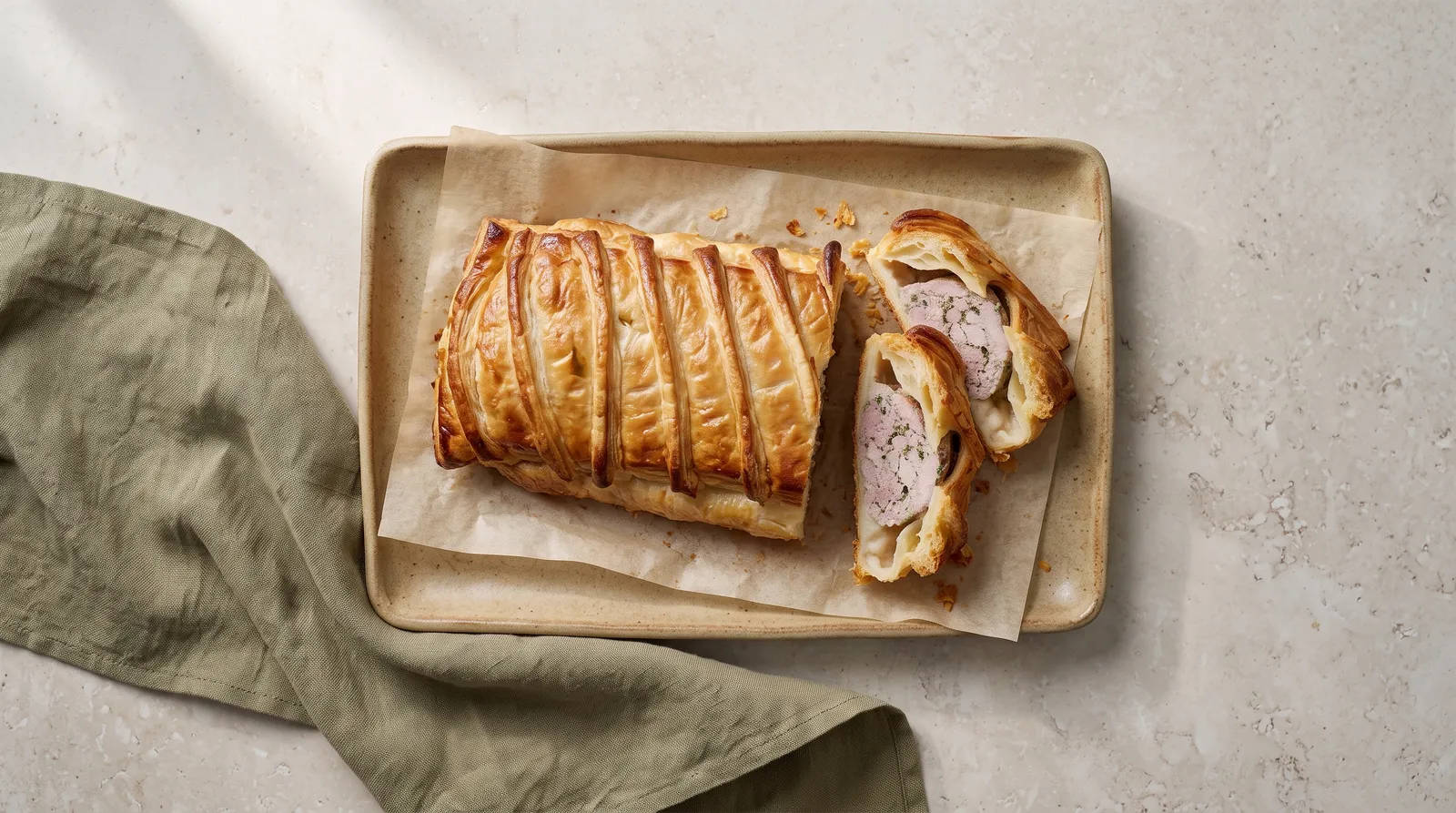
Pork and veal strips are marinated in dry white wine with shallot and herbs, drained thoroughly, enclosed in a long rectangular puff-pastry parcel and baked until every meat piece reaches 71 °C.

French National Dishes
Share
Pâté lorrain — shown with a cut section visible
Prep 45 minutes
Cook 55 minutes
Total 835 minutes
Yield 1 long pâté, 8 slices
Introduction and overview

Pâté lorrain with marinated pork and veal

Pâté lorrain is defined here by intact pieces of pork and veal rather than a minced forcemeat. The meat is cut into matching strips, marinated overnight with dry white wine, shallot, parsley, thyme and bay, then drained very thoroughly before it meets the pastry. That separation from the liquid is what allows the rectangular all-butter puff-pastry case to bake crisp instead of sitting over a wet wine-soaked base.

The pastry is rolled as one long rectangle, filled down the centre and folded into a sealed parcel with three small vents. There is no aspic and no moulded charcuterie farce. Those differences separate it from pâté en croûte even though both combine meat and pastry. The raw filling stays chilled throughout assembly, and the used marinade is discarded rather than poured into the pastry.

Baking begins hotter to establish the puff, then continues at 180 °C until the exterior is deeply golden and the thickest meat pieces reach at least 71 °C. A short 15-minute rest is enough to settle the juices while keeping the pastry crisp for warm service. Wine contributes to the aroma, and it should not be claimed that all alcohol necessarily disappears during baking.
Success points

Success points

  • Drain and blot the meat until it no longer drips, keep the strips intact and build strong seams. Verify 71 °C in the filling even if the pastry already looks ready.
Ingredients

Ingredients

Marinated filling

  • 400 g pork loin or lean shoulder, cut into 1 cm × 4 cm strips
  • 400 g veal shoulder, cut into matching strips
  • 120 ml dry white wine, for marinade
  • 80 g shallots, finely chopped
  • 20 g flat-leaf parsley, chopped
  • 3 g fresh thyme leaves
  • 1 g bay leaf, 1 leaf, removed before assembly
  • 10 g fine salt
  • 2 g black pepper, ground

Pastry

  • 700 g all-butter puff pastry, cold
  • 50 g whole egg, beaten for sealing and glazing
Method

Method

Directions

  1. Marinate under refrigeration. Refrigerate and marinate the pork and veal with white wine, shallot, parsley, thyme, bay, salt and pepper for 12 hours in a covered non-reactive container. The meat remains fully chilled and the aromatic marinade is evenly distributed. Working temperature: 4 °C. Keep at 4 °C or below.

  2. Drain and blot the meat. Drain the meat in a colander for 20 minutes, remove the bay leaf, then blot the strips thoroughly so no free wine pools in the pastry. The meat surface is moist but no longer dripping and no free marinade collects underneath. Keep the drained raw meat cold and discard unused marinade.

  3. Arrange the meat on the pastry. Roll the puff pastry into a long rectangle about 36 × 26 cm. Arrange the drained meat in a compact 28 cm-long mound down the centre, leaving a clear border all around. The filling forms an even rectangular log and the pastry border stays clean enough to seal. Avoid transferring raw-meat liquid to the outer pastry surface.

  4. Seal the puff pastry. Brush the border with some beaten egg, fold the pastry over the filling, seal the long seam and ends firmly, turn seam-side down, cut three small vents and brush with the remaining egg. All seams are closed, the parcel sits flat seam-side down and the three vents remain open. Wash hands and change or sanitise tools after raw-meat assembly.

  5. Bake to 71 °C. Bake at 200 °C for 15 minutes, then reduce to 180 °C and continue for about 40 minutes until the puff pastry is deep golden and every tested meat piece reaches at least 71 °C. The pastry is deeply golden and crisp, and meat in the thickest part reaches at least 71 °C. Probe into the meat through a vent and verify at least 71 °C.

  6. Rest for warm service. Rest on the tray for 15 minutes before slicing into 8 pieces for warm service. The pastry remains crisp and meat juices no longer run freely when the first slice is cut. Do not extend room-temperature holding beyond 2 hours cumulatively.

Serving and planning

Practical

Serving and planning

Serve warm after the 15-minute rest, cut into 8 crisp slices.

Serving and planning

Marinate the meat overnight. The assembled raw parcel may be refrigerated for up to 1 hour before baking, but prolonged holding can soften the base.

Storage and reheating

Refrigerate leftovers within 2 hours and use within 3 days. Reheat on a rack at 180 °C for about 12 minutes until the centre is hot; avoid the microwave if crisp pastry matters.

Substitutions

A neutral dry white wine can replace another dry white wine, but a sweet wine changes the seasoning balance and is not recommended.

Substitutions

All-butter puff pastry may be homemade or commercial; do not replace it with shortcrust without changing the pastry identity of this preparation.

Nutrition per serving

Nutrition per serving

  • Serving size1 of 8 slices
  • Calories594 kcal
  • Carbohydrate35.7 g
  • Protein25.5 g
  • Fat37.1 g
  • Fibre1.5 g
  • Sodium600 mg
Allergens and food safety

Allergens and food safety

Marinate under refrigeration at 4 °C or below and discard unused marinade.

Cook every meat piece to at least 71 °C.

Refrigerate leftovers within 2 hours.

Wine alcohol can remain after baking.

Allergens: egg, milk, gluten, sulphites from white wine.

FAQ

FAQ

Why not pour the marinade into the pastry?

Free wine would make the base wet and interfere with puffing. Drain the meat thoroughly and discard unused marinade.

Is pâté lorrain a minced pâté?

No. The pork and veal remain as strips or small pieces, which is a key difference from forcemeat pâtés.

Closing

Closing

  • Result: Pork and veal strips are marinated in dry white wine with shallot and herbs, drained thoroughly, enclosed in a long rectangular puff-pastry parcel and baked until every meat piece reaches 71 °C.
  • Decisive technique: Drain and blot the meat until it no longer drips, keep the strips intact and build strong seams. Verify 71 °C in the filling even if the pastry already looks ready.