French Recipes

Madeleines de Commercy

Twenty small shell-moulded butter cakes with a restrained lemon aroma, chilled batter and a hot-start bake that produces the characteristic hump.

French Recipes
Share
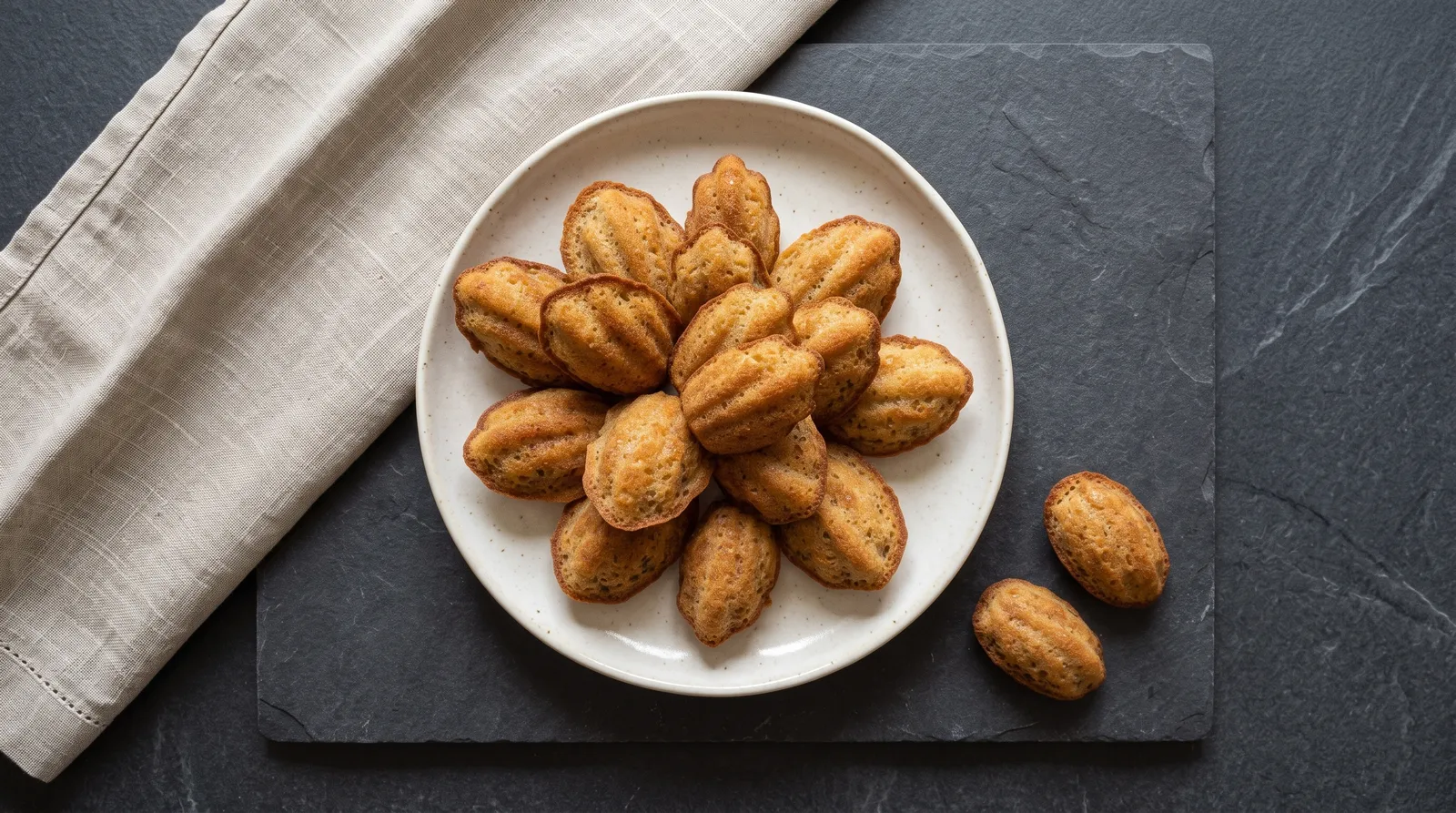
Madeleines de Commercy — served on a plate
Prep 20 minutes
Cook 15 minutes
Total 115 minutes
Yield 20 madeleines
Introduction and overview

Madeleines de Commercy with lemon

Madeleines de Commercy are small butter cakes associated with the Lorraine town of Commercy. Their practical identity lies in the shell mould, the modest portion size and the characteristic hump rather than a large muffin-like dome. Finely grated lemon zest keeps the flavour restrained.

The batter is mixed gently after the flour goes in. Eggs and sugar are whisked only until pale and ribboning, then flour and baking powder are folded just until no dry pockets remain. Milk, lemon zest and warm—not hot—butter complete a smooth batter that is chilled for an hour before portioning.

Cold batter enters a thoroughly preheated oven. The cakes bake for five minutes at 220 °C, then another five at 200 °C without opening the door. That heat contrast encourages the centre to rise into a hump while the lower finish cooks the crumb. Golden edges and a centre that springs back lightly are the readiness cues.

Success points

Success points

  • Chill the completed batter for a full 60 minutes.
  • Fill each shell cavity only about three-quarters full.
  • Keep the oven closed through the 220 °C to 200 °C bake.
Ingredients

Ingredients

Batter

  • 125 g plain wheat flour
  • 100 g whole egg — 2 large eggs
  • 87 g caster sugar
  • 33 ml whole milk
  • 125 g unsalted butter — melted and cooled slightly
  • 5 g baking powder
  • 2 g finely grated lemon zest

Mould

  • 5 g unsalted butter — for greasing the mould
Method

Method

Batter

  1. Making 125 g butter. Melt 125 g butter gently, then cool it until warm rather than hot. Tool: small saucepan. Heat: low heat. Time: 5 minutes cooking + 10 minutes passive cooling. Temperature: warm, not hot. The butter is fully melted and warm enough to flow but no longer hot enough to cook the eggs. Warm butter incorporates smoothly without seizing the batter.

  2. Whisking the eggs and. Whisk the eggs and caster sugar until pale, slightly thickened and ribboning. Tool: mixing bowl and whisk. Time: 5 minutes. Temperature: room temperature. A ribbon from the whisk remains visible on the surface for about 2 seconds. Some aeration supports a light crumb without turning the batter into a foam cake.

  3. Sifting the flour and. Sift the flour and baking powder over the egg mixture and fold just until no dry flour remains. Tool: fine sieve and flexible spatula. Time: 5 minutes. Temperature: room temperature. No dry flour pockets remain and the batter is uniform without being heavily worked. Minimal mixing limits gluten development.

  4. Folding in the 33. Fold in the 33 ml milk, lemon zest and cooled melted butter until the batter is smooth and glossy. Tool: flexible spatula. Time: 5 minutes. Temperature: room temperature. The batter is smooth, glossy and flows slowly from the spatula with no butter streaks. Complete but gentle emulsification gives an even crumb.

  5. Chilling the covered batter. Refrigerate the covered batter before baking. Tool: covered bowl. Time: 60 minutes passive refrigeration. Temperature: 4 °C or below. The batter is thoroughly chilled and visibly thicker than before refrigeration. Cold batter against a hot oven supports the characteristic hump.

Shape and bake

  1. Portioning a 20-cavity madeleine. Grease a 20-cavity madeleine mould with the remaining 5 g butter and divide the batter evenly, filling each shell about three-quarters full. Tool: 20-cavity madeleine mould. Time: 5 minutes. Temperature: batter chilled. All 20 cavities are about three-quarters full with similar batter weights. Even fill gives consistent hump size and bake time.

  2. Baking in a preheated. Bake in a preheated oven for 5 minutes at 220 °C, then reduce to 200 °C and bake 5 minutes more without opening the door. Tool: oven and madeleine mould. Heat: 220 °C then 200 °C oven. Time: 10 minutes. Temperature: 220 °C then 200 °C. The madeleines have distinct humps, golden edges and centres that spring back lightly when touched. The hot start drives the hump; the lower finish cooks the centre without scorching the edges. Do not taste raw batter; handle the hot metal mould with oven gloves.

  3. Opening in the mould. Cool in the mould for 3 minutes, then unmould onto a rack and cool completely before storage. Tool: wire rack and oven gloves. Time: 10 minutes passive cooling. Temperature: room temperature. The cakes release without tearing, the edges stay golden and the surface is dry enough to store without condensation. Short mould cooling prevents breakage while full rack cooling prevents trapped steam.

Serving and planning

Practical

Serving and planning

Serve once fully cooled or still slightly warm. The batch yields exactly 20 small shell cakes.

Serving and planning

The batter can be mixed several hours ahead and held covered in the refrigerator. Stir as little as possible before portioning.

Serving and planning

Vanilla can replace lemon zest as a simple flavour variation. Do not use a muffin pan if the shell profile and characteristic madeleine shape are part of the goal.

Storage

Once fully cool and free of condensation, keep airtight at cool room temperature for 2 days. For a fresher texture, warm briefly in a low oven. Refrigeration tends to firm the butter crumb.

Make-ahead

The batter can be made several hours ahead and held covered in the refrigerator. Stir only minimally before portioning so the chilled structure is preserved.

Substitutions

Vanilla can replace lemon zest as a clearly labelled flavour variation, but keep one restrained aroma rather than combining several.

Substitutions

Do not substitute a muffin pan if the shell shape and characteristic madeleine profile are required.

Troubleshooting

Troubleshooting

  • IssueNo hump — the batter was not cold enough or the initial oven heat was too low; use the full chill and hot start.
  • IssueTough crumb — the batter was overmixed after flour addition; fold only until uniform.
  • IssueGreasy cavities — too much mould butter was used; keep the greasing amount to 5 g total.
Nutrition per serving

Nutrition per serving

  • Serving size1 of 20 madeleines
  • Calories95 kcal
  • Carbohydrate9.3 g
  • Protein1.4 g
  • Fat5.9 g
  • Fibre0.2 g
  • Sodium35 mg
Allergens and food safety

Allergens and food safety

Allergens: Gluten; Egg; Milk

Safety: Do not taste raw batter containing egg and flour.

Safety: Bake until the centres spring back and no wet batter remains.

Safety: Use oven gloves on the hot metal mould.

Safety: Cool fully before airtight storage so condensation does not collect.

FAQ

FAQ

Why chill the batter?

The temperature contrast between cold batter and the hot oven helps create the central hump.

Why cool before airtight storage?

Warm cakes release steam; trapping it causes surface condensation and softens the edges.

Closing

Closing

  • Result: Twenty small shell-moulded butter cakes with a restrained lemon aroma, chilled batter and a hot-start bake that produces the characteristic hump.
  • Decisive technique: Chill the completed batter for a full 60 minutes.