French National Dishes

Pan-Seared Magret de Canard

A focused stovetop method for true skin-on duck magret: score the fat, begin in a cold pan, render slowly, cook to a verified 74 °C, rest, then slice across the grain.

French National Dishes
Share
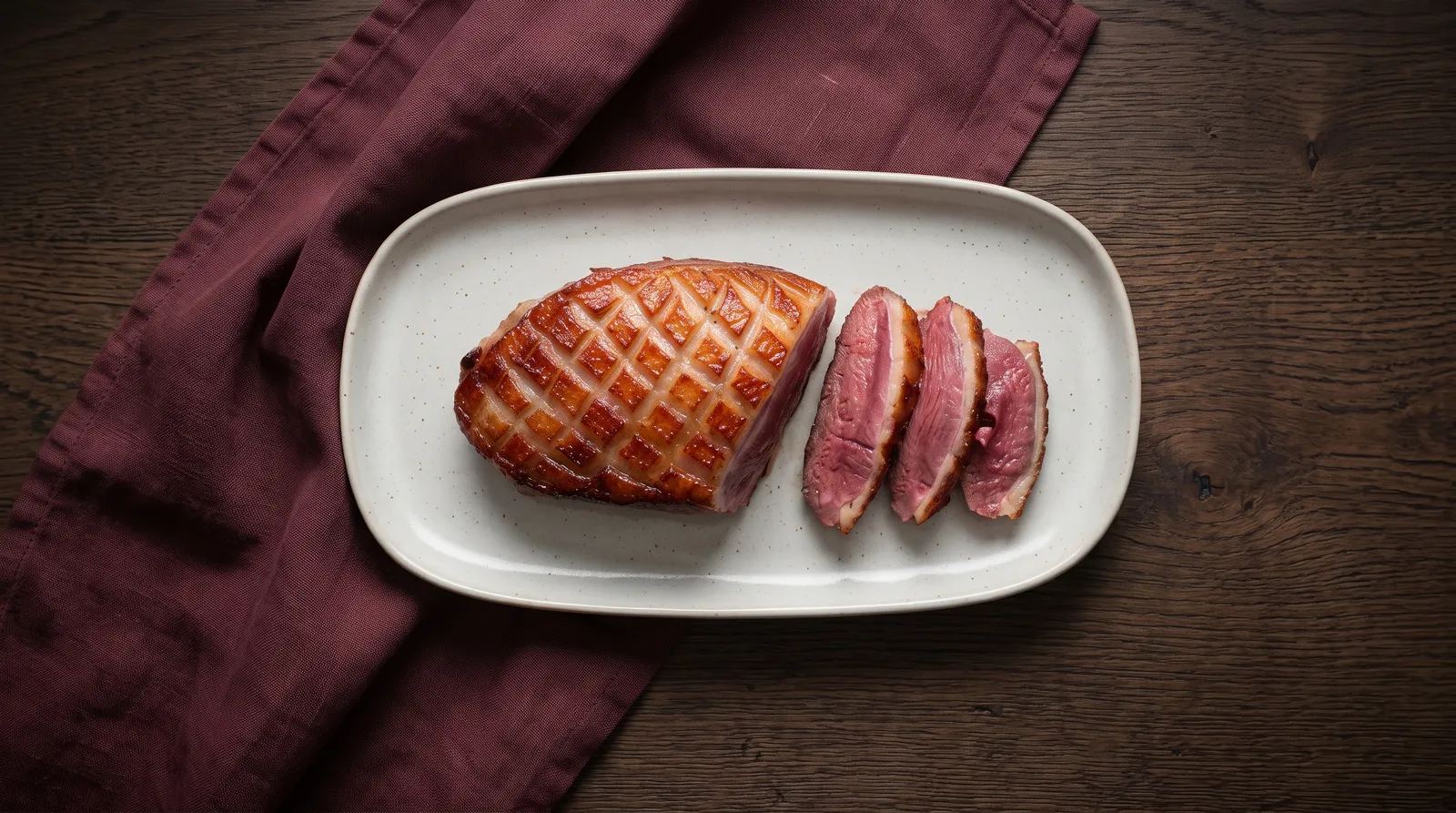
Pan-Seared Magret de Canard — arranged on a board
Prep 15 minutes
Cook 22 minutes
Total 45 minutes
Yield 2 cooked magrets, sliced into about 20 slices
Introduction and overview

Pan-Seared Magret de Canard with Slowly Rendered Skin

Magret de canard is not simply another name for duck breast. In French usage, magret refers to the thick breast from a duck raised for foie gras and presented with its substantial skin and subcutaneous fat. That fat layer is the central technical feature of the dish: it must render slowly enough to become thin and crisp while protecting the meat underneath. This preparation keeps the focus on that defining structure rather than covering it with a sweet glaze or a heavy pan sauce.

The pan starts cold. That detail gives the fat time to soften and flow before the skin surface becomes dark, and it also makes it easier to drain the rendered fat in controlled stages. Score a shallow diamond pattern through the skin and fat only, never into the flesh. As the pan warms, remove excess liquid fat so the skin continues to fry against the metal instead of simmering in a deep pool. The final flesh-side cook is shorter but must still bring the thickest point to the required internal temperature.

The safety target here is deliberately conservative for a household poultry recipe: both breasts must reach 74 °C at their thickest point, checked with a food thermometer. Pink colour is not used as a safety test. Once the endpoint is reached, an eight-minute rest lets the juices settle before the meat is sliced across the grain. The served portion includes the cooked meat and retained skin only; rendered duck fat that is poured off and reserved is outside the nutrition calculation.
Success points

Success points

  • Choose two similarly thick magrets so their cooking times stay aligned.
  • Score a 2 cm diamond pattern shallowly; exposed flesh can dry and catch in the pan.
  • Drain fat more than once during rendering rather than waiting until the end.
  • Probe both breasts at the thickest point before taking them from the pan.
Ingredients

Ingredients

  • 800 g skin-on duck magrets — 2 thick breasts; chilled; edge fat neatly trimmed; Must be true magret with skin and subcutaneous fat
  • 5 g fine salt — for measured seasoning
  • 2 g black pepper — freshly ground
Method

Method

Directions

  1. Score the skin. Trim the edges, pat both magrets dry and score the skin in a 2 cm diamond pattern without cutting into the flesh. Use Chef's knife and board. Time: 10 minutes. Temperature or condition: cold. Scoring opens channels for rendered fat without exposing the meat. Keep raw poultry separate from ready-to-eat foods. The skin is cross-hatched evenly and the knife marks stop within the fat layer.

  2. Season the magrets. Season the flesh and skin evenly with the measured salt and pepper. Use Tray. Time: 5 minutes. Temperature or condition: cold. Measured seasoning supports repeatable sodium and browning. Wash hands after handling raw duck. Seasoning is evenly distributed and no loose clumps remain.

  3. Render from cold. Place the magrets skin-side down in a cold 28 cm heavy frying pan; set over medium-low heat and render, spooning or pouring off fat as it accumulates. Use 28 cm heavy frying pan. Heat: medium-low. Time: 14 minutes. Temperature or condition: pan starts cold. A cold start gives thick magret fat time to melt before the skin burns. Hot duck fat can spit; tilt and drain the pan away from the body. The skin is deeply golden and substantially thinner, and about 180 g fat has rendered without scorching.

  4. Finish the flesh side. Turn the magrets and cook the flesh side, adjusting to medium heat, until a probe in the thickest centre of each breast reads 74 °C. Use 28 cm heavy frying pan and instant-read thermometer. Heat: medium. Time: 8 minutes. Temperature or condition: 74 °C internal. The project applies a conservative household poultry endpoint to duck breast. Do not use pink colour or clear juices as proof of safety. The thickest point of both magrets reaches 74 °C; the exterior is browned but not blackened.

  5. Rest and slice. Transfer to a warm plate, loosely tent and rest before slicing across the grain into roughly 10 slices per breast. Use Warm plate. Time: 8 minutes. Temperature or condition: resting. Resting limits juice loss during slicing. Keep the resting time within normal service time and serve promptly. Juices have settled and slices hold together cleanly when cut across the grain.

Serving, storage and substitutions

Practical

Substitutions and adaptations

- An ordinary skin-on duck breast can be cooked by the same physical method, but it should not be labelled magret unless it meets the French product definition.

Troubleshooting

Skin burns before much fat renders: lower the heat immediately and drain the pan; the process should be a steady render, not a fierce fry.

Troubleshooting

Skin stays soft: the pan is probably too crowded with rendered fat or the heat is too low after the initial melt; drain carefully and continue until the skin crisps.

Troubleshooting

Meat loses a lot of juice on the board: the rest was shortened or the slices were cut too soon.

Nutrition per serving

Nutrition per serving

  • Serving sizeAbout 130 g cooked duck with retained skin
  • Calories480 kcal
  • Carbohydrate0 g
  • Protein31 g
  • Fat39 g
  • Fibre0 g
  • Sodium560 mg
Allergens and food safety

Allergens and food safety

Allergens: No inherent major allergen is present in the fixed ingredients; check packaged ingredients for label-specific cross-contact.

Cook duck to 74 °C at the thickest point and verify with a food thermometer.

Colour alone is not a safety test for poultry.

Beware splattering hot rendered fat and keep water away from the pan.

FAQ

FAQ

Why start in a cold pan?

The thick fat layer needs time to melt before the surface over-browns. A cold start makes that gradual rendering easier to control.

Can the fat be left in the pan?

Only a shallow film should remain. A deep pool encourages splashing and prevents the skin from maintaining firm contact with the pan.

Is pink colour enough to judge doneness?

No. Check the thickest point of each breast with a thermometer and use the required 74 °C endpoint.

Closing

Closing

  • Result: Pan-Seared Magret de Canard with Slowly Rendered Skin with the intended regional structure, texture and portioning.
  • Decisive technique: Choose two similarly thick magrets so their cooking times stay aligned.