French National Dishes

Alsatian Mannele

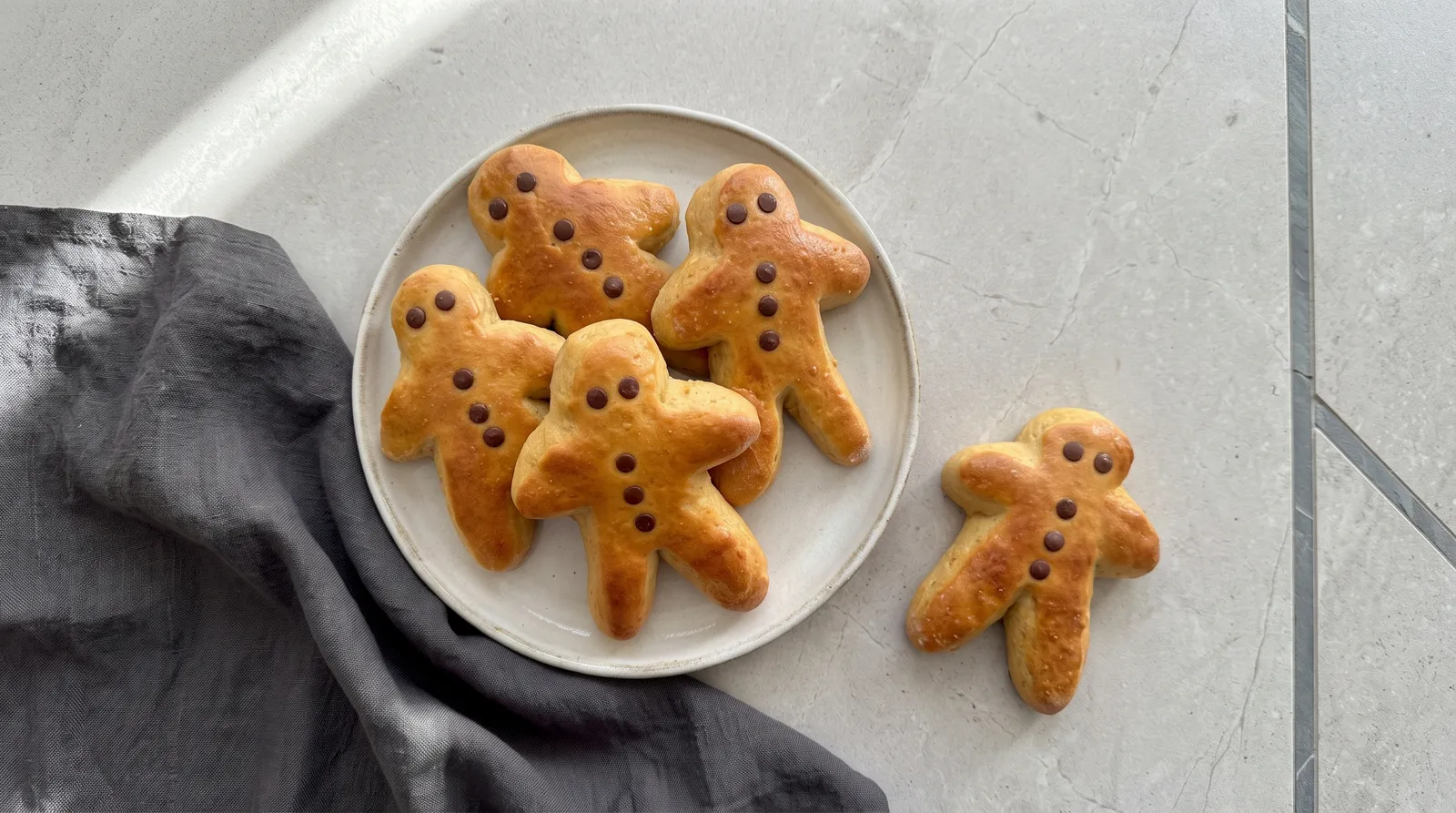
Soft person-shaped Alsatian yeast brioches made with milk, butter and egg, decorated with raisins, proofed twice and baked in measured batches for an even tender crumb.

French National Dishes
Share
Alsatian Mannele — served on a plate
Prep 45 minutes
Cook 30 minutes
Total 230 minutes
Yield 10 individual mannele, about 110 g each after baking
Introduction and overview

Alsatian Mannele Saint Nicholas Brioche Figures

Mannele are the little brioche figures associated with Saint Nicholas season in Alsace. The name varies across the region—mannala is another familiar form—but the identity here is clear: these are individual enriched yeast breads shaped like people, not gingerbread figures and not generic milk rolls. The dough contains wheat flour, milk, butter, egg and sugar, giving a tender crumb that still needs enough gluten strength to keep the head, arms and legs recognisable after proofing.

The dough is kneaded to a real windowpane. Butter is introduced after the initial dough has begun to develop, then kneading continues until a small piece can be stretched thin enough to transmit light before tearing. After the first rise, weighing the pieces matters more than it might seem: ten portions at about 115 g each produce figures that proof and bake at a similar rate. The head is rounded from the top of the piece, the arms are cut from the shoulders and one central cut forms the two legs.

Two rises and the final cooling are all included in the elapsed time. Five figures are baked on each tray, one tray at a time, so the declared cooking time counts both sequential batches. A thin yolk-and-milk glaze gives colour without filling the cut details. Raisins provide the face and buttons; because small dried fruit can be a choking hazard, the finished decoration is not suitable for every young child without age-appropriate supervision.
Success points

Success points

  • Knead until the dough passes a windowpane test; enriched dough needs sufficient structure before shaping.
  • Weigh ten equal portions instead of judging size by eye.
  • Leave generous gaps between arms, legs and neighbouring figures because the dough expands during proofing.
  • Bake one tray at a time in the centre of the oven for the most repeatable colour.
Ingredients

Ingredients

  • 600 g plain wheat flour — unbleached
  • 7 g instant dry yeast
  • 330 ml whole milk — lukewarm, about 30 °C
  • 60 g unsalted butter — softened
  • 55 g caster sugar
  • 50 g whole egg — about 1 large egg, without shell; in the dough
  • 9 g fine salt
  • 35 g egg yolk — about 2 yolks; for glaze
  • 15 ml whole milk — for glaze
  • 30 g raisins — for eyes and buttons
Method

Method

Directions

  1. Develop the dough. Mix the flour, yeast, sugar, salt, milk and whole egg, then knead before adding the softened butter and continue kneading until the dough is elastic. Use Stand mixer with dough hook or large bowl. Time: 20 minutes. Temperature or condition: dough about 24–26 °C. Developing gluten before and after butter addition gives the figures strength to hold their shape. Do not taste raw dough because raw flour and egg may carry harmful microbes. A thin stretched piece forms a translucent window before tearing, and the dough is smooth, supple and only slightly tacky.

  2. First rise. Cover the dough and let it rest for the first rise in a warm draught-free place. Use Covered bowl. Time: 90 minutes. Temperature or condition: warm room. The first fermentation develops gas and extensibility. Do not place the dough on an uncontrolled hot surface. The dough is visibly expanded to about double its starting volume and a gentle fingertip indentation fills slowly.

  3. Divide and shape. Degas gently, divide into ten equal 115 g pieces and shape each into a person: round head, short body, two arm cuts and one central leg cut; press raisins firmly into the face and torso. Use Scale, bench scraper and two lined baking trays. Time: 25 minutes. Temperature or condition: room temperature. Equal weight and thickness make the bake predictable. Keep raisins out of reach of very young children because small decorations can be a choking hazard. All ten figures are similar in weight and thickness, with limbs separated enough to remain distinct after proofing.

  4. Proof the figures. Arrange five figures per tray, cover lightly and let them rest for the final proof until clearly puffy. Use Two lined baking trays. Time: 45 minutes. Temperature or condition: warm room. Final proof prevents a dense crumb without letting the figures lose definition. Avoid overproofing until the dough collapses. The figures are visibly expanded and feel aerated, while the cut arms and legs remain distinct.

  5. Glaze evenly. Mix the egg yolk with 15 ml milk and brush a thin even coat over the figures. Use Small bowl and pastry brush. Time: 5 minutes. Temperature or condition: room temperature. A thin glaze supports even browning. Discard unused egg glaze after brushing raw dough. The surface is evenly glazed without puddles around the limbs.

  6. Bake two trays. Bake in two sequential batches of five at 180 °C, one tray at a time in the centre of the oven. Use Oven and baking tray. Heat: 180 °C oven. Time: 15 minutes per batch; 2 sequential batches. Temperature or condition: 180 °C. One tray at a time gives the small figures a repeatable heat profile. Use oven gloves and keep the hot tray stable when transferring. Each figure is evenly golden, the underside is dry, and the centre of the thick torso is fully baked rather than gummy.

  7. Cool on a rack. Move the baked mannele to a rack and cool before serving. Use Wire rack. Time: 20 minutes. Temperature or condition: cooling. Cooling completes crumb setting. Keep small raisin decorations away from children who are not developmentally ready for them. The crumb has set enough to slice or tear cleanly and the glaze is no longer tacky.

Serving, storage and substitutions

Practical

Substitutions and adaptations

- Raisins may be replaced by the same weight of small chocolate pieces only as a decoration change; it changes allergen risk depending on the chocolate label.

Troubleshooting

Dough feels greasy and tears: the butter may have been added before enough gluten developed, or the dough is too warm; continue controlled kneading and avoid adding extra flour immediately.

Troubleshooting

Figures lose their limbs: make the shaping cuts deeper and give each figure more space before the final proof.

Troubleshooting

Crumb is gummy in the torso: the figures were too thick, underbaked, or the oven was not fully preheated.

Nutrition per serving

Nutrition per serving

  • Serving size1 baked figure, about 110 g
  • Calories325 kcal
  • Carbohydrate51 g
  • Protein9 g
  • Fat9 g
  • Fibre2 g
  • Sodium380 mg
Allergens and food safety

Allergens and food safety

Allergens: Gluten (wheat); Egg; Milk.

Do not taste raw dough or raw egg glaze.

Bake until the thick centre is fully set, not raw or gummy.

Cool before giving to children, and treat small raisin or chocolate decorations as a potential choking hazard.

FAQ

FAQ

Are mannele gingerbread men?

No. This preparation is an enriched yeasted brioche shaped like a small person.

Why weigh each figure?

Equal portions make the proof and the bake more predictable and prevent small figures drying before large ones cook through.

Can the raw dough be tasted?

No. Raw flour and raw egg can carry harmful microbes, so taste only after the breads are fully baked.

Closing

Closing

  • Result: Alsatian Mannele Saint Nicholas Brioche Figures with the intended regional structure, texture and portioning.
  • Decisive technique: Knead until the dough passes a windowpane test; enriched dough needs sufficient structure before shaping.