French National Dishes

Marmite Dieppoise

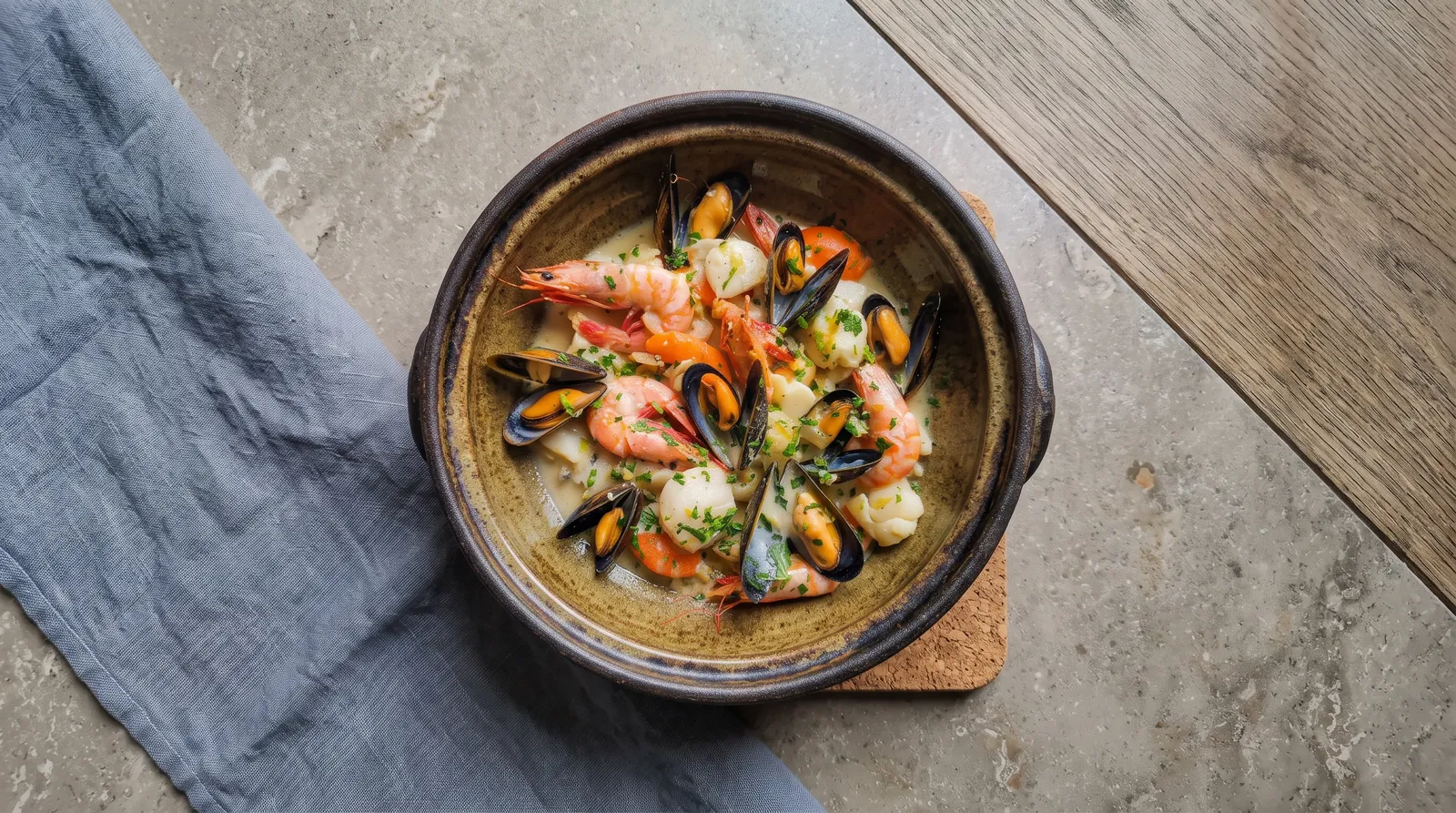
A Dieppe-style seafood marmite with monkfish, hake, sole, mussels, scallops and shrimp in a cider, fish-stock and cream broth, cooked in stages to protect each species.

French National Dishes
Share
Marmite Dieppoise — served on a plate
Prep 35 minutes
Cook 40 minutes
Total 75 minutes
Yield 6 bowls, each with mixed seafood and about 125 ml sauce
Introduction and overview

Marmite Dieppoise with Channel Fish and Shellfish

Marmite dieppoise is a Norman seafood dish built around the fishing-port character of Dieppe: several fish and shellfish share a light, cream-enriched broth. It should not eat like a flour-heavy chowder and it is not a Provençal bouillabaisse. This household preparation keeps a practical mix of monkfish, hake and sole with mussels, scallops and shrimp, using dry Normandy cider, fish stock and the strained mussel liquor as the liquid foundation.

The seafood cannot all go into the pot at once. Mussels are steamed separately so unopened shells can be discarded and their cooking liquor can be strained free of grit. The firmer monkfish and hake get a head start in the sauce; sole and scallops follow later, while already cooked shrimp and mussel meat return only long enough to heat through. Representative fish and scallop pieces must reach 63 °C without being held at a hard boil until they turn tough.

The sauce is reduced before the delicate seafood is finished. Shallot, leek and carrot soften in butter, a small amount of flour provides light body, and cider, fumet and mussel liquor are reduced into a broth that still flows freely. Cream is added near the end. The final target is about 750 ml sauce, enough for roughly 125 ml in each of six bowls, so the nutrition calculation includes the actual broth served rather than assuming the cooking liquid is discarded.
Success points

Success points

  • Keep fish, scallops, shrimp and mussels refrigerated until their specific cooking stage.
  • Strain the mussel liquor through a fine sieve before it reaches the sauce.
  • Cook firm fish before sole and scallops, then return cooked shellfish at the very end.
  • Measure the final sauce volume rather than reducing blindly to a thick cream sauce.
Ingredients

Ingredients

  • 300 g monkfish fillet — boneless; cut in 4 cm chunks
  • 300 g hake fillet — boneless; cut in 4 cm chunks
  • 240 g sole fillets — boneless; halved if large
  • 900 g live mussels — scrubbed and debearded; shell-on purchase weight; discard any that fail safety checks
  • 200 g sea scallops — side muscle removed
  • 120 g cooked peeled shrimp — chilled
  • 300 ml dry Normandy cider — contains sulphites
  • 250 ml fish stock
  • 180 ml double cream or 35% cream
  • 30 g unsalted butter
  • 20 g plain wheat flour
  • 80 g leek — white part; finely sliced
  • 80 g carrot — fine julienne
  • 60 g shallot — finely chopped
  • 5 g fine salt
  • 1 g white pepper — ground
Method

Method

Directions

  1. Prepare the seafood. Check the fish for pin bones, keep all seafood chilled, scrub the mussels, cut the fish and prepare the vegetables. Use Cold tray, tweezers, knife and board. Time: 25 minutes. Temperature or condition: cold. Even pieces allow staggered cooking without overcooking delicate species. Use separate clean utensils for raw seafood and wash hands after handling. Fish portions are evenly sized, no obvious bones or shell fragments remain, and the seafood stays cold.

  2. Measure the sauce base. Measure the cider, stock, cream, butter, flour, salt and pepper so the sauce can be finished without leaving seafood at room temperature. Use Measuring jug and small bowls. Time: 10 minutes. Temperature or condition: cold. Mise en place shortens warm holding of seafood. Return cream and unused seafood to refrigeration promptly. All sauce ingredients are measured and the cream remains refrigerated until needed.

  3. Open the mussels. Steam the mussels with 100 ml of the cider in a covered wide pot, shaking once, until the shells open; remove opened mussels promptly, discard any unopened ones and strain 120 ml cooking liquor through a fine sieve. Use Wide lidded pot and fine sieve. Heat: medium-high. Time: 5 minutes. Temperature or condition: steam. Cooking mussels separately controls shell debris and preserves their liquor. Discard mussels that do not open during cooking. The mussel shells are open; unopened mussels are discarded, and the reserved liquor is free of grit.

  4. Reduce the broth. Sweat the shallot, leek and carrot in the butter, stir in the flour, then add the remaining cider, fish stock and strained mussel liquor and reduce to about 600 ml. Use Heavy saucepan. Heat: medium. Time: 15 minutes. Temperature or condition: gentle boil. Reduction concentrates the seafood liquor and cooks out the raw flour taste. Steam can burn; stir from the side and keep the pan stable. The vegetables are tender and the liquid has reduced noticeably to a light sauce base without scorching.

  5. Poach the firm fish. Add monkfish and hake first and poach gently. Use Heavy saucepan. Heat: gentle simmer. Time: 8 minutes. Temperature or condition: 63 °C target. Firm fish needs a head start before sole and shellfish. Verify 63 °C in representative thick fish pieces. The thickest monkfish and hake pieces reach 63 °C and flake under gentle pressure without breaking apart.

  6. Add delicate seafood. Add sole and scallops and continue gently until the scallops and fish reach the safe endpoint; return the mussel meat and shrimp only at the end to heat through. Use Heavy saucepan. Heat: gentle simmer. Time: 7 minutes. Temperature or condition: 63 °C target. Staggering protects delicate seafood from prolonged heat. Check for shell fragments while returning mussel meat. Sole and scallops reach 63 °C, scallops are opaque and firm, and reheated mussels and shrimp are hot without becoming rubbery.

  7. Finish with cream. Lower the heat, stir in the cream, season with the measured salt and pepper and reduce only enough to finish at about 750 ml sauce. Use Heavy saucepan. Heat: low. Time: 5 minutes. Temperature or condition: below vigorous boil. Cream rounds the broth without turning it into a thick chowder. Do not leave the finished seafood stew at room temperature; serve promptly. The sauce lightly coats a spoon yet remains fluid enough to pool around the seafood, with about 750 ml total sauce.

Serving, storage and substitutions

Practical

Substitutions and adaptations

- A dry white Norman wine may replace cider in equal volume, but the flavour becomes less apple-led and sulphites remain relevant. - If one listed fish species is unavailable, use another firm mild white fish at the same edible weight; keep at least two fish textures rather than reducing the dish to one species.

Troubleshooting

Sauce tastes gritty: the mussel liquor was not strained finely enough; pass it again before combining with the sauce.

Troubleshooting

Fish breaks into flakes before serving: the simmer is too strong or the pieces were cut too small.

Troubleshooting

Sauce becomes pasty: the flour was overused or the liquid reduced too far; loosen with measured hot stock before the final seafood goes in.

Nutrition per serving

Nutrition per serving

  • Serving size1 bowl with mixed seafood and about 125 ml sauce
  • Calories430 kcal
  • Carbohydrate15 g
  • Protein52 g
  • Fat16 g
  • Fibre2 g
  • Sodium900 mg
Allergens and food safety

Allergens and food safety

Allergens: Fish; Molluscs (mussels and scallops); Crustaceans (shrimp); Milk; Gluten (wheat); Sulphites (cider).

Use traceable seafood and maintain the cold chain.

Cook fish and scallops to 63 °C.

Cook mussels only until they open and discard those that remain closed.

Refrigerate leftovers within 2 hours.

Alcohol from cider is reduced but may remain.

FAQ

FAQ

Why steam the mussels separately?

It makes it possible to discard unopened shells, strain away grit and control exactly how much mussel liquor enters the sauce.

Can one fish species be substituted?

Yes, another firm mild white fish can replace one listed species at the same edible weight, but keeping more than one fish texture preserves the mixed-seafood character.

Does the cider alcohol disappear completely?

No. Cooking reduces alcohol, but some can remain, so sulphites and residual alcohol should still be disclosed.

Closing

Closing

  • Result: Marmite Dieppoise with Channel Fish and Shellfish with the intended regional structure, texture and portioning.
  • Decisive technique: Keep fish, scallops, shrimp and mussels refrigerated until their specific cooking stage.