French Recipes

Fouace rouergate

A large enriched Rouergat fouace with butter, eggs, milk and orange-blossom water, fermented overnight, shaped into a crown and cut into 12 slices.

French Recipes
Share
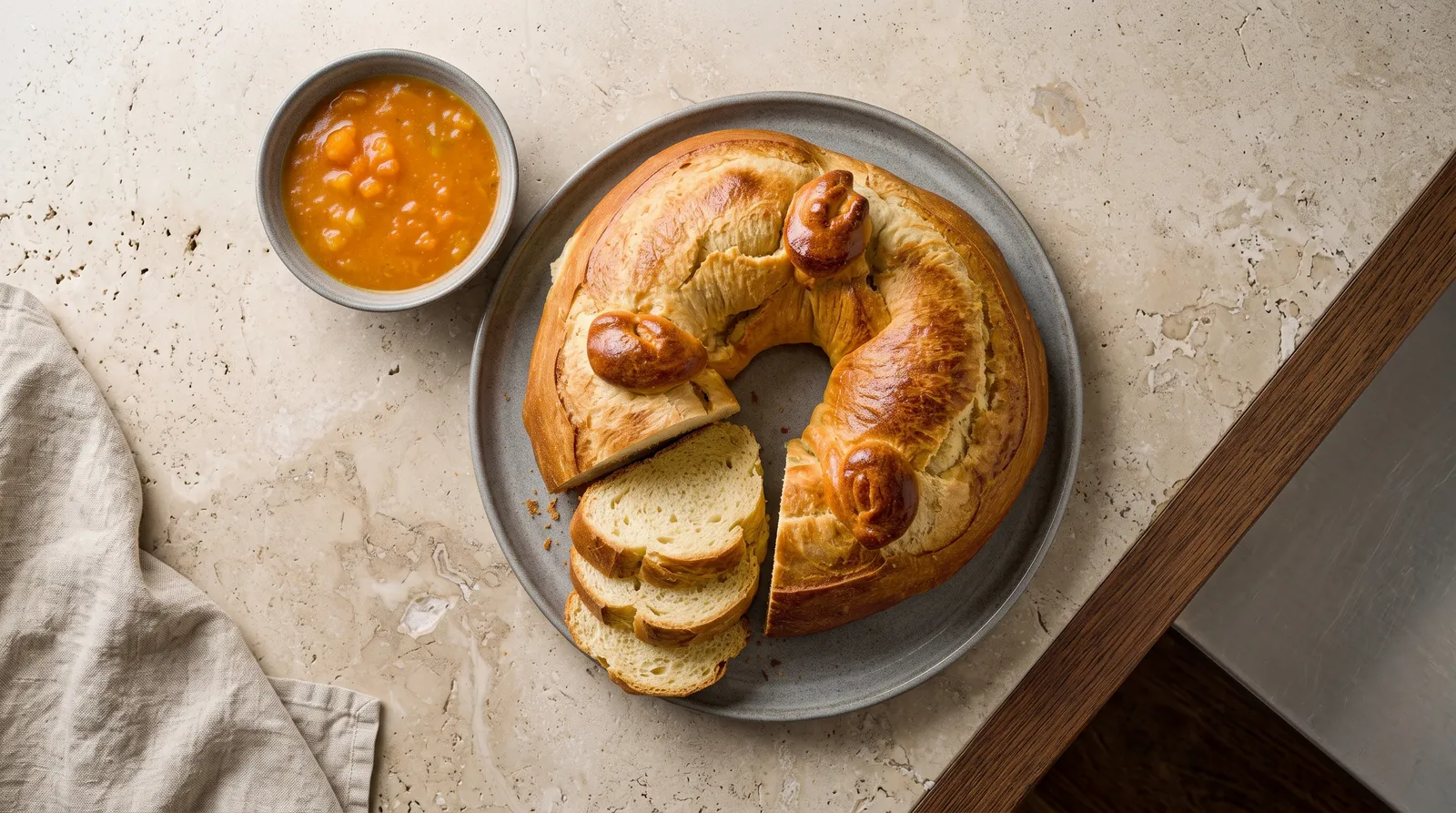
Fouace rouergate — bread shown after baking
Prep 35 minutes
Cook 38 minutes
Total 838 minutes
Yield 1 large ring, 12 slices
Introduction and overview

Fouace rouergate: orange-blossom Aveyron ring bread

Rouergat fouace belongs to the enriched-bread side of the French regional baking family. Flour and baker’s yeast are strengthened with eggs, milk, sugar and butter, while orange-blossom water supplies the perfume that identifies the loaf before it is even cut. The finished form is a substantial crown rather than a hollow pocket or a flat sugar-topped slab.

Time is a structural ingredient here. The first fermentation runs overnight in a cool room, allowing a rich dough to expand without forcing it with excessive yeast. After shaping, the ring receives a second rise of about two hours. The dough should look light and swollen before baking; a clock alone cannot show whether a butter- and egg-rich mass has fermented sufficiently.

The finish is deliberately modest. A thin egg wash supports the golden crust, while a small sugar-and-water glaze and a final measured scattering of sugar stay on the baked surface. Because those finishing ingredients are actually eaten, they remain in the nutrition calculation instead of disappearing as decorative details.
Success points

Success points

  • Keep milk and butter warm enough for incorporation but not hot enough to damage yeast.
  • Judge proofing by expansion and dough response as well as elapsed time.
Ingredients

Ingredients

Enriched dough

  • 600 g strong wheat flour
  • 180 g caster sugar
  • 150 g unsalted butter — softened, 20–22 °C
  • 150 g egg — about 3 large eggs, at room temperature
  • 75 ml whole milk — lukewarm, about 25 °C
  • 20 g fresh baker's yeast
  • 30 ml orange-blossom water
  • 6 g fine salt

Finish

  • 30 g beaten egg — for egg wash
  • 20 g caster sugar — for glaze syrup
  • 15 ml water — for glaze syrup
  • 20 g caster sugar — for final sprinkling
Method

Method

Directions

  1. Mix the dough. Dissolve the fresh yeast in the 75 ml milk at about 25 °C. Mix with the flour, 180 g sugar, eggs, orange-blossom water and salt, then begin incorporating the softened butter. The dough forms a soft cohesive mass with no dry flour remaining.

  2. Develop the dough. Knead for about 10 minutes, scraping down as needed. The dough is glossy, elastic and stretches thinly before tearing.

  3. Give the dough its overnight rise. Cover and leave the dough for about 10 hours at 18–20 °C. The dough is expanded, aerated and roughly doubled after the overnight rise.

  4. Shape the crown. Degas gently, form a large even ring on the lined tray, and brush the surface with the 30 g beaten egg. The ring is even in thickness with a clear central opening and a thin complete coat of egg wash.

  5. Proof the shaped ring. Cover and leave the ring for about 2 hours at around 22 °C. The ring looks visibly light and expanded and a gentle fingertip indentation returns slowly.

  6. Bake until fully set. Bake at 180 °C for about 38 minutes, within the regional 30–45 minute window. The top is deep golden, the crumb is fully baked and the base sounds hollow when tapped.

  7. Glaze and cool. Dissolve the 20 g sugar in 15 ml water, brush the warm ring lightly, then sprinkle with the remaining 20 g sugar. Transfer to a rack and cool for 45 minutes. The surface carries a light sugar sheen and the loaf is cool enough to slice without compressing the crumb.

Serving, storage and planning

Practical

Serving, storage and planning

Serve only after the 45-minute rack cooling period so the crumb can set. Slice the crown into 12 even wedges with a serrated knife, using a light sawing motion rather than pressing down on the tender crumb.

Serving, storage and planning

The overnight fermentation is the natural planning point: mix and knead in the evening, shape and proof the next day, then bake. Once completely cool, keep the ring well wrapped for short storage; freezing individual slices gives a better result than refrigerating the whole bread until it dries.

Serving, storage and planning

Orange-blossom water is part of this version’s identity, not a neutral liquid. Replacing it with another floral flavour produces a different aromatic profile. Likewise, changing from fresh to dry yeast requires a proper conversion rather than equal weights.

Troubleshooting

If the baked crumb is compact, the dough was probably under-proofed or stiffened with extra flour. Keep the dough soft and wait for visible expansion at both rises.

Troubleshooting

If the central hole nearly disappears, enlarge it during shaping. An enriched ring spreads inward during the two-hour proof as well as outward.

Nutrition per serving

Nutrition per serving

  • Serving size1 of 12 slices
  • Calories365 kcal
  • Carbohydrate51 g
  • Protein7 g
  • Fat15 g
  • Fibre1.5 g
  • Sodium260 mg
Allergens and food safety

Allergens and food safety

Allergen: Gluten from wheat.

Allergen: Egg from the dough and egg wash.

Allergen: Milk from butter and milk.

Safety: Raw egg used in dough and wash must be handled cleanly and baked fully.

Safety: Cool the baked ring before wrapping to prevent trapped condensation.

FAQ

FAQ

Why is the first rise so long?

The overnight rise gives the enriched dough time to expand at a cooler pace and is consistent with the regional style used for this version.

Should the fouace be cut hot?

No. The crumb is still setting when it leaves the oven; the 45-minute cooling period helps preserve a clean, tender slice.

Closing

Closing

  • Result — a fragrant, deep-golden crown with a tender enriched crumb and a light sugared surface.
  • Decisive technique — give the rich dough its full overnight fermentation and a genuinely complete shaped proof before baking.