French National Dishes

Fraisier

A structured 20 cm French fraisier with two génoise layers, vanilla crème mousseline, 600 g edible strawberries, measured syrup and a thin marzipan top.

French National Dishes
Share
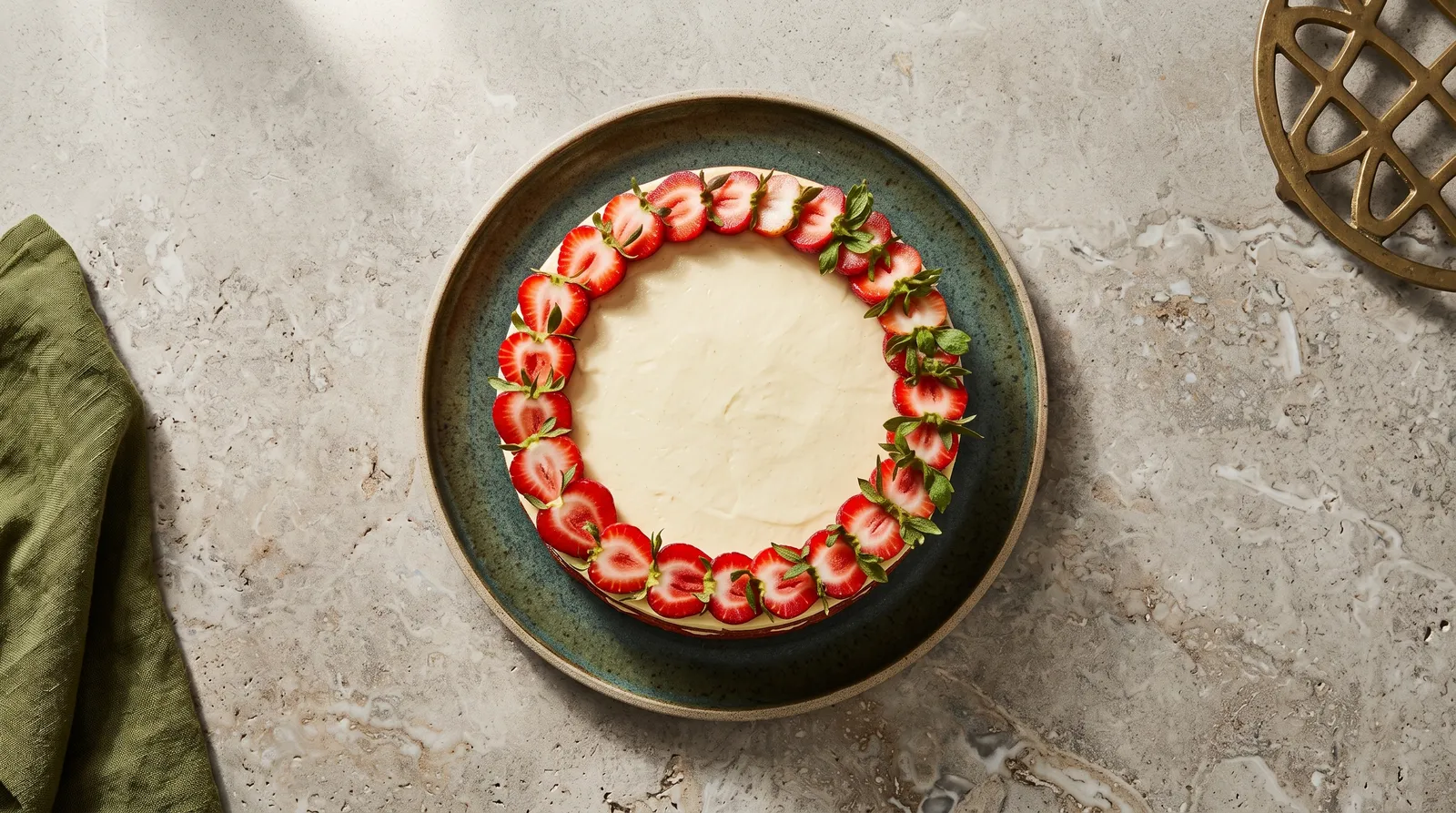
Fraisier — shown whole after baking
Prep 120 minutes
Cook 35 minutes
Total 545 minutes
Yield 1 cake in a 20 cm × 5 cm ring, 10 slices
Introduction and overview

Fraisier with génoise, crème mousseline and marzipan

A fraisier is more than sponge, cream and strawberries layered in a bowl. Its recognisable structure is built inside a ring: two level génoise discs, a band of halved strawberries pressed visibly against the acetate, vanilla crème mousseline filling the spaces between fruit, a measured soaking syrup and a controlled top finish. Here that finish is a thin disc of almond marzipan.

The mousseline demands the most temperature discipline. Its pastry-cream base is cooked to 95 °C, held for about 1 minute, enriched with part of the butter and then spread thin for rapid chilling to 4 °C or below. Only after the cream has cooled safely are the pastry-cream base and the remaining butter each brought into the same 18–20 °C working range before they are combined, producing a stable, aerated cream instead of a greasy or curdled one.

The strawberries have their own handling logic. They are washed and dried before hulling so water is not drawn into freshly cut fruit, then divided between neat ring halves and the centre. The complete cake chills for at least four hours before release, giving the cream enough body to keep the visible strawberry wall and produce ten clean slices.
Success points

Success points

  • The pastry cream must be fully cooked and rapidly chilled, then both the pastry-cream base and finishing butter must reach the same 18–20 °C working range before whipping.
  • Strawberries must be washed and dried before hulling so water is not drawn into the cut fruit.
Ingredients

Ingredients

Génoise

  • 200 g egg — about 4 large eggs
  • 125 g caster sugar
  • 125 g plain wheat flour — sifted

Vanilla crème mousseline

  • 500 ml whole milk
  • 80 g egg yolk
  • 130 g caster sugar
  • 30 g plain wheat flour
  • 30 g cornstarch
  • 4 g vanilla paste
  • 250 g unsalted butter — 125 g for hot pastry cream, 125 g softened to 18–20 °C for finishing

Syrup and fruit

  • 140 ml water — for syrup
  • 60 g caster sugar — for syrup
  • 650 g fresh strawberries — purchased weight; washed and dried before hulling

Top finish

  • 180 g almond marzipan — rolled to fit 20 cm ring
Method

Method

Génoise and syrup

  1. Make the génoise batter. Whip the 200 g egg with 125 g sugar until pale and voluminous, then fold in the 125 g sifted flour without knocking out the foam. The foam is pale and voluminous and a ribbon of batter sits briefly on the surface before sinking.

  2. Bake the sponge. Bake in the 20 cm tin at 180 °C for about 20 minutes. The sponge is evenly golden, springs back lightly in the centre and has no wet batter at the core.

  3. Prepare the syrup. As soon as the baked sponge is turned onto its rack, combine 140 ml water and 60 g sugar in a saucepan and heat over medium heat for about 5 minutes, until the sugar is fully dissolved and the syrup has briefly simmered. Remove it from the heat. Let the syrup cool during the same already counted 45-minute interval used to cool the génoise, so syrup cooling adds no extra passive time. Once cool, weigh out exactly 140 g finished syrup for the cake. The syrup sugar is fully dissolved, the syrup has heated for about 5 minutes, and exactly 140 g cooled finished syrup is reserved for assembly.

  4. Cool before splitting. Leave the sponge on the rack for the full 45-minute cooling interval. The syrup cools concurrently during this already counted period, so no additional passive time is added. The sponge is fully cool and firm enough to split into two even layers without tearing.

Crème mousseline

  1. Cook the pastry cream. Heat the milk and vanilla. Whisk the yolks with 130 g sugar, 30 g flour and 30 g cornstarch, temper with the hot milk, then return to the saucepan and cook for about 10 minutes, reaching 95 °C and holding about 1 minute. The cream reaches 95 °C, remains there for about 1 minute, and becomes smooth, glossy and thick enough to hold whisk trails.

  2. Cool the pastry cream safely. Whisk 125 g butter into the hot pastry cream, spread it in a shallow tray, cover directly on the surface and refrigerate. The pastry cream is covered on the surface and reaches 4 °C or below within 90 minutes without a warm centre.

  3. Temper and whip the mousseline. Remove the chilled pastry-cream base and the remaining 125 g finishing butter so they can temper separately for 20–30 minutes while the strawberries and ring are prepared. Before combining them, verify that both the pastry cream and the butter are in the same 18–20 °C working range. Beat the pastry cream smooth, then gradually incorporate the butter and whip until the mousseline is smooth, aerated and able to hold a clean ridge. The 20–30 minute tempering interval runs concurrently with fruit-and-ring preparation and therefore adds no extra passive time. Count all room-temperature handling toward the maximum 2-hour cumulative limit. After 20–30 minutes of tempering, both the pastry-cream base and the finishing butter measure 18–20 °C before they are combined. The finished mousseline is smooth and aerated and holds a clean ridge.

Assembly

  1. Prepare the fruit and ring. During the 20–30 minute mousseline-component tempering interval, wash and dry the 650 g purchased strawberries before hulling them. Reserve neat halves for the ring and keep the rest for the centre; about 600 g edible fruit should remain. Split the cool génoise into two even layers and line the 20 cm × 5 cm ring with acetate. About 600 g clean dry hulled strawberries are ready, with even halves reserved for the visible ring.

  2. Build the cake. Set the first génoise layer in the ring and apply half the 140 g syrup. Stand strawberry halves cut-side out around the acetate, pipe in mousseline, add the remaining strawberries, cover with more cream, then add the second sponge and remaining syrup. The strawberry halves stand flush against the acetate, both sponge layers are evenly moistened, and mousseline fills all gaps without warm pockets.

  3. Set the fraisier. Refrigerate the assembled cake for at least 4 hours at 4 °C. The cake is firm enough for the ring and acetate to lift away cleanly and the cream keeps sharp slice edges.

  4. Finish and slice. Roll the 180 g marzipan into a thin 20 cm round and place it on the cold cake. Remove the ring and acetate, leave the cake for 15 minutes before serving, then cut 10 slices with a clean knife. The 180 g marzipan forms an even top and the chilled cake cuts into 10 clean slices without cream slumping.

Serving, storage and planning

Practical

Serving, storage and planning

Work with all components cool at assembly. Temper the pastry-cream base and finishing butter only for the stated 20–30 minutes, verify that both are 18–20 °C, and count that interval toward the two-hour cumulative room-temperature limit. Keep the second sponge, fruit and finished mousseline ready before filling the ring so the cake does not spend unnecessary time on the counter.

Serving, storage and planning

The assembled fraisier needs at least 4 hours at 4 °C before release. It can be built earlier the same day and kept covered in the refrigerator. For the best berry texture and cream quality, use within 48 hours; freezing is not recommended because thawed strawberries weep and mousseline can lose its clean structure.

Serving, storage and planning

Serve after a short 15-minute temper so the butter-rich cream is not refrigerator-hard. Do not warm or reheat the cake. If marzipan is replaced with another finish, the allergen and nutrition information must be recalculated rather than assumed to remain unchanged.

Troubleshooting

If the mousseline looks split, the butter and pastry cream were probably too far apart in temperature. Before combining them, verify that both components are 18–20 °C; if needed, correct the colder or warmer component briefly before whipping again until smooth.

Troubleshooting

If the cake slumps after the ring is removed, it was either assembled with warm cream or chilled for too little time. Re-chill until the cream is fully firm before attempting another clean release.

Nutrition per serving

Nutrition per serving

  • Serving size1 of 10 slices
  • Calories550 kcal
  • Carbohydrate61 g
  • Protein8 g
  • Fat31 g
  • Fibre3 g
  • Sodium100 mg
Allergens and food safety

Allergens and food safety

Allergen: Egg from génoise and pastry cream.

Allergen: Milk from milk and butter.

Allergen: Gluten from wheat flour.

Allergen: Almond/nuts from marzipan.

Safety: Wash and dry strawberries before hulling.

Safety: Cook the pastry-cream base to 95 °C and hold about 1 minute, then spread shallow, cover and chill to 4 °C or below within 90 minutes.

Safety: Keep the finished cake at 4 °C or below and limit cumulative room-temperature exposure to no more than 2 hours; the 20–30 minute mousseline tempering interval counts toward that limit.

Safety: Refrigerate assembled chilled foods within 2 hours; do not assemble with warm cream.

FAQ

FAQ

Why is the pastry cream cooled in a shallow layer?

A shallow layer sheds heat faster and helps the cooked cream reach 4 °C or below promptly before it is turned into mousseline.

Can I use whipped cream instead of mousseline?

That produces a different strawberry cake. The butter-enriched cooked cream is structural in this selected fraisier.

Closing

Closing

  • Result — defined génoise layers, a visible wall of strawberries and a stable vanilla mousseline that holds a clean slice.
  • Decisive technique — cook and chill the pastry-cream base correctly, then combine it with the finishing butter only when both are in the same 18–20 °C working range.