French National Dishes

Fougasse d’Aigues-Mortes

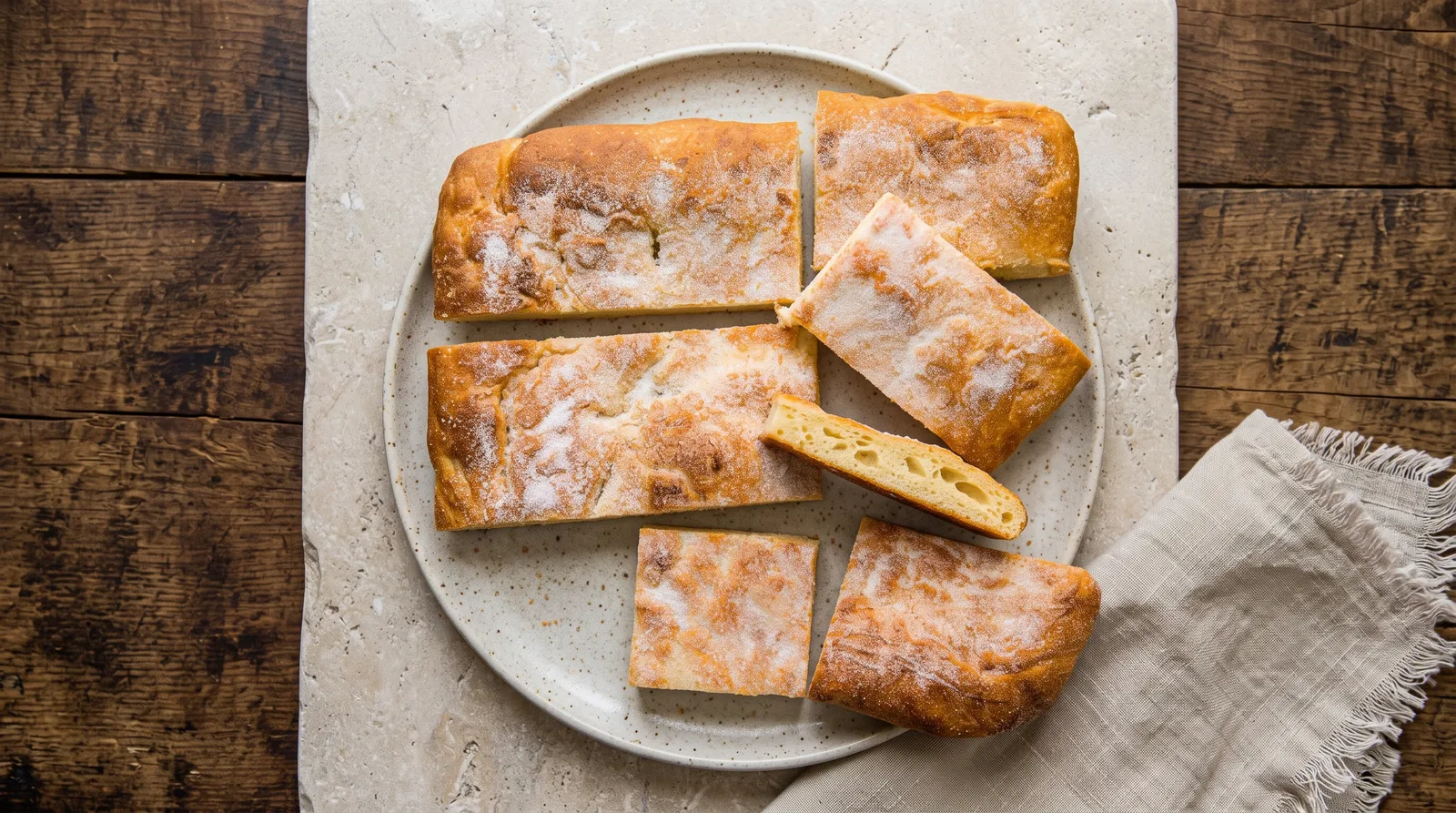
A soft, flat Camargue brioche baked in a 30 × 40 cm pan, dimpled with butter and sugar and brushed with measured orange-blossom water after baking.

French National Dishes
Share
Fougasse d’Aigues-Mortes — bread shown after baking
Prep 40 minutes
Cook 22 minutes
Total 1022 minutes
Yield 1 slab, 12 pieces about 10 × 10 cm
Introduction and overview

Fougasse d’Aigues-Mortes: sweet orange-blossom brioche

Fougasse d’Aigues-Mortes is a sweet bread despite the savoury image that the word fougasse can evoke elsewhere in southern France. In this Camargue preparation, the dough is enriched with milk, eggs and butter, scented with orange-blossom water and baked as a soft flat slab rather than cut into leaf-like slashes.

Its timing combines a first rise, an overnight chill and a final pan proof. The cold period firms the butter-rich dough and builds a practical overnight schedule; the later warm rest and proof return enough extensibility and gas to produce a tender rather than compact centre. A 30 × 40 cm pan keeps the thickness consistent with the 22-minute bake.

The finish is part of the formula, not an optional garnish. Eighty grams of butter sit in deep dimples under 80 g sugar during baking, then 90 ml orange-blossom water are brushed over the hot slab. Because the full measured finish reaches the bread, all of it is counted in the 12-piece nutrition calculation.
Success points

Success points

  • The dough remains soft; adding unmeasured flour makes the slab breadier and less tender.
  • Apply the measured butter and sugar before baking and the measured orange-blossom water immediately after baking.
Ingredients

Ingredients

Dough

  • 500 g strong wheat flour
  • 150 ml whole milk — lukewarm, about 25 °C
  • 20 g fresh baker's yeast
  • 150 g egg — about 3 large eggs
  • 100 g unsalted butter — softened
  • 60 g caster sugar
  • 6 g fine salt
  • 30 ml orange-blossom water

Butter-sugar finish

  • 80 g unsalted butter — softened, for dimples
  • 80 g caster sugar — for topping
  • 90 ml orange-blossom water — for the baked surface
Method

Method

Directions

  1. Mix and knead. Dissolve the yeast in the 150 ml milk at about 25 °C, then mix with the flour, eggs, 60 g sugar, salt and 30 ml orange-blossom water. Work in the 100 g softened butter and knead for about 20 minutes. The dough is smooth, elastic and soft, with the butter fully absorbed.

  2. Give the dough its first rise. Cover and leave the dough to rise for 2 hours. The dough is visibly expanded and aerated.

  3. Chill overnight. Refrigerate the covered dough for 12 hours at 4 °C. The dough is cold, firm and evenly fermented after the overnight chill.

  4. Take off the chill. Leave the covered dough at cool room temperature for 30 minutes. The dough has softened enough to stretch without tearing.

  5. Shape the slab. Press and stretch the dough gently into an even layer in the lined 30 × 40 cm pan. The dough forms an even flat layer that reaches the corners without thin torn patches.

  6. Proof in the pan. Cover and leave for 60 minutes. The slab is visibly puffed and feels light under a gentle fingertip touch.

  7. Add the characteristic finish. Press deep dimples across the surface. Distribute the 80 g softened butter into the dimples and scatter the 80 g sugar evenly over the top. Deep fingertip dimples hold small pieces of the 80 g butter and the 80 g sugar is evenly scattered.

  8. Bake the slab. Bake at 180 °C for about 22 minutes. The top is golden, the edges are set and the centre has a tender fully baked crumb.

  9. Finish and cool. As soon as the fougasse leaves the oven, brush the 90 ml orange-blossom water evenly over the hot surface. Leave it to cool for 30 minutes. The 90 ml orange-blossom water is absorbed across the hot surface and the slab is cool enough to cut cleanly.

Serving, storage and planning

Practical

Serving, storage and planning

Cut the cooled slab into 12 pieces, roughly 10 × 10 cm each. A serrated knife works best because it passes through the sugar-topped crust without pressing the soft crumb flat.

Serving, storage and planning

Plan this bake across two days. The dough’s 12-hour rest at 4 °C is intentional, not dead time hidden from the schedule. Once baked and fully cooled, cover the fougasse for short keeping or freeze individual pieces rather than leaving the open crumb exposed.

Serving, storage and planning

Orange-blossom water is a defining aromatic element in this version. Another floral water can make an interesting sweet bread, but it does not preserve the same Aigues-Mortes profile. Likewise, reducing the butter and sugar topping changes the characteristic surface and the nutritional result.

Troubleshooting

If the centre is tight rather than tender, check the final proof and pan size. Under-proofed dough or a smaller pan leaves the slab too dense for the stated baking time.

Troubleshooting

If melted butter pools excessively, the dimples may be too shallow or the dough may not have proofed enough to support the topping. Press deliberate pockets without tearing through the slab.

Nutrition per serving

Nutrition per serving

  • Serving size1 of 12 pieces
  • Calories333 kcal
  • Carbohydrate43 g
  • Protein6 g
  • Fat15 g
  • Fibre1.2 g
  • Sodium220 mg
Allergens and food safety

Allergens and food safety

Allergen: Gluten from wheat.

Allergen: Egg.

Allergen: Milk from milk and butter.

Safety: Keep the enriched dough at 4 °C during the 12-hour cold rest.

Safety: Handle raw egg cleanly and bake the centre fully.

Safety: Cool the baked fougasse before covering.

FAQ

FAQ

When is the orange-blossom finish added?

The 30 ml in the dough goes in during mixing; the separate 90 ml finish is brushed over the hot bread immediately after baking.

Is this the same as savoury fougasse?

No. This Aigues-Mortes specialty is a sweet, soft, butter-and-sugar-topped brioche-style slab.

Closing

Closing

  • Result — a golden, tender flat brioche with buttery sugar dimples and a clear orange-blossom aroma.
  • Decisive technique — preserve the long cold rest and apply each part of the measured finish at its correct stage.