French Recipes

Corsican Migliacci

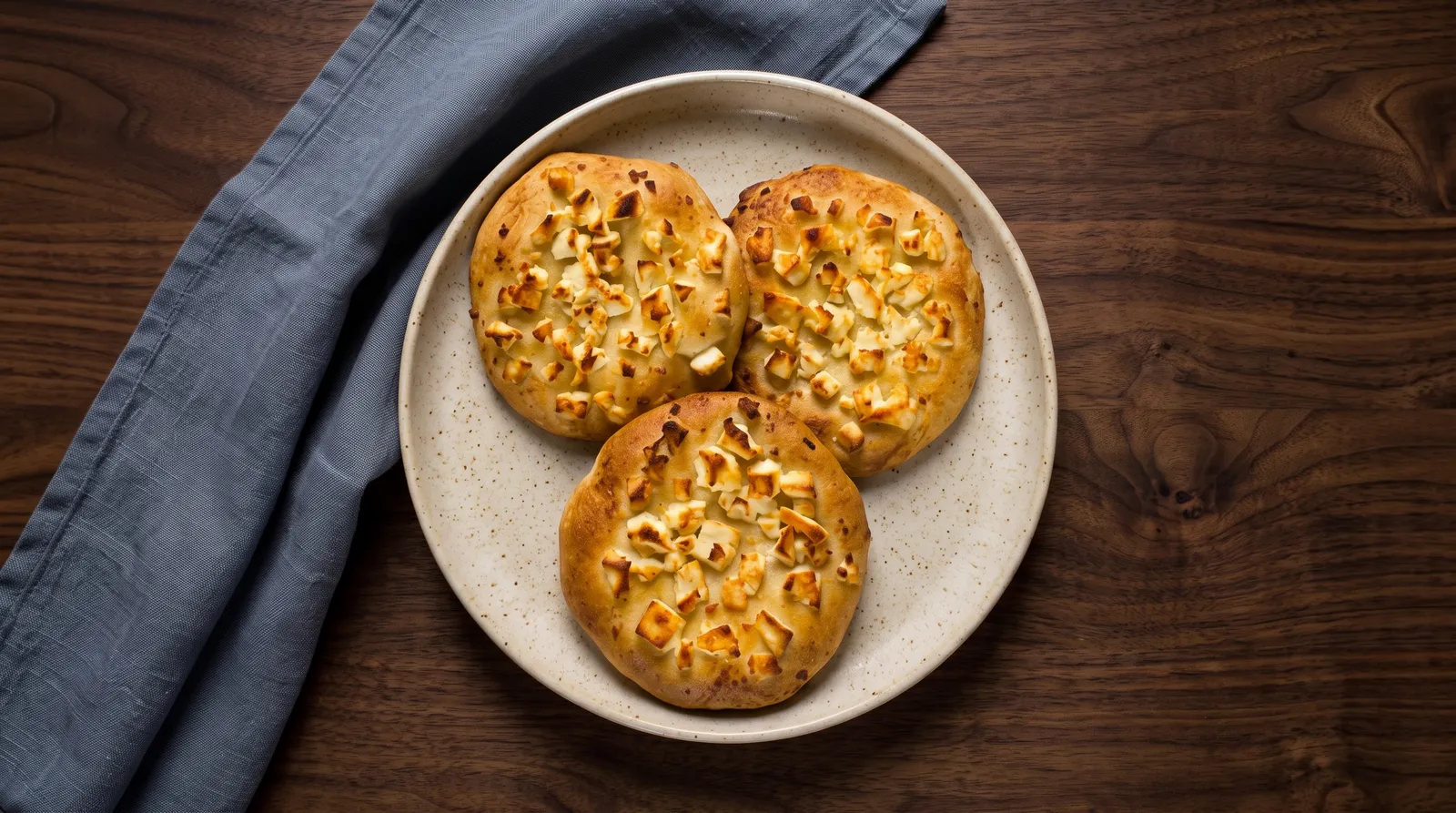
Savoury Corsican yeasted cheese galettes with fresh sheep cheese in the dough and on top, traditionally baked on soaked food-grade chestnut leaves in a hot oven.

French Recipes
Share
Corsican Migliacci — arranged on a tray
Prep 45 minutes
Cook 30 minutes
Total 575 minutes
Yield 9 individual migliacci, about 16 cm wide
Introduction and overview

Corsican Migliacci with Fresh Sheep Cheese

Migliacci are savoury Corsican cheese breads or galettes, not the sweet cheese pastries better known as fiadone or imbrucciata. The dough is yeasted, enriched with egg and fresh cheese, then topped with more cheese before baking. Dried chestnut leaves are a traditional support: they are soaked until flexible and placed beneath the dough, giving the breads a distinctive context without turning chestnut leaf into an edible ingredient.

The cheese identity matters. When the dish is presented as Corsican migliacci, genuine fresh Corsican sheep or goat cheese is the reference; this preparation uses fresh Corsican sheep cheese. Half of the 700 g cheese goes into the dough and half stays for the topping. A non-Corsican fresh sheep cheese can reproduce moisture and general texture, but it should be described as an adaptation rather than silently given the same regional identity.

The timetable is long but efficient. Food-grade dried leaves soak for eight hours, while the four-hour dough proof overlaps the final four hours of that soak. The nine shaped galettes then bake in two sequential batches at 240 °C for 15 minutes per tray. The hot oven browns the cheese and sets the enriched crumb quickly. After baking, a 20-minute cool allows the crumb to stabilise before stacking or wrapping.
Success points

Success points

  • Use only traceable food-grade chestnut leaves; unknown decorative or roadside leaves are not appropriate.
  • Drain the fresh cheese well so the dough stays soft but not runny.
  • Allow the full proof because a cheese-heavy dough rises more slowly than lean bread dough.
  • Keep the nine pieces similar in diameter and thickness so the two trays bake consistently.
Ingredients

Ingredients

  • 500 g plain wheat flour
  • 8 g instant dry yeast
  • 300 ml whey or water — lukewarm; whey preferred when available from the fresh cheese
  • 700 g fresh Corsican sheep cheese — well drained; 350 g in dough; 350 g topping
  • 100 g whole eggs — about 2 large eggs, without shell; in dough
  • 18 g egg yolk — about 1 yolk; for surface brushing
  • 20 ml olive oil
  • 8 g fine salt
  • 18 food-grade dried chestnut leaves — clean and intact; soaked before use; 2 per galette
Method

Method

Directions

  1. Soak the leaves. Cover the food-grade dried chestnut leaves with lukewarm potable water and soak until flexible. Use Large clean basin. Time: 480 minutes soaking. Temperature or condition: lukewarm water. Soaking makes dry leaves flexible enough to support the galettes. Use only food-grade leaves from a traceable source; do not use unknown roadside or chemically treated leaves. The leaves are fully pliable, clean-smelling and can bend without cracking.

  2. Mix the cheese dough. Mix the flour, yeast, whey, whole eggs, olive oil and salt to a soft dough, then incorporate 350 g drained fresh Corsican sheep cheese without fully puréeing it. Use Large mixing bowl. Time: 20 minutes. Temperature or condition: warm room. The cheese enriches the fermented dough while retaining visible curds. Keep the fresh cheese refrigerated until mixing. The dough is cohesive and soft with small cheese pieces distributed throughout, not a runny batter.

  3. Proof during the soak. While the leaves continue soaking, cover the dough and proof for 240 minutes; this proof overlaps the final four hours of the leaf soak. Use Covered bowl. Time: 240 minutes concurrent proofing. Temperature or condition: warm room. The long proof gives the heavy cheese dough enough time to aerate. Keep the dough in a controlled warm room, not on an uncontrolled hot surface. The dough is visibly aerated and expanded, with a fermented aroma and a soft extensible texture.

  4. Shape and top. Drain and pat the leaves dry, divide the dough into nine equal portions, place each on two overlapping leaves and flatten to about 16 cm; distribute the remaining 350 g cheese over the tops and brush with egg yolk. Use Scale, trays and pastry brush. Time: 25 minutes. Temperature or condition: room temperature. Equal size supports a predictable hot bake. Keep raw egg wash away from ready-to-eat foods and discard excess. All nine galettes are similar in diameter and thickness, the topping is evenly divided, and the leaves lie flat beneath them.

  5. Bake two batches. Bake in two batches in a fully heated 240 °C oven until the tops are browned and the crumb is fully cooked. Use Oven and baking trays. Heat: 240 °C oven. Time: 15 minutes per batch; 2 sequential batches. Temperature or condition: 240 °C. High heat gives the characteristic browned cheese surface while setting the enriched crumb quickly. Use oven gloves and keep leaves from contacting exposed heating elements. The cheese is browned in patches, the edges are set and the centre crumb is fully cooked with no wet dough line.

  6. Cool the galettes. Transfer the baked migliacci to racks and cool before stacking or wrapping. Use Wire racks. Time: 20 minutes cooling. Temperature or condition: cooling. Cooling prevents compression and condensation. Fresh-cheese breads are perishable; refrigerate if not eaten promptly. The crumb has set, steam no longer escapes strongly and the bases are dry rather than wet.

Serving, storage and substitutions

Practical

Substitutions and adaptations

- If genuine fresh Corsican cheese is unavailable, a well-drained unsalted fresh sheep cheese can reproduce moisture and texture, but the result should be described as an adaptation rather than Corsican migliacci in the strict sense. - Use baking parchment instead of chestnut leaves when traceable food-grade leaves are unavailable; the leaf aroma will be absent.

Troubleshooting

Dough spreads flat: the fresh cheese was too wet; drain it more thoroughly before mixing.

Troubleshooting

Surface browns while the centre stays gummy: the pieces are too thick or the oven was not fully preheated.

Troubleshooting

Leaves crack during shaping: they were not soaked long enough or were too brittle to begin with.

Nutrition per serving

Nutrition per serving

  • Serving size1 galette, about 16 cm wide
  • Calories430 kcal
  • Carbohydrate54 g
  • Protein18 g
  • Fat16 g
  • Fibre3 g
  • Sodium650 mg
Allergens and food safety

Allergens and food safety

Allergens: Gluten (wheat); Milk; Egg.

Keep fresh cheese and eggs cold until use.

Use only food-grade, traceable chestnut leaves and soak them in potable water.

Bake until the centre crumb is fully cooked.

Refrigerate fresh-cheese leftovers within 2 hours.

FAQ

FAQ

Are migliacci the same as fiadone?

No. Migliacci are savoury yeasted cheese galettes or breads; fiadone is a different Corsican cheese dessert.

Can ordinary parchment replace chestnut leaves?

Yes as a practical baking support when food-grade leaves are unavailable, but it does not reproduce the same leaf aroma or presentation.

Why divide the cheese?

Part enriches the fermented dough, while the remainder gives the browned cheese topping that is integral to the preparation.

Closing

Closing

  • Result: Corsican Migliacci with Fresh Sheep Cheese with the intended regional structure, texture and portioning.
  • Decisive technique: Use only traceable food-grade chestnut leaves; unknown decorative or roadside leaves are not appropriate.