French National Dishes

Corrèze Millassou

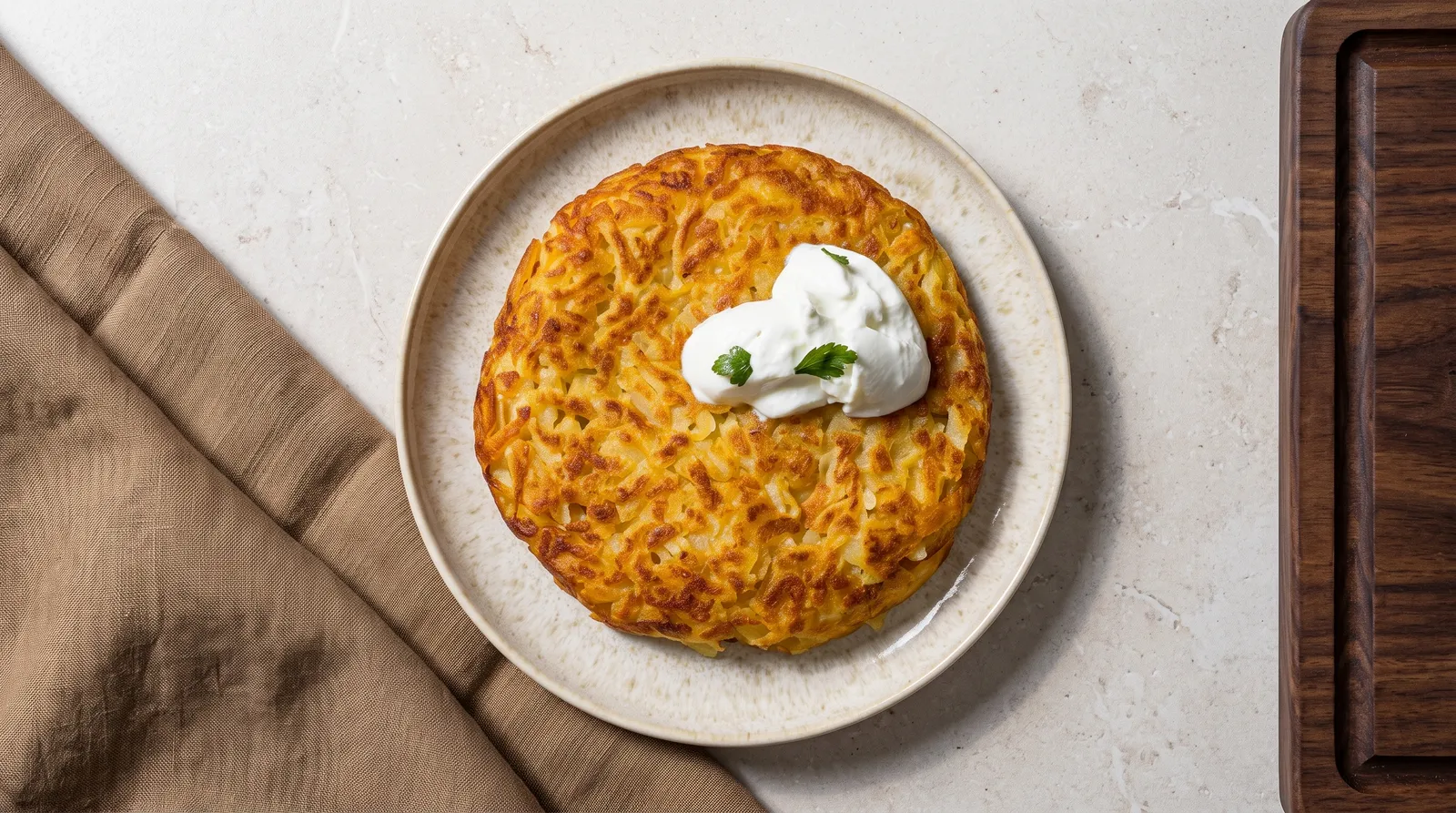
A savoury Corrèze millassou of raw grated potato, garlic, onion and parsley, drained well and pan-cooked as one thick galette until both faces brown and the centre is tender.

French National Dishes
Share
Corrèze Millassou — presented in a serving dish
Prep 20 minutes
Cook 25 minutes
Total 55 minutes
Yield 1 thick 28 cm galette, cut into 8 wedges
Introduction and overview

Corrèze Millassou Grated Potato Galette

Millassou in Corrèze is a potato dish, and that distinction matters because similar names elsewhere in south-western France can refer to sweet cornmeal preparations. The Corrèze form here is a thick savoury galette of raw grated potato with garlic, onion and parsley. There is no cornmeal, pumpkin or sweet batter, and this preparation also omits the optional egg or bacon found in some local household variations.

The potato is grated raw and allowed to drain rather than being turned into purée. Draining removes free water while keeping enough surface starch to help the galette bind. Garlic, onion, parsley, salt and pepper go in only shortly before cooking so the potato does not sit salted and release a new pool of water. The mixture is then spread about 2–2.5 cm thick in a 28 cm oiled frying pan.

Both sides need controlled heat and time. The first face cooks until deeply browned and structurally set; the heavy galette is then transferred to a flat plate and inverted back into the pan with the remaining oil. The second face continues until a skewer meets no raw resistance in the centre. A crisp dark-golden crust is desirable, but fully tender potato at the core is the doneness cue that prevents the browned exterior from hiding an undercooked middle.
Success points

Success points

  • Grate firm raw potatoes and drain them without rinsing away all their starch.
  • Mix salt and aromatics only just before the pan is ready.
  • Compress the galette evenly so the centre is not dramatically thicker than the edges.
  • Use a plate for turning and judge doneness by the centre as well as the crust.
Ingredients

Ingredients

  • 1150 g firm-fleshed potatoes — purchased weight; about 1,000 g peeled and 850 g after grating/draining
  • 100 g onion — finely chopped
  • 10 g garlic — finely chopped
  • 25 g flat-leaf parsley — finely chopped
  • 30 ml neutral cooking oil — about 20 ml retained
  • 8 g fine salt
  • 1 g black pepper — ground
Method

Method

Directions

  1. Grate the potatoes. Peel, rinse and dry the potatoes, grate them raw on a medium grater, then place them in a colander to drain. Use Medium grater and colander. Time: 10 minutes. Temperature or condition: cool. Raw grating is central to the Corrèze galette texture. Keep fingertips clear of the grater teeth. The grated potato strands are even and excess surface water begins to drain without the potato turning into purée.

  2. Drain the potato. Leave to stand and drain the grated potato without soaking, then press lightly to reach about 850 g drained potato. Use Colander. Time: 10 minutes draining. Temperature or condition: cool. Removing excess water helps the thick galette brown and set. Keep the drained potato cool and proceed promptly to limit oxidation. Free liquid no longer pools beneath the colander and about 850 g drained grated potato remains.

  3. Mix the aromatics. Mix the drained potato with onion, garlic, parsley, salt and pepper immediately before cooking. Use Large bowl. Time: 10 minutes. Temperature or condition: room temperature. Mixing close to cooking limits oxidation and salt-driven water release. Do not leave the salted raw potato mixture standing at room temperature. The aromatics are evenly distributed and the mixture remains loose enough to spread, not wet and soupy.

  4. Cook the first face. Heat about half the oil in a 28 cm frying pan, add the potato mixture and compress it to an even 2–2.5 cm galette; cook over medium heat. Use 28 cm frying pan. Heat: medium. Time: 12 minutes. Temperature or condition: steady pan heat. Moderate heat begins cooking the centre before the crust becomes too dark. Hot oil can spit; keep the handle stable and use a splatter screen if needed. The first face is well browned, the edges are set and the top surface has lost its raw wet sheen.

  5. Turn and finish. Slide the galette onto a flat plate, add the remaining oil, invert the pan over the plate and return the galette to cook the second side. Use 28 cm frying pan and flat plate. Heat: medium-low. Time: 13 minutes. Temperature or condition: steady pan heat. A controlled plate turn is safer for a heavy thick galette than an airborne flip. Use dry oven gloves or a secure grip and keep hands away from hot oil. Both faces are well browned and a skewer passes through the centre potato with no raw resistance or crunch.

Serving, storage and substitutions

Practical

Substitutions and adaptations

- Egg or bacon belong to separate regional variations; adding either changes the preparation and allergen profile.

Troubleshooting

Galette breaks during the turn: the potato was too wet or the first side was turned before it had set.

Troubleshooting

Centre remains crunchy while the outside darkens: lower the heat and extend cooking so heat reaches the middle.

Troubleshooting

Mixture becomes grey and watery: the potatoes were grated too far ahead or stood too long after salting.

Nutrition per serving

Nutrition per serving

  • Serving size2 wedges, one quarter of the galette
  • Calories230 kcal
  • Carbohydrate41 g
  • Protein5 g
  • Fat6 g
  • Fibre5 g
  • Sodium820 mg
Allergens and food safety

Allergens and food safety

Allergens: No inherent major allergen is present in the fixed ingredients; check packaged ingredients for label-specific cross-contact.

Treat the grater as a sharp-tool hazard.

Use care with hot oil and the plate-turning manoeuvre.

Cook until the centre potato is completely tender; crust colour alone is not a doneness test.

Refrigerate cooked leftovers within 2 hours.

FAQ

FAQ

Is millassou a cornmeal cake?

Not in this Corrèze preparation. It is a savoury raw-grated-potato galette with garlic, onion and parsley.

Does it need egg or flour to hold together?

No. Local sources also show a binder-free form; starch from the drained grated potato and controlled pan cooking provide the structure.

Can it be flipped in the air?

A plate turn is safer and more reliable for a thick, heavy galette, especially when hot oil is in the pan.

Closing

Closing

  • Result: Corrèze Millassou Grated Potato Galette with the intended regional structure, texture and portioning.
  • Decisive technique: Grate firm raw potatoes and drain them without rinsing away all their starch.