French National Dishes

Mille-feuille

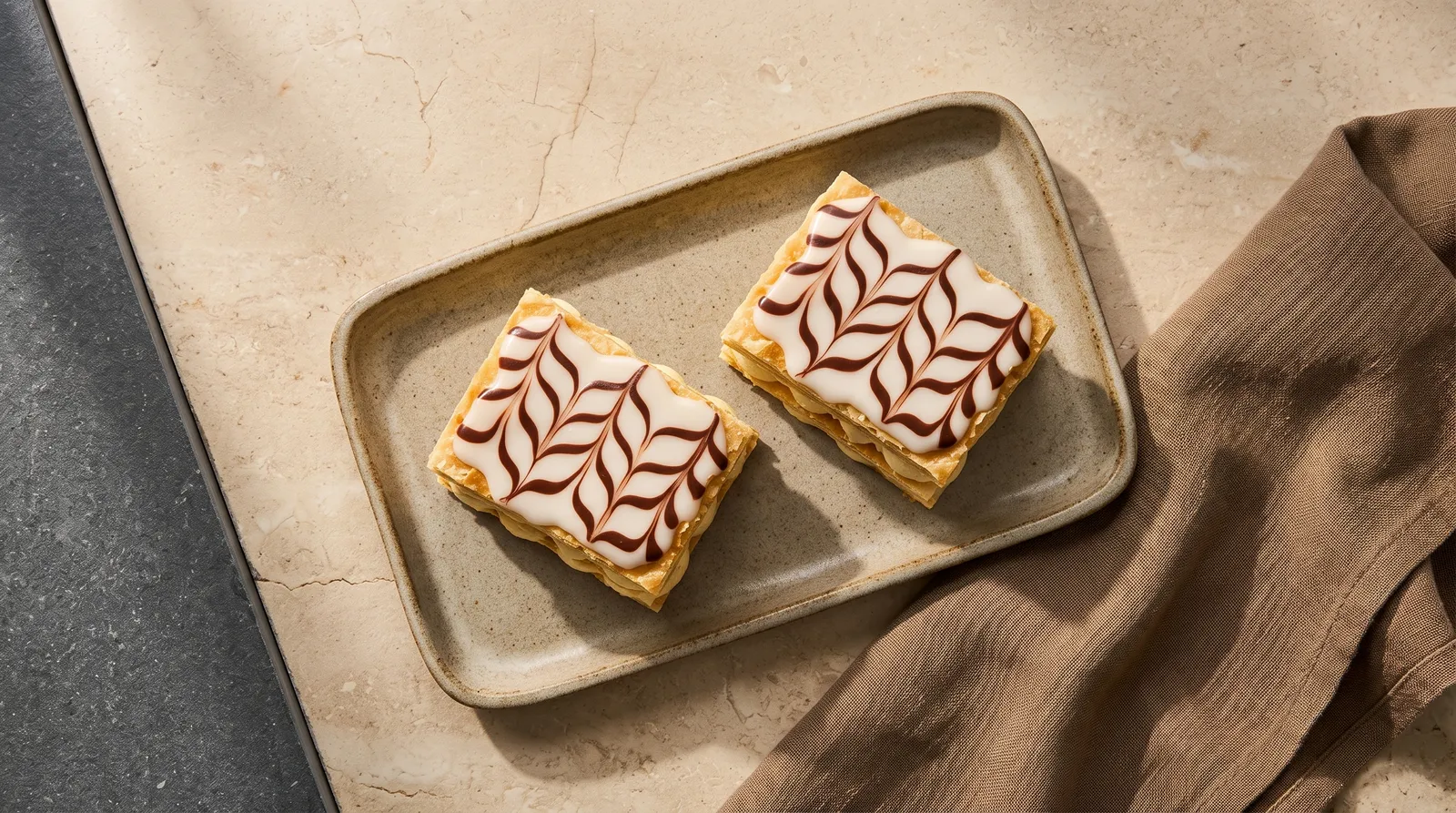
Three thin, crisp sheets of caramelised puff pastry hold two even layers of cold vanilla pastry cream under a restrained marbled icing.

French National Dishes
Share
Mille-feuille — served on a plate
Prep 60 minutes
Cook 35 minutes
Total 245 minutes
Yield 1 rectangular mille-feuille, cut into 8 portions
Introduction and overview

Classic mille-feuille with vanilla pastry cream and marbled icing

A well-made mille-feuille depends less on height than on control. The pastry should be thin, flat and thoroughly crisp, so the fork or knife meets clean layers rather than a ballooned stack of soft laminated dough. This recipe uses chilled all-butter commercial puff pastry for consistency, rolls it to 3 mm, docks it densely and bakes it between trays. The final uncovered, sugared bake gives the sheets a dry caramelised surface that stays distinct against the cream.

The filling is a classic vanilla pastry cream rather than whipped cream, buttercream or a jam layer. Yolks and cornflour provide the set, while a small amount of butter rounds the texture after cooking. The important points are temperature and cooling: the cream is cooked to 82 °C, spread shallowly so it chills quickly, and held at 5 °C or below. Assembly starts only when both pastry and cream are completely cold, which is what prevents the layers from slipping and the pastry from softening immediately.

The finished pastry is built as three matching 20 × 30 cm sheets with two equal cream layers. A thin white icing, feathered with narrow dark-chocolate lines, provides the familiar top without turning the dessert into a heavy frosted cake. After a short final chill, cut with a serrated knife and a gentle sawing motion. The decisive balance is crisp pastry against cold, smooth custard; clean dimensions and restraint in the filling make that contrast possible.
Success points

Success points

  • Bake the pastry under weight so the layers remain flat and compact.
  • Caramelise only after the pastry has baked through; the sugar should deepen the colour without scorching.
  • Spread the pastry cream shallowly and chill it fully before assembly.
  • Trim all three sheets to identical dimensions before adding any cream.
Ingredients

Ingredients

Puff pastry

  • 750 g all-butter puff pastry — well chilled; rolled and trimmed after baking to three 20 × 30 cm layers
  • 30 g icing sugar — for caramelising the pastry

Vanilla pastry cream

  • 600 ml whole milk
  • 120 g egg yolks — approximately 6 large yolks by weight
  • 120 g caster sugar
  • 50 g cornflour
  • 40 g unsalted butter — cold, diced
  • 1 vanilla bean — split and scraped

Icing

  • 180 g white fondant or icing sugar — thinned only with the listed water
  • 20 g 70% dark chocolate — melted
  • 20 ml water — for the white icing
Method

Method

Pastry

  1. Roll and dock the pastry. Roll the chilled pastry to an even 3 mm sheet, dock it thoroughly, divide it into three oversized rectangles and sandwich the pieces between baking paper and two flat trays. Allow about 20 minutes. The pastry is evenly 3 mm thick and densely docked without torn patches. Docking and weighting restrict lift so the layers bake flat. Keep the pastry cold enough to handle cleanly.

  2. Bake flat and caramelise. Bake the weighted pastry at 200 °C for 20 minutes, remove the upper tray, dust with 30 g icing sugar and continue at 220 °C for 5 minutes. Cook for about 25 minutes. Target temperature: 200 °C then 220 °C. The pastry is flat, deeply golden and crisp from edge to centre, with no scorched sugar. The final hotter stage dries and caramelises the surface. Hot sugar and trays can burn; handle with dry oven gloves.

  3. Cool the pastry. Cool the baked pastry completely on a rack; this cooling overlaps concurrently with the pastry-cream chilling period. Allow 45 minutes,. The pastry is completely cool and rigid before trimming. Warm pastry would soften the filling and smear the layers.

Pastry cream

  1. Cook the vanilla cream. Heat the milk with the vanilla bean while whisking the yolks, sugar and cornflour separately; temper with the hot milk, return everything to the saucepan and cook while whisking until the centre reaches 82 °C. Cook for about 10 minutes. The pastry cream is glossy, thick enough to hold a whisk trail and has reached 82 °C throughout. Thorough cooking sets the starch and yolk safely. Avoid splashes from the hot custard.

  2. Chill the pastry cream. Whisk in the butter off the heat, spread the cream in a shallow covered tray and refrigerate for 120 minutes. Target temperature: 5 °C. The pastry cream is at 5 °C or below and fully set. Shallow rapid chilling protects texture and food safety. Refrigerate promptly and keep the cream cold.

Assembly

  1. Trim and assemble. Trim the three pastry sheets to matching 20 × 30 cm rectangles with a serrated knife, spread half the cold cream over the first layer, add the second layer and remaining cream, then cap with the third layer. The three pastry layers are aligned and the two cream layers are even from edge to edge. Even layers give clean portions and limit crushing during cutting. Cut away from hands and keep the cream refrigerated until assembly.

  2. Marble the icing. Mix the white icing with 20 ml water to a thin spreadable consistency, coat the top in a very thin layer, pipe fine lines of the 20 g melted chocolate and feather them with a skewer. Allow about 10 minutes. The icing forms a thin opaque coat and the chocolate lines remain distinct after feathering. A thin coat sets without making the pastry top heavy.

  3. Set and portion. Refrigerate the assembled mille-feuille for 30 minutes, then cut eight portions with a clean serrated knife using a gentle sawing motion. Target temperature: 5 °C. The filling is firm enough to slice without squeezing out and the pastry still cracks cleanly. A short final chill stabilises the layers. Keep the finished pastry at 5 °C or below.

Serving and planning

Practical

Serving

Serve the mille-feuille cold enough for the pastry cream to hold cleanly, but not frozen. A single portion is one eighth of the assembled rectangle. Cut only what is needed, wiping the serrated knife between slices so pastry flakes do not drag through the cream.

Make-ahead

The pastry and cream can be prepared earlier the same day and stored separately. Keep the baked pastry dry and airtight at cool room temperature; keep the cream refrigerated. Assembly is best within a few hours of eating because moisture migrates from the cream into the pastry as it stands.

Storage and reheating

Once assembled, refrigerate at 5 °C or below and use within 24 hours for the best contrast of textures. Do not reheat. Freezing is not recommended for this finish because thawing encourages condensation and softens the laminated pastry.

Substitutions

If confectioner's fondant is unavailable, use the listed icing-sugar-and-water finish. It is less glossy but keeps the thin marbled top. Homemade classic or inverse puff pastry can replace the commercial pastry only if it is rolled to the same 3 mm thickness and baked flat to the same final dimensions.

Troubleshooting

Puffed, domed pastry means it was under-weighted or insufficiently docked; flatten only while still warm, then cool completely.

Troubleshooting

Loose cream means it was undercooked or assembled warm; recook a fresh batch to 82 °C rather than trying to rescue a filled pastry.

Troubleshooting

Smeared slices usually come from warm filling or downward pressure; chill briefly and saw with a clean serrated blade.

Nutrition per serving

Nutrition per serving

  • Serving size1 of 8 portions, about 205 g
  • Calories733 kcal
  • Carbohydrate82 g
  • Protein11 g
  • Fat41 g
  • Fibre1.5 g
  • Sodium296 mg
Allergens and food safety

Allergens and food safety

Allergens: Egg, Milk, Gluten

Safety: Cook the pastry cream to 82 °C throughout.

Safety: Cool the pastry cream rapidly in a shallow tray and refrigerate at 5 °C or below.

Safety: Refrigerate dairy- and egg-based leftovers within two hours.

Safety: Use a stable cutting board and keep fingers clear of the serrated knife.

FAQ

FAQ

Why weight the puff pastry?

Weighting keeps the laminated dough from expanding into tall uneven pockets. Mille-feuille needs compact, level layers that can support pastry cream and slice cleanly.

Can it be assembled the day before?

It is safe when kept cold, but the texture is better when the parts are prepared ahead and the pastry is assembled on the day of serving.

Closing

Closing

  • Result: Three thin, crisp sheets of caramelised puff pastry hold two even layers of cold vanilla pastry cream under a restrained marbled icing.
  • Decisive technique: Bake the pastry under weight so the layers remain flat and compact.