French Recipes

Coq au vin jaune et aux morilles

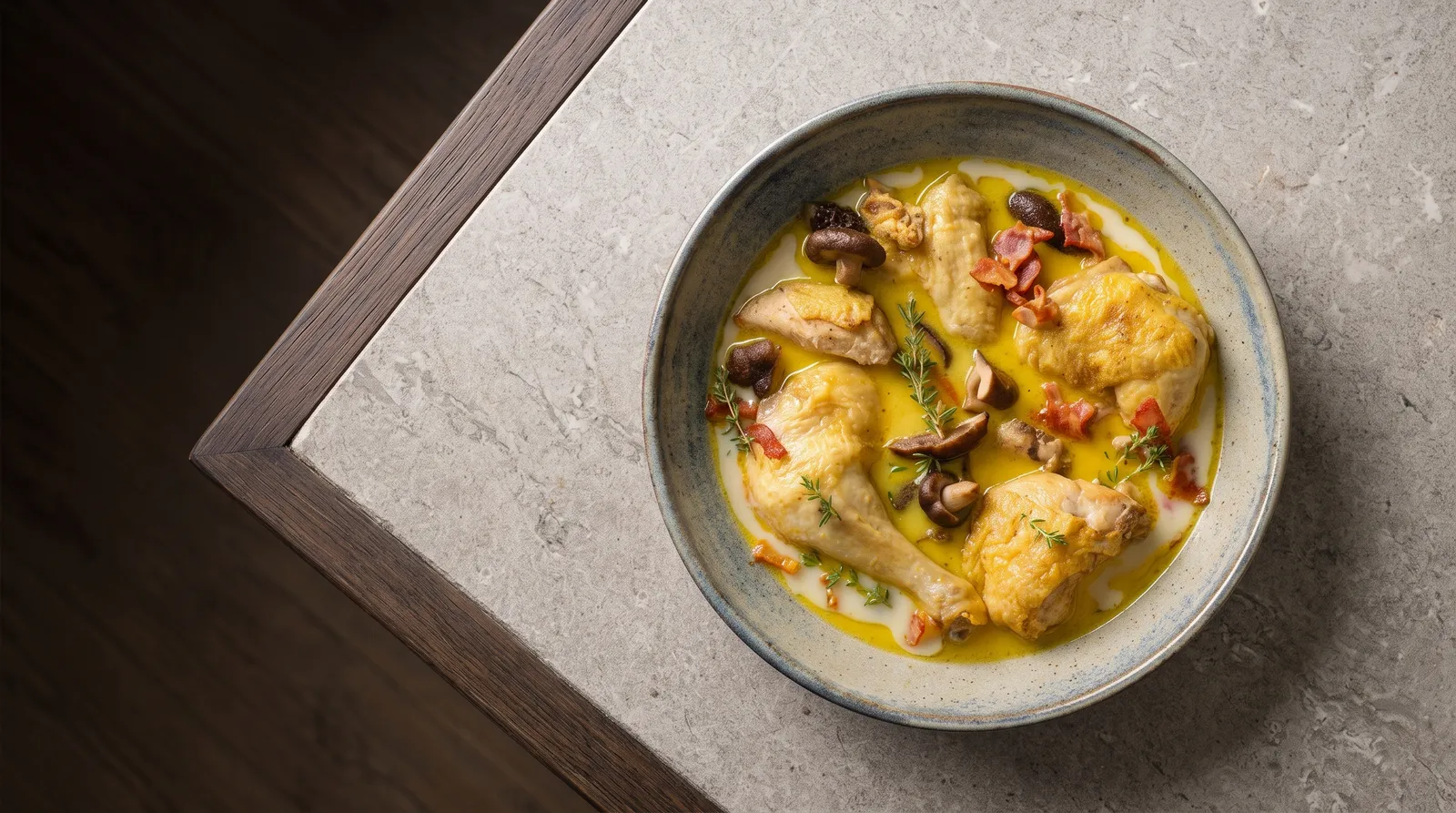
Jura Coq au Vin Jaune et aux morilles made with genuine AOP Vin Jaune, dried morels safely rehydrated and boiled, and a gentle cream sauce around 74 °C-safe rooster.

French Recipes
Share
Coq au vin jaune et aux morilles — presented in a serving dish
Prep 35 minutes
Cook 115 minutes
Total 270 minutes
Yield 6 main-course portions
Introduction and overview

Coq au Vin Jaune et aux morilles — Jura rooster with morels

The Jura identity of this dish depends on two things that should not be blurred: genuine Vin Jaune and properly handled morels. Vin Jaune is not just a poetic name for oxidatively styled white wine; it belongs to the Jura appellation framework, and ordinary white wine does not keep the same named dish.

Dried morels demand their own safety sequence. They soak for two hours, are lifted away from the gritty liquid and rinsed, then receive a full 15-minute boil in fresh water that is discarded. Only after that do they enter the rooster’s cream sauce for another 25 minutes. The method therefore treats rehydration as preparation, not as cooking.

The poultry is a young coq, browned gently and braised with Vin Jaune and stock until it reaches 74 °C and becomes tender. Cream comes later and stays below a hard boil. A small measured final addition of Vin Jaune is warmed for 15 minutes so its aromatic signature is clearer, while the nutrition note still assumes that some alcohol remains.
Success points

Success points

  • Rehydrate, rinse and boil dried morels before they ever enter the cream sauce.
  • Use genuine Jura AOP Vin Jaune if the dish keeps this exact name.
  • Keep the cream finish below a hard boil.
Ingredients

Ingredients

Morels

  • 40 g dried morels
  • 1000 ml warm water, for 2-hour rehydration; discarded
  • 1000 ml fresh water, for 15-minute boiling; discarded

Rooster and sauce

  • 1500 g young rooster (coq), jointed — Nutrition assumes about 55% cooked edible meat-and-skin yield, about 825 g.
  • 40 g unsalted butter
  • 120 g shallots, finely sliced
  • 5 g garlic, minced
  • 300 ml Jura AOP Vin Jaune, genuine Vin Jaune
  • 250 ml unsalted celery-free poultry stock
  • 300 g crème fraîche, about 30% fat
  • 1 thyme sprig
  • 1 bay leaf
  • 6 g fine salt
  • 2 g black pepper
Method

Method

Prepare morels

  1. Rehydrate the morels. Soak the dried morels in 1,000 ml warm water and leave them to rehydrate fully. The morels are fully plumped and flexible, with no hard dry centres. Dried morels still require thorough cooking after rehydration.

  2. Rinse away grit. Lift the morels from the soaking liquid, discard that liquid, split any large mushrooms, and rinse repeatedly under clean water until no sand remains. No grit is visible in the folds or at the bottom of the rinse water. Do not taste rehydrated morels raw.

  3. Boil the morels safely. Boil the rehydrated morels in 1,000 ml fresh water, then drain and discard the boiling water. Target temperature: 100 °C. The morels have boiled continuously for 15 minutes and are thoroughly cooked through. Never serve morels raw or undercooked.

Cook rooster and sauce

  1. Brown the rooster. Melt the butter in a cocotte and brown the rooster pieces lightly on all sides. The rooster is evenly golden while the butter remains nutty rather than burnt. Raw poultry must not be tasted.

  2. Sweat the shallots. Add shallots, garlic, thyme and bay and cook until softened. The shallots are translucent and fragrant without dark browning.

  3. Braise with Vin Jaune. Add 250 ml Vin Jaune and the stock, bring to a simmer, cover and cook gently. Target temperature: 74 °C. The thickest rooster pieces reach at least 74 °C without touching bone. The meat is tender but still holds on the bone. The sauce smells nutty and savoury rather than sharply alcoholic. Poultry must reach at least 74 °C.

  4. Add morels and cream. Stir in the pre-boiled morels and crème fraîche and simmer very gently. Target temperature: 85 °C. The morels are hot and tender after their separate 15-minute boil plus 25-minute sauce simmer. The cream sauce is smooth and lightly coats a spoon. The sauce stays below a hard boil at about 85 °C. Morels must be thoroughly cooked; cream should not boil aggressively.

  5. Finish with the remaining Vin Jaune. Remove the bay and thyme, stir in the remaining 50 ml Vin Jaune, and simmer briefly so the finish stays aromatic but hot. Target temperature: 85 °C. The final sauce is glossy, aromatic and spoon-coating with no raw morel texture. The rooster remains at least 74 °C and the sauce is hot at about 85 °C. Alcohol may remain; do not serve as alcohol-free.

Practical guidance

Practical

Practical guidance

Serving: rice, tagliatelle or steamed potatoes all work because they absorb the cream sauce without hiding the morels.

Practical guidance

Make-ahead: complete the morel soak, rinse and 15-minute boil earlier the same day, chill promptly, then finish in the sauce.

Practical guidance

Storage: refrigerate at 4 °C or below for up to 3 days.

Practical guidance

Reheating: reach 74 °C while stirring gently and avoiding a rolling boil.

Practical guidance

Substitution: ordinary white wine can produce a useful poultry dish but not one honestly titled Coq au Vin Jaune.

Troubleshooting

Troubleshooting

  • Issue 1Gritty sauce: the rehydrated morels were not rinsed through their folds. Split cream: the sauce boiled too hard after crème fraîche was added.
Nutrition per serving

Nutrition per serving

  • Serving size1 of 6 portions, about 140 g cooked edible rooster plus morel cream sauce
  • Calories485 kcal
  • Carbohydrate9 g
  • Protein39 g
  • Fat30 g
  • Fibre2 g
  • Sodium760 mg
Allergens and food safety

Allergens and food safety

Allergens: Milk from crème fraîche and butter; Sulphites from Vin Jaune

Dried morels must be fully rehydrated, cleaned and thoroughly cooked; never eat them raw or undercooked.

The morels receive a 15-minute boil in fresh water at 100 °C with the water discarded before the sauce stage.

Cook rooster to at least 74 °C in the thickest meat without touching bone.

Keep the finished cream sauce hot but below a hard boil around 85 °C.

Vin Jaune contains sulphites and alcohol; some alcohol may remain after cooking.

FAQ

FAQ

Are dried morels safe after soaking?

No. Rehydration alone is not cooking; they must be thoroughly heat-treated.

Can Savagnin replace Vin Jaune under the same title?

It may be a good Jura wine, but it does not preserve the exact Vin Jaune identity required here.

Closing

Closing

  • Result: The poultry is a young coq, browned gently and braised with Vin Jaune and stock until it reaches 74 °C and becomes tender.
  • Decisive technique: Rehydrate, rinse and boil dried morels before they ever enter the cream sauce.