French National Dishes

Cotriade bretonne

A southern Breton fishermen’s pot in which potatoes and onions cook first, then four fish species are added by firmness and finished with a sharp shallot-chive vinaigrette.

French National Dishes
Share
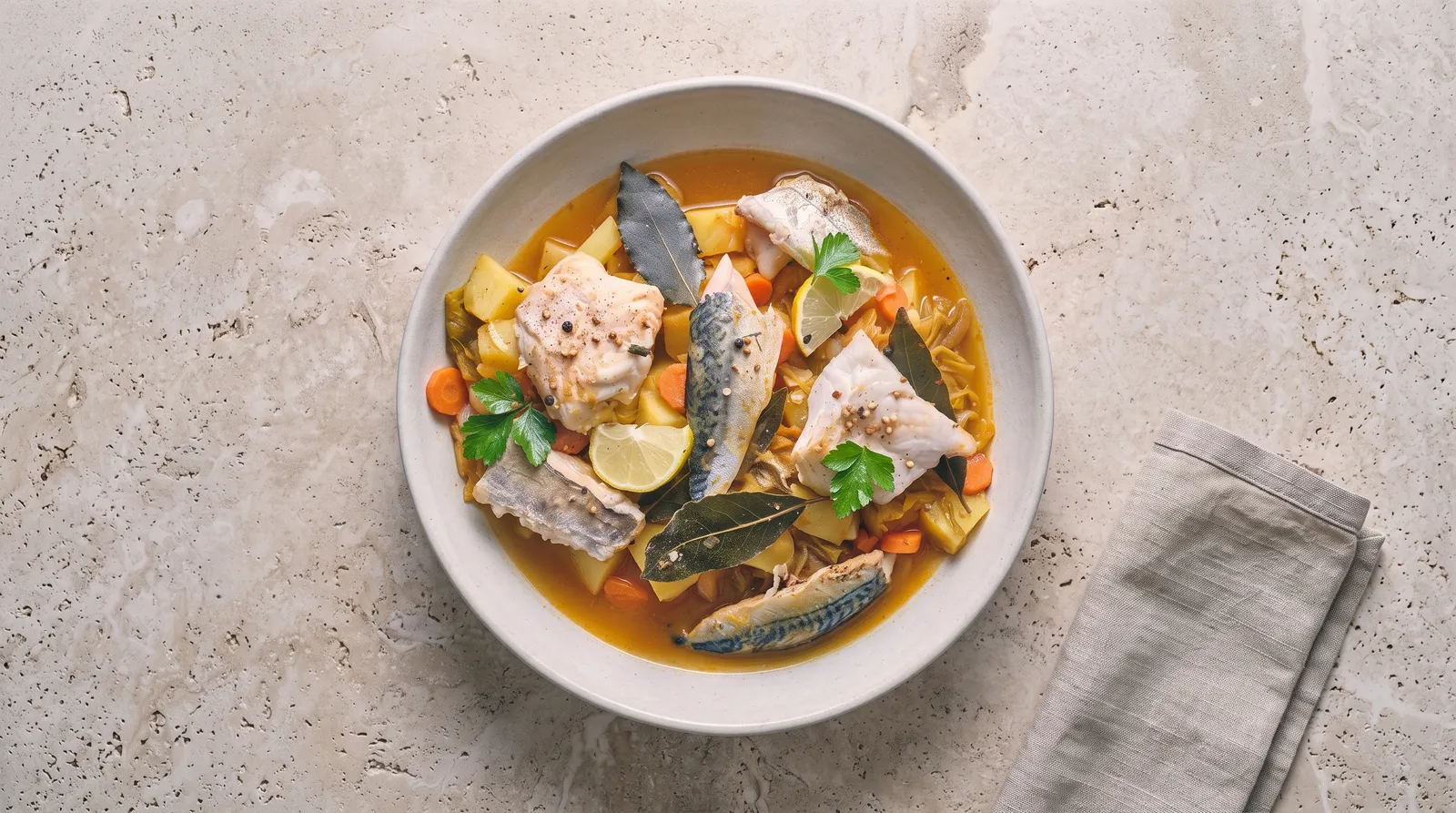
Cotriade bretonne — served on a plate
Prep 20 minutes
Cook 38 minutes
Total 58 minutes
Yield 6 main-course portions
Introduction and overview

Cotriade bretonne — Lorient-style mixed fish, potatoes and vinaigrette

Cotriade belongs to the fishing culture of southern Brittany, and Lorient is a particularly useful frame for understanding the dish: it is a practical cauldron meal built around the catch, potatoes and onions rather than a cream-thickened seafood soup. The broth stays light enough to taste the fish, while semi-salted butter gives it the rounded dairy note associated with Breton cooking.

The mixed catch matters as much as the broth. Monkfish is firm and enters first; pollock and hake follow; mackerel, which cooks quickly and has a richer flavour, goes in last. That staggered sequence lets the potatoes become tender before the fish arrives and gives each 5 cm piece a realistic chance of reaching 63 °C without being boiled to fragments.

A small vinaigrette of olive oil, white wine vinegar, shallot and chives is served separately rather than stirred into the pot. Spoon it over the fish and potatoes at the table, where its acidity cuts through butter and oily mackerel. The white wine is simmered in the potato broth, but some alcohol can remain, so it should be treated as an ingredient rather than described as having cooked away completely.
Success points

Success points

  • Keep the simmer gentle after fish is added.
  • Add fish in order of firmness and verify 63 °C rather than relying on colour alone.
  • Serve broth and solids without crushing the fish.
Ingredients

Ingredients

Pot and fish

  • 250 g hake fillet, skinless, pin bones removed, cut into 5 cm pieces
  • 250 g pollock fillet, skinless, pin bones removed, cut into 5 cm pieces
  • 250 g mackerel fillet, skinless, pin bones removed, cut into 5 cm pieces
  • 250 g monkfish tail meat, membrane removed, boneless, cut into 5 cm pieces
  • 1000 g waxy potatoes, peeled, cut into 3 cm chunks
  • 450 g yellow onions, peeled and thinly sliced
  • 15 g garlic, peeled and finely chopped
  • 120 g semi-salted butter, divided: 100 g for the pot, 20 g to finish
  • 200 ml dry white wine, measured
  • 700 ml water
  • 3 g fresh thyme
  • 2 bay leaves
  • 2 g fine salt
  • 1 g black pepper, freshly ground

Vinaigrette

  • 60 ml extra-virgin olive oil
  • 30 ml white wine vinegar
  • 40 g shallot, peeled and finely minced
  • 10 g chives, finely sliced
Method

Method

Broth base

  1. Soften the onion base. Melt 100 g semi-salted butter, add the 450 g onions and 15 g garlic, and cook for 8 minutes without strong browning. Tool or vessel: 5–6 l heavy pot. Heat: medium-low. Temperature: about 95 °C pan environment. Readiness: The onions are soft and translucent with no dark browning. Why it matters: Softening the onions builds the broth base without a roasted flavour.

  2. Cook the potatoes in the broth. Add 200 ml dry white wine, 700 ml water, thyme, bay leaves, potatoes, 2 g salt and black pepper; bring to a simmer and cook for 20 minutes. Tool or vessel: same pot. Heat: medium, then low simmer. Temperature: liquid simmer about 95–98 °C. Readiness: A knife enters the potato chunks with slight resistance, and the broth tastes integrated rather than raw-wine sharp. Why it matters: Starting the potatoes first gives them enough time before fragile fish is added. Safety: Alcohol is not assumed to disappear completely; the nutrition basis uses a conservative 40% retention factor because the wine cooks for roughly 20 minutes.

Fish and finish

  1. Start with the monkfish. Add the monkfish pieces first and simmer gently for 4 minutes. Tool or vessel: same pot. Heat: low simmer. Temperature: liquid about 90–95 °C. Readiness: The monkfish pieces are beginning to turn opaque but are not yet at their final 63 °C endpoint. Why it matters: Monkfish is the firmest fish in the mixture and benefits from the head start. Safety: keep fish refrigerated until it is added.

  2. Add the white fish. Add the pollock and hake, keeping the pieces in one layer as far as practical, and simmer for 3 minutes. Tool or vessel: same pot. Heat: low simmer. Temperature: liquid about 90–95 °C. Readiness: The white fish is mostly opaque at the surface and still holds distinct pieces. Why it matters: Staggering the fish limits breakage. Safety: Do not stir vigorously.

  3. Finish with the mackerel. Add the mackerel and cook for a final 3 minutes, checking the thickest pieces of every fish species with a clean food thermometer; all fish must reach 63 °C. Tool or vessel: same pot + food thermometer. Heat: low simmer. Temperature: 63 °C internal fish temperature. Readiness: The thickest fish pieces register 63 °C and flake at the edges while still holding their shape. Why it matters: The shortest final stage protects delicate fish while meeting the safety endpoint. Safety: Check meticulously for any remaining bones before service.

  4. Mount the broth with butter. Remove from the heat, discard thyme stems and bay leaves, gently swirl in the remaining 20 g butter, and rest only long enough to prepare the serving bowls. Tool or vessel: same pot. Heat: off heat. Temperature: off heat. Readiness: The broth is glossy from the butter and the fish pieces remain intact. Why it matters: Finishing off heat avoids extra boiling of the fish. Safety: Serve promptly; do not leave cooked fish at room temperature.

Vinaigrette

  1. Whisk the vinaigrette. Whisk the olive oil, white wine vinegar, shallot and chives until evenly dispersed. Tool or vessel: small bowl + whisk. Heat: none. Temperature: room temperature. Readiness: The shallot and chives are evenly suspended through the sharp vinaigrette. Why it matters: The vinaigrette stays fresh and is served separately.

Serving and practical guidance

Practical

Substitutions

- Fish species: Other traceable firm and medium-firm local marine fish may replace a listed species while keeping 1 kg total cleaned edible fish. Cooking order must still follow firmness and every piece must reach 63 °C.

Troubleshooting

Troubleshooting

  • Problem 1Check the cause and correction. If fish breaks apart, the simmer was too vigorous or the pot was stirred; use a barely moving simmer and lift with a slotted spoon.
  • Problem 2Check the cause and correction. If potatoes are firm when fish is ready, they were undercooked before fish addition; cook potatoes to slight knife resistance before adding fish.
Nutrition per serving

Nutrition per serving

  • Serving size1/6 of the pot plus 1/6 vinaigrette
  • Calories592 kcal
  • Carbohydrate37.9 g
  • Protein34.0 g
  • Fat33.0 g
  • Fibre5.0 g
  • Sodium377 mg
Allergens and food safety

Allergens and food safety

Allergen: Fish.

Allergen: Milk from butter.

Allergen: Sulphites from wine and potentially wine vinegar.

Allergen: Alcohol from wine.

Safety: Keep raw fish at 4 °C or below and use a clean board and knife to prevent cross-contamination.

Safety: Cook the thickest fish pieces to 63 °C and check for bones before serving.

Safety: White wine contains alcohol and usually sulphites; alcohol may remain after simmering.

Closing

Closing

  • Result: A southern Breton fishermen’s pot in which potatoes and onions cook first, then four fish species are added by firmness and finished with a sharp shallot-chive vinaigrette.
  • Decisive technique: Keep the simmer gentle after fish is added.