French National Dishes

Coupétade

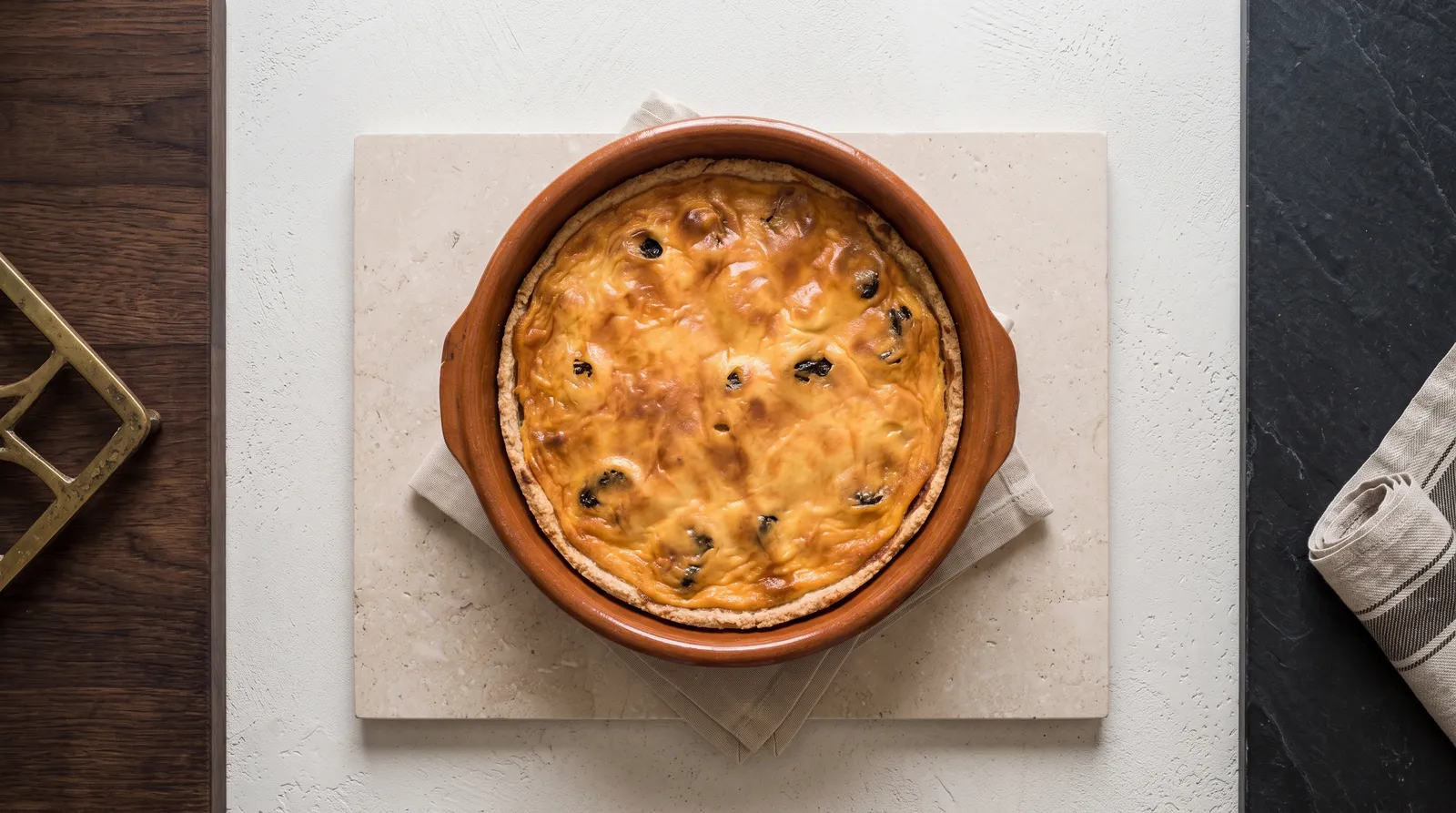
A Lozère and Cévennes-style baked dessert of stale baguette, milk, eggs, prunes and raisins, soaked before a slow bake so the centre sets without drying.

French National Dishes
Share
Coupétade — presented in a serving dish
Prep 15 minutes
Cook 65 minutes
Total 160 minutes
Yield 8 dessert portions
Introduction and overview

Coupétade — Lozère baked bread, prune and custard dessert

Coupétade is a rural dessert associated with Lozère and the Cévennes/Aubrac area, where stale bread is turned into a substantial baked sweet with milk, eggs and dried fruit. Its identity is not simply ‘bread pudding’: the combination of stale bread, prunes and raisins, the deliberate soak and the slow custard bake give it a recognisable regional shape.

The bread needs time to take up the milk before the egg mixture is added. A 20-minute soak softens the crumb without dissolving it, while a shallow 20 × 28 cm dish keeps the layers broad enough for even baking. The prunes are already pitted and the raisins go in dry, so there is no hidden fruit-soaking liquid to disturb the custard ratio.

Low oven heat is the main control. At 130 °C the centre can climb to the required 71 °C while the edges remain tender rather than rubbery. A 15-minute stand stabilises the hot custard, followed by 45 minutes of cooling for a warm-to-cool service in which the bread remains moist and the fruit stays distinct.

Success points

Success points

  • Use genuinely stale bread so the crumb absorbs rather than collapses.
  • Give the full 20-minute milk soak before adding the egg mixture.
  • Judge doneness by both 71 °C minimum centre temperature and a softly set centre.
Ingredients

Ingredients

  • 200 g stale baguette, cut into 2 cm slices
  • 600 ml whole milk, cold
  • 150 g whole egg, about 3 large eggs without shell
  • 100 g caster sugar
  • 100 g pitted prunes, purchased pitted; halved
  • 40 g raisins
  • 10 g unsalted butter, softened, for the baking dish
  • 3 g vanilla extract
Method

Method

Soak and assemble

  1. Layer the bread and fruit. Butter a 20 × 28 cm baking dish with the 10 g butter, arrange the 200 g stale baguette with the prunes and raisins between and over the slices, then pour over the 600 ml milk. Tool or vessel: 20 × 28 cm baking dish. Heat: none. Temperature: room temperature. Readiness: The fruit is distributed through the bread rather than collected in one corner. Why it matters: Layering exposes both bread and fruit to the custard.

  2. Let the bread absorb the milk. Leave the bread and fruit to soak and stand in the milk for 20 minutes. Tool or vessel: same dish. Heat: none. Temperature: room temperature. Readiness: The bread is evenly moistened and has softened without dissolving. Why it matters: A defined soak hydrates stale bread before the egg mixture sets. Safety: keep the soak to the stated time, then proceed to baking.

  3. Mix the egg custard. Whisk the 150 g egg, 100 g sugar and 3 g vanilla until uniform, then pour evenly over the soaked bread. Tool or vessel: bowl + whisk. Heat: none. Temperature: room temperature. Readiness: No streaks of unmixed egg remain, and the custard is distributed across the dish. Why it matters: Even egg distribution prevents dry pockets.

Bake and settle

  1. Bake gently. Bake in a preheated 130 °C conventional oven for 60 minutes, checking the centre with a food thermometer near the end; it must reach at least 71 °C. Tool or vessel: 20 × 28 cm baking dish. Heat: 130 °C conventional oven. Temperature: 130 °C oven; at least 71 °C centre. Readiness: The centre is set with only a slight tremble, the top is lightly coloured, and the custard is not visibly dry or curdled. Why it matters: Low heat lets the soaked bread and egg custard set without scorching. Safety: The centre must reach at least 71 °C.

  2. Let the custard settle. Remove from the oven and leave to stand in the dish for 15 minutes before cutting. Tool or vessel: same dish. Heat: none. Temperature: room temperature. Readiness: The custard firms enough to cut cleanly while remaining moist. Why it matters: Standing stabilizes the hot custard.

  3. Cool for serving. Cool for a further 45 minutes for a warm-to-cool service, or refrigerate after prompt cooling if serving later. Tool or vessel: same dish + cooling rack. Heat: none. Temperature: room temperature, then ≤4 °C if stored. Readiness: The pudding is warm or cool rather than piping hot, and the bread layers remain moist. Why it matters: The longer cool period is part of the service texture. Safety: Refrigerate leftovers at 4 °C or below.

Serving and practical guidance

Practical

Substitutions

- Stale baguette: An equivalent lean white French-style loaf of similar dryness may be used at the same dry weight. A rich brioche changes fat, sweetness and absorption and is therefore not equivalent.

Troubleshooting

Troubleshooting

  • Problem 1Check the cause and correction. If the centre is watery, the bread may not have absorbed the milk evenly or the custard did not reach 71 °C; verify the soak and thermometer reading.
  • Problem 2Check the cause and correction. If the edges are rubbery, the oven was too hot or the bake continued too long after the centre set.
Nutrition per serving

Nutrition per serving

  • Serving size1/8 of the baked dish
  • Calories250 kcal
  • Carbohydrate41.4 g
  • Protein7.3 g
  • Fat6.0 g
  • Fibre1.6 g
  • Sodium199 mg
Allergens and food safety

Allergens and food safety

Allergen: Gluten from wheat bread.

Allergen: Milk.

Allergen: Egg.

Safety: Cook the egg custard centre to at least 71 °C.

Safety: Cool promptly after service and refrigerate at 4 °C or below.

Safety: Do not taste uncooked egg mixture.

Closing

Closing

  • Result: A Lozère and Cévennes-style baked dessert of stale baguette, milk, eggs, prunes and raisins, soaked before a slow bake so the centre sets without drying.
  • Decisive technique: Use genuinely stale bread so the crumb absorbs rather than collapses.