French National Dishes

Coquilles Saint-Jacques à la bretonne

Breton Pecten maximus scallops baked in shells or ramekins with shallot, white wine, crème fraîche and breadcrumbs, using a short gratin to reach 63 °C without rubbery seafood.

French National Dishes
Share
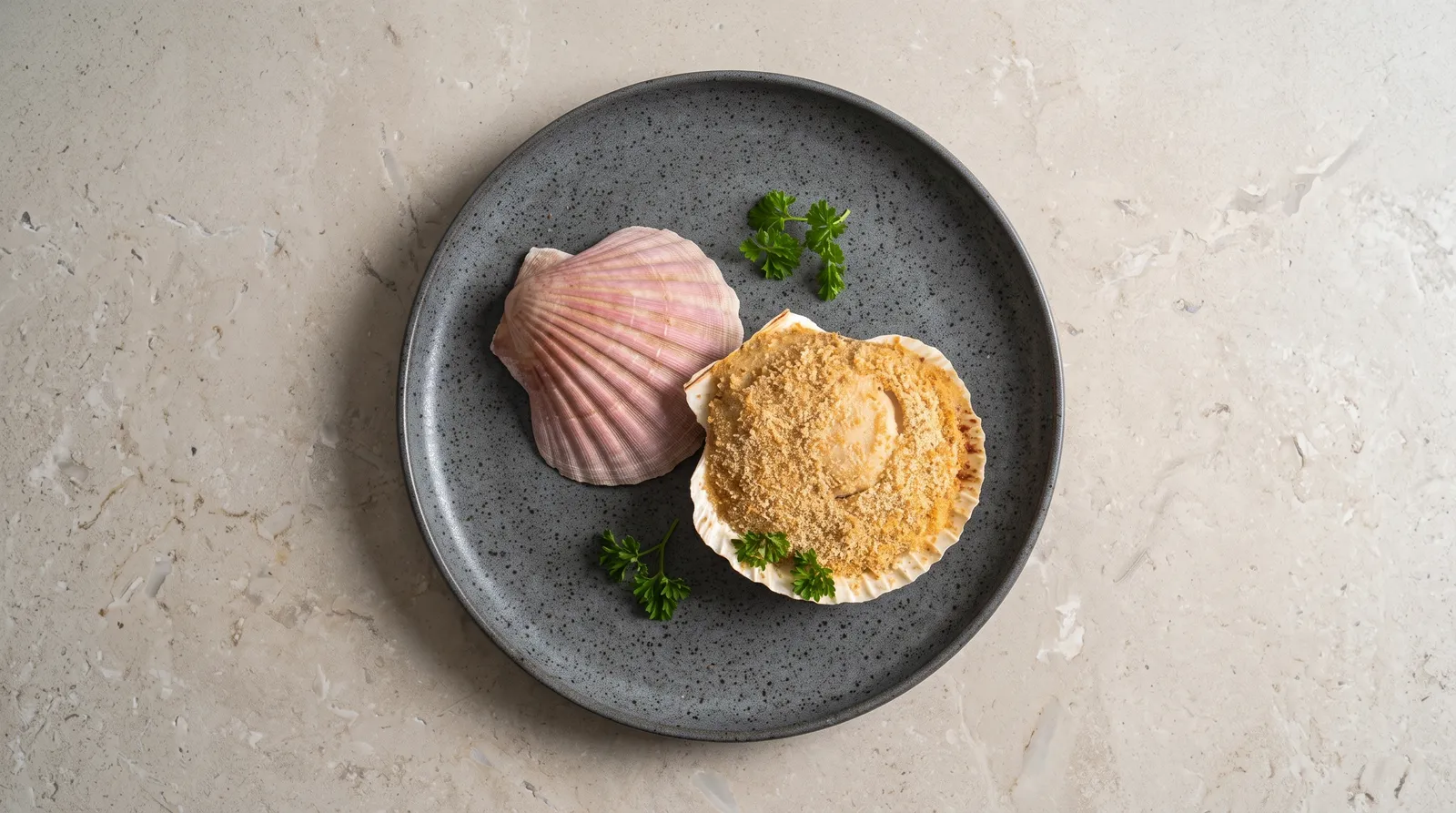
Coquilles Saint-Jacques à la bretonne — served on a plate
Prep 30 minutes
Cook 24 minutes
Total 54 minutes
Yield 4 gratin portions
Introduction and overview

Coquilles Saint-Jacques à la bretonne — Breton scallop gratin

The name Coquilles Saint-Jacques is treated literally here: the seafood is Pecten maximus, not a smaller pétoncle sold under a loose market shorthand. The 360 g weight is cleaned edible seafood after shell and frill removal, and the coral is explicitly included so the ingredient and nutrition bases are not ambiguous.

Breton gratin preparations often combine onion or shallot, white wine, cream, breadcrumbs and butter. The technical trap is cooking the scallops twice. Instead, the onion-wine-cream base is essentially finished in the pan, then raw dried scallops are assembled in shells or ramekins and baked only long enough to brown the crumbs and reach 63 °C.

That measured endpoint protects both safety and texture. Opaque, tender flesh is a useful quality cue, but a thin thermometer probe provides the safety check. The result should be spoonable and creamy beneath a light breadcrumb crust, with scallops that still have spring rather than the cottony firmness of overcooked shellfish.
Success points

Success points

  • Use true Pecten maximus and record the cleaned edible weight, not the shell-on purchase weight.
  • Finish the sauce before the scallops are assembled so seafood cooking stays short.
  • Probe the thickest scallop and stop at 63 °C while the flesh is still tender.
Ingredients

Ingredients

Scallops

  • 360 g Pecten maximus scallops, 12 cleaned edible scallops, coral included, well dried — Edible weight after shell, frill and grit removal; 90 g per serving.
  • 4 g fine salt
  • 1 g white pepper

Breton sauce and gratin

  • 120 g yellow onion, finely diced
  • 60 g shallots, finely diced
  • 40 g unsalted butter
  • 100 ml dry white wine
  • 120 g crème fraîche
  • 15 g flat-leaf parsley, finely chopped
  • 60 g dry breadcrumbs
Method

Method

Prepare

  1. Clean and dry the scallops. Check the 12 cleaned Pecten maximus scallops for grit, rinse only as needed, drain thoroughly, and pat completely dry; keep the coral attached and included. The scallops are free of grit and surface water, with the coral included in the edible portion. Maintain the cold chain and return cleaned scallops to refrigeration until assembly.

  2. Prepare the shells or ramekins. Wash and dry four clean oven-safe scallop shells or set out four 12 cm ramekins, and divide the scallops three per portion. Each vessel contains three evenly sized scallops and is dry and stable on the tray. Never use cracked, dirty or non-oven-safe decorative shells.

  3. Chop the aromatics. Finely dice the onion and shallots, chop the parsley, and measure the butter, wine, cream and breadcrumbs. The onion and shallot dice are fine enough to soften before the brief scallop bake. Keep scallops refrigerated while aromatics are prepared.

Sauce and bake

  1. Soften onion and shallot. Melt 25 g butter in a sauté pan and cook the onion and shallot gently. The onion and shallot are soft and translucent with no dark browning.

  2. Reduce the white wine. Add the white wine and simmer briskly until reduced by about two-thirds. Only a shallow glossy layer of wine reduction remains around the softened aromatics. Alcohol is reduced but not assumed to disappear completely.

  3. Finish the cream base. Stir in crème fraîche and parsley and simmer just until lightly thickened. Target temperature: 85 °C. The cream sauce lightly coats the aromatics and remains smooth without splitting. Keep dairy hot but below a hard boil.

  4. Gratinate the scallops. Spoon the hot sauce over the scallops, top with breadcrumbs and the remaining 15 g butter, then bake in a 220 °C oven until the scallops reach the measured endpoint. The breadcrumb surface is lightly golden. The scallop flesh is opaque and still tender rather than rubbery. The centre of the thickest scallop reaches at least 63 °C. Shellfish should reach 63 °C; use a thin probe in the thickest scallop.

Practical guidance

Practical

Practical guidance

Serving: bake and serve immediately; the crust softens and scallops firm as they sit.

Practical guidance

Make-ahead: prepare and chill the sauce a few hours ahead, but keep scallops separately refrigerated until assembly.

Practical guidance

Storage: cooked leftovers are best within 1 day at 4 °C or below.

Practical guidance

Reheating: warm gently to 74 °C; quality will be firmer than freshly cooked.

Practical guidance

Substitution: ramekins replace the vessel safely, not the seafood; non-Pecten scallops change the specified identity.

Troubleshooting

Troubleshooting

  • Issue 1Rubbery scallops: they were pre-cooked or baked past the measured endpoint. Watery gratin: scallops were not dried or the wine was not reduced enough before cream.
Nutrition per serving

Nutrition per serving

  • Serving size1 filled shell or ramekin with 3 scallops, about 90 g scallop meat plus sauce and topping
  • Calories360 kcal
  • Carbohydrate20 g
  • Protein24 g
  • Fat19 g
  • Fibre2 g
  • Sodium620 mg
Allergens and food safety

Allergens and food safety

Allergens: Mollusc; Milk from butter and crème fraîche; Gluten from breadcrumbs; Sulphites from white wine

Keep cleaned raw scallops refrigerated at 4 °C or below until assembly.

Use only clean oven-safe shells, or use ramekins.

Cook the thickest scallop to at least 63 °C; opaque, tender flesh is the quality cue, not a substitute for the thermometer.

White wine contains sulphites and alcohol; some alcohol may remain after reduction and baking.

Reheat any leftovers to 74 °C.

FAQ

FAQ

Is the coral included?

Yes. The 360 g cleaned edible weight includes coral, and each serving receives three scallops with their edible coral.

Why not simmer the scallops in the sauce first?

Pre-cooking followed by gratining easily makes scallops rubbery; the sauce is finished first so the seafood receives one short cooking stage.

Closing

Closing

  • Result: That measured endpoint protects both safety and texture.
  • Decisive technique: Use true Pecten maximus and record the cleaned edible weight, not the shell-on purchase weight.