French Recipes

Colombo de poulet

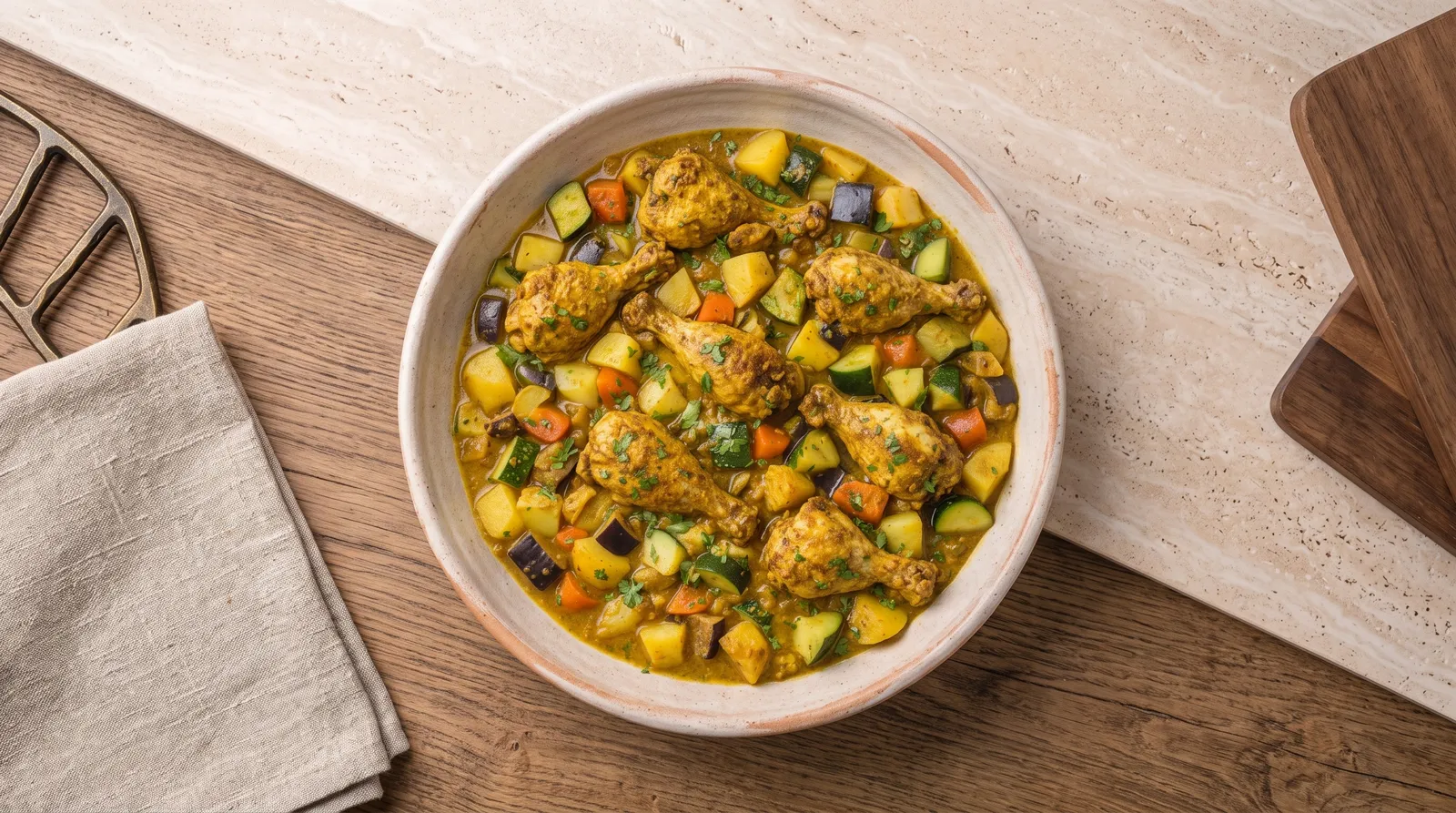
Guadeloupean chicken colombo with graines à roussir, aubergine and potato, a two-hour refrigerated citrus marinade and a measured 74 °C poultry endpoint.

French Recipes
Share
Colombo de poulet — presented in a serving dish
Prep 30 minutes
Cook 72 minutes
Total 222 minutes
Yield 6 main-course portions
Introduction and overview

Colombo de poulet — Guadeloupean chicken colombo

Chicken colombo is not simply the goat colombo with a different protein. This Guadeloupean form starts by toasting graines à roussir—cumin, fenugreek and yellow mustard—then builds the sauce around bone-in chicken, aubergine and potato. That seed step gives the dish a distinct aromatic opening before the colombo powder enters.

The chicken receives a shorter refrigerated citrus-and-garlic marinade than the cabri. Poultry does not need the same connective-tissue braise as goat shoulder, so the cooking window is built around tender vegetables and a verified 74 °C endpoint in the thickest chicken pieces. The thermometer probe should sit in meat, not against the bone.

Potatoes and aubergine are part of the cooking logic, not random additions. Potato chunks take up the spiced broth while staying intact; aubergine softens and helps the sauce feel rounded. The final ten-minute uncovered simmer should make the liquid glossy enough to cling without reducing it to a heavy curry paste.
Success points

Success points

  • Toast graines à roussir only to the first popping stage; blackened mustard or fenugreek turns bitter.
  • Probe the thickest chicken pieces without touching bone.
  • Keep potato chunks large enough to remain distinct after the covered simmer.
Ingredients

Ingredients

Chicken marinade

  • 1600 g bone-in skin-on chicken pieces, thighs and drumsticks preferred — Nutrition assumes about 60% cooked edible meat-and-skin yield, about 960 g; bones are excluded.
  • 60 ml fresh lime juice
  • 20 ml white wine vinegar
  • 15 g garlic, crushed
  • 100 g yellow onion, sliced
  • 30 g cives or spring onions, chopped
  • 6 g fine salt
  • 2 g black pepper
  • 30 ml sunflower oil

Colombo and vegetables

  • 5 g graines à roussir, cumin, fenugreek and yellow mustard seed
  • 50 g Antillean colombo spice blend
  • 350 g aubergine, 2 cm dice
  • 500 g waxy potatoes, peeled and cut into 3 cm chunks
  • 800 ml water
  • 1 bouquet garni, thyme, bay and parsley
Method

Method

Marinate

  1. Season the chicken. Combine chicken with lime juice, vinegar, garlic, onion, cives, salt, pepper and 15 ml oil, cover, and turn to coat. Every chicken piece is coated with the citrus-garlic seasoning. Keep raw poultry and juices away from ready-to-eat food.

  2. Chill the chicken. Refrigerate the covered chicken before cooking. Target temperature: 4 °C or below. The chicken has marinated for 2 hours while remaining at 4 °C or below. Do not reuse raw marinade unless it is fully cooked in the dish.

Cook

  1. Toast the graines à roussir. Heat 15 ml oil in the casserole and stir the graines à roussir just until fragrant and beginning to pop. The seeds smell nutty and a few begin to pop without blackening. Mustard seed is an allergen.

  2. Brown the chicken. Lift the chicken from the marinade, reserve the marinade, and brown the pieces in the aromatic oil. The chicken skin and exposed meat are golden on several sides. Raw chicken is not safe to taste.

  3. Cook the aromatics and spice. Add the marinade solids and colombo spice, stirring until fragrant. The onion is softened and the spice smells rounded rather than raw.

  4. Braise with vegetables. Add the reserved liquid marinade, water, bouquet garni, aubergine and potatoes, bring to a boil, then cover and simmer gently. Target temperature: 74 °C. The potatoes are tender through the centre. The aubergine has softened into the sauce without disappearing completely. The thickest chicken pieces reach at least 74 °C without the probe touching bone. Poultry must reach at least 74 °C in the thickest part, avoiding bone.

  5. Reduce the colombo sauce. Uncover and simmer until the liquid lightly coats the chicken and vegetables. Target temperature: 74 °C. The sauce is glossy and spoonable, with no raw watery layer around the vegetables. The chicken still registers at least 74 °C before service. Use clean utensils after the poultry reaches its safety endpoint.

Practical guidance

Practical

Practical guidance

Serving: spoon over or beside plain rice while keeping the potatoes and aubergine in the colombo.

Practical guidance

Make-ahead: marinate for the full 2 hours; cooked colombo can be chilled and reheated the next day.

Practical guidance

Storage: refrigerate promptly at 4 °C or below and use within 3 days.

Practical guidance

Reheating: warm to 74 °C, stirring gently so softened vegetables stay intact.

Practical guidance

Substitution: boneless chicken works only with a recalculated edible weight and shorter simmer; it is not a silent quantity swap.

Troubleshooting

Troubleshooting

  • Issue 1Bitter sauce: the graines à roussir were toasted too dark. Broken potatoes: the chunks were too small or the stew was stirred aggressively after they softened.
Nutrition per serving

Nutrition per serving

  • Serving size1 of 6 portions, about 420 g finished colombo
  • Calories520 kcal
  • Carbohydrate26 g
  • Protein42 g
  • Fat27 g
  • Fibre6 g
  • Sodium720 mg
Allergens and food safety

Allergens and food safety

Allergens: Mustard from graines à roussir

Keep raw chicken and its marinade at 4 °C or below.

Any marinade returned to the casserole must be fully cooked.

Chicken must reach at least 74 °C in the thickest pieces without touching bone.

Prevent cross-contamination and reheat leftovers to 74 °C.

FAQ

FAQ

What are graines à roussir?

They are a small seed mixture commonly built from cumin, fenugreek and mustard, toasted briefly before the wet cooking begins.

Why not use generic curry powder?

Colombo spice has its own Antillean identity and balance, so a generic curry mix changes the dish rather than simply replacing one pantry item.

Closing

Closing

  • Result: Potatoes and aubergine are part of the cooking logic, not random additions.
  • Decisive technique: Toast graines à roussir only to the first popping stage; blackened mustard or fenugreek turns bitter.