French National Dishes

Confit de canard

Duck-leg confit cured under refrigeration, slowly cooked submerged in duck fat to 74 °C and fork tenderness, crisped briefly, then handled strictly as short-life refrigerated food.

French National Dishes
Share
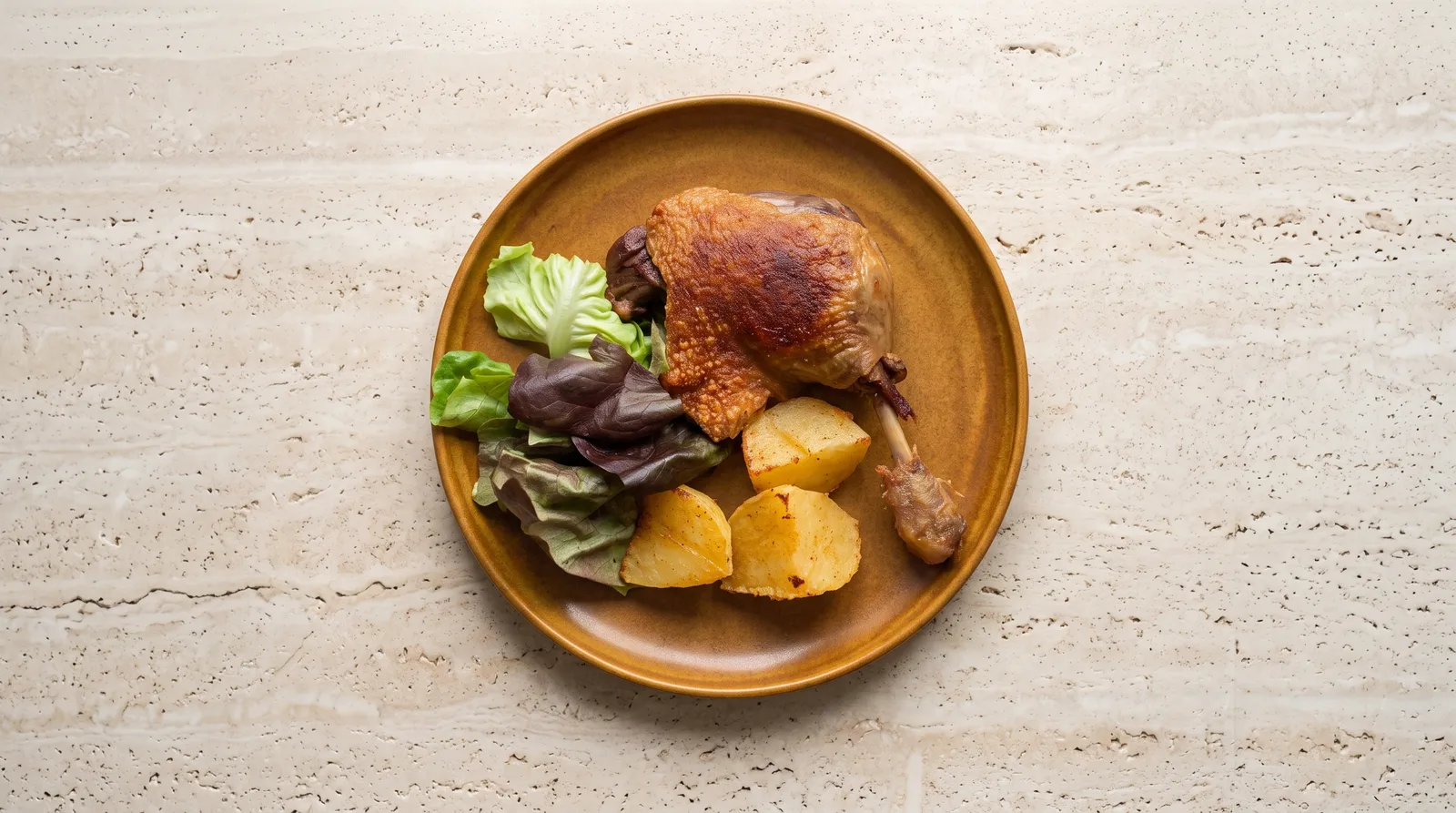
Confit de canard — served on a plate
Prep 25 minutes
Cook 170 minutes
Total 1035 minutes
Yield 4 duck-leg portions
Introduction and overview

Confit de canard — refrigerated duck-leg confit

Confit de canard is a technique before it is a storage claim: duck legs are salted, rinsed, dried and cooked slowly under duck fat until the meat becomes exceptionally tender. The household method here keeps those essential steps while refusing the unsafe shortcut of treating a fat-covered container as shelf-stable.

The 12-hour cure is intentionally controlled. Burying the legs in coarse salt seasons and firms them, but nearly all of that salt is then rinsed away. Nutrition therefore cannot count the entire kilogram as eaten. The same transparency applies to the fat: 1.2 kg is needed to submerge the legs, while exactly 80 g is assigned to the finished four servings and the rest is drained.

Temperature and tenderness are separate checkpoints. Duck is poultry, so the thickest meat must reach 74 °C; confit then continues at low oven heat until a fork slides easily into the joint. Crisping at 220 °C is brief and happens only after the slow cook, which keeps the skin crisp without sacrificing the soft interior.
Success points

Success points

  • Rinse away all visible curing salt and dry the legs thoroughly before they enter hot fat.
  • Use enough fat to keep the legs submerged during the slow cook.
  • Separate safety from texture: verify 74 °C, then continue until the joint is fork-tender.
Ingredients

Ingredients

Duck cure

  • 1200 g duck legs, 4 bone-in legs, about 300 g each
  • 1 kg coarse salt, for curing; thoroughly rinsed away before cooking — Most curing salt is discarded and is not counted as eaten.
  • 4 thyme sprigs
  • 4 g arlic cloves, lightly crushed

Fat cooking

  • 1200 g duck fat — Enough to submerge the legs; nutrition counts exactly 80 g as retained/consumed across 4 servings.
Method

Method

Cure

  1. Salt the duck legs. Pack the duck legs with the coarse salt, thyme and garlic in a shallow non-reactive dish and cover the dish. Each duck leg is evenly surrounded by coarse salt and aromatics. Keep raw poultry at 4 °C or below.

  2. Cure under refrigeration. Leave the covered legs in the refrigerator for 12 hours. Target temperature: 4 °C or below. The legs have cured for 12 hours while remaining continuously chilled. This is not a preservation step that makes the duck shelf-stable.

Cook and cool

  1. Rinse and dry. Rinse all visible salt from the legs under cold running water, then dry them extremely well with disposable paper. No coarse salt crystals remain and the skin surface is dry. Clean the sink and surrounding surfaces after raw-poultry contact.

  2. Melt the duck fat. Heat the duck fat in a snug heavy casserole until fully liquid but not smoking. The fat is completely liquid and calm, with no browning or smoke. Hot fat can cause severe burns; lower the dry legs into it carefully.

  3. Confit the legs. Submerge the duck legs completely in the melted fat, cover, and cook in a 120 °C oven until safe and very tender. The thickest part of every duck leg reaches at least 74 °C without touching bone. A skewer or fork slides into the joint with very little resistance. The fat remains calm rather than frying vigorously. All poultry must reach at least 74 °C.

  4. Crisp the skin. Lift the legs from the fat, drain well, place skin-side up on a tray, and crisp in a hot oven. Target temperature: 220 °C. The skin is visibly crisp and browned while the meat remains moist. The meat is already fully cooked; avoid splattering hot residual fat.

  5. Cool rapidly under refrigeration. Transfer the cooked legs to a shallow refrigerator-safe container, spoon over only enough clean strained fat to protect the surface, leave uncovered in the refrigerator until cold, then cover. Target temperature: 4 °C or below. The legs and covering fat are fully chilled to 4 °C or below before the container is sealed. This homemade confit remains refrigerated food, never shelf-stable.

Practical guidance

Practical

Practical guidance

Serving: crisp just before eating and serve one leg per person.

Practical guidance

Make-ahead: cure overnight; after cooking, chill in a shallow container with a thin layer of strained fat.

Practical guidance

Storage: refrigerate at 4 °C or below and use within 3 days, or freeze for up to 2 months.

Practical guidance

Reheating: heat the leg through to 74 °C, then finish skin-side up so the skin regains crispness.

Practical guidance

Fat reuse: clean strained duck fat can be chilled or frozen separately for cooking, but its presence does not make the meat shelf-stable.

Troubleshooting

Troubleshooting

  • Issue 1Too salty: the cure was too long or the legs were not rinsed thoroughly. Tough at the joint: continue the low fat cook even if 74 °C has already been reached.
Nutrition per serving

Nutrition per serving

  • Serving size1 duck leg, including about 155 g cooked edible meat and skin plus 20 g retained duck fat
  • Calories650 kcal
  • Carbohydrate1 g
  • Protein37 g
  • Fat55 g
  • Fibre0 g
  • Sodium980 mg
Allergens and food safety

Allergens and food safety

Allergens: No major regulated allergen is intrinsic to the listed ingredients.

Keep raw duck refrigerated at 4 °C or below during curing.

Cook every leg to at least 74 °C and continue until fork-tender.

Rapidly chill cooked confit in a shallow refrigerator-safe container; do not leave a deep pot of warm fat to cool at room temperature.

Do not home-can, vacuum-pack for shelf storage, or treat the fat seal as room-temperature preservation.

Reheat refrigerated confit to 74 °C.

FAQ

FAQ

Does a layer of duck fat preserve confit at room temperature?

Not safely in this household method; the cooked legs remain perishable refrigerated food.

Why count only 80 g of duck fat in nutrition?

Most fat is a cooking medium that is drained away; the calculation counts the measured amount estimated to remain with the four served legs.

Closing

Closing

  • Result: Temperature and tenderness are separate checkpoints.
  • Decisive technique: Rinse away all visible curing salt and dry the legs thoroughly before they enter hot fat.