French National Dishes

Coq au Riesling

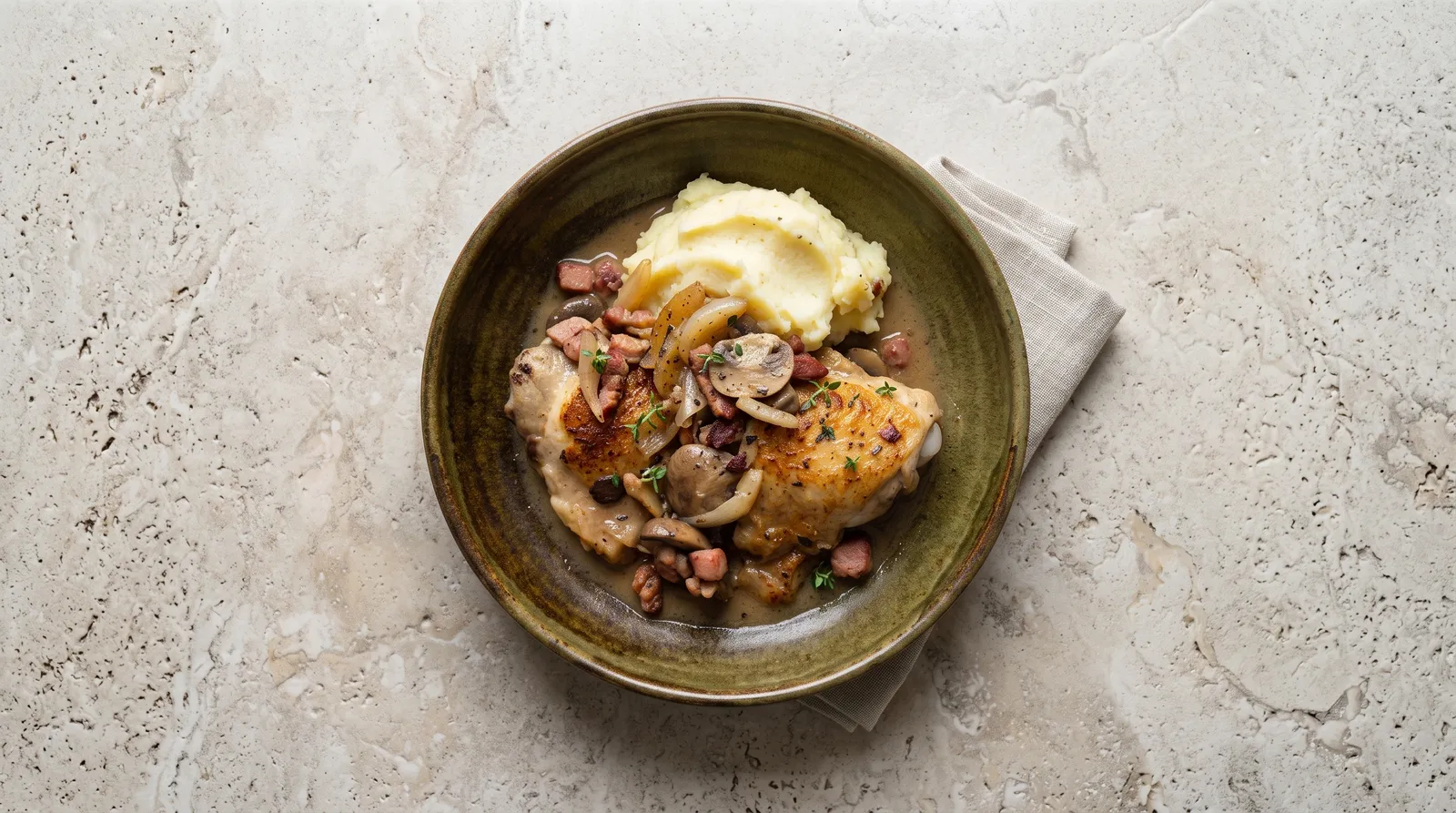
Alsatian Coq au Riesling with dry Riesling, mushrooms and a carefully tempered crème-fraîche finish, keeping poultry safety and cream-sauce temperature as separate controls.

French National Dishes
Share
Coq au Riesling — served on a plate
Prep 30 minutes
Cook 55 minutes
Total 85 minutes
Yield 6 main-course portions
Introduction and overview

Coq au Riesling — Alsatian rooster with mushrooms and cream

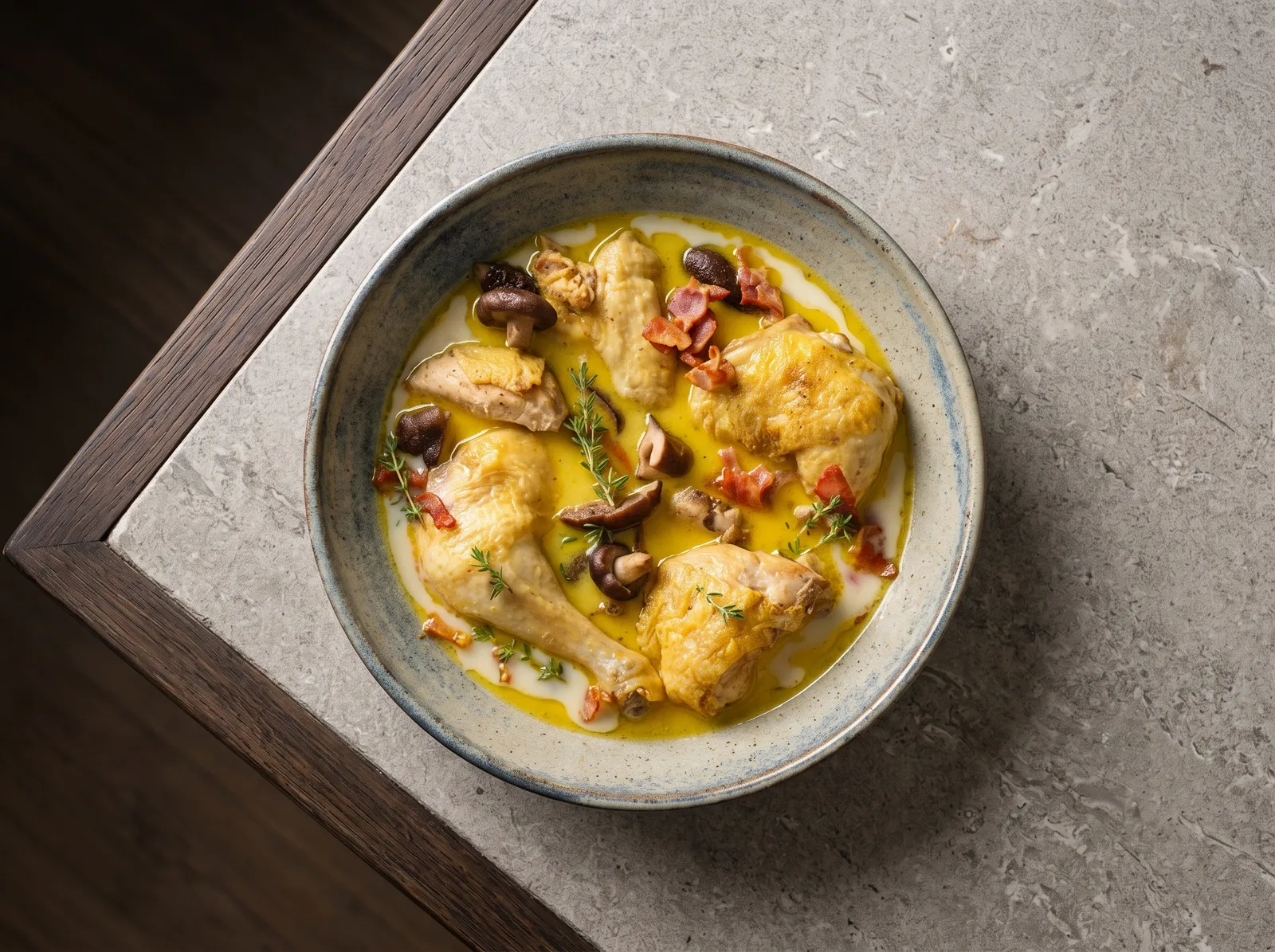
Coq au Riesling is an Alsatian white-wine poultry braise whose identity comes from dry Riesling rather than from “white wine” in the abstract. The sauce is deliberately pale and aromatic, with mushrooms and crème fraîche adding body without hiding the wine.

The bird here is a young rooster, which matters because its tenderness window is shorter than the mature coq used for the beer and red-wine records. Thirty minutes of gentle covered braising follows the browning and Cognac stage, and the poultry must reach 74 °C in the thickest meat before the delicate dairy finish begins.

The finishing mixture of crème fraîche, flour and egg yolk is the point most likely to go wrong. It should be whisked smooth, tempered with hot sauce and returned over low heat. About 85 °C is enough to thicken it; a rolling boil risks curdling the egg and splitting the cream. The result should coat a spoon in a light, velvety layer.
Success points

Success points

  • Use dry Riesling, not a sweet wine.
  • Brown lightly so the sauce remains pale rather than tasting roasted.
  • Temper the cream-egg finish and keep it below boiling to prevent curdling.
Ingredients

Ingredients

Rooster braise

  • 1500 g young rooster (coq), jointed into serving pieces — Nutrition assumes about 55% cooked edible meat-and-skin yield, about 825 g.
  • 30 ml neutral oil
  • 60 ml Cognac
  • 120 g shallots, finely sliced
  • 5 g garlic, minced
  • 250 ml dry Alsace Riesling
  • 250 ml unsalted celery-free poultry stock
  • 1 thyme sprig
  • 6 g fine salt
  • 2 g black pepper

Mushroom cream finish

  • 150 g button mushrooms, sliced
  • 100 g crème fraîche, about 30% fat
  • 15 g plain wheat flour
  • 1 egg yolk
Method

Method

Braise

  1. Brown the coq. Heat the oil in a cocotte and brown the rooster pieces gently on both sides. The rooster surfaces are evenly golden without a dark burnt crust. Raw poultry is not safe to taste.

  2. Add aromatics and Cognac. Add shallots and garlic, soften briefly, pour in the Cognac, then flame it carefully away from the extractor hood. The shallots are softened and the visible Cognac flame has gone out completely. Flaming does not remove all alcohol; keep flames away from overhead extraction and loose clothing.

  3. Braise in Riesling. Add Riesling, stock and thyme, bring to a simmer, cover and cook gently. Target temperature: 74 °C. The thickest rooster pieces reach at least 74 °C without the probe touching bone. The meat is tender enough for a fork to enter easily but still holds its shape. The Riesling sauce remains pale and aromatic. All poultry must reach at least 74 °C.

Finish

  1. Sauté the mushrooms. Cook the sliced mushrooms in a separate dry or lightly filmed pan until their released moisture has mostly evaporated, then add them to the cocotte. The mushrooms are lightly browned and no longer sitting in a pool of water.

  2. Bind without boiling. Whisk crème fraîche, flour and egg yolk smooth, temper with a little hot sauce, stir it back into the cocotte and heat gently without boiling. Target temperature: 85 °C. The sauce lightly coats the back of a spoon without curdling. The cream finish stays smooth with no separated fat or scrambled egg. The sauce reaches about 85 °C but does not boil. The poultry was already verified at 74 °C before the cream finish; keep the sauce hot but below a boil.

Practical guidance

Practical

Practical guidance

Serving: pair with spätzle, buttered noodles or potatoes rather than a strongly flavoured side.

Practical guidance

Make-ahead: complete the wine braise ahead, then sauté mushrooms and bind with cream and egg near service.

Practical guidance

Storage: refrigerate at 4 °C or below for up to 3 days.

Practical guidance

Reheating: heat gently to 74 °C without a hard boil; frequent stirring protects the cream sauce.

Practical guidance

Substitution: dry generic white wine changes the named Alsatian identity; using ordinary chicken also shortens the tenderness cook and should be declared.

Troubleshooting

Troubleshooting

  • Issue 1Curdled sauce: the finishing mixture boiled or was added too abruptly. Thin sauce: the mushroom water was not cooked off or the cream finish was underheated.
Nutrition per serving

Nutrition per serving

  • Serving size1 of 6 portions, about 140 g cooked edible rooster plus sauce
  • Calories410 kcal
  • Carbohydrate9 g
  • Protein40 g
  • Fat23 g
  • Fibre1 g
  • Sodium680 mg
Allergens and food safety

Allergens and food safety

Allergens: Milk from crème fraîche; Egg; Gluten from wheat flour; Sulphites from Riesling

Cook the thickest rooster pieces to at least 74 °C without touching bone.

Riesling and Cognac contain alcohol and some may remain after cooking.

The sauce contains egg yolk; keep the cream finish hot but below a boil and refrigerate leftovers promptly.

Reheat leftovers to 74 °C.

FAQ

FAQ

Why does the finishing sauce avoid boiling?

Egg yolk and cultured cream can curdle or split under aggressive heat.

Does flambéing remove all Cognac alcohol?

No. The recipe treats alcohol as reduced but not eliminated.

Closing

Closing

  • Result: The finishing mixture of crème fraîche, flour and egg yolk is the point most likely to go wrong.
  • Decisive technique: Use dry Riesling, not a sweet wine.